14430. Sixpenny Savings Bank (New York, NY)

Bank Information

Episode Type
Run Only
Bank Type
savings bank
Start Date
January 1, 1870*
Location
New York, New York (40.714, -74.006)

Metadata

Model
gpt-5-mini
Short Digest
be8846c35d2300e2

Response Measures

None

Description

Article (1873-10-02) describes depositors giving notices and the bank enforcing a notice-withdrawal rule during a recent episode of panic; the Sixpenny Savings Bank was meeting limited demands and had about 80 notices ($25,000). No suspension or permanent closure is described in that article. A later (1900) Tribune item briefly states that the Sixpenny was among several savings banks forced to close in the early 1870s, but provides no specifics/dates; because the 1873 article shows the bank operating (albeit under notice rule) and no explicit suspension/receivership is reported in the provided texts, the best-supported classification is run_only. The 1900 statement is noted below as a separate historical remark (insufficient detail to record a receivership event here).

Events (2)

1. January 1, 1870* Other
Newspaper Excerpt
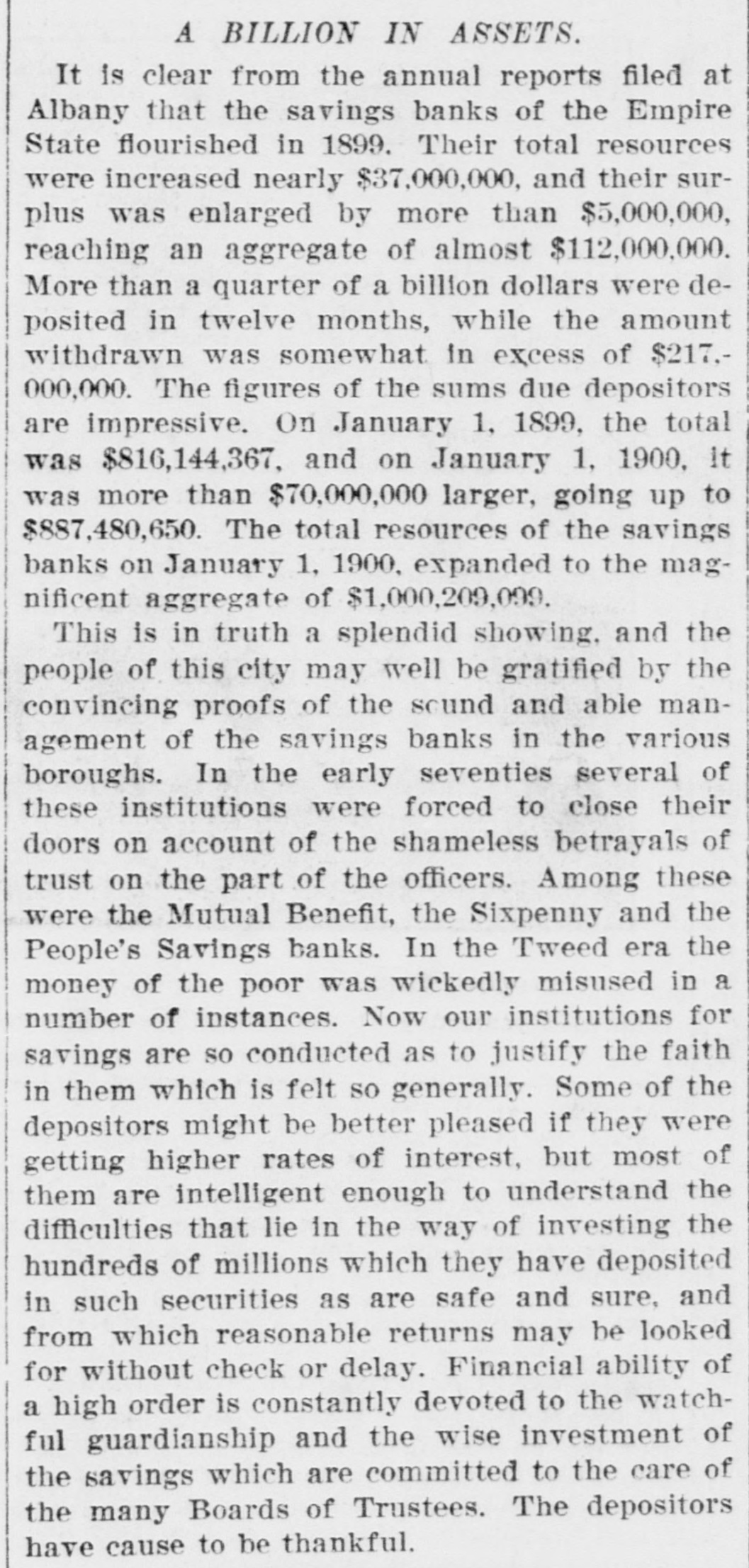
In the early seventies several of these institutions were forced to close their doors ... Among these were the Mutual Benefit, the Sixpenny and the People's Savings banks. (1900-02-23 Tribune reference).
Source
newspapers
2. October 2, 1873 Run
Cause
Rumor Or Misinformation
Cause Details
General depositor nervousness/rumors leading to withdrawals; depositors later regret their former folly and many returned funds.
Measures
Enforced notice-of-withdrawal rule (30/60/90-day style requirement) to limit immediate payouts.
Newspaper Excerpt
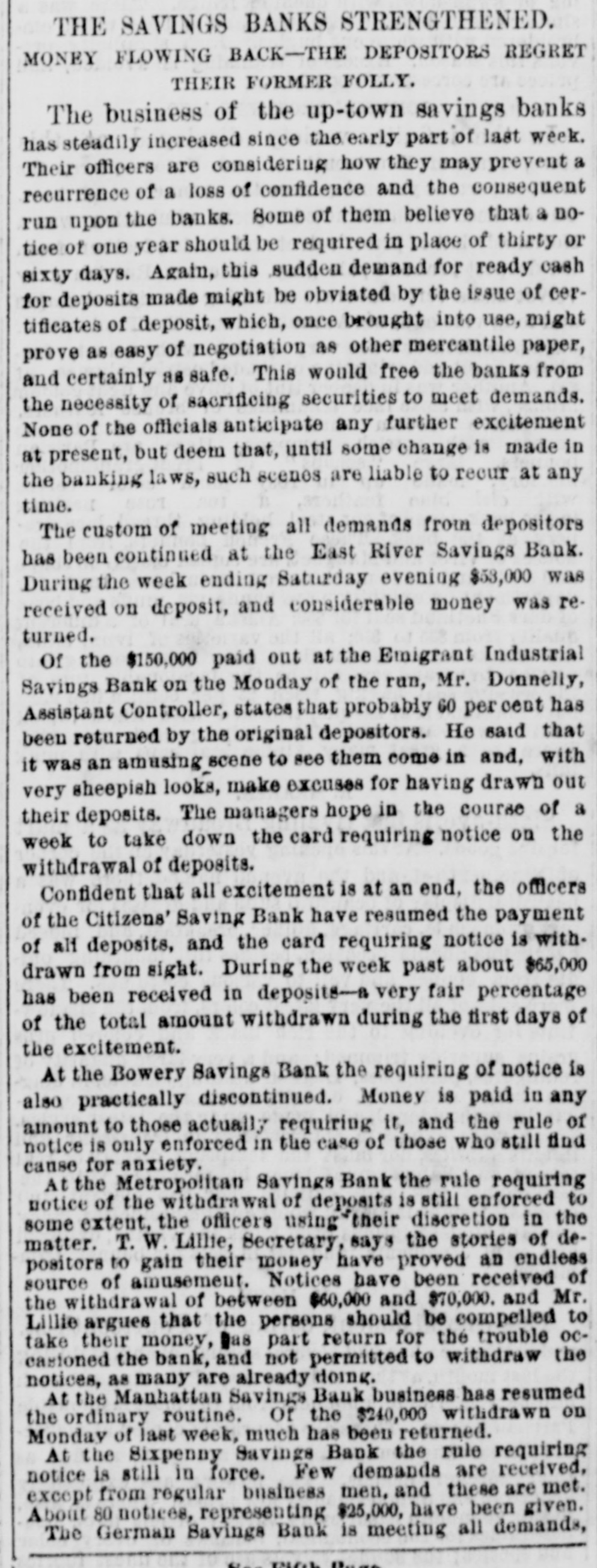
At the Sixpenny Savings Bank the rule requiring notice is still in force. Few demands are received, except from regular business men, and these are met. About 80 notices, representing $25,000, have been given.
Source
newspapers

Newspaper Articles (2)

Article from New-York Tribune, October 2, 1873

Click image to open full size in new tab

Article Text

THE SAVINGS BANKS STRENGTHENED. MONEY FLOWING BACK-THE DEPOSITORS REGRET THEIR FORMER FOLLY. The business of the up-town savings banks has steadily increased since the early part of last week. Their officers are considering how they may prevent a recurrence of a loss of confidence and the consequent run upon the banks. Some of them believe that a notice of one year should be required in place of thirty or sixty days. Again, this sudden demand for ready cash for deposits made might be obviated by the issue of certificates of deposit, which, once brought into use, might prove as easy of negotiation as other mercantile paper, and certainly as safe. This would free the banks from the necessity of sacrificing securities to meet demands. None of the officials anticipate any further excitement at present, but deem that, until some change is made in the banking laws, such scenos are liable to recur at any time. The custom of meeting all demands from depositors has been continued at the East River Savings Bank. During the week ending Saturday evening $53,000 was received on deposit, and considerable money was returned. Of the $150,000 paid out at the Emigrant Industrial Savings Bank on the Monday of the run, Mr. Donnelly, Assistant Controller, states that probably 60 per cent has been returned by the original depositors. He said that it was an amusing scene to see them come in and, with very sheepish looks, make excuses for having drawn out their deposits. The managers hope in the course of a week to take down the card requiring notice on the withdrawal of deposits. Confident that all excitement is at an end, the officers of the Citizens' Saving Bank have resumed the payment of all deposits, and the card requiring notice is withdrawn from sight. During the week past about $65,000 has been received in deposits-a very fair percentage of the total amount withdrawn during the first days of the excitement. At the Bowery Savings Bank the requiring of notice is also practically discontinued. Money is paid in any amount to those actually requiring it, and the rule of notice is only enforced in the case of those who still find cause for anxiety. At the Metropolitan Savings Bank the rule requiring notice of the withdrawa of deposits is still enforced to some extent, the officers using 'their discretion in the matter. T. W. Lillie, Secretary, says the stories of depositors to gain their money have proved an endless source of amusement. Notices have been received of the withdrawal of between $60,000 and $70,000. and Mr. Lillier argues that the persons should be compelled to take their money, as part return for the trouble occasioned the bank, and not permitted to withdraw the notices, as many are already doing. At the Manhattan Savings Bank business has resumed the ordinary routine. or the $240,000 withdrawn on Monday of last week, much has been returned. At the Sixpenny Savings Bank the rule requiring notice is still in force. Few demands are received, except from regular business men, and these are met. About 80 notices, representing $25,000, have been given. The German Savings Bank is meeting all demands, BIGH Dues

Article from New-York Tribune, February 23, 1900

Click image to open full size in new tab

Article Text

A BILLION IN ASSETS. It is clear from the annual reports filed at Albany that the savings banks of the Empire State flourished in 1899. Their total resources were increased nearly $37,000,000, and their surplus was enlarged by more than $5,000,000, reaching an aggregate of almost $112,000,000. More than a quarter of a billion dollars were deposited in twelve months, while the amount withdrawn was somewhat in excess of $217,000,000. The figures of the sums due depositors are impressive. On January 1, 1899, the total was $816,144,367. and on January 1, 1900, It was more than $70,000,000 larger, going up to $887,480,650. The total resources of the savings banks on January 1, 1900, expanded to the magnificent aggregate of $1,000,209,099. This is in truth a splendid showing, and the people of this city may well be gratified by the convincing proofs of the sound and able management of the savings banks in the various boroughs. In the early seventies several of these institutions were forced to close their doors on account of the shameless betrayals of trust on the part of the officers. Among these were the Mutual Benefit, the Sixpenny and the People's Savings banks. In the Tweed era the money of the poor was wickedly misused in a number of instances. Now our institutions for savings are SO conducted as to justify the faith in them which is felt so generally. Some of the depositors might be better pleased if they were getting higher rates of interest, but most of them are intelligent enough to understand the difficulties that lie in the way of investing the hundreds of millions which they have deposited in such securities as are safe and sure, and from which reasonable returns may be looked for without check or delay. Financial ability of a high order is constantly devoted to the watchful guardianship and the wise investment of the savings which are committed to the care of the many Boards of Trustees. The depositors have cause to be thankful.