14407. Security Bank (New York, NY)

Bank Information

Episode Type
Run β†’ Suspension β†’ Closure
Bank Type
state
Start Date
November 26, 1875
Location
New York, New York (40.714, -74.006)

Metadata

Model
gpt-5-mini
Short Digest
ab8cf9436e673678

Response Measures

None

Description

Newspaper articles describe a slight run on Security Bank around Nov 26, 1875, followed by suspension (refusing deposits/payments), a brief reopening/resumption of partial payments in early December 1875, and subsequently appointment of a receiver (Jan–Feb 1876) and discovery of a teller's large defalcation. Sequence supports a run leading to suspension and eventual closure/receivership. Dates drawn from article publication dates and in-text references (e.g., run and closures reported Nov 26, 1875; resumed Dec 8, 1875; receiver appointed late Jan 1876).

Events (6)

1. November 26, 1875 Run
Cause
Local Banks
Cause Details
Run occurred amid broader panic and failures of other New York savings banks (reports of multiple savings bank failures and runs).
Measures
Officers initially remained open but later took advantage of statutory notice in some banks; Security Bank later suspended and refused deposits/payouts.
Newspaper Excerpt
There was also a slight run on the Security Bank.
Source
newspapers
2. November 26, 1875 Suspension
Cause
Bank Specific Adverse Info
Cause Details
Examinations found deficiencies in the Security Bank's accounts (later reported ~ $23,000 deficiency) and thefts by a cashier; directors resolved to close rather than recapitalize.
Newspaper Excerpt
THE SECURITY BANK, which suspended last week, is still refusing to receive deposits or to pay out money.
Source
newspapers
3. December 8, 1875 Reopening
Newspaper Excerpt
The Security Bank resumed business yesterday morning, and began paying out twenty per cent of the amount of deposits to all who need it, taking notice for the balance. Many new accounts were opened during the day.
Source
newspapers
4. January 28, 1876 Other
Newspaper Excerpt
The receiver, Mr. William M. Banks, will file his bond to-morrow and then take charge of the affairs of the institution. ... Mr. Banks has only been secretary for a few months ... the receiver, Mr. Banks, after filing his bond to-morrow will at once make out a schedule in detail.
Source
newspapers
5. January 28, 1876 Receivership
Newspaper Excerpt
Mr. William M. Banks was appointed receiver January 28, 1876, by Judge Landon, and up to May 1877, paid the depositors twenty-seven and a half cents on the dollar.
Source
newspapers
6. April 11, 1876 Other
Newspaper Excerpt
John Seill, a teller in the suspended Security Bank, has been discovered to be a defaulter to the extent of $70,000. He has fled.
Source
newspapers

Newspaper Articles (17)

Article from The Daily Dispatch, November 27, 1875

Click image to open full size in new tab

Article Text

Bank 10rm. New YORK, November 26-The Central Park Bank, a small savings institution up town, is to be wound up. The Manufacturers and Builders Bank has suspended. There was a run on the People's Savings Bank to-day, but the officers took advantage of the sixty days' notice and closed their doors. There was also.a slight run on the Security Bank.


Article from The New York Herald, December 1, 1875

Click image to open full size in new tab

Article Text

Among the other savings banks there was but little appreciable excitement. The amounts withdrawn in every instance were slightly in advance of the usual daily outgoings, but, as a general rule, the accounts closed were small in number and not sufficient to cause any fear on the part of the presidents and other officials that they would have to sustain a run. The impression among bankers is becoming more and more pronounced that the best course that could be adopted for the benefit and protection of all would be the appointment of receivers to the well known weak banks and their speedy liquidation. This course If adopted, would, it is thought, at once put a stop to the public uneasiness, while at the saine time it would put it beyond the power of the banks to unite the money of depositors by sacrificing their securities in order to sustain a run if such should be made on them. The Bank Superintendent's departure for Albany last Saturday is thought by many to have been with this view. THE THIRD AVENUE BANK. Mr. Carman is still in possession at this bank, Judge Westbrook not yet having appointed his successor. The name of a Mr. Morgan A. Dayton, clerk in the Surrogate's office, is mentioned as the probable new receiver. It is said he is recommended by the depositors' Committee of Thirteen and is friendly to the trustees. In fact it was reported among the depositors that Mr. Dayton had even gone so far as to perfect his bond, which is required as security. His appointment would be received unfavorably by the great mass of depositors, who hope to see some gentleman of position and well known in the community put into the responsible office. THE SECURITY BANK, which suspended last week, is still refusing to receive deposits or to pay out money. From what could be learned yesterday among the largest depositors it appears to be their wish that the bank should resume business again, and that some ten or fifteen of their number should be nlaced on the research ne Associane cam


Article from The Wheeling Daily Intelligencer, December 2, 1875

Click image to open full size in new tab

Article Text

Bank Failures. Our dispatches this morning announce the suspension of the Bank of America at New Orleans. The directors have resolved to put the bank in liquidation. The cause of this necessity is not stated, but no doubt it is the old, old story with which the public are made daily familiar, viz: reckless management, favoritism to unsafe borrowers, and perhaps the payment of large interest to depositors. This is the story that we are hearing now in regard to certain Savings Banks in New York, a number of which have been examined lately and found wanting. Four of these banks are now in the hands of Receivers, the Security, the Mutual Benefit, the Central Park, and the Manufacturers' and Builders'. The New York Herald gives currency to the rumor that Supt. Ellis; of the Bank Department, is about to close up eight or ten more. There is no general alarm in the city, and the credit of none of the larger banks has yet been attacked. The columns of the New York papers are full of the most unpleasant disclosures. The officers of the Central Park Bank, in order to make a good showing, were in the habit of putting in their own checks to the aggregate of $60,000 before making their quarterly reports. After the reports were made the deposits were withdrawn. The trustees of the bank began the erection of an elegant brownstone building, although they had but $50,000 deposits. One of the Trustees took the contract to build the bank, and another to paint it. The deposits are all gone, the building stands incomplete, and is mortgaged to the Trustees for $40,000. Could Credit Mobilier further go? In the Mutual Benefit Savings Bank there is a deficiency of at least $22,000; in the Security Savings Bank the deficiency reaches $23,000. The Trustees of these institutions have been compelled to give bonds to protect the depositors. The most unpleasant feature connected with these failures is the fact that the State Superintendent of the Bank De partment as recently as Oct. 12, certified that the Manufacturers' and Builders' Bank had $180,000 of assets beyond its liabilities. It now turns out to be about $80,000 short. The Herald publishes the certificate of Superintendent Ellis in full It is accompanied with all the official trappings of seals, and depositions, and must have looked to the depositors-before whom it was of course kept in a magnificent gilt frame-as true as Gospel. The contrast between this certificate and the truth will do more to hurt Superintendent Ellis' reputation than can possibly be made good by his procrastinated efforts now to clean up the savings banks. The occurrence illustrates the dangers of the system of examination. Secretary Chase, scenting the frauds, which it has made one of his successers famous to have exposed, once asked a body of scientific men if they could not invent for him a metre that would measure and register with infallible accuracy the flow of spirits from a vat. They could, was the reply, but they could not invent a man honest enough to report infallibly, the infallible register. This is the trouble with such systems as that of the examinations of savings banks. Who is to examine the examiners?


Article from Perrysburg Journal, December 3, 1875

Click image to open full size in new tab

Article Text

and Builders' Bank York city suspended on the 26th. On the same day arun was begun on the People's vings Bank, e officers closing doors of the institution and taking vantage of the sixty-days' notice which may be required of depositors. There was also a slight run on the Security ingt-Bank COST well known Wis. consin attorney and editor of the Mauston Star, attempted suicide by shooting, at the Vilas House, Madison on It was thought he would die of the inflicted wound AT a business meeting of Brooklyn Plymouth Church,held on the evening o the 26th, an answer to Mrs. Moulton's de mand for an investigation was read, in which the ground was taken that her accusations againstaMr Beecher were.not., good defense-for her past conduct, but that, nevertheless, her proposition for call of a mutual council of churches was accepted. A RECENT decision of the Indiana Su preme Court, in the case of an attorney wh@Gbrought.spi recover for services in procuring a divorce, is to the effect that a promise made by married-woman to pay after she is divorced, for services rendered her by an attorney during her coverture is void, and a promise made after she is divorced to pay the same is invalidafor want of consideration. THE Governor of Connecticut has ap pointed-ex4Gov. English fill the vacancy in the United States Senate caused by e death of Hon. O. S. Ferry. a CHIEF-CLERK H R. CLUM and about dozen other prominent clerks of the Interior Department at Washington were removed or transferred o he 27th by Secretary Chandler :These removals are said to have been based upon the recommenda tion of Commissioner Smith, and make clean sweep of all the clerks associated fo any considerable time with the past his tory of the bureau. WORTH, the man-milliner of Paris, was reported, on the 27th, to have lost very heavily in consequence of the hard times, and to have become financially embarrassed, mainly, it is said, through the failure of prominent Americans. THE eighteenth anniversary of King Alphonzo's birthday was celebrated at Madrid on the 28th. It was reported that the King was about to take the field against the Carlists. IT was reported in Berlin on the 28th that Montenegro and Servia had concluded to form an offensive and defensive alliance in favor of Herzegovina and against Turkey. DISPATCHES from Washington on the 27th state that it had been ascertained from official sources in Spain that the negotiations between Spain and the United States were proceeding favorably. The rumors that difficulties had arisen were said to be absolutely incorrect, and the relations between the two countries might be regarded as excellent. THE Moody and Sankey meetings in Philadelphia very_largely attended on the 28th. At the women's meeting in afternoon 150 ladies stood up for pray er and at the young men's meeting in the evening 100 young men made similar requests. The interest in the work continued unabated ALFRED BEVIS, a distiller and one of the witnesses in the trial at St. Louis of Wm. O. Avery, having mentioned, in giving his evidence,a rumor that Secretary Bristow was interested in a distillery or liquor-house at Louisville, Ky: the Secre tary, on the 27th, sent telegram to the United States District. -Attorney at St. Louis emphatically denying the rumor, and stating that he did not desire the mat ter to rest upon his denial, but requested that 'every person whose name has been or can be given you s having knowledge of such alleged facts shall be brought before the Grand Jury and subjected to the most rigid examination.' The Sec. retary further says: I beg to repeat the request heretofore communicated to you, that these frauds on the Government shall be probed to the very bottom: that every ramification of the ring shall be followed in every part from beginning to end, and that no one having connection with or guilty knowledge of its operations shall be permitted to escape. So far as this department is concerned, I ask that every allegation against any officer of it, from its head to its humblest employe, be thoroughly investigated and vigorously prosecuted, if any grounds exist therefor have read this to the President, who repeats his injunction: Let no guilty man escape. ACCOUNTS received in London on the 29th ult. announcing a rising against the Russians in Khokand, Vienna dis. patches of the same date say it was feared that a majority of the smaller Russian garrisons in Khokand had been massacred A DISPATCH from Alexandria, Egypt, on the 29th ult. says the Abyssinians had recently surprised and killed 200Egyptians, gerenteen offeets. IT was reported on the 29th ult. that the Carlists had begun a vigorous bombard ment of San Sebastian. IN the Avery trial St. Louis on the 29th ult. evidence was given tending to implicate Gen. Babcock in the whisky frauds. Several telegraphic dispatches sent to him in Washington by members of the ring were produced in court, and the original copy of a telegram signed Sylph," dated Washington, Nov. 13, 1874, and directed to Gen. McDonald at St. Louis, saying "I succeeded. They will not go.- will write you." was also produced and compared with a letter of similar import, and several witnesses identified the handwriting as that of Gen. Babcock. THE MARKETS. NOVEMBER 30, 1875. NEW YORK


Article from New-York Tribune, December 3, 1875

Click image to open full size in new tab

Article Text

WEAK BANKS TO BE WEEDED OUT. SUPERINTENDENT ELLIS determined TO ERADICATE UNSOUND SAVINGS INSTITUTIONS-A RECEIVER FOR TWO BANKS. A reporter of THE TRIBUNE called on D. C. Ellis, State Superintendent of Banks, at the Metropolitan Hotel, last evening, and had a long conversation with him in relation to the condition of the savings banks in his city. Among other things Mr. Ellis said The worst is now over. I shall act carefully, cautiously and prudently, but I am determined that every unsound savings bank in this city shall be closed by the end of this month. The Examiners of the Bank Department have been hard at work for several months. and only solvent banks will remain in operation at the beginning of the new year. Very few banks will be closed. I shall compel the trustees of the weak banks to secure the depositors fully by advances of cash or approved securities. A very few banks whose deposits will not yield sufficient income to meet expenses must retire from business. The monetary condition of the country is against them. They are struggling against fate, and it is impossible for them to gain strength as there is nothing from which they can support themselves. Early in the present year I examined with great care every annual report of the banks, and marked those whose affairs seemed to require immediate examination. I came to this city and consulted with the leading bankers and merchants, and guided by their advice, I felt my way quietly but surely, until I understood fully the condition of things. There were so many millions of dollars involved, and the interests of thousands of depositors to be cared for and protected, that it would have been highly improper for me to have acted rashly. I have not acted on my own unsupported judgment, but have been advised by the best men in all positions in society. I am now undoing the bad work of Legislatures of previous years. With the new Savings Bank law and the difficulties in the way of getting charters, new banks will be established only when and where the needs of the people demand them. The new law also limits investments within a narrow circle. Mr. Ellis stated that the Security Bank had been found by the examiners to be perfectly safe, and he supposed it would resume business early next week. He had no fault to find with the bank. As to the Mutual Benefit Savings Bank, he remarked that the trustees were men of spirit and energy, and they had asked for a week's delay in which to put the bank on a sound basis. He had given them time, and the result would be made known by Monday. There was nothing against the Mechanics' and Traders' Savings Bank, and he had been surprised to learn that a run had been made on it. It is understood that Mr. French, a lawyer, has been appointed receiver of the People's and the Central Park Savings Banks. He will probably enter upon his duties to-day. There is so small an amount to be handled in the last named bank, that it was not considered advisable to appoint a separate receiver for it.


Article from The New York Herald, December 9, 1875

Click image to open full size in new tab

Article Text

THE SAVINGS BANKS. Mr. E. Hermann Uhl was appointed yesterday, by Judge Davis, of the Supreme Court, receiver of the German Uptown Savings Bank. Mr. Uhl is required to give security in the form of a bond for $150,000. The complainant at whose suit the receiver was appointed is J. M. Hart, a creditor of the bank for $2,300. His complaint sets forth the fact that the bank owes to depositors $838,000 and has but $800,000 of assets. Judge Davis' order requires the receiver to deposit all the assets coming into his possession, except $25,000, in the New York Life Insurance and Trust Company to make an inventory at once, and to make a report of the property within forty days and within each succeeding forty days, or show cause. The bond required from the receiver of the Mutual Benefit Savings Bank, Mr. F. A. Aldrich, who was appointed at the suit of E. N. Simmons, through W. A. Gallagher, his counsel, was yesterday reduced from $200,000 to $75,000. Mr. S. H. Hurd, the newly appointed receiver of the Third Avenue Savings Bank, was at the office yesterday, but has not yet obtained possession of the keys of the safe. Mr. Carman promises to hand them over today. Mr. Hurd says he shall leave the prosecution of all criminal matters to the District Attorney, and will give his whole endeavors to realizing the assets of the bank in the best interest of the depositors. Mr. Isaac M. French has been appointed receiver of the People's and Central Park savings banks, and has already taken possession. The Security Bank resumed business yesterday worning, and began paying out twenty per cent of the amount of deposits to all who need 16, taking notice for the balance. Many new accounts were opened during the day.


Article from The New York Herald, January 30, 1876

Click image to open full size in new tab

Article Text

THE SECURITY BANK. There were no further developments yesterday in relation to the affairs of the Security Bank, corner of Thirty-fourth street and Third avenue. The receiver, Mr. William M. Banks, will file his bond to-morrow and then take charge of the affairs of the institution. To a HERALD reporter last night Mr. D. D. T. Marshall, President of the bank, said:-"A few weeks ago I resigned the presidency, but on great pressure by the trustees, I determined to withdraw the resignation. Subsequently Mrs. Capen, who is a large depositor, at the instance of the trustees, applied for the appointment of a receiver, and Justice Barrett appointed Mr. William M. Banks, the late secretary. Mr. Banks, did not wish the position, but the trustees were very anxious that he should take it, he being fully acquainted with the business, and familiar with the entire work. Mr. Banks has only been secretary for a few months, and to-morrow he will file his bond before Judge Barrett, his bondsmen being some of the wealthiest people in New York city. Mr. Marshall said further:-"The bank will pay every depositor in full, or very nearly so. The trustees alone represent $150,000 of the $325,000 due to depositors. The total liabilities are $325,000, and if everything turns out as is expected, there is still a surplus of $8,000. The assets consist of the bank building, which 18 unencumbered, and is worth fully $100,000, but the dull state of the revl estate market might bring it down a few thousands, It is worth, anybow, $80,000. Then there is a house and lot at Astoria, worth $2,000, and ten acres of land in the village of Mount Vernon, worth $5,000. The remainder of the assets are in bonds and mortgages. The receiver, Mr. Banks, after filing his bond to-morrow will at once make out a schedule in detail." From inquiries in the neighborhood, among the depositors and business men generally it was ascertained that if the bank building, which cost $75,000 four years ago, was offered for sale at once it would not realize over $50,000, so, according to Mr. Marshall's statement, there will be a deficiency instead of a surplus, as has been repeatedly pointed out by the HERALD.


Article from The New York Herald, February 10, 1876

Click image to open full size in new tab

Article Text

THE SECURITY BANK. A DIVIDEND PROMISED NEXT MONTH. On the 21st of last November it became known that the affairs of the Security Bank, on Third avenue, were in poor condition. The directors called a meeting and drew up resolutions arranging an agreement with the depositors not to urge their claims for a period of twelve months, in order to give the bank time to reorganize, and stated that they would give twenty-five per cent of principal in three months. The bank reopened for business in the course of a week, about one-half of the depositors having signed the agreement. The other half refused to make any compromise and determined only to give the ordinary sixty days' notice, according to law. The notice was tendered, and at the expiration of the sixty days the directors, thinking the depositors would demand a receiver, had one appointed by Judge Barrett. Recently a call was issued to depositors to prepare their bank accounts, and promising a dividend on March 1. On the reception of this some parties hav. ing claims against the bank doubted its capacity to make any such settlement, and have demanded an investigation of the matter. A HERALD reporter accordingly called on William C. Banks, the receiver, yesterday, and in answer to inquiries touching the matter Mr. Banks said that during the last few weeks money has been coming in rapidly, and he confidently looked to a payment of the promised dividend at the time appointed. His said his report would be ready to-morrow and the depositors could learn from it the true condition of the bank.


Article from Gold Hill Daily News, April 11, 1876

Click image to open full size in new tab

Article Text

EASTERN DISPATCHES. SPECIAL TO THE GOLD HILL DAILY NEWS DOMESTIC NEWS. More of the as. Louis Whisky Frauds. Sr. Louis, April 11. - A Globe-Democrat Jefferson City special says it is alI leged that the United States District Court sentenced Colonel Joyce for six months longer time than the law calls for, and therefore the sentence is void. This question, it is said, will soon be tested by an attempt to take him out of the penitentiary on a writ of habeas corpus. District Attorney Dyer stated to-day that if the new point raised in the Mo. Kee case is sustained by Judge Dillon he will go to the District Court and call for the appearance of General Babcock to answer the original indictment against him. and if he does not answer Dyer will ask for the forfeiture of Babcock's bond, and that a warrant be issued for his arrest. Sentence of n ms. Louis Whiskey Thief Posiponed. Sr. LOUIS, April 11.-General John McDonald, ex-Superintendent of Internal Revenue in this district, who has been in the County Jail several months, pending sentence, was brought before Judge Treat. of the United States District Court this afternoon to receive sentence, but owing to the temporary ab. sΓ©uce from the city of Judge C. H. Crum, his counsel, action in the case was deferred until Thursday next. A Murderer Convicted. NEW YORK, April 11.-Andreas Fuchs, who recently chopped a fellow-workman to pieces in Brocklyn, was to-day found guilty of murder in the first degree and will be sentenced to-morrow. Another Disciple of Reecher Sus. pended. DETROIT, Mich., April 11. - The Methodist Church investigation found Rev. T. W. May guilty of slander, unchristian conduct, improper proposals and advances to ladies of his church, and also of adultery. He was suspended and his dismissal recommended. A $70,000 Defanlter. NEW YORK, April 11.-John Seill, a teller in the suspended Security Bank, has been discovered to be a defaulter to the extent of $70,000. He has fled. General Dix to be Nominated to Succeed Schouck. WASHINGTON, April 11.-It is stated here that at the Cabinet meeting to-day. the President will propose the name of General Dix for the English mission.


Article from Carson Daily Appeal, April 12, 1876

Click image to open full size in new tab

Article Text

Court sentenced Colonel Joyce for six months longer time than the law calls for, and therefore the sentence is void. : This question, it is said, will soon be tested by an attempt to take him out of the penitentiary on a writ of habeas t corpus. 3 District Attorney Dyer stated to-day $ that if the new point raised in the Mc. Kee case is sustained by Judge Dillon , he will go to the District Court and call for the appearance of General Babcock to answer the original indictment against him, and if he does not answer Dyer will ask for the forfeiture of Babcock's bond, and that a warrant be issued for his arrest. General John McDonald, ex-Superintendent of Internal Revenue in this district, who has been in the County Jail several months, pending sentence, was brought before Judge Treat, of the United States District Court this afternoon to receive sentence, but owing to the temporary absence from the city of Judge C. H. Crum, his counsel, action in the case was deferred until Thursday next. New Yor, April - -Andreas Fuchs who recently chopped a fellow workmen to pieces in Brooklyu, was to-day found guilty of murder in the first degree and will be sentenced to-morrow. John Seill, a teller in the suspended Security Bank, has been discovered to be a defaulter to the extent of $70,000. He has fled. Detroit, Mich., April 11.-The Methodist Church investigation found Rev. T. W. May guilty of Islander, unchristian conduct, improper proposals and advances to ladies of his church, and also of adultery. He was suspended and his dismissal recommended. Washington, April 11.-It is stated here that at the Cabinet meeting to-day, the President will propose the name of General Dix for the English mission. London, April 11.-Late dispatches from Lima, Pern, say that several attempts at insurrection have been made by the Chinese laborers on the sugar estates near Trojello, in the north, and in the vicinity of Lima with insignificant loss of life. These outbreaks have been suppressed, but some alarm has been caused in the Capital from the discovery of a plot among the coolies of the neighboring valley to rise on Good Friday next, and massacre all within striking distance. Steps have been taken to prevent such a catastrophe. A Rio Janeiro dispatch announces the death of Benjamin Franklin Voohees, formerly Secretary to Commodore Garrison. Voorhees was a victim of yellow 3 fever, which was raging at Rio Janeiro with great violence. His wife was with him at the time of his death. I The Turks defeated 15,000 insurgents near Maden on Saturday, killing 60 of S t hem. Five Turks were killed.


Article from Connecticut Western News, April 21, 1876

Click image to open full size in new tab

Article Text

twenty minutes and nineteen seconds, being the fastest ever recorded in these races T. G. Settle, formerly railway agent at Protosi, Mo., who was removed on complaint of Engineer Samuel Cowell, shot and killed the latter in consequence, and then killed himself The czar of Russia will not abdicate, as his health has been fully recovered The Afghanistan aemir of Cabul has defeated his rebellious subject, the meer of Maimena. The latter lost three thousand men in the battle. Mr. Alexander T. Stewart, the merchant prince, died in New York of inflammation of the bowels, brought on by a severe cold, in the seventy-fourth year of his age. Mr. Stewart was born near Belfast, Ireland, of Scotch-Irish parents. After graduating atTrinity College, Dublin, he immigrated to this country in 1823, at the age of twenty years, and opened a select school in New York. He soon afterward gave up this project and started a small retail dry goods store on Broadway, which soon became noted for the fine quality of the stock displayed, and was liberally patronized by the wealthy inhabitants. By strict attention to business, coupled with extensive but judicious advertising, Mr. Stewart had so prospered by 1848 that he was enabled to erect the large marble store at present standing on the corner of Broadway and Chambers street, and from that time on his fortune increased with the greatest rapidity. Forseeing the necessity for an uptown movement on the part of the retail dealers, Mr. Stewart erected the handsome eight-story building occupying the entire block from Ninth to Tenth streets, and from Broadway to Fourth ave., and occupied it as a retail department, retaining the old store for wholesaling. The uptown store covers two and a half acres of ground, employs two thousand hands, and the running expenses are over $1,000,000 per annum-being the most extensive establishment of the kind in the world. The wholesale and retail establishments have sold $50,000,000 worth of goods in a year. Besides the two colossal stores, Mr. Stewart held a large amount of New York city property, the elegant Grand Union hotel at Saratoga, immense mills near Fishkill, N. Y., and the entire Garden City on Long Island, which was a pet scheme of the founder, where he made great outlays in putting up houses and stores, connecting with the city by a railway run by his employees. His estate has been estimated all the way from $20,000,000 to $90,000,000, but probably now nearly approaches the latter sum. Mr. Stewart, outside of business, was of a pleasant disposition, and delighted to entertain distinguished personages in a royal manner. His wife survives him; but as she is childless, it is conjectured that the bulk of the property is left to charitable purposes. John H. Seil, one of the tellers and bookkeepers of the collaped Security bank, New York, who was assisting in winding up the institution, is a defaulter to the amount of $70,000 Several of the transatlantic steamship companies have resolved to reduce the number Five of the of passages of their steamers principal stores in Keesville, N. Y., were destroyed by fire, there being no fire extinguishing apparatus in town except a force pump, which was frozen After a fight between the Mexican state troops and insurgents, at the town of New Laredo, near the boundary, the state troops fired on United States troops, when our troops replied with twelve-pound By howitzers, silencing their opponents the falling of a high trestlework at Little Falls, N. J., two men were instantly killed and three others fatally injured. All were terribly mangied Advices from San Domingo say the election passed off peaceably. Espaillat was elected president by an overwhelming majority Philadelphia's sencus shows a population of 817,488.


Article from New-York Tribune, April 24, 1877

Click image to open full size in new tab

Article Text

reignty of the Porte. The Russian Embassy simultaneously withdrew from Constantinople, M. Nelidoff having previously informed the Porte that diplomatic relations between the two Powers were at an end. Meanwhile the Emperor of Russia is awakening the ardor of his troops for the coming conflict. He made a warlike address on Sunday and is to hold two grand reviews to-day. This energy implies that he is as heartily in favor of the war as his subjects, who are exceed- ingly enthusiastic. The formal declaration of war is expected to-day, Prince Gortchakoff's circular announcing the approach of hostilities having been delivered to the French Foreign Minister yesterday. Austria and Great Britain are, of course, watching the march of events with feverish anxiety. It is understood that Lord Beaconsfield has resolved to send a fleet to the Suez Canal, and has asked the formal sanction of the Queen for that import- ant undertaking. It is evident from this and other manifestations that the greatest care will be needed to "localize" the war in the Ottoman Empire. The first day of the investigation of the charges against Superintendent Ellis is marked by the presentation of a series of accusations against him which seem overwhelming. They cover all, or almost all, of the savings bank failures of the past two years. The gist of the charge is the same in each case, viz., that Mr. Ellis, after being fully informed of the insol- vency of the institution in question, or after having learned enough of its condition to know that there should be no delay in closing it, allowed it to run on from bad to worse, knowing all the while that the bank was taking in the money of new de- positors ignorant of its condition and of old depositors who had learned to trust it. In the case of the Mechanics' and Traders' Bank, for instance, which is now under investiga- tion, the interval between the discovery of the bank's insolvency and its closing was nearly two years; in the case of the Third Avenue Bank, which perhaps, of all these failures, revealed the greatest amount of ras- cality and involved the greatest number of inno- cent people in disaster and ruin, the interval is placed at six months. In the latter instance, no less than 600 new accounts were opened during this period, and it is alleged that the officials made careful preparation, both for themselves and their friends, against the final crash. The charges with respect to the Security, Bond Street, People's, Trades, and other banks, are mainly repetitions of this same story, with more or less difference in detail. It is idle, of course, to say that if these charges should be substantiated, Mr. Ellis should be promptly re- moved. Removal would be a slight punish- ment for the official neglect which brought incalculable suffering upon the community which it was his business to protect.


Article from The Sun, April 25, 1877

Click image to open full size in new tab

Article Text

# There Shall Be One Law for All. TO THE EDITOR OF THE SUNβ€”Sir: I find in to-day's SUN an account of the blood-curdling malediction and the appalling punishment which Recorder Hackett dealt out to a petty thief who appeared in his court yesterday. In another part of to-day's SUN I find the evidence before the Senate committee, and the message of Gov. Robinson, exposing the official career of Bank Superintendent Ellis. It appears that Mr. Ellis, after learning that certain savings banks were hastening to bankruptcy, allowed them to run on from bad to worse, knowing all the while that they were taking in the money of new depositors ignorant of their condition and of old depositors who had learned to trust them. In the case of the Mechanics' and Traders Bank, the interval between the discovery of the bank's insolvency and its closing was nearly two years; in the case of the Third Avenue Bank, which, perhaps, of all these failures, revealed the greatest amount of rascality and involved the greatest number of innocent people in disaster and ruin, the interval is placed at six months. In the latter instance, no less than 600 new accounts were opened during this period, and it is alleged that the officials made careful preparation, both for themselves and their friends, against the final crash. The charges with respect to the Security, Bond Street, People's, Trades, and other banks, are mainly repetitions of this same story. Now, what sentence will Recorder Hackett, or any other Judge, visit upon the parties guilty of these crimes, compared with which the petty theft I spoke about at the opening is nothing at all? Again, I find in to-day's SUN Mr. W. Allen Butler's extraordinary report upon the mismanagement and fraud of the officers of the Continental Life Insurance Company, which have caused widespread loss and suffering. Yet again, in Monday's SUN I saw an official report, charging ruinous cheating and perjury upon the officers of the Popular Life Insurance Company. What penalty shall be administered upon such men if a petty burglar deserved Recorder Hackett's sentence of twenty years in the State prison? But will these men receive any penalty under such law as is enforced in our courts? I see that one pompous newspaper goes so far as to say that Ellis ought to be removed from office! Now, what are we to think of laws and courts which deal with helpless men in one way, and with powerful men in another way? MOSES.


Article from The New York Herald, May 11, 1877

Click image to open full size in new tab

Article Text

at 1871 and before he was Sanator, in his 1870 bank and account amounts and the 1869, present time, as to names, exhibiting times, places the and amount of stating with amplest details and particulars. sources of He his detailed public income. service an and his and He penses, his property both to while have engaged been frugal in and economical. particular, both home, appear with emphasis and in every truth of any rumor conthe denied, charges in question attributing and mercenary also the motives or or statement to him in his official satisfied capacity. that those denials are of they duct Your committee would are do injustice alike to should the people simply the true, State and and they to Senator charges Woodin referred if to the report commit that the are report that the The committee therefore the charges so far testimony not proved. affirmati Senator lively Woodin, disproves and establishes that they they utterly affect without foundation are All of which IS respectfully B PLATT CARP SPRAGUE Jr. E. c. SCHOONMAK A. GEORGE B. BRADLEY. that moved ACTION OF the THE Senate SENATE. adopt the report Mr. concur Gerard in its conclusions by Messra. Gerard, Jacobs, Kennaand Alter eulogistic Starbuck remarks McCarthy, Cole vot and yeas 30adding Mr. Bixby hearty amen. day, the report Loomis, was adopted to bis by firmative unanimous vote the exclamaon action tion, With ..with the single neither ception house of did the anything Senate of consequence to-day. Woodin case Bank bill was referred to the Committee on and Finance Cowdin's of the RAPID Assembly. TRANSIT SKIRMISHING. continued all day The fight for rapid transit the effort was was made 10 advance Every reevening. Three bill times to kill rapid tactics transit. was their device the Hayes known to anti-rapid legislati transit came men very together near to instructed watch. Hayes sorted succeeding to. once, The vote having for Hayes got Rapid move Transit his Beach bill. bill was the Pneumatic instructed When all The boys were bill. on The the boys, to vote upposing for, it apported no moved him the bill it. and they had been the Pneum tic bill. the boys did The not understand are and prog ressed to kill rapid transit did not rally. organizer splendidly are Hare friends under of the rapid lead transit of Purdy, their Ecclesine enemies. and They tower are also of strength was more and than a match old for Tom Alvord, close who of is the session bill. a everybody reinforced in himself by made Near to the progress the wanted Hayes go motion 14, for The last dying House effort was in was suddenly confusion, sprung. and No in the under- of nays. home. stood it, The but peculiarly Purdy was his own ready called settled the the yeas matter and and The ot voice The explain so planation of of New the vote York city New triumphed. York was considreading. again the bill friends to move the the Whole to and ordered agreed to a to advise third amondm ered in Committee The Senate Committee of have the Code of the Remedial operaJustice. the passage the and code of recommend the for one year. bill suspending The "lawyers progressed, may rest be easy. tion of Excise bill came up full. and was It not lacked but again a and few The the House was will not be made to-morrow has been given a 10 put notice for that purposo. over motion votes cause of The effort call of the very House spirited the contest bill took place County tailroad of The friends repealing Committee the Queen's be of beaten the Whole. when Purdy, for the of West- yeas of the the in the first the bill appeared made the to adroit move, men bers by calling an opportunity motion The chester, explaining and nays, which their votes. gave are This greatly carried excited very great the bill, people of Brooklyn for its passage EDUCED. is and the TOLLS has been adopted by the Canal The reduced and gues toll into sheet operation immediately. SUPERINTENDENT Board THE ELLIS IN VESTIGATION. REGARDING SENATE ACTION OF THE INSTITUTIONS EXAMINED BY THE TO VARIOUS COMMITTEE-- AN ADJOURNMENT MEET IN NEW YORK. ALBANY, N. Y., May 10, 1877. the inresumed vestigation Senato Committee on Banking Superintendent Ellis charge the The of charges against relative to the Bank bank of to the morning and the up. The reports of were put in Superintendent this Lansingburg was taken for 1876 and 1877 evidence ever THE BANK OF LANSINGBURG. knowledge had of Henry L. Lamb testified that showing no that the methods capital of had been to the Superintendent that any illegal 1877. when come the bank was inflated, going or on until announced March 15, that the then business b president and cashier The Superintendent their the insolvent. them to repair bank was requisition upon and they closed stocks up. made or close notice up, of the kind of Mr. capital was no official to the department There the bank held sent requiring a schedule simply of such which Ellis had instituted a rule been the law it The was report of stocks. but is had measure never of his March, own. 1875, showed June surplus precautionary bank's condition in been $176,611; the in profits the the the profits to was have $150,000, and surplus was a divithe $53,229. In September profis $19,825, having the paid surplus re $150,000 and the July. In December 1876, profits on the 1st of $18,803; March, profits, mained dend na same; profits, $5,683; September, $6,786. $1,762; Senator St John said street. the $17,137; December, June, profits, surples, trouble $140.000 with profits, them was that and Shore they went into continued-They Wall bought quit Lake paying divi. Witness Central when those holding roads New Jersey and ceased Cenis oad stocks Michigan dends; they had also been been paying dividends prohibits them capi- from the tral, which nothing had also in the law with that the surplus depositors and had all The there investing according in rail to their 000 for last their report protection to erfere at tal; guarai rantee departi of ment $290, bank has no Investments authority charter until 18 being the violated. capital has with become regard THE im to aired LOAN or AND their Loan and COMPAN Trust committee. Company This was An New York State examined the of $1, 000.000. $268,000, the The next institution with 1875. pital showed boen deficiency done of examination company was but ID nothing February, charter. appeared The peared committee to have that waived Mr. Ellis an violation of examination its was as very it limited. authority extended in this Bank THE case LOANER'S was next name considered. BANK. of the This Pawner's the had deThe incorporated Loaner's nder admit the any authority Read to of examine so. been Bank, and would 18. not Mr. Emas sent not Mr allow nim gave to it do as his the partment the over directors would Mr. Charle Tracy no jurisdiction. into While hands. BANK. opinion it. Mr but Ellis that then question went the was department pending had the bank went thefts receiver's THE Security SECURITY Bank of by New the York directors, they In the case of had the been finding covered so much up loss, the busiby the they cashier had resolv up ed the that, capital, the but depositors close did not lose. Savings were would and ness. not This make was done GERMAN and VINGS the BANK German Hall. THE attornoy testified for that the Morrisania trustees some and whom Mr Ernest Morrisania, able citizens of confidence; and Ellis, among Bank of the most the repute depositors Held bad came to upon Albany which required time men alter May he and emselves with Mr. to the amount Ellis fused to thereupon witness had trustees a bound perfectly themseat safe; Mr the trustees made his intendent the to receive make their the of bank bonds, bonds and and mortgages OWD place dental ID order The to meet de December made assignm a mortgage surements upon of the the January the of the requited was made a good surplus in from closing ficiency there was The withdrawa that sacri and year such ities from up was depositors bank necessary to must have the present finally became save the secur got more under Mr. The


Article from New-York Tribune, May 11, 1877

Click image to open full size in new tab

Article Text

# THE ELLIS INVESTIGATION. CONTINUATION OF THE TESTIMONY BEFORE THE COMMITTEE. ALBANY, May 10. -The Senate Committee on Banking resumed the investigation of charges against Superintendent Ellis this morning, and the charge relative to the Bank of Lansingburgh was taken up. The reports of the bank to the superintendent for 1876 and 1877 were put in evidence. Henry L. Lamb testified that no knowledge had ever come to the superintendent showing that the capital of the bank was impaired, or that any illegal methods of business had been going on, until March 13, 1877, when the president and cashier announced that the bank was insolvent. The superintendent then made requisition upon them to repair their capital or close up, and they closed up. There was no official notice of the kind of stocks which the bank -held sent to the department. Mr. Ellis had instituted a rule requiring a schedule of such stocks, but it had never been the law; it was simply a precautionary measure of his own. The report of the bank's condition in March, 1875, showed the profits to have been $176,511. In June the surplus was $150,000, and the profits $55,229. In September the surplus was $150,000, and the profits $19,825, having paid a dividend on the 1st of July. In December the surplus remained the same; profits, $18,803; March, 1876, profits, $17,187; June, profits, $5.683; September, profits, $1,762; December, surplus, $140,000; profits, $6,785. They bought Lake Shore and Michigan Central when those roads quit paying dividends. They had also been holding New-Jersey Central, which had also been paying dividends, and ceased. There is nothing in the law that prohibits them from investing in railroad stocks with their surplus and capital. According to their last report the depositors had a guarantee of $290,000 for their protection. The New-York State Loan and Trust Company was the next institution exaained by the committee. The committee waived an extended examination, as it appeared that Mr. Ellis's authority in this case was very limited. The Loaners' Bank was next considered. This bank would not admit any authority of the department over it. Mr. Chas. Tracy gave it as his opinion that the department had no jurisdiction. While the question was pending, the bank went into a receiver's hands. In the case of the Security Bank of New-York, thefts by the cashier had been discovered by the directors; and they had resolved that, finding so much loss, they would not make up the capital, but close up the business. This was done, and the depositors did not lose. Ernest Hall, attorney for the German Savings Bauk of Morrisania, testified that the depositors must have got more under Mr. Ellis's actions than under the first proposition which he and Mr. Held had made. The committee will meet at the St. Nicholas Hotel, New-York, on Monday next, at 10 a. m., to continue the Ellis investigation. The management of the Third Avenue Savings Bank will be inquired into.


Article from The New York Herald, May 30, 1877

Click image to open full size in new tab

Article Text

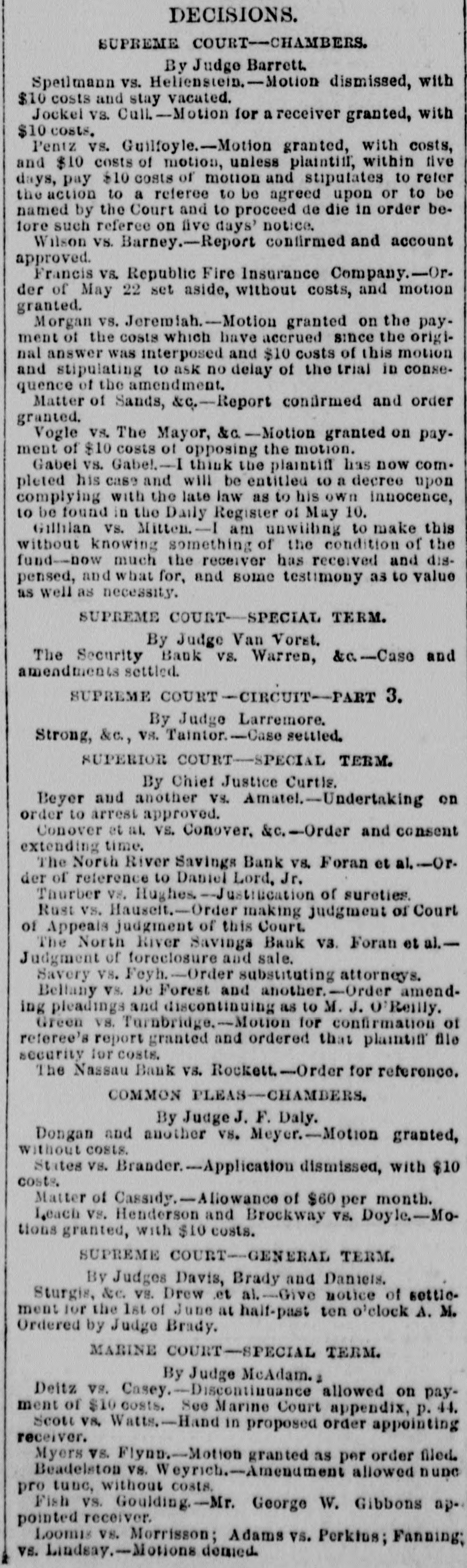
DECISIONS. SUPREME COURT-CHAMBERS. By Judge Barrett. Spetlmann vs. Helienstein.-Motion dismissed, with $10 costs and stay vacated. Jocket VS. Cull.-Motion for a receiver granted, with $10 costs. Pentz vs. Guilfoyle.-Motion granted, with costs, and $10 costs of motion, unless plaintif, within five days, pay $10 costs of motion and stipulates to reter the action to a referee to be agreed upon or to be named by the Court and to proceed de die in order be1ore such referee on five days' notice. Wilson vs. Barney.-Report confirmed and account approved. Francis VS. Republic Fire Insurance Company.-Order of May 22 set aside, without costs, and motion granted. Morgan vs. Jeremiah.-Motion granted on the payment of the costs which have accrued since the original answer was interposed and $10 costs of this motion and stipulating to ask no delay of the trial in conse. quence of the amendment. Matter of Sands, &c.-Report confirmed and order granted. Vogle vs. The Mayor, & - Motion granted on payment of $10 costs of opposing the motion. Gabel vs. Gabel.-I think the plaintiff has now com. pleted his case and will be entitled to a decree upon complying with the late law as to his own innocence, to be found in the Daily Register of May 10. Gillian vs. Mitten.- am unwilling to make this without knowing something of the condition of the fund-now much the receiver has received and dispensed, and what for, and some testimony as to value as well as necessity. SUPREME COURT-SPECIAL TERM. By Judge Van Vorst. The Security Bank vs. Warren, &c.-Case and amendments settled. SUPREME COURT-CIRCUIT-PART 3. By Judge Larremore. Strong, &c., vs. Taintor.-Case settled. SUPERIOR COURT-SPECIAL TERM. By Chief Justice Curtis. Beyer and another vs. Amatel.-Undertaking on order to arrest approved. Conover et al. vs. Conover, &c.-Order and consent extending time. The North River Savings Bank VS. Foran et al. -Or. der of reference to Daniel Lord, Jr. Thurber VS. Hughes of sureties. Rust vs. Hauseit.-Order making judgment of Court of Appeals judgment of this Court. The North River Savings Bank V3. Foran et al.Judgment of foreclosure and sale. Savery vs. Feyh.-Order substituting attorneys. Beltany vs. De Forest and another.-Order amending pleadings and discontinuing as to M. J. O'Reilly. Green vs. Turnbridge.-Mouson for confirmation of referee's report granted and ordered that plaintiff file security for costs. The Nassau Bank vs. Rockett.-Order for reference. COMMON PLEAS-CHAMBERS. By Judge J. F. Daly. Dongan and another vs. Meyer.-Motion granted, without costs. States vs. Brander.-Application dismissed, with $10 costs. Matter of Casady.-Allowance of $60 per month. Leach vs. Henderson and Brockway vs. Doyle.-Motions granted, with $10 costs. SUPREME COURT--GENERAL TERM. By Judges Davis, Brady and Daniels. Sturgis, &c. vs. Drew et al.-Give notice of setticment for the 1st of June at half-past ten o'clock A.M. Ordered by Judge Brady. MARINE COURT-SPECIAL TERM. By Judge McAdam., Deitz VS. Casey.-Discontinuance allowed on payment of $10 costs. See Marine Court appendix, p. 44. Scott vs. Watts.-Hand in proposed order appointing receiver. Myers vs. Flynn.-Motion granted as per order filed. Beadelston vs. Weyrich.-Amenument allowed nunc pro tune, without costs. Fish vs. Goulding.-Mr. George W. Gibbons appointed receiver. Loomis vs. Morrisson; Adams vs. Perkins; Fanning: vs. Lindsay.--Motions denied.


Article from The New York Herald, April 21, 1878

Click image to open full size in new tab

Article Text

amount of $0 building was so heavily mortgaged that the rent only defrayed the interest on the mortgage. Suits, how. ever, are pending against the president and trustees, and may yet result in yielding something. Clinton Baok collapsed July 5, 1877, with a roll of 1,300 depositors, calling for $88,000. Mr. Edward L. Paris was appointed receiver by Judge Landon July 17. 1877. The panie of 1873 caused such a shrinkage in the securities of this bank that It was reduced to 118 last legs, and was only kept alive by the personal sacrifices of 118 trustees, Who struggled on, making up the deficiency from year 10 year until they grew tired. From the sale of real estate owned by the bank and available assets the depositors may yet realize a dividend of thirty-five per cent, out toey must have patience. Clairmont Bank closed September, 1877, on 1,000 Repositors, representi $100,000. Judge Westbrook appointed General Henry V. Smalley receiver. but though the available assets are rated at sixty cents no dividend bus yet been declared, and the late recelver is enjoying himself in Canada. His successor as receiver is Mr. Clark Brooks, no is expected to do thing possible for the depositors GERMAN UPTOWN BANK. This institution closed on December 6, 1875, with a roll of 4,399 depositors, claiming $229,436. Mr. Herman Uni was appointed receiver by Judge Davis, and the depositors received eighty cents on the dollar, the last dividend being declared September 4, 1876, while another is expected about this time of teu per cent. The trouble with this bank was that its assistant Secretary, Schwartz, who is now in Sing Sing, stole liberally of its lunds, and a consi erable amount of its securities were in depreciat Southern bonds. The German Bank, of Morrisauia, failed March, 1877, having 2,200 depositors, 10 whom 11 owed $230,000. Mr. William J. Best was made receiver by Judge Landon, and he expects when all the available assets are realized and the trustees made to pay on account of illegal investments that the depositors will be reimbursed to the extent of seventy five cents on the dollar, but they have had nething yet. Mr. Best says that when he took possession of the bank last July its cash amounted to only $351 95 and it owed $54 000 to sundry secured creditors. including two of its own trustees The sum named had been borrowed at different times by the officers LO meet current disbursements, its payment being guaranteed by the pledge of 10wn bonds and bonds and mortgages. Mr. Best says he holds railroad bonds and other securities to the amount of $167,000, and this amount he shall endeavor to recover from those trustees who voted in favor of the purchase of the bonds and of making the loan on railroad securities, both acts being in direct violation of the charter of the bank and of the laws in relation to savings banks. If he only succeeds in this it will be a well taught lesson to all trustees in future. GUARDIAN BANK. This bank had 1,000 depositors, to whom it owed $560,000 on the day it closed, November 17, 1871# Among its directors were well known members of the Ring. Its first receiver was Mr. Jeremiah Quinlan, appointed by Judge Barnard November 17, 1871. Mr. Mr. Walter S. Roche, one of the directors, who held himself responsible for the failure of the bank. turned over to Quinlan his entire property, to make good the losses. This property realized enough to pay the depositors in full and leave a surplus of about $150,000; but Roche WMS cheated of his last dollar. Quintan resigned and Peter J. O'Donohue was ap. pointed his successor by Judge Donohue; but no Was removed by Judge Lawrence and Mr. John T. McGowan, a lawyer of good repute, WILL substituted in his place. Suits against Quiolan for the recovery of the moneys were promptly started by Mr. McGowan, but nothing has come of them yet. The depositors, however, ought to be thankful to get so much as ninety live cents OD the dollar, though it Was secured by the beggary of Roche. MECHANICS AND TRADERS' BANK. This closed June 10, 1876, having 3, 300 depositors, to whom it owed $1,454,000. On July 13 Mr. William J. Best was appointed receiver by Judge Osborne. The depositors were paid seventy one cents on the dollar, the last dividend having been declared December, 1877, and one more of ten or filteen per cent 18 expected to be declared within a few months. Snrinkage of values, along with culpable mismanagement, brought about the tate of the Mechanics and Traders'. MUTUAL BENEFIT BANK. This yielded up the ghost November 27. 1875, after being seven years in existence. It bad 4,000 depositors, to whom It owed $450,000. Judge Donohue appointed William F. Addried receiver. The depositors were paid fifty cents on the dollar up to May, 1876. Another dividend of ten per cent, and though a (orther one of ten 18 hoped for there 18 not much faith in its being realized. Fall in real estate and stupid management brought this concern to its inglorious end. MARKET BANK. This institution went under in January, 1872. through the rasculities of ring composed of its officers and one or two outsiders. The number of its depositors was 1,900, to whom $1,000,000 were due. Mr. James Dennis was appointed receiver January 20, 1872, by Judge Barnard, but the appointment, owing to the character of the Judge, excited the suspicion of the depositors, which culminated 12A such action being taken as resulted in the rejection 01 Dennis and the throwing of the bank into bankruptcy. Mr. Francis W. Worth, who died the following year, was elected assignee by the creditors, and about the same time the secretary of the bank, Conklin, departed for Canada with as much of the funds as he could conveniently lay hold OI. On Worth's death, in September, 1873, John S. Platt was appointed his successor by Judge Blatchford, but he succeeded to little more than a legacy of barassing litigation about real estate and squabbles with lawyers about fees. The bank paid thirty-eight cents on the dollar up to March 12. 1873, and another dividend is hoped for some day in the future. NEW AMSTERDAM BANK. This concern expired September 27, 1876, with a roll of 2,100 depositors, representing $510,000. It had been in existence eight years and was lodged in a large and most expensive building, that proved a fatal drag upon its resources. Mr. Richard M. Bent was appointed receiver December, 1876, by Judge Landon, and up to October 1877, bad paid the depositors sixty-five cents our the dollar. with a promised forthcoming dividend of twelve per cent. NATIONAL BANK This was a savings institution of no great consequence, and was more or less identified with the Ring, along with which It collapsed. "Hank" Smith was president. The trustees made up the deficiency and the depositors, to whom $190,000 were due, were paid in falls The receiver was appointed by Judge Barnard, but as be neid the office only ball a day, was offered $6,000 for his services, which he indignantly declined and felt ashamed o: the whole business, his name never transpired. PROPLE'S BANK. This was rather a weak institution and collapsed immediately when the hard times set in November 26, 1875. It had 1,296 depositors, to whom it owed $195,000. Isaac V. French Was appointed receiver by Judge Landon and succeeded in paying 33 1-3 cents on the dollar to the depositors up to April 4, 1876. Within the past SIX months 10 per cent additional has been paid, making 10 all 431-3 cents on the dollar, an amount which the depositors when the crash OCcurred hardly ever expected to get. SECURITY BANK. This bank failed November 26, 1875, after an existonce of seven years, which appears to be about the average longevity of a New York savings bank. It had 2,600 depositors, entitled to the gross sum of $390,000. Mr. William M. Banks was appointed receiver January 28, 1876, by Judge Landon, and up to May 1877, paid the depositors ty-seven and a half cents on the dollar. A delalcation on the part of the secretary, John L. Sen, who was subsequently sent to the Pemtentiary, and also the tall 10 the value of real estate, were the causes of the collepse. Mr. Banks expects within two months more to pay an additional live per cent THIRD AVENUE BANK. This bank closed with a deep. resounding crash September 30, 1875, and produced more w despread distress than hall the other banks put together. It bad the immense roll of 8,000 depositors, to whom was due $1,400,000. Mr. William S. Carman was first appointed receiver by Judge Osborne October, 1875, but was subsequently removed and Mr. Samuel H. Hurd, the present receiver, appointed in bis place by Judge Westbrook. Everybody has heard the history of this bank and its disgraceful and. corrupt management A loop in the law permited the escape of the president and trustees. Fifteen cents on the dollar, what they have got already is nearly all the depositors are ever likely LO see. The management of this concern was illustrated in the matter of the trustees bond suit, ID which " was shown that when the bank ran behind 80 that it could not pay a dividend the trusiees held a meeting and drew up a bond by which they became individually liable to the amount of