
14370. Phenix National Bank (New York, NY)

Bank Information

Episode Type
Run Only
Bank Type
national
Bank ID
1374
Charter Number
1374
Start Date
May 14, 1884
Location
New York, New York (40.714, -74.006)

Metadata

Model
gpt-5-mini
Short Digest
a7bb86357c7d84ff

Response Measures

Accommodated withdrawals, Public signal of financial health

Description

Contemporary reports (May 14โ€“15, 1884) describe a run on the Phenix National Bank in New York that was calmed the same day with the bank paying regularly and Clearing House action reassuring depositors. No suspension, receivership, or permanent closure is reported in these articles. OCR spelling 'Phenix' matches the historical name; articles explicitly state the run was a mistake/rumor and was settled.

Events (3)

1. July 1, 1865 Chartered
Source
historical_nic
2. May 14, 1884 Run
Cause
Rumor Or Misinformation
Cause Details
Reports and rumors spread that the bank was unsound (partly tied to its refusal to certify brokers' checks); Clearing House intervention and bank officers reassured depositors and payments continued.
Measures
Paid out funds as requested; president and officers publicly reassured depositors at the bank steps; Clearing House meeting settled the trouble and protected correspondent obligations.
Newspaper Excerpt
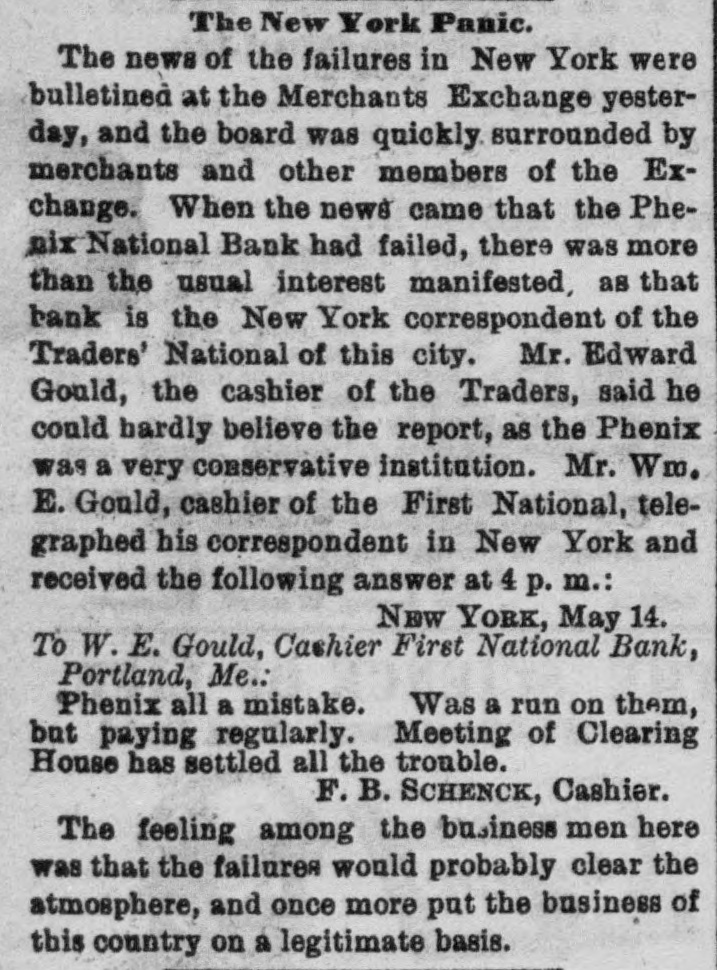
The Phenix National Bank found itself besieged about noon with a multitude clamoring for money... 'Phenix all a mistake. Was a run on them, but paying regularly. Meeting of Clearing House has settled all the trouble.'
Source
newspapers
3. March 28, 1911 Voluntary Liquidation
Source
historical_nic

Newspaper Articles (6)

Article from New-York Tribune, May 15, 1884

Click image to open full size in new tab

Article Text

GENERAL FEATURES OF THE DAY. CROWDS IN AND ABOUT WALL STREET. HOW THE ANNOUNCEMENTS OF THE FAILURES WERE RECEIVED. Much earlier than usual Wall Street was alive On the way to the street the brokers had of companions when a they had had one. Several yesterday. hundreds thousand neighborhood persons day before of had in the streets in the the before 10 the the men gathered Stock who Exchange sought o'clock, floor had and to elbow their way through a dense crowd. The majority. of course, were mere curiosity-seekers. They betrayed this afterward by standing for hours and staring at the buildings in which were the offices of the firms whose failures were announced at intervals between 10 o'clock and noon. Others had a more vital interest. These did not spend much time in looking about them; they pushed past the starers and disappeared in the brokers' offices. The brokers went upon the floor of the Exchange in larger force than usual. There they took part in occurrences, but the demonstrations not different on an day. In fact, tension ordinarily many were exciting busy widely when from those the was the business of was comparatively carried greatest on with the little Exchange noise. The happenings which set the outside crowd to rushing madly and aimlessly about subdued their brokers. Announcements were made from the rostrum every few minutes, but it was only after the news a failure was thus communicated that half alhundred men would dash wildly through the doors,and communicate their madness to the wondering multitude outside. Then a great tide in the human sea would set toward the office of the broken firm, to swirl and eddy in front of it for the rest of the day. WALL STREET ALMOST IMPASSABLE. Long before noon Wall-st. was almost impass able. Seen from the steps of Trinity Church it was black with human beings as far as the vision reached. Carriages, cabs and stages which turned into it occasionally had to make their way slowly through the path which opened in front of them. Here and there a surging mass, denser and more ex. cited than usual, was seemingly thrown up against the front of a house. Thus the offices of the brokers who had gone down e distinguished. The first of the firms was Nelson Robinson & Co., at No. 18 Wall-st. Then followed Goffe & Randle, at No. 5 New-st.; then O.M. Bogart & Co., at No.108 Broadway : and at this spot, at Broadway and Pine-st., the crowning excitement of the day was reached when about half-past 11 the Metropolitan Bank closed its doors. At ten minutes before 11 the last violent irruption from the Exchange took place. A hundred men burst almost simultaneously from the doors into New-st., gasped Hatch & Foote' as they dived into the crowd, and disappeared in all directions. Nearly all the banks 111 the vicinity of Wall-st. were crowded with people eager to reach the windows of the paying tellers. The failure of Nelson Robinson & Co., a firm composed of a son-inlaw and two sons of George I. Seney, and the fact that the Metropolitan Bank had been under suspicion for a week, started a run on that concern. The paying teller paid out money as it was called for, or certified the checks presented in the usual order of business until twenty minutes after 11 o'clock. Then he shut his window, and the announcement was made that the bank had suspended. The heavy doors in front were closed, policemen were stationed at the head of the steps to keep back the multitude, and communication between the bank officers and their customers was cut off. Till nightfall people jostled each other off the iron steps their anxiety to read the notices tacked on the door, which told simply where drafts drawn by correspondent bankers would be honored. THE CROWD EAGER FOR NEWS. On the part of the crowd there was a disposition to believe any story which told of disaster. A chance word of conversation, which had a questionable sound was picked up repeated, developed with lightning-like rapidity into a damaging ru mor. and accepted for fact, The Phenix National Bank found itself besieged about noon with a multitude clamoring for The bank began some time ago to money. reduce its broker business, and in pursuit of this policy had refused to certify checks unless there was money actually on deposit. The belief got abroad that the bank was unsound, and the turmoil began in front of its doors. President Dutilh took his station at the head of the steps in front of the bank, shook the bands of those of his customers whom he knew, and a hundred times gave the information that the bank was all right, and that those who wanted their money could have it. In an hour or two the excitement here was allayed. THE LAST ANNOUNCEMENT OF A FAILURE. The last announcement of a failure in the Board as made at 2,30. It was that of Hotchkiss & Burnham. The gavel had been kept going almost incessantly while the chairman of the Board was closing transactions under the rule" on a account of the suspended firms. but vigorous rapping than usual at the time mentioned called nearly every member on the floor to the vicinity of the rostrum. The intelligence was received with shouts of " Oh!" and whistlings, and a rush into the street. Afterward little attention was paid to the announcements. As the hands of the clock approached 3 there came a great erescendo of sound, which wasswelled into a deafening din by the signal gong. A quick hush followed the stream of enectators
Article from The Rock Island Argus, May 15, 1884

Click image to open full size in new tab

Article Text

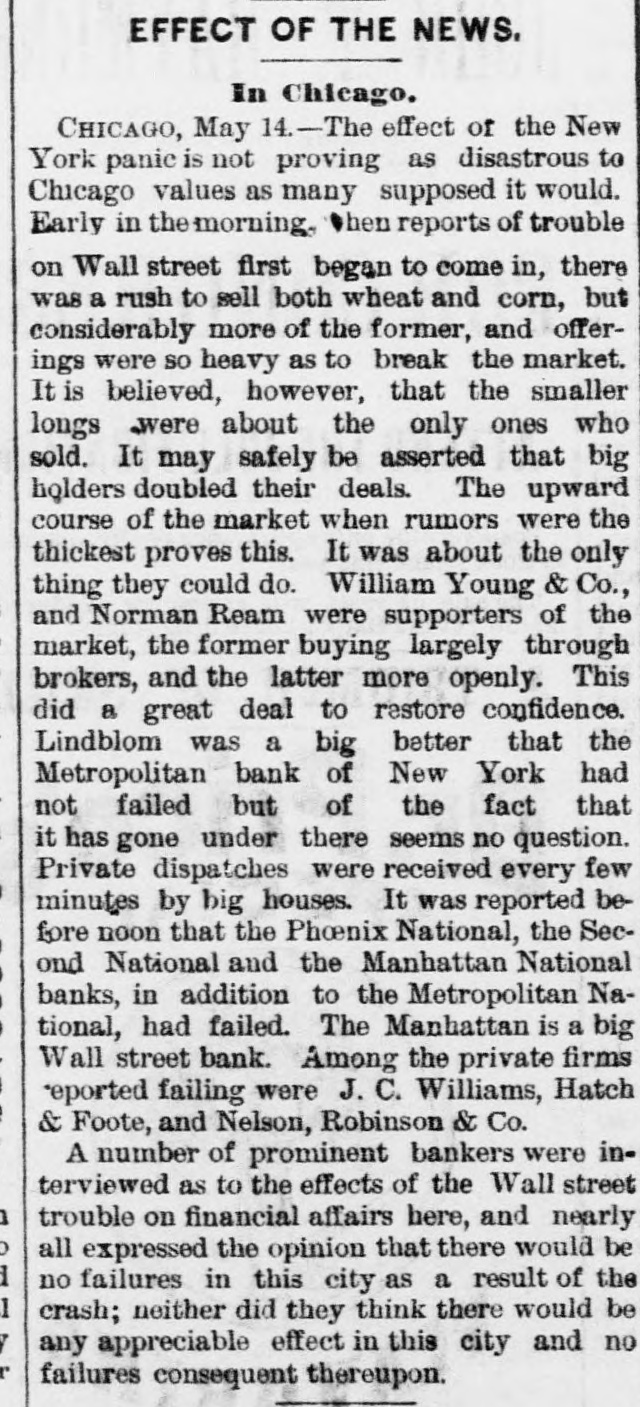
EFFECT OF THE NEWS. In Chicago. CHICAGO, May 14.-The effect of the New York panic is not proving as disastrous to Chicago values as many supposed it would. Early in the morning, then reports of trouble on Wall street first began to come in, there was a rush to sell both wheat and corn, but considerably more of the former, and offerings were so heavy as to break the market. It is believed, however, that the smaller longs were about the only ones who sold. It may safely be asserted that big holders doubled their deals. The upward course of the market when rumors were the thickest proves this. It was about the only thing they could do. William Young & Co., and Norman Ream were supporters of the market, the former buying largely through brokers, and the latter more openly. This did a great deal to restore confidence. Lindblom was a big better that the Metropolitan bank of New York had not failed but of the fact that it has gone under there seems no question. Private dispatches were received every few minutes by big houses. It was reported before noon that the Phoenix National, the Second National and the Manhattan National banks, in addition to the Metropolitan National, had failed. The Manhattan is a big Wall street bank. Among the private firms reported failing were J. C. Williams, Hatch & Foote, and Nelson, Robinson & Co. A number of prominent bankers were interviewed as to the effects of the Wall street trouble on financial affairs here, and nearly all expressed the opinion that there would be no failures in this city as a result of the 1 crash; neither did they think there would be any appreciable effect in this city and no failures consequent thereupon.


Article from The Portland Daily Press, May 15, 1884

Click image to open full size in new tab

Article Text

The New York Panic. The news of the failures in New York were bulletined at the Merchants Exchange yesterday, and the board was quickly surrounded by merchants and other members of the Exchange. When the news came that the Phenix National Bank had failed, there was more than the usual interest manifested, as that bank is the New York correspondent of the Traders' National of this city. Mr. Edward Gould, the cashier of the Traders, said he could hardly believe the report, as the Phenix was a very conservative institution. Mr. Wm. E. Gould, cashier of the First National, telegraphed his correspondent in New York and received the following answer at 4 p. m.: New YORK, May 14. To W. E. Gould, Cashier First National Bank, Portland, Me.: Phenix all a mistake. Was a run on them, but paying regularly. Meeting of Clearing House has settled all the trouble. F. B. SCHENCK, Cashier. The feeling among the business men here was that the failures would probably clear the atmosphere, and once more put the business of this country on a legitimate basis.


Article from New-York Tribune, May 15, 1884

Click image to open full size in new tab

Article Text

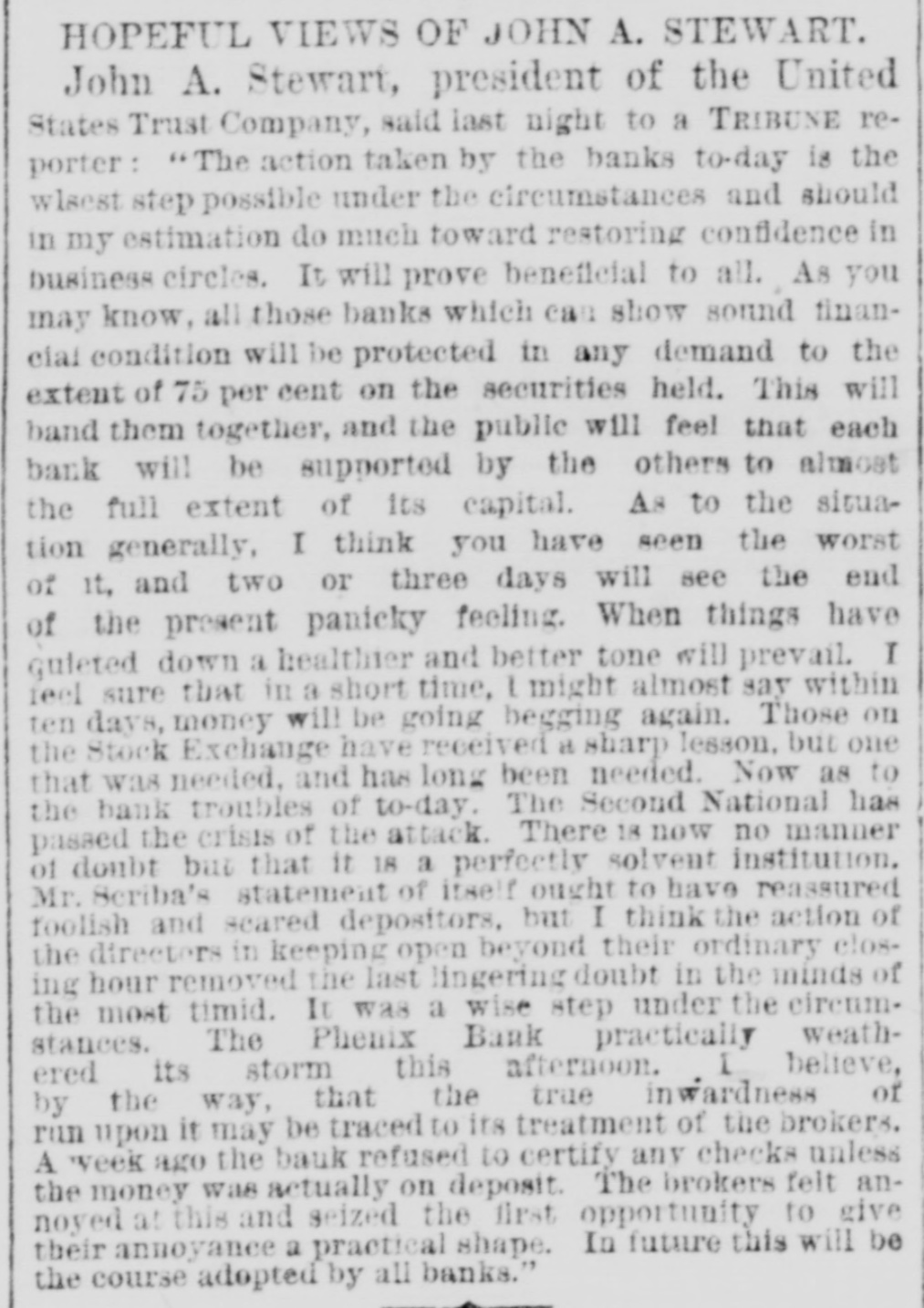
HOPEFUL VIEWS OF JOHN A. STEWART. John A. Stewart, president of the United States Trust Company, said last night to a TRIBUNE reporter: The action taken by the banks to-day is the wlsest step possible under the circumstances and should in my estimation do much toward restoring confidence in business circles. It will prove beneficial to all. As you may know, all those banks which can show sound financial condition will be protected in any demand to the extent of 75 per cent on the securities held. This will band them together, and the public will feel that each bank will be supported by the others to almost the full extent of its capital. As to the situation generally, I think you have seen the worst of it, and two or three days will see the end of the present panicky feeling. When things have guieted down a healthier and better tone will prevail. I feel sure that in a short time, I might almost say within ten days, money will be going begging again. Those on the Stock Exchange have received a sharp lesson, but one that was needed, and has long been needed. Now as to the bank troubles of to-day. The Second National has passed the crisis of the attack. There 18 now no manner of doubt but that it 18 a perfectly solvent institution. Mr. Scriba's statement of itself ought to have reassured foolish and scared depositors, but I think the action of the directors in keeping open beyond their ordinary closing hour removed the last lingering doubt in the minds of the most timid. It was a wise step under the circumstances. The Phenix Bank practically weathered its storm this afternoon. I believe, by the way, that the true inwardness of run upon it may be traced to its treatment of the brokers. A week ago the bauk refused to certify any checks unless the money was actually on deposit. The brokers felt annoyed at this and seized the first opportunity to give their annoyance a practical shape. In future this will be the course adopted by all banks."


Article from Arizona Weekly Citizen, May 17, 1884

Click image to open full size in new tab

Article Text

Condensed Telegrams. 'incinnati grand jury hae found fif. ou. indictments growing out of the recent riots. Payson has introduced a bill in Conto restrict the ownership of real gress estate in the Territories to American citizens. An indictment has been found against T.C. Campbell, a C neinnati lawyer who defended William Bowen, the murderer of Kirk. The charge is bribery. He gave bail in the sum of $1,000. H. L. Wells, a witness for the defense in the Hill-Sharon case, who contessed to having sworn falsely, has been arrested for perjury. The California Legislature adjourns sine die at Tuesday noon. The Anti-Monopolist national convention was opened Wednesday at Boston. It is probable that Benjamin F. Butler will be nominated for President. The Grand Lodge O. F., of Cali fornia, began its thirty-second session in San Francisco on Tuesday, with Grand Master W. W. Morrow in the chair. Charles M. Bayard, stock broker of Philadelphia, has failed. Liabilities not stated. The Atlantic bank, of Brooklyn, N. Y., closed its doors on Wednesday. The New Jersey Democratic State Convention met on Wednesday and was presided over by Senator McPherson, who counseled harmony and laying aside all small issues. Don Fernando Pacheco, aged 60; weight 425 lbs., died at Martinez, Cal., Monday. The following New York banks have closed their doors: Manhattan National, Metropolitan National, Phenix National and Second National. Francisco bankers believe the will no New San York panic except have to stiffen effect upon the Pacific coast rates somewhat. They maintain that the country is in condit on to stand a much greater shock than this. For several days past the passenger rates from Denver to the Missouri have been in a very unsettled condition, but not until Tuesday has a cut been openly declared. The agents of the Burlington, Missouri, Union Pacific, Atchison, Topeka & Santa Fe announce a cut unprecedented in the history of Western roads, viz: $5 to Kansas City; $8.50 to St. Louis: $14.50 to Chicago, and $28 to are in New York. They easteru fact selling point tickets from any principal for Kansas City at the same rate as to as the eastern But the result as Roads are free to that pro named. passengers rate. point Kansas carrying roads issued is City. through refused above a cir- Pool commissioner Daniels has cular ordering the restoration of rates to take effect on the 15th instant. This order however will surely be ignored. Capt. Monroe of the steamer City of Rome, stated that on April 23, while passing six sailing vessels, almost becalmed, within two or three miles of each other, a full rigged ship was observed two or three miles away, displaying signals which as interpreted by me, meat "ship wrecked crew safe," but no signal was or if was not seen, nor was displayed urgency displayed, the name or nationality of the ship given. Had the signal of distress or urgency been seen it would have had immediate attention as the day was calm. Signal dropping is difficult to make out, but it would have been easy for the vessul to have put out a boat which could have been intercepted by the City of Rome, but not until after his arrival at Liverpool, and hearing that a State line steamer was overdue that the incident became connected in his mind with the indistinct signal, when he at once reported his conjecture. "I certainly," he be the last man said, "would to render neglect the duty of every seaman to as sistance to any one in distrees at sea, having on more than one occasion been indebted to others for the preservation of my OWD life." The first and fourth officers on watch, on duty at the time of eignaling, certify their adherence to Munroe's statement.


Article from Savannah Morning News, May 17, 1884

Click image to open full size in new tab

Article Text

THE WALL STREET PANIC. Some Features of it as Presented by th New York Papers-1 President Georg I. Seney's Career-His Gifts-The Caus of His Failure-Facts About Grant Ward. The Wall street panic appears to b about over and confidence is partially, not wholly, restored. At one tim Wednesday), however, the situation looked very threatening. One of the ugl features of the day was the ruthless man ner in which the names of banks wer bandied about. Scarcely a bank withi a radius of half a mile of the Stock Ex change escaped suspicion, and incipien "runs" were started in half a dozen in stitutions that proved to be perfectly so vent. Depositors, each in a more or les feverish state of anxiety. presented them selves at the tellers' windows of the Phe nix, the Union, the Wall Street and th Gallatin National Banks, but they wer speedily reassured as to the soundness those institutions. Reports were in cin culation about noon that 'runs' were ing made on the Fourth National an United States National Banks, but officer of those two banks laughed the state ments to scorn. President Baldwin, the first -named institution, said that hi bank was not only as firm as a rock, bt that there had not been an excited cust mer inside of it during the day AMONG THE MANY EXCITING RUMORS of the day was one that Jay Gould ha been driven to the wall and had bee obliged to open his famous strong box which he keeps in the vaults of the Me cantile State Deposit Company for purpose of raising money by using all hi securities as collateral. Mr Gould ha been unable-so the story went-to rais as much money as he needed on thes securities Mr. G. Morosini, M Gould's assistant, said that the repor concerning Mr. Gould was not true. "If Mr. Gould has failed, said M Morosini, with a pleasant smile and charming broken English, wish that might fail also, in the same way. He as solid as what you call-rock Mr Washington E. Connor, Mr. Gould broker. said the report was one of th wildest and most absurd of the day has not borrowed a dollar,' added M Connor "The securites were taken of the vault this morning, but they wer taken back this afternoon. That is a every day occurrence, and is done in th usual course of business. IT WAS APPARENT THAT THE RECEN FLURRY in Wall street had trightened the de positors of the Metropolitan Nation: Bank. The deposits have ranged as hig as eleven millions of dollars. The las statement showed that they had run dow to a little over three millions, and withi the past few days there had been heav depletions. The bank had become in volved in the heavy operations of Nelso Robinson & Co., whose checks were large ly certified and not made good on Tue day. Mr. Robinson is son-in- law of Pre ident Seney, and two of Mr. Seney's son are partners in the firm. But the most serious matter presente was the embarrassment of the Presiden George I. Seney. who is largely connecte with many railroad enterprises. La summer Mr. Seney was the holder of about $4,000,000 of East Tennessee, Virginia an Georgia Railroad income bonds, whic cost him and the other members of syndicate about 40 cents on the dolla They are now selling for about 15. T1 bonds have been as high as 73, and M Seney had great confidenc in them. The constitute a large part of the assets of bank When the demands of deposito and other creditors became pressing, was, of course, impossible to realize an thing on such assets without a ruinou sacrifice Some of the Directors, among who were Isaac H. Bailey, were loth to su pend, and up to the last minute urged tl possibility of obtaining aid from other banks MR SENEY AND HIS ENTERPRISES. The bulk of the responsibility for tl failure the bank was sides place with President Seney He was born Astoria, L.I., in 1826, and was the son a Methodist who occupied se eral pulpits in this city including Mulberry street and Allen street His was daughter of Con modore Nicholson. One of his aunts the wife of Albert Gallatin. Mr. Sene was educated at Wesleyan Universit and Columbia College, and was graduate from Columbia in 1847 He W: made paying teller of the Metropo itan Bank in 1847, and cashier years later. On the death of John Williams he was made President, since he reached that position his will been really the law of the bank M Seney negotiated what is known as tl Nickel Plate Railroad enterprise, and said to have realized about a million an a half out of his sale of it to the Vande bilts. GIVING A FORTUNE AWAY. Then he loomed out as one of the m lionaires of the metropolis, and about te years ago astonished even his most in mate friends with his princely gifts various ational and stitutions. He began with a gift of to the Long Island Historical Society at followed up with valuable books manuscripts. He gave 500 to the Your Men's Association and $27 000 to the Wesleyan University Middletown. Conn., where he received early education. He gave sixteen lots Seventh avenue, Brooklyn, and $200,000 cash for the purpose of constructing new hospital, which is not yet finishe His total gifts to the Long Island Histo cal Society amounted $62,000 He $20,000 to the Industrial Home in Butl street, $50,000 to Emory College in 0 ford. Ga., and $100,000 to Wesleyan F male College at Macon, and other benefa tions, most of which were unsolicited. In explanation of these gifts, he said them to the Lord that he found it better to give than that he took pleasure in partir with half a million dollars in this way that he preferred giving in his lifetime waiting until death for a bequest which might be defeated by contest over will. He used to talk of the bad effec upon a man's disposition of hoardin wealth, and took pride in saying h gifts did not go to the idle, the dissipate or the undesery Yet at the time most of these gifts we made, while many who had long know him were surprised at these unexpecte evidences of wealth, others who kne something of his real situation, and tl immense required by his ex sive terprises. remonstrated with hir He was warned that he could not aff it; that he might get his affairs into ous complications. But he replied with great ardor and enthusiasm that he cou well afford it, and that it was his rigl and pleasure to do what he chose with own. He at the same time disclaime any desire for notoriety in the matter, an did not give ostentatiously. but rath quietly He prided himself upon bein governed by business common sense his gifts. MR. SENEY'S HOME AND WAYS. Mr. Seney lives in the splendid mansio built by Rockwell, on the crest of hill opposite Wall street ferry in Broo lyn. His neighbor across the street is A. Low. The house, which was fitted at great expense as model in sanitatio proved fatal to Mr. Rockwell, and aft his death it was discovered that the ma sion was actually ventilating gre sewer. Mr. Seney, since purchasing has added to it an art gallery. containir the choicest collection of paintings Brooklyn. He was a domestic man, ticent in habit and was but little know by sight in Brooklyn. Like Ferdinar Ward, he was an attendant of the Churo of Pilgrims. The persuasiveness of tl Rev. Dr. R.S. Storrs was potent in ope ing his purse strings, especially for ditions book treasures in the Lor Island Historical Library, of which was a most liberal patron, buyir classics, engravings, and rare thing

