14252. National Bank of North America (New York, NY)

Bank Information

Episode Type
Run β†’ Suspension β†’ Closure
Bank Type
national
Bank ID
4581
Charter Number
4581
Start Date
October 21, 1907
Location
New York, New York (40.714, -74.006)

Metadata

Model
gpt-5-mini
Short Digest
35db04a52effece6

Response Measures

Accommodated withdrawals, Borrowed from banks or large institutions, Capital injected, Full suspension, Books examined

Receivership Details

Depositor recovery rate
100.0%
Date receivership started
1908-01-27
Date receivership terminated
1908-10-31
OCC cause of failure
Losses
Share of assets assessed as good
44.7%
Share of assets assessed as doubtful
55.3%

Description

Articles describe heavy withdrawals in October 1907 (clearing-house debit balances; Clearing House assistance) driven by persistent rumors about the bank's condition. On 1908-01-27 the Comptroller ordered the bank closed for liquidation and appointed a receiver. Deposit holders were later paid dividends in 1908 and assets were turned over to stockholders, but the bank was closed by government action and placed in receivershipβ€”so the episode is a run leading to suspension/closure. OCR errors in some articles corrected (e.g., Comptroller and dates).

Events (4)

1. June 11, 1891 Chartered
Source
historical_nic
2. October 21, 1907 Run
Cause
Rumor Or Misinformation
Cause Details
Persistent rumors set afloat regarding the bank's condition produced heavy and persistent withdrawals in October 1907; clearing house assistance was required.
Measures
Clearing House association extended assistance/loan certificates; the bank used clearing-house loan certificates and support from other banks.
Newspaper Excerpt
The debit balance of the National Bank of North America was $850,000. These figures indicated that heavy withdrawals from the two banks were being made
Source
newspapers
3. January 27, 1908 Receivership
Source
historical_nic
4. January 27, 1908 Receivership
Newspaper Excerpt
At the request of the board of directors of the National Bank of North America the Controller of the Currency has ordered the bank to be closed for liquidation and appointed Charles A. Hanna ... as receiver.
Source
newspapers

Newspaper Articles (24)

Article from Deseret Evening News, October 21, 1907

Click image to open full size in new tab

Article Text

MERCANTILE BANK DEBIT BALANCE When Made Known. Gave Favorable Sentiment on Banking and Business Circles Setback. THE AMOUNT IS $1,900,000. Methods Eliminated from Situation of Last Decade-Acknowledged That Crisis Was Serious One. New York. Oct. 21.-The most favorable sentiment in business and banking circles resultant from yesterday's changes in various bank managements and the promises of support made by the Clearing House association received something of a setack today when it became known that the debit balance of the Mercantile National bank, at the clearing house was $1,900,000. The debit balance of the National Bank of North America was$850,000. These figures indicated that heavy withdrawals from the two banks were being made and the totals were referred to by one member of the Clearing House association as "unexpectedly large and disconcerting." It was announced in a short time. however, that the Clearing House association would extend assistance to the Mercantile and National Bank of North America. Seth M. Milliken, the newly elected president of the Mercantile National bank. said today that counting out the Heinze-Morse loans, the assets of the bank are $1.40 for every dollar of liability and that the loans in ques~ tion are of value. Stocks today opened strong and higher, all the market leaders participating in the rise. Sunday's meeting of bank prestdents succeeded in finally eliminating the Heinze, Morse and Thomas interests on certain of the clearing house banks. Besides choosing new officers for the banks in question, and announcing that each was in a solvent condition, a fund of $10,000,000 was pledged by a score of individual banks to extend aid to those banks and render such assistance to meet their depositors as the clearing house committee may think necessary The deposits of the banks represented at the Sunday conference amounted to $1,250,000,000. The men, 15 in number, every one a practical banker, decided upon the measures for eliminating the interests which have been under criticism, which measures, later in the day were carried out. The methods that have ben eliminated from the local banking situation, it is stated are a. development of the last decade. These consist of buying of a bank. then putting up the stock representing that control as collateral for funds to buy control of another bank, and continuing the process with banks and trust companies, so that the result is a pyramid controlling "chains" of financial institutions and their deposits. The crisis, it is declared. was a serious one, but the cure extended is expected to be complete. Manager Shearer, of the Clearing House, said today that that institution had the situation under control; that all the undesirable elements had been eliminated, and that from this time would begin a new era in banking in New York. It was officially denied that it would be necessary to issue clearing house certificates, in order to secure support for the banks, which have been under criticism. United Copper, a Heinze security, advanced two points today from 73/2 to 9Β½. Seth M. Milliken, the new president of the Mercantile National bank, questioned as to loans made to F. A. Heinze and Charles W. Morse, said it was expected that they would repay them as soon as they were able.

Article from The Barre Daily Times, October 23, 1907

Click image to open full size in new tab

Article Text

Trust Company of America Besieged Today CLAIMS IT IS COMPETENT The Knickerbocker Trust Company, Which Suspended Payment Yesterday Is Now in the Hands of the State Banking Department, New York, Oct. 23.-The state bank ing department has taken charge of the Knickerboeker Trust company, and it was officially stated that the bank would not open for business this morning. In spite of it, hundreds of people congregated about the doors, and the police reserves have been called out to control them. The Trust company of America opened with its counters stacked with enormous piles of money, prepared for a run. Before nine o'clock a double line of depositors was waiting for the open ing. The company claims it has money enough on hand to meet all demands There was the same condition at the Colonial branch of the company. The Knickerbocker Trust company, the storm center yesterday, paid out cash to depositors at the rate of $44,444 a minute for three hours and then closed its doors. At a meeting of the directors of the Hudson Trust company held yesterday, the resignation of Orlando F. Thomas as president was formally accepted, and E. R. Chapman was selected as head of the institution in his place. Other Banks Wouldn't Help. President Higgins, the new president of the Knickerbocker. when asked if the other trust company presidents were reluctant to help out his bank, replied: Reluctant is no name for it. They seemed to feel that they ought to hold on to all the money they had. One of them said to me: We might have help ed you out. but here you have closed your doors. You mean that you don't want to ride a dead horse, I said, 'but I wish you to distinctly understand that the Knickerbocker is not a dead horse, and what are you going to do about it Mr. Higgins would not say what was answered Bauks That Were Helped. The clearing house committee went into session shortly after ten o'clock yesterday and announced the following debit balances of bank: Mercantile National bank, $454,000; National Bank of North America, $543. 000: National Bank of New Amsterdam. $340,000; the Mechanics' and Traders' National bank, $335,000; the National Bank of Commerce, $7,000,000. It was sofficially announced that the clearing house committee had rendered assistance yesterday to the Mercantile National bank, the National Bank of North America and the National Bank of New Am sterdam. It was stated that the large debit balance of the National Bank of o Commerce represented the clearances of the Knickerbocker Trust company. Cortelyou's Coming Gave Strength. V Secretary of the Treasury Cortelyou o teached New York from Washington at e 9:30 last night. He was met at Jerby Hamilton Fish, assistant il United States treaurer, and the two the u were in earnest conversation during ferry trip to New York. Upon reaching A this city they went at once to the Hotel Manhattan, where several bankers later k presented to the secretary the various phases of local financial conditions. h Secretary Cortelyou is here to thor oughly look into the financial situation, for si which he has had under observation R ,several weeks. He has come with no of ideas of how much money to relieve the h P and will preconceived be required relief situation the matter of treasury meas he will be determined by what to ures learns. He will do all that he can relieve the present stress. Secretary of the Treasury George B. made the before one o'clock this shortly Cortelyou following morning: statement leaving "I repeat what I stated before for no P this afternoon if at other Washington reason than to emphasize the It titude of the treasury department in every will use its facilities to assist interests way legitimate business and thor and proper its action will be prompt at tr ough national banks of New York condition City in 'The in an exceptionally strong to be te are general situation here looked seems after U The in hand, and is being men, fil well many strong and influential in the ed by those whose recent action public it such as house received emphatic similar ha clearing The movement for trust com ne approval. of action among the and far of concert should have a helpful the day panies effect. I shall spend at the B con reaching tomorrow sub-treasury. made from a th statement was situation el This on the local banking between Γ©e ference the Hotel Manhattan Geo al held at Cortelyou, J. P. Morgan, Frank A th Secretary Perkins, George F. Baker, and J. G. fr W Vanderlip, James Stillman Cannon. ha pa and TND GREAT DEPIL


Article from New-York Tribune, January 27, 1908

Click image to open full size in new tab

Article Text

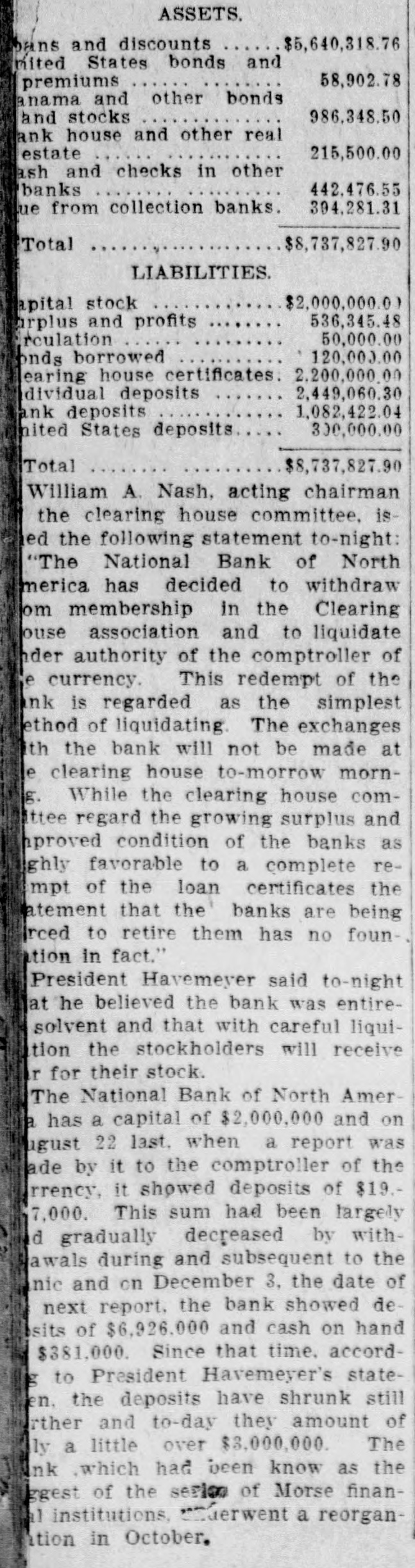
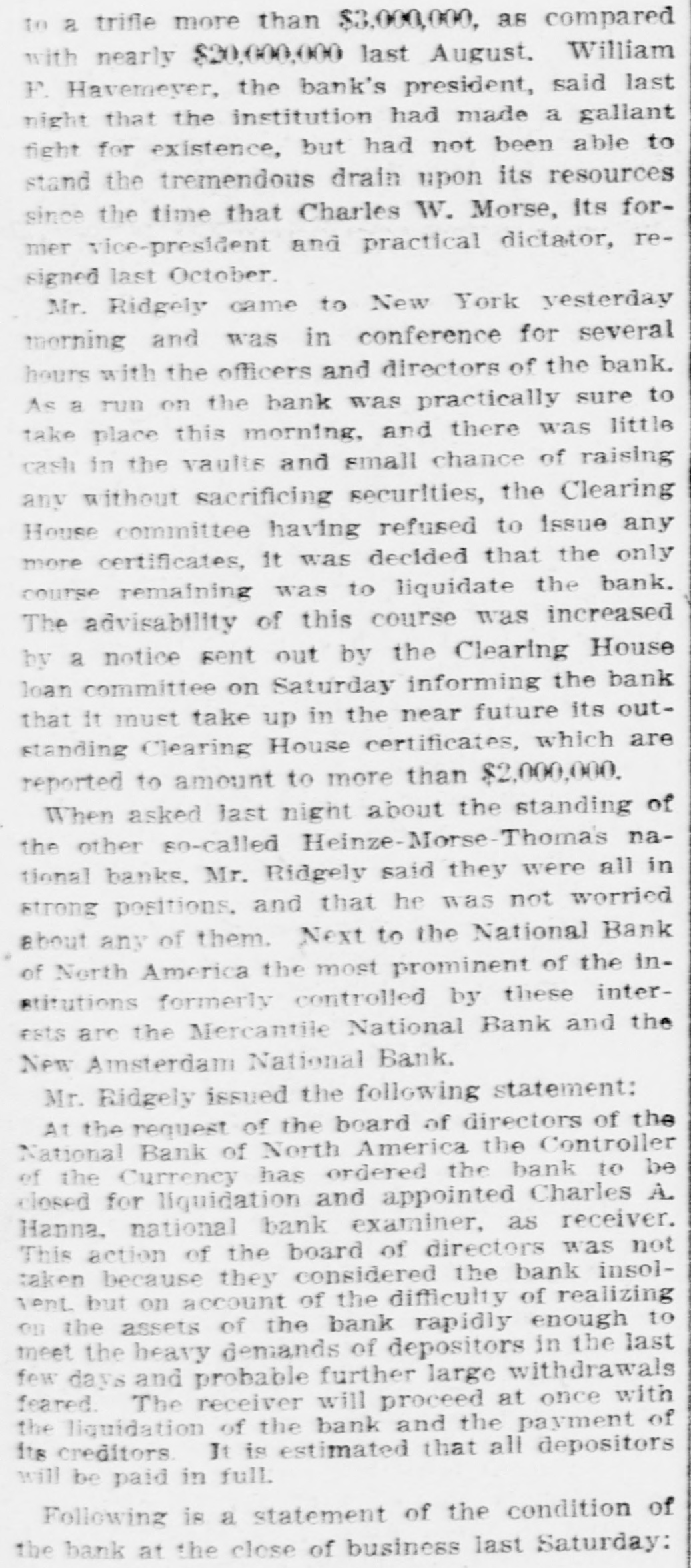
to a trifle more than $3,000,000, as compared with nearly $20,000,000 last August. William F. Havemeyer, the bank's president, said last night that the institution had made a gallant fight for existence, but had not been able to stand the tremendous drain upon its resources since the time that Charles W. Morse, Its former vice-president and practical dictator, resigned last October Mr. Ridgely came to New York yesterday morning and was in conference for several hours with the officers and directors of the bank. As a run on the bank was practically sure to take place this morning, and there was little cash in the vaults and small chance of raising any without sacrificing securities, the Clearing House committee having refused to issue any more certificates, it was decided that the only course remaining was to liquidate the bank. The advisability of this course was increased by a notice sent out by the Clearing House loan committee on Saturday informing the bank that it must take up in the near future its outstanding Clearing House certificates, which are reported to amount to more than $2,000,000. When asked last night about the standing of the other so-called Heinze-Morse-Thomas national banks. Mr. Ridgely said they were all in strong positions. and that he was not worried about any of them. Next to the National Bank of North America the most prominent of the institutions formerly controlled by these interests are the Mercantile National Bank and the New Amsterdam National Bank. Mr. Ridgely issued the following statement: At the request of the board of directors of the National Bank of North America the Controller of the Currency has ordered the bank to be closed for liquidation and appointed Charles A. Hanna. national bank examiner, as receiver. This action of the board of directors was not taken because they considered the bank insolvent but on account of the difficulty of realizing on the assets of the bank rapidly enough to meet the heavy demands of depositors in the last few days and probable further large withdrawals feared The receiver will proceed at once with the liquidation of the bank and the payment of its creditors. It is estimated that all depositors will be paid in full. Following is a statement of the condition of the bank at the close of business last Saturday:


Article from The Times Dispatch, January 27, 1908

Click image to open full size in new tab

Article Text

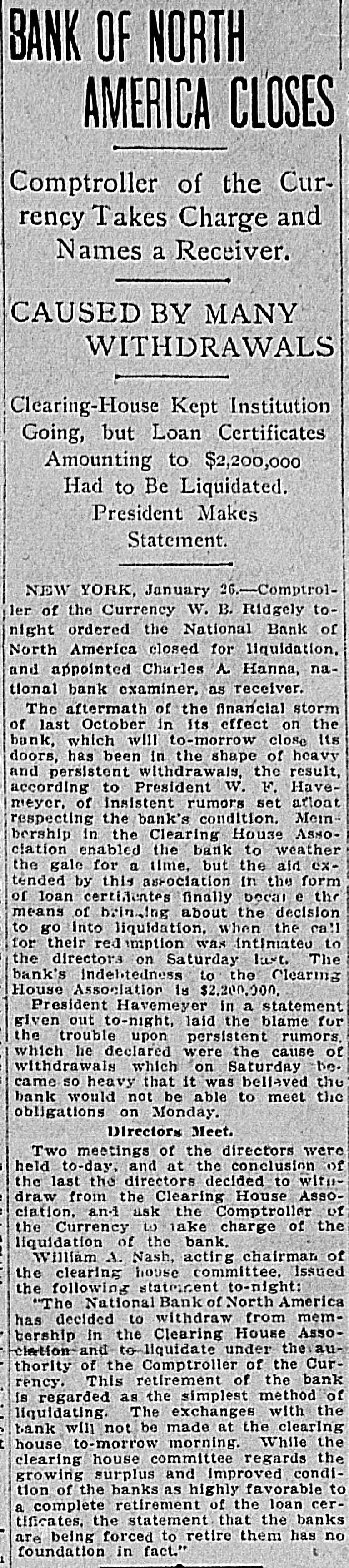
BANK OF NORTH AMERICA CLOSES Comptroller of the Currency Takes Charge and Names a Receiver. CAUSED BY MANY WITHDRAWALS Clearing-House Kept Institution Going, but Loan Certificates Amounting to $2,200,000 Had to Be Liquidated. President Makes Statement NEW YORK, January 26.-Comptroller of the Currency W. B. Ridgely tonight ordered the National Bank of North America closed for liquidation, and appointed Charles A. Hanna, national bank examiner, as receiver. The aftermath of the financial storm of last October in its effect on the bank, which will to-morrow close Its doors, has been in the shape of heavy and persistent withdrawals, the result, according to President W. F. Havemeyer, of insistent rumors set afloat respecting the bank's condition. Membership in the Clearing House Assoclation enabled the bank to weather the gale for a time, but the aid extended by this association in the form of loan certificates finally local e the means of brinking about the decision to go Into liquidation, when the call for their redimption was intimated to the directors on Saturday last The bank's indebtedness to the Clearing House Association is $2.200.000. President Havemeyer in a statement given out to-night, laid the blame for the trouble upon persistent rumors, which he declared were the cause of withdrawals which on Saturday be. came so heavy that it was believed the bank would not be able to meet the obligations on Monday. Directors Meet. Two meetings of the directors were held to-day, and at the conclusion of the last the directors decided to withdraw from the Clearing House Association. an-1 usk the Comptroller of the Currency 10 lake charge of the liquidation of the bank. William A. Nash, acting chairman of the clearing house committee, issued the following stateicent to-night: "The National Bank of North America has decided to withdraw from membership In the Clearing House Assocletion-and to-liquidate under the authority of the Comptroller of the Currency. This retirement of the bank is regarded as the simplest method of liquidating. The exchanges with the bank will not be made at the clearing house to-morrow morning. While the clearing house committee regards the growing surplus and improved condition of the banks as highly favorable to a complete retirement of the loan certificates, the statement that the banks are being forced to retire them has no foundation in fact."


Article from The Morning Journal-Courier, January 27, 1908

Click image to open full size in new tab

Article Text

ASSETS. ans and discounts $5,640,318.76 nited States bonds and 58,902.78 premiums anama and other bonds 986.348.50 and stocks ank house and other real estate 215,500.00 ash and checks in other banks 442.476.55 304,281.31 ue from collection banks Total $8,737,827.90 LIABILITIES. $2,000,000.00 apital stock 536,345.48 rrplus and profits relation 50,000.00 120,000.00 onds borrowed earing house certificates. 2.200.000,00 dividual deposits 2,449,060.30 1,082,422.04 ank deposits 300,000.00 nited States deposits Total $8,737,827.90 William A. Nash, acting chairman the clearing house committee, is ed the following statement to-night: The National Bank of North merica has decided to withdraw om membership in the Clearing ouse association and to liquidate der authority of the comptroller of e currency. This redempt of the nk is regarded as the simplest ethod of liquidating The exchanges ith the bank will not be made at e clearing house to-morrow morng. While the clearing house comttee regard the growing surplus and proved condition of the banks as ghly favorable to a complete rempt of the loan certificates the atement that the banks are being reed to retire them has no fountion in fact." President Havemeyer said to-night at he believed the bank was entiresolvent and that with careful liquition the stockholders will receive for their stock. The National Bank of North Amer has a capital of $2,000,000 and on ugust 22 last. when a report was ade by it to the comptroller of the Irrency, it showed deposits of $19.7.000. This sum had been largely gradually decreased by withawals during and subsequent to the nic and on December 3. the date of next report. the bank showed desits of $6,926.000 and cash on hand $381.000. Since that time. accordg to President Havemeyer's stateen. the deposits have shrunk still ther and to-day they amount of ly a little over $3,000,000. The nk which had been know as the ggest of the seriou of Morse finaninstitutions, Gerwent a reorgantion in October.


Article from New-York Tribune, January 30, 1908

Click image to open full size in new tab

Article Text

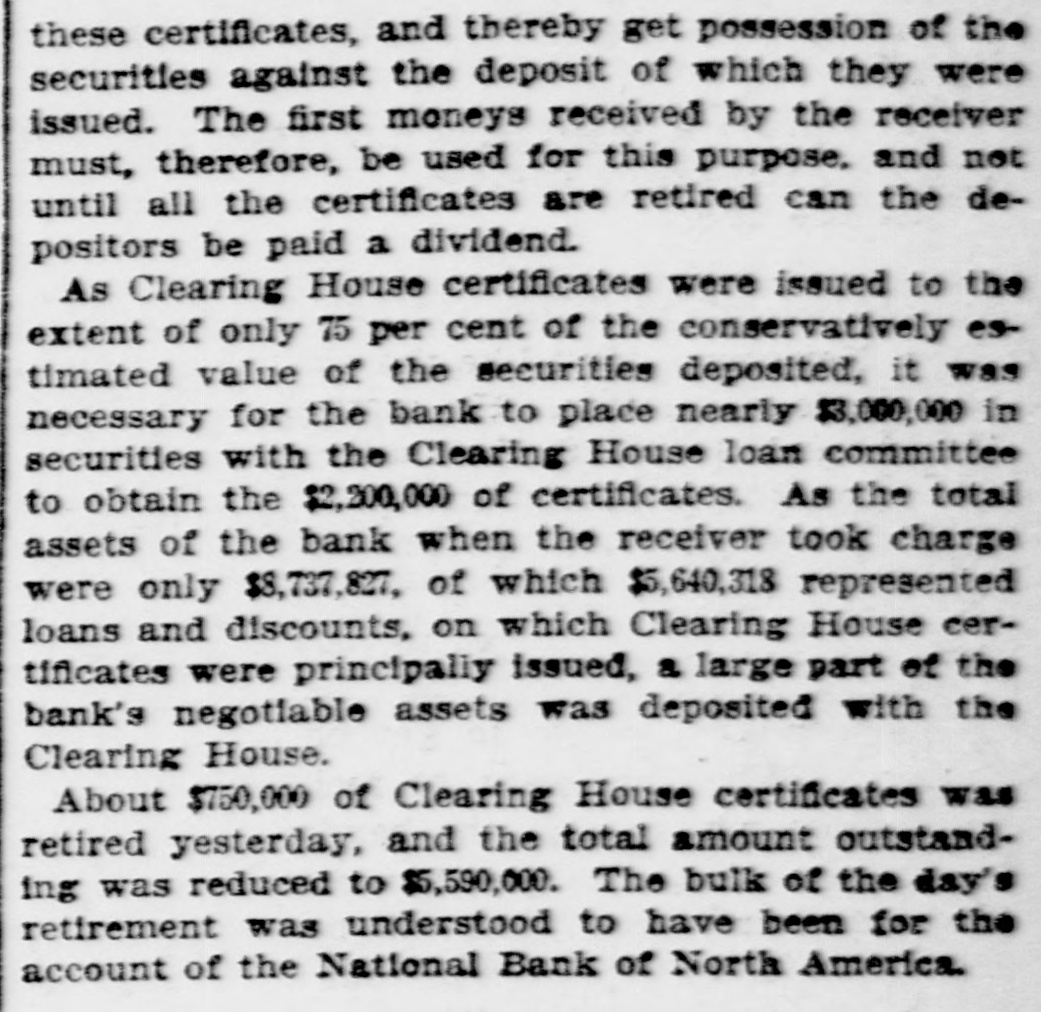
these certificates, and thereby get possession of the securities against the deposit of which they were issued. The first moneys received by the receiver must, therefore, be used for this purpose, and not until all the certificates are retired can the depositors be paid a dividend. As Clearing House certificates were issued to the extent of only 75 per cent of the conservatively estimated value of the securities deposited, it was necessary for the bank to place nearly $3,000,000 in securities with the Clearing House loan committee to obtain the $2,200,000 of certificates. As the total assets of the bank when the receiver took charge were only $8,737,827, of which $5,640,318 represented loans and discounts, on which Clearing House certificates were principally issued, a large part et the bank's negotiable assets was deposited with the Clearing House. About $750,000 of Clearing House certificates was retired yesterday, and the total amount outstanding was reduced to $5,590,000. The bulk of the day's retirement was understood to have been for the account of the National Bank of North America.


Article from The Miller Sun, February 1, 1908

Click image to open full size in new tab

Article Text

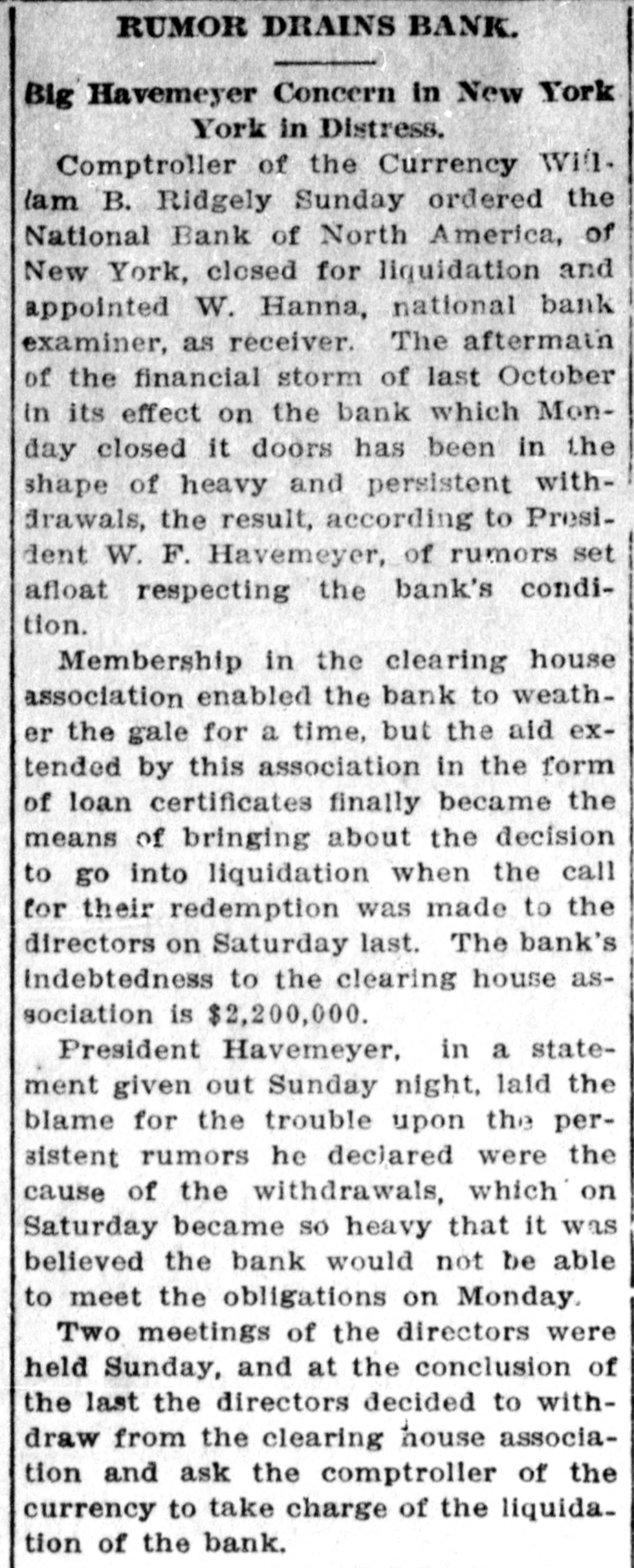
RUMOR DRAINS BANK. Big Havemeyer Concern in New York York in Distress. Comptroller of the Currency Will(am B. Ridgely Sunday ordered the National Bank of North America, of New York, closed for liquidation and appointed W. Hanna, national bank examiner, as rΓ©ceiver. The aftermatn of the financial storm of last October in its effect on the bank which Monday closed it doors has been in the shape of heavy and persistent withdrawals, the result, according to President W. F. Havemeyer, of rumors set afloat respecting the bank's condition. Membership in the clearing house association enabled the bank to weather the gale for a time, but the aid extended by this association in the form of loan certificates finally became the means of bringing about the decision to go into liquidation when the call for their redemption was made to the directors on Saturday last. The bank's indebtedness to the clearing house association is $2,200,000. President Havemeyer, in a statement given out Sunday night, laid the blame for the trouble upon the persistent rumors he declared were the cause of the withdrawals, which on Saturday became so heavy that it was believed the bank would not be able to meet the obligations on Monday. Two meetings of the directors were held Sunday, and at the conclusion of the last the directors decided to withdraw from the clearing house association and ask the comptroller of the currency to take charge of the liquidation of the bank.


Article from The Barre Daily Times, March 13, 1908

Click image to open full size in new tab

Article Text

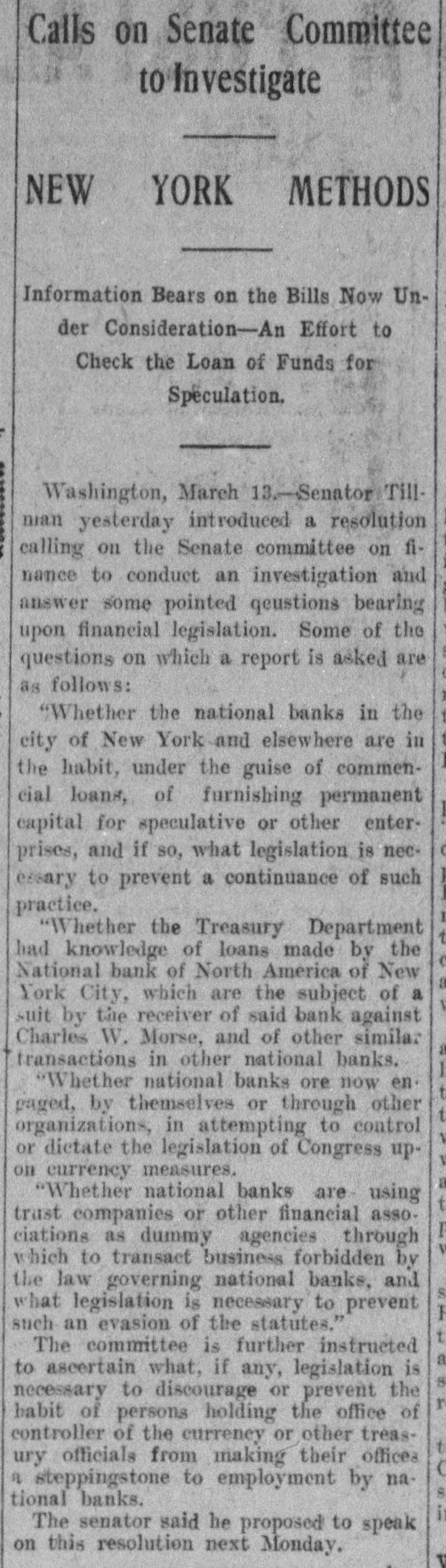
# Calls on Senate Committee to Investigate # NEW YORK METHODS Information Bears on the Bills Now Under Consideration-An Effort to Check the Loan of Funds for Speculation, Washington, March 13.-Senator Tillman yesterday introduced a resolution calling on the Senate committee on finance to conduct an investigation and answer some pointed qeustions bearing upon financial legislation. Some of the questions on which a report is asked are as follows: "Whether the national banks in the city of New York and elsewhere are in the habit, under the guise of commercial loans, of furnishing permanent capital for speculative or other enterprises, and if so, what legislation is necessary to prevent a continuance of such practice. "Whether the Treasury Department had knowledge of loans made by the National bank of North America of New York City, which are the subject of a suit by the receiver of said bank against Charles W. Morse, and of other similar transactions in other national banks. "Whether national banks ore now engaged, by themselves or through other organizations, in attempting to control or dictate the legislation of Congress upon currency measures. "Whether national banks are using trust companies or other financial associations as dummy agencies through which to transact business forbidden by the law governing national banks, and what legislation is necessary to prevent such an evasion of the statutes." The committee is further instructed to ascertain what, if any, legislation is necessary to discourage or prevent the habit of persons holding the office of controller of the currency or other treasury officials from making their offices a steppingstone to employment by national banks. The senator said he proposed to speak on this resolution next Monday.


Article from New-York Tribune, March 26, 1908

Click image to open full size in new tab

Article Text

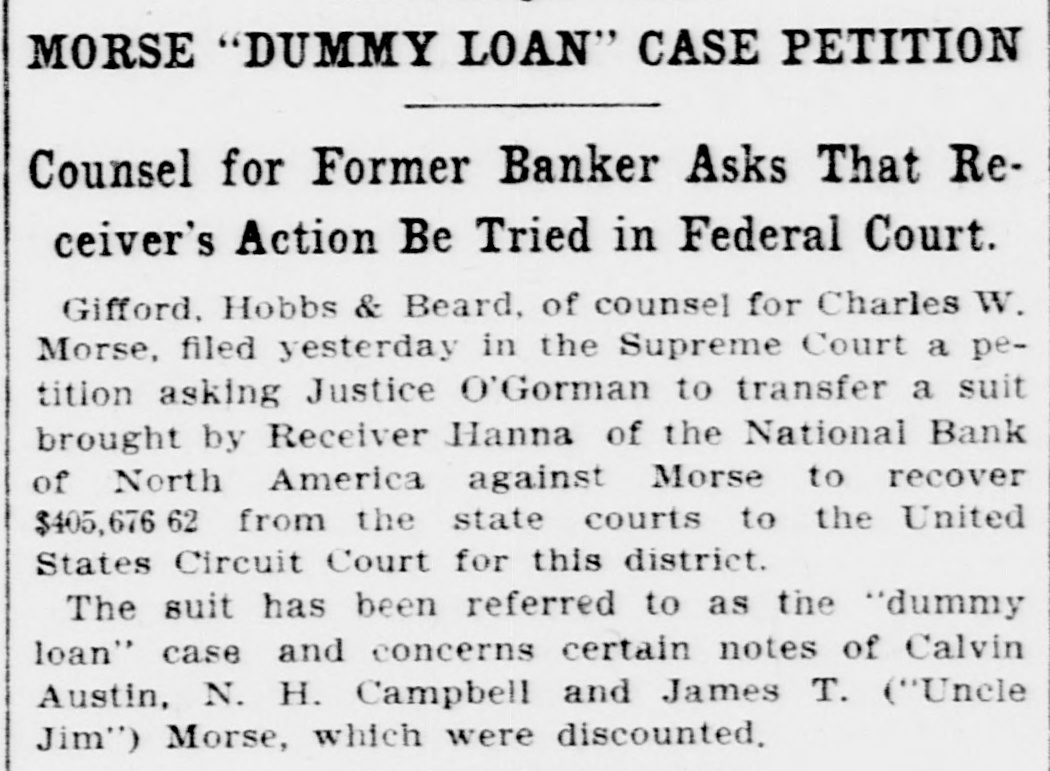
MORSE "DUMMY LOAN" CASE PETITION Counsel for Former Banker Asks That Receiver's Action Be Tried in Federal Court. Gifford, Hobbs & Beard, of counsel for Charles W. Morse, filed yesterday in the Supreme Court a petition asking Justice O'Gorman to transfer a suit brought by Receiver Hanna of the National Bank of North America against Morse to recover $405,676.62 from the state courts to the United States Circuit Court for this district. The suit has been referred to as the "dummy loan" case and concerns certain notes of Calvin Austin, N. H. Campbell and James T. ("Uncle Jim") Morse, which were discounted.


Article from New-York Tribune, June 24, 1908

Click image to open full size in new tab

Article Text

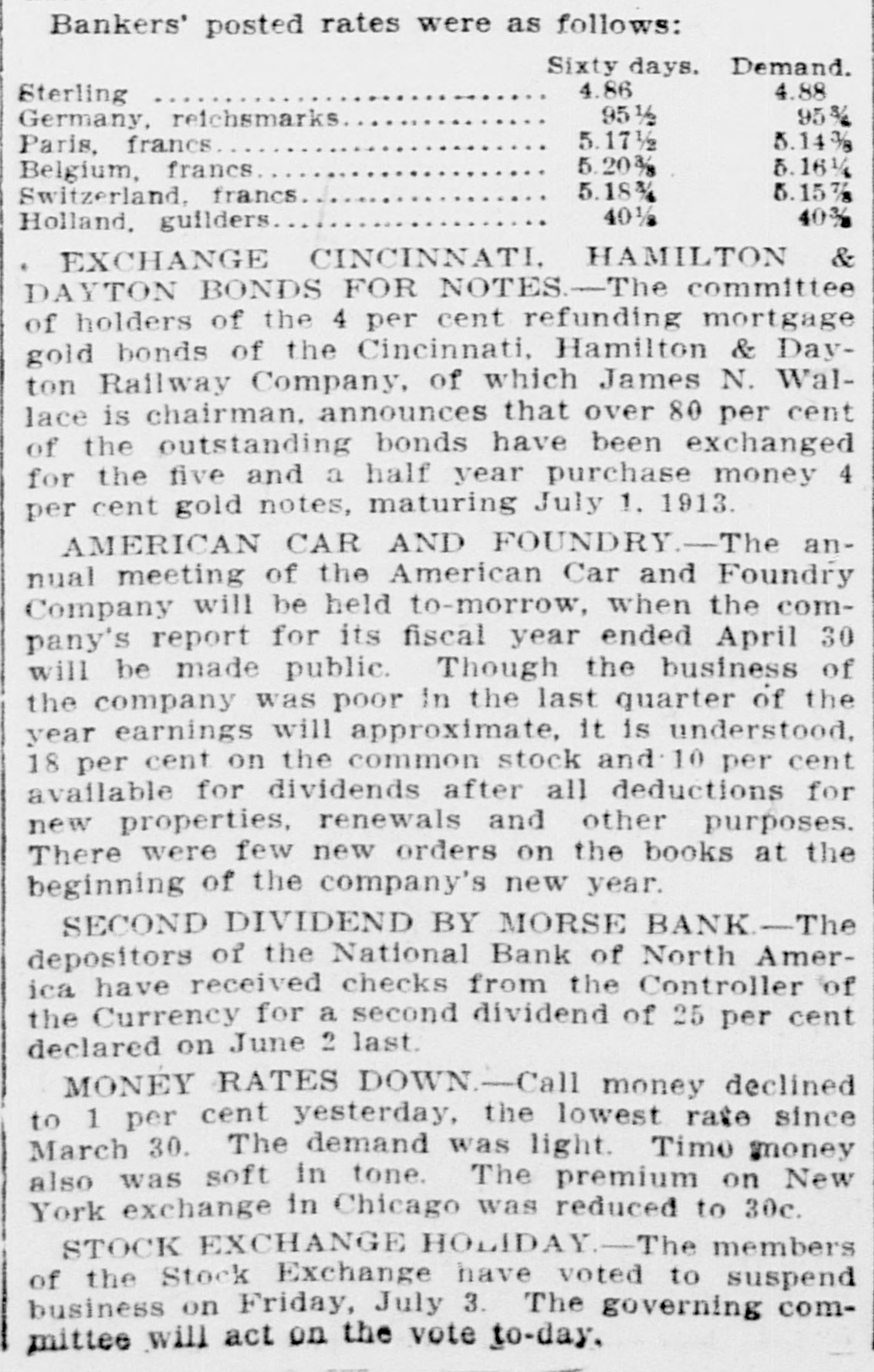
Bankers' posted rates were as follows: Demand. Sixty days. 4.86 4.88 Sterling 95 1/2 95% Germany, reichsmarks. 5.17 1/2 5.14 % Paris, francs 5.20% 5.161/4 Belgium, francs 5.18% 5.15% Switzerland, francs 401/2 40% Holland, guilders HAMILTON & EXCHANGE CINCINNATI DAYTON BONDS FOR NOTES.-The committee of holders of the 4 per cent refunding mortgage gold bonds of the Cincinnati, Hamilton & Dayton Railway Company, of which James N. Wallace is chairman, announces that over 80 per cent of the outstanding bonds have been exchanged for the five and a half year purchase money 4 per cent gold notes, maturing July 1. 1913. AMERICAN CAR AND FOUNDRY.-The - annual meeting of the American Car and Foundry Company will be held to-morrow, when the company's report for its fiscal year ended April 30 will be made public. Though the business of the company was poor in the last quarter of the year earnings will approximate, it is understood, 18 per cent on the common stock and 10 per cent available for dividends after all deductions for new properties, renewals and other purposes. There were few new orders on the books at the beginning of the company's new year. SECOND DIVIDEND BY MORSE BANK-The depositors of the National Bank of North America have received checks from the Controller of the Currency for a second dividend of 25 per cent declared on June 2 last. MONEY RATES DOWN.-Call money declined to 1 per cent yesterday, the lowest rate since March 30. The demand was light. Timo money also was soft in tone. The premium on New York exchange in Chicago was reduced to 30c. STOCK EXCHANGE HOLIDAY.-The members of the Stock Exchange have voted to suspend business on Friday, July 3. The governing committee will act on the vote to-day.


Article from New-York Tribune, August 11, 1908

Click image to open full size in new tab

Article Text

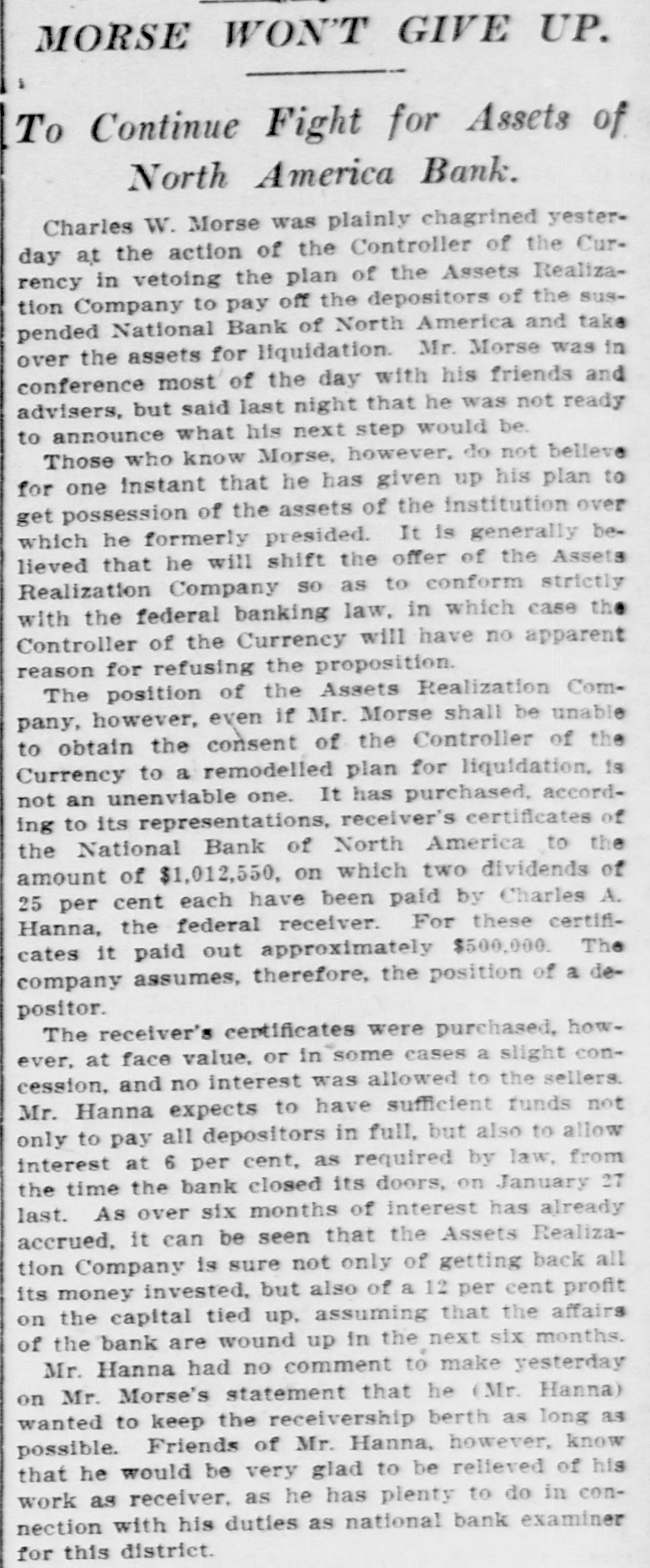
MORSE WON'T GIVE UP. To Continue Fight for Assets of North America Bank. Charles W. Morse was plainly chagrined yesterday at the action of the Controller of the Currency in vetoing the plan of the Assets Realization Company to pay off the depositors of the suspended National Bank of North America and take over the assets for liquidation. Mr. Morse was in conference most of the day with his friends and advisers, but said last night that he was not ready to announce what his next step would be. Those who know Morse, however, do not believe for one instant that he has given up his plan to get possession of the assets of the institution over which he formerly presided. It is generally believed that he will shift the offer of the Assets Realization Company so as to conform strictly with the federal banking law, in which case the Controller of the Currency will have no apparent reason for refusing the proposition. The position of the Assets Realization Company, however, even if Mr. Morse shall be unable to obtain the consent of the Controller of the Currency to a remodelled plan for liquidation. is not an unenviable one. It has purchased, according to its representations, receiver's certificates of the National Bank of North America to the amount of $1,012,550. on which two dividends of 25 per cent each have been paid by Charles A. Hanna, the federal receiver. For these certificates it paid out approximately $500,000. The company assumes, therefore, the position of a depositor. The receiver's certificates were purchased, however, at face value. or in some cases a slight concession, and no interest was allowed to the sellers. Mr. Hanna expects to have sufficient funds not only to pay all depositors in full, but also to allow interest at 6 per cent, as required by law, from the time the bank closed its doors, on January 27 last. As over six months of interest has already accrued, it can be seen that the Assets Realization Company is sure not only of getting back all its money invested, but also of a 12 per cent profit on the capital tied up, assuming that the affairs of the bank are wound up in the next six months. Mr. Hanna had no comment to make yesterday on Mr. Morse's statement that he (Mr. Hanna) wanted to keep the receivership berth as long as possible. Friends of Mr. Hanna, however, know that he would be very glad to be relieved of his work as receiver, as he has plenty to do in connection with his duties as national bank examiner for this district.


Article from The Detroit Times, September 16, 1908

Click image to open full size in new tab

Article Text

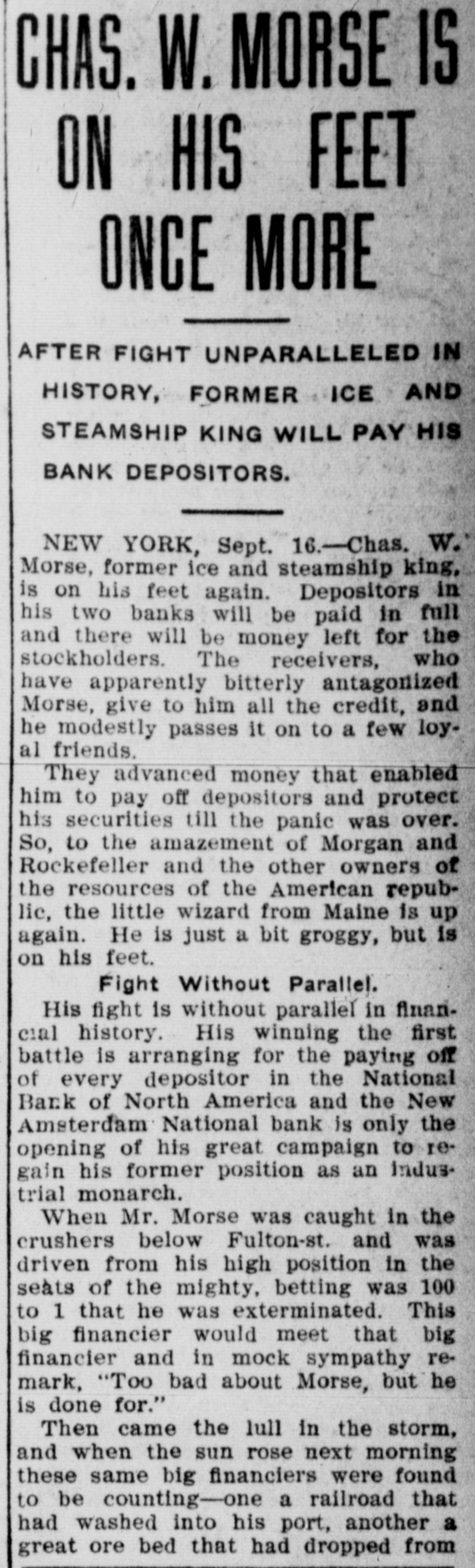
CHAS. W. MORSE IS ON HIS FEET ONCE MORE AFTER FIGHT UNPARALLELED IN HISTORY, FORMER ICE AND STEAMSHIP KING WILL PAY HIS BANK DEPOSITORS. NEW YORK, Sept. 16.-Chas. W. Morse, former ice and steamship king, is on his feet again. Depositors in his two banks will be paid in full and there will be money left for the stockholders. The receivers, who have apparently bitterly antagonized Morse, give to him all the credit, and he modestly passes it on to a few loyal friends. They advanced money that enabled him to pay off depositors and protect his securities till the panic was over. So, to the amazement of Morgan and Rockefeller and the other owners of the resources of the American republic, the little wizard from Maine is up again. He is just a bit groggy, but is on his feet. Fight Without Parallel. His fight is without parallel in financial history. His winning the first battle is arranging for the paying off of every depositor in the National Bank of North America and the New Amsterdam National bank is only the opening of his great campaign to regain his former position as an industrial monarch. When Mr. Morse was caught in the crushers below Fulton-st. and was driven from his high position in the seats of the mighty, betting was 100 to 1 that he was exterminated. This big financier would meet that big financier and in mock sympathy remark, "Too bad about Morse, but he is done for." Then came the lull in the storm, and when the sun rose next morning these same big financiers were found to be counting-one a railroad that had washed into his port, another a great ore bed that had dropped from


Article from Albuquerque Morning Journal, September 16, 1908

Click image to open full size in new tab

Article Text

MORSE BANK EMERGES FROM BANKRUPTCY Final Dividend Paid Depositors of North American National. New York, Sept. 15.-Following receipt of advices from Washington that the comptroller of the currency has authorized payment of the fourth and final dividend of 25 per cent to the depositors of the suspended National Bank of North America, Receiver Charles A. Hanna today announced that checks would be ready for depositors on Friday. This means the early turning over of the bank to the stockholders and final arrangements for that process, it is expected will be perfected at a conference on Wednesday between Receiver Hanna. Comptroller of the Currency Murray and Charles W. Morse, formerly vice president of and still the largest stockholder in the bank. Mr. Morse has been active ever since the bank suspended eight months ago, in raising the funds to rehabilitate the institution. That Mr. Morse will again take contro of the bank is assumed here.


Article from Albuquerque Morning Journal, September 16, 1908

Click image to open full size in new tab

Article Text

I MORSE BANK EMERGES 8 FROM BANKRUPTCY 0 Final Dividend Paid Depositors of North American National. New York, Sept. 15.-Following receipt of advices from Washington that the comptroller of the currency has authorized payment of the fourth and final dividend of 25 per cent to the depositors of the suspended National Bank of North America, Receiver Charles A. Hanna today announced that checks would be ready for depositors on Friday. This means the early turning over of the bank to the stockholders and final arrangements for that process, it is expected will be perfected at a conference on Wednesday between Receiver Hanna, Comptroller of the Currency Murray and Charles W. Morse, formerly vice president of and still the largest stockholder in the bank Mr. Morse has been active ever since the bank suspended eight months ago, in raising the funds to rehabilitate the Institution. That Mr. Morse will again take contro of the bank Is assumed here.


Article from New-York Tribune, October 8, 1908

Click image to open full size in new tab

Article Text

Financial Meetings. TOTICE IS HEREBY GIVEN TO THE SHAREHOLDers of The National Bank of North America, in the City of New York, that a meeting of the stockholders will be held at the office of Charles A. Hanna, Receiver, 43 Exchange Place. New York City, on the 21st day of October at 10 o'clock A. M., for the purpose of electing an Agent to whom the assets of the Bank will be transferred and delivered, in accordance with the provisions of Section 3 of the Act of Congress, entitled, An Act Authorizing the Appointment of Receivers of National Banks and for Other Purposes, approved June 30, 1876, and an Act amendatory thereto, approved August 3. 1892, and March 2. 1897: or for the purpose of continuing the Receivership in accordance with the provisions of the last named Act. LAWRENCE O. MURRAY, Comptroller of the Currency. Sept. 18, 1908


Article from New-York Tribune, October 21, 1908

Click image to open full size in new tab

Article Text

PLANS FOR BANK OF NORTH AMERICA. Stockholders Hope to Avoid LiquidationAssets Turned Over To-day. A general meeting of the stockholders of the National Bank of North America has been called for to-day by the Controller of the Currency, L. O. Murray. At this meeting Receiver Charles A. Hanna will turn over to the stockholders the assets of the bank. Informal conferences have been going on recently among the stockholders to determine whether the bank shall be placed in liquidation or resume business. A decision in the matter is expected to be reached at to-day's meeting. Colonel Robert M. Thompson said the other day that several of the stockholders, including himself, Charles M. Schwab, William F. Havemeyer, John W. Gates, John H. Flagler, Henry P. Booth, John F. Carroll and Morgan J. O'Brien, were trying to form some practical plan under which the bank might resume business, instead of going into liquidation. It was said yesterday that in the event of the institution being liquidated the stockholders might get as much as $150 a share for their holdings.


Article from Daily Kennebec Journal, October 22, 1908

Click image to open full size in new tab

Article Text

AGENT APPOINTED To Handle Affairs of National Bank Of North America. New York, Oct. 21.-In an effort to settle the affairs of the National Bank of North America, one of the Morse financial institutions which suspended at the time of the recent panic, John W. McKinnon of Chicago today was elected as agent by the shareholders of the institution. All depositors having been repaid, the remaining assets of the bank will now be turned over to Mr. McKinnon. A meeting will be held soon to decide whether the institution shall liquidated or re-organized and resume business. Minority stockholders of the bank today chose Joseph H. King of Hartford. A. W. Damon of Springfield, Mass., and Frederick R. Eaton of New York a committee to consult with the directors as to the advisability of the bank's resumption. Eugene P. Carver, attorney for Mr. Morse and also representing the Assets Realization Co., of which Mr. McKinnon is president. said after the meeting of the stockholders that the Assets Realization Co. hoped that a re-organization of the bank could be effected and the company would in no way interfere with any such a plan. This also is the desire of Mr. Morse.


Article from The Daily Democrat, October 24, 1908

Click image to open full size in new tab

Article Text

"Ice King" Morse Wins Back Old Power long. Every resource was gone, and he had apparently no place to turn for aid. He took a little office at No. 1 Nassau street. Time after time he put before the comptroller of the cur rency one plan or another looking to the rehabilitation of his institution, FORTUNE but every one was turned down. Then he began paying up the claims ALL STREET gasped the other against the bank. Where the money V day at the news that "Ice King" came from was not revealed, but all Charles W. Morse, hurled from his claims were sought out and settled. place of power in the money market Now the receiver has been in. by the collapse of his string of allied structed by Comptroller Murray to banks, and defeated in several efforts take the final steps necessary to to regain his old prestige and power, turning over the big bank to Morse had finally won his long fight. He will He will give a $500,000 bond for the have even greater sway in the world bank's contingent liabilities. He has of bank-notes than he possessed bealready bought back from the receivfore his overthrow. er, at book prices, the various loads How he has won his old place back, of securities he had sold to the bank nobody seems to know positively. His in its palmy days at figures that National Bank of North America was have been the subject of more or less the keystone institution of a great difference of opinion since the smash. chain of banks. The central bank exerted a ruling influence over the The new conditions will place chain-and C. W. Morse was the cenMorse once more in his old commandtral bank. He ran it as though it ing position on 'Change, and make him as before a dictator in the same were an indep endent corner grocery Wall street which applauded his utter with nobody to consult about anything that was to be done. defeat when his bank was closed by Then came the crash. The Nathe clearing house banks seven months tional Bank of North America went ago. In seven months he has whipped to pieces, and Morse was hurled head- fate.


Article from The Chanute Times, October 30, 1908

Click image to open full size in new tab

Article Text

To Reorganize a Morse Bank. New York, Oct. 23.-In an effort finally to settle the affairs of the Na. tional Bank of North America, one of the Morse financial institutions which suspended at the time of the recent panic, John W. McKinnon of Chicago was Wednesday elected as agent by the shareholders of the institution. All depositors having been repaid the remaining assets of the bank now will be turned over to Mr. McKinnon.


Article from The Montgomery Advertiser, November 5, 1908

Click image to open full size in new tab

Article Text

MORSE CASE WITH JURY. Five Hours of Deliberation and No Verdict. New York, Nov. -The cases of Charles W. Morse and Alfred H. Curtis, jointly indicted and on trial in the United States court here for violation of the banking law in connection with the suspension of the National Bank of North America, were given to the jury this afternoon and tonight the


Article from The San Francisco Call, November 5, 1908

Click image to open full size in new tab

Article Text

CASE OF BANKERS IS GIVEN TO JURY Fate of Charles W. Morse and Alfred H. Curtis in Hands of Talesmen NEW YORK, Nov. 4.-The cases of Charles W. Morse and Alfred H. Curtis, jointly indicted and on trial in the United States court here for violation of the banking laws in connection with the suspension of the National Bank of North America, were given to the jury today and tonight the fate of the two defendants was still undecided. At 8:30 o'clock the jury in whose hands the case had been placed five and a half hours earlier retired for the night, going to their hotel and suspending their deliberations. Before leaving the case to the jury Judge Hough outlined the evidence and gave the 12 men his final instructions. The vital question for the jury to decide, he said, was who owned the stock used as collateral on the Whitney loan. If the stock was the property of the bank it should have been included in the reports to the comptroller. If, on the other hand, Morse owned the stock, then the charge of misappropriation of the bank's money must be dismissed, as must also that of conspiracy. Judge Hough prefaced his charge with a criticism of the practices of certain journals of printing articles commenting upon certain phases of public trials outside of the evidence submitted. It was to protect the jury against the influence such publications might have on them that the jury was kept in confinement. It is the duty of the court, Judge Hough declared, to point out that one of the plainest duties of owners of public journals is to abstain, pending any trial, from statements or comments calculated to intefere with the due administration of justice. After the jury had retired at 3 p. m. Mrs. Curtis, who has been in constant attendance throughout the trial, broke down completely and had to be removed, sobbing convulsively, from the courtroom.


Article from Los Angeles Herald, November 5, 1908

Click image to open full size in new tab

Article Text

Morse Jury Still Out NEW YORK, Nov. 4.-The cases of Charles W. Morse and Alfred H. Curtis, jpintly indicted and on trial in the United States court here for violation of the banking laws, in connection with the suspension of the National Bank of North America, were given to the jury today, and the fate of the two defendants was still undecided at a late hour.


Article from The Morning Journal-Courier, November 6, 1908

Click image to open full size in new tab

Article Text

MORSE GUILTY; GOES TO JAIL (Continued from First Page.) of all the financial operations in which he and Morse were associated This fact. coupled with the plea for elemency made by the jury might, he thought, obtain for him a suspended sentence. The career of Charles W. Morse was among the sensational developments of modern American finance. Rising from successful operations in the ice business, Morse soon acquired a reputation for company promoting and trust organizing. At the time of his gaining control of the Bank of North America he had already acquired control of a number of local and out of town banks which became known in the financial world as the Morse chain of banks. AC the height of his fame, he was director in twenty-six corporations and banks. Two of his most famous exploits were engineering the formation of the American Ice company and the consolidation of several coastwise lines of steamships Up to the time of the suspension of the National Bank of North Amertea possibly no man in the banking world was held in higher regard by his associates in the field of finance than Alfred H. Curtis. One of the witnesses during the trial testified to the effect that "Curtis could not tell an untruth if he wanted to." His career in the field of banking began at sixteen when he entered the office of a Wall street broker. leaving soon afterwards to accept a clerkship in the bank of the State of New York. It was in this institution that he formed the acquaintance of Morse, Curtis had risen through every grade until he occupied the position of cashier At the time President Edwards of the Bank of the State of New York had differed with Morse on certan matters connected with the conduct of the bank and had taken advantage of his absence in Europe to depose him as director. Upon his return from abroad, Morse acquired control of the stock of the bank and ousted Edwards. It was in looking about for some one to fill his place that he chanced on Curtis. Curtis was made president and later, when the Bank of North America was merged with the Bank of the State of New York, his title and office was continued over the consolidated institutions.


Article from Barbour County Index, January 13, 1909

Click image to open full size in new tab

Article Text

Texas saving bank, placed in receiver's hands. 18-John R. Walsh, president Chicago National bank and several railroads, convicted of misappropriating institution's funds. 21-Capital State Bank, Boise, Idaho, suspended. 22-Traders and Mechanics' Bank, Pittsburg, Pa., closed doors. 25-National Bank of North America, New York, closed for liquidation, by order of government. 29-New Amsterdam National bank, capital $1,000,000, and Mechanics and Traders' bank, both of New York, taken in charge by comptroller of currency. 31-Oriental Bank of New York closed doors, following run. Feb. 13-W. B. Ridgely, comptroller of currency, accepted presidency of reorganized National Bank of Commerce, Kansas City, Mo. 26-International and Great Northern Railroad Co., a Gould line, placed in receivers' hands. 27-Financiers E. R. Thomas and O. F. Thomas indicted on charge of mismanagement of funds of Provident Savings Life Assurance society. Mar. 13-John R. Walsh denied new tr:al; sentenced to five years in federal prison. 16-People's National bank, Aspin, Col., closed. Apr. 1-Pike County Bank and Trust Co., Macomb City, Miss., placed in receiver's hands. 21-Bank of Wauseon, Wauseon, O., closed doors. 24-T. A. McIntyre & Co., with houses in many cities, failed for $1,000,000. May 8-Euclid Avenue Trust Co., Cleveland, O., assigned. 14-Reserve Trust Co., and American Savings bank, Cleveland, O., closed their doors. 28-G. W. MacMillen & Co., Pittsburg, Pa., stockbrokers, failed; liabilities, $1,800,000. Jun. 3-Kosciusko Company bank, Warsaw, Ind., closed by state auditor. 23-Citizens' bank, Dover, Ky., closed doors. Jul. 14-National Deposit bank, Philadelphia, Pa., closed by comptroller of currency. 17-Farmers and Merchants' Banking Co., Cleveland, O., failed. 22-Standard on $29,240,000 fine decision unanimously reversed by United States court of appeals at Chicago. Aug. 6-First National bank, Belle Plaine, Minn., closed by order comptroller of currency; bank was insolvent: President J. G. Lund committed suicide. 25-A. O. Brown & Co., one of largest New York brokerage firms, failed; liabilities over $1,000,000. Sep. 10-A. Booth & Co., largest fish house in country, forced into receiver's hands. Oct. 16-Union National bank, Sommerville, Pa., closed by government. Nov. 5-Charles W. Morse and Alfred H. Curtis, great financiers, found guilty of misapplication of funds and falsifying books of National Bank of America, New York. 6-C. W. Morse sentenced to 15 years; Curtis given liberty on suspended sentence. 23-Eldred bank of Eldred, Pa., suspended; capital stock, $100,000. Dec. 7-National exchange bank at Springfield, Mo., closed: excitement caused by effort of W. O. Oldham, cashier of State Savings bank, to shoot President H. B. McDaniel, of Union National bank. 11-Springport, Mich., State Savings bank closed by bank examiner. 16-Somersworth, N. H., First National bank closed. following discovery of shortage of $85,000. 23-Thomas F. Ryan announced retirement from finance. 26-Henry W. Poor, New York broker, assigned for creditors.