Accommodated withdrawals, Borrowed from banks or large institutions, Public signal of financial health, Capital injected, Full suspension, Books examined
Description
Articles describe heavy withdrawals/debit balances and runs following the collapse of Heinze's United Copper corner (mid-Oct 1907), a posted bulletin saying the bank would 'suspend for the time being,' clearing house assistance and director resignations, and later references that the Mercantile failed in the Panic of 1907. Sequence: run/withdrawals → temporary suspension actions and clearing-house support → ultimately the bank failed/was placed in receivership. Cause of the initial run/suspension was bank-specific adverse information tied to F. Augustus Heinze and related broker/bank failures. Clearing house banks pledged funds to support the Mercantile; indictments and later references confirm the bank did not survive long-term independence.
Events (5)
1.April 27, 1865Chartered
Source
historical_nic
2.October 17, 1907Suspension
Cause
Bank Specific Adverse Info
Cause Details
Bank posted notice of suspension citing 'unsolid conditions and rumors' and inability to secure currency after Heinze-related shocks and broker suspensions; suspension to stem withdrawals pending support.
Newspaper Excerpt
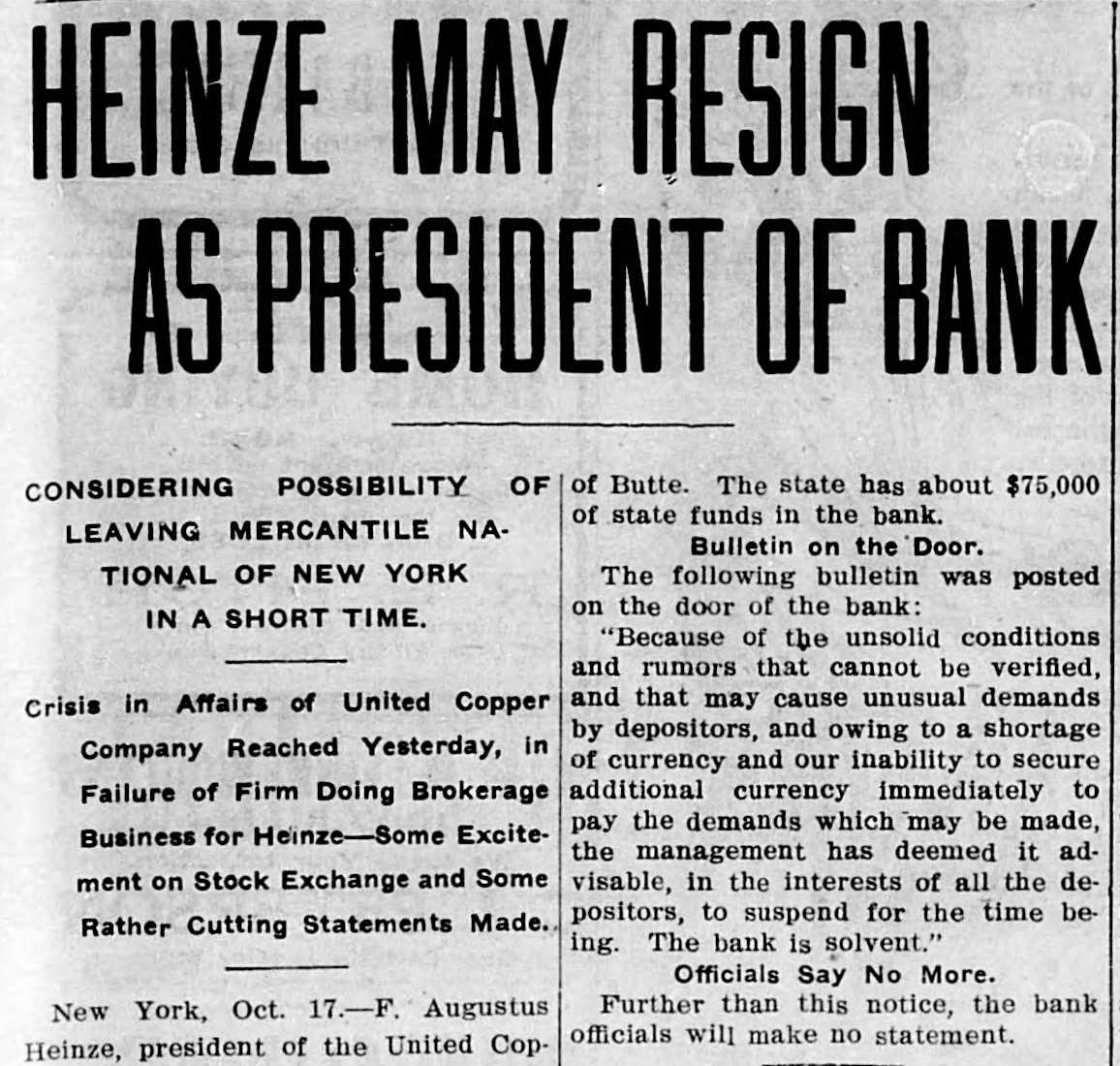
Because of the unsolid conditions and rumors ... and owing to a shortage of currency and our inability to secure additional currency immediately to pay the demands which may be made, the management has deemed it advisable ... to suspend for the time being. The bank is solvent.
Source
newspapers
3.October 18, 1907Run
Cause
Bank Specific Adverse Info
Cause Details
Heavy withdrawals and loss of confidence triggered by the collapse of the Heinze United Copper corner and suspension of Otto Heinze & Co., and association of F. Augustus Heinze with the bank.
Measures
Clearing house examination and pledge of support by nine clearing-house banks (pledges of $200,000 each; later broader $10,000,000 fund); director resignations and replacement of Heinze (Ridgely/Milliken involvement).
Newspaper Excerpt
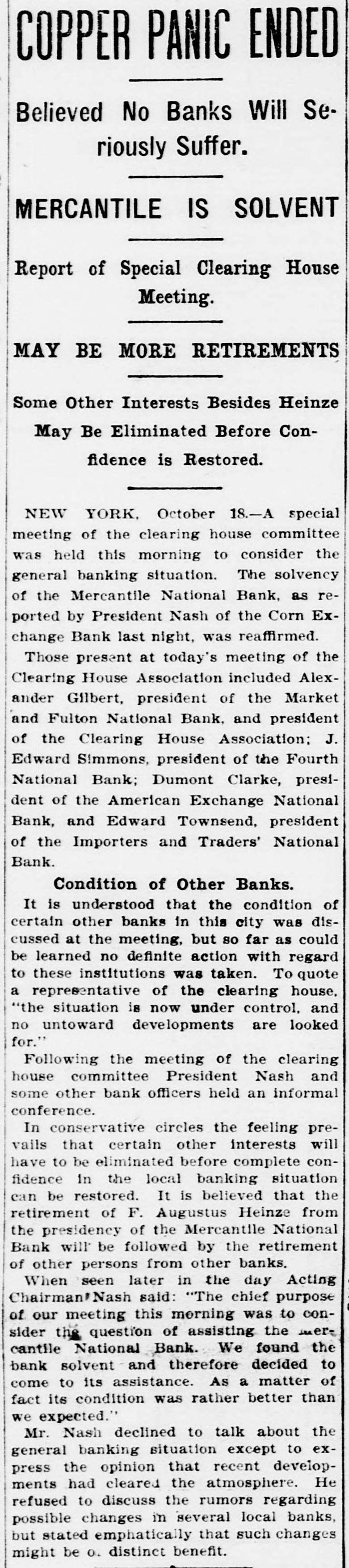
MERCANTILE IS SOLVENT Report of Special Clearing House Meeting...we found the bank solvent and therefore decided to come to its assistance.
Source
newspapers
4.June 19, 1912Voluntary Liquidation
Source
historical_nic
5.*Receivership
Newspaper Excerpt
investigation into the affairs of the Mercantile National bank, which failed during the panic of 1907, will be gone into and F. Augustus Heinze's transactions will be cleared up.
HEINZE MAY RESIGN AS PRESIDENT OF BANK of Butte. The state has about $75,000 CONSIDERING POSSIBILITY OF of state funds in the bank. LEAVING MERCANTILE NABulletin on the Door. TIONAL OF NEW YORK The following bulletin was posted on the door of the bank: IN A SHORT TIME. "Because of the unsolid conditions and rumors that cannot be verified, and that may cause unusual demands Crisis in Affairs of United Copper by depositors, and owing to a shortage Company Reached Yesterday, in of currency and our inability to secure additional currency immediately to Failure of Firm Doing Brokerage pay the demands which may be made, Business for Heinze-Some Excitethe management has deemed it adment on Stock Exchange and Some visable, in the interests of all the depositors, to suspend for the time beRather Cutting Statements Made. ing. The bank is solvent." Officials Say No More. Further than this notice, the bank New York, Oct. 17.-F. Augustus officials will make no statement. Heinze, president of the United Cop-
2.October 18, 1907Evening StarWashington, DC
Click image to open full size in new tab
Article Text
COPPER PANIC ENDED Believed No Banks Will Seriously Suffer. MERCANTILE IS SOLVENT Report of Special Clearing House Meeting. MAY BE MORE RETIREMENTS Some Other Interests Besides Heinze May Be Eliminated Before Confidence is Restored. NEW YORK, October 18.-A special meeting of the clearing house committee was held this morning to consider the general banking situation. The solvency of the Mercantile National Bank, as reported by President Nash of the Corn Exchange Bank last night, was reaffirmed. Those present at today's meeting of the Clearing House Association included Alexander Gilbert, president of the Market and Fulton National Bank, and president of the Clearing House Association; J. Edward Simmons, president of the Fourth National Bank; Dumont Clarke, president of the American Exchange National Bank, and Edward Townsend, president of the Importers and Traders' National Bank. Condition of Other Banks. It is understood that the condition of certain other banks in this city was discussed at the meeting, but so far as could be learned no definite action with regard to these institutions was taken. To quote a representative of the clearing house. "the situation is now under control, and no untoward developments are looked for." Following the meeting of the clearing house committee President Nash and some other bank officers held an informal conference. In conservative circles the feeling prevails that certain other interests will have to be eliminated before complete confidence in the local banking situation can be restored. It is believed that the retirement of F. Augustus Heinze from the presidency of the Mercantile National Bank will be followed by the retirement of other persons from other banks. When seen later in the day Acting ChairmantNash said: "The chief purpose of our meeting this morning was to consider the question of assisting the were cantile National Bank. We found the bank solvent and therefore decided to come to its assistance. As a matter of fact its condition was rather better than we expected." Mr. Nash declined to talk about the general banking situation except to express the opinion that recent developments had cleared the atmosphere. He refused to discuss the rumors regarding possible changes in several local banks, but stated emphatically that such changes might be O. distinct benefit.
3.October 18, 1907The Pacific Commercial AdvertiserHonolulu, HI
Click image to open full size in new tab
Article Text
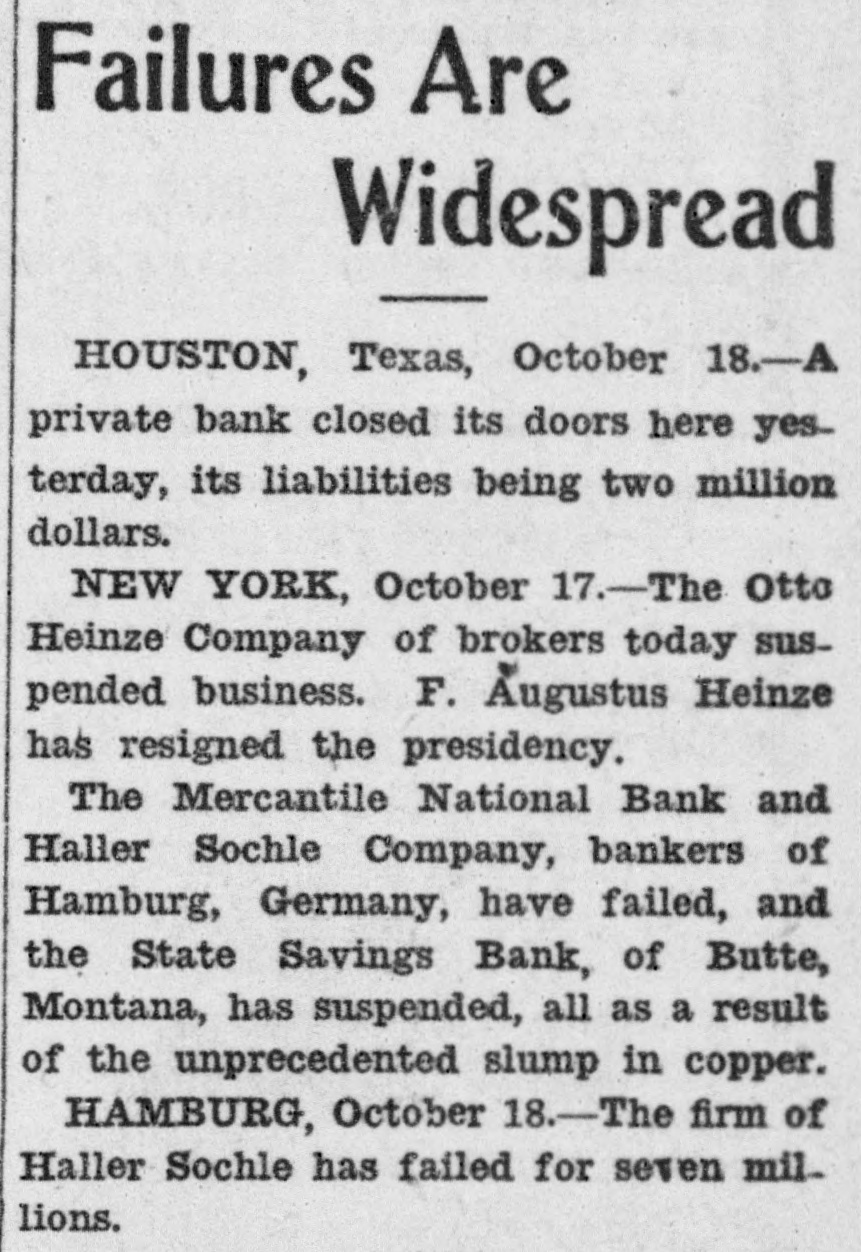
Failures Are Widespread HOUSTON, Texas, October 18.-A private bank closed its doors here yesterday, its liabilities being two million dollars. NEW YORK, October 17.-The Otto Heinze Company of brokers today suspended business. F. Augustus Heinze has resigned the presidency. The Mercantile National Bank and Haller Sochle Company, bankers of Hamburg, Germany, have failed, and the State Savings Bank, of Butte, Montana, has suspended, all as a result of the unprecedented slump in copper. HAMBURG, October 18.-The firm of Haller Sochle has failed for seven millions.
4.October 18, 1907Omaha Daily BeeOmaha, NE
Click image to open full size in new tab
Article Text
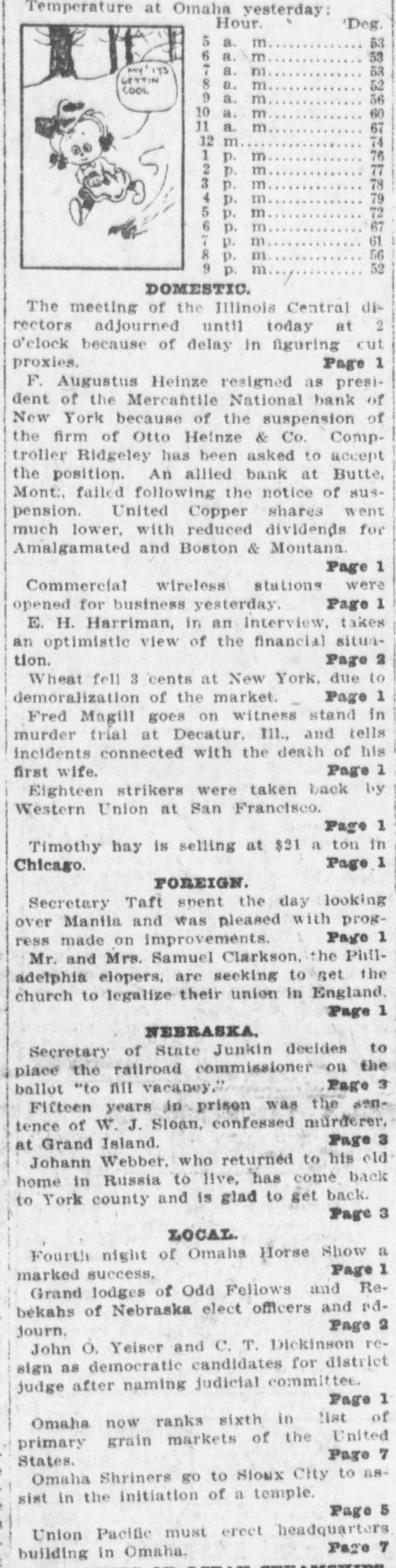
Temperature at Omaha yesterday: Hour. Deg. 5 a. m 53 6 a. m 53 MY ITS 7 a. m 53 It GETTIN 8 a. m 52 COOL 9 a. m 56 10 a. m 60 11 a. m 67 12 m 74 ao 76 1 p. m 77 2 p. m 78 3 p. m 79 4 p. m 72 5 p. m 67 6 p. m 61 7 p. m 56 8 p. m 52 9 p. m DOMESTIC. The meeting of the Illinois Central di2 rectors adjourned until today at o'clock because of delay in figuring cut proxies. Page 1 F. Augustus Heinze resigned as president of the Mercantile National bank of New York because of the suspension of the firm of Otto Heinze & Co. Comptroller Ridgeley has been asked to accept the position. An allied bank at Butte, Mont., failed following the notice of suspension. United Copper shares went much lower. with reduced dividends for Amalgamated and Boston & Montana. Page 1 Commercial wireless stations were opened for business yesterday. Page 1 E. H. Harriman, in an Interview, takes an optimistic view of the financial situation. Page 2 Wheat fell 3 cents at New York, due to demoralization of the market. Page 1 Fred Magill goes on witness stand in murder trial at Decatur. 111., and tells incidents connected with the death of his Page 1 first wife. Eighteen strikers were taken back by Western Union at San Francisco. Page 1 Timothy hay is selling at $21 a ton in Page 1 Chicago. FOREIGN. Secretary Taft spent the day looking over Manila and was pleased with progPage 1 ress made on improvements. Mr. and Mrs. Samuel Clarkson, the Philadelphia elopers, are seeking to get the church to legalize their union in England, Page 1 NEBRASKA. Secretary of State Junkin decides to place the railroad commissioner on the Page 3 ballot "to fill vacaney. Fifteen years in prison was the sentence of W. J. Sloan, confessed murderer, Page 3 at Grand Island. Johann Webber. who returned to his old home in Russia to live, has come back to York county and is glad to get back. Page 3 LOCAL. Fourth night of Omaha Horse Show a Page 1 marked success. Grand lodges of Odd Fellows and Rebekahs of Nebraska elect officers and adPage 2 journ. John O. Yeiser and C. T. Dickinson resign as democratic candidates for district judge after naming judicial committee. Page 1 Omaha now ranks sixth in list of primary grain markets of the United Page 7 States. Omaha Shriners go to Sioux City to assist in the initiation of a temple. Page 5 Union Pacific must erect headquarters Page 7 building in Omaha.
5.October 19, 1907Evening StarWashington, DC
Click image to open full size in new tab
Article Text
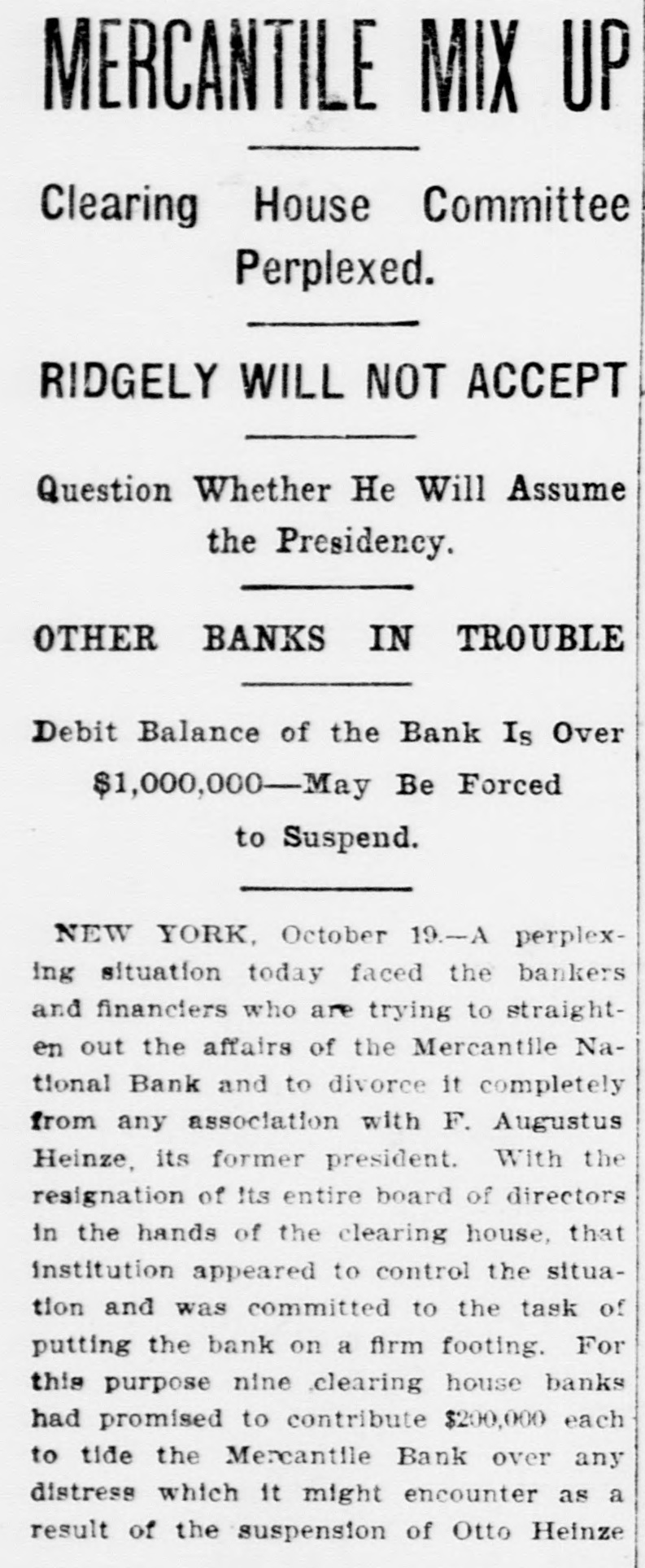
MERCANTILE MIX UP House Committee Clearing Perplexed. RIDGELY WILL NOT ACCEPT Question Whether He Will Assume the Presidency. OTHER BANKS IN TROUBLE Debit Balance of the Bank Is Over $1,000,000-May Be Forced to Suspend. NEW YORK, October 19.-A perplexing situation today faced the bankers and financiers who are trying to straighten out the affairs of the Mercantile National Bank and to divorce it completely from any association with F. Augustus Heinze, its former president. With the resignation of Its entire board of directors in the hands of the clearing house, that institution appeared to control the situation and was committed to the task of putting the bank on a firm footing. For this purpose nine .clearing house banks had promised to contribute $200,000 each to tide the Mercantile Bank over any distress which it might encounter as a result of the suspension of Otto Heinze
6.October 19, 1907Evening Times-RepublicanMarshalltown, IA
Click image to open full size in new tab
Article Text
MERCANTILE BANK FAGES DISASTER Heinze's New York Institution May Yet Be Forced to Close Its Doors if i OF $1,100,000 DEBT FACES Clearance House Committee Withdraws Further Aid-Stock Market Still Affected and Prices Close at Lowest Point of the Day-Copper and Other Stocks Affected. a New York, Oct. 19.-There was distinct lull in the financial situation in this city today, and the excitement of yesterday had materially subsided. on While the price of stocks declined e the stock exchange, the losses were not sensational. Prices of railroad been stocks were held better than had was expected. The center of interest in the situation created by develop- bank, ments in the Mercantile National the affairs of which were considered again at a meeting of the clearing official house committee. While no the statement was made at the close of meeting, several of those present that per- no mitted it to become known to the had been reached as of support of the National, except from that tile concludive continuan^ confirmed day Mercan- to day It was reported but not bank defurther assistance to the some of upon the attitude of were the pended directors whose resignations demanded yesterday. It was reported from Washington RidComptroller of the Currency of gety that today declined the presidency the Mercantile National. New York, Oct. 19.-A perplexing and situation today faced the bankers financiers who are trying to straighten Nathe affairs of the Mercantile tional out Bank and to divorce it com- F. pietely from any association with presiAugustus Heinze, its former dent. The clearing house committee weht in session this morning to com- consider its affairs. Soon after the mittee met it was reported that there to a hitch in the arrangements as was future of the Mercantile National, the the due, it was said, to the refusal on his part of Charles W. Morse and friends to consider their resignations from the directorate as permanent. The clearing house committee was .. only a short time. At the of the said the debt in Shearer conclusion sess session balance morning Manager of was the de National this and that there was no the be paid. A continuance $1,100.000 it Mercan would largely of doubt upon existence depends resources, and association is not bank's its house own the disposed unless clearing to it render further assistance shows an increased capacity to help itself. The feeling in influential be quarters is that the bank may yet compelled to go into liquidation. Heinze Says Committee is Unfair. Augustus Heinze said today: hold a controlling in the Mercantile National "I F. still bank. interest I have merparted with a share of my this I would like to say the clearing house our cantile about not stock. committee. into were asked to come and make a thorough found it bank They tion. They perfectly added examina- solvent graso. Later they a blow about the You know why pairment. and tuitious said surplus they than em- did to Nothing more or less our depositors to accounts, They were that? induce their their endeavor- withdraw own ing to as act deposits to inst.ru S ocks Sell at Low Prices. stock market opened irregular. quotations of Opening The United copper Copper propCompany stock, Heinze the were at 10, compared with price of 10 1/8 last Consolidated closing of erty, the Steamship night. Bonds Com- who controlled by C. W. Morse, the been associated with bank, started at per Mercantile pany has Heinze $1 in Fitful fluctuations in the minutes of business first share few lower. indicated points. measures of support at some stocks continued under presCopper Smelting fell 1 1/2, sure. American Copper Amalgamated Union broke Pa- 2 1/2, 8/4 higher, to a point below Reading declined cific nearly opened 1 % then last ran night. off rebounds followed, but the continued tone persisted even market ous. Violent This feverish and after spite nerv- the bank statement was issued, in of its superficially favorable character. The market closed weak at the lowest prices.
7.October 19, 1907The Marion Daily MirrorMarion, OH
Click image to open full size in new tab
Article Text
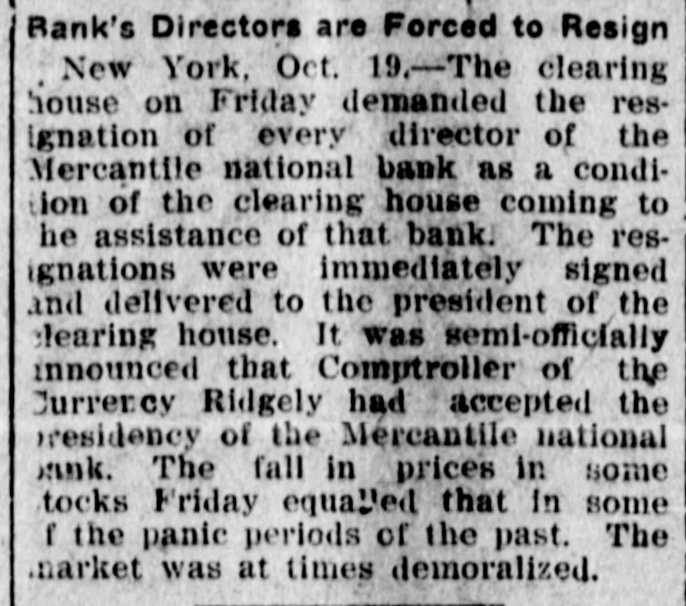
Bank's Directors are Forced to Resign New York, Oct. 19.-The clearing house on Friday demanded the resignation of every director of the Mercantile national bank as a condiion of the clearing house coming to he assistance of that bank. The resignations were immediately signed and delivered to the president of the clearing house. It was semi-officially innounced that Comptroller of the Currency Ridgely had accepted the presidency of the Mercantile national sank. The fall in prices in some tocks Friday equalled that in some f the panic periods of the past. The narket was at times demoralized.
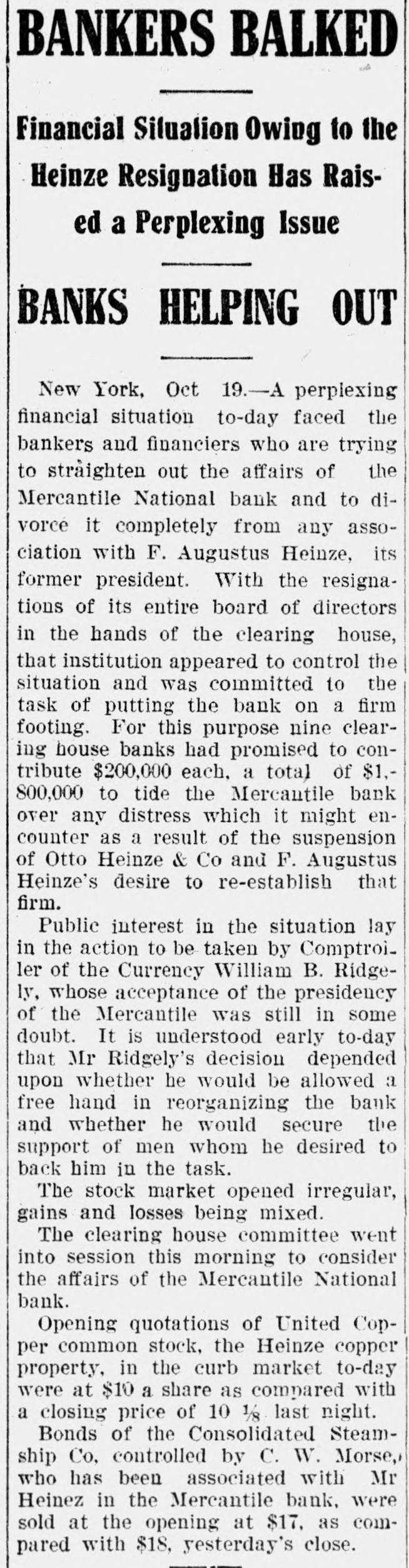
BANKERS BALKED Financial Siluation Owing to the Heinze Resignation Has Raised a Perplexing Issue BANKS HELPING OUT New York, Oct 19.-A perplexing financial situation to-day faced the bankers and financiers who are trying to straighten out the affairs of the Mercantile National bank and to divorce it completely from any association with F. Augustus Heinze, its former president. With the resignations of its entire board of directors in the hands of the clearing house, that institution appeared to control the situation and was committed to the task of putting the bank on a firm footing. For this purpose nine clearing house banks had promised to contribute $200,000 each, a total of $1,800,000 to tide the Mercautile bank over any distress which it might encounter as a result of the suspension of Otto Heinze & Co and F. Augustus Heinze's desire to re-establish that firm. Public interest in the situation lay in the action to be taken by Comptroiler of the Currency William B. Ridgely, whose acceptance of the presidency of the Mercantile was still in some doubt. It is understood early to-day that Mr Ridgely's decision depended upon whether he would be allowed a free hand in reorganizing the bank and whether he would secure the support of men whom he desired to back him in the task. The stock market opened irregular, gains and losses being mixed. The clearing house committee went into session this morning to consider the affairs of the Mercantile National bank. Opening quotations of United Copper common stock, the Heinze copper property, in the curb market to-day were at $10 a share as compared with a closing price of 10 1/8 last night. Bonds of the Consolidated Steamship Co, controlled by C. W. Morse, who has been associated with Mr Heinez in the Mercantile bank, were sold at the opening at $17, as compared with $18, yesterday's close.
9.October 19, 1907The Cairo BulletinCairo, IL
Click image to open full size in new tab
Article Text
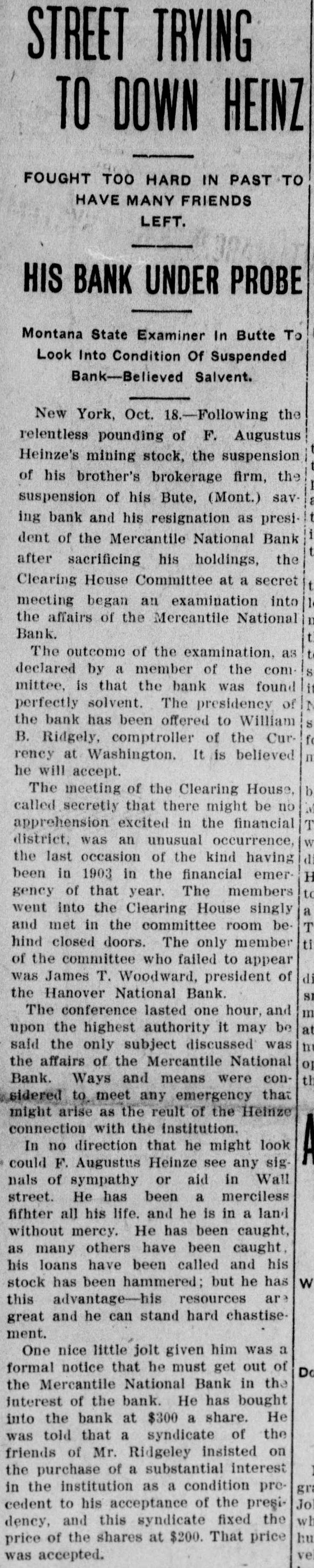
STREET TRYING TO DOWN HEINZ FOUGHT TOO HARD IN PAST TO HAVE MANY FRIENDS LEFT. HIS BANK UNDER PROBE Montana State Examiner In Butte To Look Into Condition Of Suspended Bank-Believed Salvent. New York, Oct. 18.-Following the relentless pounding of F. Augustus Heinze's mining stock, the suspension of his brother's brokerage firm, the suspension of his Bute, (Mont.) saving bank and his resignation as presi dent of the Mercantile National Bank after sacrificing his holdings, the t Clearing House Committee at a secret 1 meeting began an examination into I the affairs of the Mercantile National Bank. t t The outcome of the examination. as S declared by a member of the com i mittee, is that the bank was found I perfectly solvent. The presidency of the bank has been offered to William S f B. Ridgely, comptroller of the Cur n reney at Washington. It is believed he will accept. b The meeting of the Clearing House. a called secretly that there might be no T apprehension excited in the financial W district, was an unusual occurrence, d the last occasion of the kind having H been in 1903 in the financial emerto gency of that year. The members a went into the Clearing House singly T and met in the committee room be ti hind closed doors. The only member of the committee who failed to appear di was James T. Woodward, president of the Hanover National Bank. SI m The conference lasted one hour, and at upon the highest authority it may be In said the only subject discussed was 0) the affairs of the Mercantile National th Bank. Ways and means were considered to meet any emergency that might arise as the reult of the Heinze connection with the institution. In no direction that he might look could F. Augustus Heinze see any sig nals of sympathy or aid in Wall street. He has been a merciless fifhter all his life. and he is in a land without mercy. He has been caught, as many others have been caught, his loans have been called and his W stock has been hammered; but he has this advantage-his resources are great and he can stand hard chastisement. One nice little jolt given him was a formal notice that he must get out of Do the Mercantile National Bank in the interest of the bank. He has bought into the bank at $300 a share. He was told that a syndicate of the friends of Mr. Ridgeley insisted on the purchase of a substantial interest gra in the institution as a condition preJoi cedent to his acceptance of the presiwh dency, and this syndicate fixed the hu price of the shares at $200. That price ve was accepted.
10.October 19, 1907Deseret Evening NewsSalt Lake City, UT
Click image to open full size in new tab
Article Text
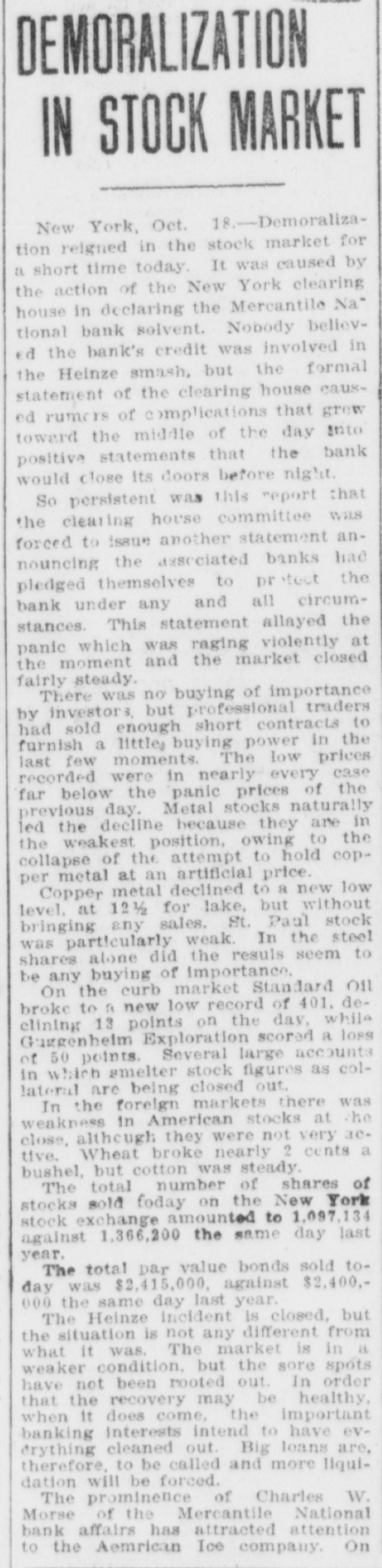
DEMORALIZATION IN STOCK MARKET New York, Oct. 18.-Demoralization reigned in the stock market for a short time today. It was caused by the action of the New York clearing house in declaring the Mercantile Na" tional bank solvent. Nobody believed the bank's credit was involved in the Heinze smash, but the formal statement of the clearing house caused rumors of complications that grew toward the middle of the day Into positive statements that the bank would close its doors before night. So persistent was this report that the clearing house committee was forced to issue another statement announcing the associated banks had pledged themselves to protect the bank under any and all circumstances. This statement allayed the panic which was raging violently at the moment and the market closed fairly steady. There was no buying of importance by investors, but professional traders had sold enough short contracts to furnish a littles buying power in the last few moments. The low prices recorded were in nearly every case far below the panic prices of the previous day. Metal stocks naturally led the decline because they are in the weakest position, owing to the collapse of the attempt to hold copper metal at an artificial price. Copper metal declined to a new low level, at 12½ for lake, but without bringing any sales. St. Paul stock was particularly weak. In the steel shares alone did the resuls seem to be any buying of importance. On the curb market Standard Oil broke to a new low record of 401, declining 13 points on the day, while Guggenheim Exploration scored a loss of 50 points. Several large accounts in which smelter stock figures as collateral are being closed out. In the foreign markets there was weakness in American stocks at the close, although they were not very active. Wheat broke nearly 2 cents a bushel, but cotton was steady. The total number of shares of stocks sold foday on the New York stock exchange amounted to 1,097,134 against 1,366,200 the same day last year. The total Dar value bonds sold today was $2,415,000, against $2,400,000 the same day last year. The Heinze incident is closed, but the situation is not any different from what it was. The market is in a weaker condition, but the sore spots have not been rooted out. In order that the recovery may be healthy, when It does come, the important banking interests intend to have evcrything cleaned out. Big loans are, therefore. to be called and more liquidation will be forced. The prominence of Charles W. Morse of the Mercantile National bank affairs has attracted attention to the Aemrican Ice company. On
11.October 19, 1907The Topeka State JournalTopeka, KS
Click image to open full size in new tab
Article Text
Comptroller Ridgley's Acceptance of the Presidency Of the Mercantile National Had a String to It. WANTED A FREE HAND Directors Who Resigned Don't Consider Action Permanent. The Institution May Yet Be Forced Into Liquidation. Washington, Oct. 19.-Comptroller of Currency W. B. Ridgley today declined the presidency of the Mercantile National bank of New York. A perplexing situation is being' faced by the bankers and financiers, who are trying to straighten out the affairs of the Mercantile National and to divorce it completely from any association with F. Augustus Heinze, its former president. With the resignations of its entire board of directors in the hands of the clearing house, that institution appeared to control the situation and was committed to the task of putting the bank on a firm footing. For this purpose nine clearing house banks had promised to contribute $200,000 each to tide the Mercantile bank over any distress which it might encounter as a result of the suspension of Otto Heinze & Co., and it is F. Augustus Heinze's desire to reestablish that firm. Public interest in the situation lay in the action taken by Comptroller of the Currency William B. Ridgley, whose acceptance of the presidency of the Mercantile was conditional. Mr. Ridgley's decision depended upon whether he would be allowed a free or hand in reorganizing the bank whether he would secure the support of men whom he desired to back him in the task. The clearing house committee held a meeting today to consider the affairs of the Mercantile National bank. It was reported that there was a hitch in the arrangements as to the bank's future, due, it was said, to a refusal of Charles W. Morse and his friends to consider their resignations from the directorate as permanent. Debt Balance $1,100,000. The clearing house committee was in session only a short time. At the conclusion of the session Manager Shearer the clearing house said that the debit of balance of the Mercantile National bank this morning was $1,100,000. Mr. Shearer said there was no doubt that it would be paid, the greater part by the clearing house banks. One of the reporters asked Mr. Shearthe amount of the debit balance of er National Bank of North America, of the which C. W. Morse is president. Mr. Shearer replied that it was about $250,000. The continuance of the Mercantile bank's existence depends largely upon own resources. The clearing house its association, it was stated, early today e is not disposed to render further assistance unless it shows increased cato help itself. The feeling in influential pacity quarters is that the bank 1 yet be compelled to go into would liquidation, may but that the depositors i be paid in full. i Opening quotations of United Copa common stock, the Heinze copper per in the curb market today property, were at 10 as compared with a closing price of 10% last night. the stock exchange copper cont tinued On under pressure. Amalgamated t Copper broke 2½ to 441/8, thus breaking t through low price touched yesterday. n American Smelting fell 1½ under yes- half t terday's closing price in the first o hour, but did not reach the low price V yesterday. Amalgamated Copper g sold of as low as 43%. Violent rebounds fein followed, but the market continued b verish and nervous. This tone persist- in a even after the bank statement sa ed of its superficial favorable char- cash spite The heavy increase in the e t item acter. was attributed to precautionary measures by the banks. a b Stocks again declined in the final deal- the ju ings, closing weak at the lowest of St day in most of the active stocks. in The closing quotations on United Copcommon on the curb stock market tl per was 87/8 bid and 91/4 asked. Heinze Talks. to F. Augustus Henze said today: ex "T still hold a controlling interest in lv
12.October 20, 1907The Montgomery AdvertiserMontgomery, AL
Click image to open full size in new tab
Article Text
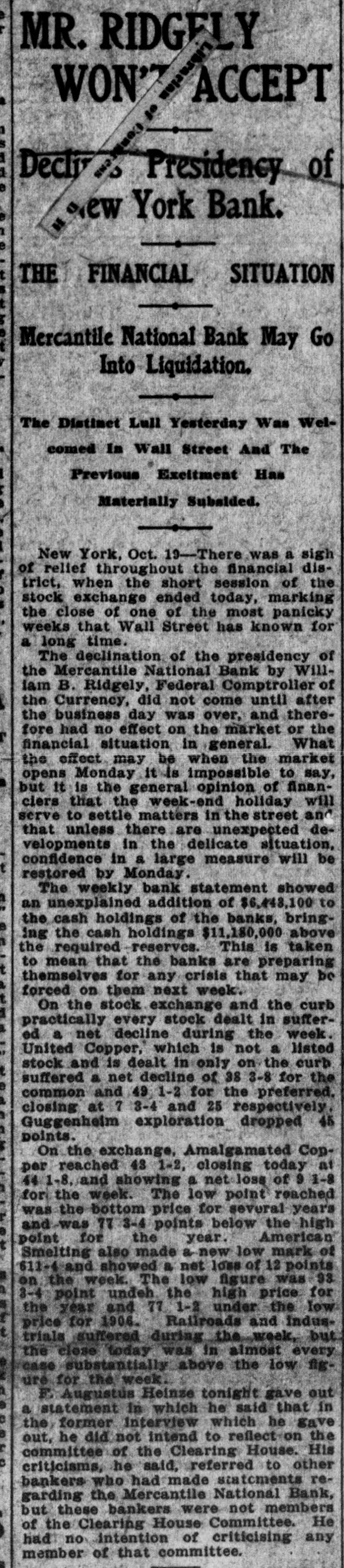
MR. RIDGELY WON'T ACCEPT Decli is Presidency of ew York Bank. THE FINANCIAL SITUATION Mercantile National Bank May Go Into Liquidation. The Distinct Lull Yesterday Was Welcomed In Wall Street And The Previous Excitment Has Materially Subsided. York, Oct. 19-There was a sigh disNew relief throughout the financial of the of when the short session marking trict, exchange ended today, panicky stock of one of the most for the weeks close that Wall Street has known a long time. of declination of the presidency by WillThe National Bank of the Mercantile Ridgely, Federal Comptroller after lam B. did not come and until therethe Currency, day was over, or the C the business no effect on the market situation in the financial may be when to say, the fore had general. market finan- What effect Monday it is impossible of opens it is the general opinion holiday will ciers that settle matters in the serve but that to the there week-end are unexpected street situation, and deunless the delicate will t velopments in in a large measure restored weekly by bank statement of $6,443,100 The addition banks, e confidence unexplained Monday. of the showed bring- above be to an cash holdings $11,180,000 the cash This is the the ing holdings reserves. preparing taken required the banks are may be themselves them next to mean that for any crisis week. that curb forced the on stock exchange stock dealt and in the sufferpractically On every decline during the week. listed ed a net Copper, which is not on the a curb stock United and is net dealt decline in only of the 38 3-8 preferred. for the closing suffered common at a and 7 3-4 exploration 1-2 and for 25 respectively. dropped 45 points. Guggenheim the exchange. Amalgameted closing today Cop- 1-8 at per On reached and showing 43 1-2, a low net point loss of roached years for 44 1-8, the the week. bottom The price for below several the high point was was 77 3-4 points year. American mark of Smelting and also showed a low net loss figure was 611-1 week. The the high price the t on 3-4 point and undeh 77 Railroads 1-2 under and indus- but and the the year for 1906. the made a new the low of weak, 12 points low for 93 case price for suffered during in almost every figfor are F. gave Heinze tonight the trials close substantially today was above the low out Augustus in a he that in said which statement he the which gave interview on to the he did not out, reflect intend His of the House. Clearing committee to he other said, referred rehad made who statements the Bank, National garding not but these members He House Clearing we Committee. of any criticising of member had the no of Intention that
13.October 21, 1907The News-DemocratProvidence, RI
Click image to open full size in new tab
Article Text
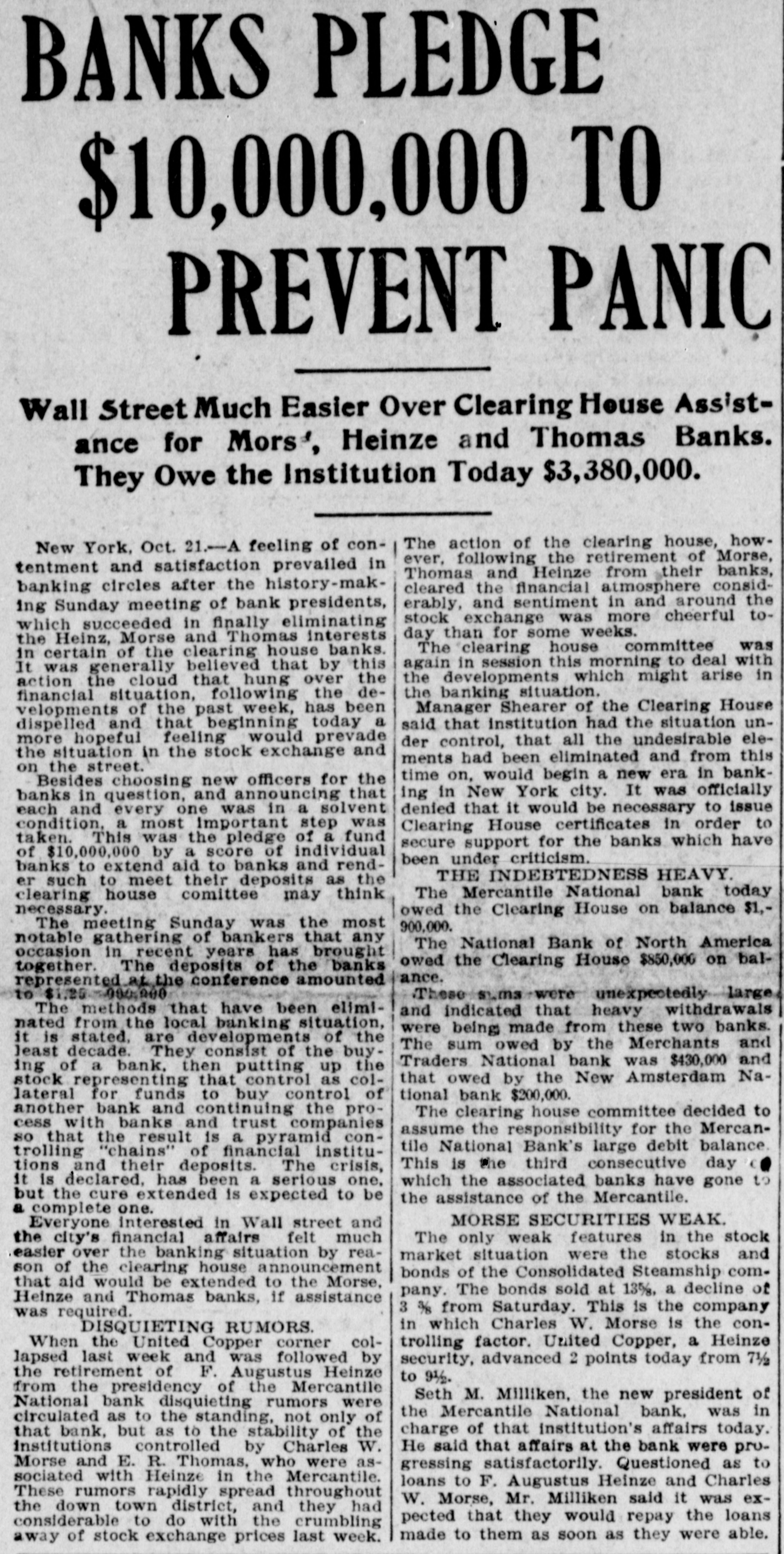
BANKS PLEDGE $10,000,000 TO PREVENT PANIC Wall Street Much Easier Over Clearing House Assistance for Mors ¹, Heinze and Thomas Banks. They Owe the Institution Today $3,380,000. The action of the clearing house, howNew York, Oct. 21.-A feeling of conever, following the retirement of Morse, tentment and satisfaction prevailed in Thomas and Heinze from their banks, banking circles after the history-makcleared the financial atmosphere considerably, and sentiment in and around the ing Sunday meeting of bank presidents, stock exchange was more cheerful towhich succeeded in finally eliminating day than for some weeks. the Heinz, Morse and Thomas interests The clearing house committee was in certain of the clearing house banks. again in session this morning to deal with It was generally believed that by this the developments which might arise in action the cloud that hung over the the banking situation. financial situation, following the deManager Shearer of the Clearing House velopments of the past week, has been said that institution had the situation undispelled and that beginning today a more hopeful feeling would prevade der control, that all the undesirable elethe situation in the stock exchange and ments had been eliminated and from this on the street. time on, would begin a new era in bankBesides choosing new officers for the ing in New York city. It was officially banks in question, and announcing that denied that it would be necessary to issue each and every one was in a solvent condition, a most important step was Clearing House certificates in order to taken. This was the pledge of a fund secure support for the banks which have of $10,000,000 by a score of individual been under criticism. banks to extend aid to banks and rendTHE INDEBTEDNESS HEAVY. er such to meet their deposits as the The Mercantile National bank today clearing house comittee may think necessary. owed the Clearing House on balance $1,The meeting Sunday was the most 900,000. notable gathering of bankers that any The National Bank of North America occasion in recent years has brought owed the Clearing House $850,000 on baltogether. The deposits of the banks ance. represented at the conference amounted to $1.20 000.000 These syms were unexpectedly large The methods that have been elimiand indicated that heavy withdrawals nated from the local banking situation, were being made from these two banks. it is stated, are developments of the The sum owed by the Merchants and least decade. They consist of the buyTraders National bank was $430,000 and ing of a bank. then putting up the stock representing that control as colthat owed by the New Amsterdam Nalateral for funds to buy control of tional bank $200,000. another bank and continuing the proThe clearing house committee decided to cess with banks and trust companies assume the responsibility for the Mercanso that the result is a pyramid contile National Bank's large debit balance. trolling "chains" of financial instituThis is the third consecutive day tions and their deposits. The crisis, it is declared, has been a serious one, which the associated banks have gone to but the cure extended is expected to be the assistance of the Mercantile. a complete one. MORSE SECURITIES WEAK. Everyone interested in Wall street and the city's financial affairs felt much The only weak features in the stock easier over the banking situation by reamarket situation were the stocks and son of the clearing house announcement bonds of the Consolidated Steamship comthat aid would be extended to the Morse, pany. The bonds sold at 13%, a decline of Heinze and Thomas banks, if assistance 3 3/8 from Saturday. This is the company was required. in which Charles W. Morse is the conDISQUIETING RUMORS. When the United Copper corner coltrolling factor. United Copper, a Heinze lapsed last week and was followed by security, advanced 2 points today from 7½ the retirement of F. Augustus Heinze to 9½. from the presidency of the Mercantile Seth M. Milliken, the new president of National bank disquieting rumors were the Mercantile National bank. was in circulated as to the standing, not only of charge of that institution's affairs today. that bank, but as to the stability of the institutions controlled by Charles W. He said that affairs at the bank were proMorse and E. R. Thomas. who were asgressing satisfactorily. Questioned as to sociated with Heinze in the Mercantile. loans to F. Augustus Heinze and Charles These rumors rapidly spread throughout W. Morse, Mr. Milliken said it was exthe down town district, and they had pected that they would repay the loans considerable to do with the crumbling made to them as soon as they were able. away of stock exchange prices last week.
14.October 21, 1907Deseret Evening NewsSalt Lake City, UT
Click image to open full size in new tab
Article Text
MERCANTILE BANK DEBIT BALANCE When Made Known. Gave Favorable Sentiment on Banking and Business Circles Setback. THE AMOUNT IS $1,900,000. Methods Eliminated from Situation of Last Decade-Acknowledged That Crisis Was Serious One. New York. Oct. 21.-The most favorable sentiment in business and banking circles resultant from yesterday's changes in various bank managements and the promises of support made by the Clearing House association received something of a setack today when it became known that the debit balance of the Mercantile National bank, at the clearing house was $1,900,000. The debit balance of the National Bank of North America was$850,000. These figures indicated that heavy withdrawals from the two banks were being made and the totals were referred to by one member of the Clearing House association as "unexpectedly large and disconcerting." It was announced in a short time. however, that the Clearing House association would extend assistance to the Mercantile and National Bank of North America. Seth M. Milliken, the newly elected president of the Mercantile National bank. said today that counting out the Heinze-Morse loans, the assets of the bank are $1.40 for every dollar of liability and that the loans in ques~ tion are of value. Stocks today opened strong and higher, all the market leaders participating in the rise. Sunday's meeting of bank prestdents succeeded in finally eliminating the Heinze, Morse and Thomas interests on certain of the clearing house banks. Besides choosing new officers for the banks in question, and announcing that each was in a solvent condition, a fund of $10,000,000 was pledged by a score of individual banks to extend aid to those banks and render such assistance to meet their depositors as the clearing house committee may think necessary The deposits of the banks represented at the Sunday conference amounted to $1,250,000,000. The men, 15 in number, every one a practical banker, decided upon the measures for eliminating the interests which have been under criticism, which measures, later in the day were carried out. The methods that have ben eliminated from the local banking situation, it is stated are a. development of the last decade. These consist of buying of a bank. then putting up the stock representing that control as collateral for funds to buy control of another bank, and continuing the process with banks and trust companies, so that the result is a pyramid controlling "chains" of financial institutions and their deposits. The crisis, it is declared. was a serious one, but the cure extended is expected to be complete. Manager Shearer, of the Clearing House, said today that that institution had the situation under control; that all the undesirable elements had been eliminated, and that from this time would begin a new era in banking in New York. It was officially denied that it would be necessary to issue clearing house certificates, in order to secure support for the banks, which have been under criticism. United Copper, a Heinze security, advanced two points today from 73/2 to 9½. Seth M. Milliken, the new president of the Mercantile National bank, questioned as to loans made to F. A. Heinze and Charles W. Morse, said it was expected that they would repay them as soon as they were able.
15.October 21, 1907The Seattle StarSeattle, WA
Click image to open full size in new tab
Article Text
MILLIKEN PRESIDENT OF MERCANTILE BANK. (By United Press.) NEW YORK, Oct. 21.Seth M. Milliken has been made president of the Mercantile National bank, to succeed F. Augustus Heinze, resigned. The bank will run under a process of slow Hquidation.
16.October 24, 1907The National TribuneWashington, DC
Click image to open full size in new tab
Article Text
NEED FOR RADICAL REFORMS. Every day's developments in the financial world brings new and stronger support to the President's attitude in insisting that business generally in this country shall be brought back to a safe and sane basis. There was imminent need of radical housecleaning in the business world when such rottenness as that which has been developed in the investigation of the traction affairs in New York remained so long undiscovered. The vigorous probing by the Public Service Commission shows that under guise of making improvements and safe investments a lot of "financiers" have made away with over $1,000,000 of other people's money in the Metropolitan Securities Company. Lawyer Ivins, who is managing the investigation, thinks that he has only made a beginning, and is now on the track of a $250,000 check for which there is no reliable accounting. Still more to the point and bearing directly upon this urgent need of business reforms are the sensational revelations regarding the operations of F. Augustus Heinze and his brothers. Heinze has been the great copper king in the West, and his operations there have been of really royal magnificence, since they involved the mustering of real armies of men, and the fighting of pitched battles for the possession of mines. The method of the Heinzes in banking has been similar to that of Mr. Harriman in railroading. After getting control of one bank they used its money and securities to get control of the stock of another bank, which they put thru the same operation, and SO on thru an endless chain. It passeth the understanding that this operation should go on as long as it has, but at last the New York Clearing House Committee called a halt and set examiners to work. Fortunately it was found that the assets of the banks which had been put thru this operation had not been seriously impaired, tho one of them, the Mercantile National Bank, a very large institution, was found to be in a highly critical situation. The other two large banks were the National Bank of North America and the New Amsterdam National Bank. The magnitude of these institutions is shown by the National Bank of North America having loans to the amount of $15,000,000 and $13,320,000 of deposits, while the New Amsterdam Bank had $4,474,000 loans and $4,945,000 deposits. The cash reserve of all these institutions had been impaired below the legal limit. All the Heinzes and their accomplices, the Thomas brothers and C. W. Morse have been compelled to withdraw from the directorate of every bank and corporation in which they were. The Mercantile National Bank is only kept from suspending by the other bankers carrying it along, which they have now done to the amount of $1,137,000. The 'expectation is to reorganize it with men at the head in whom the people can have confidence. All this salutary housecleaning is an exceedingly bitter pill for such reckless financiers, and will be a wholesome lesson to others who have emulated their "Napoleonic" ideas of finance.
17.January 8, 1908The Morning AstorianAstoria, OR
Click image to open full size in new tab
Article Text
# Federal Grand Jury Takes Action
# After Investigating Defunct Bank.
FURNISHES $50,000 BONDS
Aftermath of Collapse of Heinze Pool in United Copper and the Suspension of Mercantile National Bank Results in Indictment of Copper Magnate.
NEW YORK, Jan. 7.-Indicted by the federal grand jury for the over-certification of checks, representing in the aggregate over $400,000, drawn by the firm of Otto Heinze & Co., on the Mercantile National Bank, F. A. Heinze, copper magnate and former president of the Mercantile National Bank, surrendered himself to United States Commissioner Shields today and later was released on $50,000 bail. Heinze will be formally arraigned to plead to the indictment tomorrow. Edward Lauterback, counsel for Heinze stated tonight that his client did not wilfully overcertify the checks, as he had drawn a check to the credit of Otto Heinze & Co., for the amount of $500,000 which the bookkeeper of the bank probably failed to enter on the books until the day after the certification of the checks in question. The indictment by the federal grand jury, which has been investigating the Mercantile, and other banks identified with the Heinze and Charles W. Morse interest, is the after cause of the collapse of the Heinze pool in United Copper, which brought about the suspension of Gross & Kleeburg, stock brokers, and resulted in the resignation of F. A. Heinze from the presidency and retirement of the directorate of Mercantile National Bank, after the examination of that institution had been made by the Clearing-House. He declared at the time he had been betrayed by his friends in the United Copper pool. Heinze had been informed quietly that indictments, charging him with over-certification of 15 checks, all drawn October 14, just before the smash in United Copper, had been found by the grand jury on December 2, and that his appearance would be required today.
Without awaiting service of a bench warrant, Heinze in company with his counsel appeared before Shields this afternoon. The proceedings were short. Heinze pleaded not guilty and bail was immediately furnished by a surety company.
18.January 11, 1908Spirit of the AgeWoodstock, VT
Click image to open full size in new tab
Article Text
THURSDAY, January 9, 1908. Fred W. Elliott of Auburndale, Mass., held by Boston police on charge of being accessory after the fact of murder of Mrs. Theodore S. Whitmore of New York. Six of the necessary Thaw jurors sworn in and three more provisional members in the box; Littleton shows purpose to lay broad foundation for defence of insanity. Miss Mary McCarty murdered in vestibule of her home in Roxbury, Mass.; Michael H. Norton, a tenant, arrested. Unable to meet his notes, F. Augustus Heinze loses control of the Mercantile National bank of New York, his stock passing back to Edwin Gould; when arraigned Heinze pleads not guilty of over-certification of checks. Fowler currency bill adopted by subcommittee of house committee on banking. North German Lloyd steamship company sends passenger manager to Boston to look over the field. Bishop George Worthington dies in France. Ex-President Cleveland's letter furnishes keynote of anti-Bryan dinner of National Democratic club in New York. Ex-Insurance Commissioner Frederick L. Cutting dead at Wellesley, Mass. George Baker Glover files a petition in South Dakota asking that his mother, Mary Baker G. Eddy, be examined as to her sanity. Trial of Thomas David of Lowell, Mass., charged with wife murder, opened in Fredericton, N. B. Receivers appointed in St. Paul for the Chicago Great Western road. Striking teamsters in Brockton, Mass., reject two offers submitted by the employers. Fish and game association of Massachusetts to ask legislature for close season for one year on upland game birds.
19.February 5, 1908The Birmingham Age-HeraldBirmingham, AL
Click image to open full size in new tab
Article Text
chain banking seems to have fallen into disuse in the west. But it was revived and reappeared in New York, and at one time an audacious capitalist practically owned five national and four state banks in New York. The modus operandi, says the New York Evening Post, "was to buy shares in one bank, pledge them with another bank for a loan, use the proceeds to buy shares in yet another bank, and SO on. It was a remarkably inexpensive operation at the outset, and it was used, as might be supposed, to obtain access to the funds of such institutions to help along the personal operations of the ingenious promoters. In October, eight banks and at least two trust companies were dominated by one group of experts." The Morse-Thomas-Heinze group is referred to, and it is their peculiar method of financing that recently led to the failure of two national and two state banks, as it had during the panic swept away the Mercantile National bank and the Knickerbocker Trust. While the clearing house stood behind the banks the four mentioned banks stood secure, but as soon as cash payments to depositors were resumed they were forced to close. Confidence in them had been destroyed. The case was one of chain banking and it was well understood, and the failures of the four banks surprised no one. It was simply what all had expected. It means that there will not soon again be any chain banking in New York or elsewhere.
20.October 23, 1908The Star and Newark AdvertiserNewark, NJ
Click image to open full size in new tab
Article Text
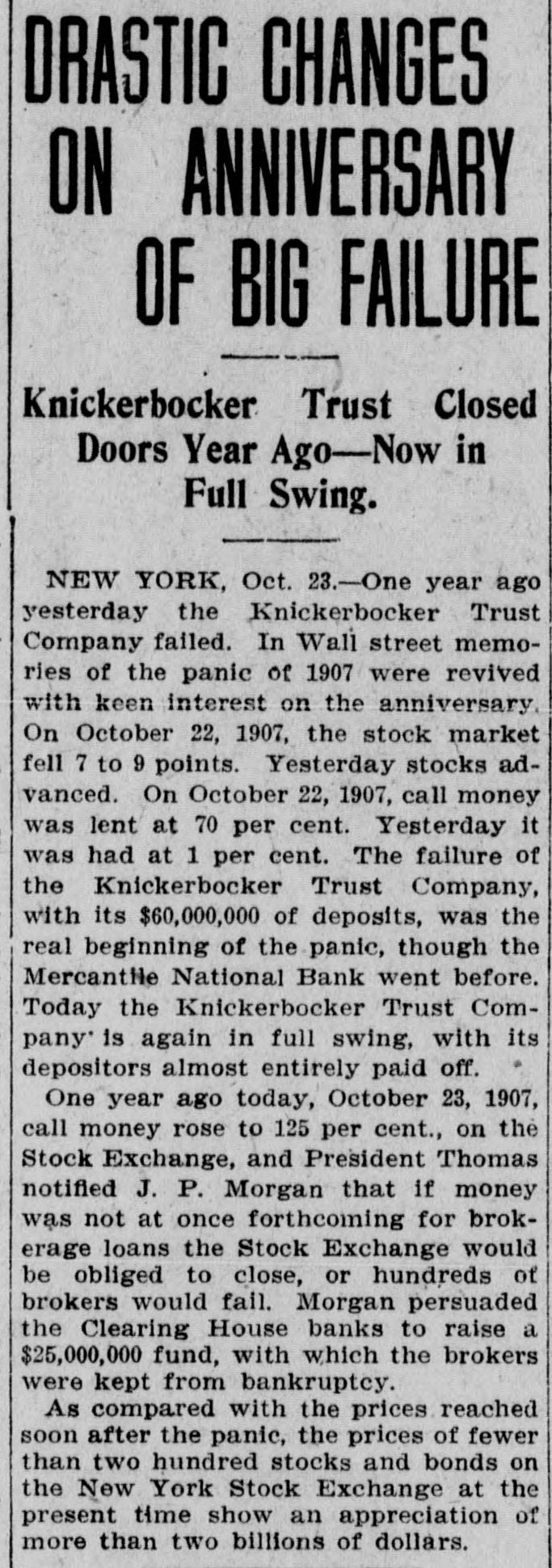
DRASTIC CHANGES ON ANNIVERSARY OF BIG FAILURE Knickerbocker Trust Closed Doors Year Ago-Now in Full Swing. NEW YORK, Oct. 23.-One year ago yesterday the Knickerbocker Trust Company failed. In Wall street memories of the panic of 1907 were revived with keen interest on the anniversary On October 22, 1907, the stock market fell 7 to 9 points. Yesterday stocks advanced. On October 22, 1907, call money was lent at 70 per cent. Yesterday it was had at 1 per cent. The failure of the Knickerbocker Trust Company, with its $60,000,000 of deposits, was the real beginning of the panic, though the Mercantile National Bank went before. Today the Knickerbocker Trust Company' is again in full swing, with its depositors almost entirely paid off. One year ago today, October 23, 1907, call money rose to 125 per cent., on the Stock Exchange, and President Thomas notified J. P. Morgan that if money was not at once forthcoming for brokerage loans the Stock Exchange would be obliged to close, or hundreds of brokers would fail. Morgan persuaded the Clearing House banks to raise a $25,000,000 fund, with which the brokers were kept from bankruptcy. As compared with the prices reached soon after the panic, the prices of fewer than two hundred stocks and bonds on the New York Stock Exchange at the present time show an appreciation of more than two billions of dollars.
21.June 5, 1909Bismarck Daily TribuneBismarck, ND
Click image to open full size in new tab
Article Text
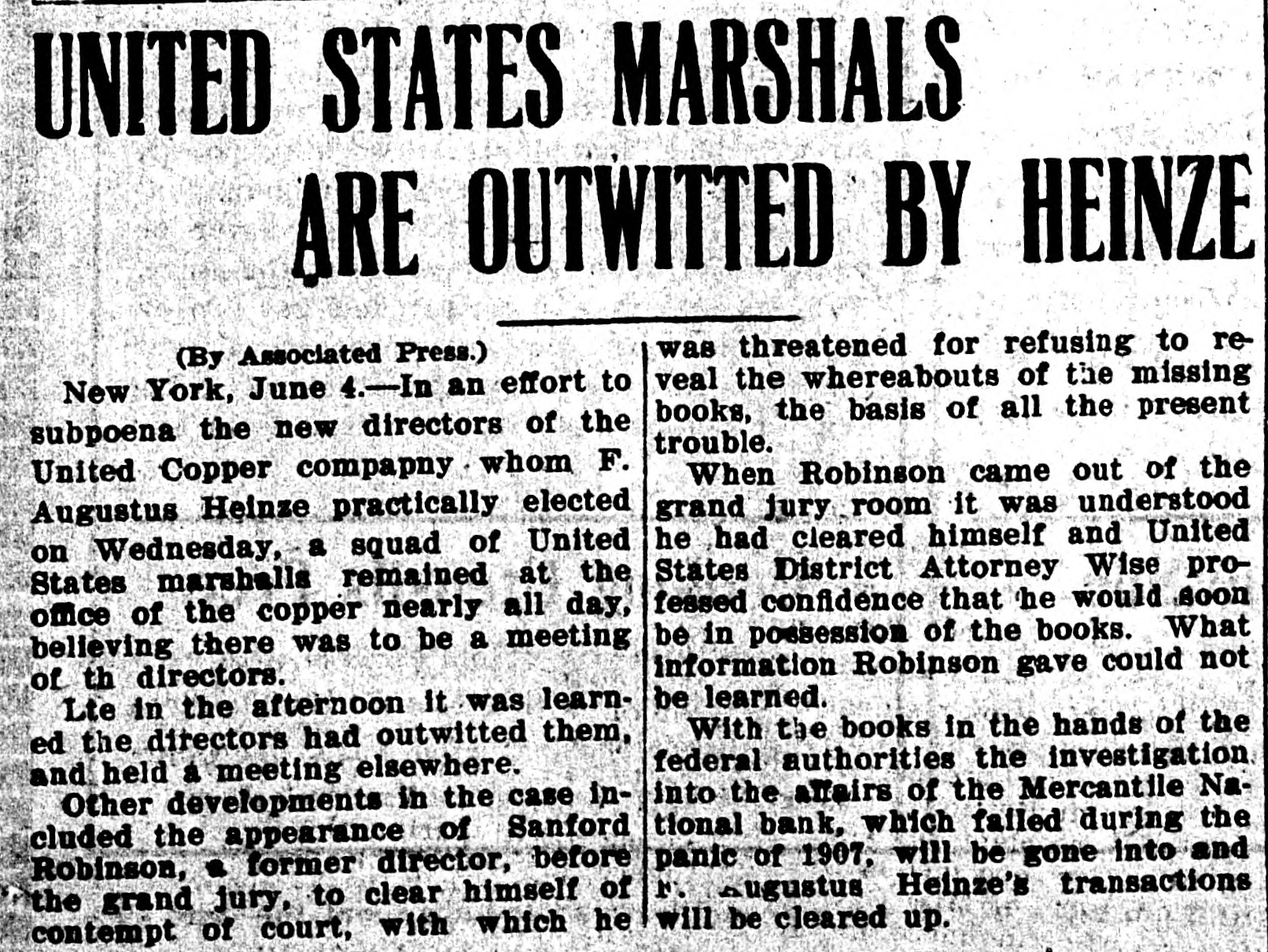
UNITED STATES MARSHALS ARE OUTWITTED BY HEINZE was threatened for refusing to re(By Associated Press.) veal the whereabouts of the missing New York, June 4.-In an effort to books, the basis of all the present subpoena the new directors of the trouble. United Copper compapny . whom F. When Robinson came out of the grand jury room it was understood Augustus Heinze practically elected he had cleared himself and United on Wednesday, a squad of United States District Attorney Wise proStates marshalls remained at the fessed confidence that he would soon office of the copper nearly all day, be in poesession of the books. What believing there was to be a meeting information Robinson gave could not of th directors. be learned. Lte in the afternoon it was learnWith the books in the hands of the ed the directors had outwitted them, federal authorities the investigation and held a meeting elsewhere. into the affairs of the Mercantile NaOther developments in the case included the appearance of Sanford tional bank, which failed during the Robinson, a former director, before panic of 1907, will be gone into and the grand jury, to clear himself of N. augustus Heinze's transactions contempt of court, with which he will be cleared up.
22.June 5, 1909The Salt Lake HeraldSalt Lake City, UT
Click image to open full size in new tab
Article Text
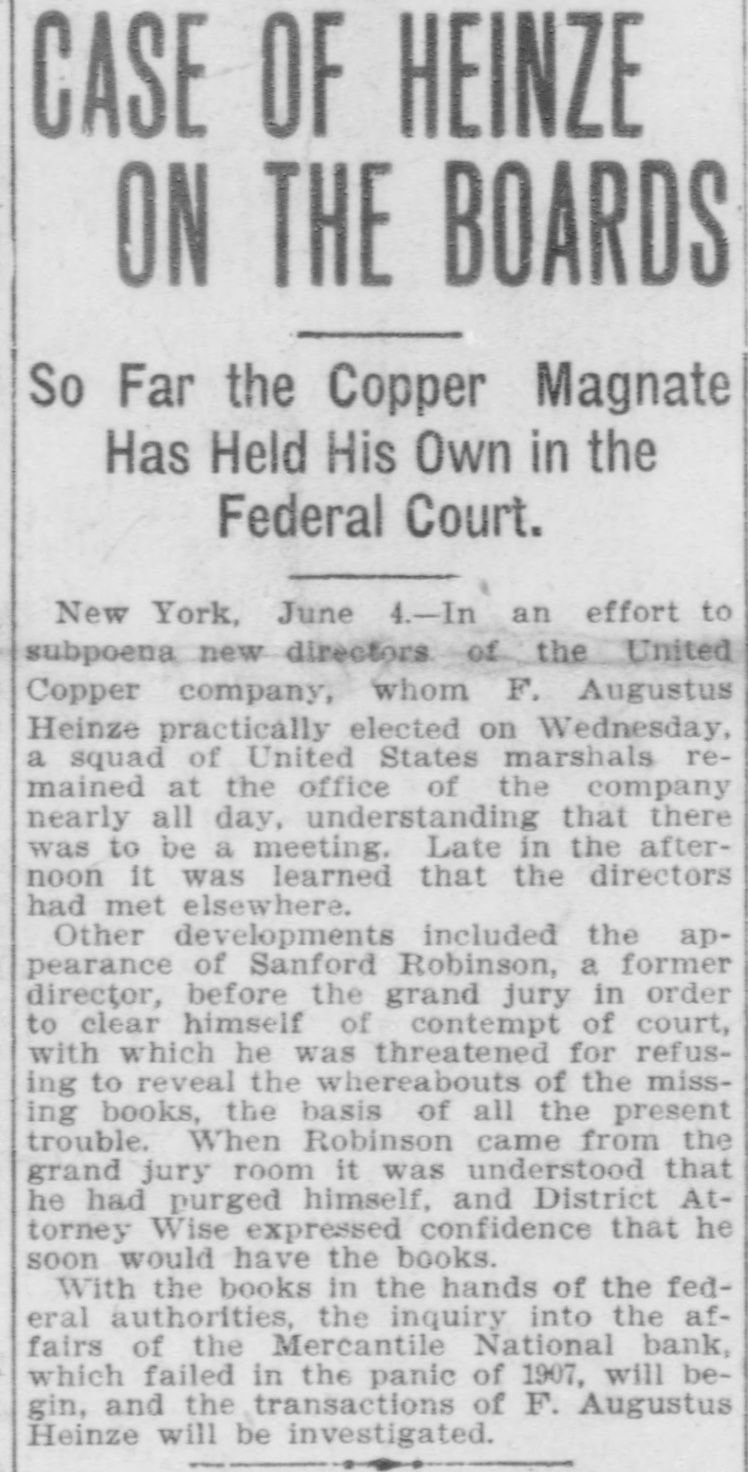
CASE OF HEINZE ON THE BOARDS So Far the Copper Magnate Has Held His Own in the Federal Court. New York, June 4.-In an effort to subpoena new directors of the United Copper company, whom F. Augustus Heinze practically elected on Wednesday, a squad of United States marshals remained at the office of the company nearly all day, understanding that there was to be a meeting. Late in the afternoon it was learned that the directors had met elsewhere. Other developments included the appearance of Sanford Robinson, a former director, before the grand jury in order to clear himself of contempt of court, with which he was threatened for refusing to reveal the whereabouts of the missing books, the basis of all the present trouble. When Robinson came from the grand jury room it was understood that he had purged himself, and District Attorney Wise expressed confidence that he soon would have the books. With the books in the hands of the federal authorities, the inquiry into the affairs of the Mercantile National bank, which failed in the panic of 1907, will begin, and the transactions of F. Augustus Heinze will be investigated.
23.June 6, 1909Omaha Daily BeeOmaha, NE
Click image to open full size in new tab
Article Text
COPPER BOOKS ARE COMING Director Robinson Agrees to Produce Necessary Records. OPEN SHOP IN SHEET MILLS Judge Gary of Steel Combine Explains Notices Recently Posted in Sheet and Tin Plants. NEW YORK, N. Y., June 5.-In an effort to subpoena new directors of the United Copper company, whom F Augustus Heinze practically elected on Wednesday, a squad of United States marshals remained at the offices of the company nearly all day understanding that there was to be a meeting. Late in the evening it was learned the directors had held a meeting elsewhere, just where is not known. Other developments in the case included the appearance of Sanford Robinson, a former director. before the grand jury with the idea of clearing himself of contempt of court with which he was threatened for refusing to reveal whereabouts of the missing books, the basis of all the present trouble When Robinson came from the grand jury room It was understood that he had purged himself and United States District "Attorney Wise professed confidence that he would soon be in possession of the books. What information Robinson volunteered concerning the whereabouts of the books could not be learned, but Mr. Wise indicated that he would have them in the near future. With the books in the hands of the federal authorities investigation into affairs of the Mercantile National bank, which failed in the panic of 1907, will be gone into and F. Augustus Heinze's transactions will be cleared up. His apparent effort to checkmate such a move has caused the present mix up. Open Shop in Steel Mills. In explanation of the new wage scale posted a few days ago at mills of the American Sheet and Tin Plate company, Elbert H. Hary, chairman of the United States Steel corporation, made the following statement today: "Most of the mills of the American Sheet and Tin Plate company here have for some years been operated as 'open shops,' the others were run as union mills and with these the wage scale has been signed on July 1 of each year. The management of the American Sheet and Tin Plate company has dicovered it has been discriminated against and in other ways unfairly treated by the Amalgamated association; the management also discovered beyond question that a decided majority of the men prefer to have all the mills operated as 'open shops.' Under these conditions It has become clear It is for the best interests for the operators to conform to the wishes of the majority. As a result the company posted notices accordingly and also posted the wage scale effective on and after July 1, which in all essential respects is unchanged. There is no dispute regarding wages. It is clear that the employes have appreciated the attitude of the company in its maintenance of the high Level of wages in the period of great business depression." Rockefeller Likes Golf. Saying that the financial situation is not half as interesting as golf, John D. Rockefeller returned here today from Hot Springs, Va., where he took Mrs. Rockefeller five months ago for her health. "We have had a splendid time," said Mr. Rockefeller, "and Mrs. Rockefeller is much better." Mr. Rockefeller was asked If he cared to say anything regarding the financial situation. "What do I know about the financial situation?" he replied. "Why, finance can't be compared with golf. I hope some day to be able to play good golf. I have played a good deal of it in my life." He spoke feelingly of the recent death of H. H. Rogers. "It is sad, very sad," he said. More Delay ir Gould Trial. Probability of a further delay in brining to trial the suit of Mrs. Katherine Clemmons Gould for a separation from her husband, Howard Gould, was indicated today when Supreme Court Justice Gildersleeve appointed Junius T. Auerbach of Boston a commissioner to examine Dr. Martin D. Moran of that city as a witness in behalf of Mrs. Gould. It was stated that Monday and Tuesday of next week might be required for the examination of Dr. Moran and that the trial of the suit would probably not be started before next Wednesday. Mayor McClellan has sent a letter to the father of George B. Duffy, the Brooklyn boy whose troubles with the police have been at the bottom of the charges brought by Supreme Court Justice Gaynor against Police Commissioner Bingham, asking that the youth be brought before the mayor next Monday.. The father is requested also to bring character witnesses. Fight With Counterfeiters. Four Italians suspected of counterfeiting were arrested in a saloon today by agents of the secret service after a fight in which bottles and glasses were thrown. The police say they found seventeen bad $2 bills on one prisoner. In his room was a rubber stamp which would print a fair imitation of a $2 bill. Bee Want Ads. are bustness boosters
24.October 8, 1911The Washington HeraldWashington, DC
Click image to open full size in new tab
Article Text
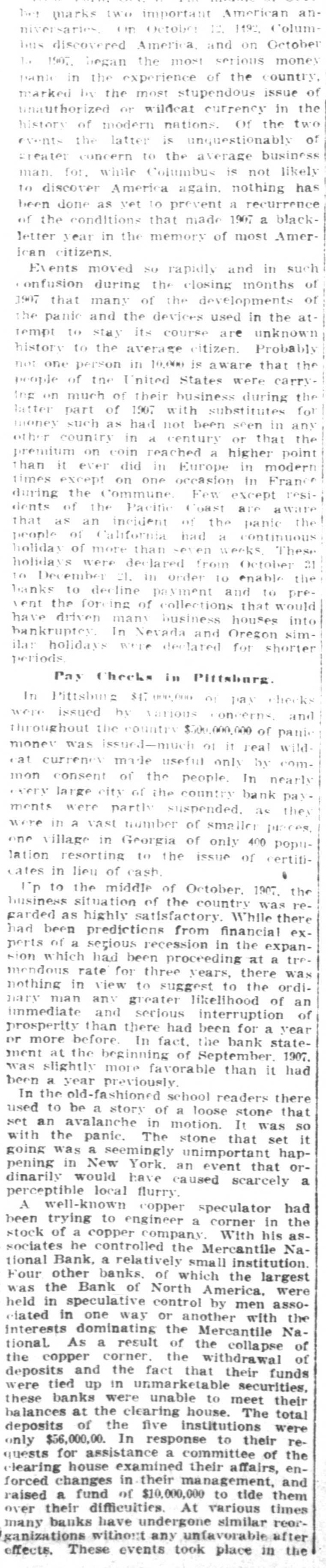
ber marks two important American an-
niversaries. On October 12, 1492, Colum-
bus discovered America, and on October
1, 1907, began the most serious money
panic in the experience of the country,
marked by the most stupendous issue of
unauthorized or wildcat currency in the
history of modern nations. Of the two
events the latter is unquestionably of
greater concern to the average business
man, for, while Columbus is not likely
to discover America again, nothing has
been done as yet to prevent a recurrence
of the conditions that made 1907 a black-
letter year in the memory of most Amer-
ican citizens.
Events moved so rapidly and in such
confusion during the closing months of
1907 that many of the developments of
the panic and the devices used in the at-
tempt to stay its course are unknown
history to the average citizen. Probably
not one person in 10,00 is aware that the
people of the United States were carry-
ing on much of their business during the
latter part of 1907 with substitutes for
money such as had not been seen in any
other country in a century or that the
premium on coin reached a higher point
than it ever did in Europe in modern
times except on one occasion in France
during the Commune. Few except resi-
dents of the Pacific Coast are aware
that as an incident of the panic the
people of California had a continuous
holiday of more than seven weeks. These
holidays were declared from October 21
to December 21, in order to enable the
banks to decline payment and to pre-
vent the forcing of collections that would
have driven many business houses into
bankruptcy. In Nevada and Oregon sim-
ilar holidays were declared for shorter
periods.
# Pay Checks in Pittsburg.
In Pittsburg $4700.000 of pay checks
were issued by various concerns, and
throughout the country $500,000,000 of panic
money was issued-much of it real wild-
cat currency made useful only by com-
mon consent of the people. In nearly
every large city of the country bank pay-
ments were partly suspended, as they
were in a vast number of smaller pieces,
one village in Georgia of only 400 popu-
lation resorting to the issue of certifi-
cates in lieu of cash.
Up to the middle of October, 1907, the
business situation of the country was re-
garded as highly satisfactory. While there
had been predictions from financial ex-
perts of a serious recession in the expan-
sion which had been proceeding at a tre-
mendous rate for three years, there was
nothing in view to suggest to the ordi-
nary man any greater likelihood of an
immediate and serious interruption of
prosperity than there had been for a year
or more before. In fact, the bank state-
ment at the beginning of September, 1907,
was slightly more favorable than it had
been a year previously.
In the old-fashioned school readers there
used to be a story of a loose stone that
set an avalanche in motion. It was so
with the panic. The stone that set it
going was a seemingly unimportant hap-
pening in New York, an event that or-
dinarily would have caused scarcely a
perceptible local flurry.
A well-known copper speculator had
been trying to engineer a corner in the
stock of a copper company. With his as-
sociates he controlled the Mercantile Na-
tional Bank, a relatively small institution.
Four other banks, of which the largest
was the Bank of North America, were
held in speculative control by men asso-
ciated in one way or another with the
interests dominating the Mercantile Na-
tional. As a result of the collapse of
the copper corner, the withdrawal of
deposits and the fact that their funds
were tied up in unmarketable securities,
these banks were unable to meet their
balances at the clearing house. The total
deposits of the five institutions were
only $56,000,00. In response to their re-
quests for assistance a committee of the
clearing house examined their affairs, en-
forced changes in their management, and
raised a fund of $10,000,000 to tide them
over their difficulties. At various times
many banks have undergone similar reor-
ganizations without any unfavorable after
effects. These events took place in the