Article Text
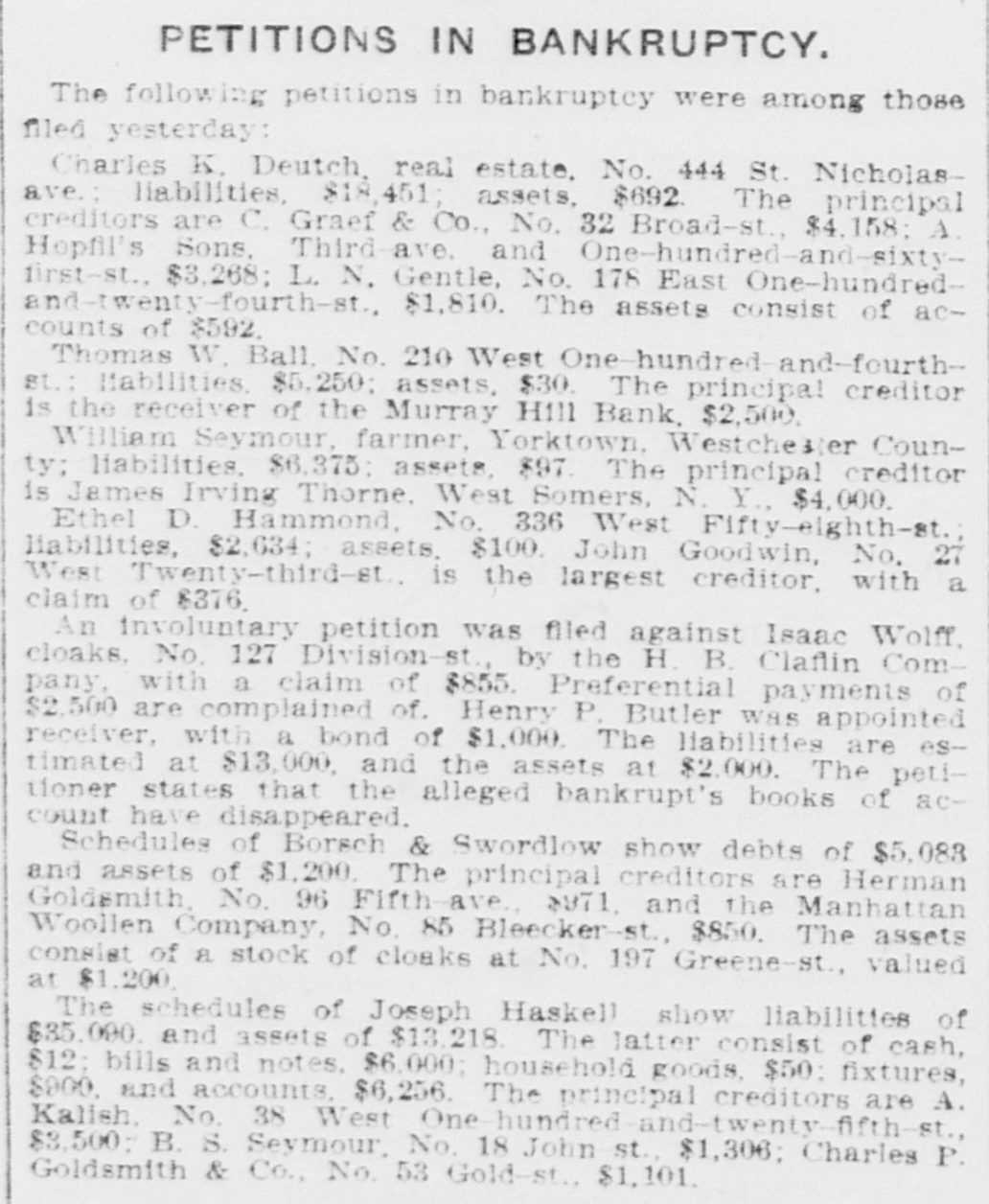
# PETITIONS IN BANKRUPTCY. The following petitions in bankruptcy were among those filed yesterday: Charles K. Deutch, real estate, No. 444 St. Nicholas-ave.; liabilities, $18,451; assets, $692. The principal creditors are C. Graef & Co., No. 32 Broad-st., $4,158: A. Hopfil's Sons, Third-ave. and One-hundred-and-sixty-first-st., $3,268; L. N. Gentle, No. 178 East One-hundred-and-twenty-fourth-st., $1,810. The assets consist of accounts of $592. Thomas W. Ball, No. 210 West One-hundred-and-fourth-st.: liabilities, $5,250; assets, $30. The principal creditor is the receiver of the Murray Hill Bank, $2,500. William Seymour, farmer, Yorktown, Westchester County; liabilities, $6,375; assets, $97. The principal creditor is James Irving Thorne, West Somers, N. Y., $4,000. Ethel D. Hammond, No. 336 West Fifty-eighth-st.; liabilities, $2,634; assets, $100. John Goodwin, No. 27 West Twenty-third-st., is the largest creditor, with a claim of $376. An involuntary petition was filed against Isaac Wolff, cloaks, No. 127 Division-st., by the H. B. Claflin Company, with a claim of $855. Preferential payments of $2,500 are complained of. Henry P. Butler was appointed receiver, with a bond of $1,000. The liabilities are estimated at $13,000, and the assets at $2,000. The petitioner states that the alleged bankrupt's books of account have disappeared. Schedules of Borsch & Swordlow show debts of $5,088 and assets of $1,200. The principal creditors are Herman Goldsmith, No. 96 Fifth ave., 971, and the Manhattan Woollen Company, No. 85 Bleecker-st., $850. The assets consist of a stock of cloaks at No. 197 Greene-st., valued at $1,200. The schedules of Joseph Haskell show liabilities of $35,000, and assets of $13,218. The latter consist of cash, $12; bills and notes, $6,000; household goods, $50; fixtures, $900, and accounts, $6,256. The principal creditors are A. Kalish. No. 38 West One-hundred-and-twenty-fifth-st., $3,500: B. S. Seymour, No. 18 John st., $1,306; Charles P. Goldsmith & Co., No. 53 Gold-st., $1,101.