
13675. Bank of the United States (New York, NY)

Bank Information

Episode Type
Suspension โ†’ Closure
Bank Type
private
Start Date
*
Location
New York, New York (40.714, -74.006)

Metadata

Model
gpt-5-mini
Short Digest
568eafa45a52cd5b

Response Measures

None

Description

Articles describe the Bank of the United States (New York) as closed and in liquidation with a receiver suing stockholders. No contemporaneous run is described in these snippets; the closure was effected by the superintendent/receiver and the bank remained closed. OCR errors in Article 1 made some dates garbled; I did not infer specific failure dates beyond what the text supports.

Events (2)

1. * Receivership
Newspaper Excerpt
closed Bank of the United States New York City ... bank could not its safely bank being liquidated ... Superintendent ... found that more than owing to creditors ... receiver ... brought actions to enforce liability of stockholders
Source
newspapers
2. * Suspension
Cause
Government Action
Cause Details
Closed by the New York superintendent of banks and placed in liquidation/receiver control; receiver bringing suits against stockholders
Newspaper Excerpt
Receiver of Bank of United States Brings Action to Collect $25 Assessment on Shares ... the closed Bank of the United States New York City were brought Friday in the Superior Court by Joseph superintendent of banks of the State of New York
Source
newspapers

Newspaper Articles (2)

Article from Hartford Courant, November 11, 1933

Click image to open full size in new tab

Article Text

Stockholders Defunct Receiver of Bank of United States Brings Action to Collect $25 Assessment on Shares County Affected Prominent 91 of in ages Superior Court damage suits against stockholders the closed Bank of the United States New York City were brought Friday in the Superior Court by Joseph superintendent of banks of the State of New York, who asked total damages $92,700. The defendants included prominent persons busiand professional in Hartford County, banks and brokerage The suits were brought under section of the New York State constitution which makes stockholders of banks individually responsible to the amount of their respective shares of stock for the debts and liabilities of the bank. They are being served by Deputy Sheriff Joseph Fanelli of Hartford and Constable Harold Cole of Stamford and returnable the first Tuesday of December 30 Million Owing Creditors. Similar to suits filed against in New the papers relate that the Bank the United States, which had capital $25,250,000, closed by the bank on when it was that the bank could not its safely bank being liquidated who found that more than owing to creditors, and above the value the On July Superintendent the stockholders the bank $25 for share stock held them. The defendants named in the present suits have refused to their assesspay ments states and the actions brought to enforce their alleged liability List of Defendants. The list of defendants, many of them prominent in public life, and the amount damages claimed against each, follows: Raymond Betts, Hartford. $3000; Edwin Hartford, $1000; Ed. ward Hartford, $3500; Max Leshin, Hartford, $1500; mond Levi, Hartford. $1500; Edward McNamara. $3000; Roy Mason, $1700: Frances Prince, Hartford. $1200: Jacob Wieder. Hartford. $1000: Peter VourHartford, $2700: Simon Yolish Hartford. $3500; William H. Hartford. Salvatore Rotella. New $2000; Charles New Britain, $3000; Michael Contaras New $3000; George William Wyatt. Bristol. Rudolph Broad Baton $12.$800; Goodwin Beach Hart$1000; Trusban Hart$6500; Latina Bros. Hartford, $1500; Grote Hart Shoor CorpoHartford. Park Street Trust Hartford. Mildred mond Bieth and Dorothea Bieth, both Hartford. Frank Adams, $200; Frieda $550; Beatrice BlodgAbraham $650; Hazel Charles $550; Sarah Daws, $150: Daly. $350; Michael Mary Stewart Dunning Rose and William Flynn

Article from Evening Star, February 3, 1939

Click image to open full size in new tab

Article Text

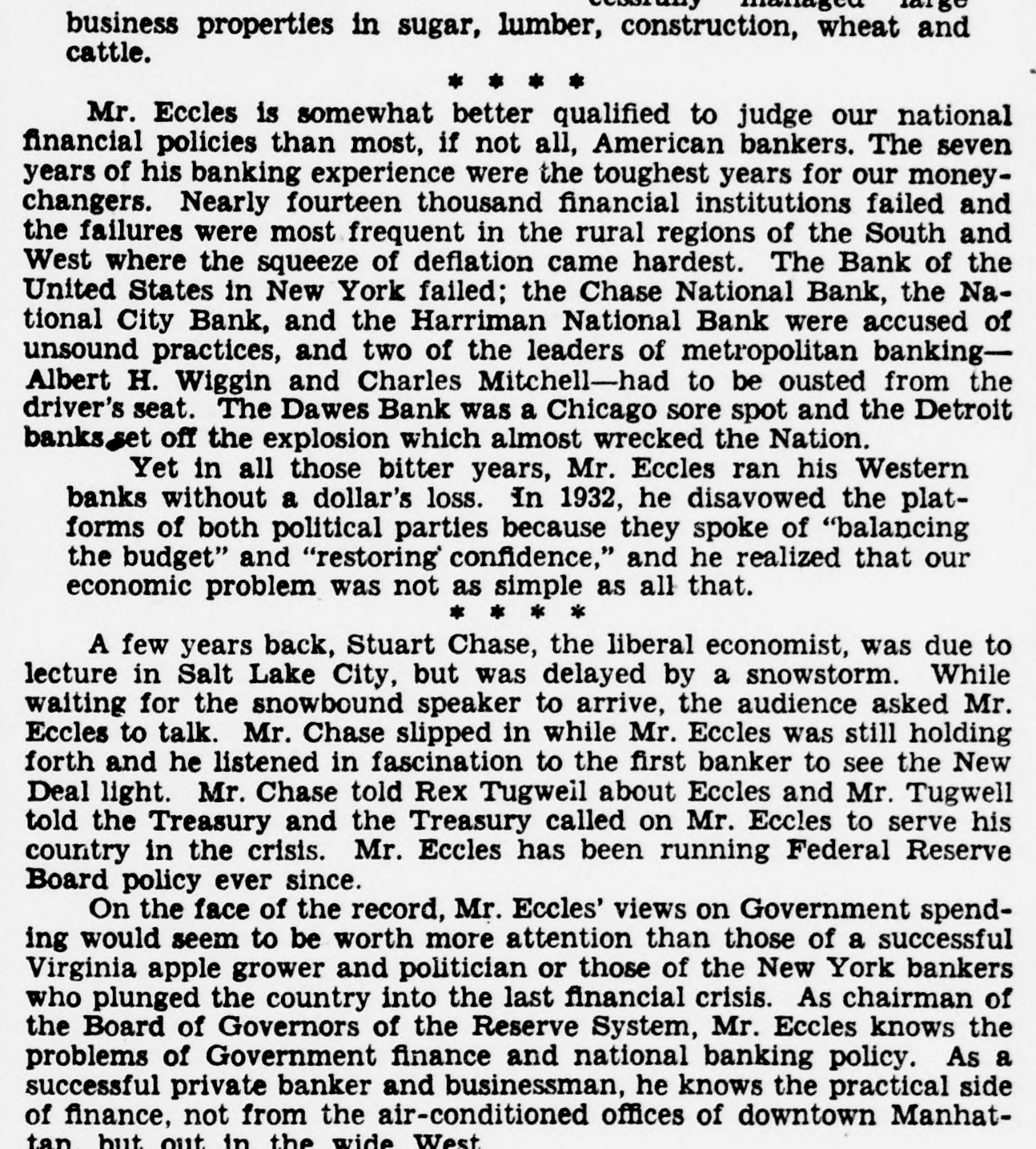
business properties in sugar, lumber, construction, wheat and cattle. Mr. Eccles is somewhat better qualified to judge our national financial policies than most, if not all, American bankers. The seven years of his banking experience were the toughest years for our moneychangers. Nearly fourteen thousand financial institutions failed and the failures were most frequent in the rural regions of the South and West where the squeeze of deflation came hardest. The Bank of the United States in New York failed; the Chase National Bank, the National City Bank, and the Harriman National Bank were accused of unsound practices, and two of the leaders of metropolitan bankingAlbert H. Wiggin and Charles Mitchell-had to be ousted from the driver's seat. The Dawes Bank was a Chicago sore spot and the Detroit banks set off the explosion which almost wrecked the Nation. Yet in all those bitter years, Mr. Eccles ran his Western banks without a dollar's loss. In 1932, he disavowed the platforms of both political parties because they spoke of "balancing the budget" and "restoring confidence," and he realized that our economic problem was not as simple as all that. A few years back, Stuart Chase, the liberal economist, was due to lecture in Salt Lake City, but was delayed by a snowstorm. While waiting for the snowbound speaker to arrive, the audience asked Mr. Eccles to talk. Mr. Chase slipped in while Mr. Eccles was still holding forth and he listened in fascination to the first banker to see the New Deal light. Mr. Chase told Rex Tugweil about Eccles and Mr. Tugwell told the Treasury and the Treasury called on Mr. Eccles to serve his country in the crisis. Mr. Eccles has been running Federal Reserve Board policy ever since. On the face of the record, Mr. Eccles' views on Government spending would seem to be worth more attention than those of a successful Virginia apple grower and politician or those of the New York bankers who plunged the country into the last financial crisis. As chairman of the Board of Governors of the Reserve System, Mr. Eccles knows the problems of Government finance and national banking policy. As a successful private banker and businessman, he knows the practical side of finance, not from the air-conditioned offices of downtown Manhatout