14194. Newark Bank (Newark, NJ)

Bank Information

Episode Type
Suspension → Closure
Bank Type
state
Start Date
May 16, 1884
Location
Newark, New Jersey (40.736, -74.172)

Metadata

Model
gpt-5-mini
Short Digest
b64fdc14

Response Measures

None

Description

Newark Bank is reported to have failed to-day (May 16, 1884) after exposure of large claims on the firm Fisk & Hatch and improper securities held by that firm. The coverage links the collapse of Fisk & Hatch and other suspensions to the wrecking of Newark Bank. Articles do not describe a depositor run on Newark Bank itself; instead the bank is described as having failed/suspended and caused runs elsewhere. No explicit receiver appointment is mentioned in these excerpts, but the bank is described as failed/broken and permanently closed in contemporary accounts.

Events (1)

1. May 16, 1884 Suspension
Cause
Bank Specific Adverse Info
Cause Details
Failure/exposure of correspondent/connected firm Fisk & Hatch; large claim against firm (~$1,000,000) and improper/pilfered securities held by Fisk & Hatch causing insolvency.
Newspaper Excerpt
NEWARK, N. J., May 16.-The Newark Bank, which failed to-day, makes a statement that the firm of Fisk & Hatch owes it nearly one million of dollars. A box of securities of the bank kept by the firm, which ought to hold Government bonds only, has instead personal property not of equal value.
Source
newspapers

Newspaper Articles (5)

Article from Wheeling Register, May 17, 1884

Click image to open full size in new tab

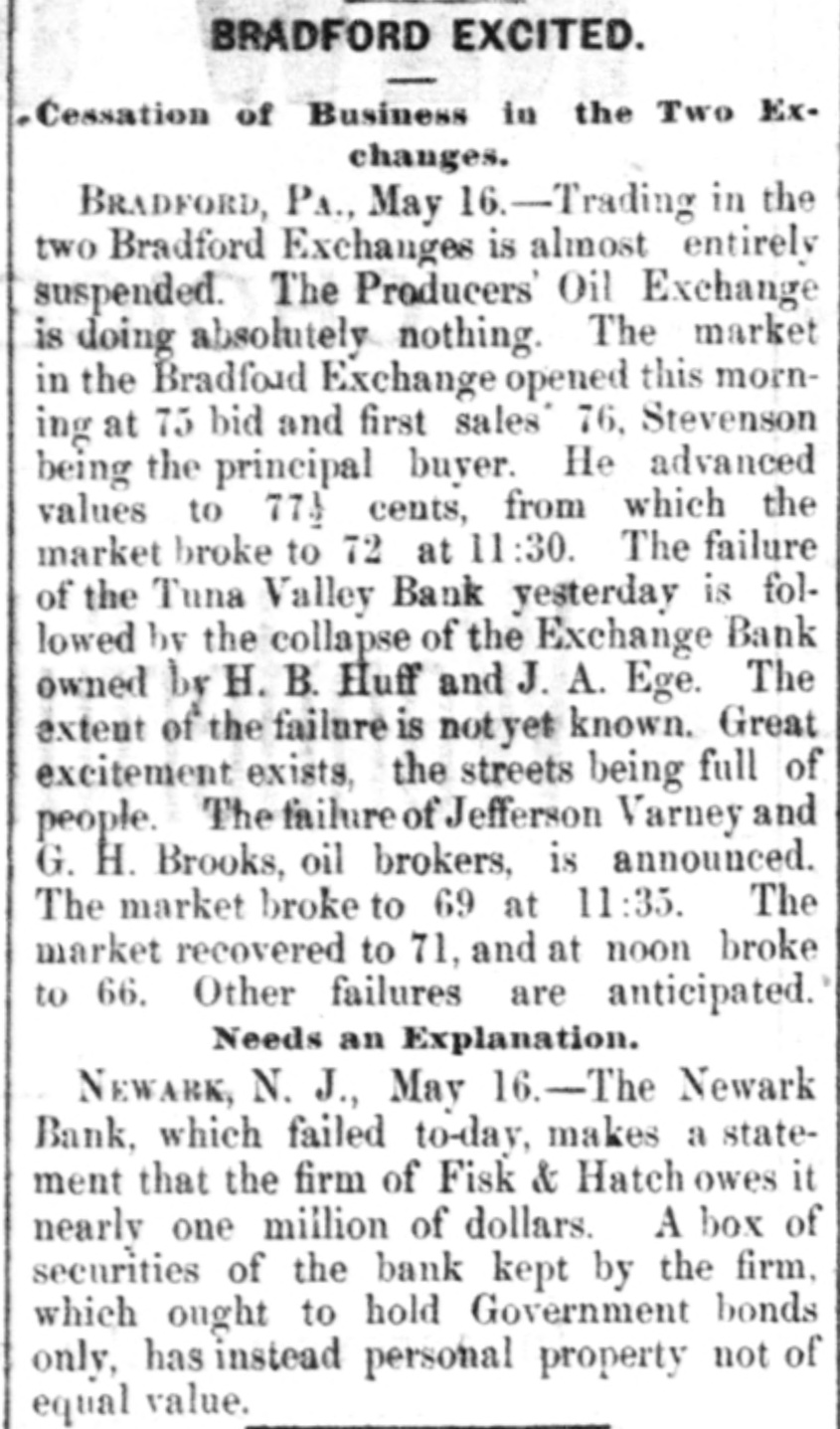
Article Text

BRADFORD EXCITED. Cessation of Business in the Two Exchanges. BRADFORD, PA., May 16.-Trading in the two Bradford Exchanges is almost entirely suspended. The Producers' Oil Exchange is doing absolutely nothing. The market in the Bradford Exchange opened this morning at 75 bid and first sales 76. Stevenson being the principal buyer. He advanced values to 77) cents, from which the market broke to 72 at 11:30. The failure of the Tuna Valley Bank yesterday is followed by the collapse of the Exchange Bank owned by H. B. Huff and J. A. Ege. The extent of the failure is notyet known. Great excitement exists, the streets being full of people. The failure of Jefferson Varney and G. H. Brooks, oil brokers, is announced. The market broke to 69 at 11:35. The market recovered to 71, and at noon broke to 66. Other failures are anticipated. Needs an Explanation. NEWARK, N. J., May 16.-The Newark Bank, which failed to-day, makes a statement that the firm of Fisk & Hatch owes it nearly one million of dollars. A box of securities of the bank kept by the firm, which ought to hold Government bonds only, has instead personal property not of equal value.

Article from New-York Tribune, May 17, 1884

Click image to open full size in new tab

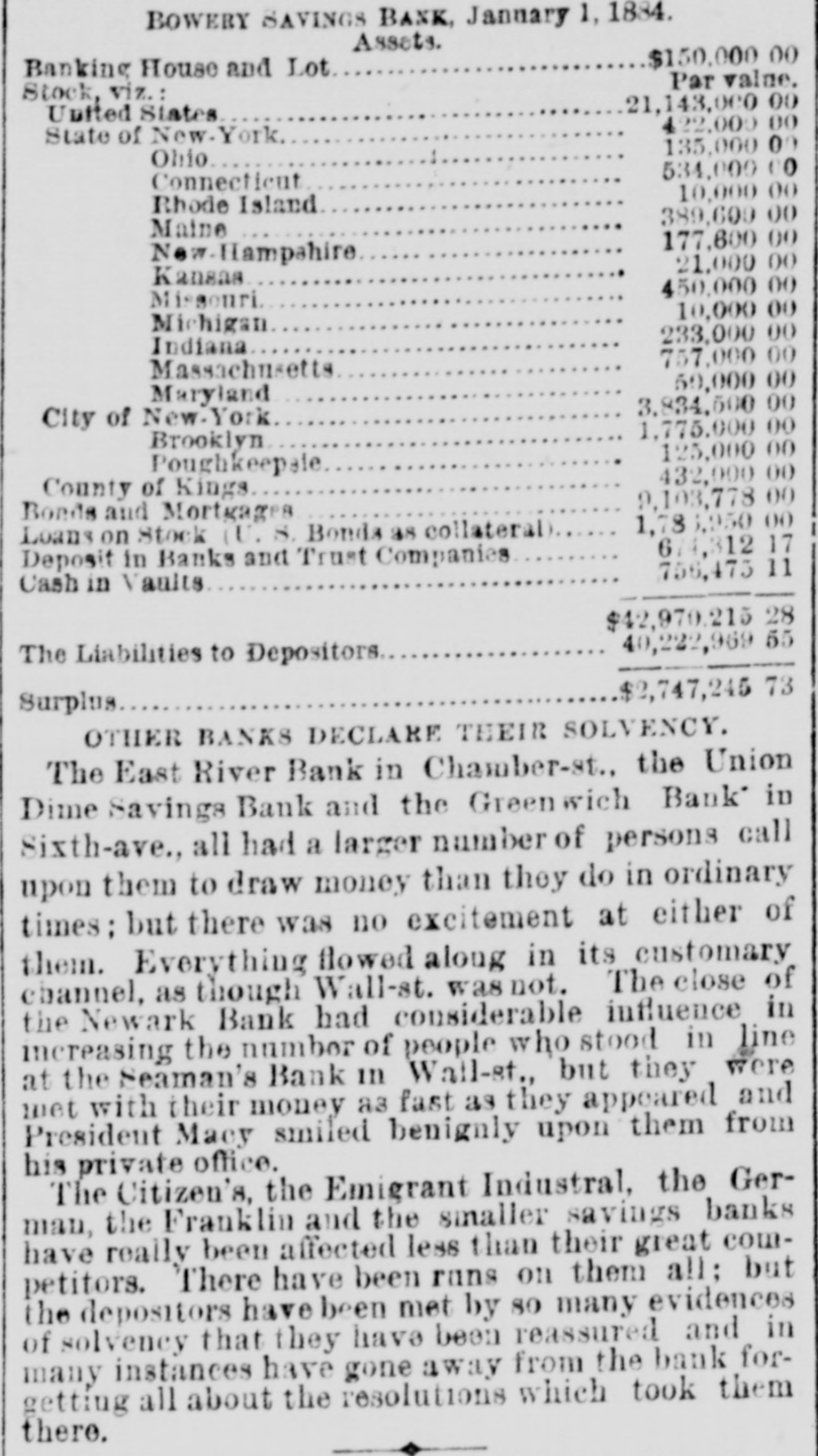
Article Text

BOWERY SAVINGS BANK, January 1, 1884. Assets. $150,000 Banking House and Lot Par value. Stock, viz.: 21,143,000 00 United States 422,000 00 State of New York 135,000 00 Ohio 534,000 Connecticut 10,000 00 Rhode Island 389,600 00 Maine 177,600 00 New Hampshire 21,000 00 Kansas 450,000 00 Missouri, 10,000 00 Michigan 233,000 00 Indiana 757,000 00 Massachusetts 50,000 00 Maryland 3,834,500 00 City of New-York 1,775,000 00 Brooklyn 125,000 00 Poughkeepsie 432,000 00 County of Kings 9,103,778 Bonds and Mortgages 1,783,950 00 Loans on Stock (U. S. Bonds as collateral) 674,312 17 Deposit in Banks and Trust Companies 756,475 11 Cash in Vaults $42,970.215 28 40,222,969 The Liabilities to Depositors $2,747,245 73 Surplus OTHER BANKS DECLARE THEIR SOLVENCY. The East River Bank in Chamber-st., the Union Dime Savings Bank and the Greenwich Bank* in Sixth-ave., all had a larger number of persons call upon them to draw money than they do in ordinary times; but there was no excitement at either of them. Everything flowed along in its customary channel, as though Wall-st. wasnot. The close of the Newark Bank had considerable influence in increasing the number of people who stood in line at the Seaman's Bank in Wall-st., but they were met with their money as fast as they appeared and President Macy smiled benignly upon them from his private office. The Citizen's, the Emigrant Industral, the German, the Franklin and the smaller savings banks have really been affected less than their great competitors. There have been runs on them all; but the depositors have been met by so many evidences of solvency that they have been reassured and in many instances have gone away from the bank forgetting all about the resolutions which took them there.


Article from New-York Tribune, May 17, 1884

Click image to open full size in new tab

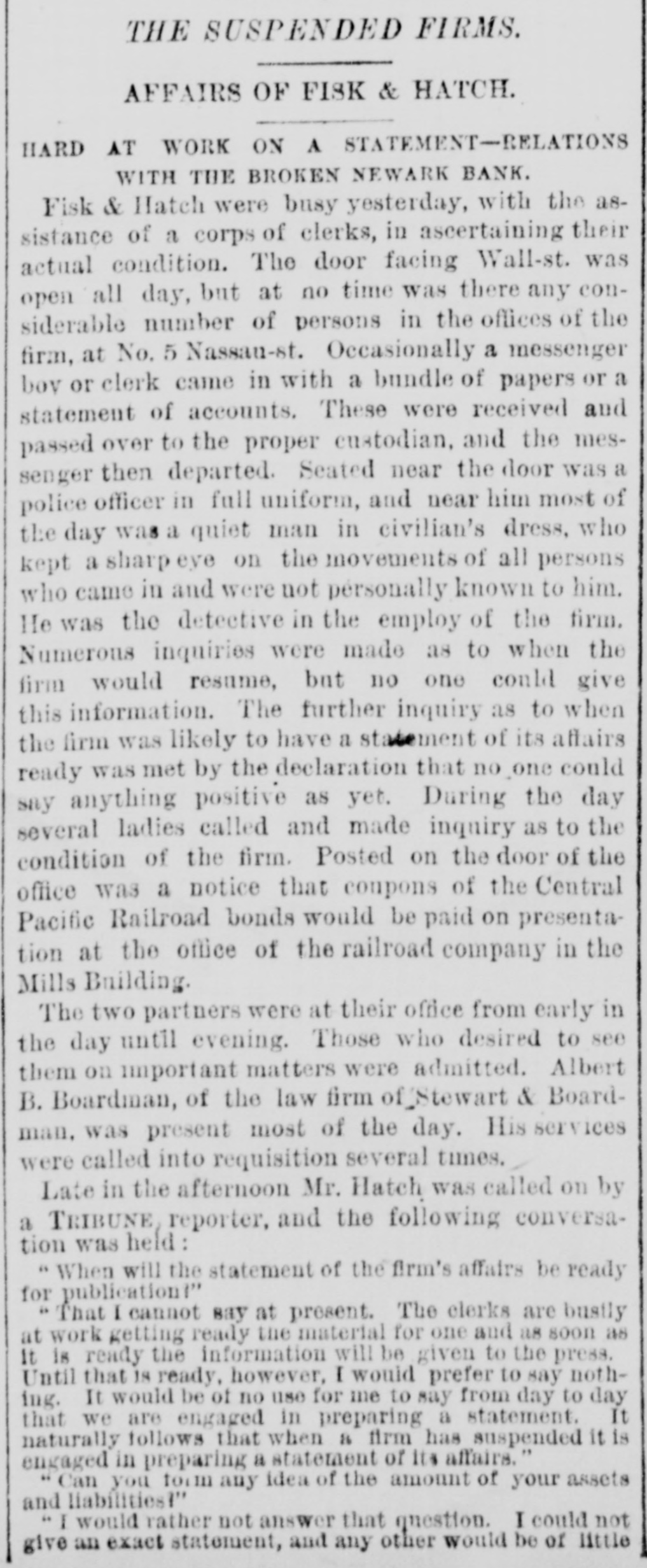
Article Text

# THE SUSPENDED FIRMS. # AFFAIRS OF FISK & HATCH. HARD AT WORK ON A STATEMENT-RELATIONS WITH THE BROKEN NEWARK BANK. Fisk & Hatch were busy yesterday, with the as- sistance of a corps of clerks, in ascertaining their actual condition. The door facing Wall-st. was open all day, but at no time was there any con- siderable number of persons in the offices of the firm, at No. 5 Nassau-st. Occasionally a messenger boy or clerk came in with a bundle of papers or a statement of accounts. These were received and passed over to the proper custodian, and the mes- senger then departed. Seated near the door was a police officer in full uniform, and near him most of the day was a quiet man in civilian's dress, who kept a sharp eye on the movements of all persons who came in and were not personally known to him. He was the detective in the employ of the firm. Numerous inquiries were made as to when the firm would resume, but no one could give this information. The further inquiry as to when the firm was likely to have a statement of its affairs ready was met by the declaration that no one could say anything positive as yet. During the day several ladies called and made inquiry as to the condition of the firm. Posted on the door of the office was a notice that coupons of the Central Pacific Railroad bonds would be paid on presenta- tion at the office of the railroad company in the Mills Building. The two partners were at their office from early in the day until evening. Those who desired to see them on important matters were admitted. Albert B. Boardman, of the law firm of Stewart & Board- man, was present most of the day. His services were called into requisition several times. Late in the afternoon Mr. Hatch was called on by a TRIBUNE, reporter, and the following conversa- tion was held: "When will the statement of the firm's affairs be ready for publication?" "That I cannot say at present. The clerks are bustly at work getting ready the material for one and as soon as It is ready the information will be given to the press. Until that is ready, however, I would prefer to say noth- ing. It would be of no use for me to say from day to day that we are engaged in preparing a statement. It naturally follows that when a firm has suspended it is engaged in preparing a statement of its affairs." "Can you form any idea of the amount of your assets and liabilities?" "I would rather not answer that question. I could not give an exact statement, and any other would be of little


Article from Savannah Morning News, June 5, 1884

Click image to open full size in new tab

Article Text

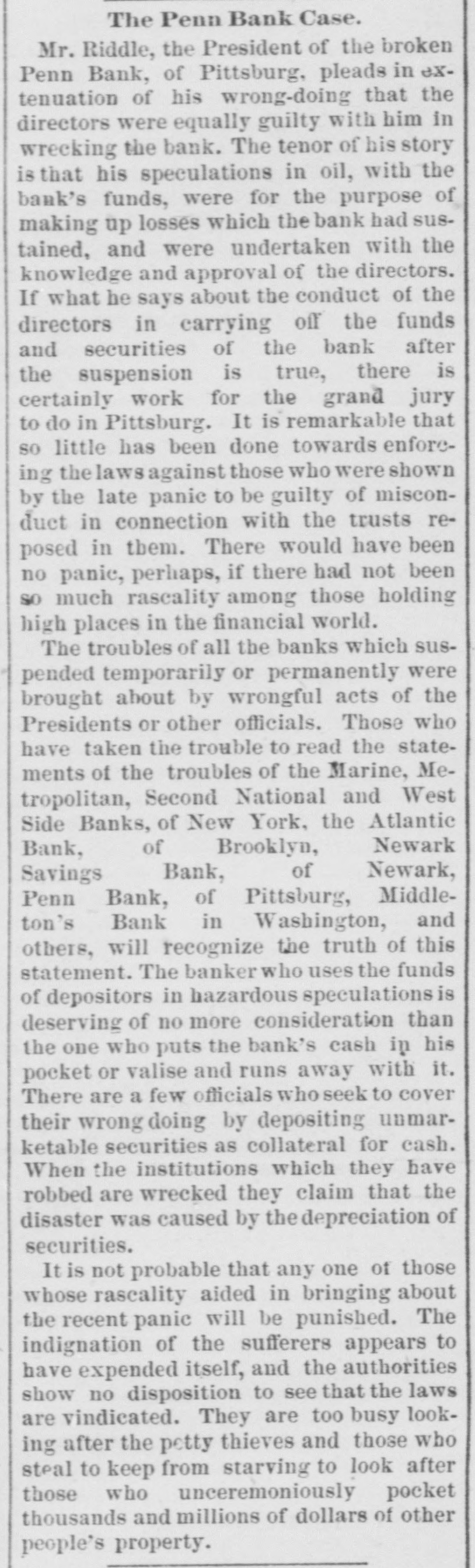
The Penn Bank Case. Mr. Riddle, the President of the broken Penn Bank, of Pittsburg, pleads in extenuation of his wrong-doing that the directors were equally guilty with him in wrecking the bank. The tenor of his story is that his speculations in oil, with the bank's funds, were for the purpose of making up losses which the bank had sustained, and were undertaken with the knowledge and approval of the directors. If what he says about the conduct of the directors in carrying off the funds and securities of the bank after the suspension is true, there is certainly work for the grand jury to do in Pittsburg. It is remarkable that so little has been done towards enforeing the laws against those who were shown by the late panic to be guilty of misconduct in connection with the trusts reposed in them. There would have been no panic, perhaps, if there had not been so much rascality among those holding high places in the financial world. The troubles of all the banks which suspended temporarily or permanently were brought about by wrongful acts of the Presidents or other officials. Those who have taken the trouble to read the statements of the troubles of the Marine, Metropolitan, Second National and West Side Banks, of New York, the Atlantic Bank, of Brooklyn, Newark of Newark, Bank, Savings Penn Bank, of Pittsburg, Middleton's Bank in Washington, and others, will recognize the truth of this statement. The banker who uses the funds of depositors in hazardous speculations is deserving of no more consideration than the one who puts the bank's cash in his pocket or valise and runs away with it. There are a few officials who seek to cover their wrong doing by depositing unmarketable securities as collateral for cash. When the institutions which they have robbed are wrecked they claim that the disaster was caused by the depreciation of securities. It is not probable that any one of those whose rascality aided in bringing about the recent panic will be punished. The indignation of the sufferers appears to have expended itself, and the authorities show no disposition to see that the laws are vindicated. They are too busy looking after the petty thieves and those who steal to keep from starving to look after those who unceremoniously pocket thousands and millions of dollars of other people's property.


Article from Savannah Morning News, June 8, 1884

Click image to open full size in new tab

Article Text

OUR FALLEN MONEY KINGS: Luxuriating in Castles and Mansions While Arranging Their Business. HATCH'S CASTLE. The gray granite castle that stands in about the centre of the hillside village of Tarrytown, says a New York letter, was built by Mr. A. W. Dimock, of Dimock & Co., who recently suspended. Five years ago Mr. Dimock sold it to Mr. A. S. Hatch, of the firm of Fisk & Hatch, which recently collapsed bringing down in its ruins the Newark Bank and causing untold misery among the poor depositors in that concern. That Mr. Hatch's residence is really his castle from turret to foundation stone no one will doubt. It looks, standing among the dwarfs of country cottages, as though Mr. Dimock had gone to Tarrytown one day with laborers, mechanics and artists and ordered them to build while he read aloud the directions from one of Sir Walter Scott's novels.