14199. Metropolitan Bank (New York, NY)

Bank Information

Episode Type
Suspension โ†’ Closure
Bank Type
state
Start Date
January 1, 1881*
Location
New York, New York (40.714, -74.006)

Metadata

Model
gpt-5-mini
Short Digest
6749e85b15ec6b2f

Response Measures

None

Description

Articles indicate Metropolitan Bank suspended payments in 1881 and later resumed (per obituary mentioning suspension in 1881 and resumption). Subsequent items (1896) show the bank went into liquidation and had a receiver (Richard V. D. Wood) who was later arrested for alleged misappropriation of the bank's funds, indicating a receivership/closure. The sources do not clearly describe a discrete run causing final suspension/closure; the evidence supports an earlier suspension with reopening (1881) and a later liquidation/receivership (closure). OCR errors in original texts were corrected (e.g., 'Metropolitau' -> Metropolitan).

Events (4)

1. January 1, 1881* Reopening
Newspaper Excerpt
He was cashier when the bank suspended payment in 1881, but retained his place until long after payments were resumed.
Source
newspapers
2. January 1, 1881* Suspension
Cause Details
Article notes suspension of payments in 1881 but gives no cause in the excerpt.
Newspaper Excerpt
He was cashier when the bank suspended payment in 1881, but retained his place until long after payments were resumed.
Source
newspapers
3. November 16, 1888 Other
Newspaper Excerpt
All these transactions were carried on through the Metropolitan Bank, of which Seney was president. ... action for the appointment of a receiver, an accounting, and an injunction restraining the defendants from using or disposing of Richmond and Alleghany Railroad bonds.
Source
newspapers
4. November 18, 1896 Receivership
Newspaper Excerpt
Richard V. D. Wood, who was paying teller of the Metropolitan bank and was afterward made receiver of that institution when it went into liquidation, was arrested ... charged with having misappropriated $60,000 of the bank's funds.
Source
newspapers

Newspaper Articles (5)

Article from New-York Tribune, November 16, 1888

Click image to open full size in new tab

Article Text

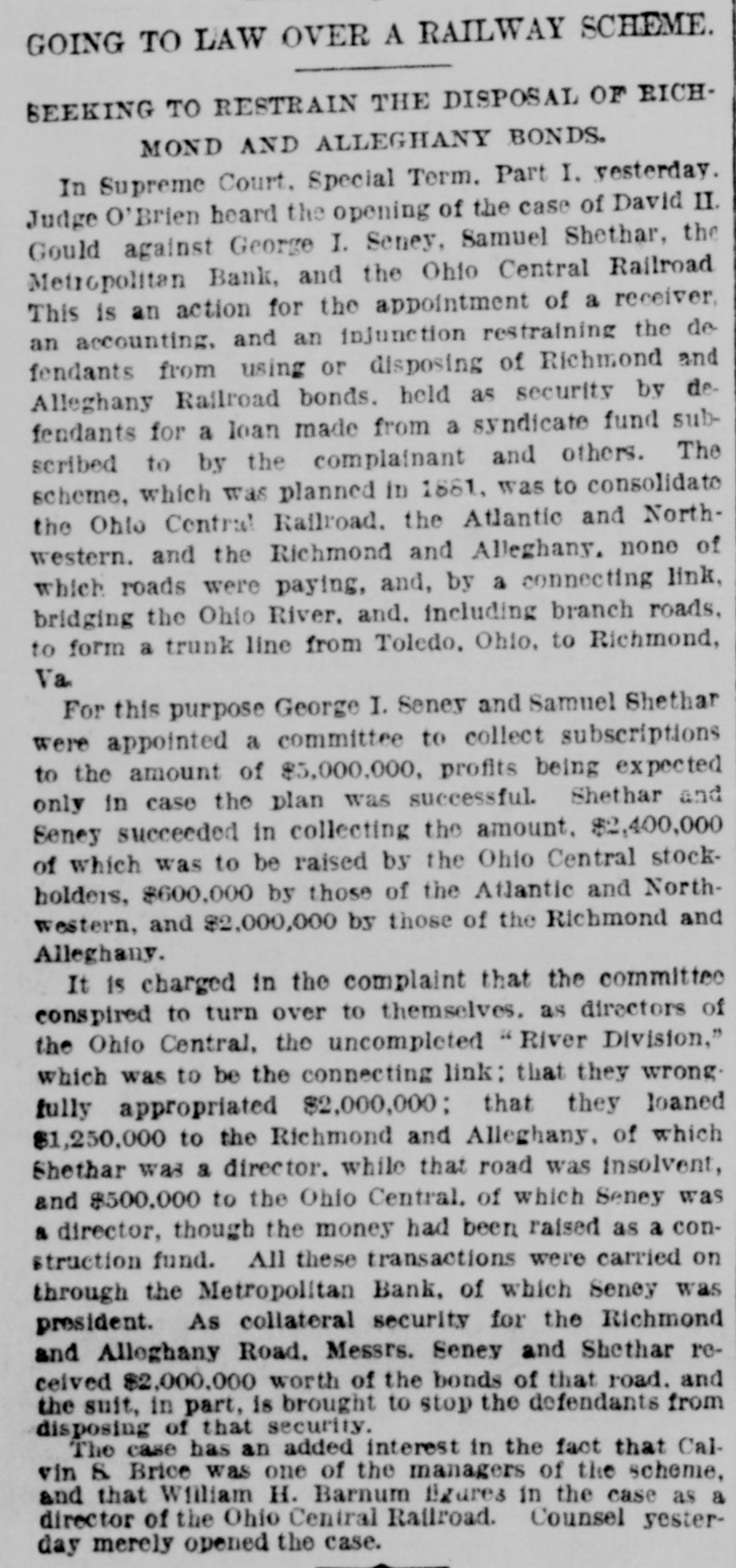
GOING TO LAW OVER A RAILWAY SCHEME. SEEKING TO RESTRAIN THE DISPOSAL OF RICHMOND AND ALLEGHANY BONDS. In Supreme Court. Special Term. Part I. yesterday. Judge O'Brien heard the opening of the case of David II. Gould against George I. Seney, Samuel Shethar, the Metropolitan Bank, and the Ohio Central Railroad This is an action for the appointment of a receiver, an accounting, and an injunction restraining the de fendants from using or disposing of Richmond and Alleghany Railroad bonds. hold as security by defendants for a loan made from a syndicate fund subscribed to by the complainant and others. The scheme, which was planned in 1881, was to consolidate the Ohio Central Railroad. the Atlantic and Northwestern. and the Richmond and Alleghany. none of which roads were paying, and, by a connecting link, bridging the Ohio River, and, including branch roads, to form a trunk line from Toledo, Ohio, to Richmond, Va For this purpose George I. Seney and Samuel Shethar were appointed a committee to collect subscriptions to the amount of $5,000,000, profits being expected only in case the plan was successful. Shethar and Seney succeeded in collecting the amount. $2,400,000 of which was to be raised by the Ohio Central stockholders, $600,000 by those of the Atlantic and Northwestern, and $2,000,000 by those of the Richmond and Alleghany. It is charged in the complaint that the committee conspired to turn over to themselves. as directors of the Ohio Central, the uncompleted "River Division," which was to be the connecting link: that they wrong. fully appropriated $2,000,000; that they loaned $1,250,000 to the Richmond and Alleghany, of which Shethar was a director. while that road was insolvent, and $500,000 to the Ohio Central. of which Seney was a director, though the money had been raised as a construction fund. All these transactions were carried on through the Metropolitan Bank, of which Seney was president. As collateral security for the Richmond and Alloghany Road. Messrs. Seney and Shethar recelved $2,000,000 worth of the bonds of that road. and the suit, in part, is brought to stop the defendants from disposing of that security. The case has an added interest in the fact that Calvin S. Brice was one of the managers of the scheme, and that William H. Barnum figures in the case as a director of the Ohio Central Railroad. Counsel yesterday merely opened the case.

Article from New-York Tribune, December 16, 1892

Click image to open full size in new tab

Article Text

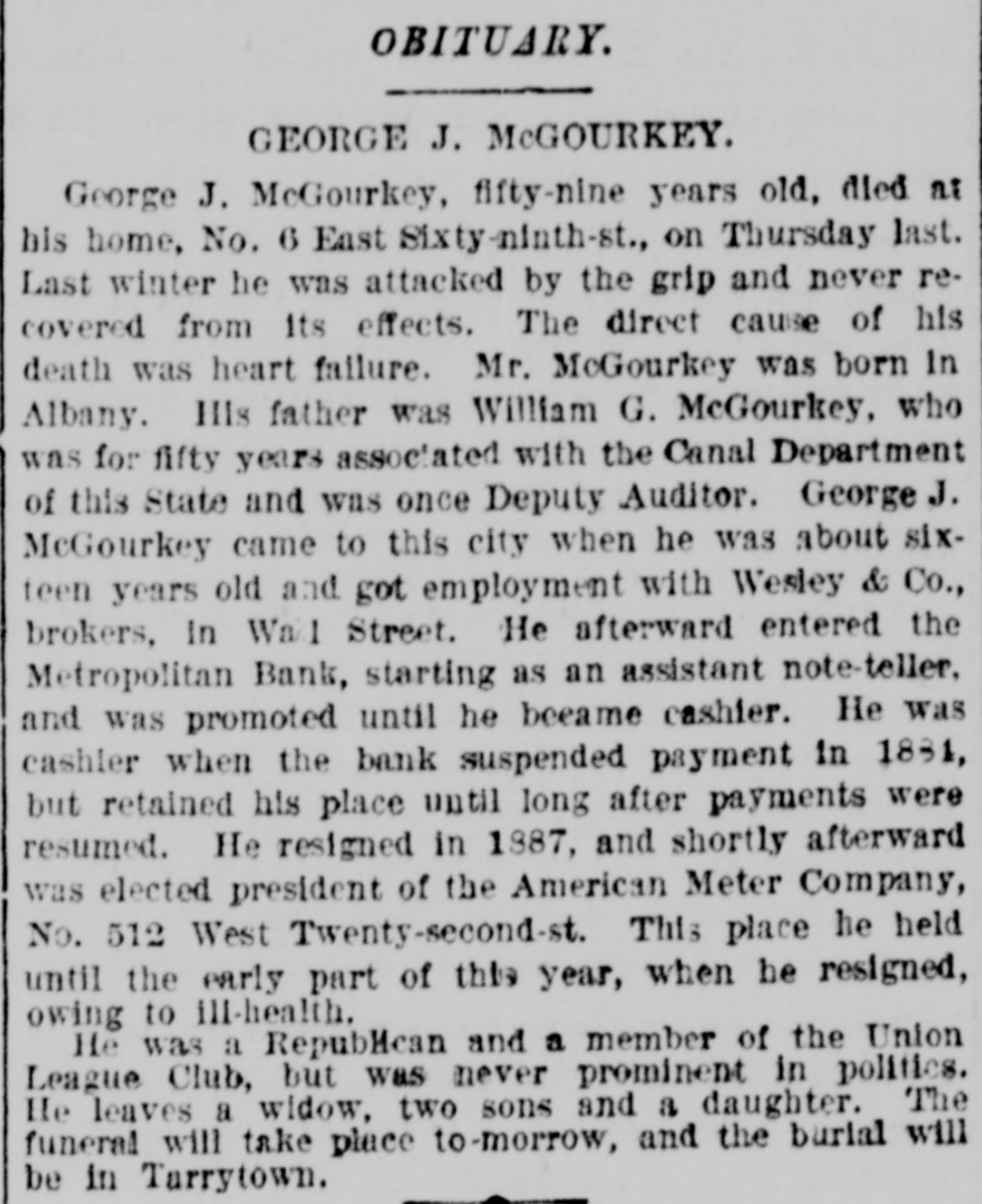
OBITUARY. GEORGE J. McGOURKEY. George J. McGourkey, fifty-nine years old, died at his home, No. 6 East Sixty-ninth-st., on Thursday last. Last winter he was attacked by the grip and never recovered from its effects. The direct cause of his death was heart failure. Mr. McGourkey was born In Albany. His father was William G. McGourkey, who was for fifty years associated with the Canal Department of this State and was once Deputy Auditor. George J. McGourkey came to this city when he was about sixteen years old and got employment with Wesley & Co., brokers, in Wall Street. He afterward entered the Metropolitan Bank, starting as an assistant note-teller. and was promoted until he became cashier. He was cashier when the bank suspended payment in 1881, but retained his place until long after payments were resumed. He resigned in 1887, and shortly afterward was elected president of the American Meter Company, No. 512 West Twenty-second-st. This place he held until the early part of this year, when he resigned, owing to ill-health. He was a RepubMcan and a member of the Union League Club, but was never prominent in politics. He leaves a widow, two sons and a daughter. The funeral will take place to-morrow, and the burial will be in Tarrytown.


Article from The Sun, June 16, 1893

Click image to open full size in new tab

Article Text

LOAN CERTIFICATES READY. CLEARING HOUSE BANKS PUT A LOAN COMMITTEE IN CHARGE. They Came Within an Ace of Asking Prest. dent Cleveland to Convene Congress Im. medintely-Man Bankers Strongly Favor Suehn Course Philadelphia Follows New York's Lead-The Situation a Bit Easter. Banks At a special meeting of the Associated of this city. hold at noon yesterday. the unanimous report of the Clearing House Committee agreed upon on Wodnesday was accepted and the following resolution was adoptod: Resolved. That a commitee of five be appointed by the Chair. with the President. to receive from banks, members of the association. bills receivable and other securities to be approves by said committee. who shall be authorize to issue therefor. to such depositing banks, loan certificate bearing interest Oper cent. er annum and such loan certificates shall not be in excess of 75 per cent of the market value of the secu. rities or bille receivible RO deposited. and such certificates shall be received and paid in settlement of balances at the Clearak House. and all the rules and regnlations heretofor adopted in the issue of such certificates shall be in are on the present issue. The Loan Committee appointed is AS follows: F. D. Tapper. Chairman: E. H. Perkins. Jr., J. Edward Simmons. H. W. Cannon, W. A. Nash, and G.G. Williams. The meeting was unusually well attended. nearly every bank in the Clearing House being represented by its President. There was no special discussion, and. of course. no opposition to the policy which the Clearing House Committee had deemed to be expedient. The Loan Committee is identical with the Clearing House Committee. but differs in its organization. in that Mr. Tappen is the Chairman. It was the intention of the Clearing House Committee that its action on Wednesday should not become public until after the meeting of the Associated Banks yesterday. Fortunately for them and for the business community generally. their intentions were thwarted: for it is almost n certainty that if public had obtained its information of what the the banks contemplated doing in is fragmentary way during business hours yesterday it would have become unnecessarily alarmed. Besides. it would have been impossible to convey to the public immediately after yesterday's meeting the motives and reasons that lod the banks to resort to an issue of loan certificates. As it was. the public was well informed through THE SUN of the proposed action by the banks and their reasons for taking it. The situation was presented in a way that removed Any possible cause for alarm. and even the Stock Exchange. where the bears endeavored on to create the impression that the of the banks was an evidence of weakcourse a more confident feeling was reflected. ness. Wall street saw at once that the banks had determined to protect themselves and advance best interests of their customers. instead the waiting until they should bo compelled to take of concerted action by a more trying situation than exists at present. The hope was generally expressed that other business centres would immediately follow prominent the example set by the banks of this city. Before the close of banking hours word came from Philadelphia that the Clearing House had decided to issue loan certificates. the there Advices from Boston were. however, that This is there did not favor the scheme. banks credible. since the money market Chi- at hardly Boston is working closer than at this city. action heard from. commending the be cago was New York banks. but it, remains to of the whether the vainglorious financiers of the shown Windy City will see the desirability of unity of action. that the banks have decided to coNow the publication of a detailed will state- be operate. of their condition on Saturday discontinued ment until the last of the certificates retired. may be issued shall have been one which situation generally was an improving reported The The number of failures past yesterday. smaller than for a number of days other flwas runs upon savings banks or A reducand no institutions were reported. discount nancial the Bank of England rate of market tion in cent. helped to depress the the way. to 2% sterling per exchange here. which. by to sell for demoralized under the pressure of WAS and it also encouraged some buying stocks bills. here for London account. Stock Ex change prices were as a mar- rule On maintained. the though the call money may well active throughout. This activity several ket was due in part to the fact that to have been dollars were called in yesterday Island million account of the Long make payments Company's on purchase of the Brooklyn Traction Railroad. This money. however. will find day or City back to Wall street within from a the its way The amount of currency taken smaller two. for shipment was much There Sub-Treasury day of late. being $400,000. the banks than was also on any n little less pressure upon from the interior. of Clearing House certificates extending The amount 1873 was $26,655,000. Jan. 14. issued over a period in from Sept. 22,1873. to 1874. issued in 1884 was $24,915,000. 6. 1884: The amount May 15. 1884. to June kept extending failure from of the Metropolitan Bank the latter and the of the certificates out beyond of certificates some 1890 the amount 1890. to date. issued was In $10,645,000. the from failure Nov. of 12. the North a Feb. River 7. Bank 1891. kept and some of the certificates out little beyond that date.


Article from Evening Journal, November 13, 1896

Click image to open full size in new tab

Article Text

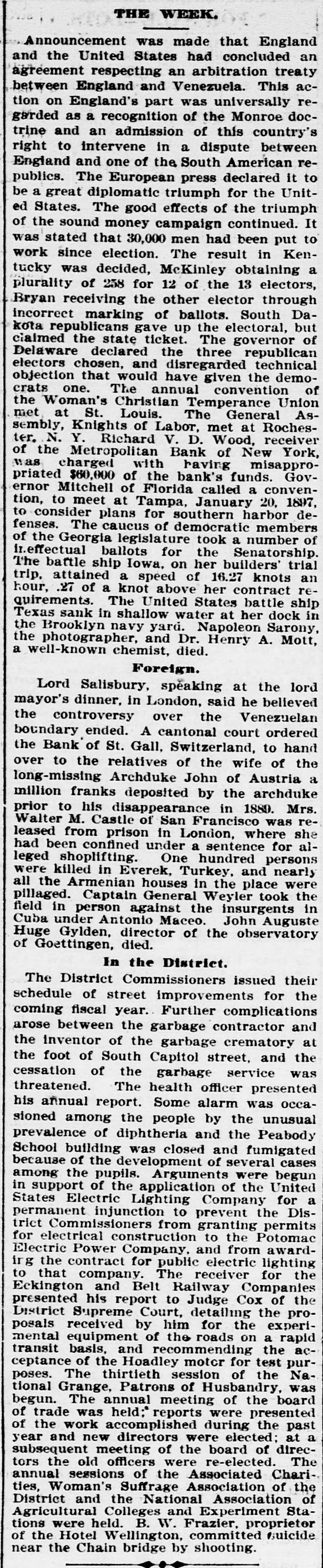
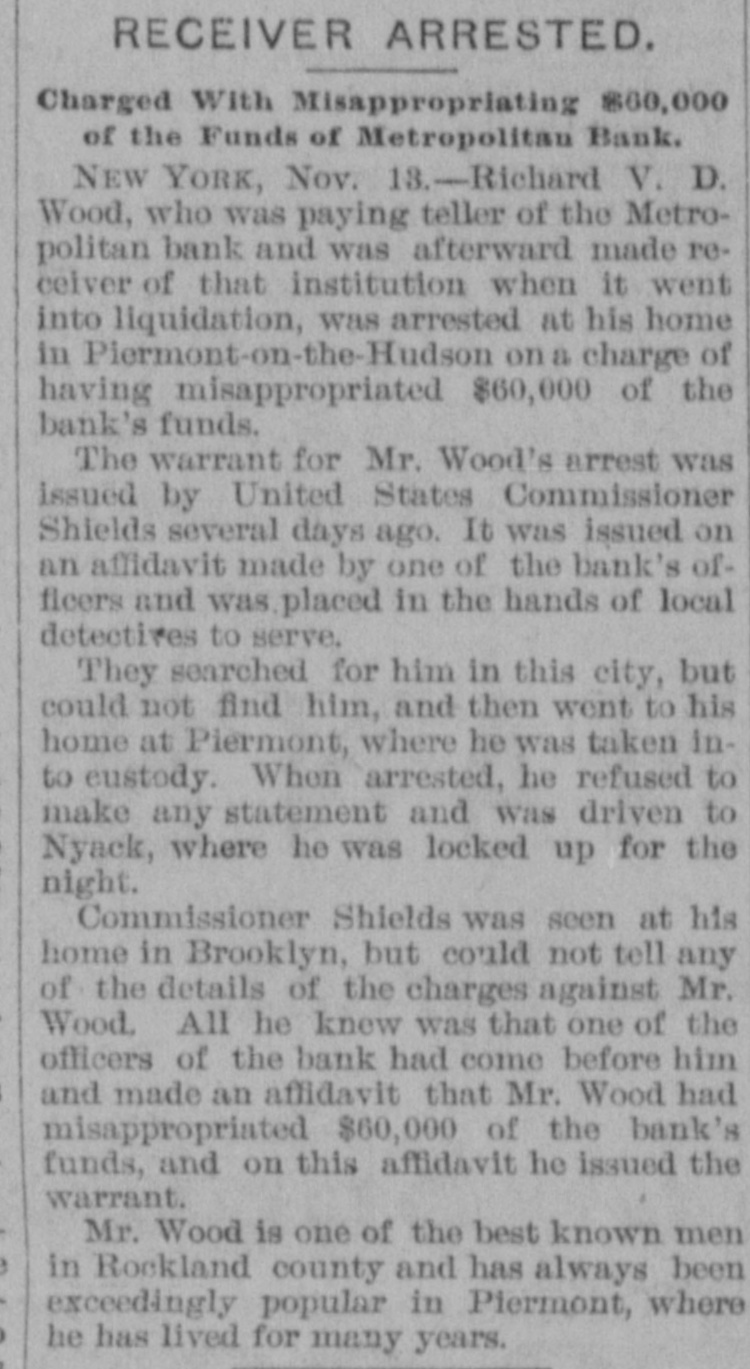
RECEIVER ARRESTED. Charged With Misappropriating 800,000 of the Funds of Metropolitau Bank. NEW YORK, Nov. 18.-Richard V. D. Wood, who was paying teller of the Metropolitan bank and was afterward made receiver of that institution when it went into liquidation, was arrested at his home in Piermont-on-the-Hudson on a charge of having misappropriated $60,000 of the bank's funds. The warrant for Mr. Wood's arrest was issued by United States Commissioner Shields several days ago. It was issued on an affidavit made by one of the bank's offleers and was placed in the hands of local detectives to serve. They searched for him in this city, but could not find him, and then went to his home at Piermont, where he was taken into eustody. When arrested, he refused to make any statement and was driven to Nyack, where he was locked up for the night. Commissioner Shields was seen at his home in Brooklyn, but could not tell any of the details of the charges against Mr. Wood. All he knew was that one of the officers of the bank had come before him and made an affidavit that Mr. Wood had misappropriated $60,000 of the bank's funds, and on this affidavit he issued the warrant. Mr. Wood is one of the best known men in Rockland county and has always been exceedingly popular in Piermont, where he has lived for many years.


Article from Evening Star, November 14, 1896

Click image to open full size in new tab

Article Text

THE WEEK. Announcement was made that England and the United States had concluded an agreement respecting an arbitration treaty between England and Venezuela. This action on England's part was universally regarded as a recognition of the Monroe doctrine and an admission of this country's right to intervene in a dispute between England and one of the South American republics. The European press declared it to be a great diplomatic triumph for the United States. The good effects of the triumph of the sound money campaign continued. It was stated that 30,000 men had been put to work since election. The result in Kentucky was decided, McKinley obtaining a plurality of 258 for 12 of the 13 electors, Bryan receiving the other elector through incorrect marking of ballots. South Dakota republicans gave up the electoral, but claimed the state ticket. The governor of Delaware declared the three republican electors chosen, and disregarded technical objection that would have given the democrats one. The annual convention of the Woman's Christian Temperance Union met at St. Louis. The General Assembly, Knights of Labor, met at Rochester, N. Y. Richard V. D. Wood, receiver of the Metropolitan Bank of New York, was charged with having misappropriated $60,000 of the bank's funds. Governor Mitchell of Florida called a convention, to meet at Tampa, January 20, 1897, to consider plans for southern harbor defenses. The caucus of democratic members of the Georgia legislature took a number of ineffectual ballots for the Senatorship. The battle ship Iowa, on her builders' trial trip, attained a speed of 16.27 knots an hour, .27 of a knot above her contract requirements. The United States battle ship Texas sank in shallow water at her dock in the Brooklyn navy yard. Napoleon Sarony, the photographer, and Dr. Henry A. Mott, a well-known chemist, died. Foreign. Lord Salisbury, speaking at the lord mayor's dinner, in London, said he believed the controversy over the Venezuelan boundary ended. A cantonal court ordered the Bank of St. Gall, Switzerland, to hand over to the relatives of the wife of the long-missing Archduke John of Austria a million franks deposited by the archduke prior to his disappearance in 1889. Mrs. Walter M. Castle of San Francisco was released from prison in London, where she had been confined under a sentence for alleged shoplifting. One hundred persons were killed in Everek, Turkey, and nearly all the Armenian houses in the place were pillaged. Captain General Weyler took the field in person against the insurgents in Cuba under Antonio Maceo. John Auguste Huge Gylden, director of the observatory of Goettingen, died. In the District. The District Commissioners issued their schedule of street improvements for the coming fiscal year. Further complications arose between the garbage contractor and the inventor of the garbage crematory at the foot of South Capitol street, and the cessation of the garbage service was threatened. The health officer presented his annual report. Some alarm was occasioned among the people by the unusual prevalence of diphtheria and the Peabody School building was closed and fumigated because of the development of several cases among the pupils. Arguments were begun in support of the application of the United States Electric Lighting Company for a permanent injunction to prevent the District Commissioners from granting permits for electrical construction to the Potomac Electric Power Company, and from awardirg the contract for public electric lighting to that company. The receiver for the Eckington and Belt Railway Companies presented his report to Judge Cox of the District Supreme Court, detailing the proposals received by him for the experimental equipment of the roads on a rapid transit basis, and recommending the acceptance of the Hoadley motor for test purposes. The thirtieth session of the National Grange, Patrons of Husbandry, was begun. The annual meeting of the board of trade was held;' reports were presented of the work accomplished during the past year and new directors were elected; at a subsequent meeting of the board of directors the old officers were re-elected. The annual sessions of the Associated Charities, Woman's Suffrage Association of the District and the National Association of Agricultural Colleges and Experiment Stations were held. B. W. Frazier, proprietor of the Hotel Wellington, committed suicide near the Chain bridge by shooting.