14148. Mechanics & Traders Savings Institution (New York, NY)

Bank Information

Episode Type
Run β†’ Suspension β†’ Closure
Bank Type
savings bank
Start Date
December 2, 1875
Location
New York, New York (40.714, -74.006)

Metadata

Model
gpt-5-mini
Short Digest
ca984818dd01ab2a

Response Measures

None

Description

Depositors made runs in Dec 1875; trustees invoked/considered 60-day notice and tried to reassure depositors. In June 1876 the NY Superintendent obtained an injunction (suspension) and proceedings for a receiver followed; a receiver was in place by July 1876 and the institution was later dissolved by court order in Dec 1877. Causes: initial panic tied to loss of confidence and internal disputes/concerns about solvency (bank-specific adverse information); suspension was by government action (injunction). Dates use newspaper publication dates when specific days mentioned.

Events (4)

1. December 2, 1875 Run
Cause
Bank Specific Adverse Info
Cause Details
Loss of depositor confidence after board discord and concerns about the accuracy of accounts; trustees had disagreements and rumors of weakness prompted withdrawals.
Measures
Trustees publicly asserted solvency; enforcement/consideration of 60 days' notice for large withdrawals; paying small and pressing claims without delay.
Newspaper Excerpt
A number of the depositors of the Mechanics and Traders' Savings Institution, at No. 283 Bowery, applied for their money yesterday. The banking rooms were crowded and the payments were made slowly...
Source
newspapers
2. June 12, 1876 Suspension
Cause
Government Action
Cause Details
Injunction obtained by the State Superintendent of Banks because of a reported deficiency arising from depreciation of Southern state securities held by the bank.
Newspaper Excerpt
Bank Superintendent Ellis, through AttorneyGeneral Fairchild, has begun proceedings for the appointment of a receiver... Justice Landon of the Supreme Court... has issued an injunction and an order to show cause why a receiver should not be appointed, returnable at Albany.
Source
newspapers
3. July 21, 1876 Receivership
Newspaper Excerpt
William J. Best, the receiver of the Mechanics' and Traders' Savings Institution ... makes the following statement... 'I am unable at present to form a reliable opinion as to the condition of this bank, as my schedules are not yet completed.'
Source
newspapers
4. December 27, 1877 Other
Newspaper Excerpt
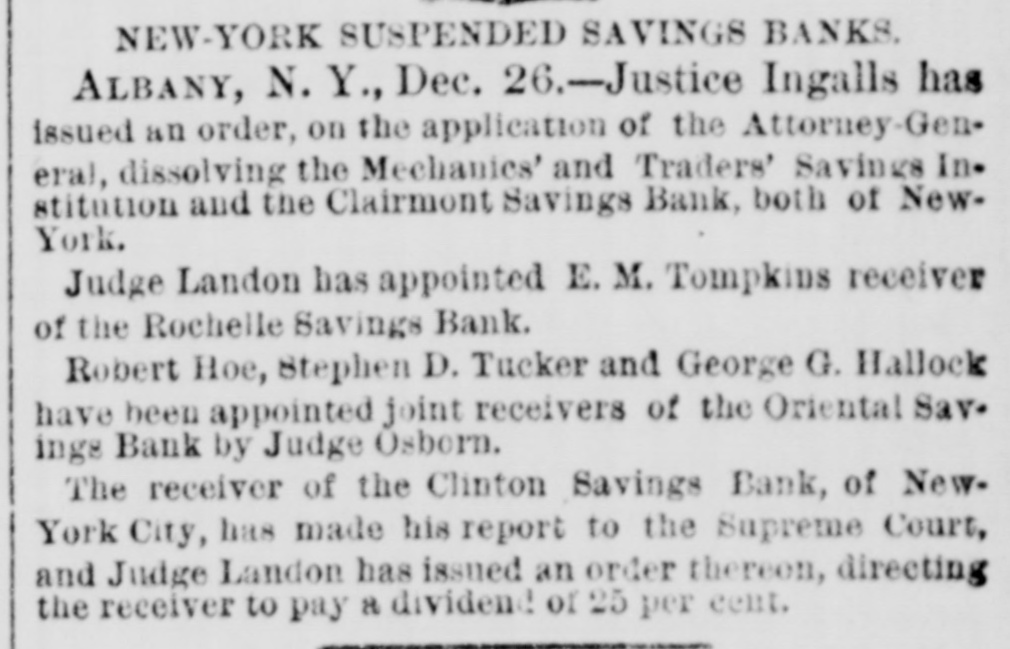
Justice Ingalls has issued an order, on the application of the Attorney-General, dissolving the Mechanics' and Traders' Savings Institution ... both of New York.
Source
newspapers

Newspaper Articles (22)

Article from New-York Tribune, September 23, 1873

Click image to open full size in new tab

Article Text

THE SAVINGS BANKS UNHARMED. SEVERAL TEMPORARY RUNS-GENERAL RESTORATION OF CONFIDENCE. Among the savings banks there was little variation in yesterday's business as compared with that of Friday, Saturday, and many previous days. A few of them alone experience anything like a run upon their deposits, and these not to such an extent as to excite anyapprehension as to solvency. All were seemingly prepared for the worst, and were most agreeably disappointed as the day passed on without any invasion of moment upon their cash assets. In anticipation of a general run, members of the police force had been assigned to duty in the different savings banks, and most of them had an easy task. The German savings banks were particularly quiet, a president in one instance informing a reporter that his bank had money on hand for any of his neigh bors who might be pressed. At number of the banks the rule requiring notice of the withdrawal of deposits over a stated sum was strictly enforced, the amount varying, and it is a somewhat singular fact that those meeting all demands were the only ones, with one or two exceptions, upon which there was any considerable run. EAST RIVERSAVINGS BANK. At the East River Savings Bank, on Chambers-st there was no variation in the usual business of the day President Whitney stated that during the morning a number of deposits had been withdrawn. and likewise a large number received, in neither case to such an ex tent as to excite comment. He knew nothing of the action taken by some of the savings banks' officers Sunday evening, and could not agree with them that any particular distinction at this time should be made in the withdrawal of deposits. His bank was paying all demands without regard to notice given. EMIGRANT INDUSTRIAL SAVINGS BANK. At the Emigrant Industrial Savings Bank a considerable amount of money was withdrawn during the day. Soon after the opening of the bank a large number of the depositors assembled, and the line formed to the paying teller's windows found constant accessions during the day. Controller David Ledwith stated that they were meeting all demands without regard to amount or notice, and apprehended no difficulty in continuing to so. Indeed, the present run was not 80 extensive as they had anticipated and had made preparations for. They were led to believe that it would be of short duration. The bank statement of Jan. showed an excess over liabilities of $790,129 The majority of those closing their accounts had comparatively small deposits, 80 that the amount paid out was not large. ATLANTIC SAVINGS BANK. At the Atlantic Savings Bank, on Chatham-st. there was no excitement; still. as a precautionary move, the officers have adopted the plan of requiring sixty days' notice in the withdrawal of all sums of over $100. CITIZENS'(SAVINGS BANK. The Citizens' Savings Bank experienced something of a run during the earlier port of the day. but before closing this had almost entirely subsided. They are paying all demands under $1,000. requiring notices for larger amounts. Those in the line early in the day were mostly new depositors, the older and heavier ones having perfect confidence] in the bank. President Quintard remarked, as an evidence of the class now withdrawing their deposits, that up to p. m. probably not more than $25,000 or $30,000 had been paid over the counter. He was satisfied that no extensive run need be anticipated, but was well prepared to meet all demands. ORIENTAL SAVINGS BANK. Everything was as quiet as usual at the Oriental Savings Bank, on Grand-st. President Buckmaster stated that many had visited the bank during the day to make inquiries as to their deposits, and had departed satisfled of their security-many, perhaps, coming with the intention of drawing, and returning with only such as they required for use. In such cases no advantage was taken of the law requiring notice of such intention. As evineing a general confidence in the institution, the cashier stated that a number of new accounts had been opened during the day, and that no inconsiderable amount had been received on deposit. BOWERY SAVINGS BANK. Before the opening of the Bowery Savings Bank it was evident that a run was to be made, from the erowd of depositors that gathered around the doors. The trustees met and decided to pay all claimstor the present, believing that the run would not last long and not interfere with,the regular business. It was understood that should it continue, they should take advantage of the 60 days' notice, even then using their own discretion in the matter, and paying larger claims, to relieve suffering or inconvenience. Throughout the day and evening the steady run continued, the number at no time greatly crowding the bank. One by one they drew their deposits, losing nearly three months interest by doing 80, 80 that they alone are the losers and the bank is in no way inconvenienced. A very great many before long were convinced of this fact, returned to the bank and again deposited their money, begging that their interest might not be sacrificed. An instance of this kind was mentioned by the President. Early in the morning a woman drew about $3,000, the earning of many years. Her anxiety to withdraw it was hardly equaled by her anxiety to return it a little later, and the loss to her of the $85 interest affected her very much. The scene deterred many from following her example. The President further stated that the majority of the deposits drawn were of small amount, and that the smaller the amount the more auxious the owners seemed to be to get it, so that up to 2 o'clock in the afternoon not more than $200,000 had been paid out, and in the same proportion during the afternoon and evening. The bank had more tban 60,000 depositors. He did not anticipate any extensive run. NEW AMSTERDAM SAVINGS BANK. The New-Amsterdam Savings Bank has experienced no run from its depositors. Yesterday was a quiet day at the bank, though considerable deposits were received. President Frohwein stated that they are more fortunate than a majority of the banks in having an abandance of small bills. having $116,000 in the safe. They proposed to help the neighboring banks as far as they could, and had already done so by furnishing one that morning with $20,000 in bills on bond security. MECHANICS AND TRADERS SAVINGS' BANK. At the Mechanics' and Traders' Savings Bank it was stated that some accounts had been closed during the day. and perhaps $20,000 drawn while the average deposits had been received. There had been no run sufflclent to excite comment. NEW-YORK SAVINGS BANK. The New York Savings Bank on Bleccker-st. was surrounded by an anxious crowd of depositors from the opening of the doors in the morning. o'elock the doorewere closed, the officers deeming that there were then as many in the building as they could pay during banking hours. Probably nearly 100 were then in walt ing. Little information could be gained, further than that considerable money had been withdrawn, and also many deposits received. The officers anticipate DO trouble in meeting all demands. PEOPLE'S SAVINGS BANK. At the People's Savings Bank the cashier stated that one or two large demands had been made, in which cases they had taken advantage of the rule requiring notice. In small amounts, $3,000 or $1,000 had been drawn, and more than made up by deposits. MANHATTAN SAVINGS BANK. At the Manhattan Savings Bank a long line of depositors presented themselves in the morning desirous of drawing out their money, but the bank readily met Nee Fourth Page
Article from New-York Tribune, December 2, 1875

Click image to open full size in new tab

Article Text

THE SAVINGS BANKS. sOLVENCY OF THE MECHANICS AND TRADERS' SAVINGS INSTITUTION - CLEAR SURPLUS OF $50,000-OTHER BANKS. A number of the depositors of the Mechantes and Traders' Savings Institution, at No. 283 Bowery, applied for their money yesterday. The banking rooms were crowded and the payments were made slowly, and after a careful examination and comparison of the pass-books with the ledger accounts of the bank. Some of the trustees were present endeavoring to reason with the frightened depositors, and to convince them of the solvency of the institution. To & reporter of THE TRIBUNE were shown the books and accounts of the bank, with a statement of the market value of the assets. A. T. Conklin, the President, and Henry C. Fisher, the Secretary, declared that the bank was perfectly safe, and could pay dollar for dollar of liabilities without any difficulty. Mr. Conklin stated that the bank wasexamined on April 1, 1874, by theState bank examiners, who reported a surplus of $82,333 18* The bank property was appraised by appraisers em. ployed by the Bank Department, and was put down to its lowest market value. The market value of the stocks, bonds, and other securities was obtained by the examiners after consultation with leading brokers in Wall-st. The annual report, Jan. 1,1875, said Mr. Conklin, was an honest and true statement of the bank's condition. It showed a large surplus over liabilities, and was in every particular corroot. A8 to the item of suspense account, bankruptcy claim, worth $20,000," that claim was well known by the trustees to be good beyond all question, and would yield, principal and interest, at least $25,000 in a few months. The lawsuit pending in relation to it was merely to determine which of two very rich men was liable to the bank for the full amount. The total market value of the stocks and bonds owned by the bank at the present time was largely in excess of the figures reported by the bank examiners. A profit of $20,000 had been made last year on the sale of Government securities a few days before the examination, which did not appear in the figures of the examiners. This sum alone met all the charges of salaries, taxes, and incidental expenses. Salaries had been reduced $5,000 last year, and a considerable reduction made in advertising, stationery, &c. In every way, Mr. Conklin continued. the bank had economized and sought to merit the confidence of its customers and the public. After deducting this suspense account of $20,000, and making due allowance for any unexpected shrinkage, the bank had a clear surplus of at least $50,000. The trustees had decided to enforce the 60 days' rule in extreme cases, but would pay small amounts and pressing claims without delay. This action had been taken in order to protect depositors in the payment of interest due them at the end of this month. Mr. Conklin said, in conclusion that there had been a want of harmony in the Board of Direction some time ago, and the attack on the bank might have originated from that cause. The Mutual Benefit and the Security Savings Banks continued open yesterday, without transacting any business. The Security, it is understood, will resume in two or three days. A receiver for the People's Savings Bank had not arrived at the bank yesterday afternoon, but it is not doubted that an appointment was made yesterday.


Article from The Sun, December 2, 1875

Click image to open full size in new tab

Article Text

THE END OF THE FRIGHT. Yesterday in those of the Savings Banks that have Stood R Run. The run on the North River Savings Bank, at 478 Eighth avenue, and on the Franklin, at 658 Eighth avenue, ceased entirely yesterday, the depositors being apparently satisfied with the assurance in THE SUN that the banks named could pay dollar for dollar. At the Mechanics' and Traders' Savings Bank. 283 Bowery, a number of depositors assembled in the morning, seemingly anxious to get their money. There was also a line of persons who wished to deposit money. The clerks seemed more accustomed to their work than on Tuesday, and paid rapidly and promptly. Toward evening the demand for money diminished. and a number went away expressing confidence in the institution. The President, Mr. A. Ξ“. Conklin, said : ** The statement of last year does not apply to the bank now. The suspense account of $39,127 07 represented money in litigation, which h is been recovered, and is now an asset. The judgment secured by real estate. $5,178 48. is against a man who is very wealthy, and is entirely good. Our stocks and bonds were placed at the lowest m rket value, and we can get more for them now. We hold no town bonds. Our bonds are all State, city, and county. As for our real estate, we have been offered $147,619.27 for the site, but in our report we put it at only the cost. $126,646.77. We have a genuine surplus of $80,000, for, unlike some other banks. our de: 08118 have increased this year instead of decreasing." Mr. Conklin added that the bank had met with some losses during the Presidency of a former trustee, which had been fully repaired. The bank. he said, would not require any sixty days' notice. but would pay everybody that called. He had received offers from other banks to take up all his securities. He added, Although I don't like a run. I would rather have it now than pay interest in January." The trustees of the Mutual Benefit Savings Bank have been discussing whether they will put in enough money to start the bank again. They will probably resolve to do SO.


Article from The Rutland Daily Globe, December 2, 1875

Click image to open full size in new tab

Article Text

Run on a Bank. NEW York, Dec. 1. There was a run to-day on the Mechanics' and Traders' savings bank, but everybody was paid and the deposits were quite large.


Article from New-York Tribune, December 3, 1875

Click image to open full size in new tab

Article Text

WEAK BANKS TO BE WEEDED OUT. SUPERINTENDENT ELLIS determined TO ERADICATE UNSOUND SAVINGS INSTITUTIONS-A RECEIVER FOR TWO BANKS. A reporter of THE TRIBUNE called on D. C. Ellis, State Superintendent of Banks, at the Metropolitan Hotel, last evening, and had a long conversation with him in relation to the condition of the savings banks in his city. Among other things Mr. Ellis said The worst is now over. I shall act carefully, cautiously and prudently, but I am determined that every unsound savings bank in this city shall be closed by the end of this month. The Examiners of the Bank Department have been hard at work for several months. and only solvent banks will remain in operation at the beginning of the new year. Very few banks will be closed. I shall compel the trustees of the weak banks to secure the depositors fully by advances of cash or approved securities. A very few banks whose deposits will not yield sufficient income to meet expenses must retire from business. The monetary condition of the country is against them. They are struggling against fate, and it is impossible for them to gain strength as there is nothing from which they can support themselves. Early in the present year I examined with great care every annual report of the banks, and marked those whose affairs seemed to require immediate examination. I came to this city and consulted with the leading bankers and merchants, and guided by their advice, I felt my way quietly but surely, until I understood fully the condition of things. There were so many millions of dollars involved, and the interests of thousands of depositors to be cared for and protected, that it would have been highly improper for me to have acted rashly. I have not acted on my own unsupported judgment, but have been advised by the best men in all positions in society. I am now undoing the bad work of Legislatures of previous years. With the new Savings Bank law and the difficulties in the way of getting charters, new banks will be established only when and where the needs of the people demand them. The new law also limits investments within a narrow circle. Mr. Ellis stated that the Security Bank had been found by the examiners to be perfectly safe, and he supposed it would resume business early next week. He had no fault to find with the bank. As to the Mutual Benefit Savings Bank, he remarked that the trustees were men of spirit and energy, and they had asked for a week's delay in which to put the bank on a sound basis. He had given them time, and the result would be made known by Monday. There was nothing against the Mechanics' and Traders' Savings Bank, and he had been surprised to learn that a run had been made on it. It is understood that Mr. French, a lawyer, has been appointed receiver of the People's and the Central Park Savings Banks. He will probably enter upon his duties to-day. There is so small an amount to be handled in the last named bank, that it was not considered advisable to appoint a separate receiver for it.


Article from New-York Tribune, June 12, 1876

Click image to open full size in new tab

Article Text

A SAVINGS BANK SHAKEN. APPLICATION FOR A RECEIVER. DEFICIENCY IN THE MECHANICS' AND TRADERS' SAVINGS INSTITUTION-DEPRECIATION IN SOUTHKRN STATE BONDS THE CAUSE-SUPERINTENDENT ELLIS APPLIES FOR A RECEIVER-THE BANK TRUSTEES WISH TO GO ON. Bank Superintendent Ellis, through AttorneyGeneral Fairchild, has begun proceedings for the appointment of a receiver to wind up the affairs of the Mechanics' and Traders' Savings Institution at No. 283 Bowery. It has become embarrassed, in the judgment of the Bank Superintendent, by the depreciation of its Southern securities. Justice Landon of the Supreme Court in the Schenectady district has issued an injunction and an order to show cause why a receiver should not be appointed, returnable at Albany to-morrow. This order was served on the officers of the bank on Saturday mor: ing, and the few depositors who called to make deposits or to draw out money were put off until Wednesday. There was no excitement and no run on the bank as the action of the Bank Superintendent and the Attorney-General had not been made public. A run was made on this bank last Fall, but was stopped on the statement of the officers that the value of the bonds and securities showed a large surplus over the liabilities to depositors. It is believed that this statement was correct at that time, but the Southern securities, composing a large portion of the assets, have steadily depreciated in value. In April, 1876, the bank was examined by George W. Reid, Bank Examiner, as required by law, and he reported to the Bank Superintendent that the bank was behind about $90,000, growing out of the depreciated market value of the bonds of the Southern States. A conference was then held between the bank officers and the Superintendent as to the way in which this deficiency could be made up, and the depositors be protected from loss. It is understood that the trustees refused to make themselves personally liable for the depreciation of these bonds, on the ground that the securities had been purchased in good faith, and were legal obligations of the States issuing them. The trustees claimed that it was a question of market value which they could not control, and the bonds would at some time in the future be worth their face. It might take a year, possibly several years, but the States finally would be obliged to pay them. The President of the bank and other officers have held several consultations with Bank Superintendent Ellis since the report of the examiner, but nothing could be agreed upon, and the Superintendent determined last week to close up the bank. Following are the resources and liabilities as reported 60 the Bank Department, Jan. 1, 1876: RESOURCES AND LIABILITIES.


Article from The Sun, June 13, 1876

Click image to open full size in new tab

Article Text

PRI E TWO CENTS. LOOKING AFTER BANK MEN THE MECHANI ICS AND TRADERS SAVINGS INSTITUTION. Enjoined by Judge Landon. at the Instance of the Superintendent of Bankine-The Institution's Latest Official Exhibit Republished At the instance of Mr. D. C. Ellis, SuperIntendent of the Banking Department, Judge Landon recently enjoined the Mechanics and Traders' Savings Institution of New York from doing further business. Notice of this injunetion was served on Saturday last, and Mr. Alfred T. Conklin, President of the Institution, went to Albany last night to make a statement of the bank's affairs, with a view of averting the appointment of a receiver. There can be no run upon the bank, Inasmuch as since last fall, when it sustained a run, it has availed itself of the right to demand from depositors sixty days' notice of withdrawal. The bank made a good statement at the time, and, as it paid checks on sixty days' maturity, the fears of depositors were momentarily calleted. The bank officers aver that it is as sound now as when the following report was made to the Bank Department on the 1st January last: Resources.-Bonds and mortgages $616,650 Stock investments: Stocks and bonds of States other than New York, cost 1,310,012 25 Banking house and lot, cost 79.093 50 Other real estate, cost. 58,748 08 Cash on deposit in Danks or trust companies 78.101 BY Cash on hand 15,000 00 Accrued interest 32 346 93 2,936 50 Interest due in less than SIX months Suspense account 89,127 or 5,354 as Judgment secured by real estate Deficiency based upon real estate at cost 5,628 31 and stock investments as market value Total $2,242,998 or $1,977,572 as Liabilities.-Amount due depositors Excess of cost over market value of stock investments 185,426 x 80,000 08 Loan had on Rochester city bonds Total $2,242,998 n Surplus based upon market value of real 9,530 is estate and stock investments This report adds that the Southern State bonds held by the bank cost $465,945.22, but were then worth in market only $236,976. In April last Mr. George W. Reid. bank examiner, reports ed to the bank superintendent a further decrease since January of about $90,000 in the market value of the Southern securities. The bank also reports at the present time a decrease since January last of $527,572 in the amount due dopositors. The bank's officers say that nearly all the Southern securities were bought prior to the war, when the credit of those States was good. and their bonds were not much below par. Others, among them Wm. H. M. Sistare, broker. of 24 Nassau street, say that nearly, if not all the bonds were purchased after the war, as depreciated rates, and that the subsequent fall has by no means caused the loss of a sum sumcient to cripple the bank. They insist that losses have been made on other securities; hence they demand that a full exhibit shall be made public. The South Carolina bonds now held by the bank are quoted at from 31 to 36 : North Carolinas, 111/6 to 60: Tennessees, 43 to 45: Alabama, 30 to 35. The question is asked whether these latter are railroad bonds, which the bank, under its charter, bad no right to purchase. The assertion is made that the State bonds did not, in general, cost more than eight or ten cents on the dollar more than the above quotations. Other savings banks rejected them as unsafe. It is said that the trustees had serious disagreements for some time, a number of them sustaining Mr. Alfred T. Conklin, the President, in his transactions, and that others, very much dissatisfied, repeatedly tried to effect the removal of Mr. Conklin, but without success. Some years ago the institution was a heavy loser by Atlantic Mall, as was the now exploded Third Avenue Savings Bank The stock had been worked up to about 115. and a loan of $175,000 was made at par for three months to O. W.Jocelvn on 1,750 shares. The price soon began to tali, and several complaining trustees urged that the loan should at once be called in. on the ground that it had been made in violation of the cbarter. Joceivn is said to have quieted the complaining trustees by arguments not specified. and the stock finally went down ta 20 and to 15. at which it was sold. Opinions are various regarding the percentage that can be paid to depositors should sue bank go into the bands of a receiver.


Article from The New York Herald, June 13, 1876

Click image to open full size in new tab

Article Text

A BANK IN TROUBLE. Another city savings bank has been enjoined from transacting any business for the present Bank Superintendent Ellis has obtained an injunction against the Mechanics and Traders' Savings Institution, No. 283 Bowery, near Houston street, on the ground of a doficiency in its resources, caused by the depreciation of certain Southern State securities held by the bank. The injunction order was Issued by Judge Landon. of the Supreme Court, and, together with an order to show cause why a receiver should not be appointed, was served on the bank officials yesterday. The order to show cause is returnable to-day at Albany. Last autumn there was a run on the bank, which was checked by the publication of a statement to the effect that the bank could more than meet its liabilities. But though the run terminated the bank suffered in its credit with prospective depositors, and since then the receipts have not been at all up to the expectations of the officers. At the beginning of the year the following statements of the bank's affairs was forwarded to the Bank Superintendent:RESOURCES AND LIABILITIES. Resources. $616,650 of Bonds and mortgages Stock investments:Stocks and bonds of States other than New 1,310,012 25 York, cost 70,093.50 Banking house and lot, cost 58,748.06 Other real estate, cost Cash on deposit in banks or trust com78,101 57 panies 15,000 00 Cash on hand 32,346.93 Accrued interest 2,936 50 Interest due less than six months 39,127 07 Suspense account 5,354.48 Judgment secured by real estate Deficiency based upon real estate at cost and stock investments at market value. 5,628 31 Total $2,242,998 67 Liabilities. $1,977,572 42 Amount due depositors Other Liabilities. Excess of cost over market value of stock investments $185,426 25 80,000 00 Loan had on Rochester city bonds Total $2,242,995 67 Surplus based upon market value of real estate and stock investments 9,530 13 At that time the bank held securities of the Southern States whose estimated market value was only $236,976, for which the sum of $465,945 22 had been paid. A HERALD reporter inquired of Mr. Alfred T. Conklin, the president of the institution, yesterday, what the present condition of the bank is, and was told in general terms that the depositors would get all that is due them. Mr. Conklin said, however, he could not tell what Southern securities they held without going over the books; but he proceeded to enumerate certain other securities that bad advanced in value since being purchased by the bank. Counsel will appear at Albany to-day on behalf of the bank, who will endeavor to show that, if let alone, it can settle its own aflairs with. out n receiver. On Wednesday morning, said Mr. Conklin, we shall know the result. News of the action of the Bank Superintendent not having yet reached the ears of the depositors, very few called during the day, although the bank now has on deposit about a million and a half of dollars. The action of Superintendent Ellis is the consequence of an investigation made last April.


Article from The New York Herald, June 14, 1876

Click image to open full size in new tab

Article Text

SUPREME COURT. ALBANY, June 13, 1876. In the Supreme Court, Special Term, Justice Osborne presiding, the case of The People vs. the Mechanics and Traders' Savings Institution, New York, came up on an order to show cause why an injunction should not be continued and a receiver for that institution appointed. The Attorney General appeared for the people. He said the accounts of the institution showed that the amount due depositors was $1,400,000, while the as sets of the bank were but $1,300,000, Mr. Creok, of Brooklyn, appeared for the defendants, and said the papers were served on him on Saturday, and ne wished to have the matter postponed so thus he might be heard on the merits. They were not insolvent, and he was informed that they had at least $100,000 surplus. He wished the injunction modified, as the interest on securities was becoming due and should be received. Current expenses were to be met, and he wished the Court to allow a margin not to exceed $3,000. The Court ordered the case to stand over until a week from to-day, at Hudson, and modified the injunction so as to enable the bank to receive the interest on securities. In other respects the injunction is to remain in force. The case of Cnarles H. Adams and Dudley Olcott vs. The Clifton Company and others, was up before Justice Oscorne this afternoon on a motion that the company be permitted to file a separate answer in the case. The action is brought to foreclose a mortgage for $60,000 on the company's property in Cohoes, given to secure $60,000 in bonds which had been issued. It was claimed that as only $37,000 of the bonds were actually sold, the balance of $23,000 cannot be held due on the mortgage, as claimed in the complaint. Mr. Stedman argued for and Mr. Miller in opposition to the motion, and the Court granted an order of reference to Charles T. F. Spoor to hear and determine, and also allows the Clifton Company to serve an answer and the plaintifis to amend their answer. CALENDAR. The following is the Supreme Court, Fourth Depart. ment, General Terin day calendar for June 14:-8, 13, 20, 22, 23, 29, 37, 41, 42 and 44.


Article from The New York Herald, July 7, 1876

Click image to open full size in new tab

Article Text

ANGRY DEPOSITORS. THE MECHANICS AND TRADERS' BANK-MEETING AT GERMANIA HALL LAST NIGHT. st a meeting of the depositors of the Mechanics and Traders' Savings Bank held last evening at Germania Hall, No. 192 Bowery, the committee of five, who PA appointed on June 29 last to investigate the affairs the ba. of presented the following as their report:That a receiver must he appointed, as the deficiency is such that it is impossible for the bank to go on and do business. And that they further recommend that the said receiver be appointed from the depositors-say one of the largest creditors of the institution, one who can give the requisite amount of bonds to oba Court. Several persons objected to the report, saying it was not full enough; that what they wauted to know was the exact financial state of the bank and how touch of their money they might expect to get out of it. The committee explained that they were willing to tell all they knew, but asked that this report be adopted in order that they might proceed 10 the business of selecting a suitable receiver at once. Mr. Underhill said, he called last Friday on the President of the Bank and asked for the book containing the list of bonds and mortgages. He was asked by what right such a demand was made and was finally taken into the back room, where be was allowed to look as IL Some of these mortgages were very good; but there were some very queer ones among them. There was oue transaction recorded where the bank had a mort. gage of $12,000 on n piece of property in Forty-Nith street, which mortgage was foreclosed at a cost of $5,600. The whole amount in bonds and mortgages is $397,450. a number of North Carolina and South Caro. lina bonds and about $80,000 in cash. The deficiency is about $137.000, though the bank officers say that there is a surplus of $6,500 The following resolutions were then offered and unanimously adopted: Resolved, That we. the depositors in the Mechanics and Traders' Savings Bank, being fully convinced that said bank is hopelessly involved. and ought not to be permitted so resurue business, unless the officers and trustees of the bank will come forward and at once make good their present deficiencies: also, in view of their having failed so to do thus far. the only question in the present aspect of its affairs is the appointment of a receiver for the institution; and as it is our earnest desire that the honorable Court appoint none to raid office of receiver but an honest. prudent, reliable business man from among and recommended by the depositors of the bank. Resolved, That a committee of five be appointed to select such n man and present his name to the depositors for their approval by vote. Resolved, That these resolutions be embodied in a peti. tion, with the name of the person selected us the depositors' choice for such office of receiver written therein, and that the petition be signed by the chairman and committee on behalf of said depositors, and presented to the Justice before whom this matter is pending. The committee was appointed. and, after an absence of twenty minutes, returned, and wished for an exteusion of time till this evening to report. The request was granted, and two more gentlemen were added to the committee. The meeting adjourned till this even. ing at seven o'clock.


Article from New-York Tribune, July 21, 1876

Click image to open full size in new tab

Article Text

MECHANICS' AND TRADERS' SAVINGS BANK. William J. Best, the receiver of the Mechanies' and Traders' Savings Institution, in reference to an article in yesterday's TRIBUNE in relation to that bank, makes the following statement: "I am unable at present to form a reliable opinion as to the condition of this bank, as my schedules are not yet completed. But I know that the statement that the depositors will receive but 25 cents is wholly incorrect. Such statements are calculated to occasion depositors unnecessary starm, and i therefore beg that you will contradict this one in your issue of to-morrow. I shall furnish you at the earliest possible moment with my official statement of the liabilities and the present market valuae of the assets."


Article from The New York Herald, July 22, 1876

Click image to open full size in new tab

Article Text

IMPORTANT TO DEPOSITORS. MECHANICS AND TRADERS' SAVINGS INSTITUTION, 283 Bowery. 1 To THE EDITOR OF THE HERALD:I earnestly desire that all of the depositors of this bank who can be reached should present their pass. books for comparison with the "dealers' ledger" and to be balanced. This should be done at once; otherwise I shall not be able to make a strictly trustworthy statement of the liabilities, which will determine the percentage that depositors should receive. The bank will be open daily from ten A. M. to three P. M., and next week open also on Monday, Wednesday and Friday evenings, from six to nine o'clock, to accommodate those who cannot call during the day. RespectWILLIAM J. BEST, Receiver. fully yours,


Article from The Sun, August 10, 1876

Click image to open full size in new tab

Article Text

CURIOSITIES OF CRIME. Nicholas Portius was sentenced to a year and a half imprisonment. yesteroay, in the G heral SesFIONS, for stealing $38 from his employer, a saloon keeper at 1,051 Third avenue. W m. H. H. Bennett was arraigned before Justice Morgan, yesterday. on a charge made by Win. J. Best. Receiver of the Mechanics' and Traders' Savings Bank, of having forged three grafts for $500, $890, and $90 respectively. purporting to be signed by Wm. B. Lynch a depositor. E. was committed without ball.


Article from Public Ledger, September 23, 1876

Click image to open full size in new tab

Article Text

Condition of the Suspended Mechanles and Traders savings Institution. NEW York, September 23.-The receiver of the Mechanics and Traders Savings Institution has made a statement of the condition of the bank to depositors, which shows a deficiency in assets of $342,816. He states that it is now well known that a number of the trustees have been insolvent for years past. They all neglected or mismanaged their trusts, and several for alleged services have withdrawn large sums of money for their own use. He further charges that the accounts have been willfully falsified fer nearly twelve years. Many of the investments, amounting to hundreds of thousands of dollars, were made in direct violation of law.


Article from The Daily Argus, September 23, 1876

Click image to open full size in new tab

Article Text

ROTTEN BANK SWINDLERS. A Fine Gang to Have Charge of Trust Funds NEW YORK, Sept. 23.-The - receiver of the suspended Mechanics' and Traders' Savings Institut on has made a statement of the condition of the bank to the depositors, which shows a deficiency in assets of $343,816. He states that it is now well known that a number of the trustees have been insolvent for years past and that all neglected or mismanaged their trusts, and several, for alleged services, have withdrawn large sums of money for their own use. He further charges that the accounts haye been wilfully falsified for nearly twelve years, and many of the investments. amounting to hundreds of thousands of dollars, were made in direct violation of the law.


Article from New-York Tribune, September 23, 1876

Click image to open full size in new tab

Article Text

SUSPENDED SAVINGS BANKS. FAITHLESS AND GRASPING TRUSTEES. THE STARTLING MISMANAGEMENT OF THE MECHANICS' AND TRADERS' SAVINGS INSTITUTION-EXTRAORDINARY TRANSACTIONS OF PRESIDENT AND TRUSTEES-RECEIVER BEST'S STATEMENT. William J. Best, Receiver of the suspended Mechanics' and Traders' Savings Institution, at No. 283 Bowery, has made a statement of the condition of the bank to the depositors, which shows a deficiency in the assets of $343,816 He estimates the amount which the depositors will receive at about 75 per cent of their respective claims. He says that "on Jan. 1, 1867, the institution had of United States bonds $1,400,000. Most of the other securities it owned were also of such a character as to be readily converted into cash. All told, it held only $83,100 of Southern bonds. In January last, and for several years previously, it had no United States securities. Instead, it owned $603,000 of the bonds of Tennessee, North and South Carolina, and Alabama. Of this amount $330,000 appear to have been purchased of Alfred T. Conkin's friends, O. W. Joslyn & Co. The purchases of and through this firm and the loan made to it on Atlantie Mail Steamship Company stock were sufficient to break the institution. The amount lost cannot be definitely determined, but it is safe to say that it exceeds $300,000." Mr. Best states that it is now well known that a number of the trustees of this institution have been insolvent for years past. All, he declares, have neglected or mismanaged their trusts, and several, for alleged services, have withdrawn large sums of money for their own use. He further charges that the accounts have been wilifully falsified for nearly twelve years. Many of the investments, amounting to hundreds of thousands of dollars, were made in direct violation of the law. "The loans to Jusiyn & Co.," the receiver says," have not even the shadow of legality. A large loan was made to this firm by Mr. Conklin in March, 1867 on Pacific Mail Steamship Company stock, and other loans of like character during the year. The loans out of which arise the loss of $152,000 appear to have been made on his own responsibility. No authority for them can be found in the minutes of either the Finance Committee or the Board of Trustees." The receiver presents several extracts from the minutes of the trustees showing appropriations of the depositors' money. Following are some of the items: Jan. 21, 1867. The examining committee (3 trustees) were voted each $800 per year; and the special examining committee," presumably trustees Gregory, Conklin, and Ross, $1,000 each for past services. Feb. 10. 1868. On motion of Mr. Gregory, trustecs Fenn and Sharet were given $300 each additional per year, for services as examiners. The president was also voted 800, as a member or the examining committee. May 11. Ira W. Gregory, chairman of the special examining committee, was voted $1,500 in full for his services as such chairman. The building committee were voted $1,000 each, and the committee on alterations and improvements $500 each. six years after the completion of the building. In 1868 Alfred T. Conkhn. the president, drew his pay as president, and member of the original building committee, and the examining committees, the whole amounting to $7,215. In 1870, on a report in favor by Messrs. Conklin and Gregory. the trustees agreed to purchase $600,000 of bonds of the Chattanooga and Alabama Railroad Company, but were subsequently enjoined by the Supreme Court from making the purenase. These bonds are now almost valueless. In 1871 M. V. Le Count, trustee, nominated himself for the position of telle, and was elected, at a salary of of $3,000. Mr. Le Count in 1874 was made a member of the Examining Committee, and was paid $1,200 per year for examining," in part, his own work as teller. The sams drawn by the trustees from 1863 to 1876, as shown by the receiver, amounted to $163,737, of which Mr. Conklin received $44,051, and Henry C. Fisher $51,576. There was paid for refreshments" $5,000. Following is is summary of the assets and liabilities: Approiced


Article from Pioche Daily Record, September 24, 1876

Click image to open full size in new tab

Article Text

BY TELEGR APH! SPECIAL TO THE PIOCHE DAILY RECORD BY WESTERN UNION LINE. EASTERN DISPATCHES. NEW YORK, Sept. 23.-The Times' Nashville dispatco says: During the speaking at Shelbyville, Tenn., yesterday. between Gen. John D. Porter, Derby B. Thomas and W. T. Yondby, the latter a colored citizen, Porter took exception to a statement made by Thomas and denounced him as a liar. Thomas immediately attacked Porter with a stick, when the latter drew a revolver. Friends instantly interferred and the collision between the two was prevented. The affair has created a great deal of excitement and Porter 18 seriously censured by many for carrying concealed weapons, thus violating one of the principal laws of the State. The following further details of the Hell Gate explosion on Sunday are published this morning. A gun will be fired from the Government scow 25 minutes before the explosion and a second gun a quarter of an hour later, when it 18 desirous for those living in the vicinity of the mines to open their doors and windows and leave their houses till after the explosion has taken place. About 53,000 pounds of explosives will be dis. charged, mainly dynamite. There is great excitement in the city on the subject. The Tribune's Washington dispatch has the following: The Attorney General says if the Democratic whites of the South insist upon organizing armed bands to intimidate the negroes and de. prive him of bis rights he sees no reason why negroes should not arm for their own protection and meet force with force. Nothern Republicans have hitherto urged the negroes to peacefulness and submission. If the Bourbons continue in their violent course a different policy may be adopted. The United States District Attorney of South Carolina and other persons who were to consult with Taft, did not arrive here until this morning. Taft left last night for Ohio without seeing them. The delegation has consequently gone to Philadelphia to confer personally with the President. They desire to have troops stationed in at least three of what are called up-country counties, to prevent intimidation of the negro vote. The President is expected here soon; his baggage has already arrived from Long Branch. NEW YORK, Sept. 23.-The explosion at Hell Gate is the talk of the people and papers. Many visitors braved the storm yesterday to look for the last time at the excavation. Not a few ladies walked with perfect coolness over the mine of fifty thousand pounds of the most destructive of known explosives. At ten o'clock last evening the wires were connected and taken in the bomb-proof. The shaft was then entirely clear of debris and the workmen ascended the stairs for the last time. When the miners reached the ground above, cheers were given for General Newton. Captain Mer cur, A. R. Boyle, Mr. Streidenger, and a successful blast. At 10:20, dispatches were sent to Washington that the work had been completed. At midnight Captain Mercur ordered the gate of the siphon opened, and Barney Boyle turned the valve. The water howled through the iron pipe, resounding through the galleries with the roar of Niagara. The work has been completed without an accident. All that remains is for a gentle inundation of the excavation. The lunatics who occupy the asylum buildings on a Ward's Island will be kept in the open air on Sunday afternoon. o The receiver of the suspended Mechanic's and Trader's Savings Bank has t made a statement of the condition of the h bank to the depositors, which shows the deficiency in the assets to be $343,816.


Article from Chicago Daily Tribune, September 24, 1876

Click image to open full size in new tab

Article Text

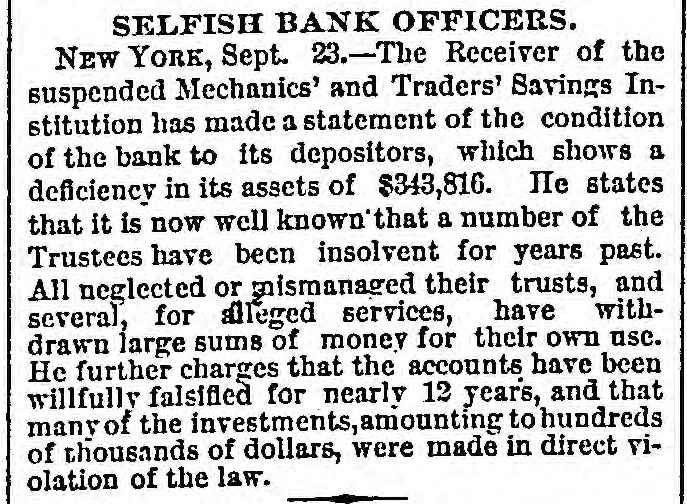
SELFISH BANK OFFICERS. NEW YORK, Sept. 23.-The Receiver of the suspended Mechanics' and Traders' Savings Institution has made a statement of the condition of the bank to its depositors, which shows a deficiency in its assets of $343,816. He states that it is now well known'that a number of the Trustees have been insolvent for years past. All neglected or mismanaged their trusts, and several, for alleged services, have withdrawn large sums of money for their own use. He further charges that the accounts have been willfully falsified for nearly 12 years, and that manyof the investments, amounting to hundreds of thousands of dollars, were made in direct violation of the law.


Article from The Daily Intelligencer, September 25, 1876

Click image to open full size in new tab

Article Text

excavation The patients who occupy the asylum building on Ward's Island will be kept in the open air Sunday afternoons The receiver of the suspended Mechances' at d Traders' Savings Institu. tion has made a statement of the condition of the bank to depositors, which shows the deficiency of 1.88 its to be $343,817 He states that it is now well known that a number of the trustees have been insolvent for years past, and all neglected or misused their trust. and several for alleged services have with drawn large sums of money for their own accounts. which have been wilfully falsified. For nearly twelve years many investments amounting to hundreds of thousands of dollars were made in direct violation of law. NEW YORK, Sept. 23.-The general verdict here among candid men is that Tilden's income tax explanation through bis law clerk has tailed of effect, because, while it carefully controverts so much of the Times' article charging him with evasion and perjury, as professed by the only estimate of his sources of a large revenue in excess of what hereturned it, the facts show by his oaths that his income in 1862 was $7,118, which is inconsistent with his more recent caths in the court proceedings, that he received in that year two fees of $10,000 each. It is argued that as the law required a full statement of the gross income, no claim of any tax through corporations in which Tilden invested covers the case. CINCINNATI, Sept. 23.-The Democrats are using every effort in Ohio, with some success, to concentrate the German Catholic vote in Tilden's favor, on distinctive sectarian grounds. This however, reacts by drawing to the other side Protestant Democrats who are disgusted and alarmed by the attempts a end ligious to achieve prejudices. political The through Republicans this State reare believed to be gaining in oyer the last gubernatorial comparative vote. NEW YORK, Sept. 23.-But little has been done by the commission appointed by Congress to determine the relative value of gold and silver thus far. Senator Jones says the sqbject which they are requested to consider is so comprehensive that it is difficult to find specialists who are qualified to give opinions worth employing in the report. The term expert, which is used in the first resolution, is one which the Commissioners think bad; there are no experts in the country who are sufficiently acquainted with the science of money to give authoritative replies to questions about the relative values of gold and silver; the policy of the restoration and the standard; the policy of conthe legal tender notes double tinuing standard, and current- other ly with the metallic kindred questions. The Commission will prepare forms which they will send to London and other European cities to be filled ont with answers from some of the ablest and most expert men in science there. Then the Commission can reach the question. It is one of such breadth and so many variations, said Jones, that it already seems a gigantic task to every member of the Commission, and it is considered very doubtful by them whether they will be able to make a satisfactory report by the 15th of January, 1877. Meetings, as yet, are only informal discussions. No two of the members have been able to agree on the methods to be pursued, and their plans will be still farther considered from day to day, until a course of procedure can be adopted.


Article from New Orleans Republican, October 22, 1876

Click image to open full size in new tab

Article Text

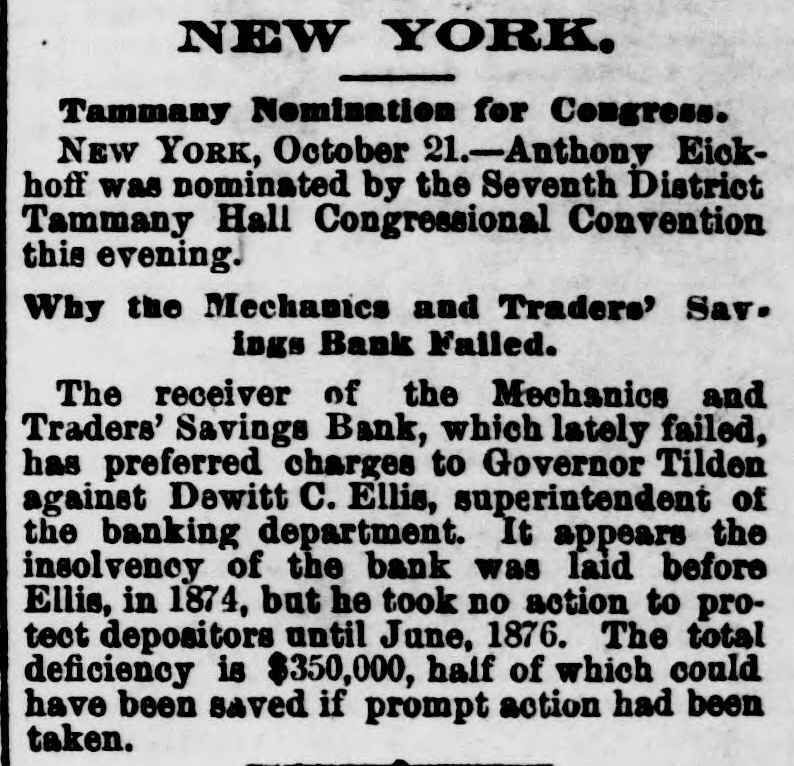
NEW YORK, Tammany Nomination for Congress. NEW YORK, October 21.-Anthony Eiokhoff was nominated by the Seventh District Tammany Hall Congressional Convention this evening. Why the Mechanics and Traders' Sav. ings Bank Failed. The receiver of the Mechanics and Traders' Savings Bank, which lately failed, has preferred charges to Governor Tilden against Dewitt C. Ellis, superintendent of the banking department. It appears the insolvency of the bank was laid before Ellis, in 1874, but he took no action to protect depositors until June, 1876. The total deficiency is $350,000, half of which could have been saved if prompt action had been taken.


Article from Chicago Daily Tribune, October 28, 1876

Click image to open full size in new tab

Article Text

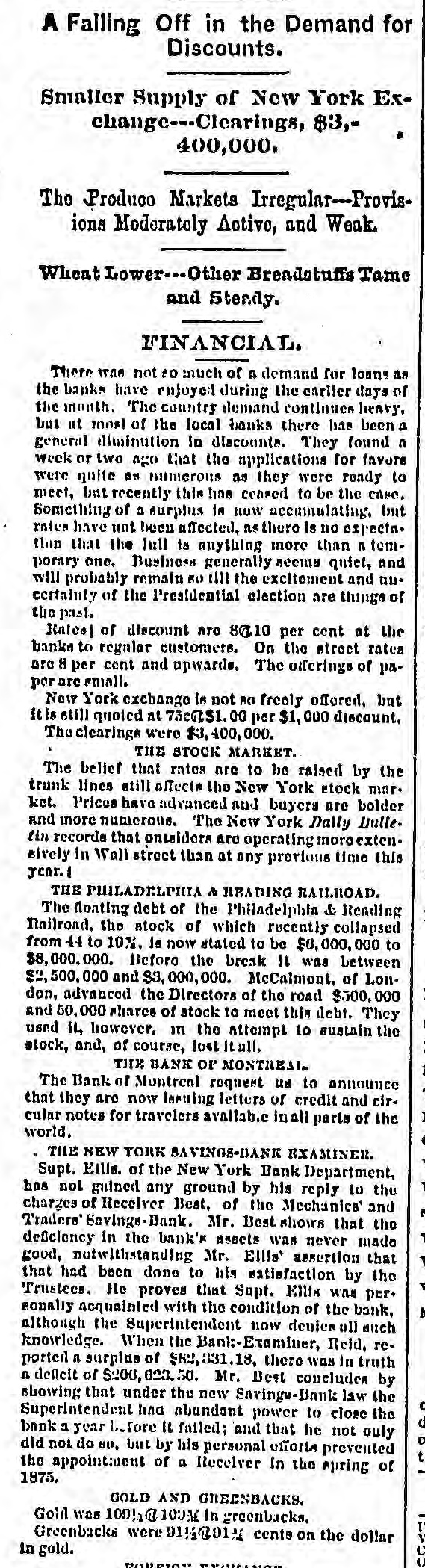
A Falling Off in the Demand for Discounts. Smaller Supply of New York Exchange---Clearings, $3,-400,000. The Produco Markets Irregular-Provisions Moderatoly Aotive, and Weak. Wheat Lower---Other Breadstuffs Tame and Stendy. FINANCIAL. There was not so much of a demand for loans as the banks have enjoyed during the earlier days of the month. The country demand continues heavy, but at most of the local banks there has been a general diminution in discounts. They found a week or two ago that the applications for favors were quite as numerous as they were ready to meet, but recently this has ceased to be the case. Something of a surplus is now accumulating, but rates have not been affected, as there is no expecta-tion that the full is anything more than a temporary one. Business generally seems quiet, and will probably remain so till the excitement and uncertainty of the Presidential election are things of the past. Rates of discount are 8@10 per cent at the banks to regular customers. On the street rates are 8 per cent and upwards. The offerings of paper are small. New York exchange is not so freely offered, but it is still quoted at 75c@$1.00 per $1,000 discount, The clearings were $3,400,000. THE STOCK MARKET. The belief that rates are to be raised by the trunk lines still affecte tho New York stock market. Prices have advanced and buyers are bolder and inore numerous. The New York Dally Bulletin records that outsiders are operating more extensively in Wall street than at any previous time this year. THE PHILADELPHIA & READING RAILROAD. The floating debt of the Philadelphia & Reading Railrond, the stock of which recently collapsed from 44 to 10%, is now stated to be $6,000,000 to $8,000,000. Before the break it was between $2,500,000 and $3,000,000. McCalmont, of London, advanced the Directors of the road $500,000 and 50,000 shares of stock to meet this debt. They used it, however, in the attempt to sustain the stock, and, of course, lost it all. THE BANK OF MONTRESI.. The Bank of Montreal roquest us to announce that they are now lasuing letters of credit and circular notes for travelers avallable in all parts of the world. THE NEW YORK SAVINGS-BANK EXAMINER. Supt. Ellis, of the New York Bank Department, has not gained any ground by his reply to the charges of Receiver Best, of the Mechanics' and Traders' Savings Bank. Mr. Best shows that the deficiency in the bank's assets was never made good, notwithstanding Mr. Ellis' assertion that that had been done to his satisfaction by the Trustees. He proves that Supt. Ellis was personally acquainted with the condition of the bank, although the Superintendent now denies all auch knowledge. When the Bank:-Examiner, Reid, reported a surplus of $62,331.18, there was in truth a deficit of $200,623.50. Mr. Best concludes by showing that under the new Savinga-Bank law the Superintendent haa abundant power to close the bank a year before it failed; and that he not ouly did not do so, but by his personal efforts prevented the appointment of a Receiver in the spring of 1875. GOLD AND GREENBACKS, Goid was 100ΒΌ@109ΒΎ in greenbacks. Greenbacks were 91Β½@91ΒΎ cents on the dollar in gold.


Article from New-York Tribune, December 27, 1877

Click image to open full size in new tab

Article Text

NEW-YORK SUSPENDED SAVINGS BANKS. ALBANY, N. Y., Dec. 26.-Justice Ingalls has issued an order, on the application of the Attorney-General, dissolving the Mechanics' and Traders' Savings Institution and the Clairmont Savings Bank, both of NewYork. Judge Landon has appointed E. M. Tompkins receiver of the Rochelle Savings Bank. Robert Hoe, Stephen D. Tucker and George G. Hallock have been appointed joint receivers of the Oriental Savings Bank by Judge Osborn. The receiver of the Clinton Savings Bank, of NewYork City, has made his report to the Supreme Court, and Judge Landon has issued an order thereon, directing the receiver to pay a dividend of 25 per cent.