14031. Henry Clews & Company (New York, NY)

Bank Information

Episode Type
Run → Suspension → Reopening
Bank Type
private
Start Date
September 23, 1873
Location
New York, New York (40.714, -74.006)

Metadata

Model
gpt-5-mini
Short Digest
d0e8b97d5d9bcbad

Response Measures

None

Description

Contemporary reports describe a heavy run and payment of large sums of greenbacks, followed by suspension on 1873-09-24. The house resumed/authored a resumption within days (by Sept. 27 reports) and by early 1874 was said to have resumed; later the firm (or its successors/related firms) faced bankruptcy/receivership in Dec 1874–1875. Classification focuses on the 1873 episode: run → suspension → reopening. OCR errors in some pieces corrected (e.g., Clewes sometimes printed as Clewes).

Events (4)

1. September 23, 1873 Run
Cause
Macro News
Cause Details
Panic stemming from the broader financial crisis (collapse of Jay Cooke & Co. and systemic money scarcity/greenbacks), producing heavy withdrawals from Clews & Co.
Measures
Paid out large amounts of greenbacks (reported ~ $1,000,000–$1,250,000 over several days); sought Treasury remittances and other loans; attempted to raise funds in market and offered securities as collateral.
Newspaper Excerpt
There has been, Sir, for four days steady, uninterrupted run upon us. We have paid out all our available currency ... In the four days preceding their suspension they having paid out to depositors the large sum of a million and a quarter dollars!
Source
newspapers
2. September 24, 1873 Suspension
Cause
Macro News
Cause Details
Unable to meet heavy demands for currency during the wider panic and scarcity of greenbacks; checks were returned by correspondent (Fourth National) leading to immediate suspension.
Newspaper Excerpt
At 2:45 the doors were closed, and it was known that Henry Clews & Co. had suspended payment.
Source
newspapers
3. September 27, 1873 Reopening
Newspaper Excerpt
As a remarkable instance of the restoration of confidence now going on, it is mentioned that the resumption of Henry Clews & Co. has received general indorsement, and most of their old customers have acquiesced in transferring their accounts to the new special accounts on their books.
Source
newspapers
4. December 1, 1874 Receivership
Newspaper Excerpt
Messrs. Henry Clews & Co., having failed to answer in bankruptcy proceedings, were adjudicated bankrupt, on petition of Arthur Cooper, trustee of their London firm, and fifteen creditors ...
Source
newspapers

Newspaper Articles (25)

Article from New-York Tribune, January 20, 1873

Click image to open full size in new tab

Article Text

JAY COOKE SUING HENRY CLEWS. A deputy sheriff called upon Henry Clews on Friday evening, in pursuance of an order by Judge Tappen of Brooklyn, with an order of arrest in case he refused to surrender into the Sheriff's hands $7,500 at the suit of Jay Cooke & Co. Mr. Clews paid the money under protest, and announced that he would contest the matter in the courts. The circumstances of the case, as stated by Mr. Cooke, are as follows: Gill Brothers bankers, of Philadelphia, deposited against their account with Henry Clews $16,100. Soon after Jay Cooke & Co. began an action against Henry Clews & Co. for the recovery of $7,500 of the $16,100 deposited with Clews & Co., on the ground that $7,500 of that sum had been obtained from them by Gill Brothers and deposited with Clews & Co. The latter claim that no part of the $16,100 deposited by Gill Brothers had been obtained by that firm from Jay Cooke & Co. Judge Tappen, at the suit of Jay Cooke & Co., appointed J. B. Haskin receiver, and Henry Clews refused to put the money in his hands. Judge Tappen then issued a peremptory order, with the above result.


Article from New-York Tribune, September 24, 1873

Click image to open full size in new tab

Article Text

a e SUSPENSION OF HENRY CLEWS & CO.-THEIR CHECKS THROWN OUT BY THE FOURTH NATIONAL BANK -TREASURY ACCOMMODATIONS UNAVAILING. A few minutes after p. m., a TRIBUNE reporter was informed by a bank president that Henry Clews & Co. had had a large amount of securities thrown back upon their hands, and would be compelled to suspend. The reporter at once visited the Fourth National Bank. which has acted for Henry Clews & Co. in the Clearing-House to learn the truth of the report. He was there informed that the bank had carried $160,000 in checks on Clews & Co., through Monday, but yesterday additional checks came in to the amount of $137,000. The firm bad no funds in bank to take up these checks, and though they offered securities of various kinds the bank officers did not feel justified in accepting them and taking up the checks. Mr. Clews had been closeted with Mr. Calhoun, the President, during the greater part of the day. using every means of persuasion in his power to prevail upon the President to take up his checks. This was without avail, and about 2 m. the checks were thrown back upon Clews & Co., and their suspension became inevitable. The reporter then went to the office of Clews & Co., expecting to find it closed. but it was still open and business was apparently proceeding as usual: but while the reporter was standing in the countingroom a check was presented to the paying teller which was returned by him to the person presenting it. Soon afterward another check was presented and met the same fate. At this moment Mr. Clews passed from his private office into the countingroom, and the reporter accosted him: Reporter-I hear the statement made that you about to suspend. Is it correct Mr. Clews-It not. Reporter- What is the meaning of the return of checks unpaid Mr. Clews-I can't tell you what it means. Mr. Clews then went out and walked up Wall-st. It was supposed by some that he had gone to make another effort to obtain funds; by others that he was simply getting out of the way before the announcement of his failure should be made public. In a few moments-at 2:45-the doors were closed, and it was known that Henry Clews & Co. had suspended payment. The house was formerly known as Livermore, Clews & Co., and in 1865 became Henry Clews & Co. L. S. Fowler is the second member of the firm. CHAOS IN THE HOUSE. In an instant a crowd collected. The news seemed to spread like the wind. A number of dapper young messengers bounced into the doorways, unmindful of the crowd and seemingly intent only on reaching the teller's desk before the windows were closed at 3 p.m. Quite a crowd," said one to a bystander. What's the matter 9" "Matter? Clews has suspended!" Each messenger blew a long whistle and took from his pocket a heavily laden deposit book. Wanted to deposit these," said one, "but I guess we can wait." In and through the rooms and doorways, the crowd thronged, lounging on the handsomely-cushioned sofas, and stretching their legs across the black walnut desks. One old gentleman became the center of an interested group in the reception room by his lively denunciation of the banker. "I had Government said and Clews me to them Railway bonds. bonds," newly-broken for Alabama he, persuaded He has change been dabbling too much in these rotten carpet-bag securities, and so I am in for it." He was somewhat violent in his gesticulations and loud in his language, and an affable friend of the firm soon persuaded him to withdraw. Henry Clews appeared at the bank soon after his walk, flushed and excited. He made no reply to the reporter who accosted him, but strode rapidly through the outer rooms to his room in the rear of the glass-cased counting-room. Here he remained for some time, and then again plunged into the crowd and was seen pushing through the busy groups in Wall-st., intent apparently on his own thoughts. In the mean time the business, such as it was, of the banking house of Henry Clews & Co. was left to the bewildered clerks, who peered through the closed windows upon the curious crowd in seeming doubt as to whether they should open the windows and resume on their own account or not. Mr. Greenough, the managing clerk, busied himself as far as he could, in settling the accounts of the day, but even he had the bewildered air common to them all. " Do you think you will pay to-morrow 9" asked one of the check-holders, who had come in half an hour late. Pay to-morrow ?" repeated the wretched clerk with an abstracted air; 'pay Oh, yes, we are expecting remittances every moment." Among the substantial men who came in to condole with the firm were Henry G. John and but they were to Hoey afflicted others, withdrew. unable Stebbins, At about afford much consolation, and BOOD o'clock policemen cleared the halls and took up their positions at the front door. My GOVERNMENT FAVORS RECEIVED. On Saturday morning when it was announced of that the Treasury would purchase 10,000,000 bonds the Union Trust Company could not obtain any greenbacks until 12 o'clock, but it is stated that at 10 o'clock Henry Clews & Co. received large packages of greenbacks from the Sub-Treasury, which were being opened in their office at that hour. of Whether this was for money, paid for purchases bonds of Henry Clews & Co. 'OVERBORNE BY A SCARCITY OF GREENBACKS." The managing clerk, Mr. Greenough, who has been familiar with the books and details of, the business infor several years, made the following formal statement to a TRIBUNE reporter: a "There has been, Sir, for four days steady, uninterrupted run upon us. We have paid out all our available currency and find ourselves We to-day at the end of all our available money. could simply pay no more, and we closed our doors." Q. What amount do you think you paid out in that time A. A million and a.quarter in greenbacks. We had no banks to back us, although we have all the duties and responsibities of a national bank, and we could not stand it. Q. Was the suspension occasioned at all by railway investment or speculation A. Not at all we had made none we were simply overborne by the of we have ample to scarcity greenbacks; securities not availmeet every liability, but the securities are able.


Article from New-York Tribune, September 24, 1873

Click image to open full size in new tab

Article Text

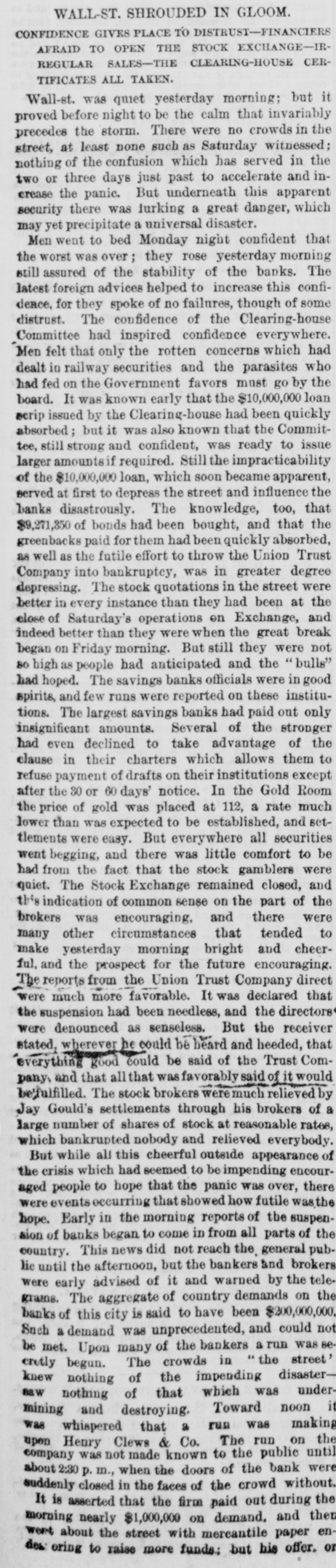
WALL-ST. SHROUDED IN GLOOM. CONFIDENCE GIVES PLACE TO DISTRUST-FINANCIERS AFRAID TO OPEN THE STOCK EXCHANGE-IRREGULAR SALES-THE CLEARING-HOUSE CERTIFICATES ALL TAKEN. Wall-st. was quet yesterday morning; but it proved before night to be the calm that invariably precedes the storm. There were no crowds in the street, at least none such as Saturday witnessed; nothing of the confusion which has served in the two or three days just past to accelerate and increase the panic. But underneath this apparent security there was lurking a great danger, which may yet precipitate a universal disaster. Men went to bed Monday night confident that the worst was over; they rose yesterday morning still assured of the stability of the banks. The latest foreign advices helped to increase this confidence, for they spoke of no failures, though of some distrust. The confidence of the Clearing-house Committee had inspired confidence everywhere. Men felt that only the rotten concerns which had dealt in railway securities and the parasites who had fed on the Government favors must go by the board. It was known early that the $10,000,000 loan scrip issued by the Clearing-house had been quickly absorbed; but it was also known that the Committee, still strong and confident, was ready to issue larger amountsi if required. Still the impracticability of the $10,000,000 loan, which soon became apparent, served at first to depress the street and influence the banks disastrously. The knowledge, too, that $9,271,350 of bonds had been bought, and that the greenbacks paid for them had been quickly absorbed, as well as the futile effort to throw the Union Trust Company into bankruptcy, was in greater degree depressing. The stock quotations in the street were better in every instance than they had been at the close of Saturday's operations on Exchange, and indeed better than they were when the great break began on Friday morning. But still they were not 80 high as people had anticipated and the "bulls" had hoped. The savings banks officials were in good spirits, and few runs were reported on these institutions. The largest savings banks had paid out only insignificant amounts. Several of the stronger had even declined to take advantage of the clause in their charters which allows them to refuse payment of drafts on their institutions except after the 30 or 60 days' notice. In the Gold Room the price of gold was placed at 112, a rate much lower than was expected to be established, and settlements were easy. But everywhere all securities went begging, and there was little comfort to be had from the fact that the stock gamblers were quiet. The Stock Exchange remained closed, and this indication of common sense on the part of the brokers was encouraging, and there were many other circumstances that tended to make yesterday morning bright and cheerful, and the prospect for the future encouraging. The reports from the Union Trust Company direct were much more favorable. It was declared that the suspension had been needless, and the directors were denounced as senseless. But the receiver stated, wherever he could be heard and heeded, that everything good could be said of the Trust Company and that all that was favorably said of it would befulfilled. The stock brokers were much relieved by Jay Gould's settlements through his brokers of a large number of shares of stock at reasonable rates, which bankrupted nobody and relieved everybody. But while all this cheerful outside appearance of the crisis which had seemed to be impending encouraged people to hope that the panic was over, there were events occurring that showed how futile wasth hope. Early in the morning reports of the suspension of banks began to come in from all parts of the country. This news did not reach the general publie until the afternoon, but the bankers and brokers were early advised of it and warned by the telegrams. The aggregate of country demands on the banks of this city is said to have been $200,000,000. Such a demand was unprecedented, and could not be met. Upon many of the bankers a run was secretly begun. The crowds in the street knew nothing of the impending disastersaw nothing of that which was undermining and destroying. Toward noon it was whispered that a run was making upon Henry Clews & Co. The run on the company was not made known to the public until about 2:38 p. m., when the doors of the bank were suddenly closed in the faces of the crowd without. It is asserted that the firm paid out during the morning nearly $1,000,000 on demand, and then went about the street with mercantile paper endes oring to raise more funds: but his offer. or


Article from New-York Tribune, September 24, 1873

Click image to open full size in new tab

Article Text

THE SITUATION. Though the panic broke out afresh, yesterday afternoon, we are far better off than the panie-mongers can believe. On careful examination, the wild alarm into which the Street was thrown is found to have little larger occasion than the failure of Henry Clews & Co., and a few out-oftown failures and runs. Clews & Co. made a gallant fight, and, all things considered, held out better than could have been expected. The country failures everybody should have anticipated. Four such banking houses as those of Jay Cooke & Co., in New-York, Philadelphia, and Washington cannot suspend at the outset of a New-York panic, when nobody is prepared for it, without gravely embarrassing scores of small banks all over the country. But the situation out of town proves far better than the alarmed brokers and private bankers believed last night. The Petersburg suspension is not alarming; the report of great trouble in Chicago is false; in Philadelphia and Pittsburgh the prospects are better; Senator Palmer denounces the story of a run on his bank at Amenia as unfounded; the runs are over in Albany, Trenton, and Washington. Courage, then ! The scare is far worse than the hurt. But we have no purpose to deceive our readers by underrating the gravity of the crisis. There is no reason for further panic and no sense in it. But we would be unreasonable if we expected, after what has happened, that no brokers with worthless stocks, no private bankers with wild-cat securities, should yet suspend. We must learn not to get into a fresh panic over every one -that is all. Our leading banks are sound. Practically they have stopped paying out legal tenders, and are thus nursing their reserves, while continuing to afford facilities for business. A great deal of liquidation is going on. The reports about serious trouble among dry goods men prove unfounded. Capitalists and that large class who keep small sums at hand watching for chances to invest legitimately at low prices, have now their opportunity, and we urge them to come forward. They can make large profits for themselves and greatly relieve the Street, by buying freely at the low rates now ruling. If you have money to invest, go to Wall Street and buy stocks that represent solid property today. If you have not, keep away, and do n't add to a foolish panic by your needless presence.


Article from New-York Tribune, September 24, 1873

Click image to open full size in new tab

Article Text

# THE PANIC EXTENDING. IN ILLINOIS. CHICAGO HOPEFUL-SLIGHT RUN ON THE BANKS. [BY TELEGRAPH TO THE TRIBUNE.] CHICAGO, Sept. 23. -The day has been one of great anxiety, though of a hopeful character. Since noon on Monday, there was a brightening of prospects. The savings banks, which yesterday inexorably demanded the usual notice, to-day made concessions to depositors and in many instances waived the notice and paid them in full. There was no serious crowd at any of these institutions. The business done at the Clearing-house to-day was comparatively small, and all the banks promptly paid their balances. There was perhaps some distrust of a few institutions, but there was no appearance of a run for deposits. Notwithstanding the seeming increase of confidence, there was anxiety. Statements that currency had been shipped hither from New-York, and that it would arrive to-morrow, was encouraging. Just about the time the banks closed business, the failure of Henry Clews & Co. of New-York was announced. Distrust of to-morrow was freely expressed, and the night closed in with feverish anxiety as to what will be the condition of affairs in New-York to-morrow. Wheat declined to-day five cents, closing at 97c. There was some complaint among sufferers on 'Change that the banks were refusing to carry grain, and were forcing holders to sell. The fall of wheat since the failure of Jay Cooke has been from $1 13⁄4 to 97 cents. There are 2,000,000 bushels bought to arrive. Considering the action of the banks, there was a motion yesterday, and again to-day, to adjourn and close the sessions of the Board of Trade, but it was rejected. There is much talk to-night of forcing the motion through to-morrow, but the cool members of the Board oppose and will probably defeat it, unless there be bad news from New-York in the morning. Everything here depends on the condition of affairs in New York. Unless there be a general break down there, Chicago will maintain herself. If the banks of New-York are not imperiled by the failure of Henry Clews & Co., none of the particulars of which are yet known here, there will be no failure of the banks of Chicago. # NO FAILURES OF GRAIN DEALERS IN CHICAGO-END OF THE RUN ON SAVINGS BANKS. CHICAGO, Sept. 23. -A report gained circulation here to-day that there were rumors in New-York of the failure of several heavy grain dealers in this city. There is not the slightest foundation for the report, as there have been neither failures nor rumors of any here. The slight run that began on some of the savings banks yesterday has entirely subsided, and the banks are now paying those who do call for their deposits without asking any notice.


Article from New-York Tribune, September 24, 1873

Click image to open full size in new tab

Article Text

THE MONEY MARKET. TUESDAY, Sept.23-P.M. The day opened with an apparently cheerful feeling in every direction, and as the day advanced the prospects of a return to the normal condition of the street become more hopeful. There was no heavy run upon any of the banks or banking-houses, while the banks were transacting business with regularity, certifying checks for large sums and paying currency for small ones, and their seemed to be no fears of their ability to weather the storm-at least all save two or three. They all went through the Clearing-house without difficulty, and this, with the payment of over $3,000,000 of greenbacks from the Treasury for bonds purchased, added to the hopeful feeling of the street. Later in the day. however, mutterings of a financial storm brewing in the West were heard, accompanied by rumors of failures and bank suspensions in some of the Middle, Southern, and Western States, and of failures of certain dry goods houses in this city. This being supplemented by the announcement of the failure of Henry Clews & Co., and the rumored failure of other banking-houses. changed the buoyant feeling which had prevailed earlier in the day to one of gloom and doubt as to what the morrow may bring forth. The announcement of the failure of Henry Clews & Co., however, need excite no fears as to the stability of our strictly first-class banking-houses. Their capital was never a large one; but they were extended over a great deal of surface, and their fame. such as it was. had not been derived from sources likely to inspire more than ordinary confidence here in NewYork, however it may have induced non-residents to deposit with the house. They must have had several hundred thousand dollars of deposits, and their failare is doubtless immediately due to the fact that they were called upon to pay. Having been recently made our Government Agents in London in place of the Barings, no doubt their credit received some enhancement from this fact; and many new parties were perhaps induced to open accounts with a house which our Government had seemed to recognize as stronger and safer than that of Messrs. Baring Brothers. What the Government may lose by this failure we may perhaps know at some day in the distant future. It IS a hopeful sign of the times that the stock brokers are making, as fast as possible, amicable settlements with each other, and are thus gradually approaching asolution of the greatest of our immediate difficulties. While there are 80 many outstanding differences between them, it would seem to be folly to open the Exchange Board, since those who have stocks to receive and those who have stocks to deliver would necessarily be ranged on opposite sides, and there would be perfectly distinct and decidedly fierce bull and bear parties immediately on the reopening of the board. Therefore, as the immediate reopening of the Exchange would, in the opinion of the clearest heads in the street, result in the failure of a very large number of stock houses, it is presumed that the Governing Committee will delay the opening till such time as the great mass of stock contracts shall have been adjusted by private arrangement. A small knot of outside brokers extemporized a veritable open board" in the street in front of the Stock Exchange, where a few transactions were made at the following prices :


Article from Eureka Daily Sentinel, September 25, 1873

Click image to open full size in new tab

Article Text

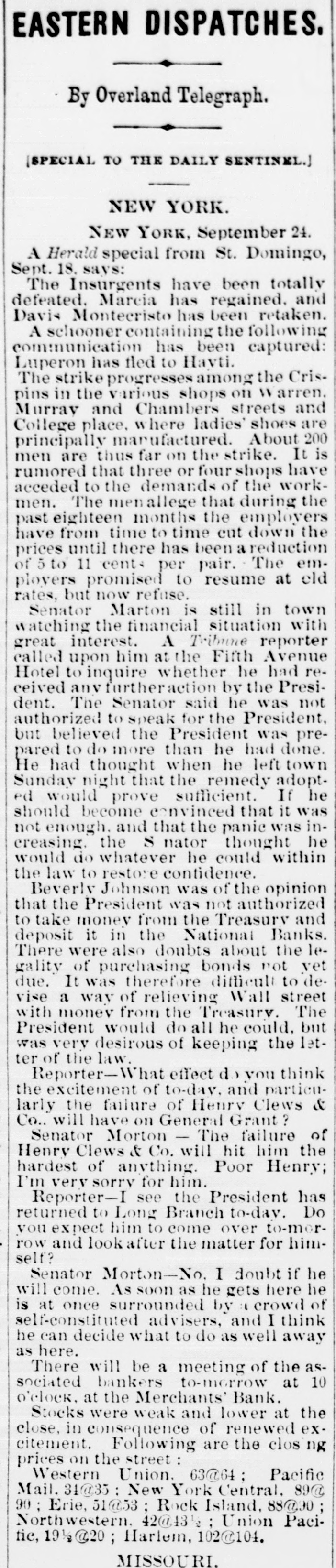
P By Overland Telegraph. |SPECIAL TO THE DAILY SENTINEL.] NEW YORK. NEW YORK, September 24. A Herald special from St. Domingo, Sept. 18. says: The Insurgents have been totally defeated. Marcia has regained. and Davis Montecristo has been retaken. A schooner containing the following communication has been captured: Luperon has fled to Havti. The strike progresses among the Crispins in the various shops on Warren. Murray and Chambers streets and College place. where ladies' shoes are principally marufactured. About 200 men are thus far on the strike. It is rumored that three or four shops have acceded to the demands of the workmen. The menallege that during the past eighteen months the employers have from time to time cut down the prices until there has been a reduction of 5 to 11 cents per pair. The employers promised to resume at old rates, but now refuse. Senator Marton is still in town watching the financial situation with great interest. A Tribune reporter called upon him at the Fifth Avenue Hotel to inquire whether he had received any furtheraction by the President. The Senator said he was not authorized to speak for the President, but believed the President was prepared to do more than he had done. He had thought when he left town Sunday night that the remedy adopted would prove sufficient. If he should become convinced that it was not enough. and that the panic was increasing. the S nator thought he would do whatever he could within the law to restore confidence. Beverly Johnson was of the opinion that the President was not authorized to take money from the Treasury and deposit it in the National Banks. There were also doubts about the legality of purchasing bonds not vet due. It was therefore difficult to devise a way of relieving Wall street with monev from the Treasurv. The President would do all he could, but was very desirous of keeping the letter of the law. Reporter-What effect do you think the excitement of to-day. and partienlarly the failure of Henry Clews & Co.. will have on General Grant? Senator Morton - The failure of Henry Clews & Co. will hit him the hardest of anything. Poor Henry; I'm very sorry for him. Reporter-I see the President has returned to Long Branch to-day. Do you expect him to come over to-morrow and look after the matter for himself? Senator Morton-No. I doubt if he will come. As soon as he gets here he is at once surrounded by : crowd of self-constituted advisers, and I think he can decide what to do as well away as here. There will be a meeting of the associated bankers to-morrow at 10 o'clock. at the Merchants' Bank. Stocks were weak and lower at the close, in consequence of renewed exeitement. Following are the clos ng prices on the street : Western Union. 63@64; Pacific Mail. 31@35: New York Central. 89@ 90 : Erie, 51@53 Rock Island, 88@30 Northwestern. 42@43 : Union Pacitic, 19 1 @20 Harlem, 102@104. MISSOURI,


Article from Nashville Union and American, September 25, 1873

Click image to open full size in new tab

Article Text

card on their door gives the failure of Henry Clews & Co. as the cause, but states that the firm will be all rightjin a few days. The mining classes are large depositors, but have not yet learned of the suspension. Much excitement exists among bankers and business men.


Article from The Pulaski Citizen, September 25, 1873

Click image to open full size in new tab

Article Text

The Wall Street Failures. The recent financial failures in New York created an unprecedented panic. For several days the dispatches contained nothing scarcely but the details of the great disaster. The country has never before witnessed such a spectacle. There were several small failures a week or ten days before the great crash, which were only rain-drops preceding the great storm which followed the fall of Jay Cooke & Co., the great millionaire bankers, whose financial operations during and since the war have been unprecedented. The government has negotiated loans amounting to millions upon millions through this firm, and it has also been the financial agent of numerous banking institutions throughout the country, Including many of the freedmen's saving Banks in the South. No banking house in America could have wide-spread alarm and failure or as disaster produced'sue by suspension this house has done. The immediate effect on Wall Street was appalling. Such wild excitement was never seen before. Banks and Bankers who felt confident and secure in the morning were closed and crushed by evening. in Undue speculation fancy and the stocks failures and bonds was the cause, produced a tumble in all kinds of stocks. The Government came in and took millions up thirty of bonds to better ease the pressure, and the feeling was afterwards. Prominent among the list of failures, after Jay Cooke & Co., came Richar Schell, Vermilye & Co., Fisk & Hatch, N. Y. Warehouse and Security Co., Kenyon, Cox & Co., &e., &c., New York, the First National Bank, Washington, &c., &c. Many others are in the list, but they are mostly small fry. The house of Jay Cooke & Co. was one of National reputation, and its failure, as before stated, will have a widespread influence upon other banking init was or stitutions agent correspondent, of which of the which financial there were thirty in the South, as follows: Alabama, 4; Arkansas, 2; Georgia, 6; Keutucky, 2; Louisiana, 1; N. Carolina, 1; S. Carolina, 5; Texas, 2: Tennessee, 3; Virginia, 3; West Virginia, 1. These are nearly all Freedmen's Savings and Trust Companies, and the probability is that the freedmen have lost considerably by the failure of their agent. On Saturday Commodore Vanderbilt proposed to come to the rescue with ten millions if the government would place thirty millions at the disposal of the New York banks. The President declined. Still the Secretary of the Treascontinued to up ury take bonds to be- the amount named above, and it was lieved on Monday that the breakers had been passed and confidence would soon be restored. LATER. The failure of Henry Clews & Co. at 3 o'clock on Tuesday created another panic. A dispatch says that confidence had been restored and the banks were doing business as usual, and just as the street was beginning to feel that all was safe, the painful rumor spread like wild-fire that Henry Clews & Co. had failed. This created as much excitement as the failure of Jay Cooke & Co., and at the close of business Tuesday evening the panic was as great as ever.


Article from Vermont Phœnix, September 26, 1873

Click image to open full size in new tab

Article Text

was resumed on Sunday. It was finally decided to purchase an unlimited amount of government bonds, but not to trench upon the legal reserve of $44,000,000-a decision which the most prominent financiers fully concurred in, as by this means a large amount of greenbacks was made available for the use of bankers and institutions of trust in meeting the demands of depositors. The week opened on Monday with a more confident feeling; the purchase of government bonds at the sub-treasury reached the sum of $3,500,000, and everybody believed that the worst was over. All went well until Tuesday afternoon, when Wall street was again stunned and the old excitement was renewed by the announcement of the suspension of the well known house of Henry Clews & Co. The brighter prospect that had prevailed, and the expectation that the Stock Exchange would be speedily re-opened and business resume its wonted channels, was of course overthrown by this untoward event, and dark forebodings again prevailed. On Wednesday a continued uneasy feeling prevailed, but as no more failures of $ pecial importance were announced, matters assumed a more encouraging aspect, and the outlook as the day closed was on the whole a hopeful one. Such, in brief, is the history of this extraordinary convulsion up to the time of our going to press. The failure of Clews & Co. was not owing to any weakness or recklessness on the part of the firm, but was simply the result of the unprecedented run which had been made upon them from the commencement of the panic-in the four days preceding their suspension they having paid out to depositors the large sum of a million and a quarter dollars! Their safes are filled with firstclass securities which they only need time to realize upon, and they confidently expect to resume in few days. Jay Cooke & Co. and Fisk & Hatch also announce themselves perfectly solvent and hope to resume business as soon as the excitement is over. The failures up to Tuesday night numbered forty-one in New York, thirteen in Philadelphia, two in Washington, and one each in several of the larger cities, not including Boston. Runs have been made to a greater or less extent on the savings banks in New York, as well as in several other cities, but the press has counselled coolness and moderation, and so far these institutions have stood firm. It is a fact which should be borne in mind that the legitimate business of the country has not suffered by this panic. That class of trade which is devoted to supplying the real wants of the people goes on as usual, and the disasters have been almost wholly confined to those houses engaged in speculative railroad enterprises. In this panic the system which we have grown into of building Western railroads with the proceeds of ) the sales of bonds whose sole value consists $ in the prospective business of a raitroad ) not yet built, has worked out its inevitable result. In the past four years more than ) $600,000,000 have been spent in building e railroads mainly on promises to pay, and I 6000 miles of railroads have been built $ where less than 600 miles were really needed. The lesson which the last week has taught ought not to be forgotten by this generation at least.


Article from The Wheeling Daily Register, September 27, 1873

Click image to open full size in new tab

Article Text

NEW YORK. Forthcoming Statements. NEW YORK, Sep. 26 -A statement of the assets and liabilities of the Union Trust Company will be made public either this evening or to-morrow. A statement of the affairs and condition of the Trust Company is expected in a few days. Fisk & Hatch will present a statement to their depositors when prepared, but & public exhibit will not be given. The office of Henry Clews & Co., is still open, but no business is transacted. Howes & Macev have partially resumed business. They receive deposits, opening new accounts and keeping everything separate from the old books. The old accounts will be settled as soon as they can realize on their securities. A large number of new accounts have been opened by the firm and several large deposits have been received to-day from country houses. Movements in Gold. The fact that the associated banks have perfected an equalization of their legal tender and other reserves gives a cheerful tone to the situation toLiquidations are progressing day. hourly and every day the Stock Exchange remains closed is 80 much time gained. An extraordinary movement in gold began about 12 o'clock. The prices have been strong all morning, opening at 111g and worked up nearly one per cent, when it was feared that sales which had been made, to arrive, as against imports of gold from England and were cramping operations. The price rapidly advance ed to 113g. Greenbacks sold for 31 per cent premium. The clearings of the Gold Exchange Bank were affected about 2 p. m., and amounted to twentyfour millions. Two dealers having been found delinquent, it was found the clearances would not be affected, but fortunately the bid was given them by Drexel, Morgan & Co., and thus a new gold panic was probably checked. After the trouble was over exports in gold commenced and ran the panic up to 1141. The Bond Purchases. Before 3 P. M. gold was loaning flat and greenbacks were 4 per cent premi3 um. Many strange rumors have been ) current in Wall street for the last two days concerning the causes of the governments action in suspending the purchase of bonds. One rumor is that the government has already paid out 24 millions in bond purchases, also that 20 million greenbacks were from on Washington sent the on street. and placed General Hillhouse, Assistant Treasurer being questioned this afternoon regarding the truth of these reports, says no such amount of the e|Government's money had been paid out, only $12,000,000 of 5-20 bonds having been purchased 3 in addition to that which we have redeemed.


Article from Washington Standard, September 27, 1873

Click image to open full size in new tab

Article Text

Mr. Redick and others represented to President Grant and Secretary Richard-son the necessity of immediate action, but they were informed that the Constitution could not be violated. It was agreed by the President and Secretary to instruct the Assistant Treasurer at New York to buy all Government bonds offered for sale to any amount. The savings banks hold many millions of Government bonds, and it is probable that they will sell them, and deposit the proceeds in National banks, which will give them relief. ### Savings Banks take Precautions against a Run. Officers of savings banks have taken prompt action to prevent an immediate run on their several institutions. A number of them met to-day and adopted a resolution that that portion of the rules governing savings institutions requiring notice to be given previous to payment be rigidly enforced. ### Suspension of the Clews Banking House in London. LONDON, Sept. 24.--Clews, Habith & Co. were informed yesterday that Henry Clews & Co. were safe, and the first they knew of the suspension of the New York house they learned to-day. They immediately called in their solicitors, and after consideration decided to suspend payment. PATERSON, N. J., Sept. 24.-Four hundred and fifteen more men to be discharged from Rogers' locomotive works, making 1,000 men this week, or two-thirds of the force. The Danforth


Article from Memphis Daily Appeal, September 28, 1873

Click image to open full size in new tab

Article Text

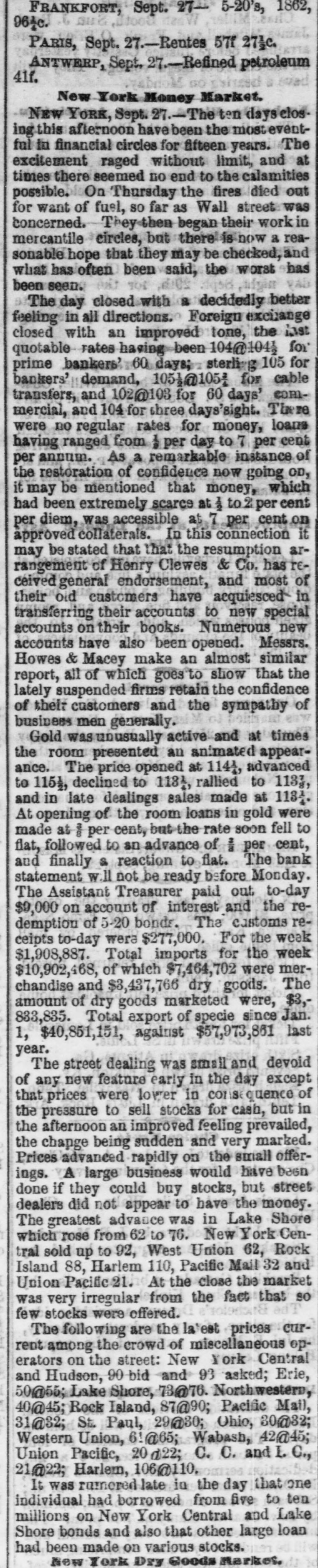
BUSINESS ON WALL STREET. THE PAST TEN DAYS. NEW YORK, September 27.-The ten days, closing this afternoon, have been the most eventful in financial circles for the past fifteen years. The excitement has raged without Cimit, and at times there seemed to be no end to the calamities possible. On Thursday the fire died out for want of fuel, so far as Wall bethen street was concerned. They gan their work in financial circles, and there is now a reasonable hope that they may be checked, and that the worst has been seen. The day closed with a decidedly better feeling in all directions. FOREIGN EXCHANGE closed with an improved tone. The last quotable rates having been 104@1041 for prime bankers' sixty-day sterling; 105 for bankers' demand; 1051@105 for cable transfers, and 102@103 for sixtyday commercial, and 104 for three days sight. MONEY. There were no regular rates for money, loans having ranged from one-fourth per cent. per day to seven per cent. per aunum. As a remarkable instance of the restoration of confidence now going on, it is mentioned that money which has been extremely scarce at one-half to two per cent. per diem, was acceptable at seven per cent. on approved collaterals. In this connection, it may be stated, that the resumption of Henry Clews & Co. has received general indorsement, and most of their old customers have acquiesced in transferring their accounts to the new special accounts on their books. Numerous new accounts have also been opened. Messrs. Howes & Macey make an almost similar repert, all of which goes to show that the lately suspended firms retain the confidence of their customers and sympathy of business men generally. GOLD was unusually active, and at times the room presented an animated appearance. The price opened at 114}, advanced to 1151, declined to 1131, rallied to 113g, and late-dealing sales were made at 1131. At the opening of the room loans in gold were made at costs per cent., but soon fell to flat, followed by an advance to e, and a final reaction to flat. The bank statement will not be ready before Monday. The assistant-treasurer paid out to-day nine thousand dollars on account of interest and the redemption of 5-20 bonds. Customs receipts to-day, $277,000; for the week, $1,908,887. IMPORTS. The total imports of the week were $10,902,468, of which $7,464,702 were merchandise, and $3,437,766 were drygoods. Amount of dry-goods marketed, $3,803,835. Total exports of specie since January 1st, $40,851,151, against $57,973,861 last year. STOCKS AND BONDS. Street dealings were small and devoid of any new feature early in the day, except that prices were lower in consequence of the pressure to sell stocks for cash, but in the afternoon improved feeling pre-ailed, the change being sudden and very marked. Prices advanced rapidly on small offerings. Large business would have been done in buying stocks, but street dealers did not appear to have money. The greatest advance was in Lake Shore, which rose from 62 to 76. New York Central sold up to 92, Western Union, 62: Rock Island, 88; Harlem, 110; Pacific Mail, 32, and Union Pacific, 21. At the close the market was very irregular, from the fact that so few stocks were offered. The following are the latest PRICES CURRENT among the crowd of miscellaneous operators on the street: New York Central and Hudson, 90 bid, 93 asked; Erie, 50 @55, Lake Shore, 73@76; Northwestern, 40@45: Rhode Island, 87@90; Pacific Mail, 31@32; St. Paul, 29@30; Ohio, 30@32; Western Union, 61@65; Wabash, 42@44; Union Pacific, 20@22; Cincinnati, Cleveland and Indianapolis Central, 21@22; Harlem, 106@110. It was rumored late in the day that one individual had borrowed from five to ten million dollars on New York Central and Lake Shore bonds, and also that other large loans had been made on various stocks.

Article from Nashville Union and American, September 28, 1873

Click image to open full size in new tab

Article Text

FRANKFORT, Sept. 27 5-20's, 1862, PARIS, Sept. 27.-Rentes 57f 271c. ANTWERP, Sept. 27.-Refined petroleum 41f. New York Money Market. NEW YORK, Sept. 27.-The ten days elos ing this afternoon have been the most eventful in financial circles for fifteen years. The excitement raged without limit, and at times there seemed no end to the calamities possible. On Thursday the fires died out for want of fuel, so far as Wall street was concerned. They then began their work in mercantile circles, but there is now a reasonable hope that they may be checked, and what has often been said, the worst has been seen. The day closed with a decidedly better feeling in all directions. Foreign exchange closed with an improved tone, the last quotable rates having been 104@1041 for prime bankers' 60 days; sterling 105 for bankers' demand, 1051@1054 for cable transfers, and 102@103 for 60 days' commercial, and 104 for three days'sight. There were no regular rates for money, loans having ranged from per day to 7 per cent per annum. As a remarkable instance of the restoration of confidence now going on, it may be mentioned that money, which had been extremely scarce at 1/4 to 2 per cent per diem, was accessible at 7 per cent.on approved collaterals. In this connection it may be stated that that the resumption arrangement of Henry Clewes & Co. has received general endorsement, and most of their old customers have acquiesced in transferring their accounts to new special accounts on their books. Numerous new accounts have also been opened. Messrs. Howes & Macey make an almost similar report, all of which goes to show that the lately suspended firms retain the confidence of their customers and the sympathy of business men generally. Gold was unusually active and at times the room presented an animated appearance. The price opened at 1141, advanced to 1151, declined to 1131, rallied to 113g, and in late dealings sales made at 1131. At opening of the room loans in gold were made at register per cent, but the rate soon fell to flat, followed to sn advance of elleg per cent, and finally a reaction to flat. The bank statement will not be ready bsfore Monday. The Assistant Treasurer paid out to-day $9,000 on account of interest and the redemption of 5-20 bonds. The castoms receipts to-day were $277,000. For the week $1,908,887. Total imports for the week $10,902,468, of which $7,464,702 were merchandise and $3,437,766 dry goods. The amount of dry goods marketed were, $3,833,835. Total export of specie since Jan. 1, $40,851,151, against $57,973,861 last year. The street dealing was small and devoid of any new feature early in the day except that prices were lower in cons quence of the pressure to sell stocks for cash, but in the afternoon an improved feeling prevailed, the chapge being sudden and very marked. Prices advanced rapidly on the small offerings. A large business would have been done if they could buy stocks, but street dealers did not appear to have the money. The greatest advance was in Lake Shore which rose from 62 to 76. New York Central sold up to 92, West Union 62, Rock Island 88, Harlem 110, Pacific Mail 32 and Union Pacific 21. At the close the market was very irregular from the fact that so few stocks were offered. The following are the latest prices current among the crowd of miscellaneous operators on the street: New York Central and Hudson, 90 bid and 93 asked; Erie, 50056; Lake Shore, 73@76. Northwestern, 40@45; Rock Island, 87@90; Pacific Mail, 31@32; St. Paul, 29@30; Ohio, 30@32; Western Union, 61@65; Wabash, 42@45; Union Pacific, 20 22; C. C. and I.C., 21@22; Harlem, 106@110. It was rumered late in the day that one individual had borrowed from five to ten millions on New York Central and Lake Shore bonds and also that other large loan had been made on various stocks. New York Dry Goods Market.

Article from New-York Tribune, September 29, 1873

Click image to open full size in new tab

Article Text

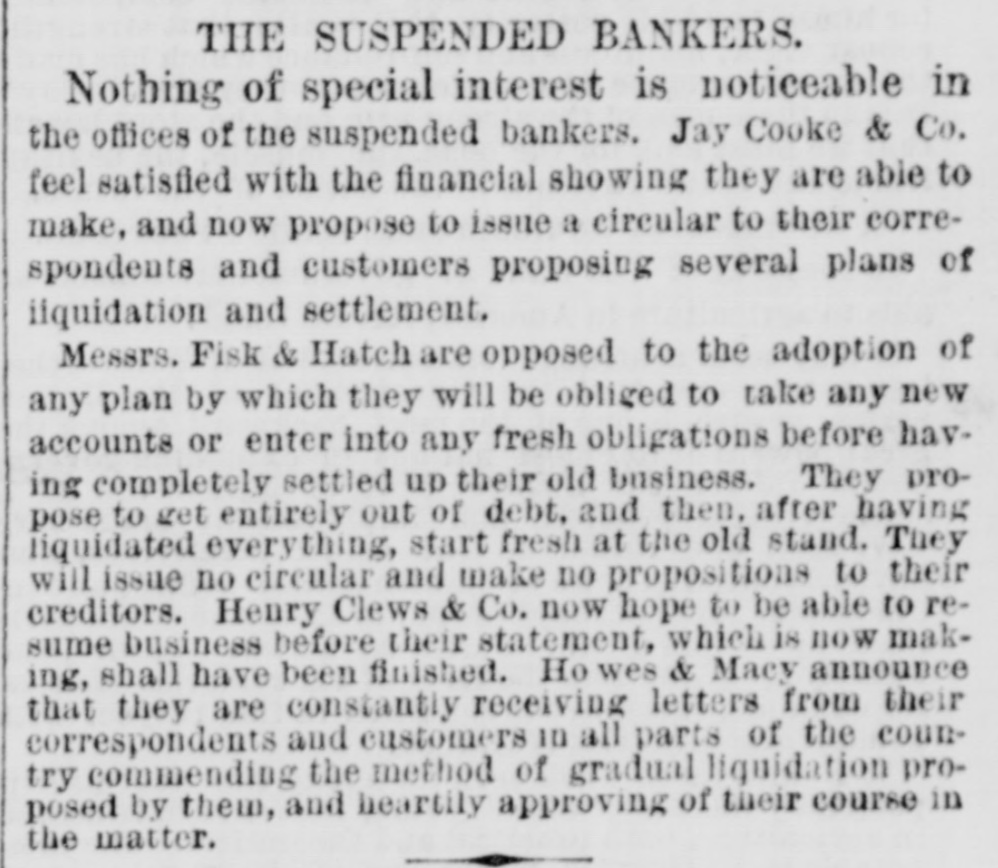
THE SUSPENDED BANKERS. Nothing of special interest is noticeable in the offices of the suspended bankers. Jay Cooke & Co. feel satisfied with the financial showing they are able to make, and now propose to issue a circular to their correspondents and customers proposing several plans of liquidation and settlement. Messrs. Fisk & Hatch are opposed to the adoption of any plan by which they will be obliged to take any new accounts or enter into any fresh obligations before having completely settled up their old business. They propose to get entirely out of debt. and then, after having liquidated everything, start fresh at the old stand. They will issue no circular and make no propositions to their creditors. Henry Clews & Co. now hope to be able to resume business before their statement, which is now making, shall have been finished. Ho wes & Macy announce that they are constantly receiving letters from their correspondents and customers 10 all parts of the country commending the method of gradual liquidation proposed by them, and heartily approving of their course in the matter.


Article from The Andrew County Republican, October 3, 1873

Click image to open full size in new tab

Article Text

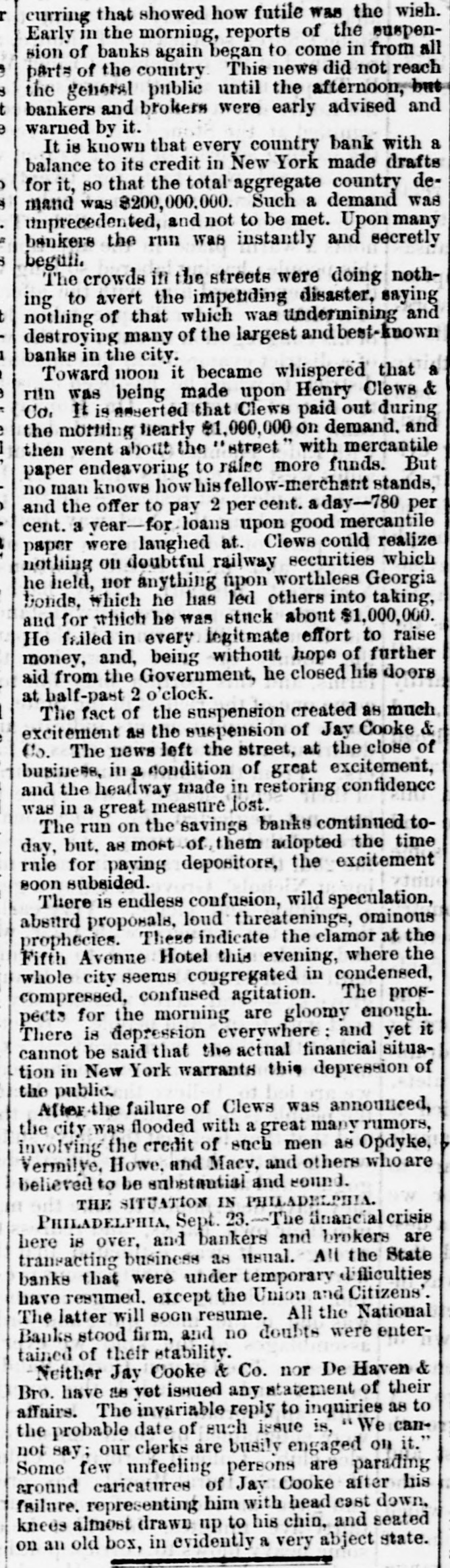
curring that showed how futile was the wieh. Early in the morning, reports of the suspension of banks again began to come in from all parts of the country This news did not reach the general public until the afternoon, but bankers and brokers were early advised and warned by it. It is known that every country bank with a balance to its credit in New York made drafts for it, 80 that the total aggregate country demand was $200,000,000. Such a demand was unprecedented, and not to be met. Upon many bankers the run was instantly and secretly beguli. The crowds in the streets were doing nothing to avert the impetiding disaster. saying nothing of that which was undermining and destroying many of the largest and best-known banks in the city. Toward noon it became whispered that a ritn was being made upon Henry Clews & Co. It is asserted that Clews paid out during the morning nearly $1,000,000 on demand. and then went about the "street" with mercantile paper endeavoring to raiec more funds. But no man knows how his fellow-merchant stands, and the offer to pay 2 per cent. a day-780 per cent. a year-for loans upon good mercantile paper were laughed at. Clews could realize nothing ou doubtful railway securities which he held, not anything upon worthless Georgia bonds, which he has led others into taking, and for which he was stnck about $1,000,000. He failed in every legitmate effort to raise money, and, being without hope of further aid from the Government, he closed his doors at half-past 2 o'clock. The fact of the suspension created as much excitement as the suspension of Jay Cooke & Co. The news left the street, at the close of business, in a condition of great excitement, and the headway made in restoring confidence was in a great measure lost. The run on the savings banks continued today, but. as most of them adopted the time rule for paying depositors, the excitement soon subsided. There is endless confusion, wild speculation, absurd proposals, loud threatenings, ominous prophecies. These indicate the clamor at the Fifth Avenue Hotel this evening, where the whole city seems congregated in condensed, compressed, confused agitation. The prospects for the morning are gloomy enough. There is depression everywhere : and yet it cannot be said that the actual financial situation in New York warrants this depression of the public, After the failure of Clews was announced, the city was flooded with a great many rumors, involving the credit of such men as Opdyke, Vermilye, Howe. and Macv. and others who are believed to be substantial and round. THE SITUATION IN PHILADELPHIA. PHILADELPHIA, Sept. 23. -The financial crisis here is over, and bankers and brokers are transacting business as usual. All the State banks that were under temporary difficulties have resumed. except the Union and Citizens'. The latter will soon resume. All the National Banks stood firm, and no doubts were entertained of their etability. Neither Jay Cooke & Co. nor De Haven & Bro. have as vet issued any statement of their affairs. The invariable reply to inquiries as to the probable date of euch issue is, We cannot say; our clerks are busily engaged on it." Some few unfeeling persons are parading around caricatures of Jay Cooke after his failure. representing him with head cast down, knees almost drawn up to his chin, and seated on an old box, in evidently a very abject state.


Article from River Falls Journal, December 5, 1873

Click image to open full size in new tab

Article Text

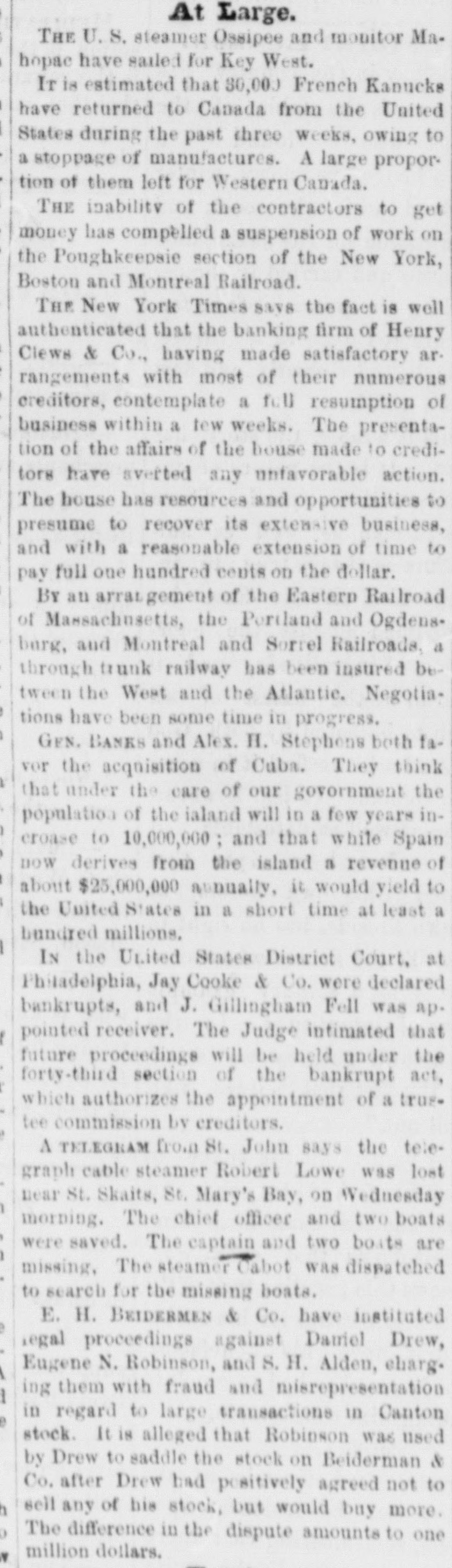
At Large. THE U.S. steamer Ossipee and monitor Mahopac have sailed for Key West. IT is estimated that 80,000 French Kanucks have returned to Canada from the United States during the past three weeks, owing to a stoppage of manufactures. A large proportion of them left for Western Canada. THE inability of the contractors to get money has compèlied a suspension of work on the Poughkeepsie section of the New York, Boston and Montreal Bailroad. THE New York Times savs the fact is well authenticated that the banking firm of Henry Clews & Co., having made satisfactory ar. rangements with most of their numerous creditors, contemplate a full resumption of business within a tew weeks. The presentation of the affairs of the house made to creditors have sverted any unfavorable action. The house has resources and opportunities to presume to recover its extensive business, and with a reasonable extension of time to pay full one hundred cents on the dollar. BY an arrat gement of the Eastern Railroad of Massachusetts, the Portland and Ogdensburg, and Montreal and Sorrel Railroads, a through trunk railway has been insured between the West and the Atlantic. Negotiations have been some time in progress. GEN. BANKS and Alex. H. Stephens both favor the acquisition of Cuba. They think that under the care of our government the population of the ialand will in a few years incroase to 10,000,000; and that while Spain now derives from the island a revenue of about $25,000,000 annually, it would yield to the United States in a short time at least a bundred millions. IN the United States District Court, at Philadelphia, Jay Cooke & Co. were declared bankrupts, and J. Gillingham Fell was ap. pointed receiver. The Judge intimated that future proceedings will be held under the forty-third section of the bankrupt act, which authorizes the appointment of a truetee commission by creditors. A TELEGRAM from St. John says the telegraph cable steamer Robert Lowe was lost near St. Skaits, St. Mary's Bay, on Wednesday morning. The chief officer and two boats were saved. The captain and two boats are missing, The steamer Cabot was dispatched to search for the missing boats. E. H. BEIDERMEN & Co. have instituted legal proceedings against Daniel Drew, Eugene N. Robinson, and S. H. Alden, charg. ing them with fraud and misrepresentation in regard to large transactions in Canton stock. It is alleged that Robinson was used by Drew to saddle the stock on Beiderman & Co. after Drew had positively agreed not to sell any of his stock, but would buy more. The difference in the dispute amounts to one million dollars.


Article from The Andrew County Republican, December 12, 1873

Click image to open full size in new tab

Article Text

FINANCIAL AND INDUSTRIAL. A NUMBER of mills at Troy, N. Y., employing in the aggregate 5,000 men, have resumed work within a few days. HENRY CLEWS & Co., the suspended Now York brokers. are about to resume. JAY COKE & Co. have been declared bankrupts, and a receiver appointed. CONGRESSMAN HAWLEY, of Illinois, will introduce a bill in Congress authorizing free banking. A WASHINGTON dispatch says the Western and Southern Congressmen are almost unanimously in favor of the passage of a bill increasing the volume of the currency $100,000,000 to $150,000,000. SENATOR FERRY, of Michigan, member of the Senate Committee on Finance, proposes, as a remedy for our monetary illa, to issue eight hundred millions currency, convertible into bonds bearing 3 65-100 interest and to be exempt from taxation. THERE was an increase in the public debt during November of $9,028,576.


Article from Sunbury American, January 16, 1874

Click image to open full size in new tab

Article Text

During the past year American timber. in various forms. to the amount of titteen million of dollars, was exported to Eng. laud. It costs two thousand dollars to bury a Congressman at Washington. Just now, however, the country would make a good speculation by getting several of them decently interred at that figure. The State Grange of Patrons of Husban dry closed its session at Harrisburg Friday last, to m et at Williamsporta year hence. In the business transacted was the adoption of a new constitution. in which was defined those eligible to membership. A number of additional deputies were appointed to constitute subordinate granges, and re 8 lutions a.lopted calculated to organize them in every community in the Common wealth. The banking house of Henry Clews & Co. has resumed, and in a circular an nounces that it is ready to meet all its ob ligations in full. The house made a hereic stand at the outset, and suspended only at ter the most extraordinary exertions to avert the catastrophe. Gov. Hartranft has officially proclaimed the adoption of the new Constitution. The California Legislature has passed a bill authorizing the Governor to offer a re ward of of $15,000 for the capture of the notorious bandit Vasquez and his band. It is reported that Vasquez is in San Franeisco at the present time. The aggregate amount of the late sales of pews at Plymouth Church was $59.430, against $59.306 50 last year, making an in crease of $123 50. Mr. Beecher has, there fore, been vindicated under the hammer.


Article from The Dallas Daily Herald, October 6, 1874

Click image to open full size in new tab

Article Text

MISCELL NEOUS. The Great Railroad Tax Case at St. Louis. Reported Flight of White Leagners From Louisiana. BOSTON, October 5.-The steamer Flag, hence to Charleston, is hard aground. A portion of the freight has been discharged. It is hoped the next tide will float her. The steamer Equator, from Charleston, ran ashore Saturday afternoon near New Castle ridge, and was bauled off last evening, by the steamer Advance, bound up from Richmond, and the tug George B. Kerfoot. The Equator proceeded on her voyage. ST. LOUIS, October 5.-The cases of the Atlantic and Pacific, Missouri Pacific, St. Louis, Iron Mountain and Southern, Missouri, Kansas and Texas, and Southeastern railroads, which have been argued for several days before the United States circuit court, on application for an injunction to restrain counties from collecting taxes on their property, has 80 far proceeded that Judge Miller yesterday decreed that they should pay from fifty-nine to sixty-two per cent of the taxes levied on or before January 2, 1875, otherwise the temporary injunction granted by Judge Dillon would be dissolved. The payment will in no way be a recognition of the validity or legality of the vote of the state board of equalization, but the court decided that some taxes are due and must be paid. NEW YORK, October 5.-The Times Orpublishes the following from New leans, received last evening Governor Kellogg received information this eyening that upon the arrival of the United States troops at Coushatta, some fifteen white leaguers, who of were engaged in the recent murder republican officeholders, left town and fled to Arkansas and Texas. Weston, at five minutes past twelve o'clock, last night, made another attempt to walk five hundred miles in 3 six consecutive days. The new republican journal, the Rei public, appeared to-day. e NEW ORLEANS, October 5.-The e parish convention of the Peoples' par- The f ty met to-day at Grunewald hall. 1 proceedings were quiet and orderly. About fifty small frame houses, on 1 two blocks, bounded by Franklin, f Liberty, Standrew and Jackson streets, were burned to-day. Loss estimated at $100,000. Insurance mostly in local companies. NEW YORK, October 5.-Henry Clews e & Co. have decided, in fairness to their t customers, to suspend for a day or two a the receiving of deposits, and have S transferred the remittances received during the past few days to the cus- the e tody of the Continenfal bank to credit of those who remitted them. e firm do this as a prudential than mati. The though a much larger loan £700,000, ter, already negotiated in London, is expected in a few days. 1. Theodore Tilton and Francis this D. g were officially notified found Moulton of the indictments for h morning them by the grand jury , against libel for slander against Mr. Beecher. $3,000, in each case was fixed at furnish Bail which they will be required to tby to-morrow. SALT LAKE, October 5.--Brigham f Young is better.


Article from The New York Herald, October 30, 1874

Click image to open full size in new tab

Article Text

THE SUSPENSION OF HENRY CLEWS The application made on behalf of the First National Bank or Tarrytown and other judgment creditors lor the appointment of a receiver over the property of Henry Clews & Co. was decided yesterday by Judge Daniels. of the Supreme Court, before whom the application was made. The house of Clews & Co. suspended on the 20th of last month. Some of these creditors had previously obtained judgment against the firm, issued executions and levied upon the property, which was thereupon placed in possession of the Sheriff. On the examination of Mr. Clews touching his property the application for a receiver was made. The following IS Judge Daniels' opinion in the case, from which it will be seen that he denies the application and dismisses the proceedings, leaving the action 01 the judgment creditors first in the field statu quo pending other proceedings:THE OPINION. The applications made in these cases are for the appointment of a receiver of the defendant's property on the ground that he has unjustly refused to apply it toward the satisfaction of the judgments recovered by the plaintiffs against him. (Code L, 292.) Before any request or demand was made that he should so apply his property executions were issued to the Sheriff for the satisfaction of the judgments, and they were levied upon the defendant's tangible property. and it was held by that officer under the levy when such request or demand was made. That property was in the wiul custody and under the control of the Sheriff by means of his levy upon it. and for that reason it could not be applied by the defendants in compliance with the terins of the demands made upon him. His refusal to apply that to the satisfaction of the judgment was therefore not unjust, for that cannot be affirmed to be the nature of a refusal to do what it is out of the power of the party making it to perform. The plaintiffs had taken another mode of applying that property to the satisfaction 01 their judgments. and had proceeded so lar in the execution of It as to put it out of defendant's power to comply with the demands made upon him. Before the demands were made and after the levy under the execution the defendants made a general assignment of their property In trust for the benefit of creditors at the time of making the assign. ment. They had various bonds and other evidences of debt and choses in action contained in the safe levied upon by the Sheriff and elsewhere. They were mere evidences or debt. and not the subject of levy and sale under execution: for that remedy is limited to money, which may be seized and applied without sale. and tangible property, which can be reduced by the officer to possesion and sold and delivered to purchasers, (Denton vs. Livingston. 9 John 96. Ingalis vs. Lord, 1 Cow., 240: Ransen vs. Miner, 3 Sand. Superior Court. (92.) The fact that some of the bonds and other evidences of debt were nominally in the Sherid's custody by reason of the circumstance that they were in the sale lawfully levied upon by him gave him uo control over them and no power to appropriate them to the avmeut of the executions issued upon the judgments. They were, therefore, snbject to the defendant's right and power or disposal. and consequently subject to the general assignment made. it is not insisted that this assignment was made in bad faith, or that it does not contain apt and proper terms for the lawful transfer to we assignee of these bonds ADD other evidences of


Article from The New Orleans Bulletin, December 2, 1874

Click image to open full size in new tab

Article Text

MISCELLANEOUS. MANCHESTER, N. H., Dec. 1.-The various manufacturing companies of this city, which, with the exception of the Manchester Mills, have been running but five days per week for some time past, will, it is understood, begin running on full time this week. BOSTON, Dec. 1.-To-day is the coldest of the season throughout the East. Thermometer ranging from three degrees below zero to seven above. COLUMBUS, O., Dec. 1.-The Legislature met to-day. HENRY CLEWS & CO.-MECHANICS DISCHARGED. NEW York, Dec. 1.-In the United States Court to-day, before Judge Blatchford, Messrs. Henry Clews & Co., having failed to answer in bankruptcy proceedings, were adjudicated bankrupt, on petition of Arthur Cooper, trustee of their London firm, and fifteen creditors in this country, who state that they represent one-quarter of the number, and a tuird in amount, of the creditors. Between three and four hundred men have been suspended at the Brooklyn Navy Yard.


Article from New-York Tribune, January 15, 1875

Click image to open full size in new tab

Article Text

who shared with Henry Clows & Co. the banking office next the Sub-Treasury office. and who failed at the same time during the panic of 1873, have completed their schedule and sworn to it before Isaac Dayton, Register in Bankruptoy, The report shows that there are no secured creditors. as in the Clews case, and that the assets are of a more substantial character than in that of their late neighbors. The following statement gives the list of the principal creditors and the assets:


Article from New-York Tribune, March 19, 1875

Click image to open full size in new tab

Article Text

MEETING OF HENRY CLEWS'S CREDITORS. A meeting of the creditors of Henry Clews & Co. was held yesterday at the office of Edgar Ketcham, Register of Bankruptcy, corner of Ann and Nassau-sts. Mr. Cornelius F. Timpson, cashier of the Continental Bank, was elected trustee without any opposition. One of the gentlemen present made the following statement to a TRIBUNE reporter: The new firm of Clews & Co. has made a loan to the old firm that suspended in 1873 of about $160,000, and has received for collateral security a large amount of rai road and other securities. If the trustee of the old firm, Mr. Tappen, comes forward and pays the loan and redeems the securities, then the creditors of the new firm will realize dividends nearly in full. The actual value of the securities has not been determined yet.


Article from The Rutland Daily Globe, March 31, 1875

Click image to open full size in new tab

Article Text

From New York. New YORK, March 30. HENRY CLEWES &-co. A special to the Troy Times says: The property of the first firm of Henry Clews & Co., was transferred to the keeping of the city chamberlain, who has been appointed receiver. A large amount of securities were given into his possession by the state assignee. The assets included a trunk filled with presents made to Mr. Clews on his marriage to Secretary Belknap's sister. The property of the new firm of Henry Clews & Co., which was formed after the September panic, and which was declared in voluntary bankruptcy, is to be taken out of the vault to-day by Mr. Timpson of the Continental bank, who is the assignee. Their securities are said to be worth about $2,500,000 on their face. STOCKS AND GOLD. The stock market to-day does not present the excitement of yesterday. At noon, Union Pacific, Western Union and Pacide Mail were strong. Gold also is quiet thus far to-day. It is weaker than yesterday. DEATH OF A BANKER. Lazarus Hallgarten, whose death is announced, was the head of one of the oldest banking houses in the city. HENRY WARD BEECHER TO THE STAND. Last night, after a consultation by Messrs. Evarts, Porter and Shearman at the residence of Mr. Beecher, it was decided to put Mr. Beecher on the witness stand without further delay. This was decided upon on account of the absence of other witnesses. A NEW CABLE. President Orton of the Western Union telegraph company, who has gone to Europe, has for his errand the making of contracts for the laying ot a new sub-marine telegraph cable between Key West and Ponta Rosa, Florida. The line will be about one hundred and twenty miles long.