14020. Harlem River Bank (New York, NY)

Bank Information

Episode Type
Suspension โ†’ Closure
Bank Type
state
Start Date
April 27, 1894
Location
New York, New York (40.714, -74.006)

Metadata

Model
gpt-5-mini
Short Digest
ddd829d4262ae593

Response Measures

None

Description

Articles from Aprโ€“May 1894 report the Harlem River Bank being closed by the State Banking Department/examiner (doors ordered closed by Examiner Judson) and placed in the hands of a temporary receiver (David B. Sickels) on 1894-05-02. The cause is internal bank problems (defalcation by a bookkeeper, heavy loans to directors, impaired capital). There is mention of anxious depositors gathering, but no clear, discrete run driven by misinformation; the sequence is a suspension followed by receivership/closure. Dates corrected/normalized from article publication dates and internal references.

Events (2)

1. April 27, 1894 Suspension
Cause
Bank Specific Adverse Info
Cause Details
State examiner ordered the bank closed after finding impaired capital, objections to collateral, heavy loans to directors and published refusal of Garfield National Bank to act as its clearing-house agent; later investigations revealed defalcation by bookkeeper Kean.
Newspaper Excerpt
When Mr. Judson walked into the bank yesterday afternoon, he told us to close our doors, and then announced that he was in charge.
Source
newspapers
2. May 2, 1894 Receivership
Newspaper Excerpt
At 12.45 o'clock Judge Bookstaver signed an order appointing David B. Sickles temporary receiver of the bank. The receiver's bond is fixed at $250,000, and he is directed to deposit the funds coming into his hands with the Union Trust Company. (Evening World, 1894-05-02).
Source
newspapers

Newspaper Articles (21)

Article from The Evening World, April 28, 1894

Click image to open full size in new tab

Article Text

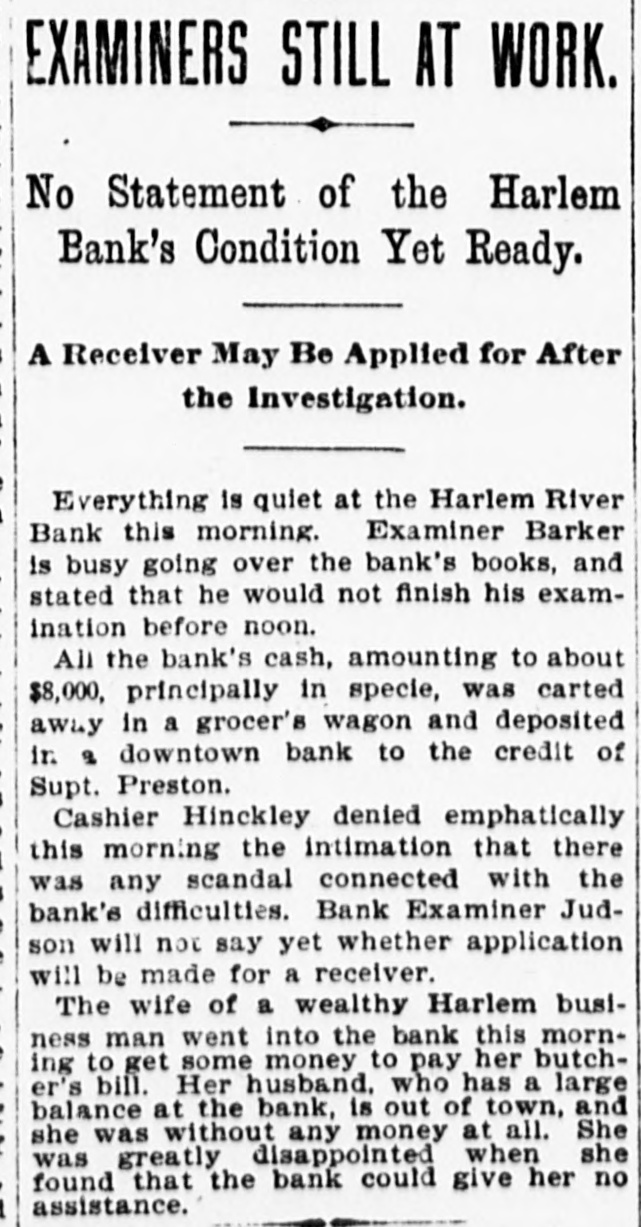
EXAMINERS STILL AT WORK. No Statement of the Harlem Bank's Condition Yet Ready. A Receiver May Be Applied for After the Investigation. Everything is quiet at the Harlem River Bank this morning. Examiner Barker is busy going over the bank's books, and stated that he would not finish his examination before noon. All the bank's cash, amounting to about $8,000, principally in specie, was carted away in a grocer's wagon and deposited in % downtown bank to the credit of Supt. Preston. Cashier Hinckley denied emphatically this morning the intimation that there was any scandal connected with the bank's difficulties. Bank Examiner Judson will not say yet whether application will be made for a receiver. The wife of a wealthy Harlem business man went into the bank this morning to get some money to pay her butcher's bill. Her husband, who has a large balance at the bank, is out of town, and she was without any money at all. She was greatly disappointed when she found that the bank could give her no assistance.


Article from The Evening World, April 28, 1894

Click image to open full size in new tab

Article Text

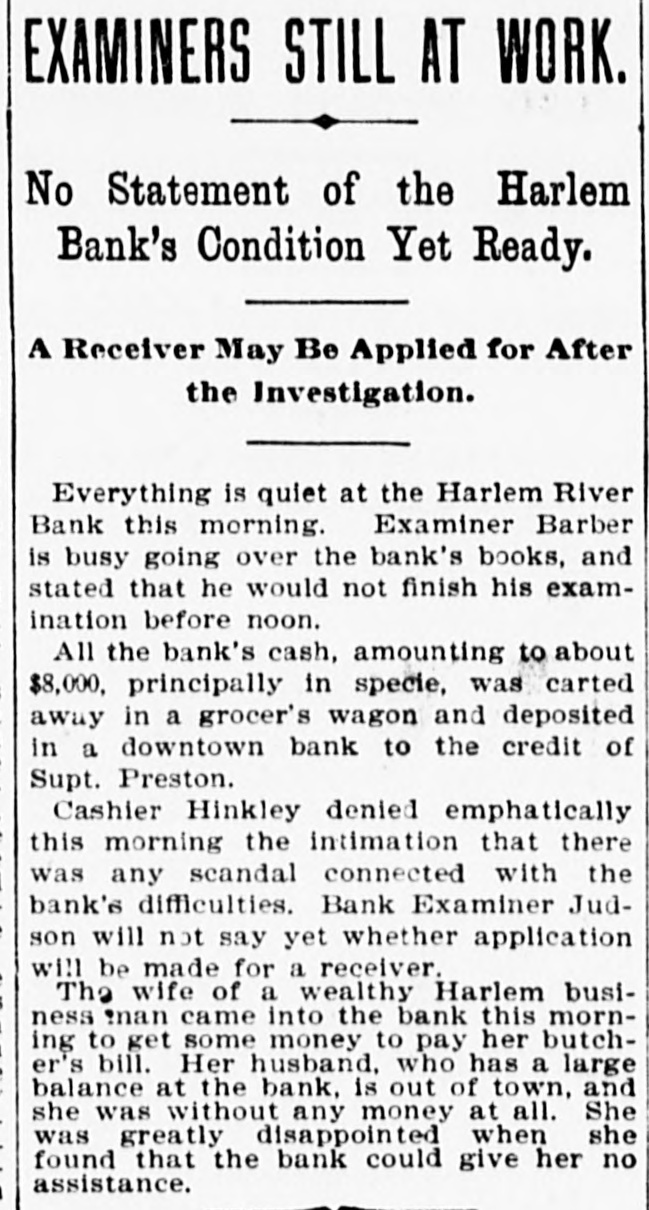
EXAMINERS STILL AT WORK. No Statement of the Harlem Bank's Condition Yet Ready. A Receiver May Be Applied for After the Investigation. Everything is quiet at the Harlem River Bank this morning. Examiner Barber is busy going over the bank's books, and stated that he would not finish his examination before noon. All the bank's cash, amounting to about $8,000, principally in specie, was carted away in a grocer's wagon and deposited in a downtown bank to the credit of Supt. Preston. Cashier Hinkley denied emphatically this morning the intimation that there was any scandal connected with the bank's difficulties. Bank Examiner Judson will not say yet whether application will be made for a receiver. The wife of a wealthy Harlem business man came into the bank this morning to get some money to pay her butcher's bill. Her husband, who has a large balance at the bank, is out of town, and she was without any money at all. She was greatly disappointed when she found that the bank could give her no assistance.


Article from New-York Tribune, April 28, 1894

Click image to open full size in new tab

Article Text

DEPOSITORS ARE ANXIOUS. INQUIRIES AT THE HARLEM RIVER BANK THE CASHIER DECLARES THEY WILL BE PAID IN FULL - -LIQUIDATION PROBABLE, SAYS BANK EXAMINER JUDSON A number of depositors gathered in front of the closed Harlem River Bank, at No. 2,007 Third-ave., yesterday morning, and made anxious Inquiries as to the time when they could withdraw their money from the bank. Some of them said that they could 111 afford to do without their money while the examination of the bank's affairs were being made, although they thought they would lose nothing in the end. Some of the tradesmen in the neighborhood. who were depositors, and had drawn checks against their accounts in the bank on Thursday, posted notices on the front of the bank saying that they would personally cash the checks at their places of business. Mr. Hinckley, the cashier of the bank, was at his post early and answered many questions. He said there was not the slightest doubt that the depositors would be paid in full some time, but he thought it would be a week, and perhaps longer, before any money could be drawn by the depositors. "We will have to wait until the examination is completed before we can do anything," he said, "and the action of the directors will depend on the result of the examination. Possibly an application may be made to the courts for a receiver to wind up the affairs of the bank. That will be the only course if the capital of the bank is found to be impaired. There was no reason for placing the bank in this unfortunate position, however. Had it not been for the published statement that we had been informally notified by the Garfield National Bank people that they desired us to secure another Clearing House agent, things would have gone just as smoothly as ever. There is not the slightest doubt that the Garfield Bank would have continued to act as our agent. When Mr. Judson walked into the bank yesterday afternoon, he told us to close our doors, and then announced that he was in charge. I never was more shocked and surprised in my life." There was no meeting of the directors of the bank yesterday, and it was said that no meeting probably would be held until the examination of the bank's affairs was completed. Mr. Judson, the examiner, was at the bank nearly all day. He expressed the belief that the bank would be compelled to go into liquidation, because it would be impossible for it to get a Clearing House agent. The bank had not been in good standing, he said although its capital might be found not to be impaired. Regarding the increase in the loans to directors recently, Mr. Judson said that the directors had not been borrowers to a great extent, but they had been made to appear as borrowers by their action in securing loans to other persons. A. H. Leszynsky, the former president of the bank. yesterday contradicted a report that he owed $10,000 to the bank. Robinson Gill, the present president of the bank. was a director of the Commercial Bank, of Brooklyn, which failed some time ago, and was one of the directors who gave their notes for $10,000 each to make good an impairment of the capital of the Commercial Bank


Article from New-York Tribune, May 1, 1894

Click image to open full size in new tab

Article Text

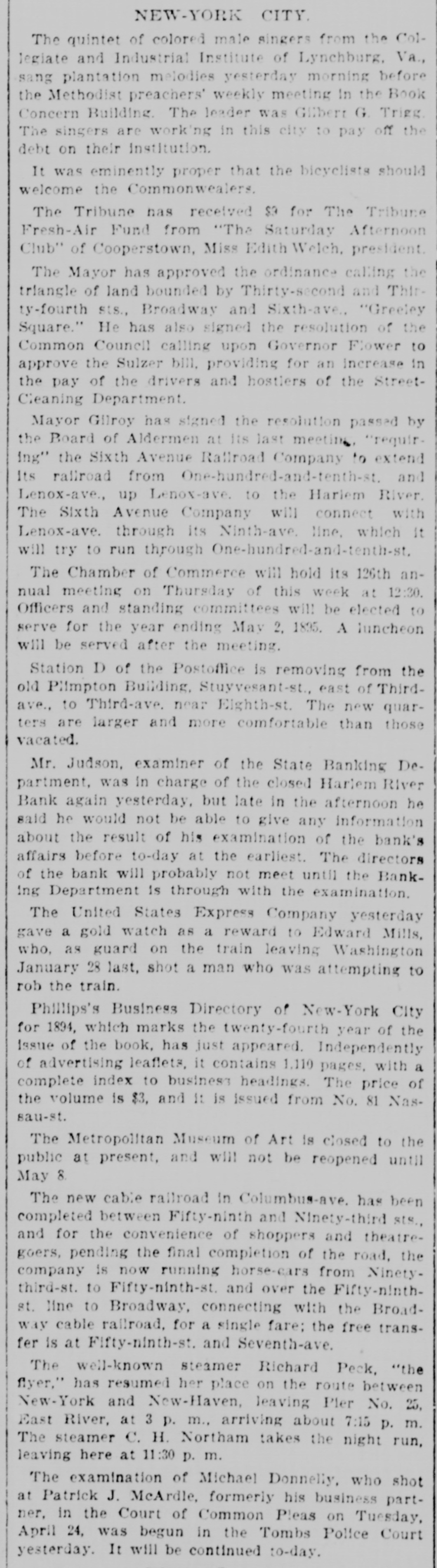
NEW-YORK CITY. The quintet of colored male singers from the Collegiate and Industrial Institute of Lynchburg, Va., sang plantation melodies yesterday morning before the Methodist preachers' weekly meeting In the Book Concern Building. The leader was Glibert G. Trigg. The singers are working in this city to pay on the debt on their institution. It was eminently proper that the bicyclists should welcome the Commonwealers. The Tribune has received $9 for The Tribune Fresh-Air Fund from "The Saturday Afternoon Club" of Cooperstown, Miss Edith Welch, president. The Mayor has approved the ordinance calling the triangle of land bounded by Thirty-second and Thirty-fourth sts., Broadway and Sixth-ave., "Greeley Square." He has also signed the resolution of the Common Council calling upon Governor Flower to approve the Sulzer bill, providing for an increase in the pay of the drivers and hostlers of the StreetCleaning Department. Mayor Gilroy has signed the resolution passed by the Board of Aldermen at its last meeting, "requiring" the Sixth Avenue Railroad Company to extend Its railroad from One-hundred-and-tenth-st, and Lenox-ave., up Lenox-ave. to the Harlem River. The Sixth Avenue Company will connect with Lenox-ave. through its Ninth-ave. line, which It will try to run through One-hundred-and-tenth-st. The Chamber of Commerce will hold its 126th annual meeting on Thursday of this week at 12:30. Officers and standing committees will be elected to serve for the year ending May 2, 1895. A luncheon will be served after the meeting. Station D of the Postoffice is removing from the old Plimpton Building, Stuyvesant-st., east of Thirdave., to Third-ave. near Eighth-st. The new quarters are larger and more comfortable than those vacated. Mr. Judson, examiner of the State Banking Department, was in charge of the closed Harlem River Bank again yesterday, but late in the afternoon he said he would not be able to give any information about the result of his examination of the bank's affairs before to-day at the earliest. The directors of the bank will probably not meet until the Banking Department is through with the examination. The United States Express Company yesterday gave a gold watch as a reward to Edward Mills, who, as guard on the train leaving Washington January 28 last, shot a man who was attempting to rob the train. Phillips's Business Directory of New-York City for 1894, which marks the twenty-fourth year of the Issue of the book, has just appeared. Independently of advertising leaflets, it contains 1,110 pages, with a complete index to business headings. The price of the volume is $3, and it is issued from No. 81 Nassau-st. The Metropolitan Museum of Art is closed to the public at present, and will not be reopened until May 8. The new cable railroad in Columbus-ave. has been completed between Fifty-ninth and Ninety-third sts., and for the convenience of shoppers and theatregoers, pending the final completion of the road, the company is now running horse-cars from Ninetythird-st. to Fifty-ninth-st. and over the Fifty-ninthst. line to Broadway, connecting with the Broadway cable railroad, for a single fare; the free transfer is at Fifty-ninth-st. and Seventh-ave. The well-known steamer Richard Peck, "the flyer," has resumed her place on the route between New-York and New-Haven, leaving Pler No. 25, East River, at 3 p. m., arriving about 7:15 p. m. The steamer C. H. Northam takes the night run, leaving here at 11:30 D. m. The examination of Michael Donnelly, who shot at Patrick J. McArdle, formerly his business partner, in the Court of Common Pleas on Tuesday, April 24, was begun in the Tombs Police Court yesterday. It will be continued to-day.


Article from The Evening World, May 1, 1894

Click image to open full size in new tab

Article Text

PRESTON TO VISIT THE BANK. Decision May Be Reached and Made Known This Evening. Bank Examiner Judson, who is in charge of the suspended Harlem River Bank, said this morning that Bank Superintendent Preston is in town, and will visit the bank this evening. when a decision will probably be reached and promulgated. Many depositors and stockholders were at the bank this morning. but there was no excitement, all seeming to be destrous for a favorable decision and an early resumption of business by the bank.


Article from The Evening World, May 1, 1894

Click image to open full size in new tab

Article Text

PRESTON TO VISIT THE BANK. Decision May Be Reached and Made Known This Evening. Bank Examiner Judson, who is in charge of the suspended Harlem River Bank, said this morning that Bank Superintendent Preston is in town, and will visit the bank this evening. when a decision will probably be reached and promulgated. Many depositors and stockholders were at the bank this morning. but there was no excitement. all seeming to be desirous for a favorable decision and an early resumption of business by the bank.


Article from The Evening World, May 2, 1894

Click image to open full size in new tab

Article Text

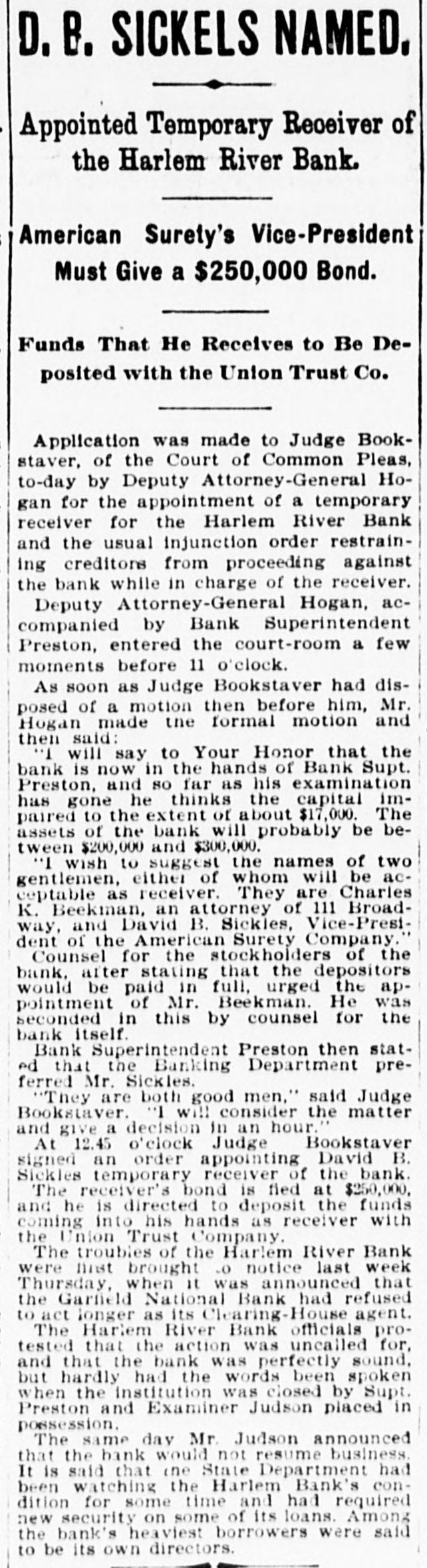
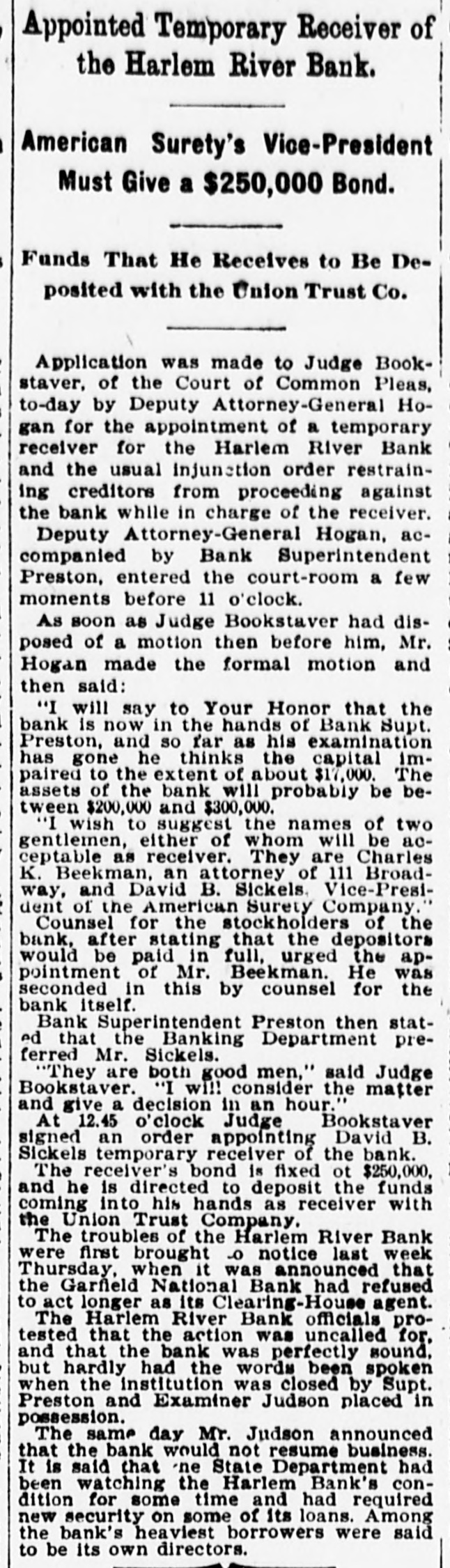
D.B. SICKELS NAMED. Appointed Temporary Receiver of the Harlem River Bank. American Surety's Vice-President Must Give a $250,000 Bond. Funds That He Receives to Be Deposited with the Union Trust Co. Application was made to Judge Bookstaver, of the Court of Common Pleas, to-day by Deputy Attorney-General Hogan for the appointment of a temporary receiver for the Harlem River Bank and the usual injunction order restraining creditors from proceeding against the bank while in charge of the receiver. Deputy Attorney-General Hogan, accompanied by Bank Superintendent Preston, entered the court-room a few moments before 11 o'clock. As soon as Judge Bookstaver had disposed of a motion then before him, Mr. Hogan made the formal motion and then said: "1 will say to Your Honor that the bank is now in the hands of Bank Supt. Preston, and so far as his examination has gone he thinks the capital impaired to the extent of about $17,000. The assets of the bank will probably be between $200,000 and $300,000. "I wish to suggest the names of two gentlemen, either of whom will be acceptable as receiver. They are Charles K. Beekman, an attorney of 111 Broadway, and David B. Sickles, Vice-President of the American Surety Company.' Counsel for the stockholders of the bank, after stating that the depositors would be paid in full, urged the appointment of Mr. Beekman. He was seconded in this by counsel for the bank itself. Bank Superintendent Preston then stated that the Banking Department preferred Mr. Sickles. "They are both good men," said Judge Bookstaver. "I will consider the matter and give a decision in an hour. At 12.45 o'clock Judge Bookstaver signed an order appointing David B. Sickles temporary receiver of the bank. The receiver's bond is fied at $250,000, and he is directed to deposit the funds coming into his hands as receiver with the Union Trust Company. The troubles of the Harlem River Bank were first brought -0 notice last week Thursday, when it was announced that the Garfield National Bank had refused to act longer as its Clearing-House agent. The Harlem River Bank officials protested that the action was uncalled for, and that the bank was perfectly sound, but hardly had the words been spoken when the institution was closed by Supt. Preston and Examiner Judson placed in possession. The same day Mr. Judson announced that the bank would not resume business. It is said that the State Department had been watching the Harlem Bank's condition for some time and had required new security on some of its loans. Among the bank's heaviest borrowers were said to be its own directors.


Article from The Evening World, May 2, 1894

Click image to open full size in new tab

Article Text

Appointed Temporary Receiver of the Harlem River Bank. American Surety's Vice-President Must Give a $250,000 Bond. Funds That He Receives to Be Deposited with the Union Trust Co. Application was made to Judge Bookstaver, of the Court of Common Pleas, to-day by Deputy Attorney-General Hogan for the appointment of a temporary receiver for the Harlem River Bank and the usual injunction order restraining creditors from proceeding against the bank while in charge of the receiver. Deputy Attorney-General Hogan, accompanied by Bank Superintendent Preston, entered the court-room a few moments before 11 o'clock. As soon as Judge Bookstaver had disposed of a motion then before him, Mr. Hogan made the formal motion and then said: "I will say to Your Honor that the bank is now in the hands of Bank Supt. Preston, and so far as his examination has gone he thinks the capital impaired to the extent of about $17,000. The assets of the bank will probably be between $200,000 and $300,000. "I wish to suggest the names of two gentlemen, either of whom will be acceptable as receiver. They are Charles K. Beekman, an attorney of 111 Broadway, and David B. Sickels. Vice-President of the American Surety Company." Counsel for the stockholders of the bank, after stating that the depositors would be paid in full, urged the appointment of Mr. Beekman. He was seconded in this by counsel for the bank itself. Bank Superintendent Preston then stated that the Banking Department preferred Mr. Sickels. "They are both good men," said Judge Bookstaver. "I will consider the matter and give a decision in an hour." At 12.45 o'clock Judge Bookstaver signed an order appointing David B. Sickels temporary receiver of the bank. The receiver's bond is fixed ot $250,000, and he is directed to deposit the funds coming into his hands as receiver with the Union Trust Company. The troubles of the Harlem River Bank were first brought 0 notice last week Thursday, when it was announced that the Garfield National Bank had refused to act longer as its Clearing-House agent. The Harlem River Bank officials protested that the action was uncalled for, and that the bank was perfectly sound, but hardly had the words been spoken when the institution was closed by Supt. Preston and Examiner Judson placed in possession. The same day Mr. Judson announced that the bank would not resume business. It is said that ne State Department had been watching the Harlem Bank's condition for some time and had required new security on some of its loans. Among the bank's heaviest borrowers were said to be its own directors.


Article from The Evening World, May 7, 1894

Click image to open full size in new tab

Article Text

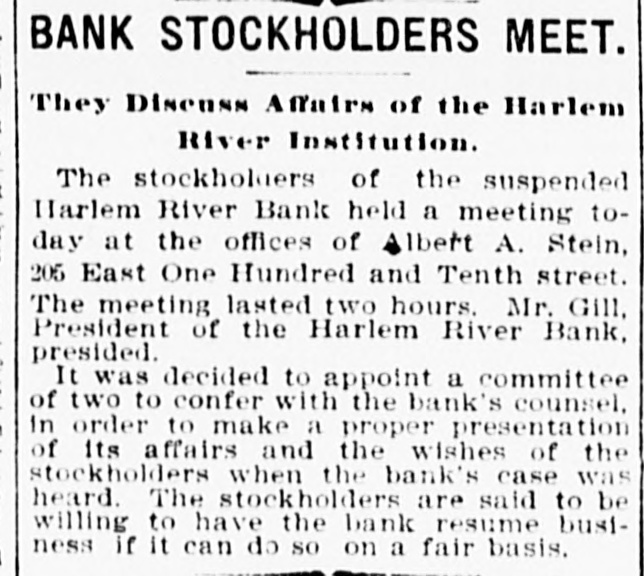
BANK STOCKHOLDERS MEET. They Discuss Affairs of the Harlem River Institution. The stockholuers of the suspended Harlem River Bank held a meeting today at the offices of Albert A. Stein, 205 East One Hundred and Tenth street. The meeting lasted two hours. Mr. Gill, President of the Harlem River Bank, presided. It was decided to appoint a committee of two to confer with the bank's counsel, In order to make a proper presentation of its affairs and the wishes of the stockholders when the bank's case was heard. The stockholders are said to be willing to have the bank resume business if it can do so on a fair basis.


Article from New-York Tribune, May 8, 1894

Click image to open full size in new tab

Article Text

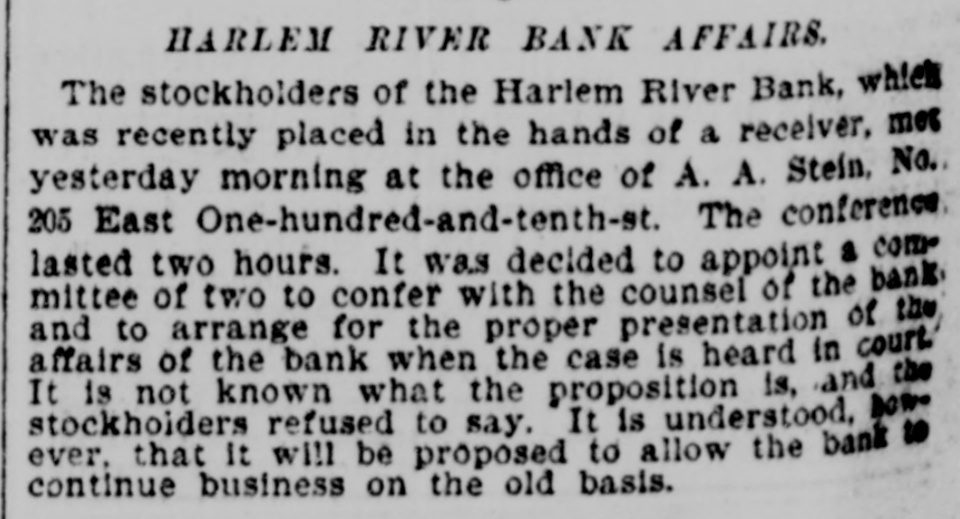
HARLEM RIVER BANK AFFAIRS. The stockholders of the Harlem River Bank, which was recently placed in the hands of a receiver, met yesterday morning at the office of A. A. Stein, No. 205 East One-hundred-and-tenth-st. The conference lasted two hours. It was decided to appoint a come mittee of two to confer with the counsel of the bank, and to arrange for the proper presentation of the affairs of the bank when the case is heard in court. It is not known what the proposition is, and the stockholders refused to say. It is understood, now- to ever, that It will be proposed to allow the bank continue business on the old basis.


Article from New-York Tribune, May 9, 1894

Click image to open full size in new tab

Article Text

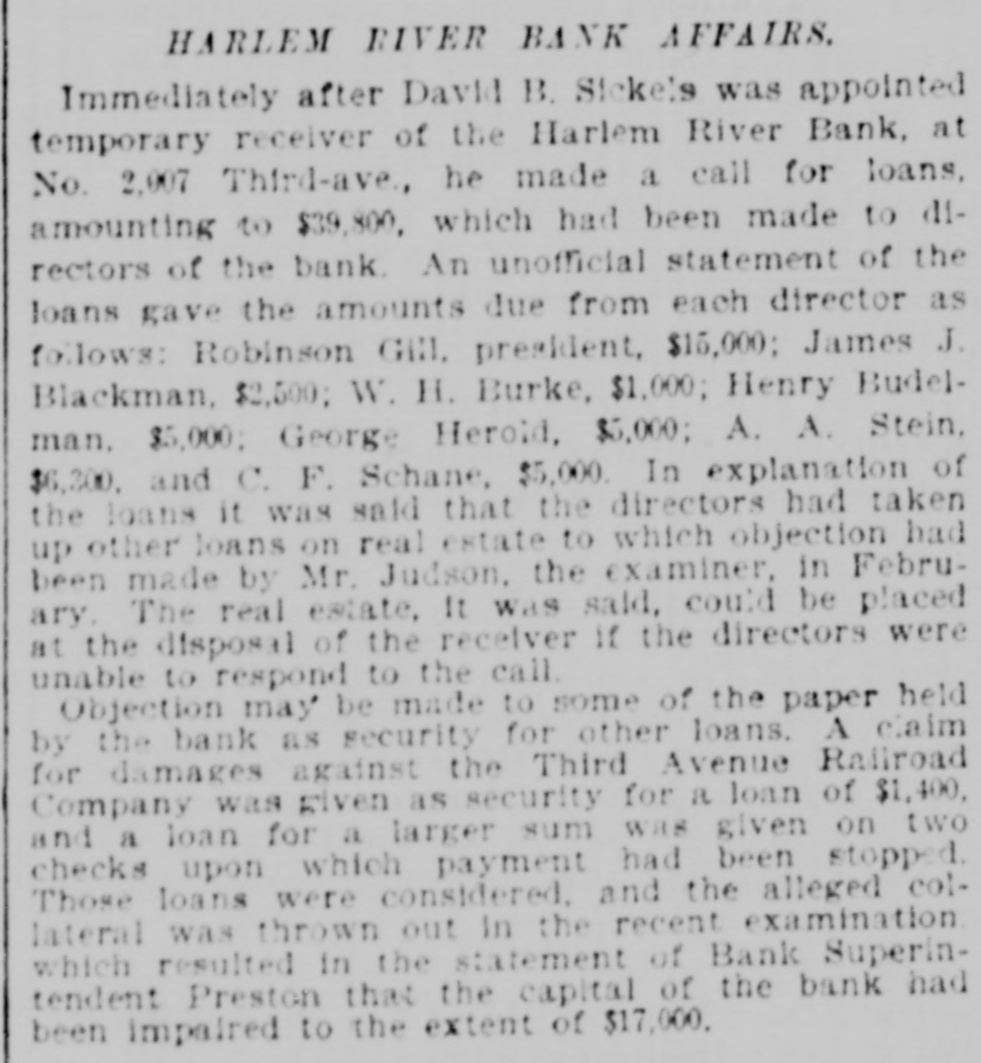
HARLEM RIVER BANK AFFAIRS. Immediately after David B. Sickels was appointed temporary receiver of the Harlem River Bank, at No. 2,007 Third-ave., he made a call for loans, amounting to $39,800, which had been made to directors of the bank. An unofficial statement of the loans gave the amounts due from each director as follows: Robinson Gill, president, $15,000; James J. Blackman, $2,500; W. H. Burke, $1,000; Henry Budelman. $5,000; George Herold, $5,000; A. A. Stein, $6,300. and C. F. Schane, $5,000. In explanation of the loans it was said that the directors had taken up other loans on real estate to which objection had been made by Mr. Judson, the examiner, in February, The real estate, It was sald, could be placed at the disposal of the receiver if the directors were unable to respond to the call. Objection may be made to some of the paper held by the bank as security for other loans. A claim for damages against the Third Avenue Railroad Company was given as security for a loan of $1,400, and a loan for a larger sum WAS given on two checks upon which payment had been stopped. Those loans were considered. and the alleged collateral was thrown out In the recent examination which resulted in the statement of Bank Superintendent Preston that the capital of the bank had been impaired to the extent of $17,000.


Article from New-York Tribune, May 20, 1894

Click image to open full size in new tab

Article Text

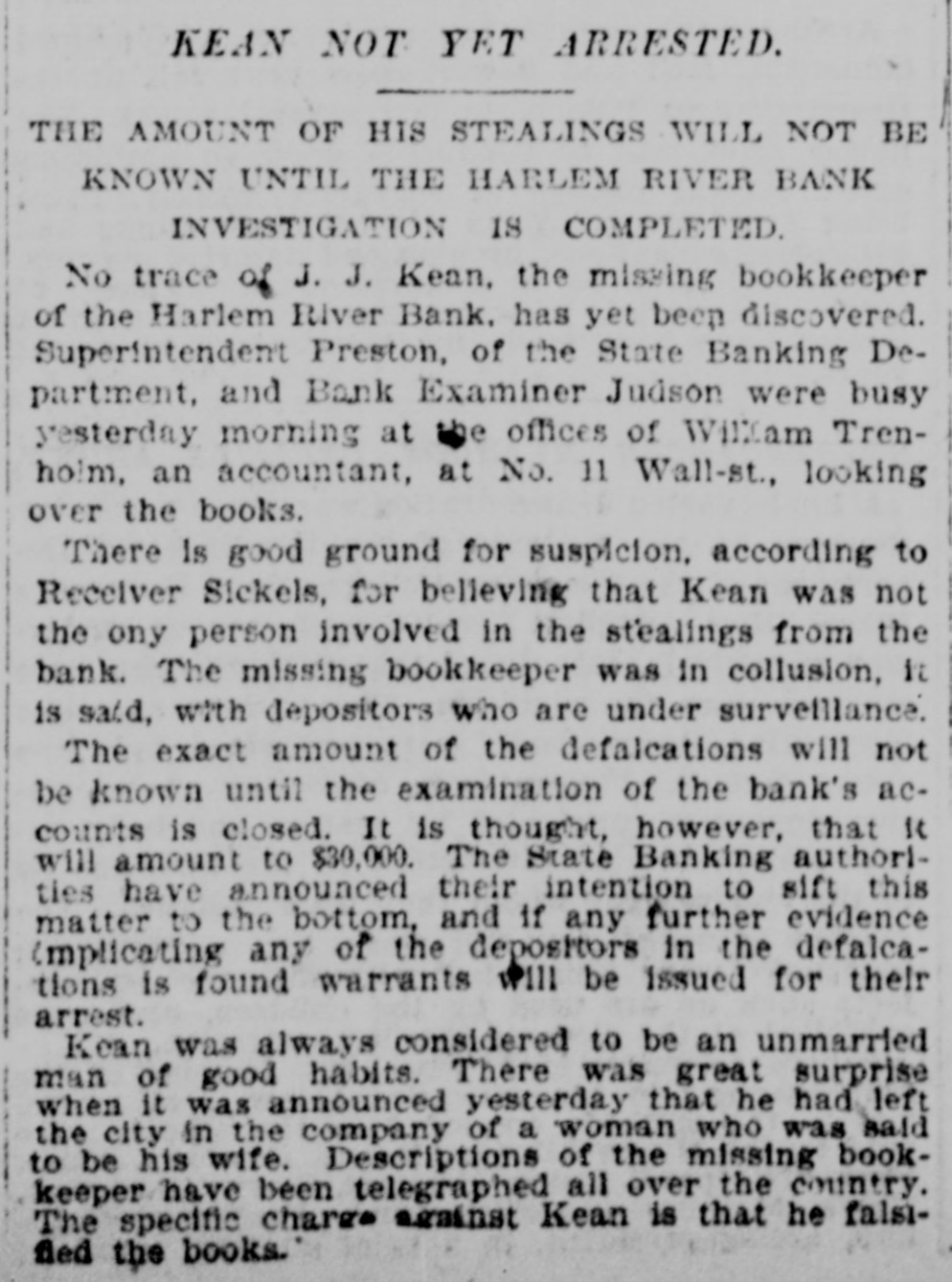
KEAN NOT YET ARRESTED. THE AMOUNT OF HIS STEALINGS WILL NOT BE KNOWN UNTIL THE HARLEM RIVER BANK INVESTIGATION IS COMPLETED. No trace of J. J. Kean, the missing bookkeeper of the Harlem River Bank. has yet been discovered. Superintendent Preston, of the State Banking Department, and Bank Examiner Judson were busy yesterday morning at be offices of William Trenholm, an accountant, at No. 11 Wall-st., looking over the books. There is good ground for suspicion, according to Receiver Sickels, for believing that Kean was not the ony person involved in the stealings from the bank. The missing bookkeeper was in collusion, it is said, with depositors who are under surveillance. The exact amount of the defalcations will not be known until the examination of the bank's accounts is closed. It is thought, however, that It will amount to $30,000. The State Banking authorities have announced their intention to sift this matter to the bottom, and if any further evidence (mplicating any of the depositors in the defalcations is found warrants will be issued for their arrest. Kean was always considered to be an unmarried man of good habits. There was great surprise when it was announced yesterday that he had left the city in the company of a woman who was said to be his wife. Descriptions of the missing bookkeeper have been telegraphed all over the country. The specific charge against Kean is that he falsified the books.'


Article from New-York Tribune, May 23, 1894

Click image to open full size in new tab

Article Text

BITS OF LEGAL NEWS. Justice Patterson, in Supreme Court, Chambers, was occupied yesterday in hearing a discussion in the suit brought by Edward S. Stokes against WillIam E. D. Stokes to recover $250,000 damages for libel. Ex-Congressman John J. Adams yesterday moved that the first cause of action, in which he procured a judgment, be severed from the other two causes of action, and that they be tried separately as soon as possible. The motion was opposed by Benjamin F. Tracy, and decision was reserved. Chief Judge Daly, of the Court of Common Pleas, yesterday granted permission to Receiver Sickles, of the Harlem River Bank, to bring suits against W. W. Belvin, Louis G. Todd and Charles A. Gerlach and his wife, to recover $13,699 18 on promissory notes made by the defendants. Senator Lexow left the Investigating Committee session long enough yesterday morning to appear before Chief Judge Daly and argue a motion in behalf of the receiver of the Harlem River Bank concerning a mortgage on the property Nos. 415 and 417 East One-hundred-and-twelfth-st., given to secure a loan of $5,600. The mortgage held by the bank 18 the fourth mortgage on the property. The holder of the second mortgage on the property is the wife of the former president of the bank. She, in order to protect the bank as much as possible, has consented to allow the fourth mortgage to take the place of the second mortgage, and $3,000 is to be paid upon it, leaving a balance of $2,000 still due the bank. This is to. be secured by a mortgage on unimproved property which is to be exchanged for the houses, but is not to take the preference over builder's liens, in case buildings are erected on that property. This agreement was satisfactory to everybody, and Judge Daly said he would sign an order to that effect. The suit of Pampeo Maresi, the caterer, against the American Yacht Club for $215 for champagne furnished in 1888, was dismissed by Chief Justice Ehrlich of the City Court yesterday. It was shown that the steward of the club gave the order on his own responsibility, and that money was afterward given to him to settle the bill, which he failed to do.


Article from Mineral Point Tribune, May 31, 1894

Click image to open full size in new tab

Article Text

where he is serving a sentence for bigamy. Two previous ceremonies had been performed. Business men of the northwest met at Minneapolis and formed an association whose object is to built up a home market for home-manufactured goods. The No. 6 Wamsutta mill at New Bedford, where the weavers have been on strike 14 weeks, has shut down indefinitely. Attempts have been made to keep the mill running with "knobsticks" without success, as the "knobsticks" were induced to leave soon after they began work. David B. Sickles, receiver of the Harlem River bank at New York, says that as soon as the experts now examining the bank's books get further along in their work it will develop that Kean, the defaulting book-keeper, had accomplices. The total defalcation, will foot up fully $30,000. Armsted Rice was hanged at Eutaw, Ala., for the murder of Burrell Kimbro last December. On the scaffold Rice confessed the crime also to having murdered a man in Mississippi years ago, and afterward another in Birmingnam, and to shooting a woman in Greene county last fall.


Article from New-York Tribune, June 21, 1894

Click image to open full size in new tab

Article Text

BITS OF LEGAL NEWS. United States District-Attorney Platt, at the request of Attorney-General Olney, is preparing a suit against the North American Commercial Company to recover $132,187. The secretary of the company on March 12, 1890, made an agreement with the Secretary of the Treasury for the exclusive privilege for twenty years for seal fishing on the islands of St. George and St. Paul, Alaska, the annual rent for which privilege was $60,000, with additional taxes for oil, payable on or before April 1. As the North American Commercial Company is in default of last year's rent, the suit is being prepared to recover what is due the Government. The Duke d'Auxy was before William J. Boyhan, at No. 291 Broadway, yesterday afternoon. Mr. Boyhan is the referee in supplementary proceedings in the suit brought by a Columbus-ave. grocer to recover a bill of $78 12. The examination failed to reveal anything possessed by the Duke which could be attached, and the hearing was adjourned until June 29. A sweeping and comprehensive order was granted yesterday by Judge Bischoff, of the Court of Common Pleas, to David B. Sickels, temporary receiver of the Harlem River Bank. He is empowered to redeem all mortgages and conditional contracts, and all pledges of personal property, and to adjust all accounts between the bank and its creditors and debtors. Meantime all persons indebted to the bank are directed to come forward with their accounts and pay their indebtedness. The order has been given with a view to the payment as soon as possible of a 25 per cent dividend. The Grand Jury for the present term of the United States Circuit Court was sworn in by Judge Benedict yesterday morning. John H. Hudson, secretary of the West Side Savings Bank, was appointed foreman.


Article from New-York Tribune, July 19, 1894

Click image to open full size in new tab

Article Text

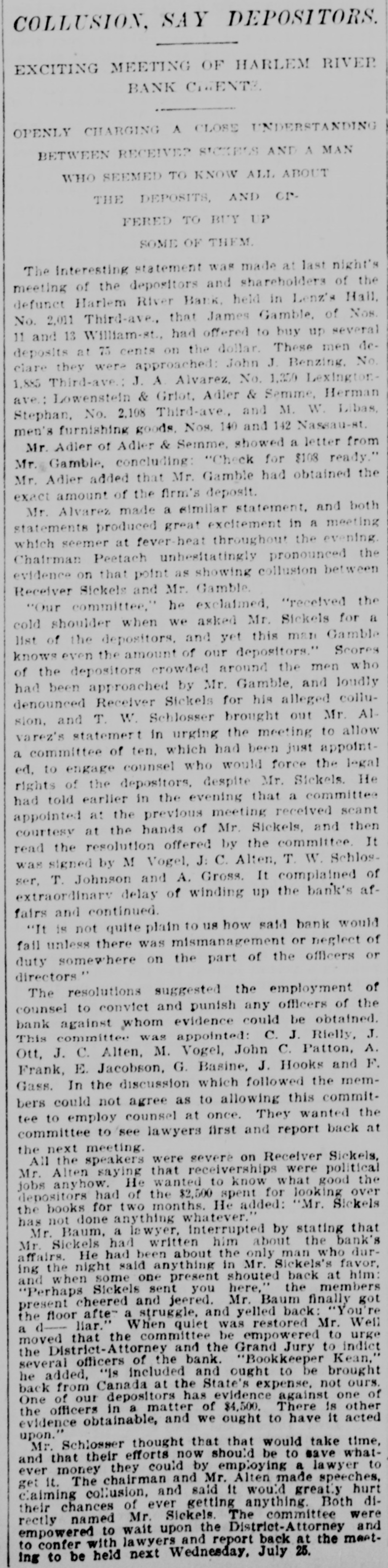
COLLUSION, SAY DEPOSITORS. EXCITING MEETING OF HARLEM RIVER BANK CHENTE OPENLY CHARGING A CLOSE UNDERSTANDING BETWEEN RECEIVE? SICKERS AND A MAN WHO SEEMED TO KNOW ALL ABOUT THE DEPOSITS, AND CPFERED TO BUY UP SOME OF THEM The Interesting statement was made at last night's meeting of the depositors and shareholders of the defunct Harlem River Bank held in Lenz's Hall. No. 2,011 Third-ave. that James Gamble. of Nos 11 and 13 William-st., had offered to buy up several deposits at 75 cents on the dollar. These men declare they were approached: John J. Benzing No. 1,885 Third-ave. J. A Alvarez, No. 1,350 Lexington ave.: Lowenstein & Griot, Adler & Semme, Herman Stephan, No. 2,108 Third-ave. and M. W. Libas, men's furnishing goods. Nos. 140 and 142 Nassau-st. Mr. Adler of Adler & Semme, showed a letter from Mr. Gamble, concluding "Check for $108 ready." Mr. Adier added that Mr. Gamble had obtained the exact amount of the firm's deposit. Mr. Alvarez made a similar statement, and both statements produced great excitement in a meeting which seemer at fever-heat throughout the evening Chairman Peetach unhesitatingly pronounced the evidence on that point as showing collusion between Receiver Sickets and Mr. Gamble "Our committee," he exclaimed "received the cold shoulder when we asked Mr. Sickels for a list of the depositors, and yet this man Gamble knows even the amount of our depositors." Scores of the depositors crowded around the men who had been approached by Mr. Gamble, and loudly denounced Receiver Sickels for his alleged collusion, and T. W. Schlosser brought out Mr. A1varez's statement in urging the meeting to allow a committee of ten. which had been just appointed, to engage counsel who would force the legal rights of the depositors, despite Mr. Sickels. He had told earlier in the evening that a committee appointed at the previous meeting received scant courtesy at the hands of Mr. Sickels, and then read the resolution offered by the committee. It was signed by M Vogel, J: C. Alten, T. W. Schlosser, T. Johnson and A. Gross. It complained of extraordinary delay of winding up the bank's affairs and continued "It is not quite plain to us how said bank would fall unless there was mismanagement or neglect of duty somewhere on the part of the officers or directors The resolutions suggested the employment of counsel to convict and punish any officers of the bank against whom evidence could be obtained. This committee was appointed: C. J. Rielly, J. Ott, J. C. Alten, M. Vogel, John C. Patton, A. Frank, E. Jacobson, G. Basine, J. Hooks and F. Gass. In the discussion which followed the members could not agree as to allowing this committee to employ counsel at once. They wanted the committee to see lawyers first and report back at the next meeting. All the speakers were severe on Receiver Sickels, Mr. Alten saying that receiverships were political jobs anyhow. He wanted to know what good the depositors had of the $2,500 spent for looking over the books for two months. He added: Mr. Sickels has not done anything whatever.' Mr. Baum, a lawyer, Interrupted by stating that Mr. Sickels had written him about the bank's affairs. He had been about the only man who during the night said anything in Mr. Sickels's favor, and when some one present shouted back at him: "Perhaps Sickels sent you here." the members present cheered and jeered. Mr. Baum finally got the floor afte- a struggle, and yelled back: You're d- liar.' When quiet was restored Mr. Well a moved that the committee be empowered to urge the District-Attorney and the Grand Jury to indict several officers of the bank. 'Bookkeeper Kean,' he added, "Is included and ought to be brought back from Canada at the State's expense, not ours. One of our depositors has evidence against one of the officers in a matter of $4,500. There is other evidence obtainable, and we ought to have it acted upon." Mr. Schlosser thought that that would take time, and that their efforts now should be to save whatever money they could by employing a lawyer to get it. The chairman and Mr. Alten made speeches, claiming collusion, and said it would great.y hurt their chances of ever getting anything. Both directly named Mr. Sickels. The committee were empowered to wait upon the District-Attorney and to confer with lawyers and report back at the meeting to be held next Wednesday, July 25.
Article from New-York Tribune, July 26, 1894

Click image to open full size in new tab

Article Text

# SETTLING HARLEM RIVER BANK AFFAIRS. Judge Bookstaver, of the Court of Common Pleas, yesterday confirmed the report of William J. Lardner, who was appointed referee to determine as to the compensation due to Messrs. Trenholm, Teele and Dennis, the accountants who made the investigation of the books of the Hariem River Bank. The accountants will receive $2,000 for their work. The stenographer's bill for $58.75 and the referee's bill for $200 was also passed upon, and Receiver David B. Sickels was ordered to pay them. President Putsch presided at last night's meeting of the depositors of the bank. Chairman Reilly, on the part of the Executive Committee, submitted a report recommending a permanent organization of a depositors' association, and recommending the retaining of Mr. Epstein as its attorney. His figure was $250 as a retainer and $500 at the completion of the work. It was finally decided to authorize the Executive Committee to confer with Mr. Gayton, who offered to do all the work for 2 per cent of the money secured from Receiver Sickels. Ernest Fuchs, a liquor dealer, of No. 1,759 Lexington-ave., made the startling statement that a Mr. Sharkey, who lived in his house, claimed that he had, through a friend, secured every cent of his deposit from Receiver Sickels. Another meeting will be held on next Wednesday evening.


Article from New-York Tribune, October 4, 1894

Click image to open full size in new tab

Article Text

LOCAL BUSINESS COMPLICATIONS. Benjamin H. Tuthill, stock broker, of No. 60 Broadway, confessed judgment yesterday for $5,407 in favor of George J. O'Brien for money loaned and services rendered. Mr. O'Brien loaned him $2,000 on February 18, 1893, and $1,875 on September 8, 1893, and performed certain work between March 11, 1893, and July 25, 1894, worth $1,180, and for each of the above Items Mr. Tuthill gave a demand note. Interest and costs make up the balance of the judgment. Mr. Tuthill became a member of the Consolidated Exchange in 1886, and is a brother of "Gus" Tuthill, whom Police Captain Doherty testified In his trial made so much money for him in Wall Street. Benjamin H. Tuthill's assets are said to be small, and no execution was issued to the Sheriff on the judgment. The Sheriff has received an execution against Albert H. Leszynsky, of No. 35 Broad-st., for $5,731, in favor of David B. Sickels as receiver of the Harlem River Bank, on a note dated March 23. payable four months from date, which he gave to the bank. Transcript of a judgment for $117,719 obtained in the Kings County Supreme Court, was docketed here yesterday against Daniel G. Brown and Carrie M. Hasbrouck, lumber dealers of Newburg, N. Y., and Newark, N. J., in favor of Abijah Weston & Co., lumber merchants of Tonawanda, N. Y. Judgment for $854 was entered yesterday against Oliver Sumner Teall in favor of the Madison Square Garden Company.


Article from The Evening World, October 5, 1894

Click image to open full size in new tab

Article Text

Receiver Sickels in Court. A motion was made before Judge Glegerich, of the Court of Common Pleas, to-day by counsel for David B. Sickels, receiver of the Harlem River Bank, for permission to pay to Lueder Pieper, owner of the premises, 2007 Third avenue, $475, and surrender the lease of the property. Receiver Sickels alleges that the bank had a lease of the property for three years. and that since the failure of the bank Mr. Pieper had refused to allow the releasing of the property. Judge Glegerich signed an order authorizing it.


Article from New-York Tribune, February 3, 1895

Click image to open full size in new tab

Article Text

THE EAST SIDE BANK CLOSED. Continued from First Page. was not paying expenses and was running behind in its business, and at length we stepped in and took possession in order to prevent loss to depositors." "Will the depositors lose anything?" "I feel confident that there will be no loss to the depositors, and it is possible that the stockholders will not lose much, but a receivership is expensive and it is hard to say what will happen after the bank is in the hands of a receiver." "The affairs of the bank will, then, be closed?" "Yes, It will be impossible for the bank to go on again." "You do not feel that the State Banking Department was remiss in allowing the affairs of the bank to get in such a condition?" "No. We have kept watch of the bank and have taken possession in time to prevent loss to the depositors. I do not think the public can accuse the department of failure to guard the interests of the public in the banks. It is not yet certain that the depositors will lose anything in the case of the Madison Square Bank or of the St. Nicholas Bank. The depositors can recover from the stockholders, under the law that makes a stockholder responsible for twice the amount of his stock." "In the case of the closed Harlem River Bank, where there was a defalcation, will the depositors lose anything?" "That will depend upon the question as to the responsibility of the stockholders."


Article from New-York Tribune, January 4, 1902

Click image to open full size in new tab

Article Text

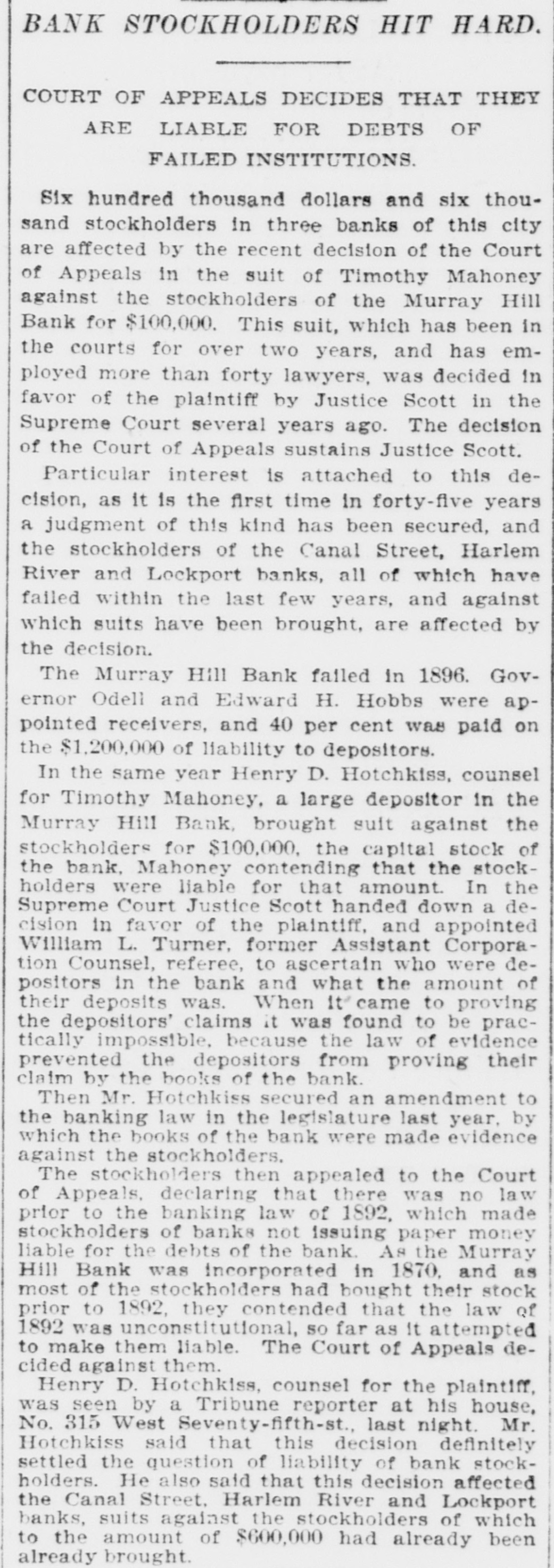
BANK STOCKHOLDERS HIT HARD. COURT OF APPEALS DECIDES THAT THEY ARE LIABLE FOR DEBTS OF FAILED INSTITUTIONS. Six hundred thousand dollars and six thousand stockholders in three banks of this city are affected by the recent decision of the Court of Appeals in the suit of Timothy Mahoney against the stockholders of the Murray Hill Bank for $100,000. This suit, which has been in the courts for over two years, and has employed more than forty lawyers, was decided in favor of the plaintiff by Justice Scott in the Supreme Court several years ago. The decision of the Court of Appeals sustains Justice Scott. Particular interest is attached to this decision, as it is the first time in forty-five years a judgment of this kind has been secured, and the stockholders of the Canal Street, Harlem River and Lockport banks, all of which have failed within the last few years, and against which suits have been brought, are affected by the decision. The Murray Hill Bank failed in 1896. Governor Odell and Edward H. Hobbs were appointed receivers, and 40 per cent was paid on the $1,200,000 of liability to depositors. In the same year Henry D. Hotchkiss, counsel for Timothy Mahoney, a large depositor in the Murray Hill Bank, brought suit against the stockholders for $100,000, the capital stock of the bank, Mahoney contending that the stockholders were liable for that amount. In the Supreme Court Justice Scott handed down a decision in favor of the plaintiff, and appointed William L. Turner, former Assistant Corporation Counsel, referee, to ascertain who were depositors in the bank and what the amount of their deposits was. When it came to proving the depositors' claims it was found to be practically impossible, because the law of evidence prevented the depositors from proving their claim by the books of the bank. Then Mr. Hotchkiss secured an amendment to the banking law in the legislature last year. by which the books of the bank were made evidence against the stockholders. The stockholders then appealed to the Court of Appeals, declaring that there was no law prior to the banking law of 1892, which made stockholders of banks not issuing paper money liable for the debts of the bank. As the Murray Hill Bank was Incorporated in 1870, and as most of the stockholders had bought their stock prior to 1892, they contended that the law of 1892 was unconstitutional, so far as it attempted to make them liable. The Court of Appeals decided against them. Henry D. Hotchkiss, counsel for the plaintiff, was seen by a Tribune reporter at his house, No. 315 West Seventy-fifth-st., last night. Mr. Hotchkiss said that this decision definitely settled the question of liability of bank stockholders. He also said that this decision affected the Canal Street, Harlem River and Lockport banks, suits against the stockholders of which to the amount of $600,000 had already been already brought.