Contemporary articles describe a run in October 1875 (triggered by general distrust after the Third Avenue Savings Bank failure and the president's financial embarrassments), the bank invoking the 60-day notice and later suspending operations with a receiver appointed in December 1875. Receivership followed findings of large deficiencies and alleged fraud; dividends were subsequently paid by the receiver but the bank remained closed/defunct. I inferred 'state' for a savings bank (state-chartered). Dates taken from newspaper publication dates; OCR errors in names/dates corrected where obvious (e.g., 'Schwartz' corrected from OCR variants).
Events (4)
1.October 9, 1875Run
Cause
Local Banks
Cause Details
Run originated in general distrust created by failure/suspension of the Third Avenue Savings Bank and depositors' nervousness; also linked to the president's personal embarrassments.
Measures
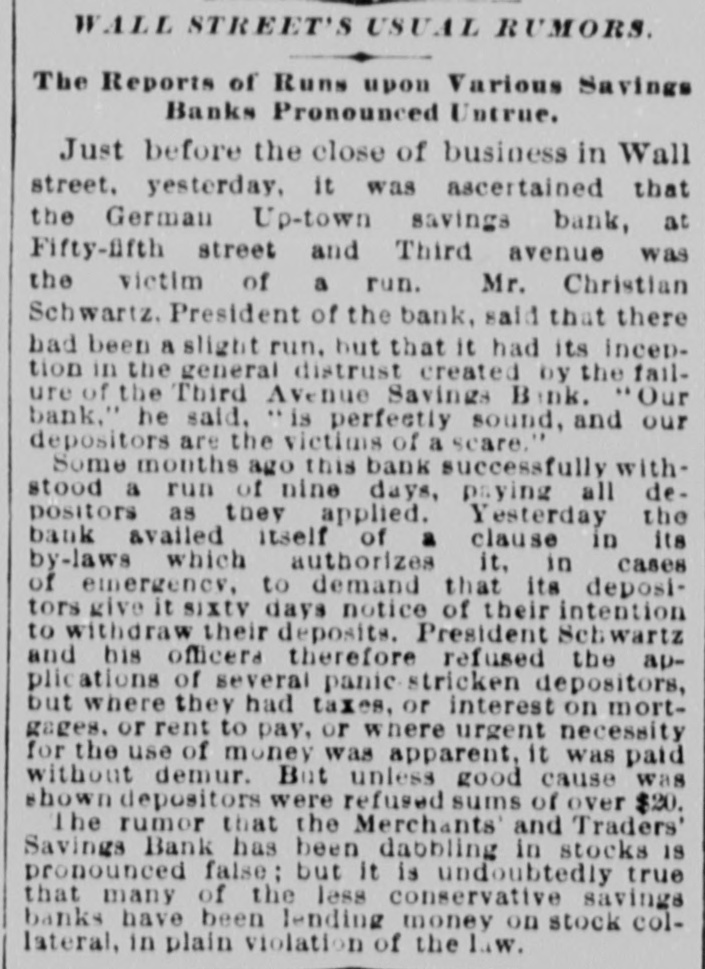
Bank paid depositors in urgent need; then invoked by-laws to require sixty days' notice of withdrawal and refused withdrawals except for urgent necessity or small sums.
Newspaper Excerpt
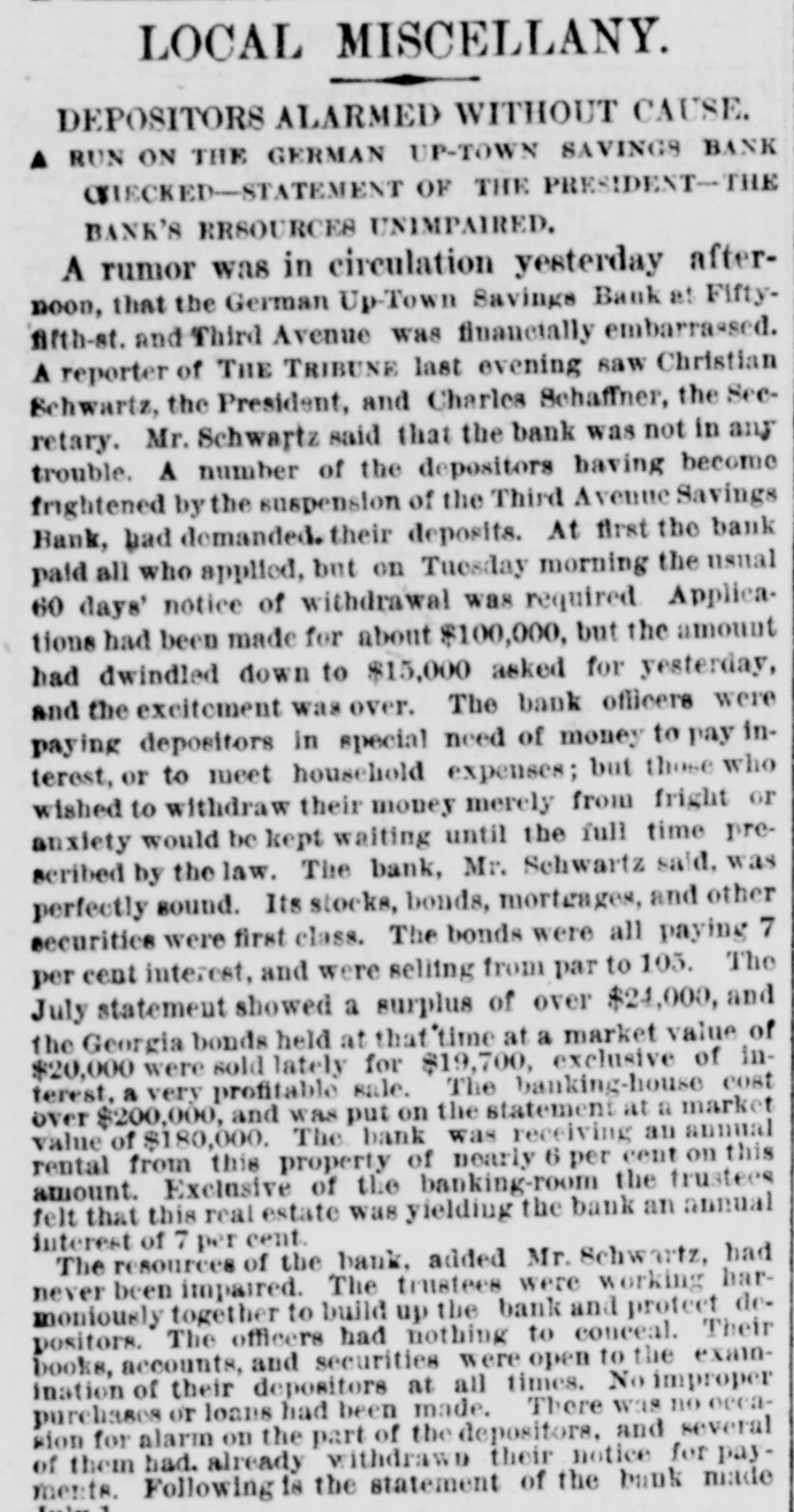
A rumor was in circulation yesterday afternoon ... run on the German Up-Town Savings Bank ... A number of the depositors having become frightened by the suspension of the Third Avenue Savings Bank, had demanded their deposits.
Source
newspapers
2.December 11, 1875Suspension
Cause
Bank Specific Adverse Info
Cause Details
Examination revealed large deficiencies, questionable loans and worthless Southern/state bonds and alleged misappropriations by officers leading to suspension and receiver appointment.
Newspaper Excerpt
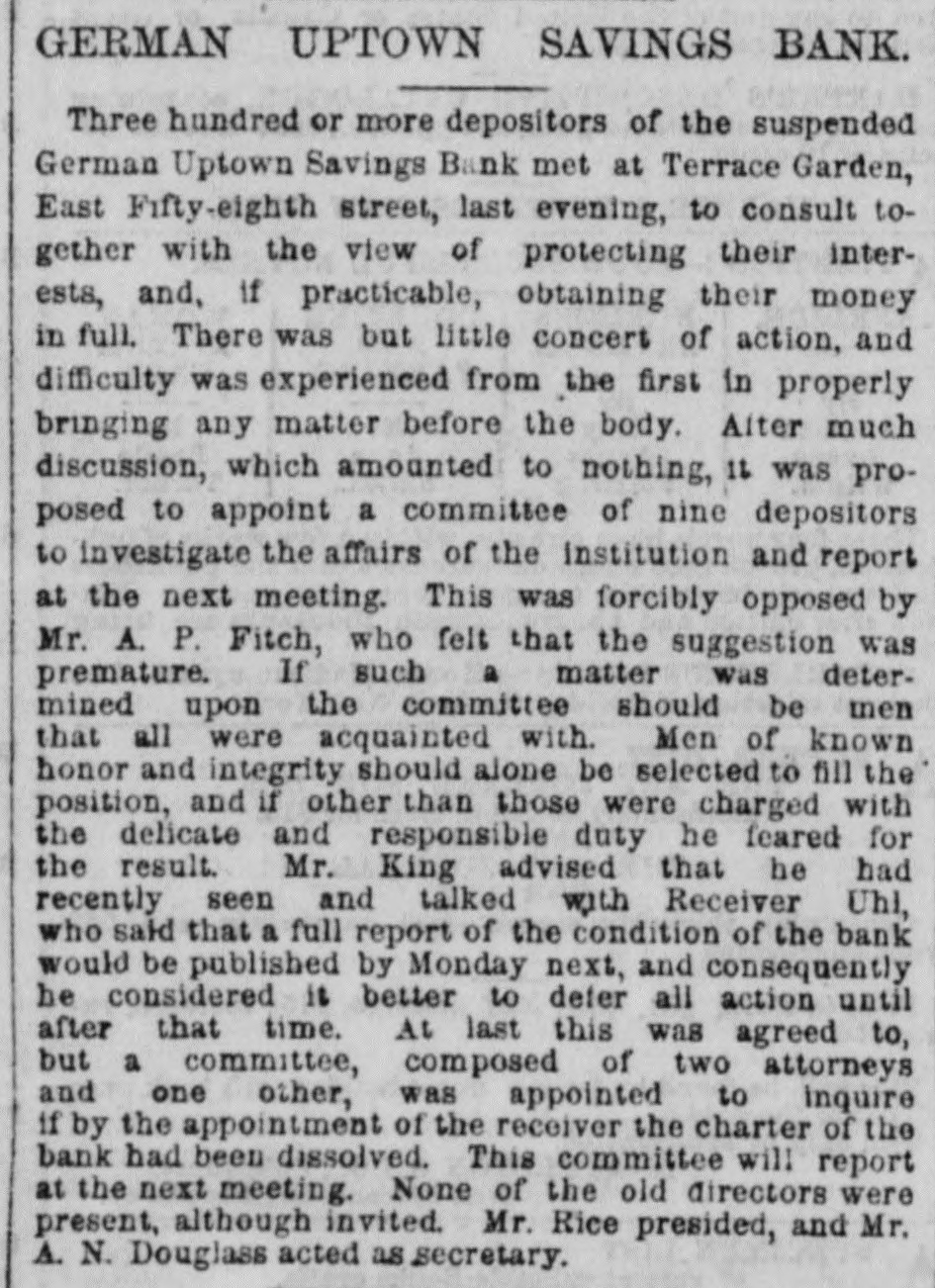
Three hundred or more depositors of the suspended German Uptown Savings Bank met ... Receiver Uhl ... Looking into the Books of the German Up-Town Savings Bank.
Source
newspapers
3.December 16, 1875Receivership
Newspaper Excerpt
Christian Schwartz, the President, and the Secretary ... have not been seen at the bank since the suspension. Every day develops some new fraud or improper transaction ... Mr. Herman Uhl, the receiver of the German Up-town, is laboring ... to bring to justice all who have misused the funds.
Source
newspapers
4.January 31, 1876Other
Newspaper Excerpt
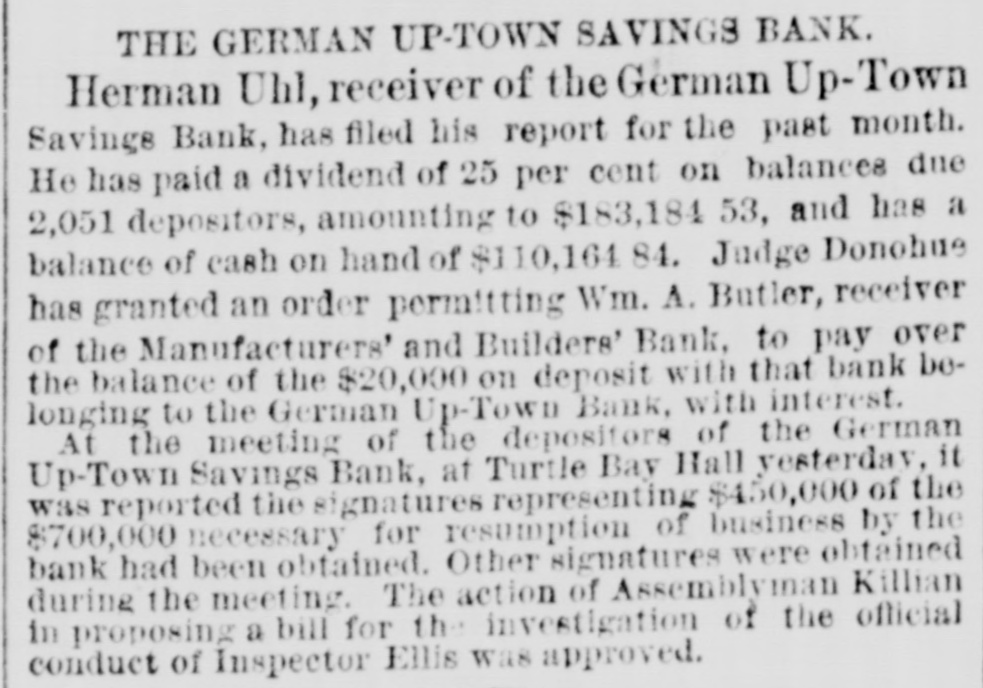
Herman Uhl, receiver ... has paid a dividend of 25 per cent on balances due 2,051 depositors ... and has a balance of cash on hand of $110,164.84.
Source
newspapers
Newspaper Articles (22)
1.October 9, 1875New-York TribuneNew York, NY
Click image to open full size in new tab
Article Text
LOCAL MISCELLANY. DEPOSITORS ALARMED WITHOUT CAUSE. RUN ON THE GERMAN UP-TOWN SAVINGS BANK CIECKED-STATEMENT OF THE PRESIDENT-THE BANK'S RESOURCES UNIMPAIRED. A rumor was in circulation yesterday afternoon, that the German Up-Town Savings Bank at Fiftyfifth-st. and Third Avenue was financially embarrassed. A reporter of THE TRIBUNE last evening saw Christian Schwartz, the President, and Charles Schaffner, the Secretary. Mr. Schwartz said that the bank was not in any trouble. A number of the depositors having become frightened by the suspension of the Third Avenue Savings Bank, bad demanded. their deposits. At first the bank paid all who applied, but on Tuesday morning the usual 60 days' notice of withdrawal was required. Applications had been made for about $100,000, but the amount had dwindled down to $15,000 asked for yesterday, and the excitement was over. The bank officers were paying depositors in special need of money to pay interest, or to meet household expenses; but those who wished to withdraw their money merely from fright or anxiety would be kept waiting until the full time prescribed by the law. The bank, Mr. Schwartz said, was perfectly sound. Its stocks, bonds, mortgages, and other securities were first class. The bonds were all paying 7 per cent interest, and were selling from par to 105. The July statement showed a surplus of over $24,000, and the Georgia bonds held at that time at a market value of $20,000 were sold lately for $19,700, exclusive of interest, a very profitable sale. The banking-house cost over $200,000, and was put on the statement at a market value of $180,000. The bank was receiving an annual rental from this property of nearly 6 per cent on this amount. Exclusive of the banking-room the trustees felt that this real estate was yielding the bank an annual interest of 7 per cent. The resources of the bank. added Mr. Schwartz, had never been impaired. The trustees were working barmoniously together to build up the bank and protect depositors. The officers had nothing to conceal. Their books, accounts, and securities were open to the exainination of their depositors at all times. No improper purchases or loans had been made. There was no occasion for alarm on the part of the depositors, and several of them had. already withdrawn their notice for payments. Following is the statement of the bank made
2.October 9, 1875The SunNew York, NY
Click image to open full size in new tab
Article Text
WALL STREET'S USUAL RUMORS. The Reports of Runs upon Various Savings Banks Pronounced Untrue. Just before the close of business in Wall street. yesterday, it was ascertained that the German Up-town savings bank, at Fifty-fifth street and Third avenue was the victim of a run. Mr. Christian Schwartz. President of the bank, said that there bad been a slight run. but that it had its inception in the general distrust created by the failure of the Third Avenue Savings Bank. "Our bank, he said. is perfectly sound, and our depositors are the victims of a scare." Some months ago this bank successfully withstood a run of nine days, paying all depositors as they applied. Yesterday the bank availed itself of a clause in its by-laws which authorizes it, in cases of emergency, to demand that its depositors give it SIXTV days notice of their intention to withdraw their deposits. President Sebwartz and his officera therefore refused the applications of several panic stricken depositors, but where they had taxes, or interest on mortgages. or rent to pay, or where urgent necessity for the use of money was apparent, it was paid without demur. But unless good cause was shown depositors were refused sums of over $20. The rumor that the Merchants' and Traders' Savings Bank has been dabbling in stocks IS pronounced false: but it is undoubtedly true that many of the less conservative savings banks have been lending money on stock collateral, in plain violation of the law.
3.November 29, 1875New-York TribuneNew York, NY
Click image to open full size in new tab
Article Text
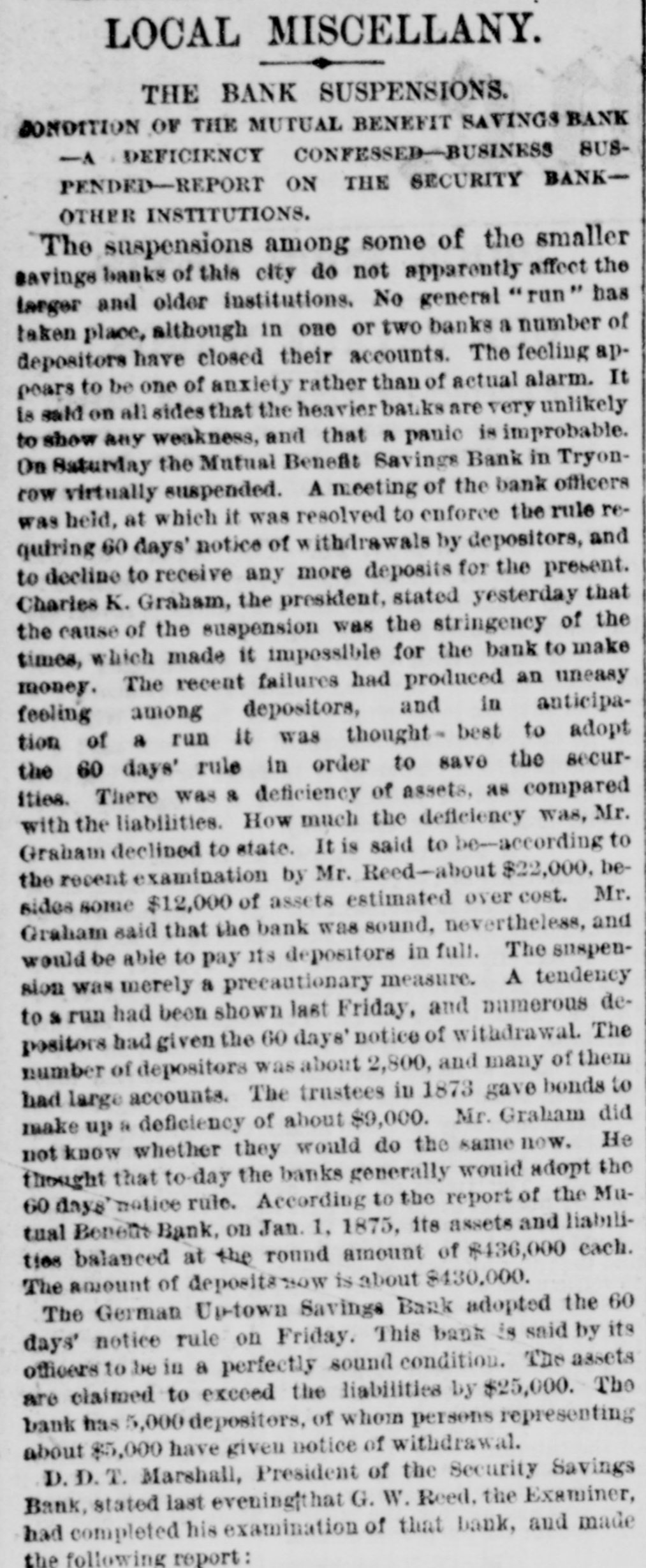
LOCAL MISCELLANY. THE BANK SUSPENSIONS. DONOTTION OF THE MUTUAL BENEFIT SAVINGS BANK -A DEFICIENCY CONFESSED-BUSINESS SUSPENDED-REPORT ON THE SECURITY BANKOTHER INSTITUTIONS. The suspensions among some of the smaller savings banks of this city do not apparently affect the larger and older institutions. No general "run" has taken place, although in one or two banks a number of depositors have closed their accounts. The feeling appears to be one of anxiety rather than of actual alarm. It is said on all sides that the heavier bauks are very unlikely to show any weakness, and that a panic is improbable. On Saturday the Mutual Benefit Savings Bank in Tryonrow virtually suspended. A meeting of the bank officers was held, at which it was resolved to enforce the rule requiring 60 days' notice of withdrawals by depositors, and to decline to receive any more deposits for the present. Charles K. Graham, the president, stated yesterday that the cause of the suspension was the stringency of the times, which made it impossible for the bank to make money. The recent failures had produced an uneasy feeling among depositors, and in anticipation of a run it was thought best to adopt the 60 days' rule in order to save the securities. There was & deficiency of assets, as compared with the liabilities. How much the deficiency was, Mr. Graham declined to state. It is said to be-according to the recent examination by Mr. Reed-about $22,000, besides some $12,000 of assets estimated over cost. Mr. Graham said that the bank was sound, nevertheless, and would be able to pay its depositors in full. The suspension was merely a precautionary measure. A tendency to & run had been shown last Friday, and numerous depositors had given the 60 days' notice of withdrawal. The number of depositors was about 2,800, and many of them had large accounts. The trustees in 1873 gave bonds to make up a deficiency of about $9,000. Mr. Graham did not know whether they would do the same now. He thought that to-day the banks generally would adopt the 60 days' notice rule. According to the report of the Mutual Benefit Bank, on Jan. 1, 1875, its assets and liabilities balanced at the round amount of $436,000 each. The amount of depositsnow is about $430,000. The German Up-town Savings Bank adopted the 60 days' notice rule on Friday. This bank is said by its officers to be in a perfectly sound condition. The assets are claimed to exceed the liabilities by $25,000. The bank has 5,000 depositors, of whom persons representing about $5,000 have given notice of withdrawal. D. D. T. Marshall, President of the Security Savings Bank, stated last evening(that G. W. Reed, the Examiner, had completed his examination of that bank, and made the following report:
4.December 8, 1875The SunNew York, NY
Click image to open full size in new tab
Article Text
The Grent Showman's Scn-in-Law Appointed Receiver- Looking into the Books of the German Up-Town Savings Bank.
5.December 11, 1875The New York HeraldNew York, NY
Click image to open full size in new tab
Article Text
GERMAN UPTOWN SAVINGS BANK. Three hundred or more depositors of the suspended German Uptown Savings Bank met at Terrace Garden, East Fifty-eighth street, last evening, to consult together with the view of protecting their interests, and, If practicable, obtaining their money in full. There was but little concert of action, and difficulty was experienced from the first in properly bringing any matter before the body. Alter much discussion, which amounted to nothing, 11 was proposed to appoint a committee of nine depositors to investigate the affairs of the institution and report at the next meeting. This was forcibly opposed by Mr. A. P. Fitch, who felt that the suggestion was premature. If such a matter was determined upon the committee should be men that all were acquainted with. Men of known honor and integrity should alone be selected to fill the position, and if other than those were charged with the delicate and responsible duty he feared for the result. Mr. King advised that he had recently seen and talked with Receiver Uhl, who said that a full report of the condition of the bank would be published by Monday next, and consequently he considered it better to defer all action until after that time. At last this was agreed to, but a committee, composed of two attorneys and one other, was appointed to inquire if by the appointment of the receiver the charter of the bank had been dissolved. This committee will report at the next meeting. None of the old directors were present, although invited. Mr. Rice presided, and Mr. A. N. Douglass acted as secretary.
6.December 16, 1875The SunNew York, NY
Click image to open full size in new tab
Article Text
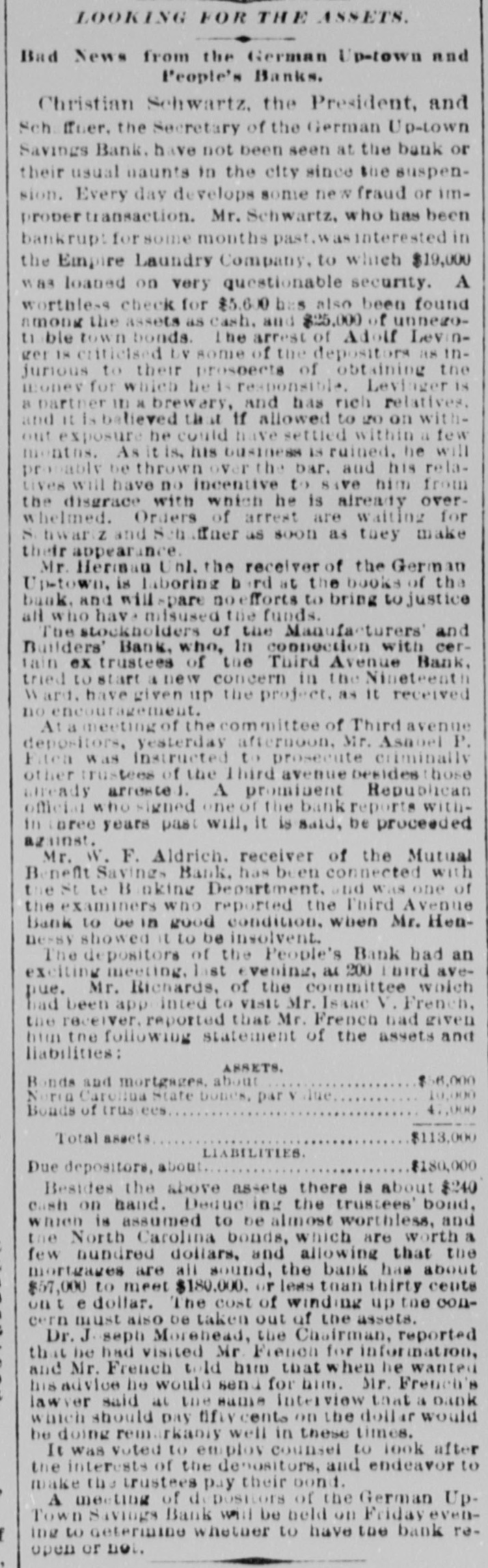
LOOKING FOR THE ASSETS. Bad News from the German Up-town and People's Banks. Christian Schwartz, the President, and Sch: ffuer. the Secretary of the German Up-town Savings Bank. have not been seen at the bank or their usual haunts in the city since the suspension. Every day develops some new fraud or improper transaction. Mr. Schwartz, who has been bankrupt for some months past. was interested in the Empire Laundry Company, to which $19,000 was loaned on very questionable security. A worthless check for $5,600 has also been found among the assets as cash. and $25,000 of unnegoti ble town bonds. The arrest of Adolf Levinger 18 criticlsed LV some of the depositors as injurious to their prospects of obtaining the money for which he is responsible. Levinger is a partner ID H. brewary, and has rich relatives. and It is believed that if allowed to 120 on without exposure be could have settled within a few months. As it is, his business IS ruined. he will propably be thrown over the bar. and his relaLives will have no incentive to save him from the disgrace with which he is already overwhelmed. Orders of arrest are waiting for S. hwar z and Seb as soon as they make their appearance. Mr. Herman Unl. the receiver of the Germ an Up-town, is laboring b ird at the books of the bank. and will-pare noefforts to bring tojustice all who have misused the funds. The stockholders of the Manufacturers' and Builders' Bank, who, In connection with certain ex trustees of the Third Avenue Bank, tried to start a new concern in the Nineteenth Ward. have given up the project, as it received no encouragement. At a meeting of the committee of Third avenue depositors, yesterday afternoon, Mr. Asnoel P. Fitch was instructed to prosecute criminally other trustees of the Third avenue besides hose already arrested. A prominent Republican official who signed one of the bank reports within three years past will, it is Sald, be proceeded against. Mr. W. F. Aldrich. receiver of the Mutual Benefit Savings Bank, has been connected with the St te B oking Department. and was one of the examiners who reported the Third Avenue Bank to be in good condition, when Mr. Hennessy showed it to be insolvent. The depositors of the People's Bank had an exciting meeting, last evening, at 200 Chird avenue. Mr. Richards. of the committee which had been app inted to VISIT Mr. Isaac V. French, the receiver. reported that Mr. French had given him the following statement of the assets and liabilities: ASSETS. $56,000 Bonds and mortgages. about 10,000 Nurca Carolina State Dones, par Jue 47,000 Bonds of trus ees $113,000 Total assets LIABILITIES. $180,000 Due depositors, about Besides the above assets there is about $240 cash on hand. Dedue ing the trustees' bond, which is assumed to be almost worthless, and the North Carolina bonds, which are worth a few nundred dollars, and allowing that the mortgages are all sound, the bank has about $57,000 to meet $180,000. or less toan thirty cents ont e dollar. The cost of winding up the concern must also be taken out of the assets. Dr. seph Morehead, the Chairman, reported that be had visited Mr. French for information, and Mr. French told him that when he wanted his advice he would send for him. Mr. French's lawver said at the same interview that a bank which should pay fifty cents on the dollar would be doing remarkanly well in these times. It was voted to employ counsel to look after the interests of the denositors, and endeavor to
7.December 16, 1875The New York HeraldNew York, NY
Click image to open full size in new tab
Article Text
SUMMARY OF LAW CASES. Argument in the Barrmore contested will case was concluded yesterday afternoon before Surrogate Hutchings. Decision was reserved. Paul V. Gross, who was arrested on a charge of obtaining money under false pretences, has been honorably discbarged by the Grand Jury, there not being sufficient grounds for his indictment. Leave was granted yesterday by Judge Davis to William E. Butler, receiver of the Manufacturers and Builders' Bank, to sell, at $56 each, thirty-eight bonds or the Utica, Ithaca and Elmira Railroad Company pledged to the Chatham Bank to be paid on 120 days' drafts on England On application yesterday on behalf of the German Eptown Savings Bank, Mr. John E. Parsons was substituted, by order of Judge Davis, as counsel, in place of Adolph Levinger, under arrest upon a charge of embezzling the funds of the bank. An alternative mandamus was yesterday granted by Judge Davis against the Board of Health, directing it to enter on the burial records the name of Mary C. Goodwin, instead of Mary C. Goodman, or show cause why the alteration should not be made. The writ is made returnable morrow, A judgment was entered in the County Clerk's office yesterday in favor of the Trenton Banking Company against Duncan, Sherman & Co. for $136,000. The suit upon which this judgement was obtained was brought to recover money on deposit at the banking house at the time of its suspension. Application was made by Henrietta Hurt to the Su. preme Court some time ago for a writ of habeas corpus to compel her husband, who is separated from her, to Testore to her the custody of their child. The husband answered that the child died in Bellevue Hospital. To 5nd out whether this was the case the Court rejerred the matter to Nathaniel Jarvis, Jr. He reported yesterday in favor of the wife and against the husband's story that the child was dead. Catherine Davis, an administratrix, brought suit in the Superior Court, before Judge Freedman, against a William Hickman, to recover $5,000 damages for the death of her husband, caused, as 18 alleged, through the negligence of the defendant. The deceased was employed by the defendant in tearing down an old build. ing, and, as the widow claims, without proper facilities to do the work, and while so employed was killed. Judge Freedman yesterday dismissed the complaint, on the ground that no negligence had been shown. The case of Charles L. Lawrence, indicted in the United States Circuit Court, for the alleged forgery of the name of F.L. Blanding upon owner's oaths and Importer's entries, and also with presenting the same at the Custom House, with intent to defraud the United States, was continued yesterday until this morning. Application has been made by the counset for the defence to examine certain papers in the hands of the United States District Attorney, and he requested this delay for consideration of the request. Mr. Wade brought suit nineteen years ago against Anthony De Leyer for an accounting on a part-
8.December 18, 1875The SunNew York, NY
Click image to open full size in new tab
Article Text
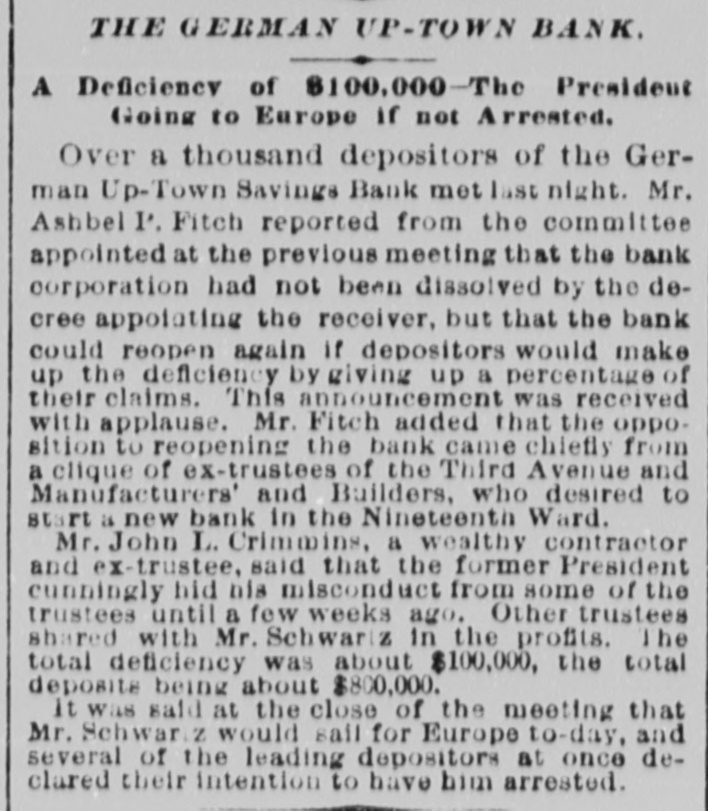
THE GERMAN UP-TOWN BANK. A Deficiency of $100,000-The President Going to Europe if not Arrested. Over a thousand depositors of the German Up-Town Savings Bank met last night. Mr. Ashbel P. Fitch reported from the committee appointed at the previous meeting that the bank corporation had not been dissolved by the decree appointing the receiver, but that the bank could reopen again if depositors would make up the deficiency by giving up a percentage of their claims. This announcement was received with applause. Mr. Fitch added that the opposition to reopening the bank came chiefly from a clique of ex-trustees of the Third Avenue and Manufacturers' and Builders, who desired to start a new bank in the Nineteenth Ward. Mr. John L. Crimmins, a wealthy contractor and ex-trustee, said that the former President cunningly hid his misconduct from some of the trustees until a few weeks ago. Other trustees shared with Mr. Schwartz in the profits. The total deficiency was about $100,000, the total deposits being about $800,000. it was said at the close of the meeting that Mr. Schwar: would sail for Europe to-day, and several of the leading depositors at once declared their intention to have him arrested.
9.December 20, 1875New-York TribuneNew York, NY
Click image to open full size in new tab
Article Text
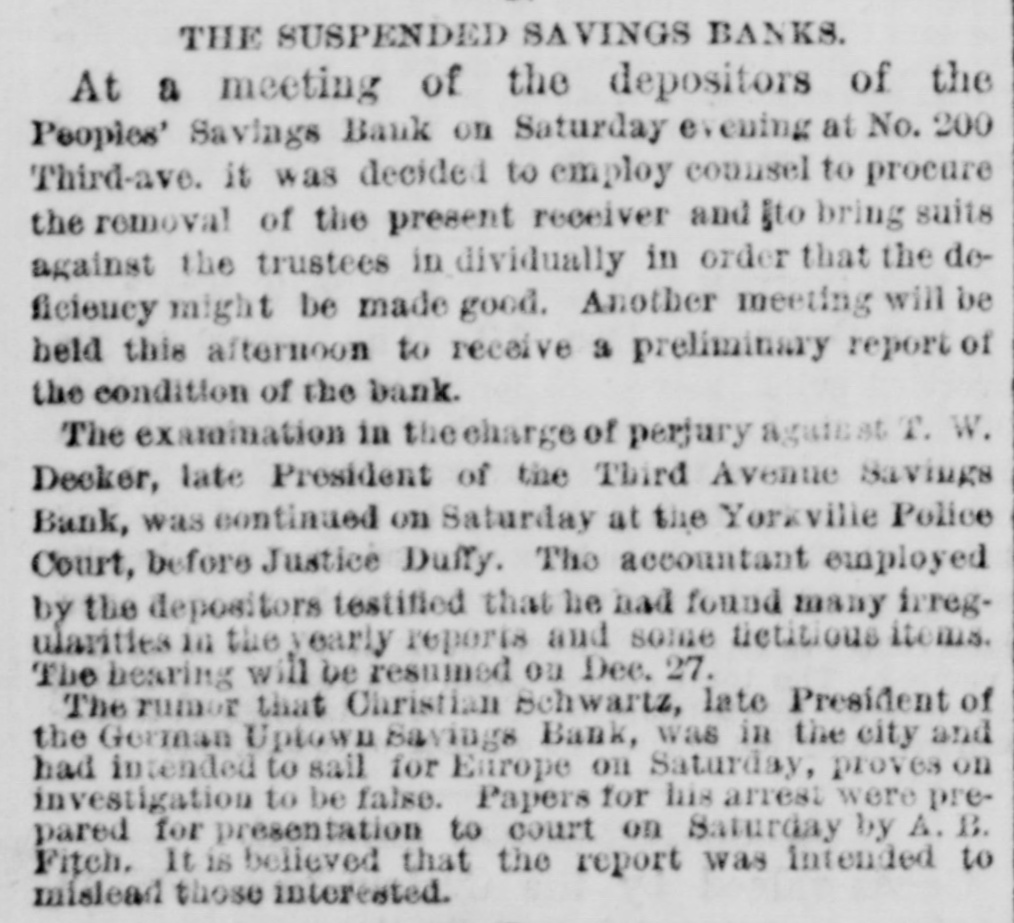
THE SUSPENDED SAVINGS BANKS. At a meeting of the depositors of the Peoples' Savings Bank on Saturday evening at No. 200 Third-ave. it was decided to employ counsel to procure the removal of the present receiver and Ito bring suits against the trustees in dividually in order that the deficiency might be made good. Another meeting will be held this afternoon to receive a preliminary report of the condition of the bank. The examination in the charge of perjury against T. W. Decker, late President of the Third Avenue Savings Bank, was continued on Saturday at the Yorkville Police Court, before Justice Duffy. The accountant employed by the depositors testified that he had found many irregularities in the yearly reports and some tietitious items. The hearing will be resumed on Dee. 27. The rumor that Christian Schwartz, late President of the German Uptown Savings Bank, was in the city and had intended to sail for Europe on Saturday, proves on investigation to be false. Papers for his arrest were prepared for presentation to court on Saturday by A. B. Fitch. It is believed that the report was intended to mislead those interested.
10.December 20, 1875Chicago Daily TribuneChicago, IL
Click image to open full size in new tab
Article Text
THE NEW YORK SAVINGS BANKS. The deeper the examination of the affairs of the broken New York savings banks is carried, the more Indignant and hopeless the depositors become, and the larger the deficiencies. The former President of the German Up-Town Havings Bank is shown to have been In the habit of making loans to bis personal friends on worthless securities, The counsel of the Lank approp risted to his own UHO $33,735 which Le had collected for the Lank. Large amounts of Seathern and county bonds which were rated in his assets at par, are worthless, The Mutual Benefit Ravings Bank is in the hands of A Receiver, who refusos to give the depositors any information about its condition, and these unfortunate creditors have appointed an expert to ascertain what their prospects are for dividends. The Receiver, W. F. Aldrich, in stated by the Now York Sun to have been, when connected with the State Banking Department, one of the Examiners who reported the Third Avenue Savings Bank sound, when it was insolvent. The People's Savings Bank has assets of about $57,000, to meet $180,000. The Receiver of this bank bluffed the representative of the depositors with the remark that when he wanted him he would send for him, and the Receiver's lawy er gave him the desolating informati >n that a bank which could pay 50 per cent to these titnes was doing remarkably well! The books of the Third Avenue Savings Bank thow that a deficiency of $235,000 was known to the Trustees in 1872. Their bond for $176,000, cannot be enforced till 183.1 SCARCITY OF GOLD IN BALTIMORE. There is BO little cash gold in Baltimore that Importera there have difficulty in obtaining enough to pay duties with. The American says: It is hardly credible, but it is n fact, that one Inporter who wanted $50 visited four brokers' offices be fore he could secure that small amount. Those who winh larger amounts have to wait until they can, through their correspondents, buy gold notes in New York. The Committee of Baltimore sugar-importers who recently visited Washington in reference to drawbacks on sugars called the attention of Treasurer New to the trouble that existed here on account of the BubTreasurer having discontinued the sale of gold memorandum checks. They urged upon Mr. New the necescity: that existed for affording them relief, and he promised that be would 800 what could be done. GROWTH OF TAXATION. The New York Daily Bulletin is compiling comparative statistics of the growth of taxation and population, national, State, and local, The list is as follows: 44 Ordinaty expeditures of the United States Government " in 1874 and 1860, exclusive of interest on debt. 1674. 1900.
11.December 23, 1875The SunNew York, NY
Click image to open full size in new tab
Article Text
OLOSING SAVINGS BANKS. The Yorkville and the East Side Sailors' to be Forced One of Business. Superintendent Ellis has resolved to close the Yorkville Savings Bank, known as "Harry Genet's bank." The examiner reported a deficiency two years ago, but the bank has been allowed to go on. Its condition has been made still more hopeless by the refusal of the State of Alabama to recognizo the railroad bonds endorsed by the State, in which It Invested $10,000. Most of the depositors are Hariem working people. The Superintendent has also decided to close the East Side Savings Bank for 8 tor. a Uenev olent institution, with about $16,000 on deposit. It IS solvent. and has been conducted gratis by S. toping Commissioner Duncan. Rei reiver Uni, of the Germ 11 Up-town Savtries Bank, says there will be a dividend about the first of next January. He DODES to be able to settle up the affairs of the bank within three months. Ex-Pre-ident Clausen 8318 that the run on the b nk was caused by the financial emrassment of President Sebwarz. that Mr. Cummiss collected $26,000 of the bask's money. and that depositors should not seil their books. Depositors of the German i---Town Savings Bank. in a meeting last eventage considered is prej osition to allow half of their deposits to reminin for one year with some favor.
12.December 23, 1875The New York HeraldNew York, NY
Click image to open full size in new tab
Article Text
THE GERMAN UPTOWN BANK. LETTER FROM MR. CLAUSEN, THE LAST PRESIDENT, TO THE DEPOSITORS. Mr. Henry Clausen, Jr., late President of the German Uptown Savings Bank, addresses a long letter to the depositors of that institution in regard to the suspension and its causes. He says that after the failure of the Third Avenue Savings Bank there was a heavy run on the German Uptown Savings Bank, and that the directors arrived at the conclusion that the "run" has resulted chiefly from the financial embarrassments of the President, Mr. C. Schwarz. Mr. Clausen's letter goes on to explain how he and other directors began to realize that Alabama State bonds, of the town of Springport, Cayuga county, and North and South Carolina bonds, were comparatively worthless. He then refers to the fact that Mr. Crimmins had acknowledged that he had collected $26,000 belonging to the bank and appropriated 16 to his own use. In conclusion Mr. Clausen says:-"I, in conjunction with some of the directors, used my best efforts to secure the appointment of a receiver who would conscientiously administer the affairs of the bank for the best interests of the depositors. Mr. J. D. Crimmins and I then called upon General Uhl, who, after considerable hesitancy, consented to accept the receivership if appointed by the courts.' Mr. Clausen advises depositors not to dispose of their bank books, as the receiver will wind up the affairs of the bank as rapidly as possible, for the best interests of the depositors. In connection with the failure of the German Uptown Savings Bank the most surprising fact is that securities such as North and South Carolina and Alabama State bonds, which have long been known to be absolutely worthless, should have been counted in the assets of the company at the values assigned to them. A meeting of the heavy depositors of the German Uptown Savings Bank was held last evening at No. 1,037 Third avenue, Mr. Louis Reiss presiding. About $100,000 was represented, the largest single deposit being $5,500. A plan was submitted for consideration recommending the depositors to stipulate to allow at least fifty per cent of the amount to their credit in the bank to remain untouched for one year, 60 that the institution would not go into bankruptcy. According to the inventory of the receiver the amount due the depositors is $838,888. The aggregate of the reduction would be $167,377 62. The plan further suggested the propriety of making an application to the next Legislature to change the name of the institution; that a board of trustees be selected from among the depositors, a committee of which should take all the questionable securities and doubtful claims now held by the bank, and when $20,000 should be realized from the collection of these claims or the disposal of any securities that may come into their bands, declare a dividend pro rata to be added to the books a those who had made a reduction in their original claims. Mr. Michelbacher, one of the trustees of the bank, made a statement showing the actual deficiency to be $30,000, and that the institution might still go on with its business if the depositors would agree to lose five per cent. A vote subsequently taken showed that a majority of those present were in favor of continuing the business of the bank, and about thirty-five of them placed their names on record as favoring that proposition, but the plan above mentioned was not adopted.
13.December 23, 1875New-York TribuneNew York, NY
Click image to open full size in new tab
Article Text
01 Totals These figures indicate a dividend of 35 cents on the dollar to depositors. If the trustees' bonds are contested the dividend will be materially reduced. It is hoped by the depositors' committee that by skillful management on the part of the receiver the assets may be made to yield their full market value, and that by granting reasonable time for payment some of the bad debts may be compromised and settled to the advantage of the de. positors. The outlook at present is not hopeful. THE GERMAN UP-TOWN BANK. Henry Clausen, jr., recently President of the German Up-town Savings Bank, has addressed a long letter to the depositors in regard to the suspension and its causes. He says that after the failure of the Third Avenue Savings Bank there was a heavy run on the German Up-town Savings Bank, and that the directors arrived at the conclusion that the run had resulted chiefly from the financial emba arrassments of the President, C. Schwarz. Mr. Clausen's letter explains how he and other directors began to realize that Alabama State bonds, bonds of the town of Springport, Cayuga County and North and South Carolina bonds were comparatively worthless. In conclusion Mr. Clausen says: "I, in conjunction with some of the directors, used my best efforts to secure the appointment of a receiver who would conscientiously administer the affairs of the bank for the best interests of the depositers. J. D. Crimmins and I then called upon Gen. Uhl, who, after considerable hesitancy, consented to accept the receivership if appointed by the courts." Mr. Clausen advises depositors not to dispose of their bankbooks, as the receiver will wind up the affairs of the bank as rapidly as possible for the best interests of the depositors. The depositors of large sums in the German Up-town Lank met last evening at No. 1,037 Third-ave. Forty were present, representing about $100,000. A paper, drawn up by Mr. Crimmins and others, made the fellow. las sucgestions: According to the receiver's inventory
14.December 24, 1875New-York TribuneNew York, NY
Click image to open full size in new tab
Article Text
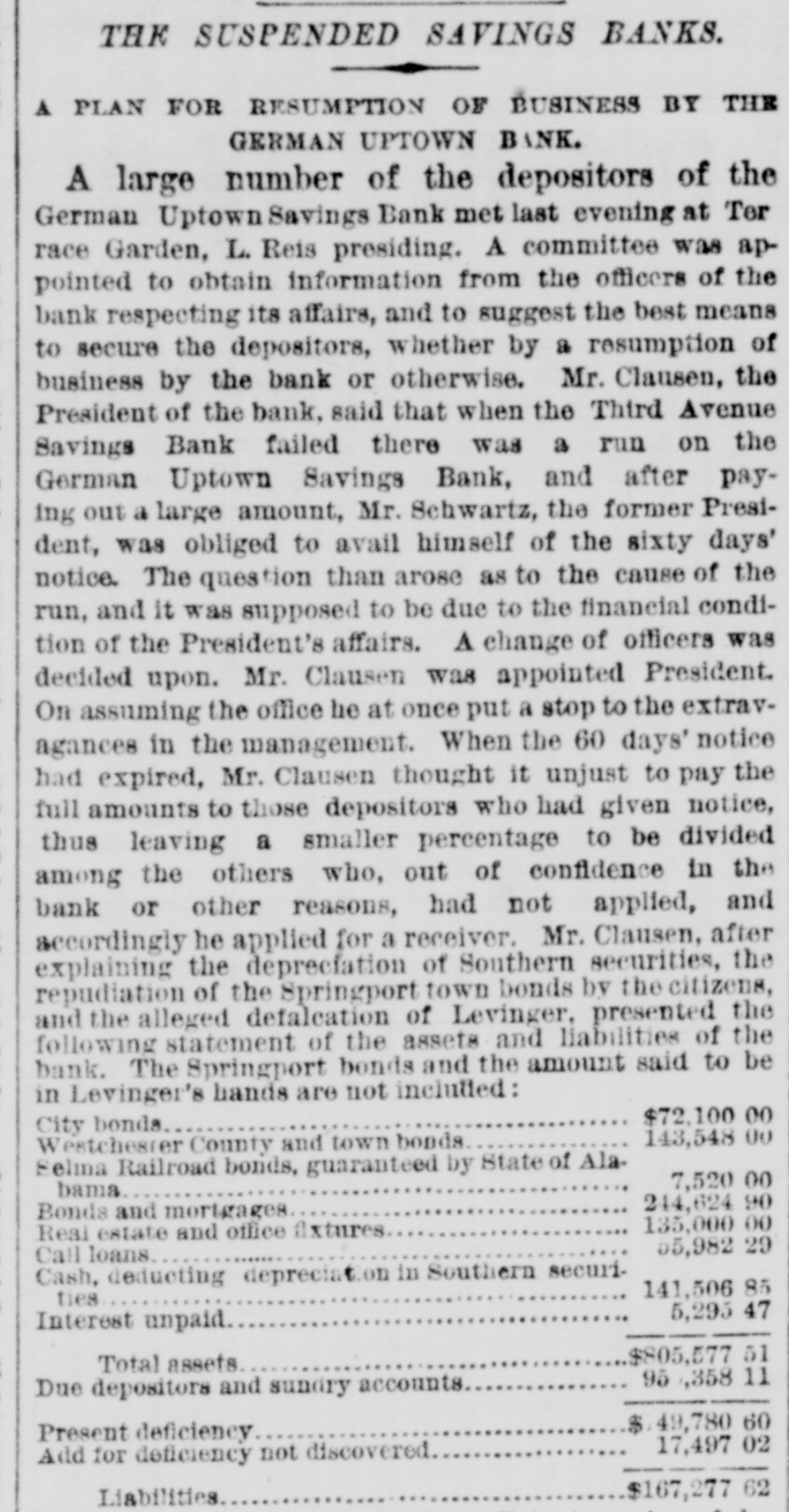
THE SUSPENDED SAVINGS BANKS. A PLAN FOR RESUMPTION OF BUSINESS BY THE GERMAN UPTOWN BANK. A large number of the depositors of the German Uptown Savings Bank met last evening at Ter race Garden, L. Reis presiding. A committee was appointed to obtain information from the officers of the bank respecting its affairs, and to suggest the best means to secure the depositors, whether by a resumption of business by the bank or otherwise. Mr. Clausen, the President of the bank. said that when the Third Avenue Savings Bank failed there was a run on the German Uptown Savings Bank, and after paying out a large amount, Mr. Schwartz, the former President, was obliged to avail himself of the sixty days' notice. The question than arose as to the cause of the run, and it was supposed to be due to the financial condition of the President's affairs. A change of officers was decided upon. Mr. Clausen was appointed President. On assuming the office he at once put a stop to the extravagances in the management. When the 60 days' notice had expired, Mr. Clausen thought it unjust to pay the full amounts to those depositors who had given notice, thus leaving a smaller percentage to be divided among the others who, out of confidence in the bank or other reasons, had not applied, and accordingly he applied for a receiver. Mr. Clausen, after explaining the depreciation of Southern securities, the repudiation of the Springport town bonds by the citizens, and the alleged detalcation of Levinger, presented the following statement of the assets and liabilities of the bank. The Springport bonds and the amount said to be in Levinger's hands are not included: $72,100.00 City bonds 143,548 00 Westchester County and town bonds Selma Railroad bonds, guaranteed by State of Ala. 7,520 00 bama 244,624 90 Bonds and mortgages 135,000 00 Real estate and office fixtures 55,982 29 Call loans Cash, deducting depreciat on in Southern securi141,506 85 ties 5,295 47 Interest unpaid $805,577 51 Total assets 1,358 11 Due depositors and sunday accounts $.49,780 60 Present deficiency 17,497 02 Add for deficiency not discovered $167,277 62 Liabilities
15.December 31, 1875The SunNew York, NY
Click image to open full size in new tab
Article Text
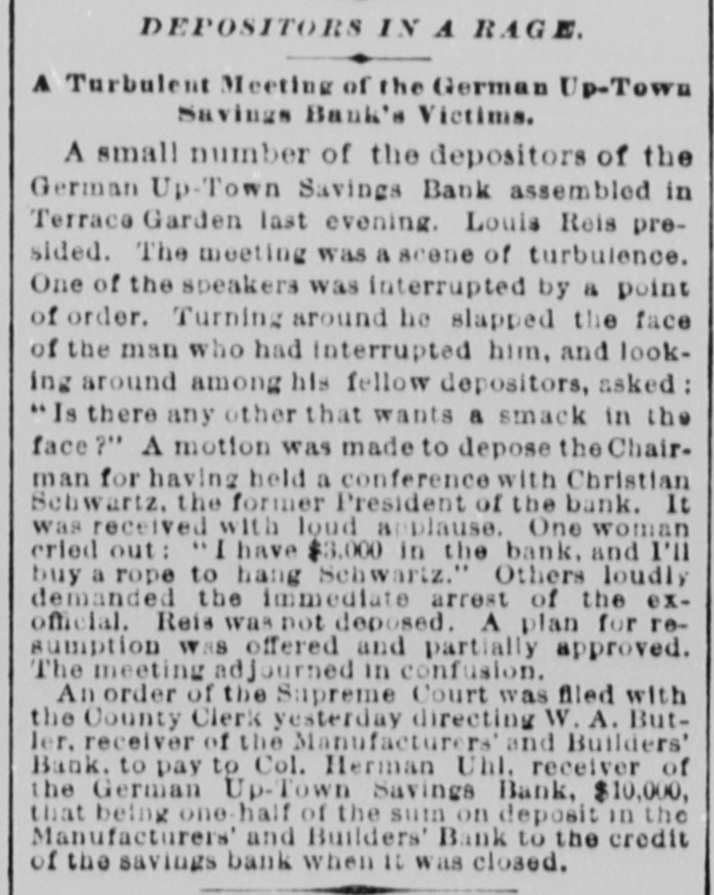
DEPOSITORS IN A RAGE. A Turbulent Meeting of the German Up-Town Savings Bank's Victims. A small number of the depositors of the German Up-Town Savings Bank assembled in Terrace Garden last evening. Louis Reis presided. The meeting was a scene of turbulence. One of the speakers was interrupted by a point of order. Turning around he slapped the face of the man who had interrupted him. and looking around among his fellow depositors, asked: Is there any other that wants a smack in the face?" A motion was made to depose the Chairman for having held a conference with Christian Schwartz. the former President of the bank. It was received with loud applause. One woman cried out: "I have $3.000 in the bank. and I'll buy a rope to hang Schwartz." Others loudly demanded the immediate arrest of the exofficial. Reis was not deposed. A plan for resumption WAS offered and partially approved. The meeting adjourned in confusion. An order of the Supreme Court was filed with the County Clerk yesterday directing W. A. Butler, receiver of the Manufacturers' and Builders' Bank. to pay to Col. Herman Uhl. receiver of the German Up-Town Savings Bank, $10,000, that being one half of the sum on deposit in the Manufacturers' and Builders' Bank to the credit of the savings bank when It was closed.
16.December 31, 1875New-York TribuneNew York, NY
Click image to open full size in new tab
Article Text
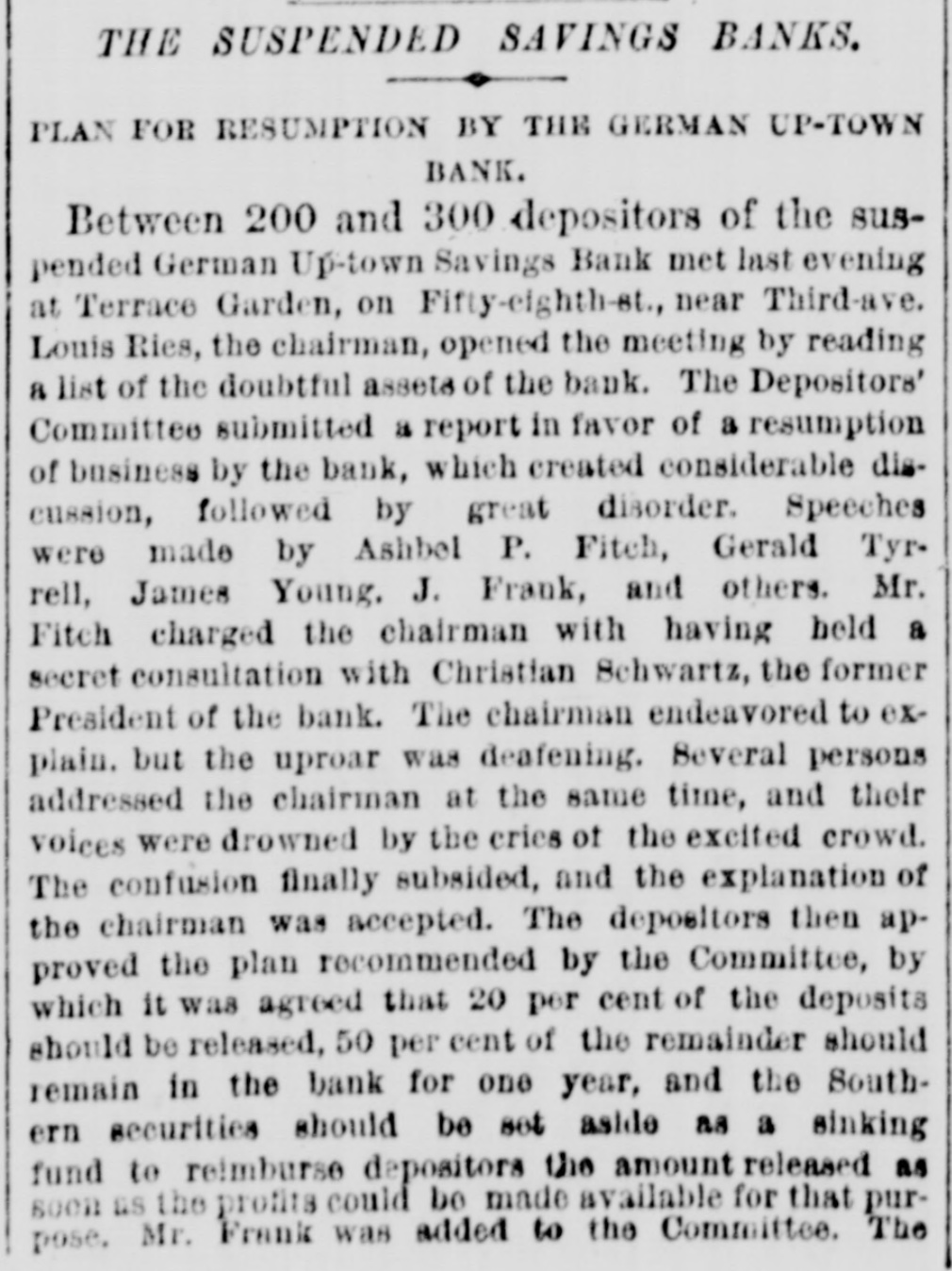
THE SUSPENDED SAVINGS BANKS. PLAN FOR RESUMPTION BY THE GERMAN UP-TOWN BANK. Between 200 and 300 depositors of the suspended German Up-town Savings Bank met last evening at Terrace Garden, on Fifty-eighth-st., near Third-ave. Louis Ries, the chairman, opened the meeting by reading a list of the doubtful assets of the bank. The Depositors' Committee submitted a report in favor of a resumption of business by the bank, which created considerable discussion, followed by great disorder. Speeches were made by Ashbel P. Fitch, Gerald Tyrrell, James Young. J. Frank, and others. Mr. Fitch charged the chairman with having held a secret consultation with Christian Schwartz, the former President of the bank. The chairman endeavored to explain. but the uproar was deafening. Several persons addressed the chairman at the same time, and their voices were drowned by the cries of the excited crowd. The confusion finally subsided, and the explanation of the chairman was accepted. The depositors then approved the plan recommended by the Committee, by which it was agreed that 20 per cent of the deposits should be released, 50 per cent of the remainder should remain in the bank for one year, and the Southern securities should be set aside as a sinking fund to reimburse depositors the amount released as soon as the profits could be made available for that purpose. Mr. Frank was added to the Committee. The
17.January 12, 1876New-York TribuneNew York, NY
Click image to open full size in new tab
Article Text
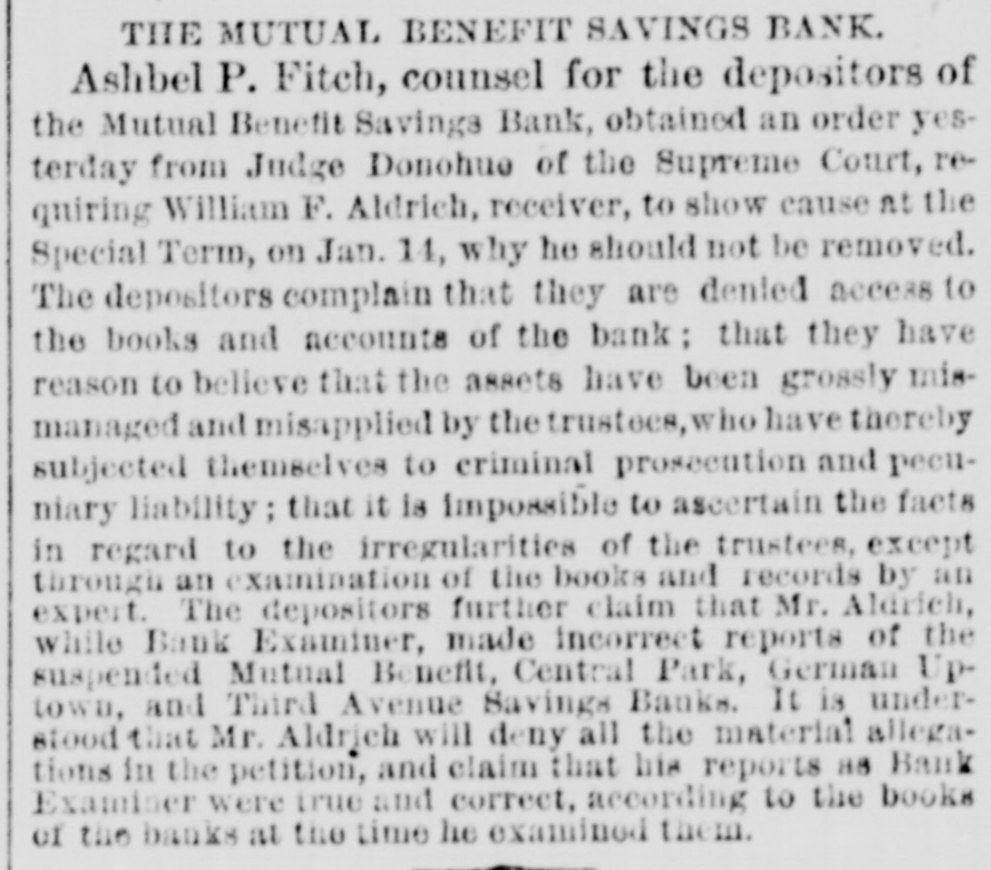
THE MUTUAL BENEFIT SAVINGS BANK. Ashbel P. Fitch, counsel for the depositors of the Mutual Benefit Savings Bank, obtained an order yesterday from Judge Donohue of the Supreme Court, requiring William F. Aldrich, receiver, to show cause at the Special Term, on Jan. 14, why he should not be removed. The depositors complain that they are dented access to the books and accounts of the bank: that they have reason to believe that the assets have been grossly mismanaged and misapplied by the trustoes, who have thereby subjected themselves to criminal prosecution and pecuniary liability; that it is impossible to ascertain the facts in regard to the irregularities of the trustees, except through an examination of the books and records by an expert. The depositors further claim that Mr. Aldrich, while Bank Examiner, made incorrect reports of the suspended Mutual Benefit, Central Park, German Uptown, and Third Avenue Savings Banks. It is understood that Mr. Aldrich will deny all the material allegations in the petition, and claim that his reports as Bank Examiner were true and correct, according to the books of the banks at the time he examined them.
18.January 21, 1876New-York TribuneNew York, NY
Click image to open full size in new tab
Article Text
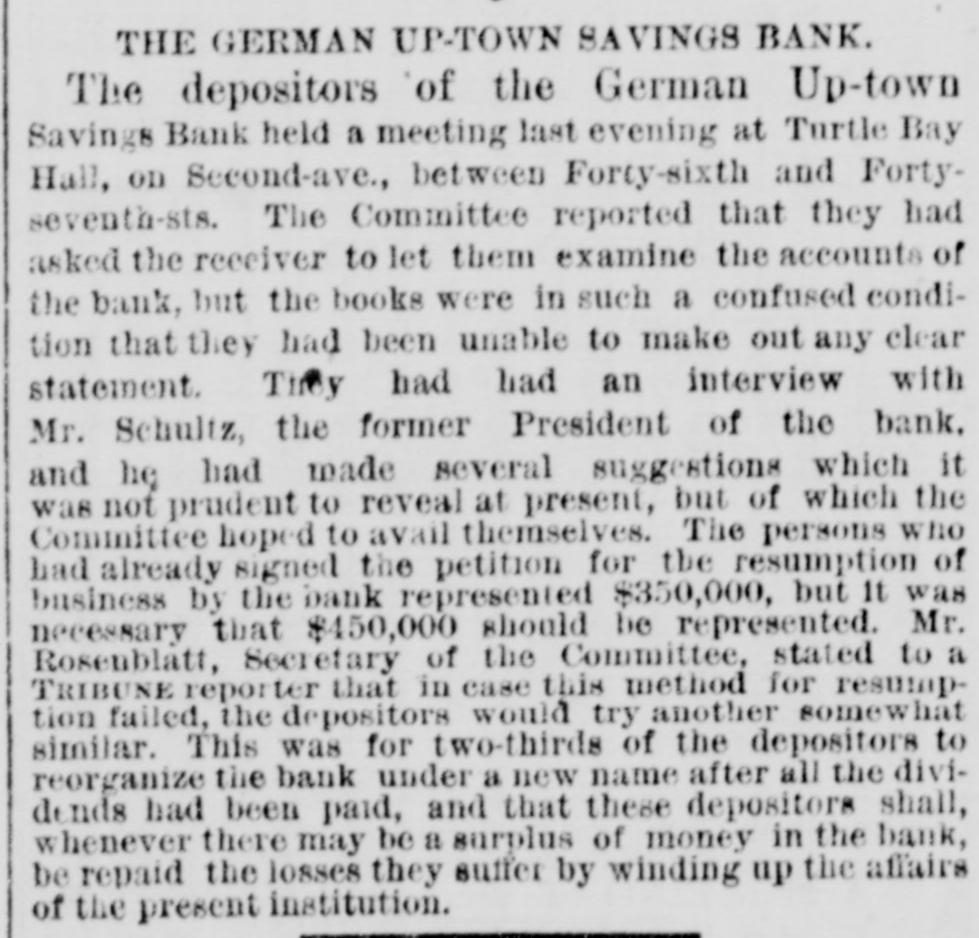
THE GERMAN UP-TOWN SAVINGS BANK. The depositors of the German Up-town Savings Bank held a meeting last evening at Turtle Bay Hall, on Second-ave., between Forty-sixth and Fortyseventh-sts. The Committee reported that they had asked the receiver to let them examine the accounts of the bank, but the books were in such a confused condition that they had been unable to make out any clear statement. They had had an interview with Mr. Schultz, the former President of the bank. and he had made several suggestions which it was not prudent to reveal at present, but of which the Committee hoped to avail themselves. The persons who had already signed the petition for the resumption of business by the bank represented $350,000, but It was necessary that $450,000 should be represented. Mr. Rosenblatt, Secretary of the Committee, stated to a TRIBUNE reporter that in case this method for resumption failed, the depositors would try another somewhat similar. This was for two-thirds of the depositors to reorganize the bank under a new name after all the dividends had been paid, and that these depositors shall, whenever there may be a surplus of money in the bank, be repaid the losses they suffer by winding up the affairs of the present institution.
19.January 31, 1876New-York TribuneNew York, NY
Click image to open full size in new tab
Article Text
THE GERMAN UP-TOWN SAVINGS BANK. Herman Uhl, receiver of the German Up-Town Savings Bank, has filed his report for the past month. He has paid a dividend of 25 per cent on balances due 2,051 depositors, amounting to $183,184 53, and has a balance of cash on hand of $110,164 84. Judge Donohue has granted an order permitting Wm. A. Butler, receiver of the Manufacturers' and Builders' Bank, to pay over the balance of the $20,000 on deposit with that bank belonging to the German Up-Town Bank, with interest. At the meeting of the depositors of the German Up-Town Savings Bank, at Turtle Bay Hall yesterday, it was reported the signatures representing $450,000 of the $700,000 necessary for resumption of business by the bank had been obtained. Other signatures were obtained during the meeting. The action of Assemblyman Killian in proposing a bill for th investigation of the official conduct of Inspector Ellis was approved.
20.April 18, 1876New-York TribuneNew York, NY
Click image to open full size in new tab
Article Text
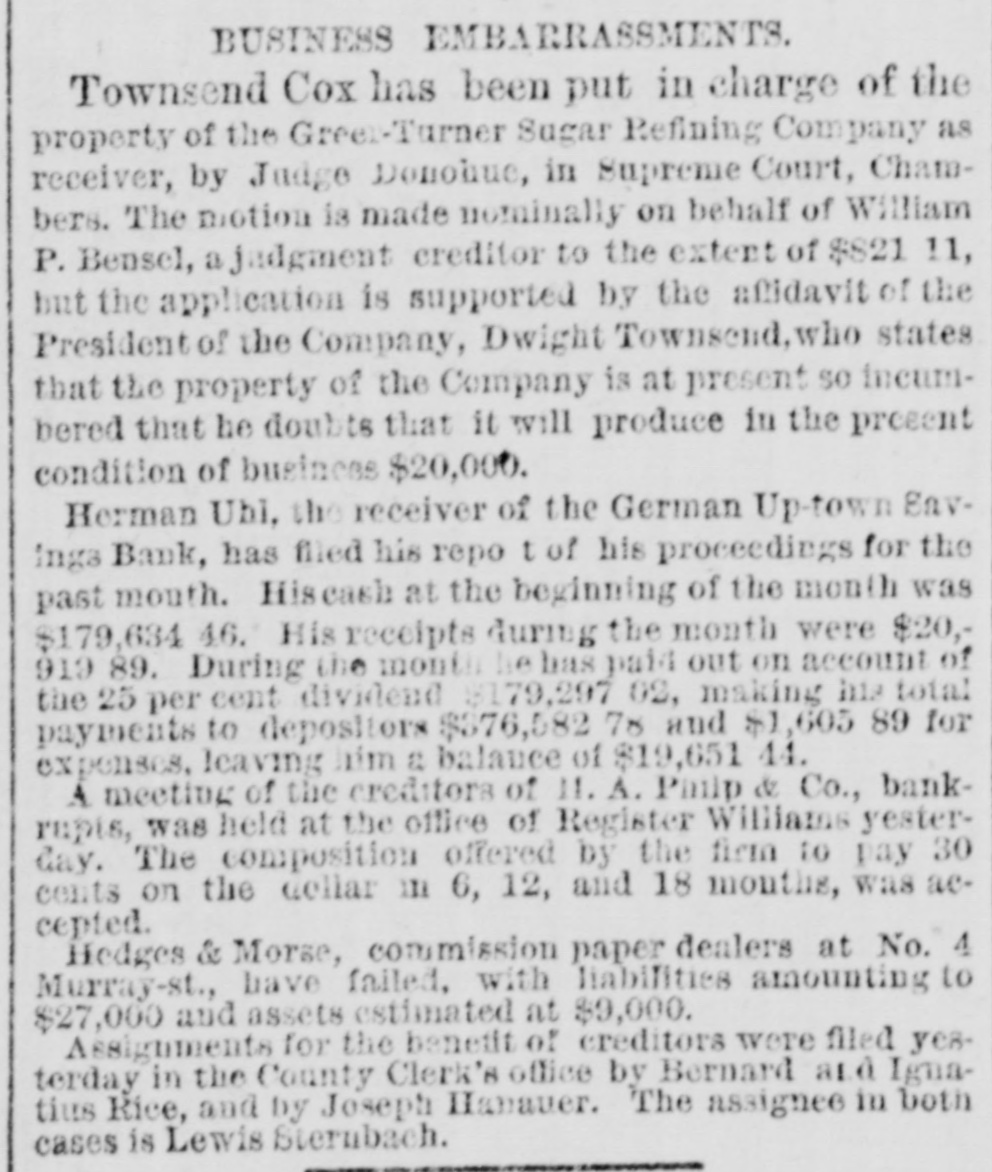
BUSINESS EMBARRASSMEN TS. Townsend Cox has been put in charge of the property of the Green-Turner Sugar Refining Company as receiver, by Judge Donobuc, in Supreme Court, Chambers. The motion is made nominally on behalf of William P. Bensel, a jadgment creditor to the extent of $821 11, but the application is supported by the afidavit of the President of the Company, Dwight Townsend, who states that the property of the Company is at present so incumhered that he doubts that it will produce in the present condition of business $20,000. Herman Ubi, the receiver of the German Up-town Savinga Bank, has filed his repo t of his proceedings for the past mouth. Hiscash at the beginning of the month was $179,634 46. His receipts during the month were $20, 919 89. During the month he has paid out on account of the 25 per cent dividend $179,297 02, making his total payments to depositors $376,582 78 and $1,605 89 for expenses. leaving aim a balance of $19,651 44. A meeting of the creditors of 11. A. Philp & Co., bankrupts, was held at the office of Register Williams yesterGay. The composition offered by the firm to pay 30 cents on the Gollar III 6, 12, and 18 months, was accepted. Hedges & Morse, commission paper dealers at No. 4 Murray-st., have failed, with liabilities amounting to $27,000 and assets estimated at $9,000. Assignments for the benefit of creditors were filed yesterday in the County Clerk's office by Bernard and Ignatius Rice, and by Joseph Hanaver. The assignee in both cases is Lewis Sternbach.
21.April 21, 1876The New York HeraldNew York, NY
Click image to open full size in new tab
Article Text
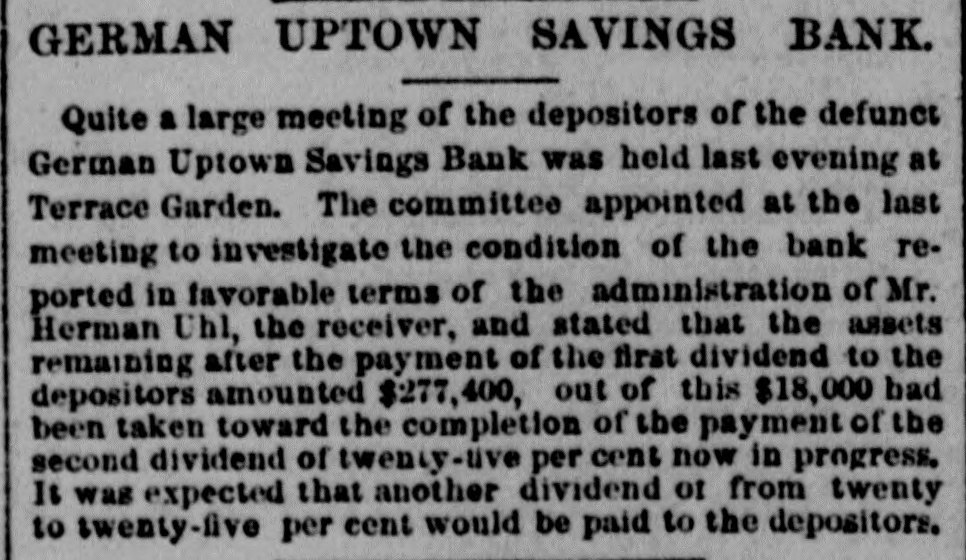
BANK. GERMAN UPTOWN SAVINGS Quite a large meeting of the depositors of the defunct German Uptown Savings Bank was held last evening at Terrace Garden. The committee appointed at the last meeting to investigate the condition of the bank reported in favorable terms of the administration of Mr. Herman Uhl, the receiver, and stated that the assets remaining after the payment of the first dividend to the depositors amounted $277,400, out of this $18,000 bad been taken toward the completion of the payment of the second dividend of twenty-tive per cent now in progress. It was expected that another dividend of from twenty to twenty-five per cent would be paid to the depositors.
22.June 22, 1876The SunNew York, NY
Click image to open full size in new tab
Article Text
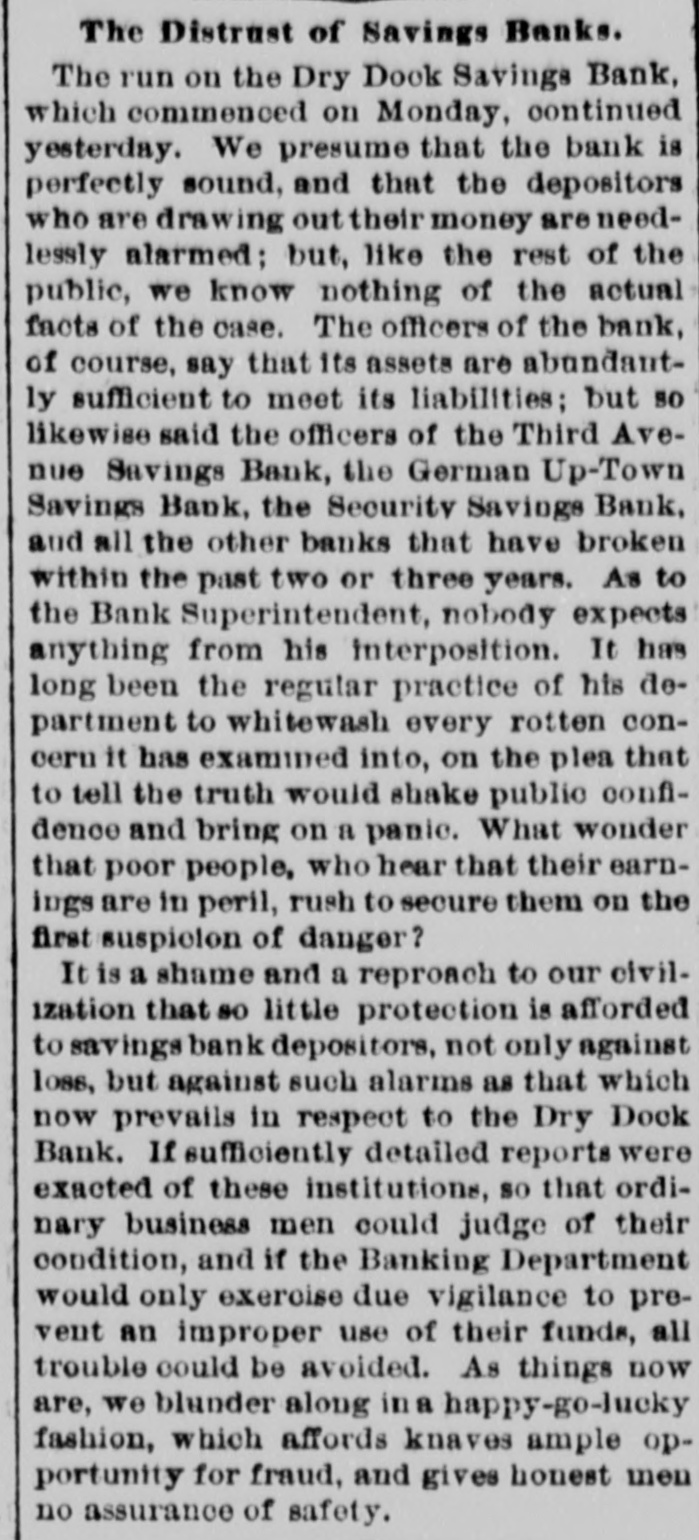
# The Distrust of Savings Banks.
The run on the Dry Dook Savings Bank, which commenced on Monday, continued yesterday. We presume that the bank is perfectly sound, and that the depositors who are drawing out their money are needlessly alarmed; but, like the rest of the public, we know nothing of the actual facts of the case. The officers of the bank, of course, say that its assets are abundantly sufficient to meet its liabilities; but so likewise said the officers of the Third Avenue Savings Bank, the German Up-Town Savings Bank, the Security Savings Bank, aud all the other banks that have broken within the past two or three years. As to the Bank Superintendent, nobody expects anything from his interposition. It has long been the regular practice of his department to whitewash every rotten concern it has examined into, on the plea that to tell the truth would shake public confidence and bring on a panic. What wonder that poor people, who hear that their earnings are in peril, rush to secure them on the first suspiolon of danger?
It is a shame and a reproach to our civilization that so little protection is afforded to savings bank depositors, not only against loss, but against such alarms as that which now prevails in respect to the Dry Dock Bank. If sufficiently detailed reports were exacted of these institutions, so that ordinary business men could judge of their condition, and if the Banking Department would only exercise due vigilance to prevent an improper use of their funds, all trouble could be avoided. As things now are, we blunder along in a happy-go-lucky fashion, which affords knaves ample opportunity for fraud, and gives honest men no assurance of safety.