1391. Exchange Bank (Hartford, CT)

Bank Information

Episode Type
Suspension → Reopening
Bank Type
state
Start Date
October 6, 1857
Location
Hartford, Connecticut (41.764, -72.685)

Metadata

Model
gpt-5-mini
Short Digest
7e7edee067d06263

Response Measures

None

Description

Multiple contemporary articles report the Exchange Bank of Hartford suspended specie payments on Oct 6, 1857 during the Panic of 1857. By Dec 4, 1857 an injunction was removed and the bank was prepared to resume business. No articles describe a depositor run or receivership.

Events (2)

1. October 6, 1857 Suspension
Cause
Macro News
Cause Details
General financial crisis / panic of 1857 and widespread suspension of banks leading Hartford banks to suspend specie payments.
Newspaper Excerpt
The Charter Oak, Mercantile, and Exchange banks have suspended specie payment.
Source
newspapers
2. December 4, 1857 Reopening
Newspaper Excerpt
The injunction against the Mercantile, Charter Oak and Exchange Banks of Hartford was this morning removed, and they are now prepared to do business as formerly.
Source
newspapers

Newspaper Articles (15)

Article from The Washington Union, October 6, 1857

Click image to open full size in new tab

Article Text

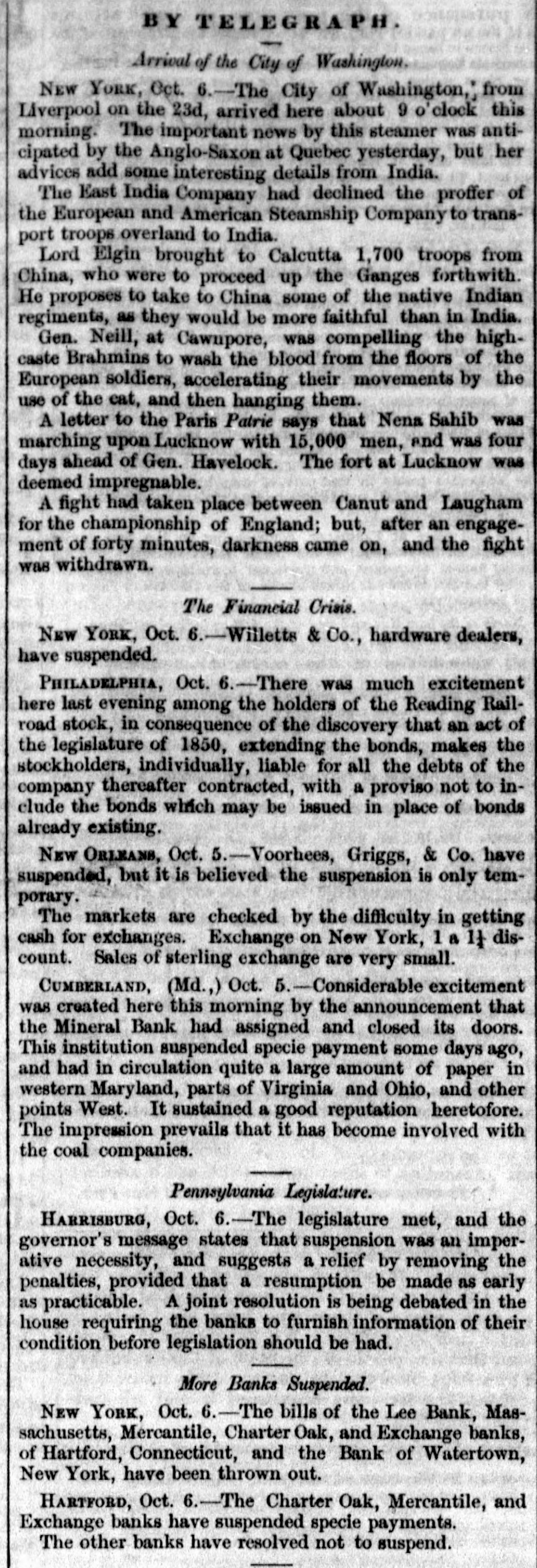
BY TELEGRAPH. Arrival of the City of Washington, NEW YORK, Oct. 6.-The City of Washington," from Liverpool on the 23d, arrived here about 9 o clock this morning. The important news by this steamer was anticipated by the Anglo-Saxon at Quebec yesterday, but her advices add some interesting details from India. The East India Company had declined the proffer of the European and American Steamship Company to transport troops overland to India. Lord Elgin brought to Calcutta 1,700 troops from China, who were to proceed up the Ganges forthwith. He proposes to take to China some of the native Indian regiments, as they would be more faithful than in India. Gen. Neill, at Cawnpore, was compelling the highcaste Brahmins to wash the blood from the floors of the European soldiers, accelerating their movements by the use of the eat, and then hanging them. A letter to the Paris Patrie says that Nena Sahib was marching upon Lucknow with 15,000 men, and was four days ahead of Gen. Havelock. The fort at Lucknow was deemed impregnable. A fight had taken place between Canut and Laugham for the championship of England; but, after an engagement of forty minutes, darkness came on, and the fight was withdrawn. The Financial Crisis. NEW YORK, Oct. 6.-Willetts & Co., hardware dealers, have suspended. PHILADELPHIA, Oct. There was much excitement here last evening among the holders of the Reading Railroad stock, in consequence of the discovery that an act of the legislature of 1850, extending the bonds, makes the stockholders, individually, liable for all the debts of the company thereafter contracted, with a proviso not to include the bonds which may be issued in place of bonds already existing. NEW ORLEANS, Oct. 5. - Voorhees, Griggs, & Co. have suspended, but it is believed the suspension is only temporary. The markets are checked by the difficulty in getting cash for exchanges. Exchange on New York, 1 a 11 discount. Sales of sterling exchange are very small. CUMBERLAND, (Md.,) Oct. 5. Considerable excitement was created here this morning by the announcement that the Mineral Bank had assigned and closed its doors. This institution suspended specie payment some days ago, and had in circulation quite a large amount of paper in western Maryland, parts of Virginia and Ohio, and other points West. It sustained a good reputation heretofore. The impression prevails that it has become involved with the coal companies. Pennsylvania Legislature. HARRISBURG, Oct. S.-The legislature met, and the governor's message states that suspension was an imperative necessity, and suggests a relief by removing the penalties, provided that a resumption be made as early as practicable. A joint resolution is being debated in the house requiring the banks to furnish information of their condition before legislation should be had. More Banks Suspended. NEW YORK, Oct. 6. -The bills of the Lee Bank, Massachusetts, Mercantile, Charter Oak, and Exchange banks, of Hartford, Connecticut, and the Bank of Watertown, New York, have been thrown out. HARTFORD, Oct. 6.-The Charter Oak, Mercantile, and Exchange banks have suspended specie payments. The other banks have resolved not to suspend.


Article from Worcester Daily Spy, October 7, 1857

Click image to open full size in new tab

Article Text

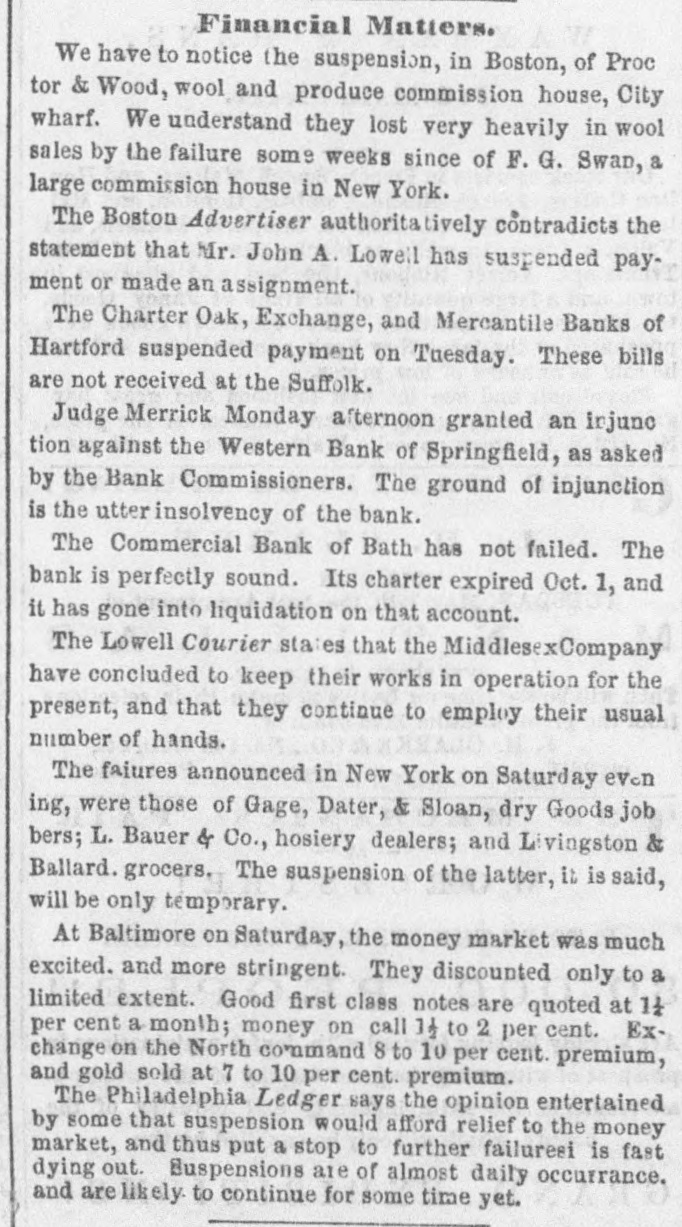
Financial Matters. We have to notice the suspension, in Boston, of Proc tor & Wood, wool and produce commission house, City wharf. We understand they lost very heavily in wool sales by the failure some weeks since of F. G. Swan, a large commission house in New York. The Boston Advertiser authoritatively contradicts the statement that Mr. John A. Lowell has suspended payment or made an assignment. The Charter Oak, Exchange, and Mercantile Banks of Hartford suspended payment on Tuesday. These bills are not received at the Suffolk. Judge Merrick Monday afternoon granted an injune tion against the Western Bank of Springfield, as asked by the Bank Commissioners. The ground of injunction is the utter insolvency of the bank. The Commercial Bank of Bath has not failed. The bank is perfectly sound. Its charter expired Oct. 1, and it has gone into liquidation on that account. The Lowell Courier states that the MiddlesexCompany have concluded to keep their works in operation for the present, and that they continue to employ their usual number of hands. The faiures announced in New York on Saturday even ing, were those of Gage, Dater, & Sloan, dry Goods job bers; L. Bauer & Co., hosiery dealers; and Livingston & Ballard. grocers. The suspension of the latter, it is said, will be only temporary. At Baltimore on Saturday, the money market was much excited. and more stringent. They discounted only to a limited extent. Good first class notes are quoted at 11 per cent a month; money on call 11 to 2 per cent. Exchange on the North command 8 to 10 per cent. premium, and gold sold at 7 to 10 per cent. premium. The Philadelphia Ledger says the opinion entertained by some that suspension would afford relief to the money market, and thus put a stop to further failuresi is fast dying out. Suspensions are of almost daily occurrance. and arelikely. to continue for some time yet.


Article from The Daily Dispatch, October 7, 1857

Click image to open full size in new tab

Article Text

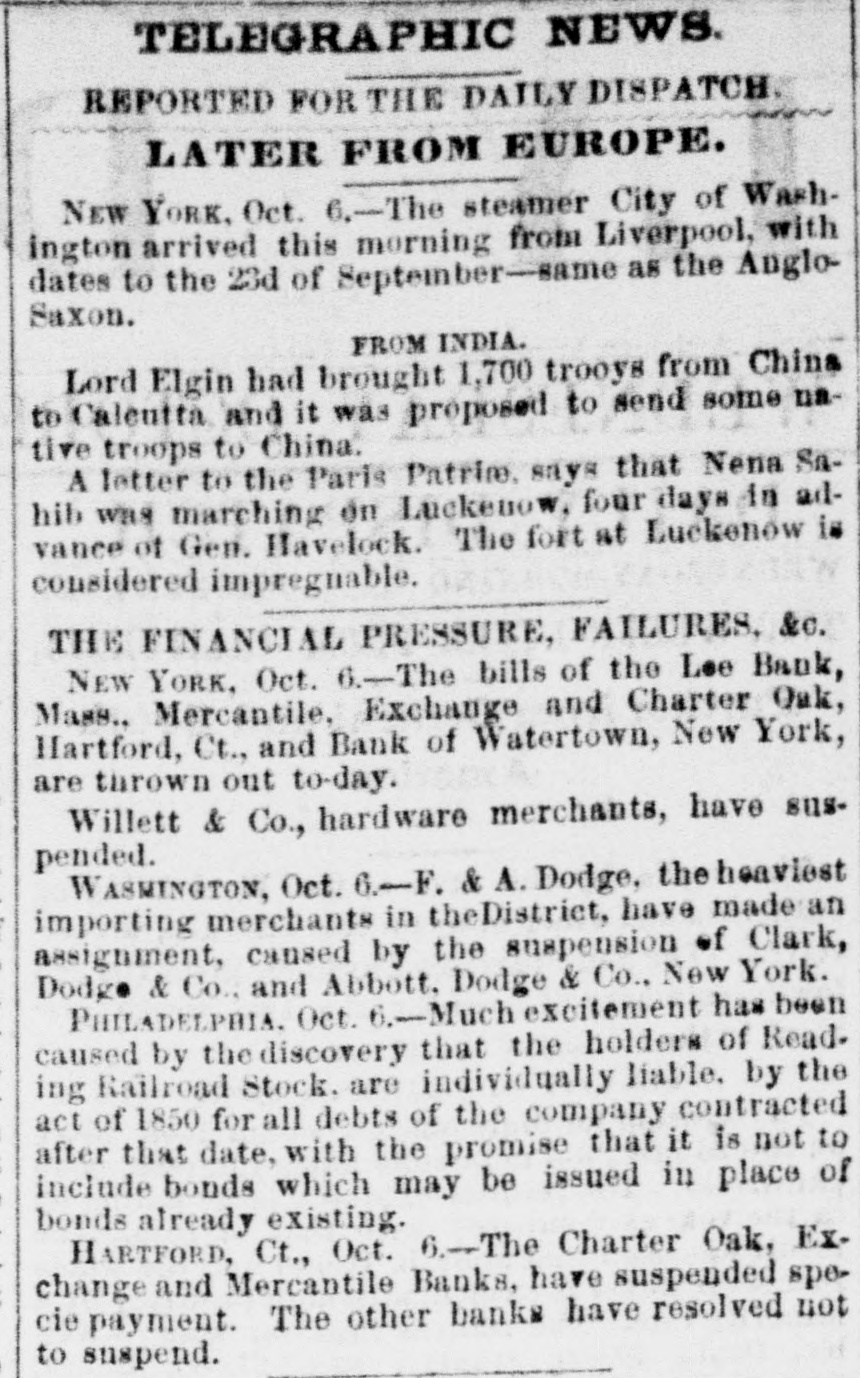
TELEGRAPHIC NEWS. REPORTED FOR THE DAILY DISPATCH. LATER FROM EUROPE. NEW YORK, Oct. 6,-The steamer City of Washington arrived this morning from Liverpool, with dates to the 23d of September-same as the AngloSaxon. FROM INDIA. Lord Elgin had brought 1,700 trooys from China to Calcutta and it was proposed to send some native troops to China. A letter to the Paris Patrim. says that Nena Sahib was marching on Luckenow, four days in advance of Gen. Havelock. The fort at Luckenow is considered impregnable. THE FINANCIAL PRESSURE, FAILURES, &c. NEW YORK, Oct. 6-The bills of the Lee Bank, Mass., Mercantile, Exchange and Charter Oak, Hartford, Ct., and Bank of Watertown, New York, are thrown out to-day. Willett & Co., hardware merchants, have suspended. WASMINGTON, Oct. 6.-F. & A. Dodge, the heaviest importing merchants in theDistrict, have made an assignment, caused by the suspension of Clark, Dodge & Co., and Abbott. Dodge & Co., New York. PHILADELPHIA. Oct. 6.-Much excitement has been caused by the discovery that the holders of Reading Railroad Stock. are individually liable. by the act of 1850 for all debts of the company contracted after that date, with the promise that it is not to include bonds which may be issued in place of bonds already existing. HARTFORD, Ct., Oct. 6.-The Charter Oak, Exchange and Mercantile Banks, have suspended specie payment. The other banks have resolved not to suspend.


Article from The Day Book, October 7, 1857

Click image to open full size in new tab

Article Text

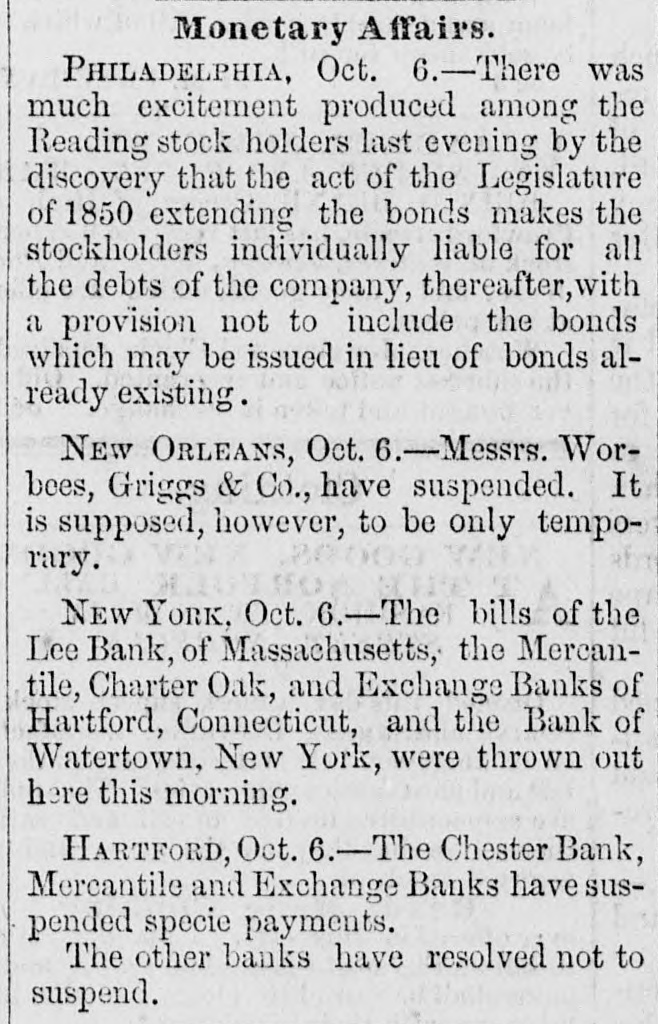
Monetary Affairs. PHILADELPHIA, Oct. 6.-There was much excitement produced among the Reading stock holders last evening by the discovery that the act of the Legislature of 1850 extending the bonds makes the stockholders individually liable for all the debts of the company, thereafter, with a provision not to include the bonds which may be issued in lieu of bonds already existing. NEW ORLEANS, Oct. 6.-Messrs. Worbees, Griggs & Co., have suspended. It is supposed, however, to be only temporary. NEW YORK, Oct. 6.-The bills of the Lee Bank, of Massachusetts, the Mercantile, Charter Oak, and Exchange Banks of Hartford, Connecticut, and the Bank of Watertown, New York, were thrown out here this morning. HARTFORD, Oct. 6.-The Chester Bank, Mercantile and Exchange Banks have suspended specie payments. The other banks have resolved not to suspend.


Article from The Day Book, October 7, 1857

Click image to open full size in new tab

Article Text

Bank Suspensions. HARTFORD, CT., Oct. 6.-Financial affairs here have grown very stringent and much excitement exists. Three of the prominent banks, viz:-the Exchange, Charter Oak, and Mercantile-have suspended specie payments. It is generally believed that other suspensions will soon take place throughout the State. NEW YORK, Oct. 6.-There is a shade more ease to-day in the money market, though great stringency still prevails. The banks continue to pay specie. PHILADELPHIA, Oct 6.-The money here remains tight. A good deal of excitement and dissatisfaction prevails amongst the loboring classes, who are subjected to losses on uncurrent funds.


Article from Evening Star, October 7, 1857

Click image to open full size in new tab

Article Text

The Financial Crisis, &c. NEW YORK, October 6 -The Evening Post regards the aspect of financial affairs as favorable, and the Commercial of this afternoon discovers no material change from resterday. The specie lost by the banks last week went to sustain other cities standing in more need of it than New York. The movement is regarded by cool-headed business men as exceedingly praiseworthy, though the croakers make use of the loss of specie for the renewal of the panic. Stocks were firmer after the adjournment of the second board. The payments at the sub-treasury to-day were over one million and a quarter of dollars, which is a very encouraging feature. The bills of the Lee Bank, of Massachusetts, the Mercantile, Charter Oak and Exchange Banks of Hartford, Conn., and the Banks of Watertown, New York, were thrown out here this morning PHILADELPHIA, Oct. 6.-There was much excitement produced among the Reading stockholders last evening by the discovery that the act of the Legislature of 1850 extending the bonds makes the stockholders individually liable for all the debts of the company thereafor, with a provision not to include the bonds which may be issued in lieu of bonds already existing. HARTFORD, Oct. 6 -The Charter Oak, Mercantile and Exchange Banks have suspended specie payment. The other banks have resolved not to suspend. NEW ORLEANS, October 4.-Messrs. Vorhees, Griggs & Co. have suspended. It is supposed, however, to be only temporary.


Article from New-York Daily Tribune, October 7, 1857

Click image to open full size in new tab

Article Text

THE BANKS OF HARTFORD. HARTFORD, Conn., Tuesday, Oct. 6, 1857. The Charter Oak Bank, the Mercantile Bank sad the Exchange Bank suspended specie payment this morning. The officers of all the other banks met last night, and resolved not to suspend.


Article from The New York Herald, October 7, 1857

Click image to open full size in new tab

Article Text

THE WESTERN BANK, SPRINGFIELD, MASS. BOSTON, Ost. 6, 1857 Judge Merrick, upon the motion of the Bank Commis sioners, has granted A temporary injunction on the West ern Bank of Springfield SUSPENSION OF THE BANKS OF HARTFORD. HARTFORD, Comn., Oct. 6, 1867. The Charter Oak Bank, the Mercantile Bank, and the Exchange Bank, suspended specie payment this morning The officers of all the other banks met last night and re solved not to suspend. THE FARMERS' AND MECHANICS' BANK AT DETROIT. DEPROIT, Oct 6, 1857. The Farmers' and Mechanion' Ba: k in this city has been placed under an injune lon by the Attorney General FAILURE IN GEORGETOWN. WASHINGTON, Oct 6, 1857. Messrs. F. & A H. Dodge, merchants and importers in Georgetown, are said to have made an assignment. Heretofore they were considered the heaviest business firm in the District of Columbia THE BANKS OF WILMINGTON. PETERSBURG, Oct. 6, 1857. The Petersburg Express says it is rumored here this evening that the banks of Wilmington and Cape Fear refueed to redeem their notes yesterday. The Commercial and Bank of the State redeemed everything All of them are said to be perfectly solvent. SUSPENSION IN NEW ORLEANS. New ORLEANS Ost 5, 1857. Messrs. Voorbies, Griggs & Co. have suspended, tempo. racily, it is supposed. LIABILITY OF READING RAILROAD STOCKHOLDERS. Philadelphia, Oct. 6, 1857. Much excitement was occasioned among the stockholders of the Reading Railroad last evening, by the discovery of an not of the Legislature of 1850 extending the bonds, which make stockholders individually liable for all the debts of the comp ny thereafter contracted, with a pro vision ' no: to include bonds which may be issued in Hou of bonds already existing." THE PHILADELPHIA STOCK BOARD. PHILADELPHIA, Oct 6, 1857. Stocks heavy. Pennsylvania State 5's, 19%; Reading Railroad, 13½; Morris Canal, 40; Long Island Railroad, 8; Pennsylvania Railroad, 37.


Article from Weekly National Intelligencer, October 10, 1857

Click image to open full size in new tab

Article Text

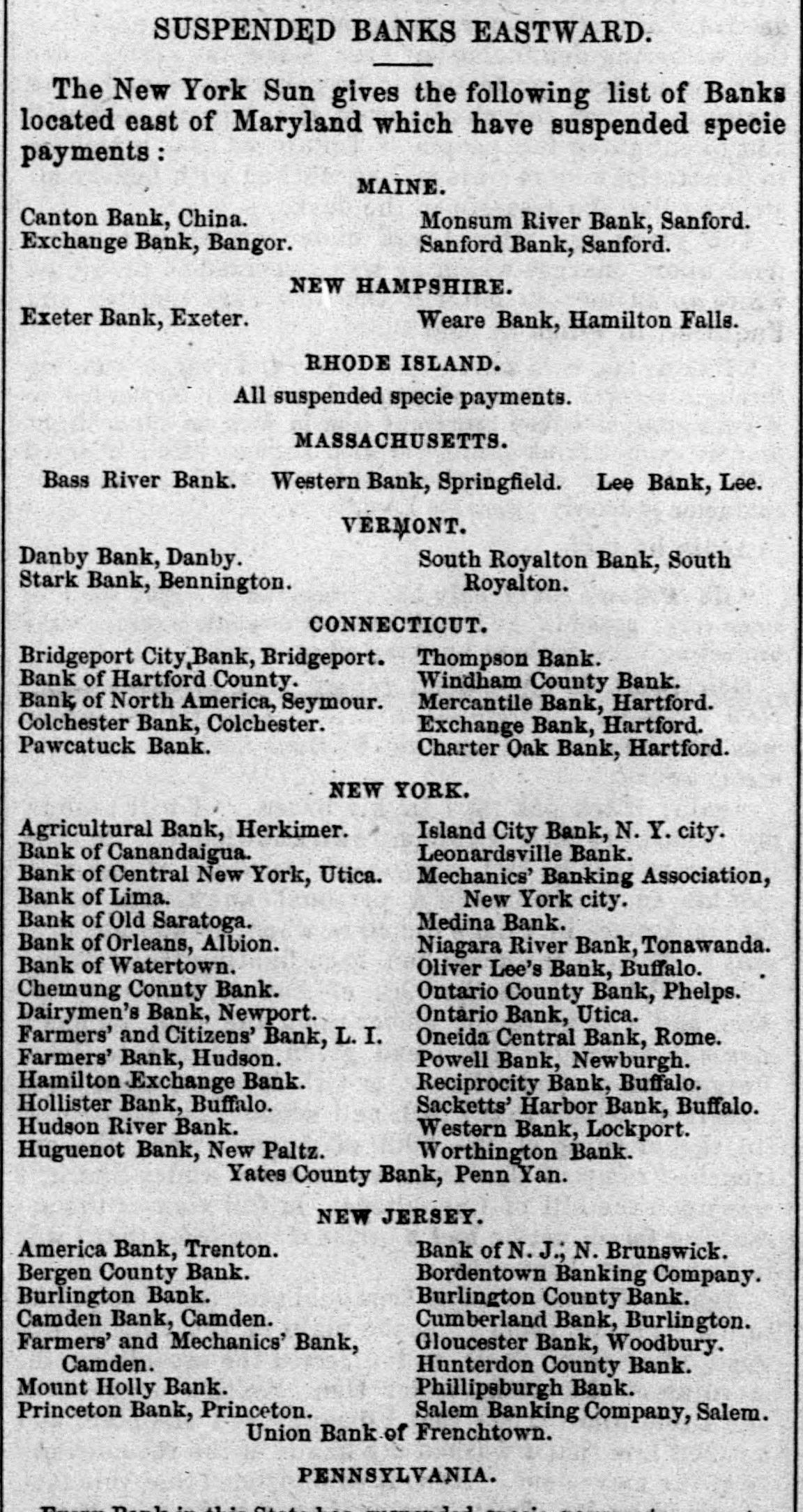
SUSPENDED BANKS EASTWARD. The New York Sun gives the following list of Banks located east of Maryland which have suspended specie payments : MAINE. Canton Bank, China. Monsum River Bank, Sanford. Exchange Bank, Bangor. Sanford Bank, Sanford. NEW HAMPSHIRE. Exeter Bank, Exeter. Weare Bank, Hamilton Falls. RHODE ISLAND. All suspended specie payments. MASSACHUSETTS. Bass River Bank. Western Bank, Springfield. Lee Bank, Lee. VERMONT. Danby Bank, Danby. South Royalton Bank, South Stark Bank, Bennington. Royalton. CONNECTICUT. Bridgeport City, Bank, Bridgeport. Thompson Bank. Bank of Hartford County. Windham County Bank. Bank, of North America, Seymour. Mercantile Bank, Hartford. Colchester Bank, Colchester. Exchange Bank, Hartford. Pawcatuck Bank. Charter Oak Bank, Hartford. NEW YORK. Agricultural Bank, Herkimer. Island City Bank, N. Y. city. Leonardsville Bank. Bank of Canandaigua. Bank of Central New York, Utica. Mechanics' Banking Association, Bank of Lima. New York city. Bank of Old Saratoga. Medina Bank. Bank of Orleans, Albion. Niagara River Bank, Tonawanda. Bank of Watertown. Oliver Lee's Bank, Buffalo. Chemung County Bank. Ontario County Bank, Phelps. Dairymen's Bank, Newport. Ontario Bank, Utica. Farmers' and Citizens' Bank, L.I. Oneida Central Bank, Rome. Farmers' Bank, Hudson. Powell Bank, Newburgh. Hamilton Exchange Bank. Reciprocity Bank, Buffalo. Hollister Bank, Buffalo. Sacketts' Harbor Bank, Buffalo. Hudson River Bank. Western Bank, Lockport. Huguenot Bank, New Paltz. Worthington Bank. Yates County Bank, Penn Yan. NEW JERSEY. America Bank, Trenton. Bank of N. J.; N. Brunswick. Bergen County Bank. Bordentown Banking Company. Burlington Bank. Burlington County Bank. Camden Bank, Camden. Cumberland Bank, Burlington. Farmers' and Mechanics' Bank, Gloucester Bank, Woodbury. Camden. Hunterdon County Bank. Mount Holly Bank. Phillipeburgh Bank. Princeton Bank, Princeton. Salem Banking Company, Salem. Union Bank of Frenchtown. PENNSYLVANIA.


Article from Burlington Free Press, October 16, 1857

Click image to open full size in new tab

Article Text

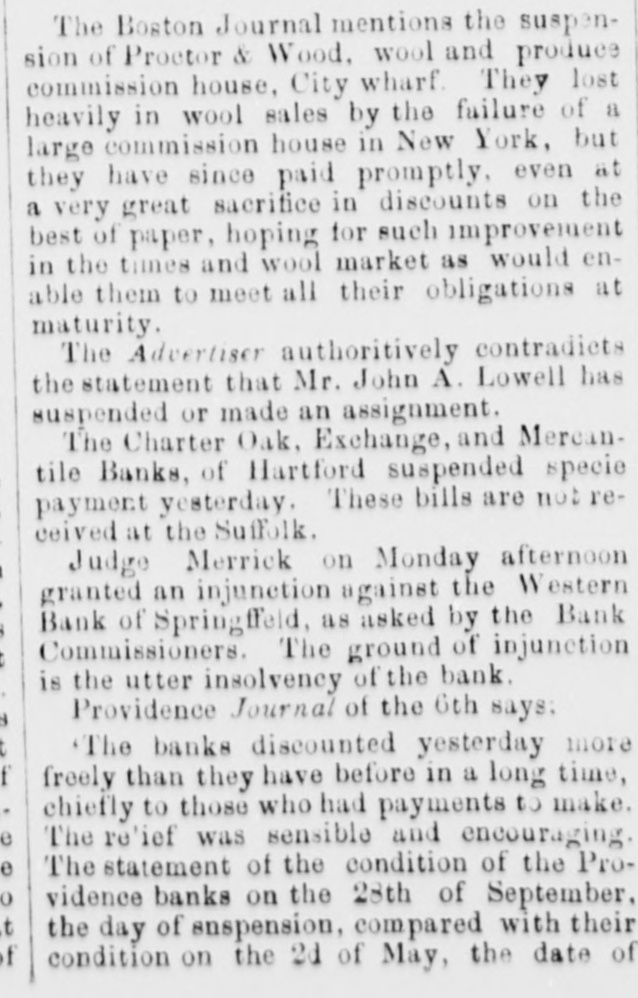
The Boston Journal mentions the suspension of Proctor & Wood. wool and produce commission house. City wharf They lost heavily in wool sales by the failure of a large commission house in New York, but they have since paid promptly. even at a very great sacrifice in discounts on the best of paper, hoping for such improvement in the times and wool market as would enable them to meet all their obligations at maturity. The Advertiser authoritively contradicts the statement that Mr. John A. Lowell has suspended or made an assignment. The Charter Oak, Exchange, and Mercantile Banks, of Hartford suspended specie payment yesterday. These bills are not redeived at the Suffolk. Judge Merrick on Monday afternoon granted an injunction against the Western Bank of Spring ffeld, as asked by the Bank Commissioners. The ground of injunction is the utter insolvency of the bank. Providence Journal of the 6th says: The banks discounted yesterday more freely than they have before in a long time, chiefly to those who had payments to make. The re'ief was sensible and encouraging. The statement of the condition of the Providence banks on the 28th of September. the day of snspension, compared with their condition on the 2d of May, the date of


Article from Weekly Council Bluffs Bugle, October 28, 1857

Click image to open full size in new tab

Article Text

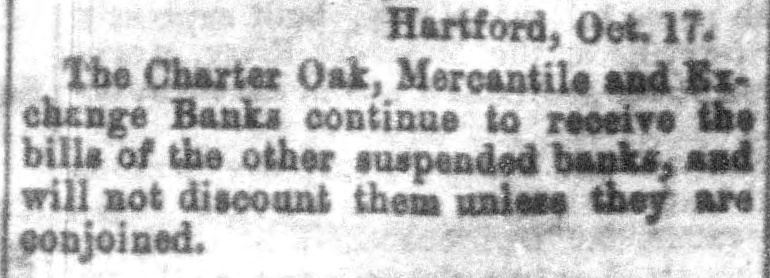
Hartford, Oct. 17. The Charter Oak, Mercantile and Exchange Banks continue to receive the bills of the other suspended banks, and will not discount them unless they are conjoined.


Article from Vermont Phœnix, October 31, 1857

Click image to open full size in new tab

Article Text

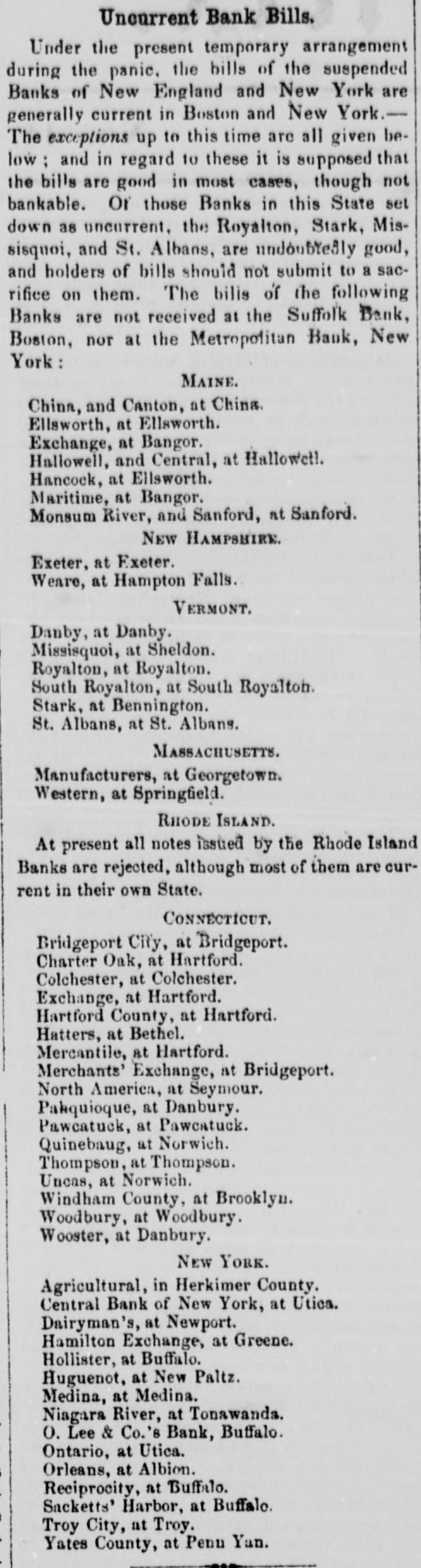
Uncurrent Bank Bills. Under the present temporary arrangement during the panic, the bills of the suspended Banks of New England and New York are generally current in Boston and New York.The exceptions up to this time are all given below ; and in regard to these it is supposed that the bills are good in most cases, though not bankable. Or those Banks in this State set down as uncurrent, the Royalton, Stark, Missisquoi, and St. Albans, are undoubtedly good, and holders of bills should not submit to a sacrifice on them. The bilis of the following Banks are not received at the Suffolk Bank, Boston, nor at the Metropolitan Bank, New York : MAINE. China, and Canton, at China. Ellsworth, at Ellsworth. Exchange, at Bangor. Hallowell, and Central, at Hallowell. Hancock, at Ellsworth. Maritime, at Bangor. Monsum River, and Sanford, at Sanford. NEW HAMPSHIRE. Exeter, at Exeter. Weare, at Hampton Falls. VERMONT. Danby, at Danby. Missisquoi, at Sheldon. Royalton, at Royalton. South Royalton, at South Royalton. Stark, at Bennington. St. Albans, at St. Albans. MASSACHUSETTS. Manufacturers, at Georgetown. Western, at Springfield. RHODE ISLAND. At present all notes issued by the Rhode Island Banks are rejected, although most of them are current in their own State. CONNECTICUT. Bridgeport City, at Bridgeport. Charter Oak, at Hartford. Colchester, at Colchester. Exchange, at Hartford. Hartford County, at Hartford. Hatters, at Bethel. Mercantile, at Hartford. Merchants' Exchange, at Bridgeport. North America, at Seymour. Palaquioque, at Danbury. Pawcatuck, at Pawcatuck. Quinebaug, at Norwich. Thompson, at Thompson. Uncas, at Norwich. Windham County, at Brooklyn. Woodbury, at Woodbury. Wooster, at Danbury. NEW YORK. Agricultural, in Herkimer County. Central Bank of New York, at Utica. Dairyman's, at Newport. Hamilton Exchange, at Greene. Hollister, at Buffalo. Huguenot, at New Paltz. Medina, at Medina. Niagara River, at Tonawanda. O. Lee & Co.'s Bank, Buffalo. Ontario, at Utica. Orleans, at Albion. Reciprocity, at Buffalo. Sacketts' Harbor, at Buffalo. Troy City, at Troy. Yates County, at Penn Yan.


Article from The New York Herald, December 4, 1857

Click image to open full size in new tab

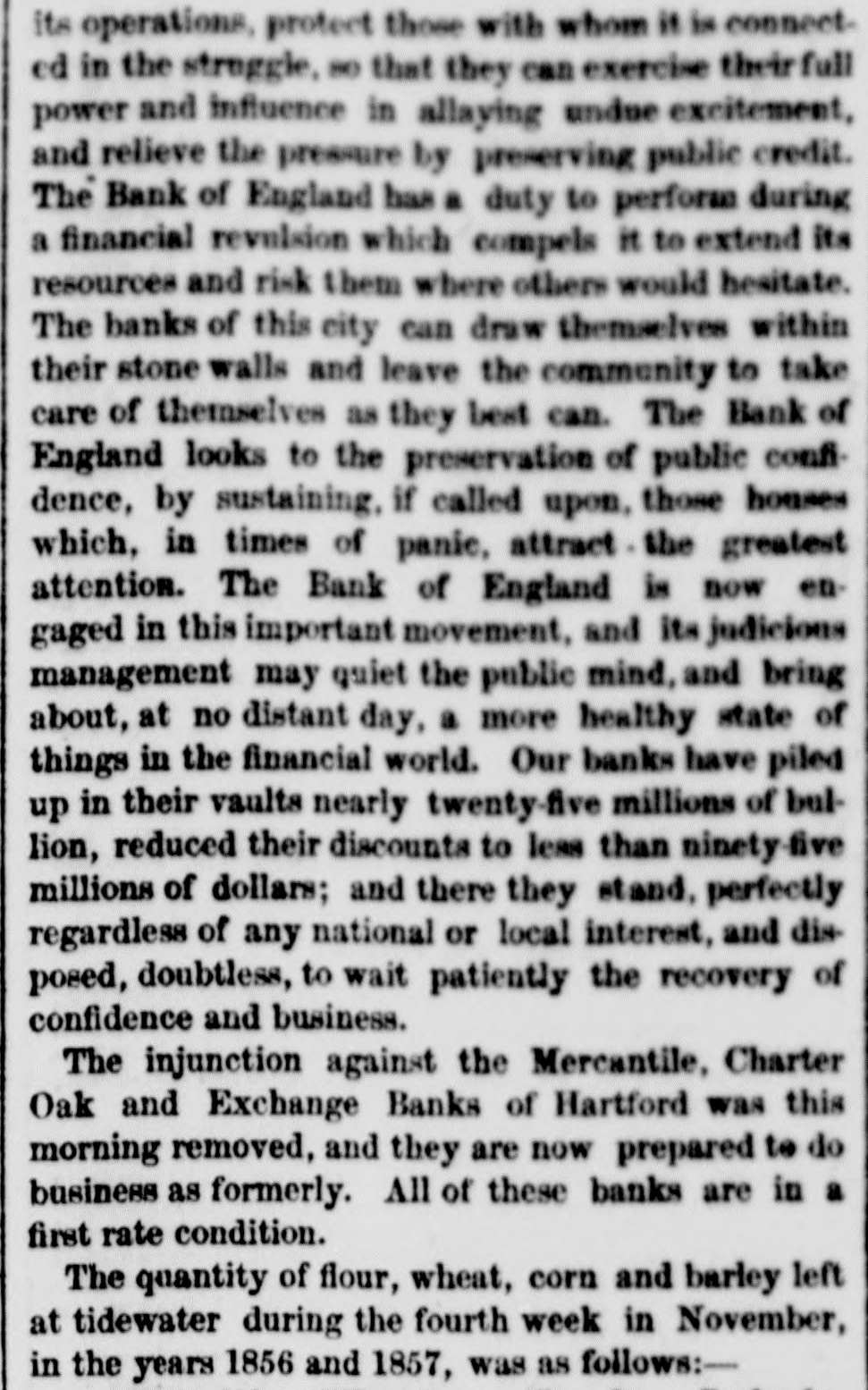
Article Text

its operations, protect those with whom it in connected in the struggle, BO that they can exercise their full power and influence in allaying undue excitement, and relieve the pressure by preserving public credit. The Bank of England has a duty to perform during a financial revulsion which compels it to extend its resources and risk them where others would hesitate. The banks of this city can draw themselves within their stone walls and leave the community to take care of themselves as they best can. The Bank of England looks to the preservation of public confidence, by sustaining, if called upon, those houses which, in times of panie, attract the greatest attention. The Bank of England is now engaged in this important movement, and its judicious management may quiet the public mind, and bring about, at no distant day, a more healthy state of things in the financial world. Our banks have piled up in their vaults nearly twenty-five millions of bullion, reduced their discounts to less than ninety-five millions of dollars; and there they stand, perfectly regardless of any national or local interest, and disposed, doubtless, to wait patiently the recovery of confidence and business. The injunction against the Mercantile, Charter Oak and Exchange Banks of Hartford was this morning removed, and they are now prepared to do business as formerly. All of these banks are in a first rate condition. The quantity of flour, wheat, corn and barley left at tidewater during the fourth week in November, in the years 1856 and 1857, was as follows:-


Article from New-York Daily Tribune, May 21, 1858

Click image to open full size in new tab

Article Text

FROM OPENING OF NAVIGATION TO MAY 17, 62,012 1356. Flour, bbls 883,199 Wheat. bush Com bush FROM OPENING OF NAVIDATION TO JULY 29,150 1, 1857. Flour, bble.. 217 250 Wheat, bush 433 Corn, bush This shows a large increase in Flour and Wheat, and an equally large fallir g off in Corn. The reason is not yet sufficiently advance to justify the prediction that the comparative increase thus far will continue through the season. It is sife, however, to ealculate 88 long 88 Flour remains at its present low figure, and the money market is such 88 to secure 60 and 90 day credits, that the great bulk of the Flour and Wheat at the West will continue to seek tidewater through the Canals. The annexed abstract of the Connecticut Bank Commissioners' Report gives a very unfavorable report of the management and condition of some of the banks of that State: From The New Haven Journal and Courier. The Commissioners refer in the first place to the financial panic, at the commencement of which our banks bad an out tanding circulation of $10,000,000; the sudden withdrawal of pub is confidence caused & sudden contraction of currency, which proved 8 84 urce of great temporary embarrassment. On the 1st day of July, the circulation of the banks of this State was $10,411,000; on the let of January it W&S reduced to $4,130,265, 8 contraction of over $6 000 000, and most of which took place between the 1st of August and the 1st of November. The ability of the banks to sustain the mselves, without break ng down their custom under a contraction 80 un precedented, exhibited a degree of soundness and stability which must place them bigh in the confidence of the iblie of this and other States. Prior to the general suspension, several banks be. came embarrassed. The Hartford County Bank, &S early ES September, was unable to provi te for an outstanding circulation of $440,000, and an examination showed great mismanagement and duplicity on the part of the directors. Large claims, amounting in one instance to over $80,000, had been entirely concealed by being placed in the na nes of responsible parties, under an agreement that they should be held harm ess. In other instances, large amoun's of debts, the character of which the Commissioners could know nothing about without investigations out of the bank, were represented by the directors to be good and available, when in fact it was evident to them that they were either wortbless or nearly 80. Notwitzstanding this the Directors declared 8 dividen last July, ereupon the Com missioners obtained an injunction and bad receivers appointed. By g bod management, the Bank has been relieved, with the loss of half its capital and has been allowed to 10sume its business with $300,000 capital stock. It is a question of some importance to determine who shall pay the $6,000 or $7,000 in notes of this Bank, stolen by W. S. Carter, a Clerk in the Treasury Department. The Bank of North America, at Seymour, which had been the subject of remark in the previous re. port of the Commissioners, was found, in September last, to have loaned large sums out of the State. on unavailable security, leaving the Bank without the means to redeem its circulation. Its general management was bad, auspended debtir creased. and capital stock impaired. Its immediate liabilities were over $70,000 and they had on hand only $1,072 in specie. An injurction was issued. On the 10th of April the case was aled and it was found the eivers hid reduced the liabilities of the Bank for circulation, posits and balances, down to $48,541. The assets of the Bank now amount to $169,000. The Commissioners say that the Exchange Bank of Hartf had carried A heavy amount of protested paper of a doubtful charae er form series of years. It is their opinion that the bank should have ceased to make dividends more than two years ago A civide nd was passed in January, 1857. but in July of that year a dividend of 4 P cent was declared and paid As this dividend impaired the capital, the Commissioners consider it to have been injudicious and illegal. A further examination developed a defalcation of about $25 000 in the accounts of the Cashier. This developme nt indicated great on the part of the offiand direct rs of the Bank, for the defalcati n had extended through several years, and might have been exposed had the monthly statem ente been examined and tested with their own books. At the time the Bank wasenjoined, its liabilities amounted to 250 000, and their specie funds were reduced down to $ 12 939. ben the Bank resumed specie payment, its liabilities were redue to $141,811, and their available funds amounted to $57,000. It was largely secured against ultimate loss by collate rals. It has from the beginning indulged in the illegal and dangerous practice of buying New York, and in -bruary last it declared a dividend, though it bad on hand over $ 200 000 of pr The Mercantile Bank, at first embarraseed by the failure of its correspondent in New-York, will not sustain losses sufficient to seriously impair itscapital As to the Colchester Bank, the Commissioners, after the char gealn itsadmir istration, by direction of the last Legislature, were still unatisfied with its condition. In September It ceased itsredemptions in Boston and was discredited in York. Its general circulation at that time. by its books was $14,000, of which $6,000 had been redeemed by New York banks but this was evidently not the real condition of affairs. On the 31 of De ember an xamination was again made, and it was found that Cashier S. F. Jopes had caused to be printed fr you the original Plates, by a firm of lithographers in Hartford bills amounting to $101 102 fact which the President Cashier and Directors must have been fully aware. The Commissioners looked upon this transaction as fraudulent. applied for an injenction, and had Jones arrested in New-York; but he was released before the préper papers could be procured from the Governor J. H. Baell, the former President, testified that he had signed a quantity of notes without keeping any record of the amount or number, and that Jones had taken them away, promising to deliver them up, but had never done so. The amount of the irregular issue is supposed to be over but as only $8000 of it has beed presented for redemption it bas probably not beea put extedsively into circulation. The assets of the bank will be suffi fignt to protect its creditore, but the stockholders will auffer largely. It is DOW being wound up by Receivers. The Granite Bank swindle W88 one of the most delibe rate frauds ever undertaken is this State. The first 10 P cent of the capital paid in. was paid back by the Directors, and the payment of the 40 cent was mere pretense, the money used being the bills of broken backs and worthless checks on banks out of the State, and the real ma agers who furbished the means of pay ment to the nominal stockholders in Voluntown, resided out of the State. The bank pretended that it had issued DO bills, but it was found that $23,000 had been signed and could not be pro dused. Outside parties were distributing these bills. The headquarters of the concern were in & drinki g saloon in New York, kept under the name of Prescott & Co. Samuel Wagner of Ohio, Alexander Miller of Buffalo, and Roswell C Peck of Hartford, are II bail for trial before the Superior Court of Windham County, all parties conde ited with the Granite Bank. An in junction was granted on the 10th of last November: its circulation is reduced to $3000 and the assets and unpaid stock will et able the Receivers to protect the public from loss. The Litchfield Bank started irregularly, without bons fide capital The Commissioners checked its operations, and caused & change in its officers, and the payment of a bona fide cash eapital of $50,00, with which i 18 now doing a legisimate business. One of the most flagrant violations of the banking laws of the State, is in the case of the Quinnebaug Back of Norwich, which us Moruly keepsa less amount of specie on hand than the law requires. It also loans too great an amount to individuals and to parties out of he State, and last December it had $725,000 under protest, n which its losses will be large. The Shatucket, Norwich, Uncas, Iron, Norfolk, Winsted. Saugatuck, Farmers (Bridgeport Danbury, Pahquioke, Manufacturers (Derby), in inam, Waterbury, Middlesex County, Middletown, State, Merchants and Manufacturers' (Hartford). Home Meriden, Clinton City (Bridgeport) baling. Commerce Mystic River, Jewelt City, Rockville, Connection: River, and Stafford Banks,


Article from The New York Herald, May 24, 1858

Click image to open full size in new tab

Article Text

# THE WAY BANKS ARE MANAGED IN CONNECTICUT. [From the New Haven Courier, May 28.] We are obliged to Mr. Commissioner Noyce for copy of the Bank Commissioners' Report for the yearjst expired. The commissioners refer in the first place to the financial panis, at the commencement of which our banks had he outstanding circulation of $10,000,000; the sudden withdrawal of public confidence caused a sudden contraction of currency, which proved a source of great temporary embarrassment. On the first day of July the circulation of the banks of this State was $10,411,000; on the first of January it was reduced to $4,130,266, a contraction of over $6,000,000, and most of which took place between the first of August and the first of November. The ability of the banks to sustain themselves, without breaking down their customers, under a contraction so unprecedented, exhibited a degree of soundness and stability which must place them high in the confidence of the public of this and other States. With but few exceptions, they continued to redeem their notes in Boston and New York, and to pay specie at their banking house until the general suspension of the banks in New York and Boston, which took place on the 14th of October. On the 15th most of the banks of this State suspended specie payment, but in a majority of cases continued their redemption in Boston or New York, thus keeping the currency of this State from depreciation, and enabling all parts of the country possessing it to go forward in the liquidation of their debts, without suffering loss from the currency of Connecticut. Of the nine banks chartered by the last Legislature only the Etna, Merchants' and Manufacturers' of Hartford, and Bank of Norwalk, have gone into operation. Prior to the general suspension several banks became embarrassed The Harford County Bank, as early as September, was unable to provide for an outstanding circulation of $440.000, and an examination showed great mismanagement and duplicity on the part of the directors. Large claims, amounting in one instance to over $80,000, had been entirely concealed by being placed in the names of responsible parties, under an agreement that they should be held harmless. In other instances large amounts of debts, the character of which the commissioners could know nothing about without investigations out of the bank, were represented by the directors to be good and available, when in fact it was evident to them that they were either worthless or nearly so. Notwithstanding this the directors declared a dividend last July, whereupon the commissioners obtained an injunction and had receivers appointed. By good management the bank has been relieved, with the loss of half its capital, and has been allowed to resume its business with $300,000 stock. It is a question of some importance to determine who shall pay the $6,000 or $7,000, in notes of this bank, stolen by W. S. Carter, a clerk in the treasury department The Bank of North America, at Seymour, which had been the subject of remark in the previous report of the commissioners, was found in September last to have loaned large sums out of the State, on unavailable security, leaving the bank without the means to redeem its circulation. Its general management was bad, suspended debt increased, and capital stock impaired. Its immediate liabilities were over $70.000, and they had on hand only $1,072 in specie. An injunction was issued. On the 10th of April the case was called up, and it was found the receivers had reduced the liabilities of the bank for circulation, deposits and balances, down to $48,541. The assets of the bank now amount to $169,000. The commissioners say that the Exchange Bank of Hartford had carried a heavy amount of protested paper of a doubtful character for a series of years. It is their opinion that the bank should have ceased to make dividends more than two years ago. A dividend was passed in January, 1857, but in July of that year a dividend of 4 per cent was declared and paid. As this dividend impaired the capital the commissioners consider it to have been injudicious and illegal. A further examination developed a defalcation of about $25,000 in the accounts of the Cashier. This developement indicated great carelessness on the part of the officers and directors of the bank, for the defalcation had extended through several years, and might have been exposed, had the monthly statements been examined and tested with their own books. At the time the bank was enjoined its liabilities amounted to $250,000, and their specie funds were reduced down to $2,939. When the bank resumed specie payments its liabilities were reduced to $141,811, and their available funds amounted to $67,000. It was largely secured against ultimate loss by collaterals. It has from the beginning indulged in the illegal and dangerous practice of buying paper in New York, and in February last it declared a dividend, though it had on hand over $200,000 of protested paper. The Mercantile Bank, at first embarrassed by the failure of its correspondent in New York, will not sustain losses sufficient to seriously impair its capital. As to the Colchester Bank, the commissioners, after the changes in its administration, by direction of the last legislature, were still unsatisfied with its condition. In September it ceased its redemptions in Boston and was discredited in New York. Its general circulation at that time, by its books, was $14,000, of which $6,000 had been redeemed by New York banks; but this was evidently not the real condition of affairs. On the 3d of December an examination was made again, and it was found that Cashier F. S. Jones had caused to be printed from the original plates, by a firm of lithographers in Hartford, bills amounting to $101,108, a fact of which the president, cashier and directors must have been fully aware. The commissioners looked upon this transaction as fraudulent, applied for an injunction, and had Jones arrested in New York; but he was released before the proper papers could be procured from the Governor. J. H. Buell, the former President, testified that he had signed a quantity of notes without keeping any record of the amount or number, and that Jones had taken them away, promising to deliver them up, but had never done so. The amount of the irregular issue is supposed to be over $100,000, but as only $3,000 of it has been presented for redemption, it has probably not been put extensively into circulation. The assets of the bank will be sufficient to protect its creditors, but the stockholders will suffer largely. It is now being wound up by receivers. The Granite Bank swindle was one of the most deliberate frauds ever undertaken in this State. The first 10 per cent of the capital paid in was paid back by the directors, and the payment of the 40 per cent. was "a mere pretence," the money used being the bills of broken banks and worthless checks on banks out of the State, and the real managers who furnished the means of payment to the nominal stockholders in Voluntown resided out of the State. The bank pretended that it had issued no bills, but it was found that $23,000 had been signed and could not be produced. Outside parties were distributing these bills the headquarters of the concern were in a drinking saloon in New York, kept under the name of Prescott & Co. Samuel Wagner, of Ohio, Alexander Miller, of Buffalo, and Roswell C. Peck, of Hartford, are held on bail for trial before the Superior Court of Windham county as parties connected with the Granite Bank. An injunction was granted on the 10th of last November; its circulation is reduced to $3,000, and the assets and unpaid stock will enable the receivers to protect the public from loss. The Litchfield Bank started irregularly, without a bona fide capital. The commissioners checked its operations, and caused a change in its officers, and the payment of a bona fide cash capital of $50,000, with which it is now doing a legitimate business. One of the most flagrant violations of the banking laws of the State is in the case of the Quinnebaug Bank, of Norwich, which uniformly keeps a less amount of specie on hand than the law requires. It also loans too great an amount to individuals and to parties out of the State, and last December it had $225,000 under protest, on which its losses will be large. The Shetucket, Norwich, Uncas, Iron, Norfolk, Winsted. Saugaluck, Farmers' (Bridgeport), Danbury, Pabquioke, Manufacturers' (Derby), Windham, Waterbury, Middlesex County, Middletown, State, Merchants' and Manufacturers' (Hartford), Home, Meriden, Clinton, City (Bridgeport), Whaling, Commerce, Mystic River, Jewett City, Rockville, Connecticut River, and Stafford Banks are also reported as having, more or less, frequently violated some provision or provisions of the law, generally by loaning too much to directors or parties out of the State, keeping too little specie and buying brokers' paper at large discounts. The Phoenix Bank of Hartford has a suspended debt of $347,224, growing out of loans to Henry Dwight and the Chicago and Mississippi Railroad, from which must result a large loss, and which, in the opinion of the commissioners, made the payment of a dividend last March of doubtful expediency, if not illegal. Of the banks in New Haven, the commissioners say: The condition of the New Haven County Bank has not materially improved since it was first reported to the Legislature in 1856. Some portion of the debts due the bank have been adjusted by taking therefor a direct interest in the real estate, located in Brooklyn, N. Y. This arrangement covered $137,135 of the Dwight debt, and to protect this interest the bank is obliged to pay its proportion of the interest upon the first mortgages upon the property; also, its share of taxes and assessments for improvements. These items increase rapidly, and last year amounted to $16,000, which included, however, a small payment to the first mortgagees. The directors have been careful at all times to keep at command available means sufficient to protect the bill holders and depositors. But it is not in harmony with the uniform policy of the State to allow a bank so greatly depreciated to represent so large a capital stock. In the opinion of the commissioners the capital of the bank should be reduced to a proper level or its affairs placed