13905. Chelsea Second National Bank & Trust Company (Atlantic City, NJ)

Bank Information

Episode Type
Run → Suspension → Closure
Bank Type
national
Bank ID
5884
Charter Number
5884
Start Date
January 1, 1933*
Location
Atlantic City, New Jersey (39.364, -74.423)

Metadata

Model
gpt-5-mini
Short Digest
c74600f0

Response Measures

Full suspension

Other: Receiver appointed and depositors' committee litigation; bank remained closed with receiver (Charles A. Faircloth).

Description

Newspaper articles consistently describe the Chelsea-Second National Bank & Trust Company as closed (receiver assigned) after large withdrawals in January 1933. Allegations of irregularities and 'unsteady condition' indicate bank-specific adverse information prompted withdrawals; the bank remained closed and a receiver (Charles A. Faircloth) was appointed. Dates: bank closed in January 1933 (articles in 1933-1934 discuss receiver actions and litigation).

Events (5)

1. January 1, 1933* Receivership
Newspaper Excerpt
closed Chelsea Second National Bank and Trust Company ... the bank closed its doors later (after Jan. 14, 1933) ... Charles A. Faircloth, receiver for the bank, ... was handling the affairs of the closed bank.
Source
newspapers
2. January 1, 1933* Run
Cause
Bank Specific Adverse Info
Cause Details
Depositors (including a director) made large withdrawals days before the bank closed because of knowledge or belief in the bank's unsteady condition; allegations of irregularities by officers.
Measures
None described in the articles as measures to stem withdrawals; later receiver litigation and investigations followed.
Newspaper Excerpt
Salus withdrew ... several days before it closed because he knew of its unsteady condition.
Source
newspapers
3. July 8, 1933 Other
Newspaper Excerpt
Receiver Opposes Plea to Scan Records ... committee intends instituting suit against directors ... brief pointed out that the committee hopes sufficient information from the books ... George Bourgeois, counsel for Charles Faircloth, receiver for the bank, argued against the quest ... the bank's affairs are already under probe investigators the Department Justice the Federal Banking Judge continued the case for days.
Source
newspapers
4. May 12, 1934 Other
Newspaper Excerpt
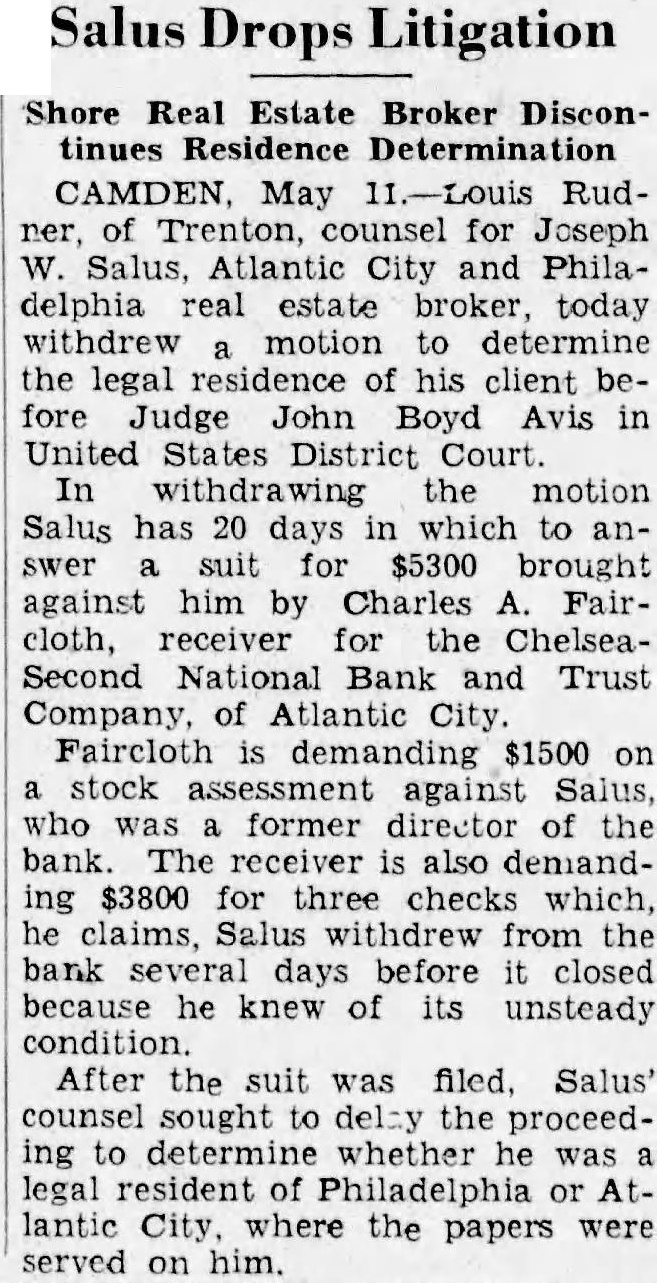
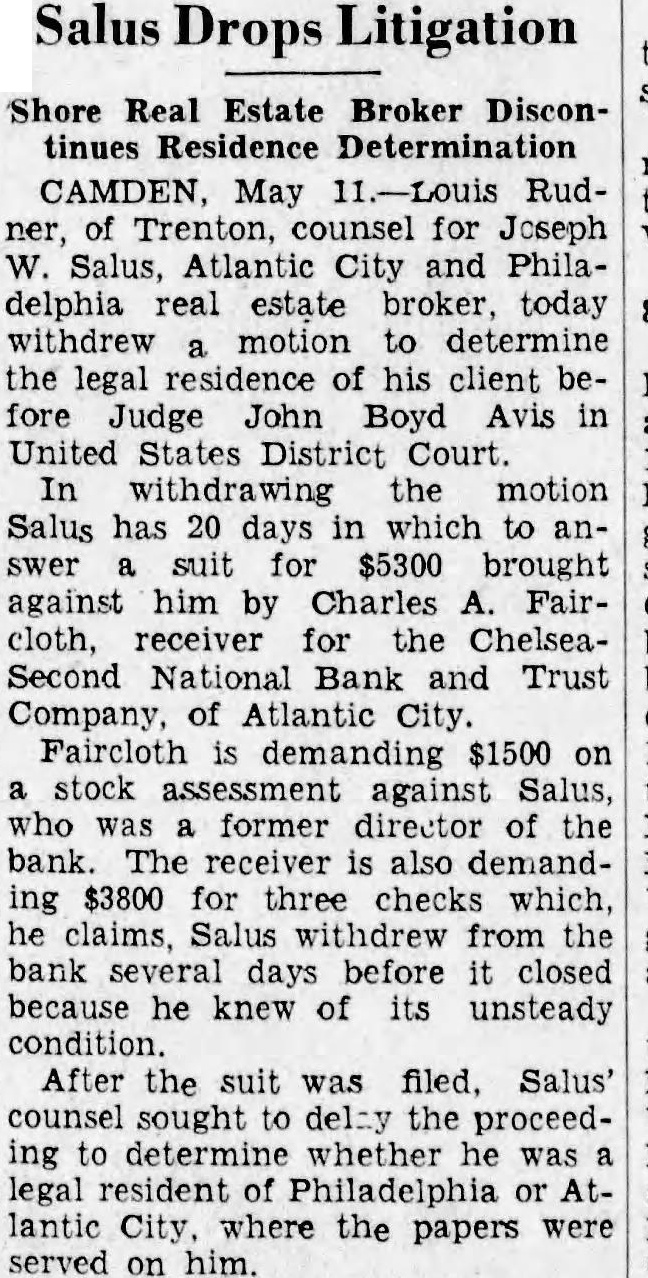
Faircloth is demanding $1500 on stock assessment against Salus ... the receiver is also demanding $3800 for three checks which, he claims, Salus withdrew from the bank several days before it closed because he knew of its unsteady condition.
Source
newspapers
5. August 17, 1934 Other
Newspaper Excerpt
assertion that the affairs of the closed Chelsea-Second National Bank & Trust Company of Atlantic City had been 'mismanaged most horribly' was made today by Judge John Boyd Avis ... taking under advisement an application by the bank's receiver to dismiss a 'suit for discovery' brought by a group of depositors.
Source
newspapers

Newspaper Articles (6)

Article from Press of Atlantic City, July 8, 1933

Click image to open full size in new tab

Article Text

Chelsea Delay Receiver Opposes Plea to Scan, Records, Issues State July deposicommittee the closed Chelsea-Second National Bank Trust Company, Atlantic City, today asked Federal Judge Avis for order authorizing access institution brief filed Charles Hyman, counsel the committee, stated committee intends instituting suit against directors the based on alleged regularities." The brief pointed out that the committee hopes sufficient information from the books of the from which proceed proposed action. George Bourgeois, counsel for Charles Faircloth, receiver for the bank, argued against the quest, that the bank's affairs are already under probe investigators the Department Justice the Federal Banking Judge continued the case for days. In the five months of the tion the the ChelNational Bank and Trust Company approximately twelfth the assets been turned into cash, according to the quarterly condition issued yesterday by Charles receiver. The statement showed the total cash from assets and stock assessments. (Continued on Page Four)


Article from Courier-Post, March 28, 1934

Click image to open full size in new tab

Article Text

JUDGE AVIS DENIES PREFERENCE RIGHTS AT BANK TO COUNTY Atlantic Board of Freeholders Sought Funds for Highway Bonds MONEY HELD 'DEPOSIT' U. S. District Judge John Boyd Avis yesterday ruled that a county having money on deposit in closed bank is not a preferred creditor. Sitting in federal court in Camden Judge Avis dismissed the suit of Atlantic county and the Atlantic county board of freeholders to recover $40,000 from the closed Chelsea Second National Bank and Trust Company. The suit was directed againnst the bank's receiver, Charles A. Faircloth, on the ground that $40,000 it had deposited in the institution was trust fund and that the county would therefore have preference over general depositors. The testimony and subsequent nonsuit arguments were on the question of whether the money was actually in trust or merely general deposit. Franklin E. Smith, county auditor and formerly assistant county treasurer, testified that the two checks were issued to bank by the county Jan. 14, 1933, to cover Atroad bonds for $40,000, maturing the next day One check covered this amount and the second check covered $7897.50 interest. Smith testified that it had been the custom of the bank to place such county moneys for maturing bonds or bond coupons in separate envelope and lay them aside, thus creating trust fund to pay off the bonds. In this case, he said, this procedure was not followed The bank closed its doors later Two former bank employes testified this was the bank's usual procedure. But one William H. Giberteller, said that this son, former note custom had been dropped and that the bank later placed such county moneys in a. separate account, drawing from this account to pay the bonds. Judge Avis referred to several U. Supreme Court decisions and stated that the county had not proved there was trust fund at the time the bank closed. Therefore, the county was merely general depositor and had no prior rights over other depositors The bond holders have agreed to accept tax anticipation notes in lieu of cash payment, it was announced. Robert K. Bell, of Ocean City, was counsel for the County Solicitor Edmund C. Gaskill, and former Judge Clarence L. Cole appeared for the county. Gaskill filed notice that he would appeal the decision to the U. S. Circuit Court of Appeals.
Article from Press of Atlantic City, May 12, 1934

Click image to open full size in new tab

Article Text

Salus Drops Litigation Shore Real Estate Broker Discontinues Residence Determination ner, of Trenton. counsel for Joseph W. Salus, Atlantic City and Philadelphia real estate broker. today withdrew motion to determine the legal residence of his client before Judge John Boyd Avis in United States District Court. In withdrawing the motion Salus has 20 days in which to answer suit for $5300 brought against him by Charles A. Faircloth, receiver for the ChelseaSecond National Bank and Trust Company, of Atlantic City. Faircloth is demanding $1500 on stock assessment against Salus, who was former director of the bank. The receiver is also demanding $3800 for three checks which, he claims, Salus withdrew from the bank several days before it closed because he knew of its unsteady After the suit was filed. Salus' counsel sought to delay the proceeding determine whether he was legal resident of Philadelphia or Atlantic City, where the papers were served on him.


Article from Press of Atlantic City, May 12, 1934

Click image to open full size in new tab

Article Text

Salus Drops Litigation Shore Real Estate Broker Discontinues Residence Determination CAMDEN, May 11.-Louis Rudner, of Trenton, counsel for Joseph W. Salus, Atlantic City and Philadelphia real estate broker. today withdrew motion to determine the legal residence of his client before Judge John Boyd Avis in United States District Court. In withdrawing the motion Salus has 20 days in which to answer suit for $5300 brought against him by Charles A. Faircloth. receiver for the ChelseaSecond National Bank and Trust Company, of Atlantic City. Faircloth is demanding $1500 on stock assessment against Salus, who former director of the bank. The receiver also demanding $3800 for three checks which, he claims, Salus withdrew from the bank days before it closed because he knew of its unsteady condition. After the suit was filed. Salus' counsel sought to delay the proceeding to determine whether he was legal resident of Philadelphia or Atlantic City, where the papers were served on him.


Article from Brooklyn Eagle, August 17, 1934

Click image to open full size in new tab

Article Text

Judge Accuses Bank Receiver Camden, N. J., Aug 17 (AP)-An assertion that the affairs of the closed Chelsea-Second National Bank & Trust Company of Atlantic City had been "mismanaged most horribly' was made today by Judge John Boyd Avis in United States District Court. He made the accusation in taking under advisement an application by the banks receiver to dismiss a "suit for discovery" brought by a group of depositors. Charleh A. Faircloth, the receiver. asked that he be relieved of the necessity of answering 113 questions, many in the nature of accusations, asked by the depositors committee 'Why haven't the people a right to know what happened. and what happens to their money?" Judge Avis asked. Why can a receiver say, in effect. "This is your money but we are going to handle it in private'? "The receiver has some obligations to depositors and others. The more hear about these banks the sorrier am for their depositors. If the responsible persons are able to pay they should pay.


Article from The Daily Journal, August 18, 1934

Click image to open full size in new tab

Article Text

Judge Raps Bank In Atlantic City Says Affairs Mismanaged Horribly and That Depositore Have Some Rights That the affairs of the closed Chelsea-Second National Bank and Trust Company of Atlantic City had been "mismanaged most horrobly" was made yesterday by Judge John Boyd Avis in U. S. District Court at Camden, in taking under advisement an application by the bank's receiver to dismiss a "suit for discovery" brought by a group of depositors. Charles A. Faircloth. the receiver, asked to be relieved of the necessity of answering 113 questions, asked by the depositors' committee. "Why have not the people a right to know what happened and what happens to their money ?" said Judge Avis. "Why can a receiver say, in effect. "This is your money, but we are going to handle it in private?' The more hear about these banks the sorrier I am for the depositors. The stockholders and depositors assert that the bank's officers allowed large withdrawals before it closed in January, 1933, when it had $5,000,000 deposits, and that the receiver has refused to take proper legal action against the officers.