13797. Colonial Trust Company (New York, NY)

Bank Information

Episode Type
Run Only
Bank Type
trust
Start Date
October 23, 1907
Location
New York, New York (40.714, -74.006)

Metadata

Model
gpt-5-mini
Short Digest
1cd8ce55270b1fef

Response Measures

None

Description

Articles describe a heavy run on the Colonial Trust Company (a branch of the Trust Company of America) beginning Oct 23, 1907. The bank paid out depositors (multiple articles note paying tellers, windows, and resumed payments) and was not closed by state action in these pieces; events are part of the wider 1907 panic triggered by the Knickerbocker failure. Cause attributed to runs on other New York banks (contagion), not to a discrete misinformation event.

Events (1)

1. October 23, 1907 Run
Cause
Local Banks
Cause Details
Contagion from the Knickerbocker Trust Company failure and general panic in New York banking (1907 panic); depositors queued to withdraw funds.
Measures
Payments made from paying-teller windows (two windows at branches), police kept order, bank officers and examiners on site; bank asserted it had substantial cash reserves to meet demands.
Newspaper Excerpt
A run similar to that which forced the Knickerbocker Trust Company to close its doors ... began this morning on the Trust Company of America ... and the Colonial Trust Company, its lately acquired branch ...
Source
newspapers

Newspaper Articles (11)

Article from Evening Star, October 23, 1907

Click image to open full size in new tab

Article Text

MANY DEPOSITORS CLAMOR FOR MONEY Another Trust Company Suffers Heavy Run. OVER IN NEW YORK TODAY Trust Company of America in Financial Limelight. THREE PAYING TELLERS BUSY Company Knickerbocker Trust Acknowledges That It Is Unable to Open Its Doors. A heavy run of depositors on the Trust Company of America in New York today to withdraw money served to continue the nervousness in financial circles, brought about by the developments in the MorseHeinze-Thomas banks last week and the closing of the Knickerbocker Trust Company yesterday. It was stated today that the Knickerbocker Trust Company would not reopen its doors. Although no official statement was made upon it the subject or was obtainable, was learned on very good authority that the amount, of cash deposited with the New York banks by the Treasury Department today amounted to about $10,000,000. Special Dispatch to The Star. NEW YORK, October 23.-A run similar to that which forced the Knickerbocker Trust Company to close its doors yesterday began this morning on the Trust Company of America, at 37 Wall street, and the Colonial Trust Company, its lately acquired branch in the St. Paul building, at Broadway and Ann street. By the time the office of the company opened, at 10 o'clock, there were over 300 persons crowded about the narrow entrance of the Colonial Trust Company, and so great a jam of depositors and others about the Trust Company of America. in Wall street, that the police had to be called out. The Knickerbocker Trust Company has already acknowledged that it is unable to open its doors. Acting SuperIntendent of State Banking Department Skinner posted a notice at 10 o'clock on the doors of the Fifth avenue branch of the Knickerbocker Trust Company announceing that he had taken possession of it. Bank examiners from his department have assumed charge of the Bronx, Harlem and lower Broadway branches. At all the offices of the Knickerbocker Tfust Company there was a dense mass of depositors, apparently looking for further developments. Considerable excitement existed, but no rioting has been reported. Examiner Skinner's Statement. Bank Examiner Skinner gave out the following "Under the advice of the attorney general, I have taken possession of the Knickerbocker Trust Company and its branch offices. "The support to this institution which was expected has not been furnished. "A bank examiner Is in charge of each branch office. Payments will be received and obligations due to the trust company, but no payments, will be made by the examiners in charge. "Payments should be made in cash Collateral will not be surrendered until it is shown that it is not pledged for other Indebtedness to the institution." President Oakleigh Thorne of the Trust Company of America was early on hand in the Wall street office, and with him at 7 o'clock this morning were all the officers of the company. He said that the trust company had plenty of money to meet all demands and that he anticipated no trouble, although he spent a number of yours last night in conference with prominent bankers, making arrangements for assistance that might be needed. Treasurer H. B. Fonda of the company said at 10:15 o'clock that there was no cause for alarm and that the company had enough funds on hand to meet every demand, whether for cash or certifications 1,000 Persons in Front of Building. At the time he spoke there were close to 1,000 persons before the building in Wall street. and nearly as many more in front of the Colonial Trust Company's offices in Broadway. Officers of the company later declared that they had about $11,000,000 on hand to meet the run. The expected run on the Trust Company of America, at 37 Wall street, started promptly when the doors of the Institution were opened. Although the crowd was permitted to enter the trust company's offices at 9 o'clock, it was said no money would be paid out until 10 o'clock. Between 9 and 9:30 o'clock*the number of anxious depositors increased twofold, and the attendants of the bank requested them to form in two lines. These extended from the paying tellers' windows to the street. There were few women in the crowd. The trust company officers said most of the men were clerks who had small accounts in the institution. The first depositor to station himself outside the institution this morning was a man named Donahue, a coffee broker, who is said to have had an account of $8,500. He arrived on the scene before 7 o'clock One of the features of the two lines formed in the large corridor was that a

Article from The Richmond Palladium and Sun-Telegram, October 23, 1907

Click image to open full size in new tab

Article Text

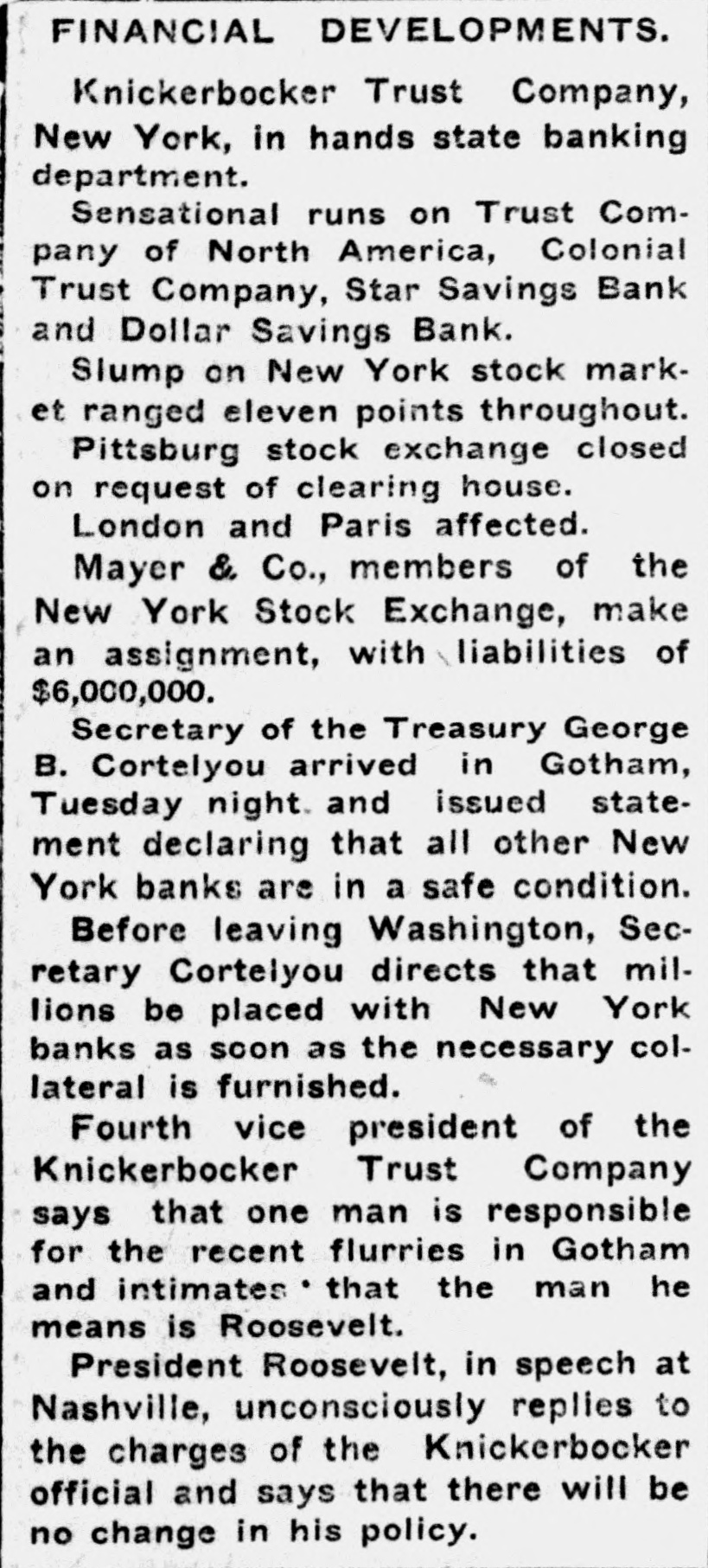
FINANCIAL DEVELOPMENTS. Knickerbocker Trust Company, New York, in hands state banking department. Sensational runs on Trust Company of North America, Colonial Trust Company, Star Savings Bank and Dollar Savings Bank. Slump on New York stock market ranged eleven points throughout. Pittsburg stock exchange closed on request of clearing house. London and Paris affected. Mayer & Co., members of the New York Stock Exchange, make an assignment, with liabilities of $6,000,000. Secretary of the Treasury George B. Cortelyou arrived in Gotham, Tuesday night. and issued statement declaring that all other New York banks are in a safe condition. Before leaving Washington, Secretary Cortelyou directs that millions be placed with New York banks as soon as the necessary collateral is furnished. Fourth vice president of the Knickerbocker Trust Company says that one man is responsible for the recent flurries in Gotham and intimates that the man he means is Roosevelt. President Roosevelt, in speech at Nashville, unconsciously replies to the charges of the Knickerbocker official and says that there will be no change in his policy.


Article from The Richmond Palladium and Sun-Telegram, October 23, 1907

Click image to open full size in new tab

Article Text

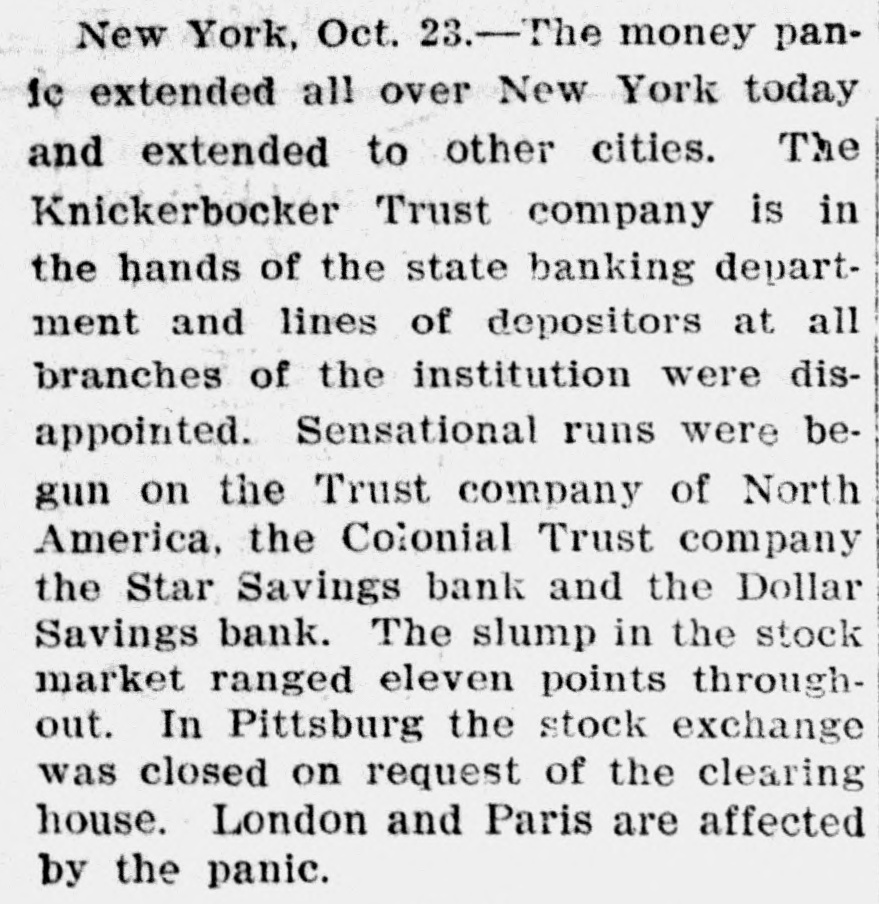
New York, Oct. 23.-The money panfe extended all over New York today and extended to other cities. The Knickerbocker Trust company is in the hands of the state banking department and lines of depositors at all branches of the institution were disappointed. Sensational runs were begun on the Trust company of North America, the Colonial Trust company the Star Savings bank and the Dollar Savings bank. The slump in the stock market ranged eleven points throughout. In Pittsburg the stock exchange was closed on request of the clearing house. London and Paris are affected by the panic.


Article from New-York Tribune, October 24, 1907

Click image to open full size in new tab

Article Text

COMPANY MEETS RUN. Continued from first page line long enough to reach the windows were badly flustered, for the most part. They could not make their pens work. they indorsed their checks at the wrong end. and dropped them on the floor before they could get them safely to the paying teller All day there were about three hundred or so in line-sometimes less, sometimes more There was no disorder. for there were too many policement ready for It. Some pickpockets mixed in the crowd. but the Wall Street sleuths soon hurried them out of the financial district. For some reason group of about twenty persons gathered across the street from the Morgan office and gazed steadlly at it for a couple of hours or so. On the other corner the steps of the Sub-Treasury were packed. On the other side of the street the crowd amused itself by trying to dodge the police and still keep within the focus of the cameras being snapped from the Sub-Treasury steps. A block away no one could tell that anything unusual was going on. Vehicular traffic was practically prohibited between Broad and William streets. Captain Hogan was in charge of the police under Chief Inspector Cortright, who took personal charge while the crowd was thickest. BANK EXAMINERS BUSY Just off Wall street. in a quiet corner of Broadway, fifteen of the state bank examiners were carrying on a comprehensive surveillance of all banks and trust companies. These were posted. like so many scouts, at all the banking centres throughout the city. From the opening of banking hours the fifteen official watchers kept reporting to the central office, showing just how each bank and trust company was doing business, how much ready cash it had, how it was accumulating a fund of defensive cash. A chart lay before the chief at the central office showing the status of every bank. A glance at the chart at 11 o'clock showed no runs at any points except at the Trust Company of America. It disclosed, too, how all the outlying banks were storing up reserve funds to meet all emergencies. The whole storm centred, of course, in Wall street, but it overflowed into Broadway. Nearly a thousand, mostly clerks and stenographers, were waiting when the doors opened at the Colonia! Trust Company, at No. 222 Broadway. The reserves kept the long lines in order, but there was not much need of their services. HISTORY OF TRUST COMPANY. The Trust Company of America represents the consolidation of several similar institutions and its history is one of successive enlargements. The old company of that name was organized in 1899, with the late Ashbel P. Fitch as president. The first amalgamation out of which the present company was evolved was in 1900, when the International Banking and Trust Company, of which Oakleigh Thorne was president at the time, consolidated with the North American Trust Company under the title of the North American Trust Company. The old North American Trust Company was formed in 1893, taking over the assets of the Jarvis-Conklin Mortgage Company. On May 26, 1899, the late Alvah Trowbridge was elected president of the company. The International Banking and Trust Company was organized in 1899 and its first president was Stewart Browne, who had been connected with the New York Life Insurance Company. He was succeeded by Mr. Thorne. The second amalgamation took place in 1901, when the North American Trust Company, of which Mr. Thorne had become president the year before. consolidated with the Trust Company of New York, with combined assets of $22,000,000. and at about the same time the former company took over the Holland Trust Company and the Century Trust Company in liquidation. The third and last amalgamation was in 1903, when. after about two years of intermittent negotiations, the North American Trust Company, the Trust Company of America and the City Trust Company were merged into one concern with a capital of $2,000,000 and a surplus of $9,600,000. The total deposits of the three companies were more than $50,000,000. The new company took the name of the Trust Company of America, and Oakleigh Thorne was made president. In January, 1907, the Trust Company of America and the Colonial Trust Company were consolidated. The first named is now known as the Colonial Branch of the Trust Company of America. John E. Borne, who was the president of the Colonial. is now chairman of the executive committee of the Trust Company of America. The officers of the company are: President, Oakleigh Thorne; vice-presidents, James W. Tappin, William H. Leupp. Heman Dowd and Philip S. Babcock; chairman of the


Article from Mexico Weekly Ledger, October 24, 1907

Click image to open full size in new tab

Article Text

A run was started on the Colonial Trust Company, No. 22 Broadway New York City to-day. There is great excitement in financial circles, and the stock exchange at Pittsburg, Pa, was closed.


Article from New-York Tribune, October 25, 1907

Click image to open full size in new tab

Article Text

IN LINE ALL NIGHT. Depositors Besiege Doors of Trust Company of America. The run at the main offices of the Trust Company of America and at its branch. the Colonial Trust Company, in the St. Paul Building, continued throughout the day yesterday, though the attitude of the waiting depositors toward the company was noticeably less suspicious and belligerent than on Wednesday. It was scarcely six hours after the anxious line of depositors had been dispersed at the regular closing hour on Wednesday when they began to reassemble at both offices, eager to get a favored position in the line pending the reopening of business yesterday. As early as 10 o'clock on Wednesday night men and women who had deposits in one of the branches of the trust company began to arrive in Wall street and in front of the St. Paul Building. When the first comers, most of whom had stood in vain in line for six hours or more on Wednesday, appeared on the scene there was a halt in front of each office. They hesitated, however, for a short while to take up a stand in front of the offices, but as soon as they saw they had company there was a recurrence of courage, and by the time the Trinity chimes were striking midnight there were small lines formed both in front of No. 37 Wall street and at the Ann street corner of the St. Paul Building. In expectation of such a happening a policeman from the John street station was on duty at the Wall street office all night, and one from the Oak street station at the St. Paul Building. The line in Wall street, which had included fifteen men and women at midnight, had increased to almost a hundred at 7 'clock yesterday morning, and when the trust company opened its doors for business it included fully twice that number of depositors, and stretched well down Wall street and around the corner into William street. At the Colontal Trust Company branch there were fifteen depositors, including several women, at 3 o'clock yesterday morning. When the branch opened its doors at 9 o'clock several hundred depositors were in the line that extended through Ann street to Fulton. The morning newspapers were in great demand with the early comers. and the reassuring statements contained in the "extra" headlines servad to improve the humor of the crowd. Still, none showed any inclination to yield up the coveted places which meant the loss of a night's sleep while there was a good chance to get at the paying teller's windows. Chief Inspector Cortright was again in charge in Wall street yesterday, but the forty patrolmen and the 'mounted men had much less to do than on the day before in preserving order. Traffic of vehicles in Wall street between Broad and William was suspended by order of the police. Progress toward the doors of the trust company was somewhat quicker than on Wednesday, and this fact aided greatly in allaying the anxiety of depositors. Arrangements were made early in the day to admit groups of fifty depositors at a time, and as soon as one batch was disposed of another was let in. At one time in the morning the line stretched around William street and along Exchange Place well toward Broad street. Everybody who had no place in the line or who could not give immediate and good reason for standing about was kept on the hustle. By 2 o'clock the line had dwindled until its end rested near the corner of Wall and William streets, and at the hour of closing, 3 o'clock, the end had turned around Will1am street. Even at that about two hundred depositors were turned away. Not a few of those waiting to get a chance to make withdrawal from the trust company presented checks drawn on the company, but which, the holders asserted, their own banks had refused to honor in the present crisis. There was much indignant protest when, because of lack of proper identification, the officials of the trust company refused to honor these claims, but the news of the company's action helped to cause many vacancies in the line. Philip S. Babcock, vice-president of the Trust Company of America, said last night that no exact statement of the amount paid out to depositors during the day would be given. Mr. Babcock said, however, that it would not be nearly as large as that paid out on Wednesday. The total of the claims presented had been smaller than on the preceding day. said Mr. Babcock. While he looked for a continuance of the run this morning, every claim would be honored. Vice-President James W. Tappin was at the Colonial Trust branch of the company promptly at the opening yesterday morning and remained there till late in the afternoon Mr. Tappin said business would go on in the usual way and was as optimistic as to the outlook as Mr. Babcock. At both branches payments were made from two windows, but several hundred depositors failed to get inside the Colonial Trust branch before the closing of business.


Article from The Daily Morning Journal and Courier, October 26, 1907

Click image to open full size in new tab

Article Text

APPLICATION OF CURB. Conditions Settled Into Waiting Attitude With Late Upward Spurt. New York, Oct. 25.-The stock market reflected an early curb to the exuberance of cheer which market the revulsion late yesterday from the depths of despair into which it was slipping. After the check had been applied conditions settled down into a dull waiting attitude with a late upward spurt. Activity was on a small scale. Prices generally were pretty well sustained, but weak spots constantly developed which showed the occasional necessity of additional liquidation. It was said that the only buyers were bears who had shorts to cover or operators who had cash in hand. For most of the day funds offering on call were simply non-resistent. Brokers waited around in the loan crowd at the stock exchange in large numbers and with heavy requirements to be met to tide them over until Monday. The borrowers who secured portions of the $25,000,000 loaned late yesterday by the bank ers' pool found themselves in comfortable circumstances to-day and were allowed renewals at the rate of 20 per cent. Bankers were said to be advising stock brokers against undertaking any business except for cash, the effect being to relieve so far the money stringency. The amount of business done on this basis was surprisingly large and the amount of cash which changed hands in brokers' offices during the day might afford a clue to the destination of some of the funds that were being withdrawn from deposits with banking institutions. The considerable number of additions to banking and trust company institutions whch closed their doors, most of them to check runs, had little effect on market sentiment. The belief that the situaion was clearing in the financial center here in New York was the paramount influence on sentiment. The dwindling of the runs of the Trust Company of America and its Colonial Trust company branch was accepted as the subsidence of the greatest danger. Further deposits of government funds were made with the banks and the ablest financial minds in the country continued to devise means for improving the situation. The constant evidence of this activity had a soothing effect on apprehension. From the strictly stock market view, when funds appeared in the loan crowd late in the day supplied by a bankers' pool to the extent of $15,000,000 and was loaned on call at the stock exchange, it meant that stock market needs were supplied until Monday. Prices rose rapidly then and closed strong at the best prices. It was hoped that by Monday next when the loans must be renewed, the situation will be so far cleared up that the money stringency will be sensibly relaxed and saner conitions established. There was contind evidence of painful liquidation in laked stocks to-day and the same as true in even greater degree in the ond market. Some sensational delines on small transactions were thus occasioned. Bonds were weak. Total sales par value $4,556,000. U. S. 2s declined 1-8 and the 4s registered 1-2 per cent. on call.


Article from Daily Kennebec Journal, October 26, 1907

Click image to open full size in new tab

Article Text

NEW YORK STOCK MARKET. Features of the Day's Dealings in All the Leading Stocks. New York. Oct. 25.-The stock market reflected an early curb to the exuberance of cheer which marked the revulsion late yesterday from the pths of despair into which it was slipping. After the check had been applied. conditions settled down into a dull waiting attitude with 2 late upward spurt. Activity was on a small scale. Prices generally were pretty well sustained. but weak spots constantly developed which showed the oceasional necessity of additional liquidation. It was said that the only buyers were bears who had shorts to cover, or operators who had cash in hand. For most of the day funds offering on call were simply non-existent. Brokers waited around in the loan crowd at the Stock Exchange in large numbers and with heavy requirements to be met to tide them over till Monday. The borrowers who secured portions of the $25,000,000 loaned late yesterday by the bankers' pool found themselves in comfortable circumstances today and were allowed renewals at the rates of 20 per cent. Bankers were said to be advising stock brokers against undertaking any business except for cash, the effect being to relieve so far the monev stringency. The amount of business done on this basis was surprisingly large and the amount of cash which changed hands in brokers' offices during the day might afford a clue to the destination of some of the funds that were being withdrawn from deposits with banking institutions. The considerable number of additions to banking and trust company institutions which closed their doors. most of them to check runs. bad little effect on market sentiment. The belief that the situation was clearing in the financial center here in New York was the paramount influence on sentiment. The dwindling of the runs of the Trust Corapany of America and its Colonial Trust Co., a branch, was accepted as the subsidence of the greatest danger. Further deposits of government funds were made with the banks and the ablest financial minds in the country continned to devise means for improving the situation. The constant evidence of this activity had a soothing effect on apprehension. From the strictly stock market view. when funds appeared in the loan crowd late in the day supplied by a bankers' pool to the extent of $15,000,000 and was loaned on call at the Stock Exchange. it meant that stock market needs were supplied until Monday. Prices rese rapidly then and closed strong at the best prices. It was hoped that by Monday next, when the loans must be renewed. the situation will be so far cleared up that the money


Article from Evening Star, October 29, 1907

Click image to open full size in new tab

Article Text

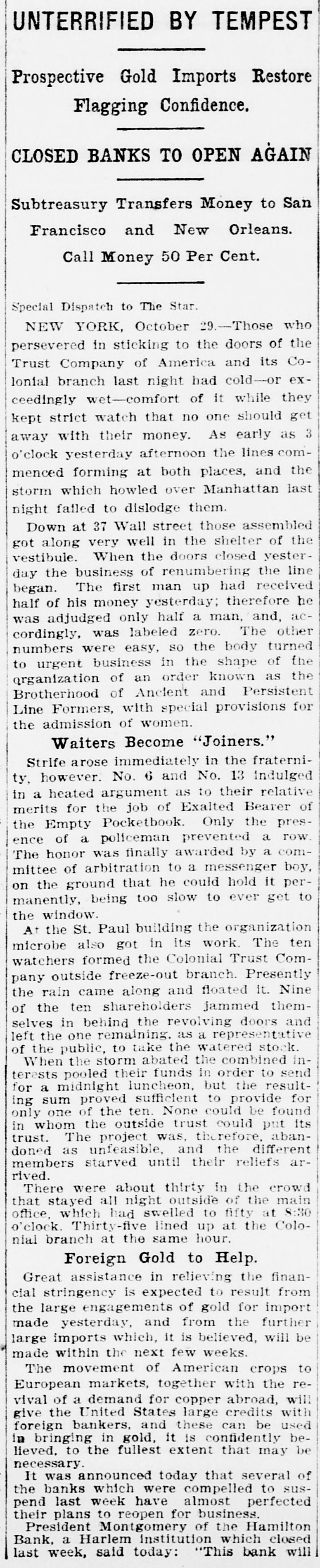
UNTERRIFIED BY TEMPEST Prospective Gold Imports Restore Flagging Confidence. CLOSED BANKS TO OPEN AGAIN Subtreasury Transfers Money to San Francisco and New Orleans. Call Money 50 Per Cent. Special Dispatch to The Star. NEW YORK, October 29.-Those who persevered in sticking to the doors of the Trust Company of America and its Colonial branch last night had cold-or exceedingly wet-comfort of it while they kept strict watch that no one should get 3 away with their money. As early as o'clock yesterday afternoon the lines commenced forming at both places, and the storm which howled over Manhattan last night failed to dislodge them. Down at 37 Wall street those assembled along very well in the shelter of the vestibule. got When the doors closed yesterday the business of renumbering the line began. The first man up had received half of his money yesterday; therefore he was adjudged only half a man, and, accordingly, was labeled zero. The other numbers were easy, so the body turned the to urgent business in the shape of the organization of an order known as Brotherhood of Ancien't and Persistent Line Formers, with special provisions for the admission of women. Waiters Become "Joiners." Strife arose immediately in the fraternihowever. No. 6 and No. 13 indulged ty, in a heated argument as to their relative merits for the job of Exalted Bearer of the Empty Pocketbook. Only the presof a policeman prevented a row. ence The honor was finally awarded by a committee of arbitration to a messenger boy, the ground that he could hold it peron manently, being too slow to ever get to the window. A the St. Paul building the organization microbe also got in its work. The ten watchers formed the Colonial Trust Company outside freeze-out branch. Presently the rain came along and floated it. Nine of the ten shareholders jammed themselves in behind the revolving doors and left the one remaining. as a representative of to take the watered stock. storm abated the intheir funds in send When the public, pooled the order combined to luncheon, but for sufficient to ing terests for a sum midnight proved could provide the be result- found of the ten. None the outside trust its in The was, only trust. whom one project therefore, could put abandoned as unfeasible, and the different members starved until their reliefs arrived. There were about thirty in the crowd that stayed all night outside of the main office. which had swelled to fifty at 8:30 o'clock. Thirty-five lined up at the Colonial branch at the same hour. Foreign Gold to Help. Great assistance in relieving the financial stringency is expected to result from the large engagements of gold for import made yesterday, and from the further large imports which, it is believed, will be made within the next few weeks. The movement of American crops to European markets, together with the rea demand for copper abroad, will United States large vival give the of credits be used with foreign bankers, and these can in bringing in gold, it is confidently be- be lieved. to the fullest extent that may necessary. It was announced today that several of the banks which were compelled to suspend last week have almost perfected their plans to reopen for business. President Montgomery of the Hamilton Bank, a Harlem institution which closed last week, said today: "This bank will


Article from The Washington Times, November 4, 1907

Click image to open full size in new tab

Article Text

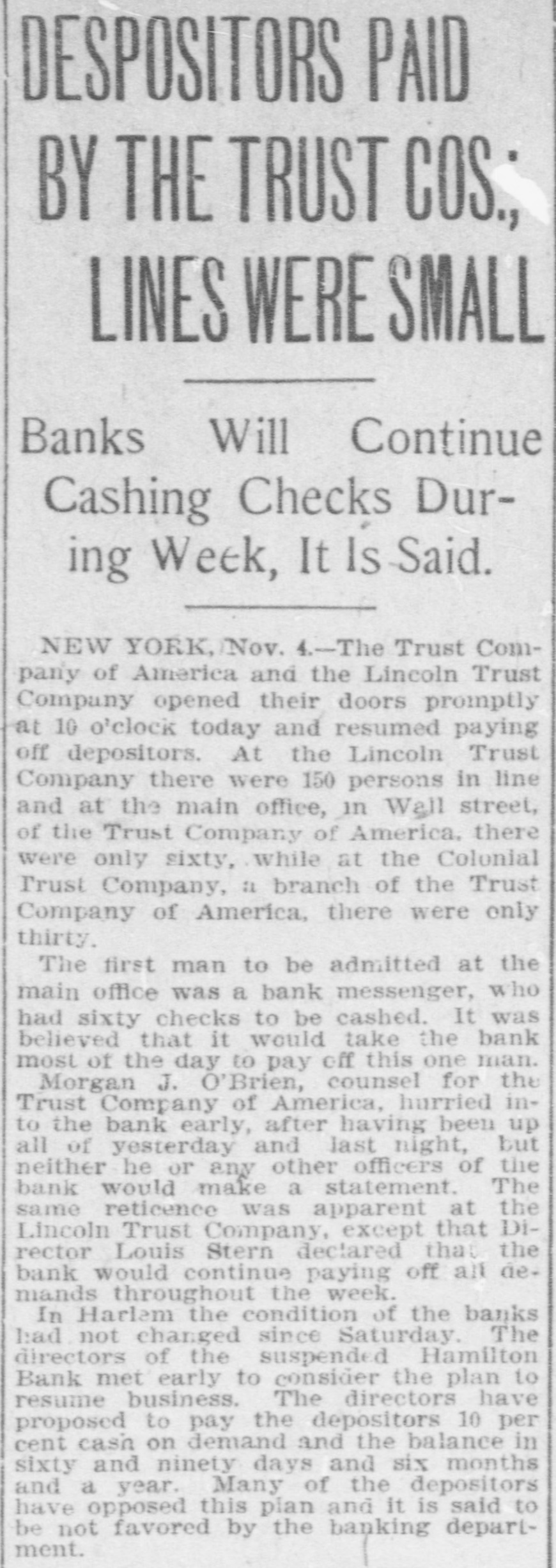
DESPOSITORS PAID BY THE TRUST COS. LINES WERE SMALL Will Banks Continue Cashing Checks During Week, It Is Said. NEW YORK, Nov. 4.-The Trust Company of America and the Lincoln Trust Company opened their doors promptly at 10 o'clock today and resumed paying off depositors. At the Lincoln Trust Company there were 150 persons in line and at the main office, in Wall street, of the Trust Company of America. there were only sixty, while at the Colonial Trust Company, a branch of the Trust Company of America, there were only thirty. The first man to be admitted at the main office was a bank messenger, who had sixty checks to be cashed. It was believed that it would take the bank most of the day to pay off this one man. Morgan J. O'Brien, counsel for the Trust Company of America, hurried into the bank early, after having been up all of yesterday and last night, but neither he or any other officers of the bank would make a statement. The same reticence was apparent at the Lincoln Trust Company, except that Director Louis Stern declared that the bank would continue paying off all demands throughout the week. In Harlem the condition of the banks had not changed since Saturday. The directors of the suspended Hamilton Bank met early to consider the plan to resume business. The directors have proposed to pay the depositors 10 per cent cash on demand and the balance in sixty and ninety days and six months and a year. Many of the depositors have opposed this plan and it is said to be not favored by the banking department.


Article from El Regidor, November 14, 1907

Click image to open full size in new tab

Article Text

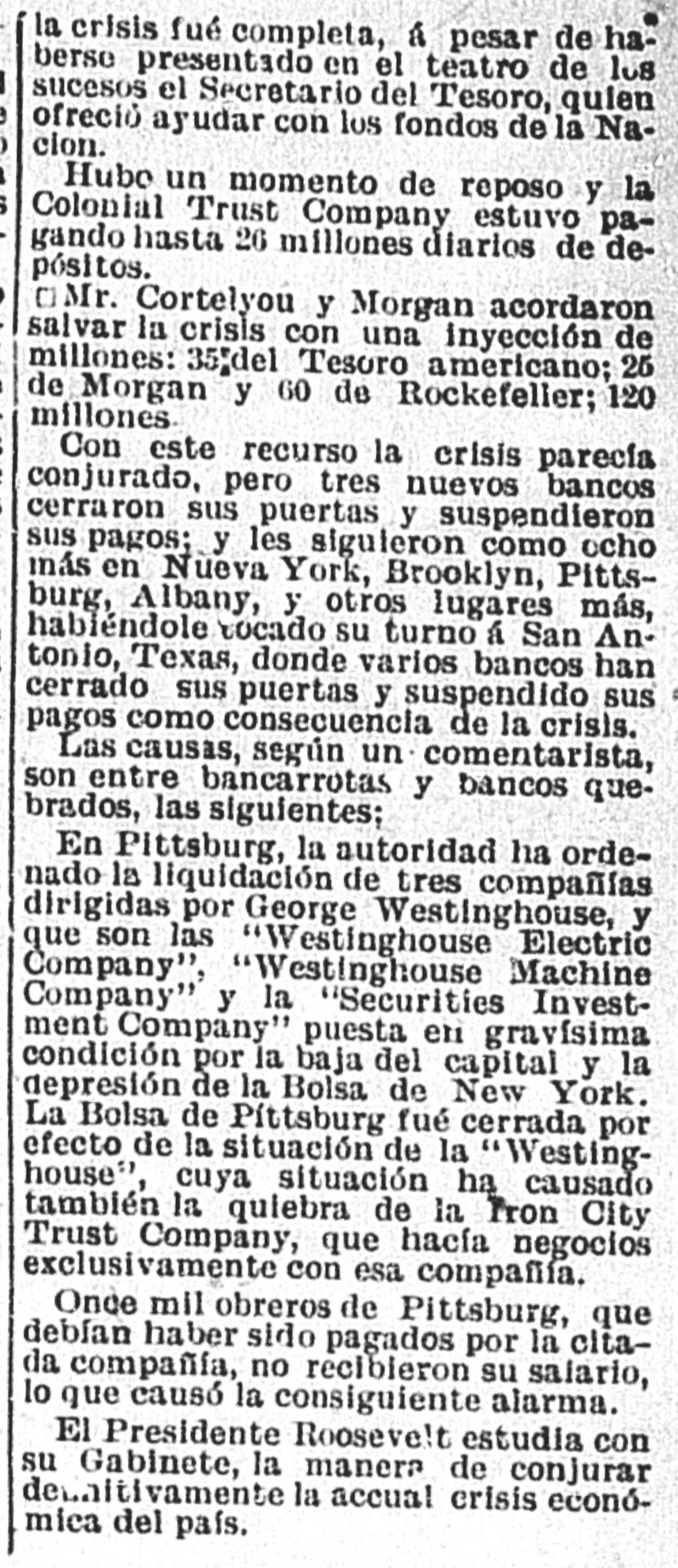
la crisis fue completa, á pesar de haberse presentado en el teatro de lus sucesos el Secretario del Tesoro, quien ofreció ayudar con los fondos de la Nacion. Hube un momento de reposo y la Colonial Trust Company estuvo pagando hasta 26 millones diarios de depósitos. Mr. Cortelyou y Morgan acordaron salvar la crisis con una inyección de millones: 35'del Tesoro americano; 25 de Morgan y 60 de Rockefeller; 120 millones. Con este recurso la crisis parecia conjurado, pero tres nuevos bancos cerraron sus puertas y suspendieron sus pagos; y les siguleron como ocho más en Nueva York, Brooklyn, Pittsburg, Albany, y otros lugares más, habléndole vocado su turno á San Antonio, Texas, donde varios bancos han cerrado sus puertas y suspendido sus pagos como consecuencia de la crisis. Las causas, según un comentarista, son entre bancarrotas y bancos quebrados, las siguientes; En Pittsburg, la autoridad ha ordenado la liquidación de tres compañias dirigidas por George Westinghouse, y que son las "Westinghouse Electric Company", "Westinghouse Machine Company" y la "Securities Investment Company" puesta en gravísima condición por la baja del capital y la depresión de la Bolsa de New York. La Bolsa de Pittsburg fué cerrada por efecto de la situación de la "Westinghouse", cuya situación ha causado también la quiebra de la Iron City Trust Company, que hacía negocios exclusivamente con esa compafifa. Once mil obreros de Pittsburg, que debían haber sido pagados por la citada compañia, no recibieron su salario, lo que causó la consiguiente alarma. El Presidente Roosevelt estudia con su Gabinete, la manera de conjurar des.altivamente la accual crisis económica del país.