Article Text
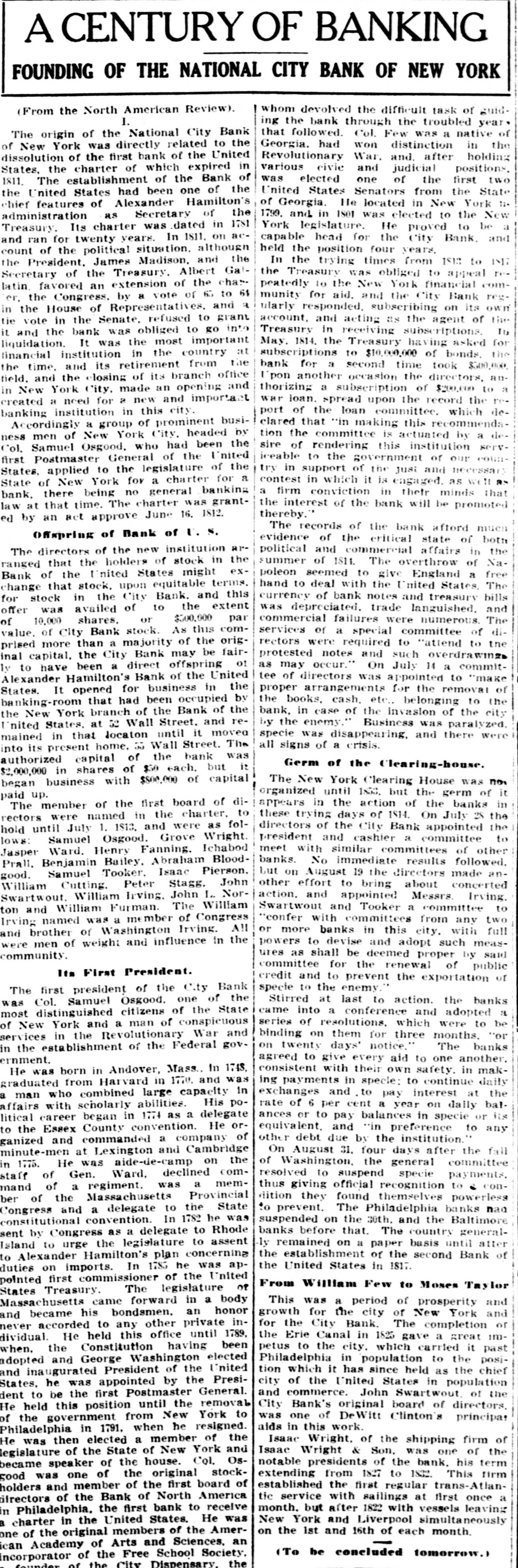
A CENTURY OF BANKING FOUNDING OF THE NATIONAL CITY BANK OF NEW YORK whom devolved the difficult task of guid(From the North American Review). 1. ing the bank through the troubled years that followed. Col. Few was a native of The origin of the National City Bank Georgia. had won distinction in the of New York was directly related to the Revolutionary War. and. after holding dissolution of the first bank of the United various civie and judicial positions, States, the charter of which expired in was elected one of the first two 1811. The establishment of the Bank of United States Senators from the State the United States had been one of the of Georgia. He located in New York 11. chief features of Alexander Hamilton's 1799. and in 1801 was elected to the New administration as Secretary of the York legislature. He proved to be a Treasury. Its charter was dated in 1781 capable head for the City Bank. and and ran for twenty years. In 1811. on acheld the position four years, count of the political situation. although In the trying times from 1813 to 1817 the President. James Madison. and the the Treasury was obliged to appeal reSecretary of the Treasury. Albert Galpeatedly to the New York financial comlatin. favored an extension of the cha:munity for aid. and the City Bank reger. the Congress. by a vote of 65 to 64 ularly responded, subscribing on its own in the House of Representatives. and a account, and acting as the agent of the vote in the Senate. refused to grant Treasury in receiving subscriptions. 11, and the bank was obliged to go into May, 1814. the Treasury having asked for liquidation. It was the most important subscriptions to $10,000,000 of bonds. the financial institution in the country at bank for a second time took $500,000. the time. and its retirement from the pon another occasion the directors, aufield, and the closing of its branch office thorizing a subscription of $200,000 to a in New York City, made an opening and war loan. spread upon the record the recreated a need for a new and important port of the loan committee. which debanking institution in this city. clared that "in making this recommendaAccordingly a group of prominent busition the committee is actuated by a deness men of New York City, headed by sire of rendering this institution servCol. Samuel Osgood, who had been the iceable to the government of our counfirst Postmaster General of the United try in support of the just and necessary States, applied to the legislature of the contest in which it is engaged. as well as State of New York for a charter for a a firm conviction in their minds that bank, there being no general banking the interest of the bank will be promoted law at that time. The charter was grantthereby." ed by an act approve June 16. 1812. The records of the bank aftord much Offspring of Bank of 1. S. evidence of the critical state of both political and commercial affairs in the The directors of the new institution arsummer of 1814. The overthrow of Naranged that the holders of stock in the poleon seemed to give England a free Bank of the United States might exhand to deal with the United States. The change that stock, upon equitable terms. currency of bank notes and treasury bills for stock in the City Bank. and this was depreciated. trade languished. and offer was availed of to the extent commercial failures were numerous. The of 10,000 shares. or $500,000 par services of a special committee of divalue. of City Bank stock. As this comrectors were required to "attend to the prised more than a majority of the origprotested notes and such overdrawing. inal capital, the City Bank may be fairas may occur." On July 14 a committo have been a direct offspring of tee of directors was appointed to "make Alexander Hamilton's Bank of the United proper arrangements for the removal of States. It opened for business in the the books, cash. etc.. belonging to the banking-room that had been occupied by bank, in case of the invasion of the city the New York branch of the Bank of the by the enemy." Business was paralyzed. nited States. at 52 Wall Street, and respecie was disappearing, and there were mained in that locaton until it movea all signs of a crisis. into its present home. 50 Wall Street. The authorized capital of the bank was Germ of the Clearing-house. $2,000,000 in shares of $50 each. but it The New York Clearing House was not began business with $800,000 of capital organized until 1853. but the germ of it paid up. appears in the action of the banks in The member of the first board of dithese trying days of 1814. On July 28 the rectors were named in the charter, to directors of the City Bank appointed the hold until July 1. 1813, and were as folpresident and cashier a committee to lows: Samuel Osgood. Grove Wright. meet with similar committees of other Jasper Ward. Henry Fanning. Ichabod banks. No immediate results followed. Prall. Benjamin Bailey, Abraham Bloodbut on August 19 the directors made angood. Samuel Tooker. Isaac Pierson. other effort to bring about concerted William Cutting. Peter Stagg. John action. and appointed Messrs. Irving. Swartwout. William Irving. John L. NorSwartwout and Tooker a committee to ton and William Furman. The William "confer with committees from any two Irving named was a member of Congress or more banks in this city, with full and brother of Washington Irving. All powers to devise and adopt such measwere men of weight and influence in the ures as shall be deemed proper by said community. committee for the renewal of public Its First President. credit and to prevent the exportation of specie to the enemy." The first president of the City Bank Stirred at last to action. the banks was Col. Samuel Osgood. one of the came into a conference and adopted a most distinguished citizens of the State series of resolutions, which were to be of New York and a man of conspicuous binding on them for three months. "or services in the Revolutionary War and on twenty days' notice." The banks in the establishment of the Federal gov. agreed to give every aid to one another. ernment. consistent with their own safety. in makHe was born in Andover, Mass. In 1748, ing payments in specle: to continue daily graduated from Harvard in 1770, and was exchanges and to pay interest at the man who combined large capacity In rate of 6 per cent a year on daily balaffairs with scholarly abilities. His poances or to pay balances in specie or its litical career began in 1774 as a delegate equivalent. and "in preference to any the Essex County convention. He orother debt due by the institution." ganized and commanded a company of On August 31, four days after the fall minute-men at Lexington and Cambridge of Washington, the general committee 1775. He was aide-de-camp on the resolved to suspend specie payments, staff of Gen. Ward, declined comthus giving official recognition to - conmand of a regiment. was a memdition they found themselves powerless of the Massachusetts Provincial to prevent. The Philadelphia banks nao Congress and a delegate to the State suspended on the 30th. and the Baltimore constitutional convention. In 1782 he was banks before that. The country generalsent by Congress as a delegate to Rhode ly remained on a paper basis until after Island to urge the legislature to assent the establishment of the second Bank of Alexander Hamilton's plan concerning the United States in 1817. duties on imports. In 1785 he was appointed first commissioner of the United From William Few to Moses Tay lor States Treasury. The legislature of This was a period of prosperity and Massachusetts came forward in a body growth for the city of New York and and became his bondsmen. an honor for the City Bank. The completion or never accorded to any other private inthe Erie Canal in 1825 gave a great imdividual. He held this office until 1789, petus to the city, which carried it past when, the Constitution having been Philadelphia in population to the posiadopted and George Washington elected tion which it has since held as the chief and inaugurated President of the United city of the United States in population States, he was appointed by the Presiand commerce. John Swartwout of the dent to be the first Postmaster General. City Bank's original board of directors. held this position until the removal was one of DeWitt Clinton's principal the government from New York to aids in this work. Philadelphia in 1791, when he resigned. Isaac Wright, of the shipping firm of was then elected a member of the Isaac Wright & Son, was one of the legislature of the State of New York and notable presidents of the bank, his term became speaker of the house. Col. Osextending from 1827 to 1832. This firm good was one of the original stockestablished the first regular trans-Atlanholders and member of the first board of tic service with sailings at first once a directors of the Bank of North America month. but after 1822 with vessels leaving Philadelphia, the first bank to receive New York and Liverpool simultaneously charter in the United States. He was on the 1st and 16th of each month. of the original members of the AmerAcademy of Arts and Sciences, an (To be concluded tomorrow.) incorporator of the Free School Society. Counder of the City Dispensary the