13673. Bank of the United States (New York, NY)

Bank Information

Episode Type
Run Only
Bank Type
private
Start Date
July 2, 1913
Location
New York, New York (40.714, -74.006)

Metadata

Model
gpt-5-mini
Short Digest
65ce8f542be63119

Response Measures

None

Description

Article 1 (1913-07-02) describes a frenzied crowd rushing to deposit funds at the opening of a new Bank of the United States branch on Delancey Street โ€” a positive 'run for' deposits, not withdrawals. No suspension, closure, or receivership is described. Article 2 is a historical aside about the earlier (19th-century) Bank of the United States and does not describe an event for this 1913 institution.

Events (1)

1. July 2, 1913 Run
Cause Details
Enthusiastic depositors rushing to open accounts at the new bank's opening (a run to deposit rather than to withdraw).
Measures
Opened every window as a receiving window; thirty-five special clerks employed; guards at the door; handed out handbags/wallets as souvenirs.
Newspaper Excerpt
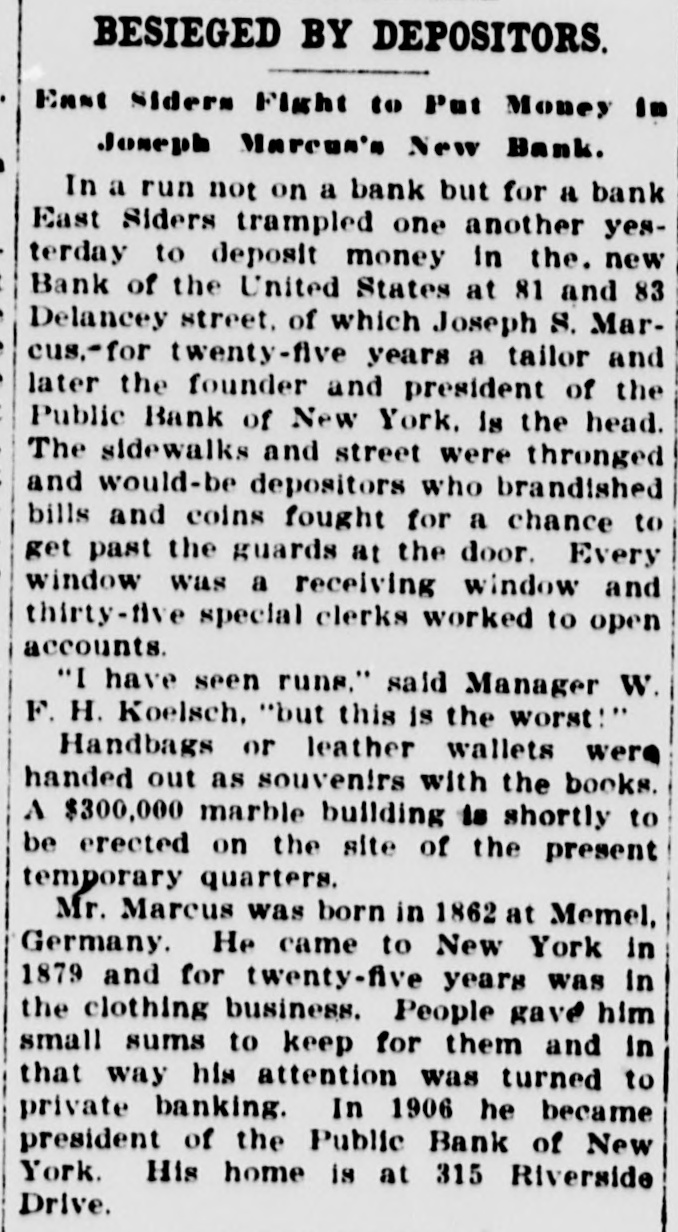
In a run not on a bank but for a bank East Siders trampled one another yesterday to deposit money in the new Bank of the United States at 81 and 83 Delancey street
Source
newspapers

Newspaper Articles (2)

Article from The Sun, July 2, 1913

Click image to open full size in new tab

Article Text

BESIEGED BY DEPOSITORS. East Siders Fight to Put Money in Joneph Marcus's New Bank. In a run not on a bank but for a bank East Siders trampled one another yesterday to deposit money in the. new Bank of the United States at 81 and 83 Delancey street, of which Joseph S. Marcus."for twenty-five years a tailor and later the founder and president of the Public Bank of New York. is the head. The sidewalks and street were thronged and would-be depositors who brandished bills and coins fought for a chance to get past the guards at the door. Every window was a receiving window and thirty-five special clerks worked to open accounts. "I have seen runs." said Manager W. F. H. Koelsch. "but this is the worst!" Handbags or leather wallets were handed out as souvenirs with the books. A $300,000 marble building is shortly to be erected on the site of the present temporary quarters. Mr. Marcus was born in 1862 at Memel, Germany. He came to New York in 1879 and for twenty-five years was in the clothing business. People gave him small sums to keep for them and in that way his attention was turned to private banking. In 1906 he became president of the Public Bank of New York. His home is at 315 Riverside Drive.

Article from The Washington Herald, September 19, 1920

Click image to open full size in new tab

Article Text

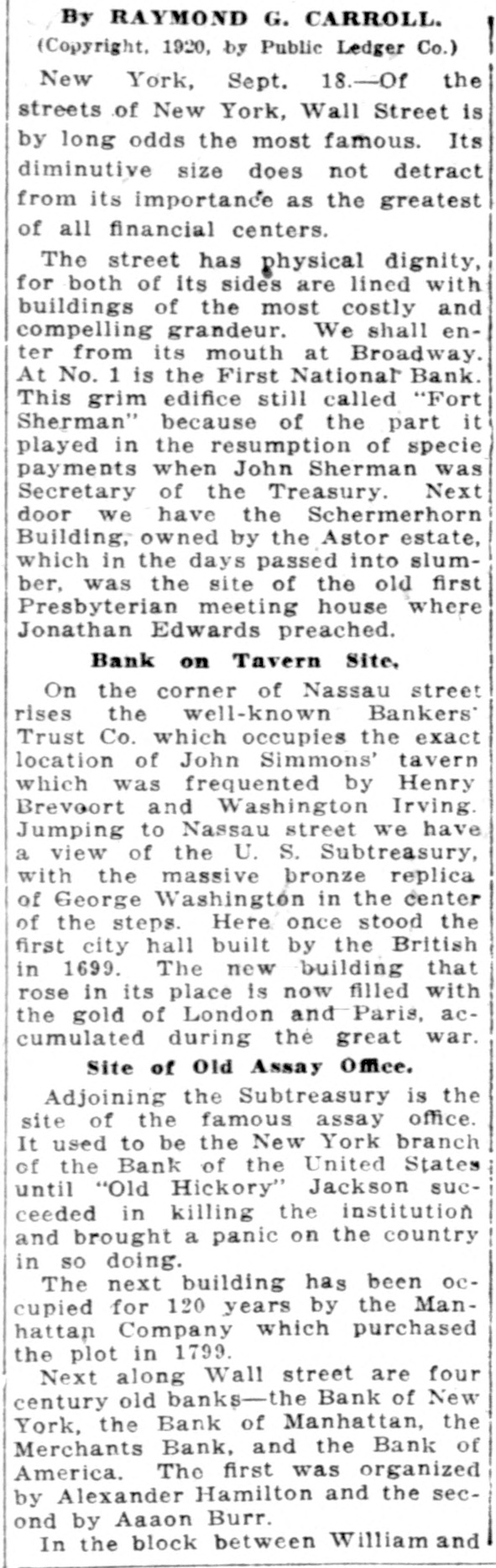
By RAYMOND G. CARROLL. (Copyright, 1920, by Public Ledger Co.) New York, Sept. 18.-0f the streets of New York, Wall Street is by long odds the most famous. Its diminutive size does not detract from its importance as the greatest of all financial centers. The street has physical dignity, for both of its sides are lined with buildings of the most costly and compelling grandeur. We shall enter from its mouth at Broadway. At No. 1 is the First National Bank. This grim edifice still called "Fort Sherman" because of the part it played in the resumption of specie payments when John Sherman was Secretary of the Treasury. Next door we have the Schermerhorn Building, owned by the Astor estate, which in the days passed into slumber, was the site of the old first Presbyterian meeting house where Jonathan Edwards preached. Bank on Tavern Site, On the corner of Nassau street rises the well-known Bankers' Trust Co. which occupies the exact location of John Simmons' tavern which was frequented by Henry Brevgort and Washington Irving. Jumping to Nassau street we have a view of the U. S. Subtreasury, with the massive bronze replica of George Washington in the center of the steps. Here once stood the first city hall built by the British in 1699. The new building that rose in its place is now filled with the gold of London and Paris, accumulated during the great war. Site of Old Assay Office. Adjoining the Subtreasury is the site of the famous assay office. It used to be the New York branch of the Bank of the United States until "Old Hickory" Jackson succeeded in killing the institution and brought a panic on the country in so doing. The next building has been OCcupied for 120 years by the Manhattan Company which purchased the plot in 1799. Next along Wall street are four century old banks-the Bank of New York, the Bank of Manhattan, the Merchants Bank, and the Bank of America. The first was organized by Alexander Hamilton and the second by Aaaon Burr. In the block between William and