13642. First National Bank (Sutton, NE)

Bank Information

Episode Type
Suspension → Closure
Bank Type
national
Bank ID
3240
Charter Number
3240
Start Date
November 5, 1913
Location
Sutton, Nebraska (40.606, -97.859)

Metadata

Model
gpt-5-mini
Short Digest
499d49e6

Response Measures

None

Receivership Details

Depositor recovery rate
14.5%
Date receivership started
1913-11-05
Date receivership terminated
1918-10-31
OCC cause of failure
Fraud
Share of assets assessed as good
29.2%
Share of assets assessed as doubtful
58.5%
Share of assets assessed as worthless
12.2%

Description

Articles (Nov 5, 1913) report the First National Bank of Sutton was closed by its directors because a large shortage was discovered; Frank B. McCormick was appointed receiver. Later court articles (1914–1915) describe prosecutions related to looting/misapplication of funds. No run or depositor panic is described; this is a director-closure leading to receivership.

Events (4)

1. August 25, 1884 Chartered
Source
historical_nic
2. November 5, 1913 Receivership
Source
historical_nic
3. November 5, 1913 Receivership
Newspaper Excerpt
Frank B. McCormick was appointed receiver for the bank.
Source
newspapers
4. November 5, 1913 Suspension
Cause
Bank Specific Adverse Info
Cause Details
Directors closed the bank after National Bank Examiner reported a large shortage in the bank's accounts.
Newspaper Excerpt
the closing by the directors of the First National Bank of Sutton, Neb. A large shortage was reported by the examiner.
Source
newspapers

Newspaper Articles (12)

Article from The Evening World, November 5, 1913

Click image to open full size in new tab

Article Text

Comptroller of the Currency Kane recelved word to-day from National Bank Examiner Seybolt, of the closing by the directors of the First National Bank of Sutton, Neb. A large shortage was reported by the examiner. Frank B. MeCormick was appointed receiver.


Article from Evening Times-Republican, November 5, 1913

Click image to open full size in new tab

Article Text

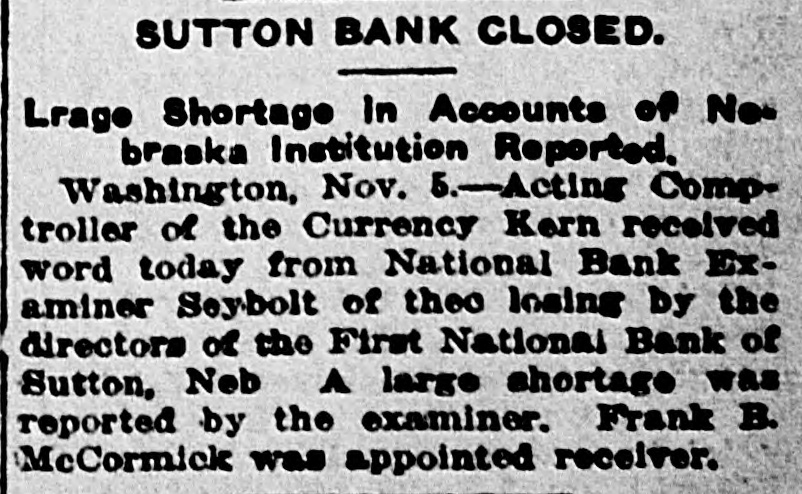
SUTTON BANK CLOSED. Lrage Shortage in Accounts of No. braska Institution Reported. Washington, Nov. 5.-Acting Comptroller of the Currency Kern received word today from National Bank Examiner Soybolt of theo losing by the directors of the First National Bank of Sutton, Neb A large shortage was reported by the examiner. Frank B. McCormick was appointed receiver.


Article from The Topeka State Journal, November 5, 1913

Click image to open full size in new tab

Article Text

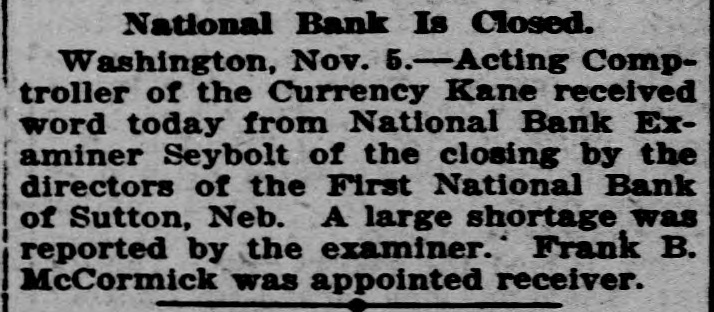
National Bank Is Closed. Washington, Nov. 5.-Acting Comptroller of the Currency Kane received word today from National Bank Examiner Seybolt of the closing by the directors of the First National Bank of Sutton, Neb. A large shortage was reported by the examiner. Frank B. McCormick was appointed receiver.


Article from Newark Evening Star and Newark Advertiser, November 5, 1913

Click image to open full size in new tab

Article Text

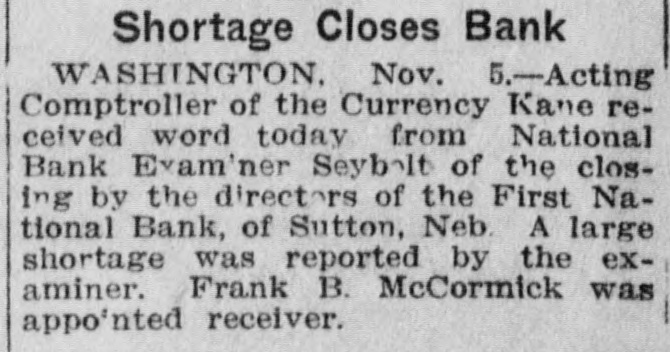
Shortage Closes Bank WASHINGTON, Nov. 5.-Acting Comptroller of the Currency Kane received word today from National Bank Exam'ner Seybolt of the closing by the directors of the First National Bank, of Sutton, Neb. A large shortage was reported by the examiner. Frank B. McCormick was appointed receiver.


Article from The Washington Times, November 5, 1913

Click image to open full size in new tab

Article Text

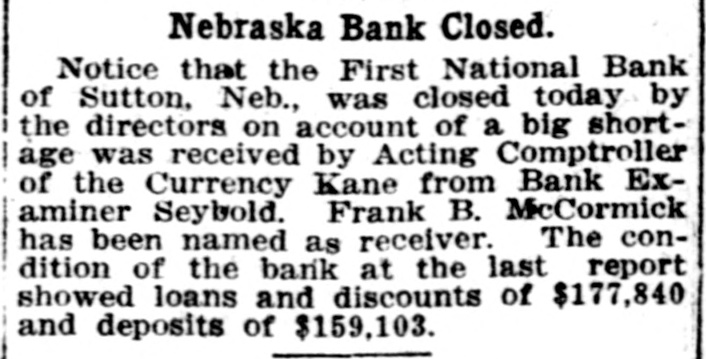
Nebraska Bank Closed. Notice that the First National Bank of Sutton, Neb., was closed today by the directors on account of a big shortage was received by Acting Comptroller of the Currency Kane from Bank Examiner Seybold. Frank B. McCormick has been named as receiver. The condition of the bank at the last report showed loans and discounts of $177,840 and deposits of $159,103.


Article from The Daily Banner, November 6, 1913

Click image to open full size in new tab

Article Text

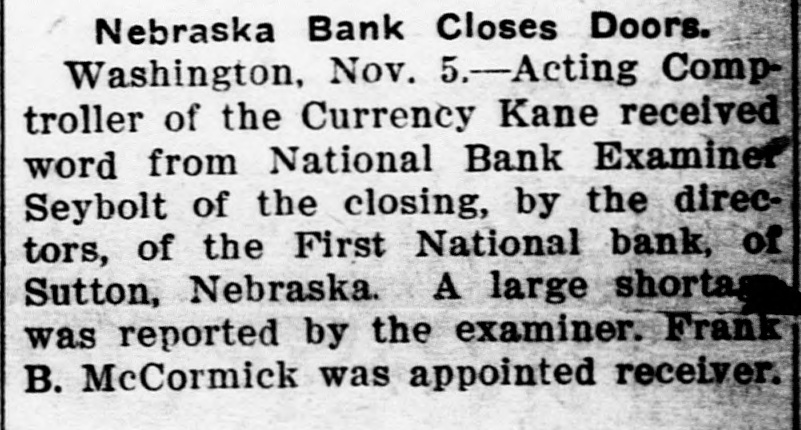
Nebraska Bank Closes Doors. Washington, Nov. 5.-Acting Comptroller of the Currency Kane received word from National Bank Examinet Seybolt of the closing, by the directors, of the First National bank, of Sutton, Nebraska. A large shorta was reported by the examiner. Frank B. McCormick was appointed receiver.


Article from The Washington Herald, November 6, 1913

Click image to open full size in new tab

Article Text

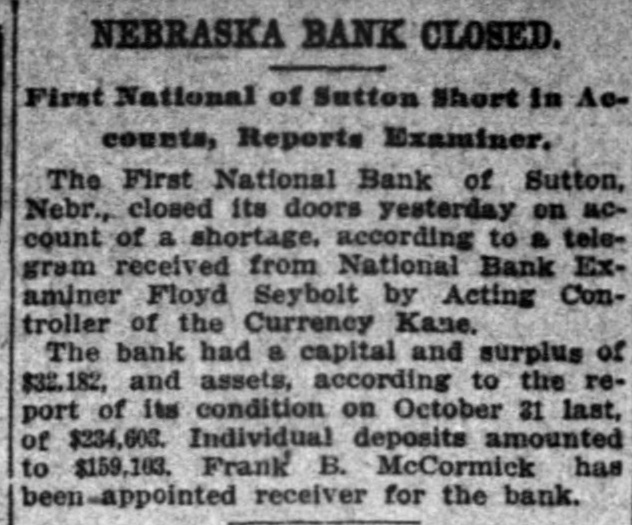
NEBRASKA BANK CLOSED. First National of Sutton Short in Accounts, Reports Examiner. The First National Bank of Sutton, Nebr., closed its doors yesterday on account of a shortage, according to & telegram received from National Bank Examiner Floyd Seybolt by Acting Controller of the Currency Kane. The bank had & capital and surplus of $32.182, and assets, according to the report of its condition on October 31 last, of $234,603. Individual deposits amounted to $159,103. Frank B. McCormick has been-appointed receiver for the bank.


Article from Omaha Daily Bee, November 15, 1914

Click image to open full size in new tab

Article Text

# WOULD QUASH INDICTMENT Counsel for Thomas H. Matters Seek Abatement of Charges. # JURY IS ALLEGED ILLEGAL Plea on Legal Technicality is Set Aside for Consideration by Judge Morris Until Week from Monday. Thomas H. Matters' case was taken up before Federal Judge Paige Morris when ex-Senator Burkett and W. J. Connell, representing Mr. Matters, offered a motion of abatement in an effort to quash the indictment. Connell for the defense asserted that the grand jury which brought the indictment was drawn illegally owing to the fact that the deputy clerk at Lincoln drew the jurors, when the law declares that the clerk himself must perform this act. Judge Morris did not agree with the defense on this point insofar as sustaining their plea in entirety, but put the case over until a week from next Monday. Matters' attorneys have been arguing ever since the case has been taken up that United States Attorney Howell did not have the books of the bank at Sutton and the papers relative to the case at their disposal for examination. Howell stated in court that everything relative to the case had been in his office for weeks, and on application Matters and his attorneys might peruse them at their leisure. "Your honor, this is merely a sfubterfuge to continue this case, and I don't want to see this ball game called on account of rain when there is no rain," argued Howell. "I am willing this case comes to trial next Monday if the defense guarantees that it will make no effort to continue it." "No, you bet we won't," inserted Mntters, "You don't get me that way." Federal Judge Morris finally set the date for a week from Monday, and instructed Howell to write the receiver at the First National bank of Sutton to send every scrap of paper relative to the books and case, at once, to the United States attorney's office. "Gentlemen," concluded Judge Morris, "this will give all a concerned a chance to straighten this book argument. I set th's case for a week from Monday and you can count that there will be not many rain checks issued by this court at that time unless it's raining very hard."


Article from Omaha Daily Bee, February 10, 1915

Click image to open full size in new tab

Article Text

JURY SELECTED TO TRY T. H. MATTERS Omaha Attorney Before Federal Court on Charge of Complicity in Looting of Sutton Bank. FEW CHALLENGES EMPLOYED With a jury chosen from a special panel of forty men, the criminal prosecution of Attorney Thomas H. Matters of Omaha, formerly of Harvard, will begin at 9 o'clock this morning in federal court before District Judge Frank A. Youmans of Fort Smith, Ark. Matters is charged in federal grand jury indictments with having aided President Melchior L. Luben, president of the First National bank of Sutton, in Issuing certificates of dewithout authority and misapfunds of the posit plying bank, which later went into the hands.of a receiver. Grand Jury Overruled. case mediate Attack Judge Youmans trial on yesterday. ordered the after denying to im defense for a to term of court motions the April of the and continuance to quash that the charges on the alleged grounds they had been brought by a grand jury, the drawing of which had been technically defective. In presiding at the selection of jurors, which began at 2:30 p. m., the judge urged the lawyers to be as speedy as possible. He continued the afternoon session without recess until after 6 o'clock, and ordered the trial to start half an hour earlier this morning than court usually convenes. He also gave notice that court would hold all day Saturday. The jurors chosen were: J. G. Benedict, West Point, farmer. W. F. Roseman, Fremont, retired dentist, aged 74. Charles G. Edmonds, 2720 Pratt street, Omaha, packing house workman. H. F. Kohlmeler, Wakefield, general merchant. James Girard, Schuyler, general merchant. Melvin Ellison, Elgin, farmer. E. F. Gibbs, Newcastle, live stock and real estate dealer. M. E. Kerl, West Point, hardware merchant. Ernest Deitrich, Dodge, blacksmith. John G. Ashley, Decatur, stockman. William Arndt, Columbus, retired farmer, Frank Wurdeman, Creston, farmer. Questions Put to Jurors. In examining the jurora as to their qualifications for service attorneys for both sides asked many questions respecting the particular features concerned in the case. Among them were such as these: "Are you a/man of family? "Have you a son?' "Have /you ever lost money through bank failures?' Did you ever work for the Union Pacific? (for which road Matters has been mentioned as special/coinsel), "Do you know George B. Darr? (who has been mentioned in connection with the Matters case), "Have you adquaintances in or around Sutton?" "Are you of German extraction? Has the indictment, or the defendant's other litigation or his efforts continue the case or quash the charges, prejudiced you in any way? Ten Peremptory Challenges. Twenty-four prospective jurors out of the special panel of forty were examined, before both sides were satisfied. Two men, J. M Balley, a Benson carpenter, and Alfred Bowman, a Craig farmer, were challenged and excused for cause, because they said the reading of the grand jury's Indictments or charges against matters had caused them to form opinions, which would place a burden upon the defense to dislodge. The defense used only seven of its ten per-emptory challenges, and the government employed only three of the six it was entitled to. One of the former was exercised against W. D. Schaal, a farmer from near Meadow, who had served as state senator in 1907 and 1909 and knew ex-United States Senator Elmer J. Burkett, of counsel for the defense. E. F. Gibbs of Newcastle was accepted by both sides, although he said he had friends who had lost money in bank failures.
Article from Omaha Daily Bee, March 30, 1915

Click image to open full size in new tab

Article Text

T. H. MATTERS IS SENTENCED TO SIX YEARS IN PRISON Judge Frank A. Youmans Overrules Motions in Arrest of Judgment and for New Trial. SENTENCED ON ALL COUNTS But Entire Nineteen Will Run Concurrently Making Total Time to Be Served Six Years. WILL GO TO COURT OF APPEALS Six years in the federal penitent'ary at Leavenworth, Kan., was the H. court sentence Matters in imposed federal upon Thomas Monday afternoon, after Judge Frank A. Youmans had overruled his motions in arrest of judgment and for a new trial. Matters was recently convicted by a jury of violation of the National banking laws in connection with the First National bank of Sutton, which afterwards failed. He will appeal the case. The sentence as pronounced by the judge was for six years' confinement on each of the nineteen counts on which Matters was found guilty, a total of 114 years, but by order of the court, the nineteen terms of six years each will run concurrently, so that the time Matters must serve totals only six years. Under the law, the penalty is fixed at from five to ten years. Matters is now 57 years of age. By special order of the court, agreed to by F. S. the a stay Howell, United execution who States prosecuted of District sentence Attorney case, of was granted until to Matters' lawyers to their bill June time 1, in prepare order give lengthy of exceptions and error to the States in and making file the appeal supersedeas assignment bond United necessary of circuit court of appeals. Appearance Bond Furnished. An bond under order staying of the the appearance execution immediately judgment the of court was furnished by was sum of Matters. signed by It Henry M. in Browning the and $5,000. Clinton J. Sutphen, both of Omaha. The supersedeas bond on appeal will probably be of the/same amount to be decided by Judge Youmans, June 1, when he allows the bill of exceptions for appeal. Just before Matters was sentenced, his only son, Attorney Thomas H. Matters, jr., made an appeal to the court to take life as into consideration and Matters' a true father record a hard worker and to make the as as in view of Matters' of a wife, husband, light age and his and possible, family, comprised sentence and a son. The only Miss member Helen three daughters Matters, of the family present was a daughter, who wept during her brother's appeal for their father. Receives Sentence. The convicted man himself then stepped before Judge Youmans, stood erect and unflinching and received his sentence without a word or gesture. H then helped to his bond. L. Luebben of President arrange who M. the defunct bank, was indicted as the Matters was deals in which principal prose- in cuted as an aider and abettor. has not yet He was the against chief been to witness be tried. Matters, government's and is now said ready to plead guilty and throw on of the in both offenses himself charged the leniency indictments court. con- The issuance and cerned ficates of unauthorized deposit misapplication of certi- of the funds raised thereby lived at Neb., Matters, and formerly Harvard, was attorney for the Sutton bank. Many Allegations. Over 150 allegations were made by Matas grounds for a new consumed most of the ters' and argument. they counsel day trial, in Among the in the conduct of Irregularities in being allowed allegations the jurors, were: to read newspapers and to telephone home; of giving and letters tions the court and and in refusing errors instrucin admitting and excluding It asserted rious pieces that of testimony. was also vathe jury's verdict was con(Continued on Page Three, Col. Three.) mh


Article from Omaha Daily Bee, April 3, 1915

Click image to open full size in new tab

Article Text

# FILE AMENDED ANSWER TO # SUIT STARTED BY MATTERS An echo of the recent trial and convic- tion of Thomas H. Matters in federal court is brought up by the filing of an amended answer to a civil suit started some time ago by Matters against Frank R. McCormick, receiver of the bank. The National Surety company, bondsman for the receiver, in an amended separate an- swer to the civil suit, disputes Matters' original claim that the First National bank of Sutton owed him about $30,000 when it failed, and makes counter claims and set-offs totaling $14,000, alleged to be due the bank from Matters.


Article from The Sutton Register, August 11, 1927

Click image to open full size in new tab

Article Text

Bank Closed by the First National Bank $430,246 and deposits