13529. Middletown National Bank (Middletown, NY)

Bank Information

Episode Type
Suspension โ†’ Closure
Bank Type
national
Bank ID
1276
Charter Number
1276
Start Date
November 28, 1884
Location
Middletown, New York (41.445, -74.424)

Metadata

Model
gpt-5-mini
Short Digest
133e16474509a32d

Response Measures

None

Receivership Details

Depositor recovery rate
100.0%
Date receivership started
1884-11-29
Date receivership terminated
1893-03-29
OCC cause of failure
Excessive lending
Share of assets assessed as good
73.1%
Share of assets assessed as doubtful
6.5%
Share of assets assessed as worthless
20.3%

Description

The Middletown National Bank suspended/closed on Nov 28, 1884 due to irregular acceptances/advances by President Thomas King (speculation with B. D. Brown). A bank examiner took charge and the Controller placed the affairs in the hands of a receiver (receiver appointed Dec 2, 1884). There was a separate, slight run on the local Savings Bank (depositors withdrew $20kโ€“$26k), but that was a distinct institution and remained solvent. Classified as suspension_closure because the national bank suspended and was placed in receivership.

Events (5)

1. June 14, 1865 Chartered
Source
historical_nic
2. November 28, 1884 Other
Newspaper Excerpt
A slight run occurred at the Middletown Savings Bank to-day. $20,000 was drawn. Later accounts report $26,000 withdrawn; the run ended and the savings bank remained able to meet demands.
Source
newspapers
3. November 28, 1884 Suspension
Cause
Bank Specific Adverse Info
Cause Details
President Thomas King accepted large unsecured drafts/acceptances for grain dealer B. D. Brown, concealing transactions; irregular loans/acceptances wiped out capital and surplus.
Newspaper Excerpt
The Middletown National Bank has failed; its doors are closed this morning. The failure was caused by its president, Thomas King, who accepted large drafts from Benjamin D. Brown ...
Source
newspapers
4. November 29, 1884 Receivership
Source
historical_nic
5. December 2, 1884 Receivership
Newspaper Excerpt
A. W. Blye, of Syracuse, has been appointed receiver of the Middletown National Bank. He took possession this morning.
Source
newspapers

Newspaper Articles (21)

Article from Evening Star, November 28, 1884

Click image to open full size in new tab

Article Text

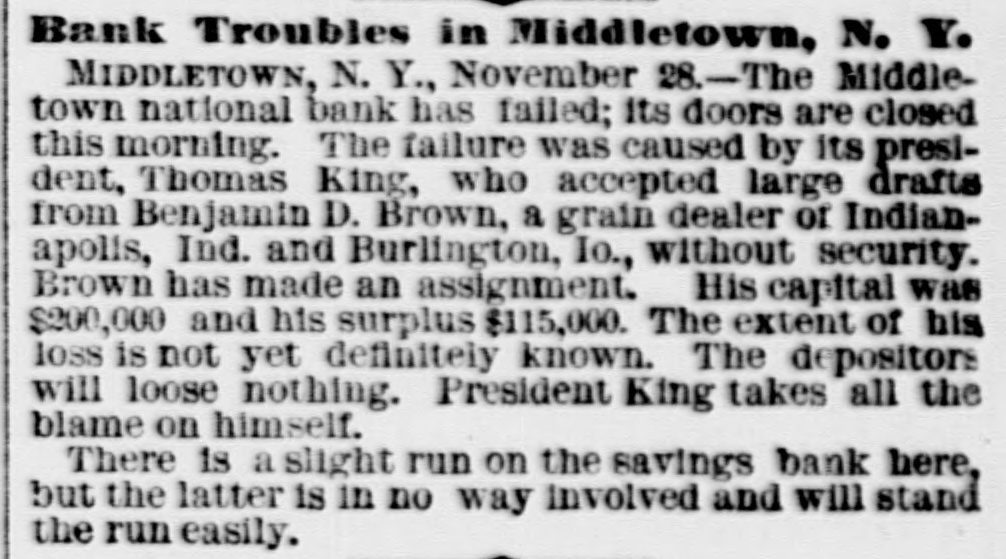
Bank Troubles in Middletown, N. Y. MIDDLETOWN, N. Y., November 28.-The Middletown national bank has failed; its doors are closed this morning. The failure was caused by its president, Thomas King, who accepted large drafts from Benjamin D. Brown, a grain dealer or Indianapolis, Ind. and Burlington, Io., without security. Brown has made an assignment. His capital was $200,000 and his surplus $115,000. The extent of his loss is not yet defluitely known. The depositors will loose nothing. President King takes all the blame on himself. There is a slight run on the savings bank here, but the latter is in no way involved and will stand the run easily.


Article from The Evening Critic, November 28, 1884

Click image to open full size in new tab

Article Text

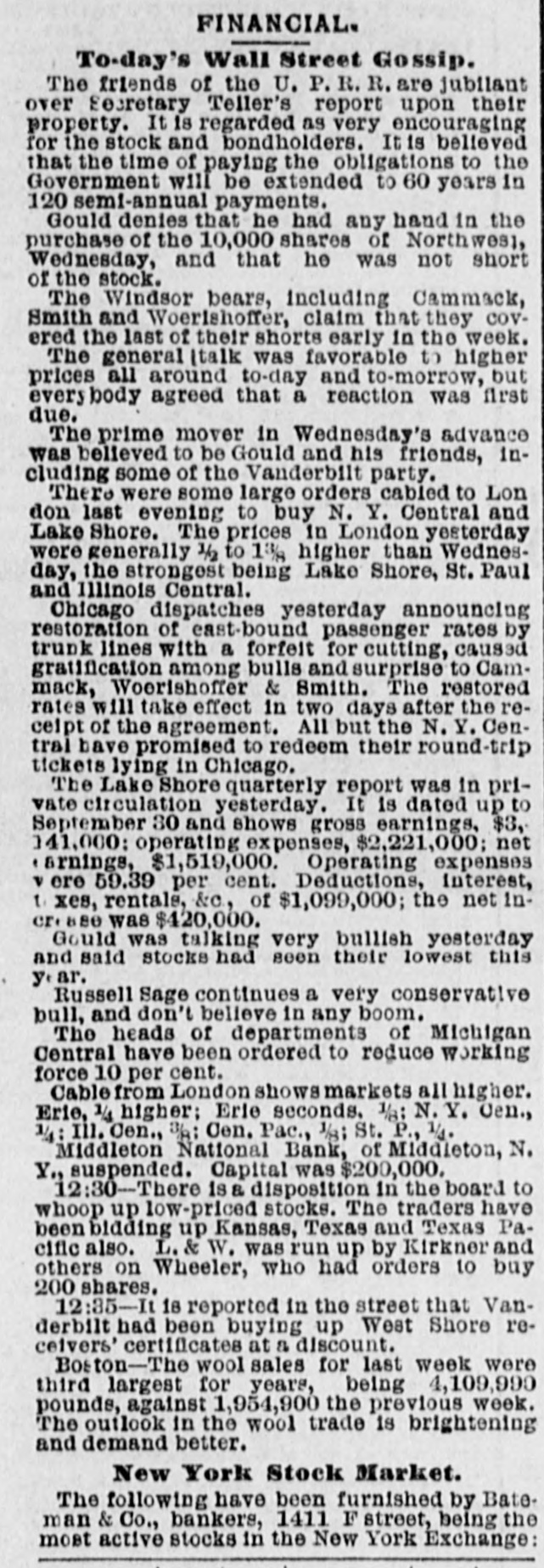
FINANCIAL. To-day's Wall Street Gossip. The friends of the U. P. R. R. are jubilant over Secretary Teller's report upon their property. It 18 regarded as very encouraging for the stock and bondholders. It is believed that the time of paying the obligations to the Government will be extended to 60 years in 120 semi-annual payments. Gould denies that he had any hand in the purchase of the 10,000 shares of Northwesi, Wednesday, and that he was not short of the stock. The Windsor bears, including Cammack, Smith and Woerishoffer, claim that they covered the last of their shorts early in the week. The general Italk was favorable to higher prices all around to-day and to-morrow, but every body agreed that a reaction was first due. The prime mover in Wednesday's advance was believed to be Gould and his friends, including some of the Vanderbilt party. There were some large orders cabled to Lon don last evening to buy N. Y. Central and Lake Shore. The prices in London yesterday were generally 1/2 to 13/8 higher than Wednesday, the strongest being Lake Shore, St. Paul and Illinois Central. Chicago dispatches yesterday announcing restoration of east-bound passenger rates by trunk lines with a forfeit for cutting, caused gratification among bulls and surprise to Cammack, Woerishoffer & Smith. The restored rates will take effect in two days after the receipt of the agreement. All but the N. Y. Central have promised to redeem their round-trip tickets lying in Chicago. The Lake Shore quarterly report was in private circulation yesterday. It is dated up to September 30 and shows gross earnings, $3, 141,000: operating expenses, $2,221,000; net arnings, $1,519,000. Operating expenses V ere 59.39 per cent. Deductions, Interest, 1. xes, rentals, &c, of $1,099,000; the net Incr. 880 was $420,000. Gould was talking very bullish yesterday and said stocks had seen their lowest this y. ar. Russell Sage continues a very conservative bull, and don't believe in any boom. The heads of departments of Michigan Central have been ordered to reduce working force 10 per cent. Cable from London shows markets all higher. Erie, 1/4 higher; Erie seconds. 1/8; N. Y. Cen., 1/4; Ill. Cen., %; Cen. Pac., 1/8; St. P., 1/1. Middleton National Bank, of Middleton, N. y., suspended. Capital was $200,000. 12:30-There is & disposition in the board to whoop up low-priced stocks. The traders have been bldding up Kansas, Texas and Texas Pacific also. L. & W. was run up by Kirkner and others on Wheeler, who had orders to buy 200 shares. 12:35-It 18 reported in the street that Vanderbilt had been buying up West Shore receivers' certificates at a discount. Boston-The wool sales for last week were third largest for years, being 4,109,990 pounds, against 1,954,900 the previous week. The outlook in the wool trade is brightening and demand better. New York Stock Market. The following have been furnished by Bateman & Co., bankers, 1411 F street, being the most active stocks in the New York Exchange:


Article from Alexandria Gazette, November 28, 1884

Click image to open full size in new tab

Article Text

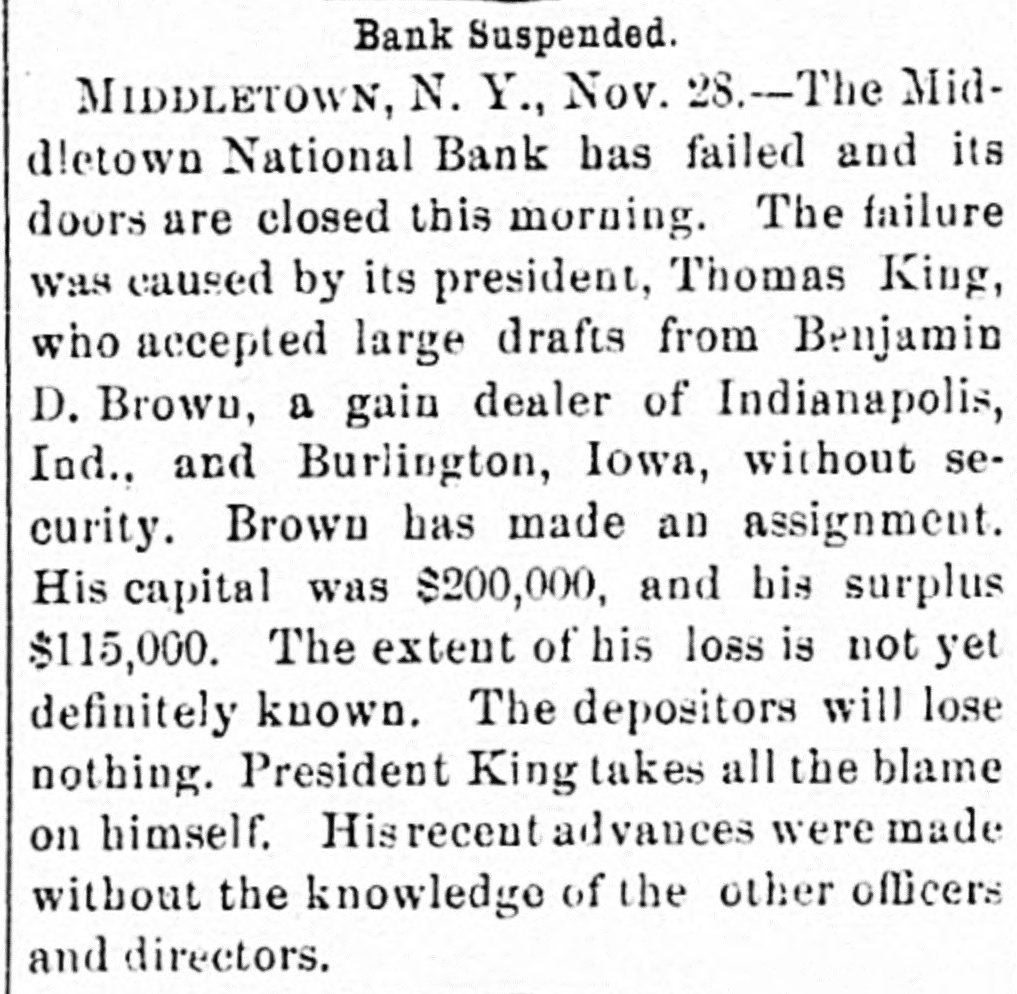
Bank Suspended. MIDDLETOWN, N. Y., Nov. 28.-The Middletown National Bank has failed and its doors are closed this morning. The failure was caused by its president, Thomas King, who accepted large drafts from Benjamin D. Brown, a gain dealer of Indianapolis, Ind., and Burlington, Iowa, without security. Brown has made an assignment. His capital was $200,000, and his surplus $115,000. The extent of his loss is not yet definitely known. The depositors will lose nothing. President King takes all the blame on himself. Hisrecent advances were made without the knowledge of the other officers and directors.


Article from Daily Kennebec Journal, November 29, 1884

Click image to open full size in new tab

Article Text

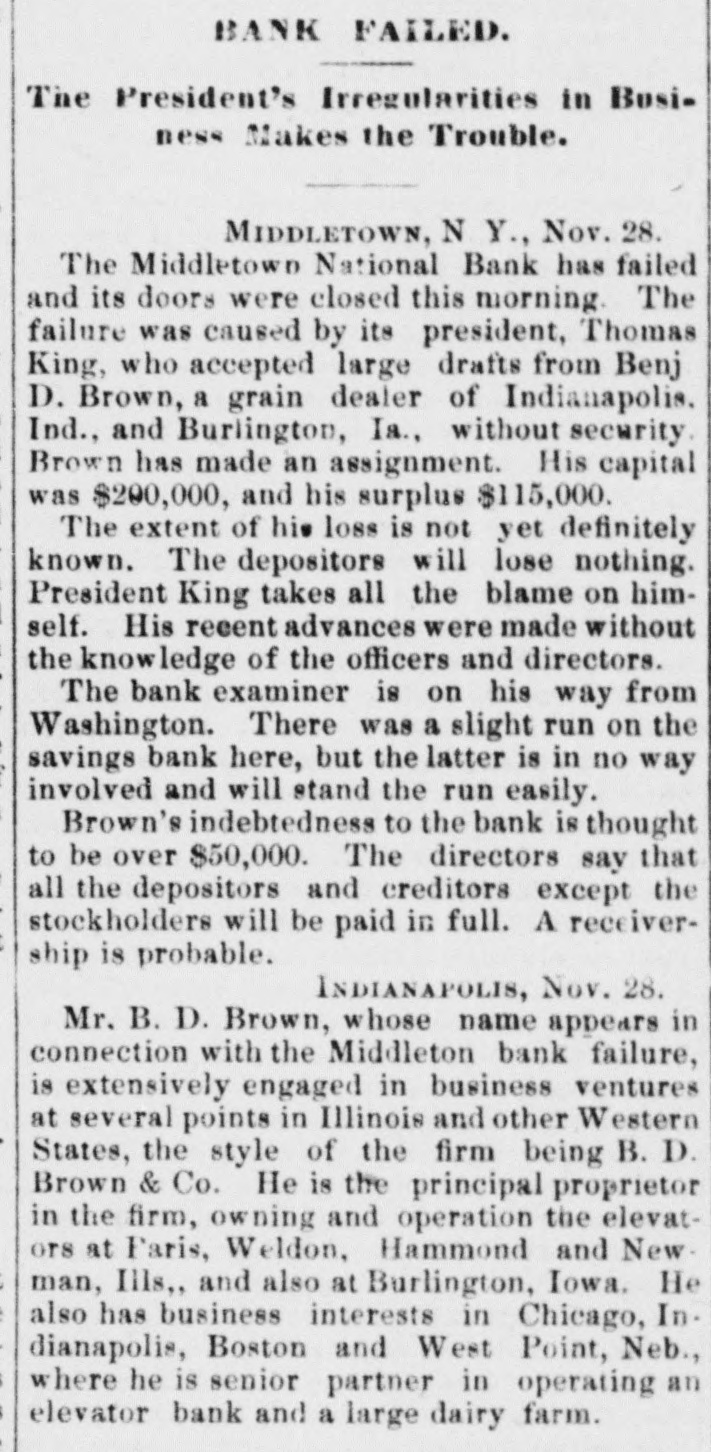
BANK FAILED. The President's Irregularities in Business Makes the Trouble. MIDDLETOWN, N Y., Nov. 28. The Middletown National Bank has failed and its doors were closed this morning. The failure was caused by its president, Thomas King, who accepted large drafts from Benj D. Brown, a grain dealer of Indianapolis. Ind., and Burlington, Ia., without security Brown has made an assignment. His capital was $200,000, and his surplus $115,000. The extent of his loss is not yet definitely known. The depositors will lose nothing. President King takes all the blame on himself. His recent advances were made without the knowledge of the officers and directors. The bank examiner is on his way from Washington. There was a slight run on the savings bank here, but the latter is in no way involved and will stand the run easily. Brown's indebtedness to the bank is thought to be over $50,000. The directors say that all the depositors and creditors except the stockholders will be paid in full. A receivership is probable. INDIANAPOLIS, Nov. 28. Mr. B. D. Brown, whose name appears in connection with the Middleton bank failure, is extensively engaged in business ventures at several points in Illinois and other Western States, the style of the firm being B. D. Brown & Co. He is the principal proprietor in the firm, owning and operation the elevators at Paris, Weldon, Hammond and New man, Ills,, and also at Burlington, Iowa. He also has business interests in Chicago, In. dianapolis, Boston and West Point, Neb., where he is senior partner in operating an elevator bank and a large dairy farm.


Article from Savannah Morning News, November 29, 1884

Click image to open full size in new tab

Article Text

a 1 ITS PRESIDENTS MISPLACED CONFIDENCE THE CAUSE, Disobedience of the Admonition of the Directors Gives the Affair a Bad Coloring- The Erring Officer Infatuated with a Bold Speculator-Many Thousands in Concealed Acceptances. MIDDLETOWN, N. Y., Nov. 28.-The Middletown National Bank has failed and its doors were closed this morning. The failure was caused by its President, Thomas King, who accepted large drafts from Benjamin D. Brown, a grain dealer of Indianapolis, Ind., and Burlington, Iowa, without security. Mr. Brown has made an assignment. The capital was The $200,000, and its surplus $115,000. extent of his loss IS not yet definitely known. Depositors will lose nothing. President King takes all the blame made on himself. His recent advances were other without the knowledge of the officers and directors of the bank. An is his way from Washington. was a slight run on the banks here, but the latter is in no way There examiner easily. savings involved and will stand the run President King was considered one of ablest financiers in the country, and the the the bank was looked upon as one of most The solid run, in which the State. started on the savings quieted down when despositors bank, found that their money was forthcoming. The directors had announced that all demands would be met. The American Loan in and Trust Company sent up $30,000 Bank currency, and the First National also Bank helped. Examiner May arrived here at and the following notice was dis- of noon, played: "This bank is in the hands national bank examiners. No business mawill be done except the collection of tured All the paper.". banks in the county have slight being balances on collections, the highest with Bank, of Newburg, All these will be $3,000. the Highland paid. bank petitioned The board of directors of the the Comp- have of the troller unanimously Currency receiver. to Mr. apMoses D. Stivers and point Stivers is senior editor of the Press, Internal 14 years was Collector of New for Revenue of the Eleventh district of York. Houston & Conkling. dealers in grain a millers, and C. C. N. Ketchum, and wholesale grain dealer, have made firms had assignfor large amounts. Both They ments indorsed Brown's notes heavily. There are have made no statements. many rumors of other losers. THE BANK EXAMINER IN CHARGE. Bank Examiner George T. May, of the of Washington, is now in possession notified bank. In July last the directors credit King that Mr. Brown's Mr. President not be extended, but reduced. must King disobeyed the instructions, and of the the has gone under. The record the bank of Mr. Brown's drafts on a were kept by President which-he kept in his own book concealed from the other and bank acceptances officers. King possession of such in So far known more than $200,000 of as are out. It is the opinion acceptances best informed that the entire will-be capital the surplus of the institution and out. The directors are County Senwiped John G. Wilkin, United States D. C. ator Judge Van Wyek of Nebraska, Col. Dusenberry, Hon. W. H. Clark, Horatio PresiWilcox, A. H. Vail, U.T. Hayes, Corwin. dent R. King and Cashier Daniel C. resulted in run on the savings bank bank $20,000 The being paid out to-day. The is solvent and ready for any emergency. It President King is at his by thought here that he has profited infatuis not transactions, but that he was operthe with Mr. Brown. The latter's much ated ations have been very heavy, as handled as $500,000 of hispaper having been by the bank in a single week. COMPTROLLER CANNON'S ACTION. WASHINGTON, Nov. 28.-Mr. Cannon, to-day of the Currency, said to the Comptroller answer to inquiries in regard Bank, in the Middletown National N.Y., that he of in the bank last failure Middletown, trouble of special Wednesday examiner learned of the and ordered a take evening, to the bank at once and said of it. The Comptroller in July the report of the to charge proceed the examiner King, also that on was discovered that from was borrowing immedilast President, bank. it The directors indebtedness were largely of the notified that the to com- Mr. ately should be reduced to a point was subwith the law. Information been ply received that this had under sequently The Comptroller, however, being done. that the bank was not directthe belief managed, notified the be its coarter would not expire ors as the charter ed, few months (May, 1885), judiciously in a and that that, liquidate would steps its indebted- extend- should be at once The taken Comptroller to said, further. Mr. King, that ness. through the action of recently, has been crippled very serious the think there would be unless, he did bank not failure. loss to the public through its INSOLVENTS ARRESTED. CANTON, MISS., Nov. Stadeker -Alfonzo & Son, Stadeker, of the Nov. firm 15 of for J. $100,000 with assets which of failed $25,000, the firm, and were his brother arrested Henry, to-day late the on clerk for of conspiracy to defraud concealcreditors a charge of and Stadeker other assets & Son of by the firm. for They ing goods were admitted to bail to appear examination Tuesday. ILLINOIS BANK IN TROUBLE. AN ILL., Nov. 28.-The its doors First CARLINVILLE. Bank of this city closed arrangeNational the purpose of making to-day ments to for go into liquidation. Depositors will be paid in full. TOTAL OF THE WEEK. THE Nov. 28.-The business NEW occurring YORK, throughout the Mercan- counfailures to R. G. Dun Co.'s week in try tile reported Agency number for the last
Article from New-York Tribune, November 29, 1884

Click image to open full size in new tab

Article Text

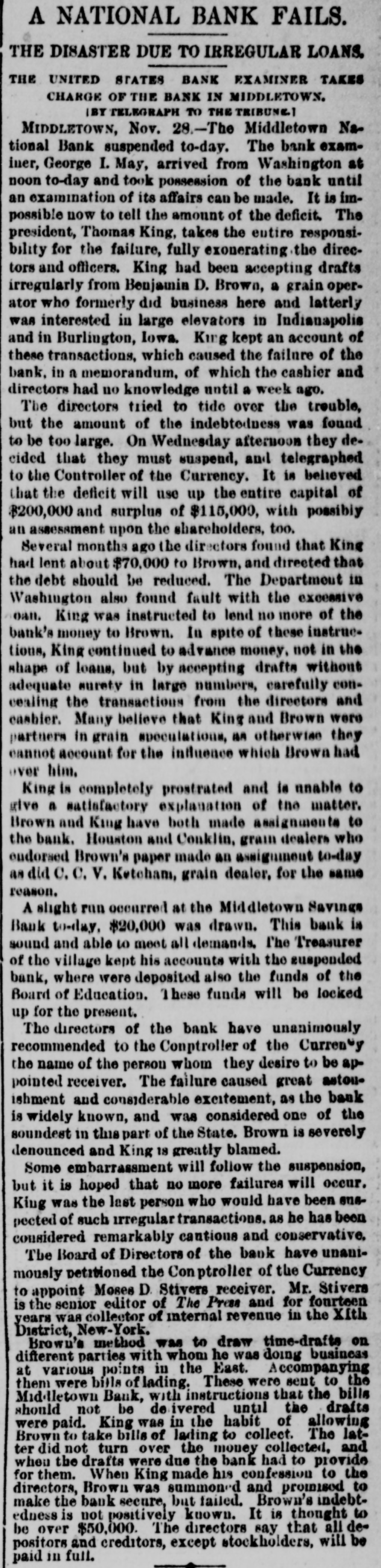
A NATIONAL BANK FAILS. THE DISASTER DUE TO IRREGULAR LOANS. THE UNITED STATES BANK EXAMINER TAKES CHARGE OF THE BANK IN MIDDLETOWN. IBY TELEGRAPH TO THE TRIBUNG) MIDDLETOWN, Nov. 28.-The Middletown Na. tional Bank suspended to-day. The bank examiner, George I. May, arrived from Washington at noon to-day and took possession of the bank until an examination of its affairs can be made. It is impossible now to tell the amount of the deficit. The president, Thomas King, takes the entire responsibility for the failure, fully exonerating the directors and officers. King had been accepting drafts irregularly from Benjamin D. Brown, a grain operator who formerly did business here and latterly was interested in large elevators in Indianapolis and in Burlington, Iowa. King kept an account of these transactions, which caused the failure of the bank, in a memorandum. of which the cashier and directors had no knowledge until a week ago. The directors tried to tide over the trouble, but the amount of the indebtedness was found to be too large. On Wednesday afternoon they decided that they must suspend, and telegraphed to the Controller of the Currency. It is believed that the deficit will use up the entire capital of $200,000 and surplus of $115,000, with possibly an assessment upon the shareholders, too. Several months ago the directors found that King had lent about $70,000 to Brown, and directed that the debt should be reduced. The Department in Washington also found fault with the excessive oan. King was instructed to lend no more of the bank's money to Brown. In spite of these instructions, King continued to advance money, not in the shape of loans, but by accepting drafts without adequate surety in large numbers, carefully concealing the transactions from the directors and cashier. Many believe that King and Brown were partners in grain speculations, as otherwise they cannot account for the influence which Brown had over him. King is completely prostrated and is unable to give a satisfactory explanation of the matter. Brown and King have both made assignments to the bank. Houston and Conklin, grain dealers who endorsed Brown's paper made an assignment to-day as did c. c. V. Ketcham, Krain doaler, for the same reason. A slight run occurred at the Middletown Savings Bank to-day. $20,000 was drawn. This bank is sound and able to meet all demands. The Treasurer of the village kept his accounts with the suspended bank, where were deposited also the funds of the Board of Education. These funds will be locked up for the present. The directors of the bank have unanimously recommended to the Conptroller of the Currency the name of the person whom they desire to be appointed receiver. The failure caused great astou. ishment and considerable excitement, as the bank is widely known, and was considered one of the soundest in this part of the State. Brown is severely denounced and King 18 greatly blamed. Some embarrassment will follow the suspension, but it is hoped that no more failures will occur. King was the last person who would have been onepeeted of such irregular transactions. as he has been considered remarkably cantious and conservative. The Board of Directors of the bank have unanimously petitioned the Conptroller of the Currency to appoint Moses D. Stivers receiver. Mr. Stivers is the senior editor of The Press and for fourteen years was collector of internal revenue in the Xith District, New-York. Brown's method was to draw time-drafts on different parties with whom he was doing business at various points in the East. Accompanying them were bitts of lading. These were sent to the Middletown Bank, with instructions that the bills should not be delivered until the drafts were paid. King was in the habit of allowing Brown to take bills of lading to collect. The latter did not turn over the money collected. and when the drafts were due the bank had to provide for them. When King made his confession to the directors, Brown was summoned and promised to make the bank secure. but failed. Brown's indebteducss is not positively known. It is thought to be over $50,000. The directors say that all depositors and creditors, except stockholders, will be paid in full.


Article from Evening Star, November 29, 1884

Click image to open full size in new tab

Article Text

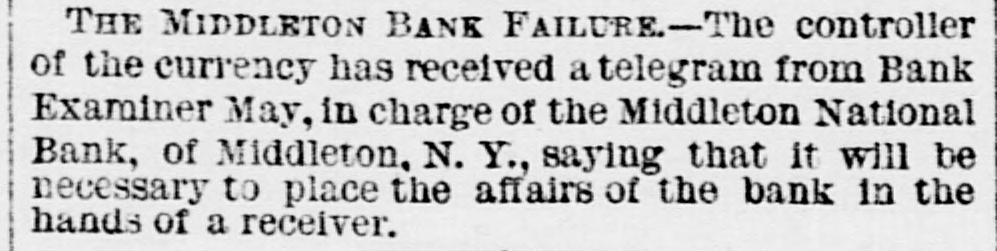
THE MIDDLETON BANK FAILURE-The controller of the currency has received a telegram from Bank Examiner May, in charge of the Middleton National Bank, of Middleton, N. Y., saying that it will be necessary to place the affairs of the bank in the hands of a receiver.


Article from The Wheeling Daily Intelligencer, November 29, 1884

Click image to open full size in new tab

Article Text

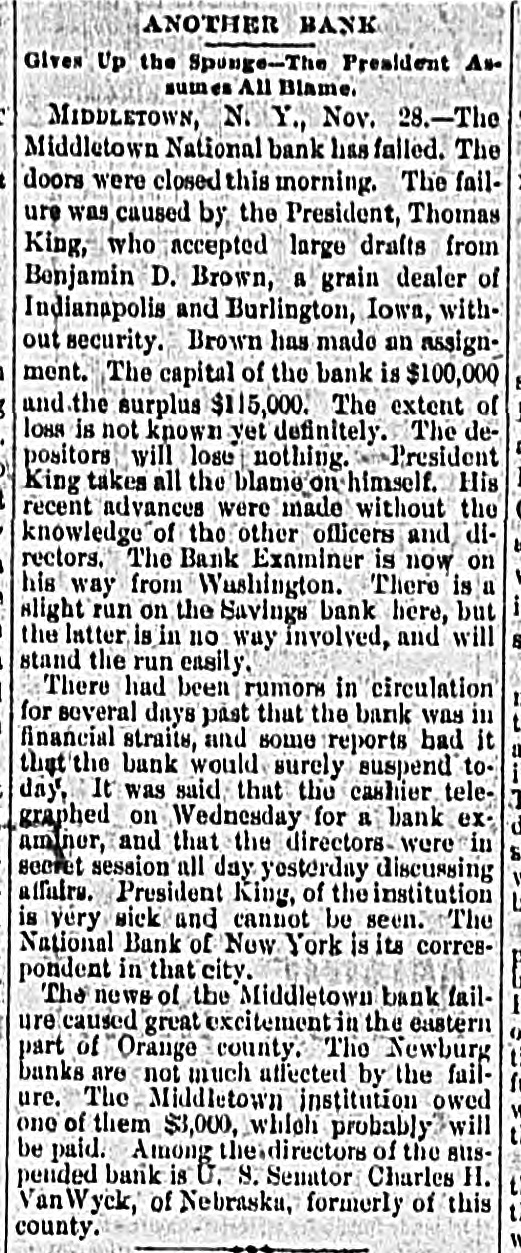
ANOTHER BANK Given Up the Sponge-The President Assumes All Blame. MIDDLETOWN, N. Y., Nov. 28.-The Middletown National bank has failed. The doors were closed this morning. The failure was caused by the President, Thomas King, who accepted large drafts from Benjamin D. Brown, a grain dealer of Indianapolis and Burlington, Iowa, without security. Brown has made an assignment. The capital of the bank is $100,000 and the surplus $115,000. The extent of loss is not known vet definitely. The depositors will lose nothing. President King takes all the blane on himself. His recent advances were made without the knowledge of the other officers and directors. The Bank Examiner is now on his way from Washington. There is a slight run on the Savings bank here, but the latter is in no way involved, and will stand the run easily. There had been rumors in circulation for several days past that the bank was in financial straits, and some reports had it that the bank would surely suspend to. day, It was said that the cashier telegraphed on Wednesday for a bank ex amlner, and that the directors were in secret session all day yesterday discussing affairs. President King, of the institution is very sick and cannot be seen. The National Bank of New York is its correspondent in that city. The news of the Middletown bank failure caused great excitement in the eastern part of Orange county. The Newburg banks are not much affected by the failure. The Middletown institution owed one of them $3,000, which probably will be paid. Among the indirectors of the auspended bank is U. S. Senator Charles H. Van Wyck, of Nebraska, formerly of this county.


Article from National Republican, November 29, 1884

Click image to open full size in new tab

Article Text

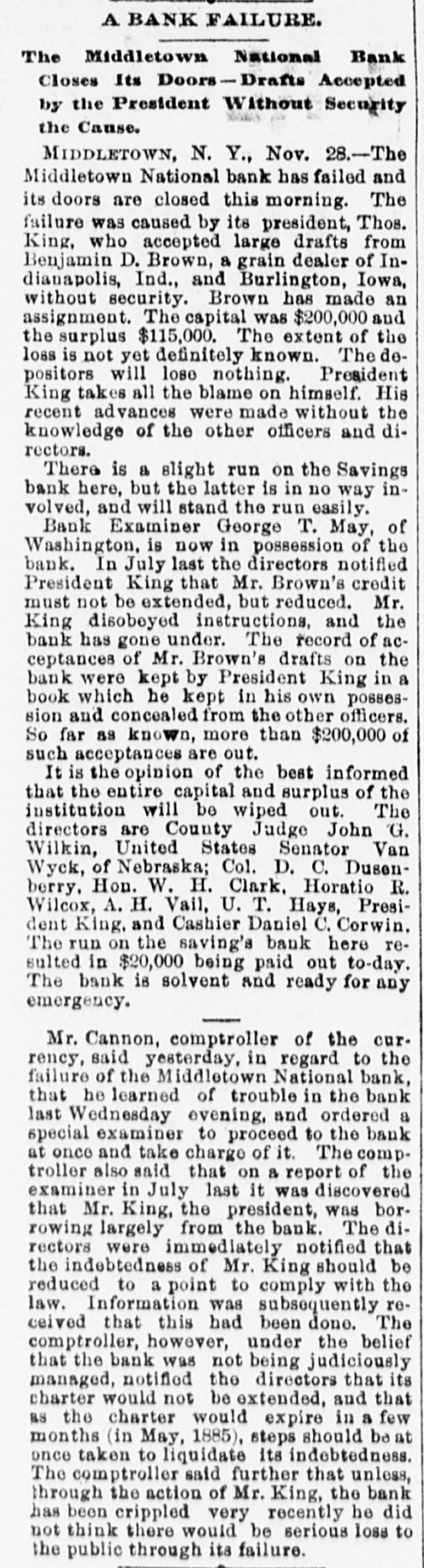
A BANK FAILURE. The Middletown National Bank Closes Its Doors- Drafts Accepted by the President Without Security the Cause. MIDDLETOWN, N. Y., Nov. 28.-The Middletown National bank has failed and its doors are closed this morning. The failure was caused by its president, Thos. King, who accepted large drafts from Benjamin D. Brown, a grain dealer of Indianapolis, Ind., and Burlington, Iowa, without security. Brown has made an assignment. The capital was $200,000 and the surplus $115,000. The extent of the loss is not yet definitely known. The depositors will lose nothing. President King takes all the blame on himself. His recent advances were made without the knowledge of the other officers and directors. There is a slight run on the Savings bank here, but the latter is in no way involved, and will stand the run easily. Bank Examiner George T. May, of Washington, is now in possession of the bank. In July last the directors notified President King that Mr. Brown's credit must not be extended, but reduced. Mr. King disobeyed instructions, and the bank has gone under. The record of acceptances of Mr. Brown's drafts on the bank were kept by President King in a book which he kept in his own possession and concealed from the other officers. So far as known, more than $200,000 of such acceptances are out. It is the opinion of the best informed that the entire capital and surplus of the institution will be wiped out. The directors are County Judge John G. Wilkin, United States Senator Van Wyck, of Nebraska; Col. D. C. Dusenberry. Hon. W. H. Clark, Horatio R. Wilcox, A. H. Vail, U. T. Hays, President King. and Cashier Daniel C. Corwin. The run on the saving's bank here resulted in $20,000 being paid out to-day. The bank is solvent and ready for any emergency. Mr. Cannon, comptroller of the currency, said yesterday, in regard to the failure of the Middletown National bank, that he learned of trouble in the bank last Wednesday evening, and ordered a special examiner to proceed to the bank at once and take charge of it. The comptroller also said that on a report of the examiner in July last it was discovered that Mr. King, the president, was borrowing largely from the bank. The directors were immediately notified that the indebtedness of Mr. King should be reduced to a point to comply with the law. Information was subsequently received that this had been done. The comptroller, however, under the belief that the bank was not being judiciously managed, notified the directors that its charter would not be extended, and that as the charter would expire in a few months (in May, 1885), steps should be at once taken to liquidate its indebtedness. The comptroller said further that unless, through the action of Mr. King, the bank has been crippled very recently he did not think there would be serious loss to the public through its failure.


Article from The Daily Cairo Bulletin, November 29, 1884

Click image to open full size in new tab

Article Text

Takes all the Blame. MIDDLETOWN, N. Y., November 28.The Middletown National Bank closed its doors this morning. The failure was caused by President Thomas King, who accepted a large draft from Benjamin D. Brown, a grain dealer of Indianapolis and Burlington, ,without security. Brown has made an assignment. This bank has a capital of $200,000, and a surplus fund of $115,000. The extent of the loss is not yet known. King takes all the blame on himself. His recent advances were made without the knowledge of the other officers and directors. The Bank Examiner is on the way from Washington. A slight run has occurred on the Savings Bank here, but the latter is in no way involved, and will stand the run easily.


Article from St. Paul Daily Globe, November 29, 1884

Click image to open full size in new tab

Article Text

THE MIDDLETON BANK. A Black Friday for Middleton over the Failure of the Middleton National Bank. A Full Description of the Manner in Which the Man Brown Worked President King. PORT JARVIS, N. Y., Nov. 28.-To-day is a terrible black Friday for Middleton. Ugly rumors were on the streets yesterday. Nothing could be learned, but it was evident big failure was at hand. The bank has a capital stock of $200,000 and a surplus fund of $115,000 The president, Thomas King, was considered one of the ablest financiers of and the was the country, bank the state. looked upon as one of the solidest in No statement is yet published The entire capital and surplus is wiped out. President King is at home completely will no statement except make prostrated. that all blame He was on him. The run on the savings bank quieted down when the depositors found all their money fortheoming. The directors announced all demands will be met. The American Loan and Trust company sent up $30,000 in currency, and the First National also helped. Bank Examiner May arrived at noon and this notice was posted: "Tuis bank is in the hands of the national bank examiner. No business will be done except the cellection of matured papers." All banks in the county have slight balances on collections, the highest being the Highland bank. of Newburg, $3,000. All these will be The that Brown had been borrowing paid. comptroller learned largely in from July the bank and notified the directors that Brown's credit and indebtedness must be reduced at once to a comply with the law, and the point which directors should did. notified At the same time President King was that further credit must not be given Brown. This, it was supposed, was done. But it King has seems given him follows: credit in a private manner as Brown drew time drafts on different parties, with whom he was doing business at various points east. Accompaning them were bills of lading. Those were sent the Middleton bank, with instructions the bills were not to be delivered until the draft was paid. King was in the habit of allowing Brown to take the bill of lading to collect, and did not turn over the money he collected, and when the for dratts came a memorandum them. King due kept the private bank had to provide till of Brown's account, and not he saw ruin staring him in the face did be confess to the directors. This was on Thurs day last week. Brown was and to secure the promised tide bank, summoned but but failed. they Every effort was made to over, were unavailing. Brown's indebtedness is not positively known, though it will be over The directors says and the be $50,000. ereditors except Huston & Conkling, stockholders all depositors dealers will paid in rult. in grain and millers, and C. C. V. Ketcham, wholesale grain dealer, have made an assignment. Both had heavily endorsed Brown's notes. There are many other losers. Brown is a native of Orange county, formerly a miller at Burnside. While here he engaged in wholesale grain He went t built and an operations. an elevator later Indianapolis built the elevator and at Brown was on wrong side market him. The of swamped Burlington. of the and board the of recent directors decline unanithe to appoint the mously Middleton petitioned National Moses comptroller bank Stivers have receiver. of the Mr. senior editor and for was currency fourteen Stivers is years collector of the of Press, internal revenue for the Eleventh district. INDIANAPOLIS, Ind., Nov. 28.-W. H. Baker, in charge of the business of B. D. this is Brown. of point, unable Brown's to furnish any information concerning connection with the Middleton, N.Y., bank failure. The business here is conducted under the name of B. D. Brown, is indeof of which Browg is is cerns pendent in any the other interested, numerous and consaid exin at tensively several to be engaged entirely points solvent. in business Illinois Brown ventures and is at other The B. & Co. in firms western D. states. Brown style of He and the is firm operating principal being at and and at proprietor elevators Newman, Ills., Paris, also owning Weldon, Burlington, Hammond Iowa. He also has business interests in Chicago, Boston and West Point, Neb., where he is senior partner of the firm operating an elevator, a bank and a large dairy farm. Baker knows nothing as to the condition of these but business in that various the enterprises, considerable this city confidently is not oits only asserts credit solvent, but has a sum


Article from The Rock Island Argus, November 29, 1884

Click image to open full size in new tab

Article Text

Another Bank Goes Under. MIDDLETOWN N. Y., Nov. 29.-The Middietown National bank has failed. Its doors were closed Friday morning. The failure was caused by the president, Thomas King, who accepted large drafts from Benjamin D. Brown, a grain dealer of Indianapolis and Burlington, with out security. Brown has made an as signment. The bank's capital is $200,000 and its surplus $115,000. The extent of the loss is not yet known definitely. The depositors will lose nothing. President King takes all the blame on himself. His recent advances were made unknown to the other officers and directors. The bank-examiner is on his way from Washington. A slight run has occurred on the savings bank here, but the latter is in no way involved and will stand the run easily.


Article from Richmond Dispatch, November 29, 1884

Click image to open full size in new tab

Article Text

Bank Failure in Middletown. N. Y. (ky telegraph to the Dispatch.] MIDDLETOWN, N.Y., November 28.-The Middletown National Bank has failed, and its doors are closed this morning. The failure was caused by its president, Thomas King. who accepted large drafts from Benjamin D. Brown. grain-dealer, of Indianapolis, Ind., and Burlington. Iowa, without security. Brown has made an assignment. His capital was $200,000 and bis surplus $115,000. The extent of his loss is not yet definitely known. The depositors will lose nothing. President King takes all the blame on himself. His recent advances were made without the knowledge of the other officers and directors. The Bank Examiner 18 on his way from Washinston. There is a slight run on the Savings Bank bere. but the latter is in no way involved and will stand the run easily. Houston & Conkling, dealers in grain and millers, and C.C.V. Ketchan, wholesale grain dealer. have made assignments for large amounts. Both tirms had endorsed Brown's notes heavily. They have made no statements. There are many rumors of other losers.


Article from Los Angeles Daily Herald, November 29, 1884

Click image to open full size in new tab

Article Text

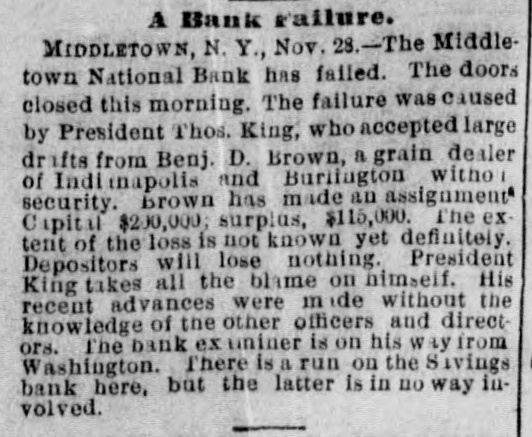
A Bank railure. MIDDLETOWN, N. Y., Nov. 28.-The Middletown National Bank has failed. The doors closed this morning. The failure was caused by President Thos. King, who accepted large drifts from Benj. D. Brown, a grain dealer of Indi thapolis and Burlington witho I security. Brown has made an assignmentยฎ Capital $200,000; surplus, $115,000. The extent of the loss is not known yet definitely. Depositors will lose nothing. President King takes all the blame on himself. His recent advances were m de without the knowledge of the other officers and directors. The bank ex uniner is on his W ay from Washington. There is a run on the S ivings bank here, but the latter is in no way involved.


Article from The Salt Lake Herald, November 29, 1884

Click image to open full size in new tab

Article Text

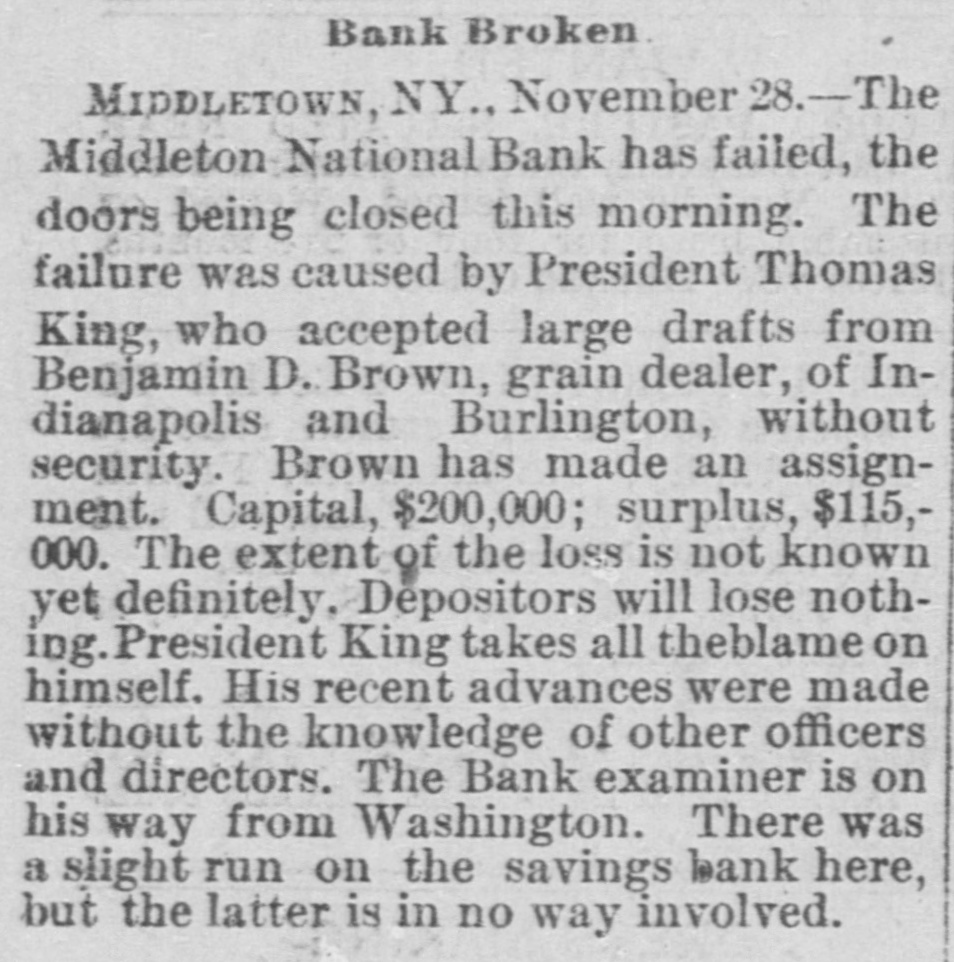
Bank Broken MIDDLETOWN, NY., November 28.-The Middleton National Bank has failed, the doors being closed this morning. The failure was caused by President Thomas King, who accepted large drafts from Benjamin D. Brown, grain dealer, of Indianapolis and Burlington, without security. Brown has made an assignment. Capital, $200,000; surplus, $115,000. The extent of the loss is not known yet definitely. Depositors will lose nothing. President King takes all theblame on himself. His recent advances were made without the knowledge of other officers and directors. The Bank examiner is on his way from Washington. There was a slight run on the savings bank here, but the latter is in no way involved.


Article from Fort Worth Daily Gazette, November 29, 1884

Click image to open full size in new tab

Article Text

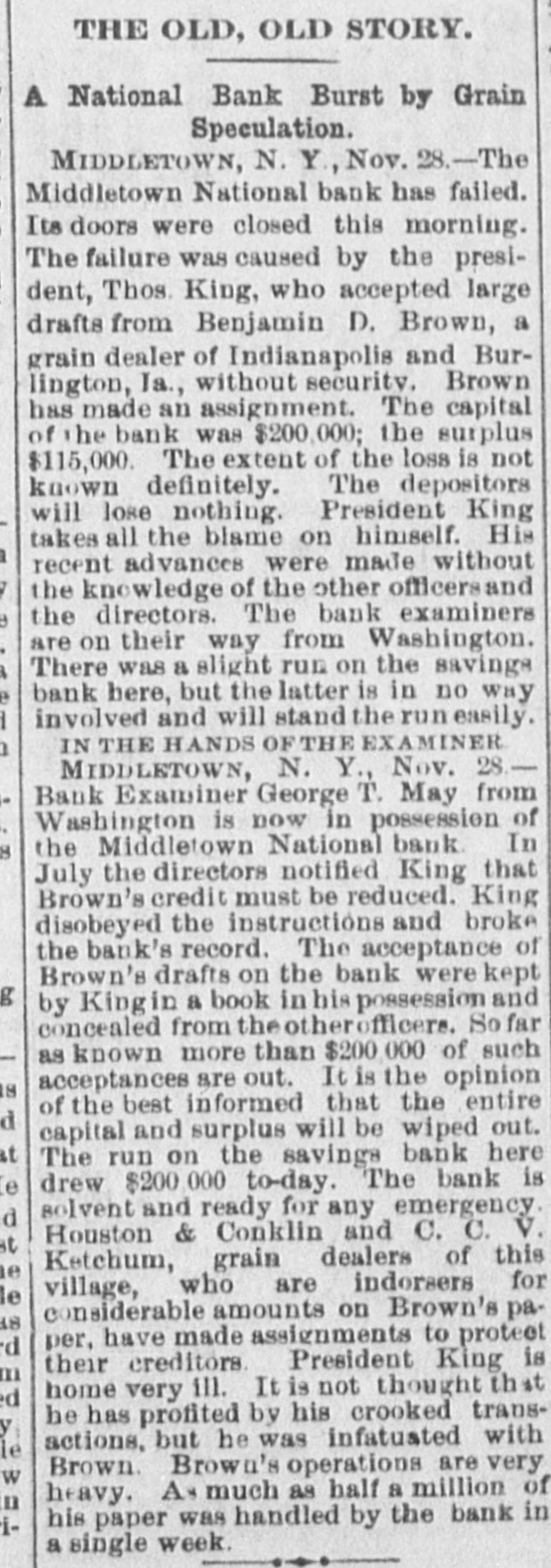
THE OLD, OLD STORY. A National Bank Burst by Grain Speculation. MIDDLETOWN, N. Y., Nov. 28.-The Middletown National bank has failed. Its doors were closed this morning. The failure was caused by the president, Thos. King, who accepted large drafts from Benjamin D. Brown, a grain dealer of Indianapolis and Burlington, Ia., without security. Brown has made an assignment. The capital of the bank was $200,000; the surplus $115,000. The extent of the loss is not known definitely. The depositors will lose nothing. President King takes all the blame on himself. His recent advances were made without the knowledge of the other officersand the directors. The bank examiners are on their way from Washington. There was a slight run on the savings bank here, but the latter is in no way involved and will stand the run easily. IN THE HANDS OF THE EXAMINER MIDDLETOWN, N. Y., Nov. 28.Bank Examiner George T. May from Washington is now in possession of the Middletown National bank. In July the directors notified King that Brown's credit must be reduced. King disobeyed the instructions and broke the bank's record. The acceptance of Brown's drafts on the bank were kept by Kingin a book in his possession and concealed from the other officers. So far as known more than $200,000 of such acceptances are out. It is the opinion of the best informed that the entire capital and surplus will be wiped out. The run on the savings bank here drew $200,000 to-day. The bank is solvent and ready for any emergency. Houston & Conklin and C. C. V. Ketchum, grain dealers of this e village, who are indorsers for e considerable amounts on Brown's pa18 per, have made assignments to protect d their creditors. President King is home very ill. It is not thought th st d be has profited by his crooked transactions, but he was infatuated with Brown. Brown's operations are very heavy. As much as half a million of his paper was handled by the bank in a single week.


Article from New-York Tribune, November 30, 1884

Click image to open full size in new tab

Article Text

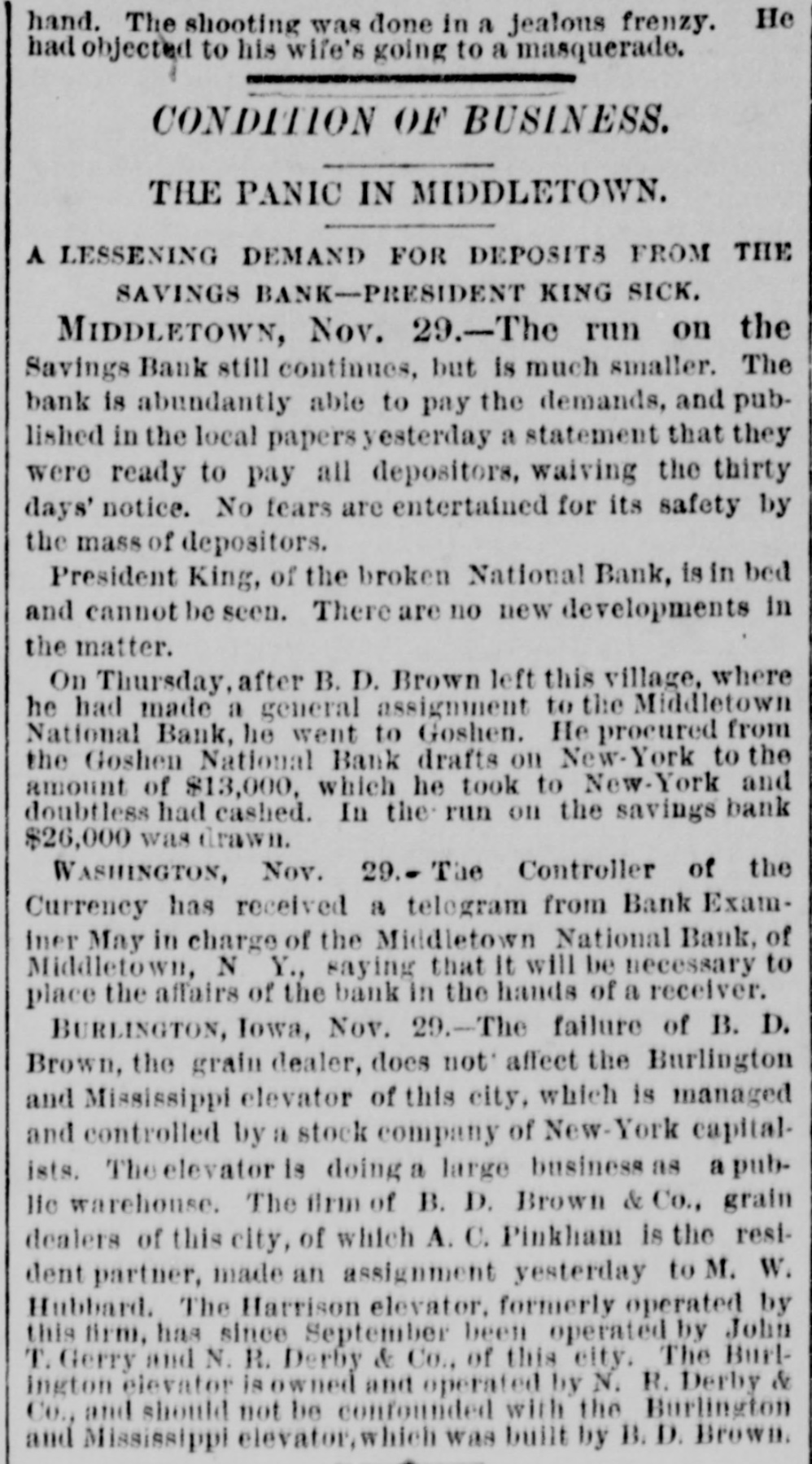
He hand. The shooting was done in a jealous frenzy. had objected to his wife's going to a masquerade. CONDITION OF BUSINESS. THE PANIC IN MIDDLETOWN. A LESSENING DEMAND FOR DEPOSITS FROM THE SAVINGS BANK-PRESIDENT KING SICK. MIDDLETOWN, Nov. 29.-The run on the Savings Bank still continues, but is much smaller. The bank is abundantly able to pay the demands, and published in the local papers yesterday a statement that they were ready to pay all depositors, waiving the thirty days' notice. No fears are entertained for its safety by the mass of depositors. President King, of the broken National Bank, is in bed and cannot be seen. There are no new developments in the matter. On Thursday, after B. D. Brown left this village, where he had made a general assignment to the Middletown National Bank, he went to Goshen. He procured from the Goshen National Bank drafts on New-York to the amount of $13,000, which he took to New-York and doubtless had cashed. In the run on the savings bank $26,000 was drawn. WASHINGTON, Nov. 29. The Controller of the Currency has received a telegram from Bank Examiner May in charge of the Middletown National Bank, of Middletown, N Y., saying that It will be necessary to place the affairs of the bank in the hands of a receiver. BURLINGTON, Iowa, Nov. 29.-The failure of B. D. Brown, the grain dealer, does not affect the Burlington and Mississippi elevator of this city, which is managed and controlled by a stock company of New-York capitalists. The elevator is doing a large business as a publie warehouse. The firm of B. D. Brown & Co., grain dealers of this city, of which A. C. Pinkham is the resident partner, made an assignment yesterday to M. W. Hubbard. The Harrison elevator. formerly operated by this firm, has since September been operated by John T. Gerry and N. R. Derby & Co., of this city. The Burlington elevator is owned and operated by N. R. Derby & Co., and should not be confourided with the Burlington and Mississippi elevator, which was built by B. D. Brown.


Article from The Indianapolis Journal, December 1, 1884

Click image to open full size in new tab

Article Text

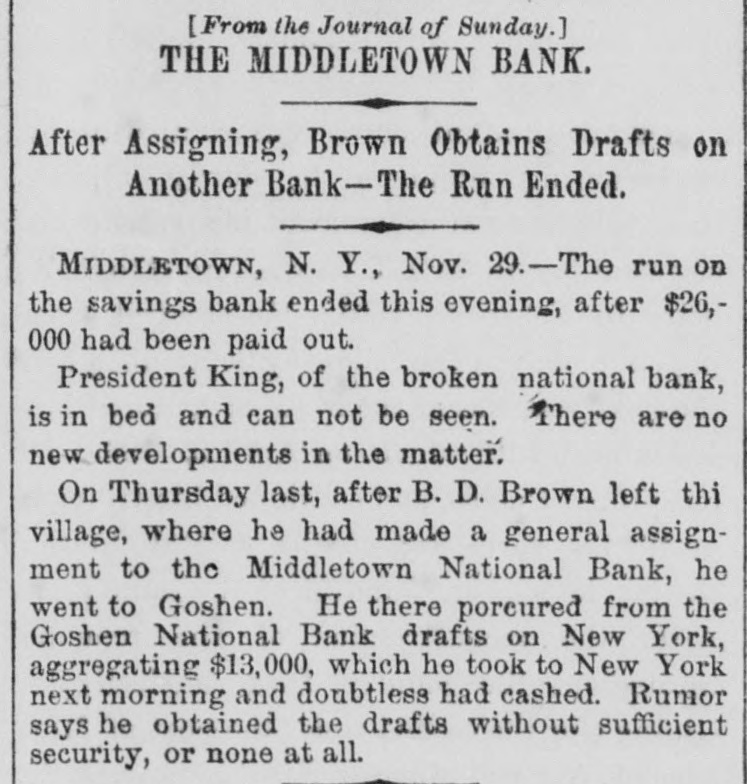
[From the Journal of Sunday.] THE MIDDLETOWN BANK. After Assigning, Brown Obtains Drafts on Another Bank-The Run Ended. MIDDLETOWN, N. Y., Nov. 29.-The run on the savings bank ended this evening, after $26,000 had been paid out. President King, of the broken national bank, is in bed and can not be seen. There are no new developments in the matter. On Thursday last, after B. D. Brown left thi village, where he had made a general assignment to the Middletown National Bank, he went to Goshen. He there poreured from the Goshen National Bank drafts on New York, aggregating $13,000, which he took to New York next morning and doubtless had cashed. Rumor says he obtained the drafts without sufficient security, or none at all.


Article from St. Paul Daily Globe, December 1, 1884

Click image to open full size in new tab

Article Text

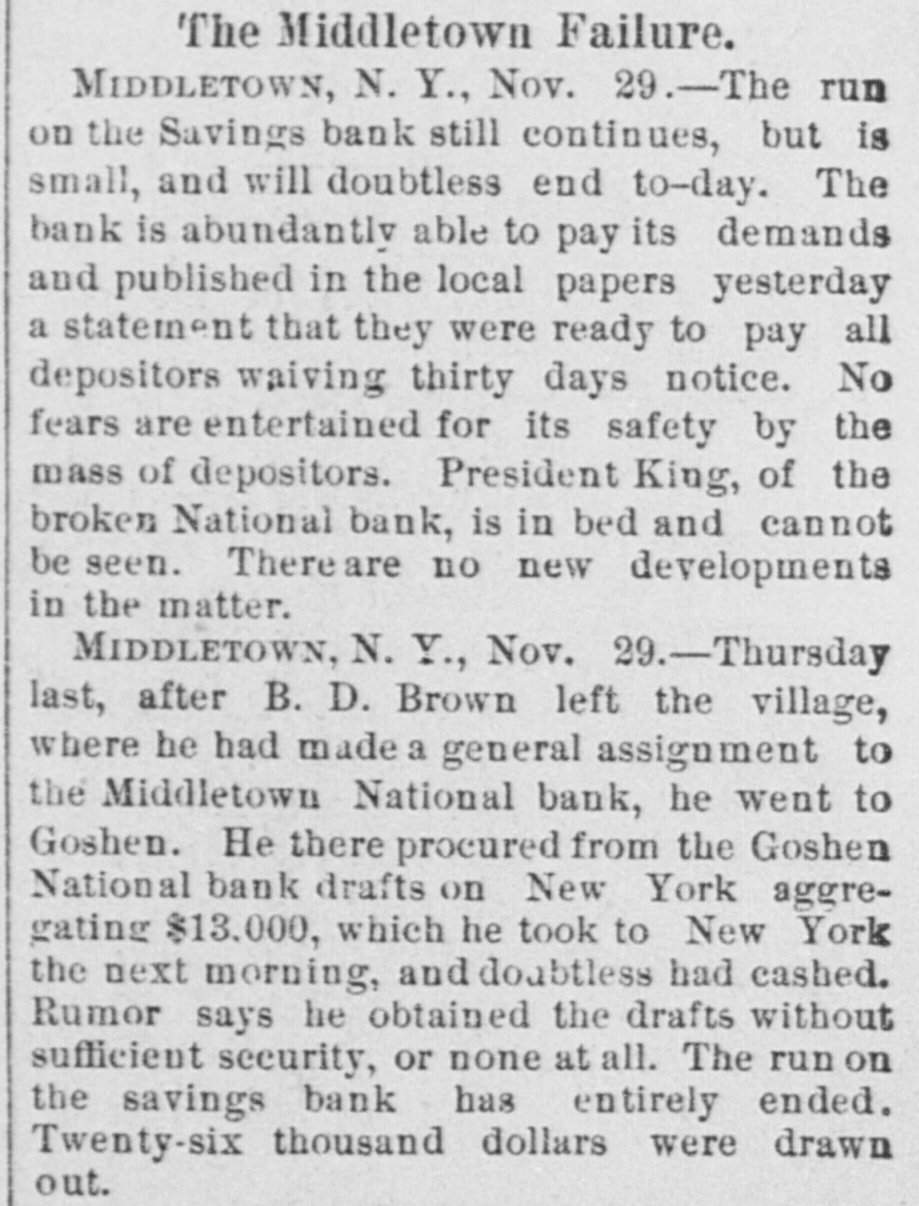
The Middletown Failure. MIDDLETOWN, N. Y., Nov. 29.-The run on the Savings bank still continues, but is small, and will doubtless end to-day. The bank is abundantly able to pay its demands and published in the local papers yesterday a statement that they were ready to pay all depositors waiving thirty days notice. No fears are entertained for its safety by the mass of depositors. President King, of the broken National bank, is in bed and cannot be seen. Thereare no new developments in the matter. MIDDLETOWN, N. Y., Nov. 29.-Thursday last, after B. D. Brown left the village, where he had made a general assignment to the Middletown National bank, he went to Goshen. He there procured from the Goshen National bank drafts on New York aggregating $13.000, which he took to New York the next morning, and doubtless had cashed. Rumor says he obtained the drafts without sufficient security, or none at all. The run on the savings bank has entirely ended. Twenty-six thousand dollars were drawn out.


Article from New-York Tribune, December 3, 1884

Click image to open full size in new tab

Article Text

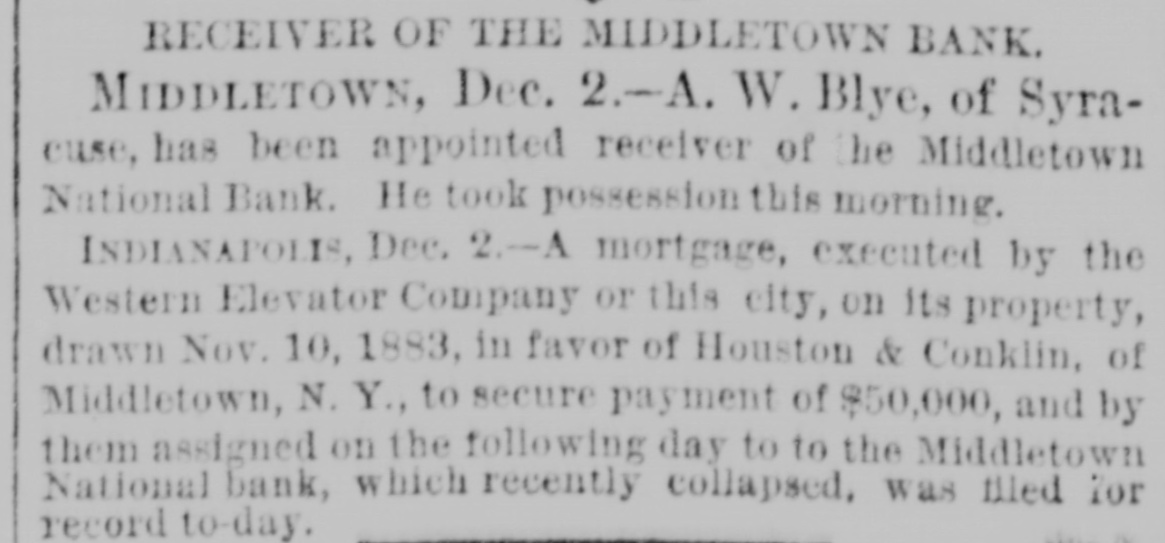
RECEIVER OF THE MIDDLETOWN BANK. MIDDLETOWN, Dec. 2.-A. W. Blye, of Syracuse, has been appointed receiver of the Middletown National Bank. He took possession this morning. INDIANAPOLIS, Dec. 2.-A mortgage, executed by the Western Elevator Company or this city, on its property, drawn Nov. 10, 1883, in favor of Houston & Conklin, of Middletown, N. Y., to secure payment of $50,000, and by them assigned on the following day to to the Middletown National bank, which recently collapsed, was filed for record to-day.


Article from National Republican, February 25, 1886

Click image to open full size in new tab

Article Text

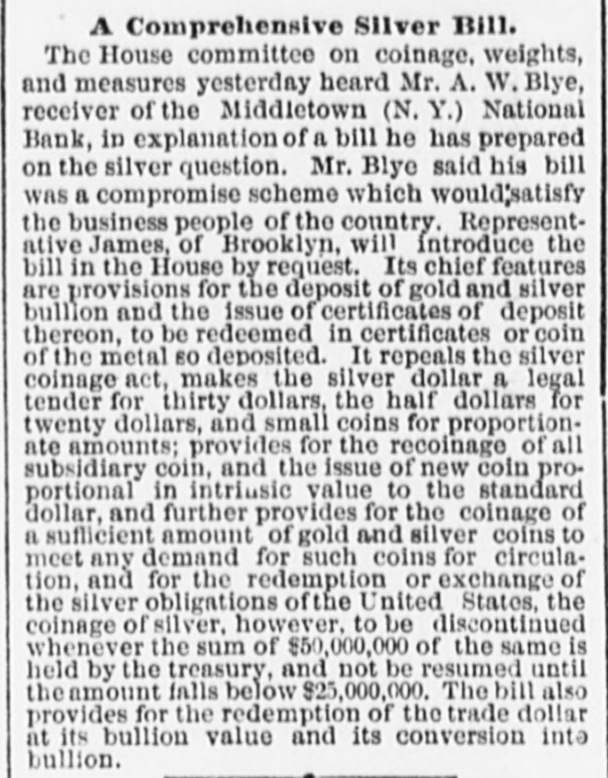
# A Comprehensive Silver Bill. The House committee on coinage, weights, and measures yesterday heard Mr. A. W. Blye, receiver of the Middletown (N. Y.) National Bank, in explanation of a bill he has prepared on the silver question. Mr. Blye said his bill was a compromise scheme which would satisfy the business people of the country. Representative James, of Brooklyn, will introduce the bill in the House by request. Its chief features are provisions for the deposit of gold and silver bullion and the issue of certificates of deposit thereon, to be redeemed in certificates or coin of the metal so deposited. It repeals the silver coinage act, makes the silver dollar a legal tender for thirty dollars, the half dollars for twenty dollars, and small coins for proportionate amounts; provides for the recoinage of all subsidiary coin, and the issue of new coin proportional in intrinsic value to the standard dollar, and further provides for the coinage of a sufficient amount of gold and silver coins to meet any demand for such coins for circulation, and for the redemption or exchange of the silver obligations of the United States, the coinage of silver, however, to be discontinued whenever the sum of $50,000,000 of the same is held by the treasury, and not be resumed until the amount falls below $25,000,000. The bill also provides for the redemption of the trade dollar at its bullion value and its conversion into bullion.