Hanover National Bank (New York, NY)

Episode Information

Episode UID
135201294
Episode Type
Suspension β†’ Reopening
Bank Type
national
Bank ID
13520 national
Charter Number
1352
Start Date
October 22, 1907
Location
New York, New York (40.714, -74.006)

Metadata

Model
gpt-5-mini (chosen from majority vote of a three-model LLM ensemble)
Short Digest
68249757cbab8984

Response Measures

None

Description

Hanover National is mentioned as clearing house chairman; no article describes a specific depositor run on Hanover itself.

Events (4)

1. June 28, 1865 Chartered
Source
historical_nic
2. October 22, 1907 Suspension
Cause
Macro News
Cause Details
Part of the nationwide 1907 financial panic: New York banks suspended specie payments and issued clearing house certificates, tying up cash and disrupting correspondent relations.
Newspaper Excerpt
James T. Woodward, president of the Hanover National bank, and chairman of the clearing house committee, said that conditions were improving
Source
newspapers
3. November 5, 1907 Reopening
Newspaper Excerpt
we understand will be called off November 5; banks adopted the policy of paying large depositors in checks...Runs upon the banks here have practically ceased since the banks adopted the policy of paying large depositors in checks. Some transfers...strengthening the larger institutions to meet pressure and to support the market. (mentions resumption Nov. 5).The New York banks have been announcing for some time that specie payments are about to be resumed. (multiple articles).β€”Paonia piece states called off November 5. (Article excerpts).
Source
newspapers
4. April 23, 1929 Voluntary Liquidation
Source
historical_nic

Newspaper Articles (13)

Article from The Birmingham Age-Herald, October 22, 1907

Click image to open full size in new tab

Article Text

Clearing House Assists All the Shaky Banks to Get on Their Feet COMMITTEE FEELS EQUAL TO MEET ANY EMERGENCY Improved Conditions Are Reflected in Buoyancy of the Stock Market. Plans Are Made to Help Other Banks, New York, October 21.-The recent tension of the banking community was today considerably relieved and today passed with no adverse developments of a serious character but with much that was reassuring. At the same time there was evidence that some of the banks most affected by recent events were still in need of assistance, but the promptness with which the clearing house accorded it did much to ally further alarm. The general improvement was reflected in the buoyancy of the stock market and the steady advance in prices from previous low levels. The clearing house was called upon to get debit balances of the Mercantile and the New Amsterdam banks to the extent of upwards of $2,000,000 of which the Mercantile owed about $1,900,000 and the New Amsterdam $200,000. The debit balance of the National Bank of North America amounted to $850,000. While there was said to have been some discussion between the clearing house committee and the officers of the latter bank as to the necessity of giving it any support it was found necessary to do so. The fact that the clearing house committee regards the situation as still serious was shown by the remark of a member of the committee that the Mercantile bank's debit balance was "unexpectedly large and disconcerting." The committee remained in session the greater part of the day discussing a general plan of policy with regard to assisting such banks as might need help. After the committee had adjourned for the day James T. Woodward, president of the Hanover National bank, and chairman of the clearing house committee. said that conditions were improving and that the committee felt equal to meeting any emergency that might arise tomorrow. On the stock exchange the improved banking conditions resulted in a rally of pronounced proportions, the more active issues advancing two and three points with greater gains in some of the specialties. Part of this advantage was lost later by a flurry on call loans. the rate for which advanced to 91/4 per cent. On the curb the feature was the heavy selling at severe declines of Consolidated Steamship bonds, which at one time sold at 7% a decline of 3% points from the high. The net loss for the day was 2 points. The Consolidated Steamship company is controlled by Charles W. Morse, One development today which did not tend to ease the prevailing conditions was the application for a receiver for the firm of Otto Heinze & Co. Argument on the motion was deferred until Wednesday.
Article from The Madison Daily Leader, October 30, 1907

Click image to open full size in new tab

Article Text

SCARE IS SUBSIDING Runs Upon New York Banks Practically Cease. STOCK MARKET UNSTEADY Calling in of Loans Causes a Decline in Prices, Canadian Pacific Leading in the Slump-Worldwide Scramble for Gold. New York, Oct. 30.-The financial situation is without notable developments. and the abating interest indicates that the public has pretty well gotten over its scare. The stock markets is a little unsteady, but without extreme agitation. The announcement at the ImpeS rial bank of Germany a raised its discount rate from 5 1/2 to 6 1/2 per cent in order to protect its gold holdings was not unexpected by bankers here. It is thought quite likely that the Bank of England will follow suit by raising its rate at the regular meeting on Thursday. The scramble for gold is such at all the financial centersLondon, Paris, Berlin and New York -that the metel will go to the highest bidder and under present conditions New York is likely to appear for a time in this role. Her ability to get gold is due not only to the need for it, but to the large credits which are being established by the movement of the crops and other products-notably wheat, cotton, copper, tobacco and meats-and by the sale of American securities. These influences are usually more potent than artificial measures to obtain the yellow metal. It is believed this will be effective to place sufficient gold at the command of the New York market and to maintain credit and cause the resumption of banking operations in the usual manner within a few days. Runs upon the banks here have practically ceased since the banks adopted the policy of paying large depositors in checks. Some transfers of accounts are being made from the smaller to the larger banks, which resulted in adverse balances against the former, but strengthening the ability of the larger institutions to meet pressure and to support the market.


Article from The Newspaper, November 1, 1907

Click image to open full size in new tab

Article Text

THE financial situation in New York, contrary to the general belief did reach west and has OC casioned some inconvenience. The entire trouble hinges on the system of doing business. All western banks use Denver as a depository for surplus funds. Denver in turn sends the money to New York. Their banks utter it on loans to the gamblers on Wall street and as a result when speculation has gone to a certain limit and panic sets in there the strained relations extend with marvelous rapidity west. Last week New York determined to refuse to pay in money, but to issue in lieu of cash, clearing house certificates. This effectually tied up the huge deposits of western banks and they speedily adopted the New York system of refusing to pay out cash in any except small amonuts. This action was taken on the permission of the comptroller of the currency and of the state bank examiner. Of course this seems arbitrary and unfair, but at the same time it effectually stops runs and in some cases protects depositors. It is also only a temporary expedient and we understand will be called off November 5. Paonia has not been effected to any ex tent by the flurry.


Article from Lewiston Evening Teller, November 22, 1907

Click image to open full size in new tab

Article Text

Chicago banks are ready to resume cash business and will do so whenever New York banks consent and co-operate. The magnates who have been asking the people to have confidence can now reciprocate and loosen up the wheels of trade bot' east and west. It was the east that locked the doors on western reserves and started the flurry among western institutions. but in spite of that the west has had no run on its. banks and has only used due precaution In guarding its cash waiting for the east to get over its scare and resume normal business relations. New York can very properly be instructed that the only proper way to resume is to resume.


Article from The Stark County Democrat, November 22, 1907

Click image to open full size in new tab

Article Text

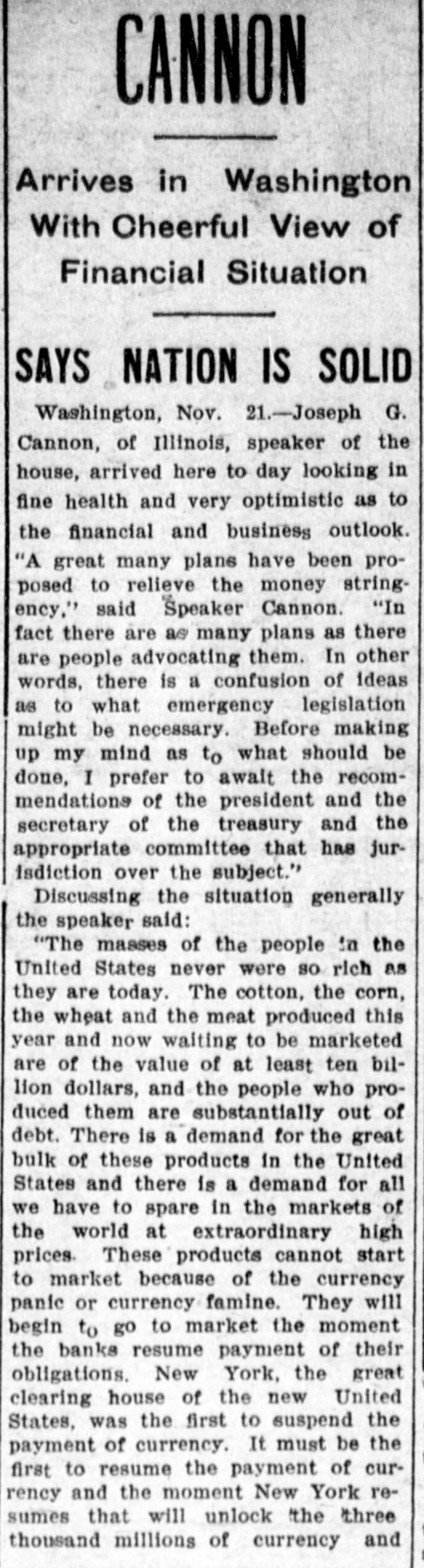
CANNON Arrives in Washington With Cheerful View of Financial Situation SAYS NATION IS SOLID Washington, Nov. 21.-Joseph G. Cannon, of Illinois, speaker of the house, arrived here to day looking in fine health and very optimistic as to the financial and business outlook. "A great many plans have been proposed to relieve the money stringency," said Speaker Cannon. "In fact there are as many plans as there are people advocating them. In other words, there is a confusion of ideas as to what emergency legislation might be necessary. Before making up my mind as to what should be done, I prefer to await the recommendations of the president and the secretary of the treasury and the appropriate committee that has jurisdiction over the subject." Discussing the situation generally the speaker said: "The masses of the people in the United States never were so rich as they are today. The cotton, the corn, the wheat and the meat produced this year and now waiting to be marketed are of the value of at least ten billion dollars, and the people who produced them are substantially out of debt. There is a demand for the great bulk of these products in the United States and there is a demand for all we have to spare in the markets of the world at extraordinary high prices. These products cannot start to market because of the currency panic or currency famine. They will begin to go to market the moment the banks resume payment of their obligations. New York, the great clearing house of the new United States, was the first to suspend the payment of currency. It must be the first to resume the payment of currency and the moment New York resumes that will unlock the three thousand millions of currency and


Article from The Roswell Daily Record, December 3, 1907

Click image to open full size in new tab

Article Text

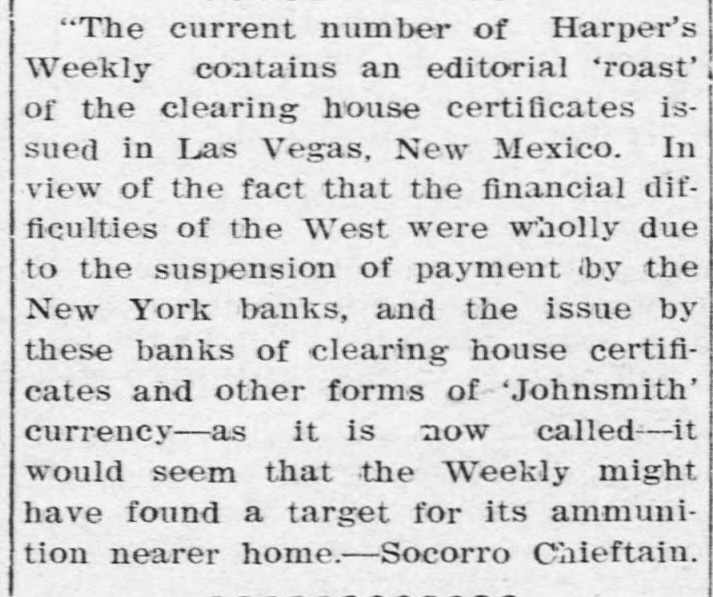
"The current number of Harper's Weekly contains an editorial 'roast' of the clearing house certificates issued in Las Vegas, New Mexico. In view of the fact that the financial difficulties of the West were wholly due to the suspension of payment by the New York banks, and the issue by these banks of clearing house certificates and other forms of 'Johnsmith' currencyβ€”as it is now calledβ€”it would seem that the Weekly might have found a target for its ammunition nearer home.β€”Socorro Chieftain.


Article from Deseret Evening News, December 3, 1907

Click image to open full size in new tab

Article Text

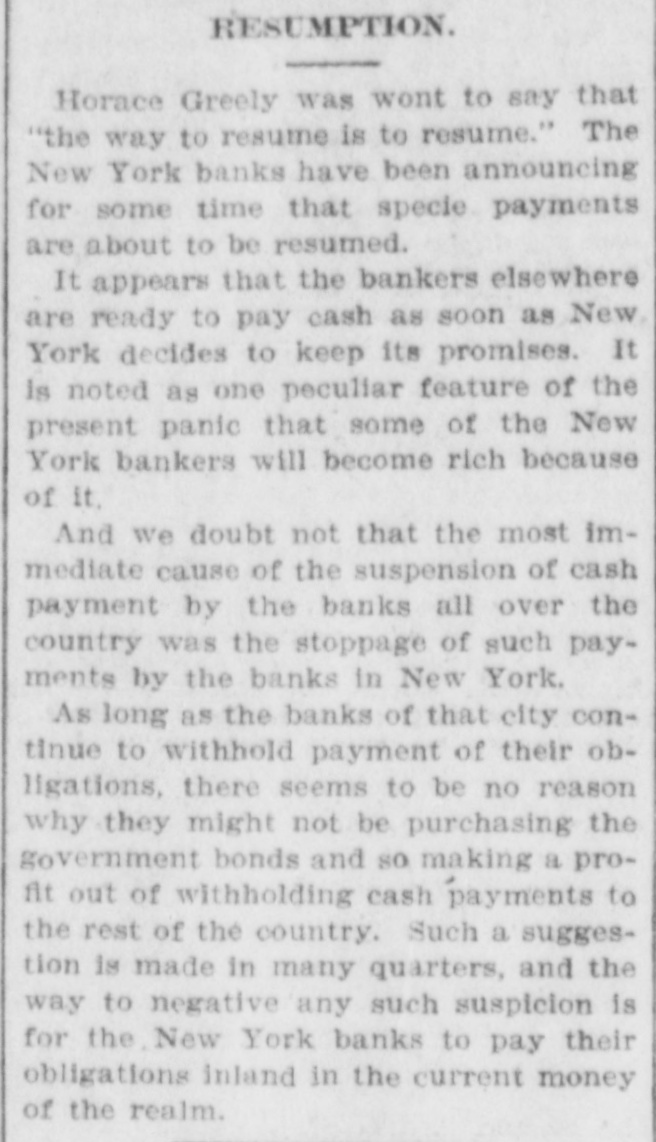
# RESUMPTION. Horace Greely was wont to say that "the way to resume is to resume." The New York banks have been announcing for some time that specie payments are about to be resumed. It appears that the bankers elsewhere are ready to pay cash as soon as New York decides to keep its promises. It is noted as one peculiar feature of the present panic that some of the New York bankers will become rich because of it. And we doubt not that the most immediate cause of the suspension of cash payment by the banks all over the country was the stoppage of such payments by the banks in New York. As long as the banks of that city continue to withhold payment of their obligations, there seems to be no reason why they might not be purchasing the government bonds and so making a profit out of withholding cash payments to the rest of the country. Such a suggestion is made in many quarters, and the way to negative any such suspicion is for the New York banks to pay their obligations inland in the current money of the realm.


Article from The Tucumcari News and Tucumcari Times, December 14, 1907

Click image to open full size in new tab

Article Text

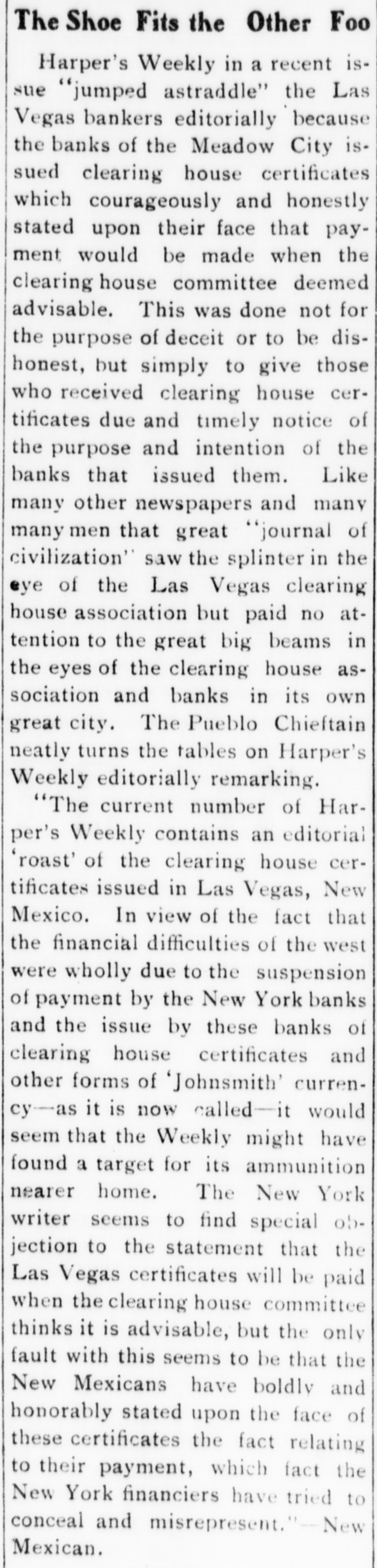
The Shoe Fits the Other Foo Harper's Weekly in a recent issue "jumped astraddle" the Las Vegas bankers editorially because the banks of the Meadow City issued clearing house certificates which courageously and honestly stated upon their face that payment would be made when the clearing house committee deemed advisable. This was done not for the purpose of deceit or to be dishonest, but simply to give those who received clearing house certificates due and timely notice of the purpose and intention of the banks that issued them. Like many other newspapers and many many men that great "journal of civilization" saw the splinter in the eye of the Las Vegas clearing house association but paid no attention to the great big beams in the eyes of the clearing house association and banks in its own great city. The Pueblo Chieftain neatly turns the tables on Harper's Weekly editorially remarking. "The current number of Harper's Weekly contains an editorial 'roast' of the clearing house certificates issued in Las Vegas, New Mexico. In view of the fact that the financial difficulties of the west were wholly due to the suspension of payment by the New York banks and the issue by these banks of clearing house certificates and other forms of 'Johnsmith' currency-as it is now called-it would seem that the Weekly might have found a target for its ammunition nearer home. The New York writer seems to find special objection to the statement that the Las Vegas certificates will be paid when the clearing house committee thinks it is advisable, but the only fault with this seems to be that the New Mexicans have boldly and honorably stated upon the face of these certificates the fact relating to their payment, which fact the New York financiers have tried to conceal and misrepresent."-New Mexican.


Article from The Montgomery Advertiser, December 17, 1907

Click image to open full size in new tab

Article Text

That government officials feel that the backbone of the panic is broken is evidenced from the fact that postal authorities at Wasnington have sent letters to all postmasters whose offices are depositories either for registry and money order accounts, to prepare to receive checks from the smaller offices. In the letter it is stated that the authorities feel that it will not be many days until he New York banks will resume the payment of currency and when this is done the panic will be over. While this circular letter was sent to all postoffices that are depositories for government accounts, there are but few of them effected by the order. The Montgomery office is not a depository but the instructions are particularly significant throughout the country from the fact that it gives the views to a certain extent of officials in Washington on the money situation. According to these instructions conditions are rapidly becoming better as the postal officials would not say this unless they knew and they are in a position to know the facts if anyone is. The instructions will be welcomed by a great many offices in different parts of the country as the arrangement since October 30 has been very inconvenient. By the action of the banks handling United States accounts it has been necessary in many cases for the smaller offices to send all of their money to the depositories in currency. The government requires that all of its checks be paid in currency and when money became tight the banks refused to take government checks for


Article from The Morning Journal-Courier, January 15, 1908

Click image to open full size in new tab

Article Text

POOR NEW YORK. New York thrives on the money which the 6,000 banks throughout the United States keep in that city. Compared with Philadelphia and some other leading towns, New York produces of itself relatively very little wealth. But it uses the money of 80,000,000 people. When recently the crookedness of some New York banks caused first a series of failures and then a financial panic there, the banks all over the country began to withdraw their deposits from New York. This cash did not belong to Wall street, but it was merely kept on deposit there. The owners had a right to take it away at any time they saw fit. One might suppose from the cries that come from Wall street that the 6,000 banks not in that town were committing a crime by demanding their own money. As a matter of fact, the New York banks locked their doors and refused to permit outside banks to get their own money except by paying a large bonus for something that already belonged to them. The cash which New York sends South and West to move crops every autumn is cash which the banks from those sections have loaned in Wall street. It is not New York's money although, judging by that town's comments, anyone not familiar with the true facts might suppose otherwise. Now we witness the spectacle of America's so-called financial center being the only spot where a premium is paid for currency. The reason is because that city suffers a money famine, since the rest of the country has withdrawn only a part of the cash which it had been lending there. What would happen If the rightful owners should take all that belongs to them may only be imagined.-Philadelphia Press.


Article from The Times Dispatch, February 7, 1908

Click image to open full size in new tab

Article Text

City were increased on the security of stock and bond loans from $281,000,000 to $302,000,000. Three hundred and twelve millions loaned on collateral of Wall Street, and yet they suspended payments to their individual depositors and to their banking correspondents throughout the country. And they did it when they had money in their treasury with which to meet their obliga-tions." ### Kept Cash; Got Premium. Mr. Culberson declared that while New York had so much cash in its banks Southern banks were paying a premium for cash. The Aldrich bill, he declared, would give the banks more power and would foster stock and bond speculation by the banks and still further discriminate against the general public, and in the interest of the bondholding classes. "Against this policy," he added, "I want to enter my earnest and emphatic protest." Senator Hopkins replied briefly to Mr. Culberson. "Every statement made by the Senator," he said, "has been answered by the Secretary of the Treasury in his report." Mr. Culberson said the secretary refused to give the Texas banks deposits they asked for, and Mr. Hopkins replied that he had done the same thing in respect to Chicago banks, as he put the money where he believed the greatest emergency existed. The consideration of Mr. Culberson's resolution was postponed, and it was allowed to lie on the table.


Article from The Detroit Times, June 14, 1912

Click image to open full size in new tab

Article Text

GOVERNMENT'S MONEY STOPPED PANIC IN 1907 George B. Cortelyou Tells How $25,000,000 Was Loaned To J. P. Morgan NEW YORK, June 13.-Testifying today before the Pujo congressional committee. which is investigating the money trust, George B. Cortelyou, who was secretary of the treasury at the time of the 1907 panic, told how the government loaned J. Pierpont Morgan the $25,000,000 which Morgan in turn loaned to banks and thus broke the panic on Oct. 24, 1907, sending call money down from 125 to 6 per cent. It was the first time that the details of how the treasury came to the rescue of the stock exchange was ever told by an authority as high as the ex-treasurer, and the brokers and spectators who packed the room listened with breathless interest as the real inside story was unfolded. Cortelyou said that he came to New York on Oct. 22, 1907, to investigate conditions, that night held a conference at the Hotel Manhattan with Morgan, Perkins, Vanderlip, Cannon, Hepburn, Stillman and other bankers. He denied that he had told them of his coming, but explained that Hamilton Fish, then sub-treasurer in New York, knew of Cortelyou's intended visit and informed him that the Morgan party would like to confer with him. At that time he obtained from each financier, he said, his views on the situation, but did not make any specific promise of aid from the government. There was no formal conference the next day, Cortelyou asserted, but he believed he talked to Morgan and Perkins again that night. As the result of these conferences, Cortelyou said he decided to advise the government to give relief and recommended that $25,000,000 be loaned for the purpose. The money was deposited with several New York banks the next day: Cortelyou said that Morgan represented no particular bank in the panic conferences, but was the "leading spirit among the business men seeking to relieve the situation. The witness admitted that he knew the $25,000,000 was loaned to New York banks under the direct supervision of Morgan. Asked what banks got the money, Cortelyou said he did not know but thought they were "such banks as the National Bank of Commerce, Hanover National, National City and First National. Job Printing Done Right. Times Printing Co., 15 John R.-st.


Article from The Washington Times, December 9, 1913

Click image to open full size in new tab

Article Text

Currency Bill Speeches Soon To Be Concluded Early conclusion of the set speeches on the currency bill is expected in the Senate and the bill will then be considered paragraph by paragraph. Much informal discussion will arise in that connection, but nothing has developed to indicate the bill will not be passed before Christmas. The feature of the debate yesterday was the attack by Senator Swanson on the banks of New York for their suspension of payments of the money they held belonging to other banks in the 1907 panic. This was resented by Senator O'Gorman in strong language. Senators Root and Weeks also defended the New York banks. Senators Nelson and Weeks, in addition to Senator Swanson, were the chief speakers in the course of the session yesterday afternoon and last night.