Knickerbocker Trust Company (New York, NY)

Episode Information

Episode UID
1019971294
Episode Type
Run → Suspension → Reopening
Bank Type
trust
Bank ID
101997 routing
Routing Number
1-0199
Start Date
October 22, 1907
Location
New York, New York (40.714, -74.006)

Metadata

Model
gpt-5-mini (chosen from majority vote of a three-model LLM ensemble)
Short Digest
42b34eb67d2c3d63

Response Measures

None

Description

Resignation and disclosures about management (Charles T. Barney) precipitated the run and suspension.

Events (4)

1. October 22, 1907 Run
Cause
Bank Specific Adverse Info
Cause Details
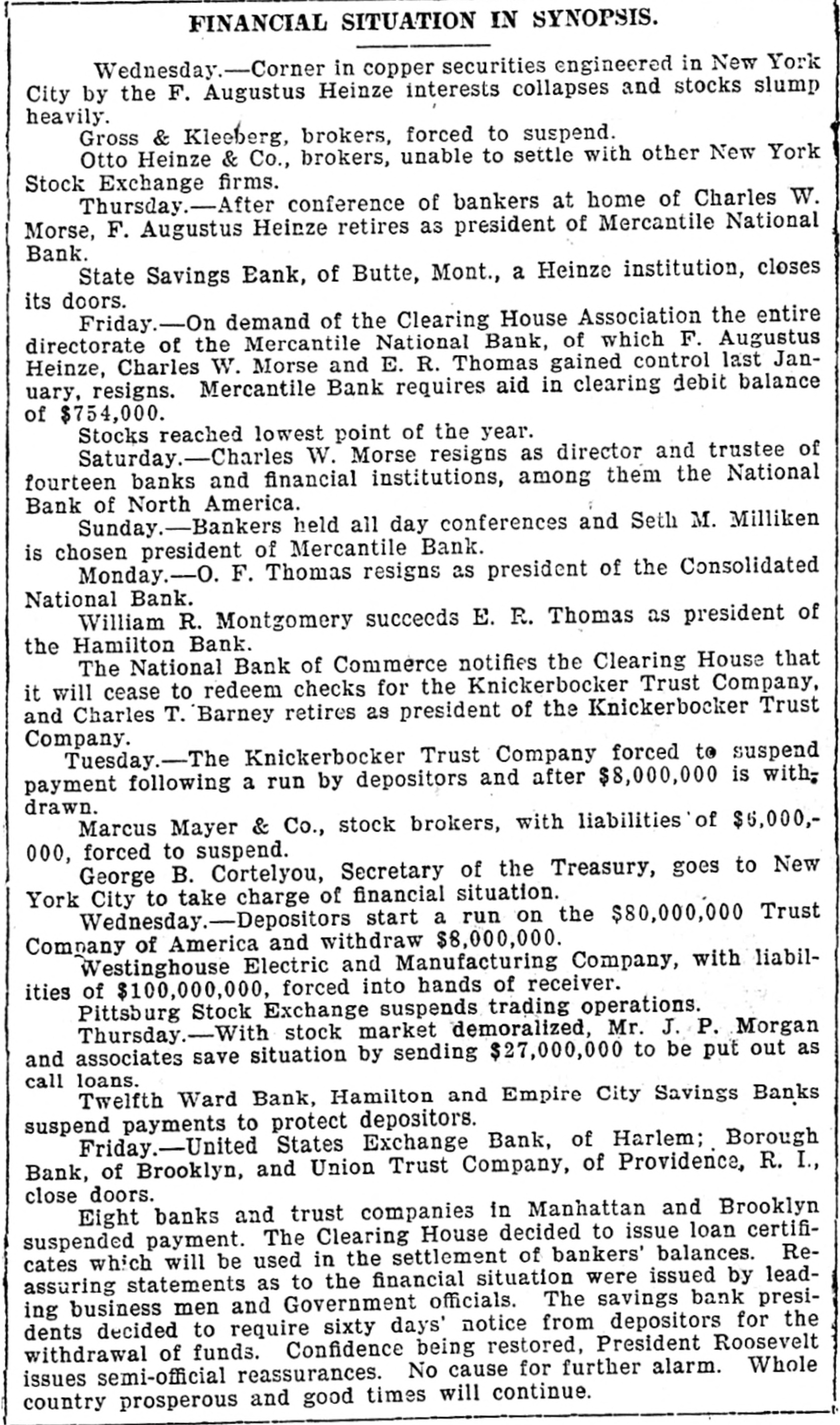
Publicized disclosures about the Knickerbocker's affairs and forced resignation of President Charles T. Barney undermined confidence and triggered heavy withdrawals.
Measures
Paid out cash from vaults ($8,000,000 reported) and attempted to meet withdrawals before running out and suspending payments.
Newspaper Excerpt
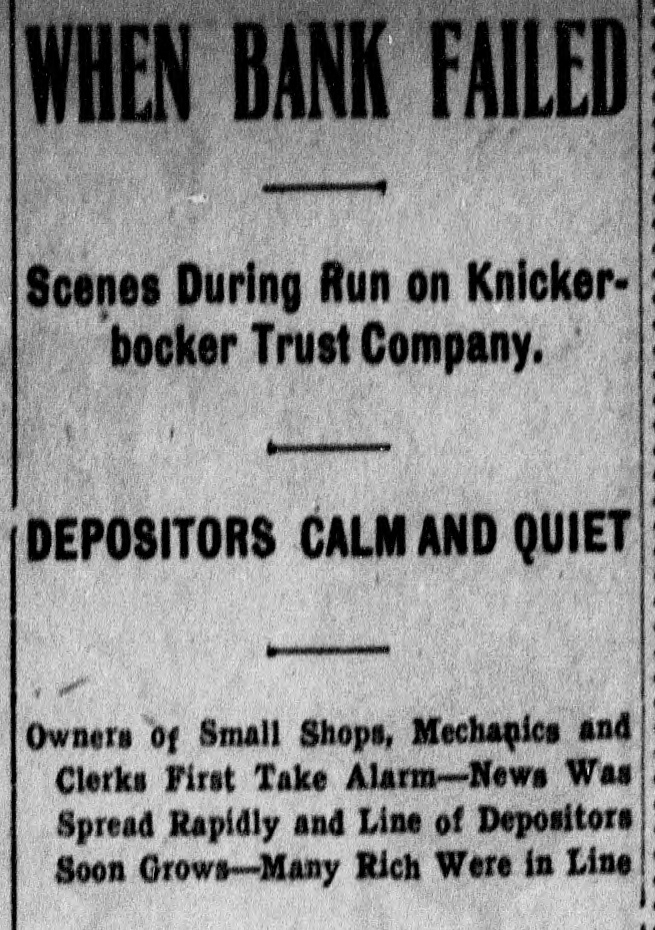
a run of considerable proportions was being made on the various offices of the Knickerbocker Trust company.
Source
newspapers
2. October 23, 1907 Suspension
Cause
Bank Specific Adverse Info
Cause Details
Payments were suspended after cash on hand was exhausted amid continued withdrawals following disclosures and loss of confidence.
Newspaper Excerpt
the Knickerbocker Trust Company which suspended yesterday, remained closed.
Source
newspapers
3. October 26, 1907 Receivership
Newspaper Excerpt
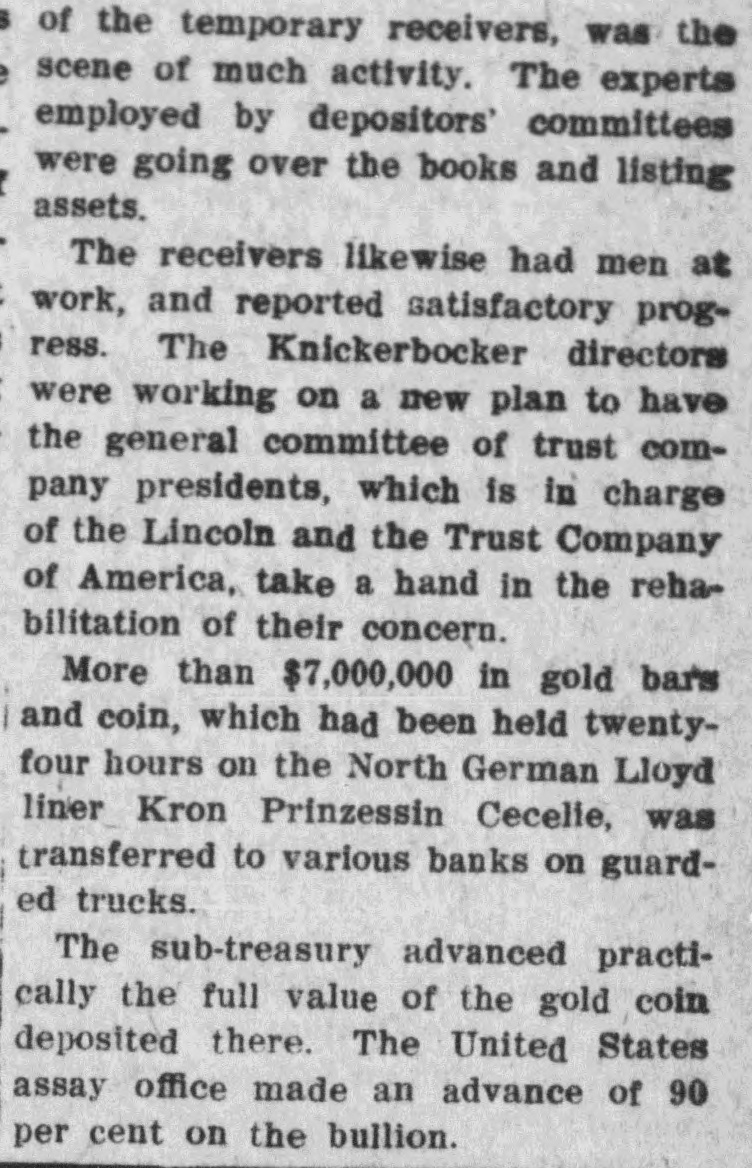
temporary receivers were appointed for the Knickerbocker Trust company, which closed its doors on Tuesday afternoon after a run by its depositors.
Source
newspapers
4. March 26, 1908 Reopening
Newspaper Excerpt
the Knickerbocker Trust Co., which closed its doors last October, was re-opened for business at noon today.
Source
newspapers

Newspaper Articles (24)

Article from The Topeka State Journal, October 22, 1907

Click image to open full size in new tab

Article Text

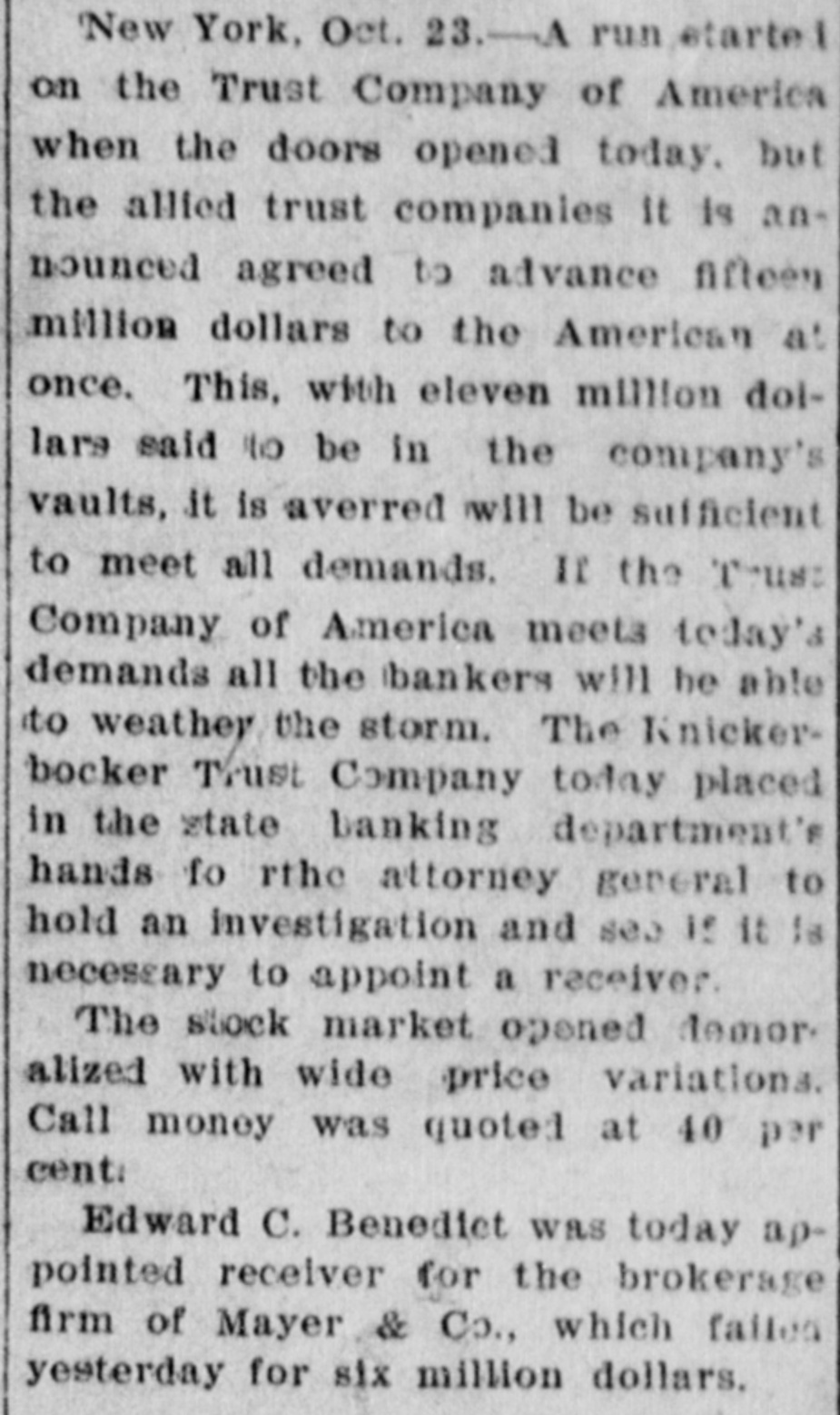
STREET IS PANICKY. Market Opened Demoralized But Rallied a Little Later. New York, Oct. 22.-Excitement amounting almost to alarm marked the opening of the business today in Wall street. The stock market opened demoralized under heavy selling by brokers in all departments of the exchange and at the same moment a run of considerable proportions was being made on the various offices of the Knickerbocker Trust company. At the main office, Fifth avenue and Thirty-fourth street more than 150 persons were in line at 10:30, and there was a line of carriages in waiting extending for more than a block. The stock markets opening showed severely the effect of the renewed shock to confidence caused by the spread of financial distrust by the published details of the affairs of the Knickerbocker Trust company. Prices broke widely on the opening transactions under this outpouring of stocks, but almost immediately rallied. The rebound approximated from one-fourth to one-half of the first break.


Article from Perth Amboy Evening News, October 23, 1907

Click image to open full size in new tab

Article Text

WALL STREET IN PANIC IN TODAY'S DEALINGS. GEO. F. BAKER PLANS Knickerbocker Did STOCK MARKET BELIEF Not Open As Promised. RUN ANOTHER. NEW YORK, Oct. 23:-Wall street is experiencing the worst panic in years today. When the time for opening arrived this morning the Knickerbocker Trust Company which suspended yesterday, remained closed. Hundreds of depositors had waited since daylight, and there was a great demonstration when it became know that the institution had doubtless gone under for good. A run was started on the Trust Company of America when it opened its doors today, but the allieri trust companies advanced $15,000,000 to the America at once. This, with $11,000,000. which is said to be in the company's vaults is declared to be sufficient to meet all demands. If the Trust Company of America meets George F. Baker, president of the today's demands, the banks say all First National bank, New York city, will be able to weather the storm. which is taking the lead among Wall The Knickerbocker Trust ComStreet's banking interests to form a pany today was placed in the state syndicate to avert further declines in banking department's hands and the the stock market. The reported attorney general is investigating to plan calls for a fund amounting to see if it is necessary to appoint a reseveral million dollars, which will be ceiver. turned over to a member of the synCall money is quoted at 40 per dicate to be used at its discretion in cent. supporting prices whenever they Edward C. Benedict today was apshow signs of heavy declines. pointed receiver for the brokerage firm of Mayer & Company, which failed yesterday for $600,000. The scene in Wall street this afternoon cannot be described. Thousands of people crowd the narrow BOY'S DEATH thoroughfare and block the steps of the buildings. Many of these are cnlookers, while not a few wea" an anxious face denoting something more than curiosity. WAS NOT DUE PITTSBURG, Oct. 23:-Complying with the request of the clearing house the Pittsburg stock exchange did not open today. TO BEATING. PARIS, Oct. 23:-Precautions by the Rothchilds and other leading bankers of Europe, forseeing the An autopsy today revealed the fact New York's financial trouble, that the death of Abe Kaufman, strengthened the market and pretwelve years old, of Avenel, was not vented a panic at the opening of the due to a beating, as a result of which Bourse today. The large French suspicion two boys had been held at banks were unaffected by the New the Woodbridge lockup. York trouble, but the smaller ones Both the county physician and Cormay feel it. The Bourse was steady. oner Bishop of this city, were in Woodbridge today, looking up the The crisis came in New York yescase. The funeral was to have been terday morning when the run was held yesterday, but it was held up by started on the Knickerbocker Trust Coroner Bishop. Company resulting, as told in yesThe death certificate was signed terday's NEWS with the suspension by Dr. Galloway, of Rahway, that the of payments in the afternoon. The boy died from hydrophobia. The lad Knickerbocker Trust Company is the was bitten by a dog a few weeks ago. second largest concern of its kind in A number of local Hebrews became New York city, having deposits interested in the case and, with Dr. amounting to about $60,000,000. Charles I. Silk, of this city, two of them (Continued on page 3.) attended the autopsy this morning at the home of the boy's parents in Avenel.


Article from The Salt Lake Herald, October 23, 1907

Click image to open full size in new tab

Article Text

New York, Oct. 22.-The failure of Mayer & Co. was announced on the stock exchange at 2:50 this afternoon. The liabilities of Mayer & Co., whose failure was announced on the stock exchange this afternoon, are about $6,000,000. This is much larger than has been expected, as it was thought the firm was doing a small business. New York, Oct. 22.-Credit, the underthe-surface foundation of all business, trembled for a time today, and before confidence had been restored New York's second largest financial institution had emptied its cash vaults under the pressure of the biggest run experienced here in a generation; a stock exchange firm had failed for six millions; Wall street's principal securities had settled from $5 to $8 a share; call money had risen to 70 per cent, and local bankers, united to stem the tide of distrust, had been forced to appeal for relief to the secretary of the treasury at Washington. No Faith in Statements. All this was in the face of reassuring statements by the acting state superintendent of banks that the suspected bank was solvent, declarations by prominent bankers that there was no true basis for alarm, and assurances from Washington that Secretary Cortelyou would not hesitate to act prémptly in any situation where legitimate business was threatened. Now that the first scare is over, and the worst of the future discounted, it is believed that the local banking affairs will soon readjust themselves. Secretary of the Treasury Cortelyou reached New York from Washington at 2:30 o'clock. He was met at Jersey City by Hamilton Fish, assistant United States treasurer, and the two were in earnest conversation during the ferry trip to New York. Upon reaching this city they went at once to the Hotel Manhattan, where several bankers were later presented to the secretary. Run on the Knickerbocker. The Knickerbocker Trust company, the storm center today, paid out cash to depositors at the rate of $44,444 a minute for three hours today, and then closed its doors. The directors had, as they thought, fully prepared for a run, and caused to be announced in today's papers that $8,000,000 in cash was on hand to meet all eventualities. At 9:30 a few depositors withdrew their accounts and an hour afterwards hundreds were in line to take out their deposits at the main office at 34th street and Fifth avenue and at the Harlem and Bronx and down-town branches. The $8,000,000 lasted until 12:30, when Vice President J. T. Brown announced that the bank had no more cash available and payments were suspended. Question of Raising Cash. Mr. Brown said that the bank would open tomorrow and payments be resumed at 10:30 o'clock. The Knickerbocker, it was announced, had ample securities to meet all demands, was perfectly solvent. and it was only a question of raising the cash, when all depositors who wished to withdraw could do so. J. P. Morgan and his partners were in conference at their Wall street offices until after 6 o'clock. Mr. Morgan, when asked as to the situation, said: "We are doing everything we can, as fast as we can, but nothing has yet crystallized." He would give no intimation as to the plans under way to alleviate the situation. George W. Perkins, Mr. Morgan's partner, met a number of bankers and trust company officials at the Union League club tonight, when the financial situation was canvassed in an informal way. There was a meeting of the Trust Companies' association after banking hours today, at which a committee consisting of George J. Young of the Windsor Trust


Article from The Washington Times, October 23, 1907

Click image to open full size in new tab

Article Text

Presaging a Clear Sky. Every good reason sustains the belief that yesterday's financial storm in New York was only the thunder clap which presages a clear sky and good weather. The bank statements are reassuring. Under competent leadership, the bankers are uniting forces to grapple the first indications of panic. The businesses so far affected are not classified with the firm, conservative trade of banking upon which the financial world relies, and which must be shaken before there can be general panic. The condition of the Knickerbocker Trust Company is not known at this writing. It may be entirely solvent. It may have suffered from the disposition of some directors to finance operations for each other on security which would not. have been accepted 28 sufficient if offered by anyone else. But this much is sure -that the Knickerbocker was a trust company, not a national bank, and that (heing outside the District of Columbia) it enjoyed a latitude, questionable and dangerous, which is not permitted the national banks. What is happening in New York is a pulling-up of weeds. From the great insurance companies to this double failure of yeşterdaý, involving a powerful trust company and a well-known firm of stock brokers, the whole story is one of overreaching corrected, of operations on bad security either recovered or exposed, of publicity and open dealing supplanting easy money in the dark. Out of this the whole notion must benefit. When any institution, particularly one that operates with the money of investors, is brought back to the conditions of sound business, the banker and the business man generally profit as much as the individual depositor in the company directly concerned. The President puts the case


Article from New-York Tribune, October 25, 1907

Click image to open full size in new tab

Article Text

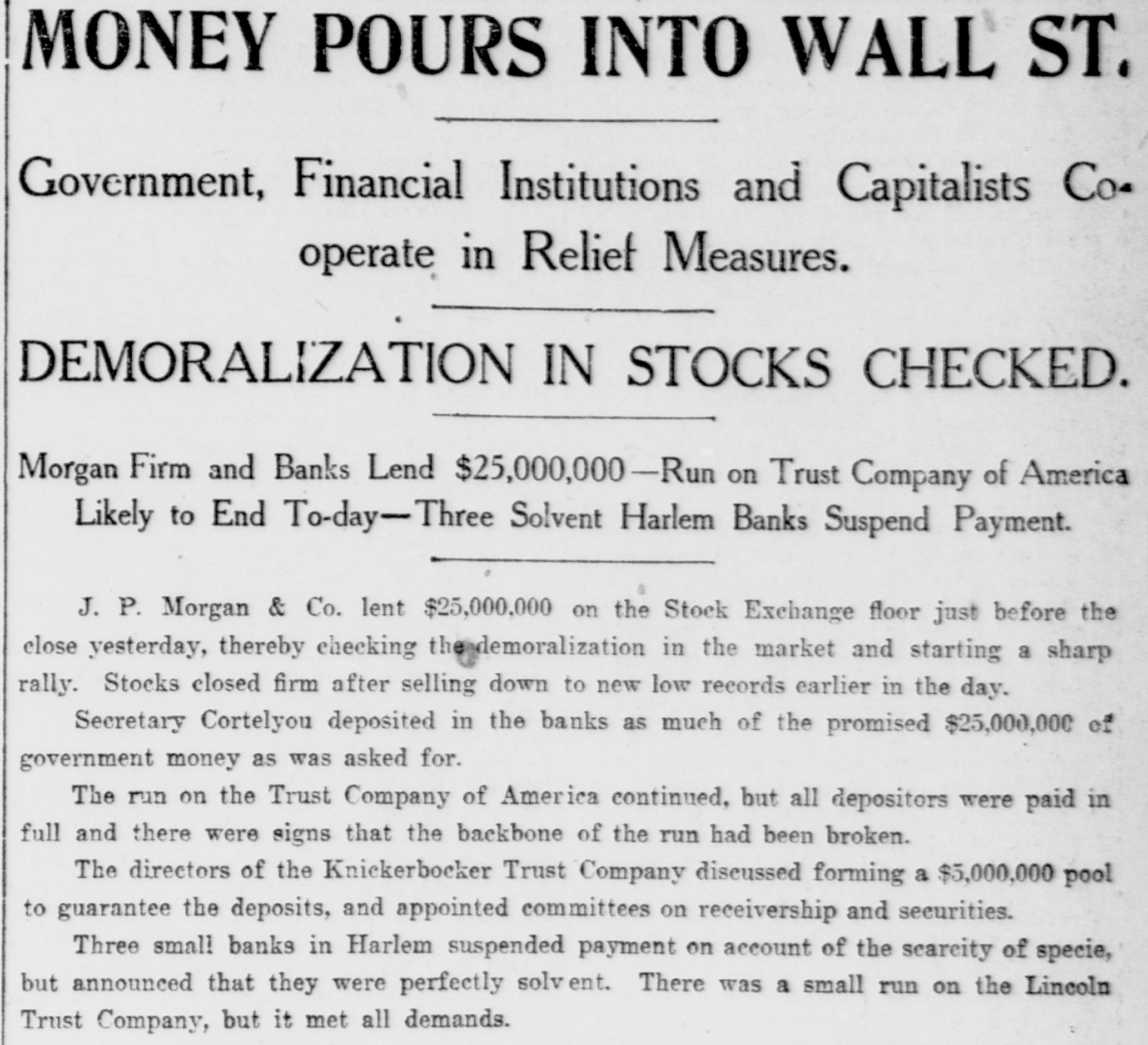
MONEY POURS INTO WALL ST. Co. Government, Financial Institutions and Capitalists operate in Relief Measures. DEMORALIZATION IN STOCKS CHECKED. Morgan Firm and Banks Lend $25,000,000-Run - on Trust Company of America Likely to End To-day-Three Solvent Harlem Banks Suspend Payment. J. P. Morgan & Co. lent $25,000,000 on the Stock Exchange floor just before the close yesterday, thereby checking the demoralization in the market and starting a sharp rally. Stocks closed firm after selling down to new low records earlier in the day. Secretary Cortelyou deposited in the banks as much of the promised $25,000,000 of government money as was asked for. The run on the Trust Company of America continued, but all depositors were paid in full and there were signs that the backbone of the run had been broken. The directors of the Knickerbocker Trust Company discussed forming a $5,000,000 pool to guarantee the deposits, and appointed committees on receivership and securities. Three small banks in Harlem suspended payment on account of the scarcity of specie, but announced that they were perfectly solvent. There was a small run on the Lincoln Trust Company, but it met all demands.


Article from The Madison Daily Leader, October 26, 1907

Click image to open full size in new tab

Article Text

Receiver for Trust Company. New York, Oct. 26.-Upon application of State Attorney General Jackson temporary réceivers were appointed for the Knickerbocker Trust company, which closed its doors on Tuesday afternoon after a run by its depositors. The receivers are Otto T. Bannard, Ernest T. Halmann and General Henry C. Ide, all of New York city. Each of the receivers is required to furnish a bond in $500,000.


Article from Virginia Gazette, November 2, 1907

Click image to open full size in new tab

Article Text

BIG TRUST COMPANY SUSPENDS BUSINESS Knickerbocker Trust, the Second Largest in New York City, Goes Under As Result of Panic in Wall Street— Carried Deposits of $60,000,000. NEW YORK.-Special-The Knickerbocker Trust Company was forced to suspend payments at its main office and three branches this afternoon, after one of the most sensational runs In the history of New York banking. Although the second largest trust company in the city, with deposits of $60,000,000 and a surplus of more than $5,000,000, the institution found itself helpless in the face of the crises precipitated by the forced resignation of Charles T. Barney as president last night, Even with the pledge of support by the Clearing House Association and the millions in cash of J. Pierpont Morgan, F.G. Bourne and other financiers available, It was impossible to continue the steady stream of gold and silver that flowed through the paying tellers' windows. The Harlem Branch, at One Hundred and Twenty-fifth Street and Lenox Avenue, where the run began this morning, was the first to close its deors. At 12:30 o'clock the branch was closed, after they had paid $850,000.


Article from Alexandria Gazette, November 15, 1907

Click image to open full size in new tab

Article Text

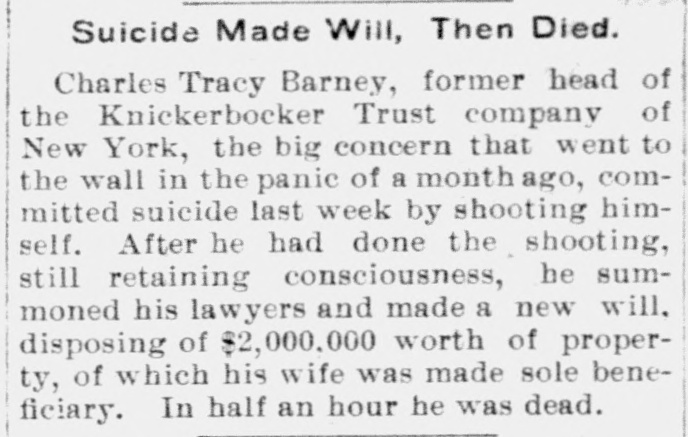
# Suicide of Chas. T. Barney. New York, Nov. 15. —Former President Charles T. Barney of the suspended Knickerbocker Trust Company, who died yesterday from a self-inflicted pistol shot wound, leaves an estate which his business friends say today will probably finally foot up more than $2,000,000. Agreeing with Coroner's Physician O'Hanlon that a would-be suicide would not shoot himself in the abdomen, they still stick to it that Barney shot himself accidantly, as he told Dr. George Dixon, who was the first to reach the dying man's side. Coroner Harburger, holds to his previously expressed view, however, that the case was one of suicide. The inquest will not be completed far several days, to give time for a fuller investigation. The coroner will direct his inquiries less into Barney's financial affairs than toward a fuller investifiations of his domestic troubles. He will seek to learn the grounds of the divorce which his wife was to soon secure. Barney's intimate friends, said today that after careful investigation they were convinced that domestic rather than financial troubles led him to end his life. It was the inner life of the man that was hopelessly wrecked. It was the moral debt that he could not meet. It was remorse growing out of his neglect of his wife, that was eating away his heart. His error had been brought home to him in a powerful and astounding manner. When the financial cloud broke over him the beautiful woman for whom he had practically deserted his wife, turned her back upon him. The mother of his children, estranged for years and about to obtain a decree of absolute divorce, in marked contrast put aside her resentment and rushed to his aid. She laid her fortune, inherited from the Whitney family of which she is a member, at his feet. She offered comfort and solace. She sought to cheer him. Then he knew the wrong he had done her. The remorse was too great. Even in his dying moments it was his wife who supported his head and her sympathytic face was before his eyes when they closed for the last time.


Article from The Democratic Advocate, November 15, 1907

Click image to open full size in new tab

Article Text

Maryland News Before election Congressman Talbott many times asserted that Judge Crothers would get 2,000 majority in Baltimore county. He got nearly 2,500. The police census of Baltimore, lately completed, shows that there are 114.165 houses in the city, or 6,349 more than shown by the census of 1904. The Democrats polled the biggest vote in Baltimore county last Tuesday in the party's history. The woods seem to have been liter ally alive with Democrats that day. There were 47 deaths from typhoid fever in Baltimore city last month, which was about twice as many as in October, 1907. The health authorities say that impure water is the prin. cipal cause. What Annapolis wants to see is a bride in the Executive Mansion. Let the next Gov. ernor propose at once and marry before Christmas that he may bring a wife to grace the Executive Mansion when he comes here in January. Annapolis does not want to see the State's home of the Governor closed after the family of Governor Warfield leaves it.Annapolis Capitol. While a large freight barge was being tow ed across the Baltimore harbor on Friday evening of last week, she turned turtle, and eleven freight cars, containing eleven thou sand cases of tomatoes landed at the bottom of the Patapsco river. The shipment of tomatoes was for the Southern states, and this shortening of this year's pack of tomatoes will no doubt tend to strongly strengthen the tomato market. The Glyndon Country Club, which was recently organized, has closed a deal for the purchase of 17 acres of land on the east side of Central avenue, Glyndon. It will be prepared for an athletic field, and a golf course will be laid out which will be ready for use next spring. It is the intention of the club to erect a club house and bowling alley, as well as to provide the other features of amusement and recreation usually enjoyed by members of country clubs. Rev. G. F. Beaven has a record that has rarely been surpassed, as 50 years have gone by since he preached his first sermon to the congregation of St. Paul's church, St. John's Parish, Hillsboro. When Mr. Beaven assum ed charge of the parish it was a missionary field, there were not more than four communicants in all Caroline county, and but one church edifice. Now there are three parishes, with their own rectors and a number of churches and hundreds of communicants. Adjutant General Riggs has issued an order for the muster out of Company G., First Regiment, Maryland National Guard, located in Annapolis, one of the old companies of the regiment and of the guard. It is commanded by Capt. P. Elwood Porter. The action was taken because of the fact that the company did not contain the number of men fixed by law as the minimum, which is forty. Nov. ember 14 next is fixed as the date for the muster out. The failure of the Knickerbocker Trust Company, of New York, it is said, will cause a curtailment of operations on the great power plant at Mc Call's Ferry, and already three hundred men have been laid off, although efforts will be made to get the work in shape to withstand the Spring's ice freshets. The Knickerbocker Trust Company was the trustee of a $10,000,000 mortgage on the plant, and at the time of the failure there was $800.000 deposited to the order of the Power Company. Owing to repairs being made on the bridge which spans Chester river, at Crumpton, the citizens of that town are experiencing considerable inconvenience. The merchants of Crumpton, in order to keep their large trade on Kent side, are compelled to send delivery wagons all the way around by Millington. A ferry boat has been put in commission to convey passengersacross. The reason of this is that the work of making the bridge im


Article from The Topeka State Journal, November 16, 1907

Click image to open full size in new tab

Article Text

When the original will was drawn Barney was estimated to be worth between $7,000,000 and $9,000,000. It is believed that the estate at present will amount to $2,500,000. In his last will the banker directed that his estate should be incorporated and administered by a board of trustees chosen from his former associates in the directorate of the now suspended Knickerbocker Trust company. Barney directed that his wife should be the chief beneficiary after his debts were paid. He further willed that the agreement made some time ago with his creditors should be lived up to and that such of the estate as proved necessary be used to discharge his obligations. The only reservation made was in the matter of his life insurance which amounts to $185,000. The policies are incontestable and are to be paid to the widow. While the attorneys were engaged with the clerical work involved, Barney it is said chatted freely with the others in the room. His mind appeared clear and his judgment as deliberate as in the days when for him the disposition of millions was part of the day's work. Rev. Dr. Chas. H. Parkhurst called at the Barney home. Upon leaving he announced that a private funeral will be held. Coroner Harburger who will hold an inquest on November 26, sent a detective to the Barney home with instructions to bring to the coroner's office the clothing worn by Barney. The officer returned with the information that the clothing had been burned by the family. Ernest Thalmann, one of the receivers of the Knickerbocker Trust company said: "We have checked all the securities and find that they are all there. We have not observed any evidence of irregularity as yet, nor anything that would tend to lead us to believe that there has been any violation of the banking laws of the state." William A. Tucker of Boston, one of the directors of the Knickerbocker, who is also a member of the examining committee of the board said: "I am confident of the ability of the company, not only to resume business and pay depositors in full, but to keep the stock intact and also a considerable part of a $5,000,000 surplus."


Article from The Bennington Evening Banner, November 16, 1907

Click image to open full size in new tab

Article Text

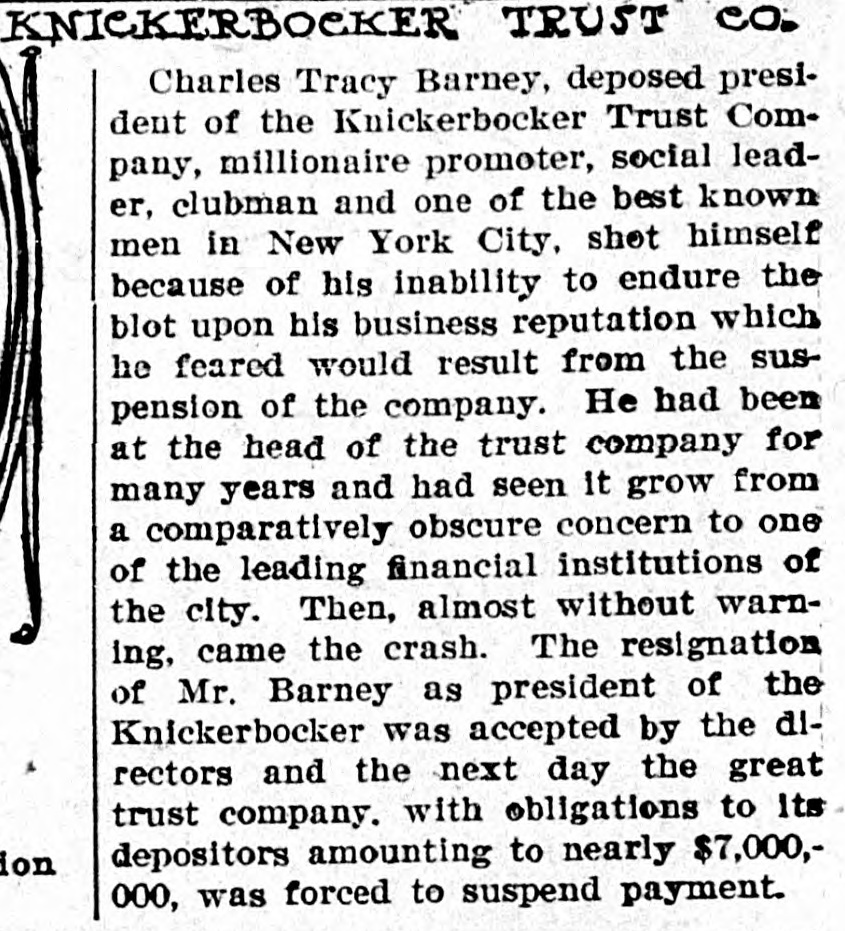
# BARNEY WAS A SUICIDE Ex-President of the Defunct Knickerbocker Trust. NEW YORK, Nov, 15.-Charles T. Barney, former president of the Knickerbocker Trust company, which recently closed its doors, committed suicide in his palatial home here at the northeast corner of Park avenue and Thirty-eighth street. He shot himself shortly before 10 o'clock in the morning and died at 2:30 o'clock. He had made a previous attempt on his life last Monday, but it was unsuccessful. The coroner was not notified of the suicide for some hours, when a man at the Barney residence called the office on the telephone and reported the sudden death of Charles T. Barney, fifty-five years old, a banker, Clerk Charles Burns asked for further details, and Dr. Blake of 601 Madison avenue got on the telephone. The doctor said he had been called to the house and found the banker dead. Death, the doctor said, was due to a pistol shot wound in the stomach. The doctor reported the case ther as one of suicide and not a "sudden death," as a sudden, natural death is usually reported. Mr. Barney had evidently tried to shoot himself through the heart, but his aim was poor, and the bullet entered the stomach on the left side just below the heart. The following statement was issued by George L. Nichols, the dead man's lawyer: "Charles T. Barney died as a result of a self inflicted pistol wound." Mrs. Barney and other members of the family were in the house when they heard the shot. Mr. Barney had got out of bed, dressed and had eaten his breakfast. He lingered about the house for some time and then went up to his bedroom. A few minutes later the servants in the household and the members of the family were startled by the report of the pistol. Ashbel P. Barney rushed upstairs and found his father lying across his bed groaning. He was lifted up and Dr. George A. Dixon, the family physician, was sent for at once. Other physicians came, and they had the dying man's clothing removed so that they might make a close examination. After a consultation they decided to probe for the bullet, and an operating table was improvised and the physicians began their search, but Mr. Barney died before they had finished. Mr. Nichols, personal counsel for Mr. Barney, was hurriedly sent for, and when he arrived he found the house in an uproar. He took charge of the situation at once and insisted that nothing should be said about the tragedy until the surgeons should report. Though some rumors had spread downtown about the affair, it did not become known positively until the report was made to the coroner. Just as soon as the wounded man died Mr. Nichols and the physicians called up the coroner's office and an investigation was begun. Mr. Barney had been under medical treatment for some time for nervous prostration, and the family were greatly alarmed about his condition. On Monday he attempted to jump out of a third story window, but was restrained in time and had been carefully watched since then. It was said that only Wednesday night he was in a condition touching closely on total collapse. The difficulties in which he was placed because of the suspension of the Knickerbocker Trust company were more than he could stand. Mr. Barney is believed to have lost a great part of his fortune in the crash which carried down the Knickerbocker Trust company. He had been rated at many times a millionaire, having inherited $10,000,000 alone from his father. Mr. Barney's undoing came with the disclosures in the Knickerbocker Trust company management, which followed the failure of Otto Heinze & Co. Mr. Barney had been associated with O. F. and E. R. Thomas and Charles W. Morse, and when these three men were eliminated from the banking business suspicion was directed toward the Knickerbocker. The National Bank of Commerce notified the Clearing House association that it would no longer clear for the Knickerbocker. A meeting of the trust companies' directors was hurriedly called, and that night Mr. Barney resigned the presidency. Poor Jones Shut Up. CHICAGO, Nov. 15. John H. Jones,


Article from The Jasper Weekly Courier, November 22, 1907

Click image to open full size in new tab

Article Text

THE LATEST EVENTS OF THE WORLD BRIEFLY TOLD. # NORTH, EAST WEST, SOUTH Foreign Lands, Throughout the Nation and Particularly From the Great Southwest. Governor Haskell made a sharp attack on President Roosevelt in his inaugural address during the ceremonies marking the admission of Oklahoma. Two policemen were injured by bricks, five men were arrested and a number of persons clubbed as the result of a riot and demonstration made by striking street car employes and their friends at Louisville, Ky, Sunday afternoon. In a letter made public and mailed to the governor of every state and territory, President Roosevelt issues the formal call for a special conference at the White House to consider ways and means of best conserving the natural resources of the country. May 13 to 15 is the date set. A complete transformation in the railroad terminal facilities at Washington was effected Sunday, when the old Baltimore & Potomac (Pennsylvania) railroad depot was abandoned and every railroad entering Washington shifted its trains to the new union station. Secretary of the Treasury Cortelyou, with the approval of the president, has announced an issue of Panama canal bonds to the extent of $50,000,000. The treasury will also issue interest-bearing certificates of indebtedness to run for one year, to the extent, if necessary, of $100,000,000. This action is the result of the series of night conferences at the White House. A new star was added to the American flag by the admission formally into the Union of the state of Oklahoma. President Roosevelt at 10:16 o'clock Saturday morning signed the proclamation admitting Oklahoma and Indian Territories jointly as one of the American states. In appending his signature to the proclamation, the president used a pen formed from a quill plucked from the wing of an American eagle. The pen will be deposited with the Oklahoma Historical Society. The Farmers' union warehouse in Houston, Tex., sold 1,000 bales of cotton at 10¾c. This is the third big sale made by the union in the past few weeks of the original 15c cotton. Embargo on grain shipments in the East is raised and railroads are co-operating in moving it for export. Close friends of Charles T. Barney, deposed president of the Knickerbocker Trust Co. of New York, who killed himself, declared that worry over his marital relations had no doubt prompted his act as much as his brooding over the loss of financial prestige. William J. Bryan is willing to be nominated for President or to fight in the ranks, as the Democratic party may wish, according to an announcement which appears in the Commoner. In the editorial Mr. Bryan says he believes a party should thoroughly consider everything before selecting a man to head the national ticket. President Roosevelt has made public a letter in which he explains why the words "In God We Trust" were left off the St. Gaudens coin. The letter was prepared for reply to scores of persons throughout the country who have forwarded protests because of the motto's absence from the new gold pieces, and copies are being mailed. Charles T. Barney, late president of the suspended Knickerbocker Trust Co.of New York City, and prominently identified with many industrial and financial institutions throughout the country, committed suicide Thursday afternoon at his residence in West Thirty-eighth street, shooting himself in the head. Juliette Estelle Prescott Mathis, 68 years old, a writer of songs and verses, formerly a resident of Illinois, died at Los Angeles at the home of her son, Frank C. Prescott, registrar of the United States land office. A movement that is said to be far-reaching among bankers and railway managers is on foot. It is a petition to the interstate commerce commission, through the president, and the state railway boards and the governors of various states, to cease the war on railroads. Rear Admiral Asa Walker of the navy retired on account of having reached the statutory age limit. The directors of the Jamestown exposition unanimously accepted a committee report favoring keeping the exposition open next year, provided $600,000 can be raised by popular subscription. The condition of Premier Campbell-Bannerman continues satisfactory. William Jennings Bryan was the guest of honor at a banquet on the 21st anniversary of the Jefferson Club of Milwaukee at the Plankington house Monday night. Covers were laid for over five hundred guests. Mr. Bryan responded to the toast, "Democracy."


Article from New-York Tribune, December 14, 1907

Click image to open full size in new tab

Article Text

# ICE DIRECTORS TO GO. # American Securities Company to Elect New Board. At a conference of interests identified with the American Ice Securities Company at the office of the Knickerbocker Trust Company yesterday it was agreed that the present board of directors should be succeeded by men representing a majority of the stock of the company as soon as the necessary arrangements could be effected. The new board will consist of Lewis Cass Ledyard, Charles M. Schwab, Isaac Guggenheim, James McCutcheon and George L. Rives, one of the receivers of the Knickerbocker Trust Company. Mr. Ledyard will represent the New York Loan and Improvement Company on the board, and Mr. Rives the Knickerbocker Trust Company, which holds a considerable amount of the stock. The other men mentioned are large individual holders the stock. The present directors are A. H. Barney, a son of the late Charles T. Barney, S. H. Dorr, C. E. Bedford, Walter Lee and H. H. Head. The receivers of the Knickerbocker Trust Company attended the conference, and so did W. M. Oler, president of the American Ice Company. Mr. Rives said that the present directorate was really a dummy board and that it had been thought desirable to have as directors men who represented a majority interest in the stock. He added that while the anuual meeting of the company would not be held until March it was probable that the present members of the board would retire before that time, and that, in fact, Mr. Bedford and Mr. Barney had already signified their willingness to do so. The American Ice Securities Company was incorporated in New Jersey in 1905, to acquire the stock of the American Ice Company. Its authorized capital stock is $20,000,000, of which $19,029,400 is outstanding. Up to January 1 of this year it had acquired 143,383 out of a total of 149,202 shares of the preferred and 234,553 out of a total of 238,711 shares of the common stock of the American Ice Company.


Article from The Caucasian, January 2, 1908

Click image to open full size in new tab

Article Text

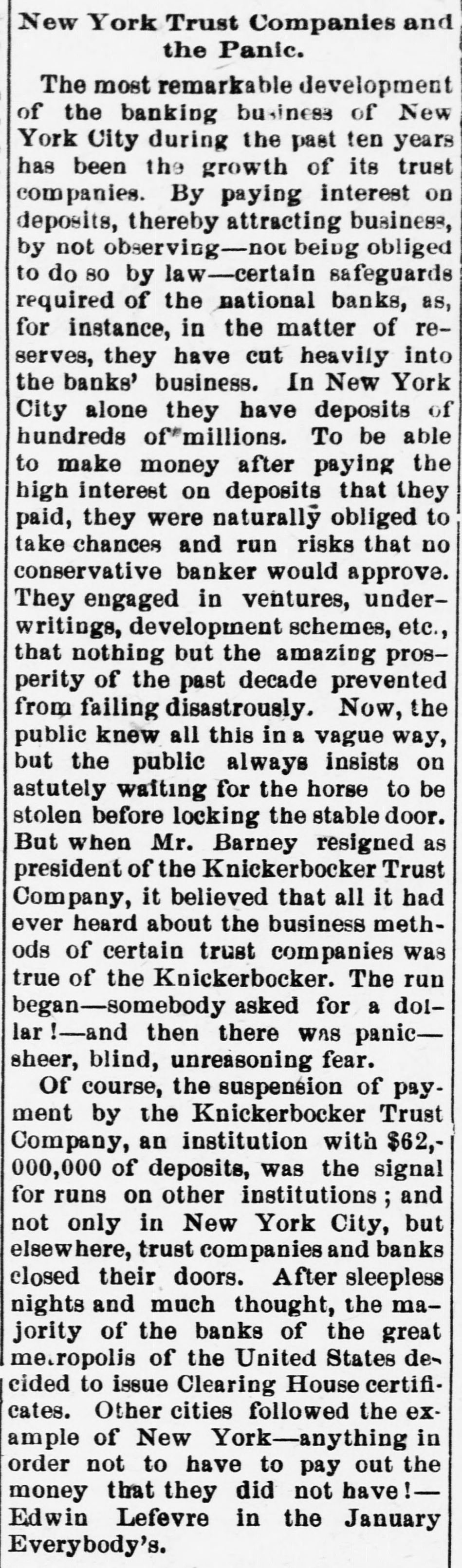
# New York Trust Companies and the Panic. The most remarkable development of the banking business of New York City during the past ten years has been the growth of its trust companies. By paying interest on deposits, thereby attracting business, by not observing—not being obliged to do so by law—certain safeguards required of the national banks, as, for instance, in the matter of reserves, they have cut heavily into the banks' business. In New York City alone they have deposits of hundreds of millions. To be able to make money after paying the high interest on deposits that they paid, they were naturally obliged to take chances and run risks that no conservative banker would approve. They engaged in ventures, underwritings, development schemes, etc., that nothing but the amazing prosperity of the past decade prevented from failing disastrously. Now, the public knew all this in a vague way, but the public always insists on astutely waiting for the horse to be stolen before locking the stable door. But when Mr. Barney resigned as president of the Knickerbocker Trust Company, it believed that all it had ever heard about the business methods of certain trust companies was true of the Knickerbocker. The run began—somebody asked for a dollar!—and then there was panic-sheer, blind, unreasoning fear. Of course, the suspension of payment by the Knickerbocker Trust Company, an institution with $62,000,000 of deposits, was the signal for runs on other institutions; and not only in New York City, but elsewhere, trust companies and banks closed their doors. After sleepless nights and much thought, the majority of the banks of the great metropolis of the United States decided to issue Clearing House certificates. Other cities followed the example of New York—anything in order not to have to pay out the money that they did not have!—Edwin Lefevre in the January Everybody's.


Article from Bisbee Daily Review, February 8, 1908

Click image to open full size in new tab

Article Text

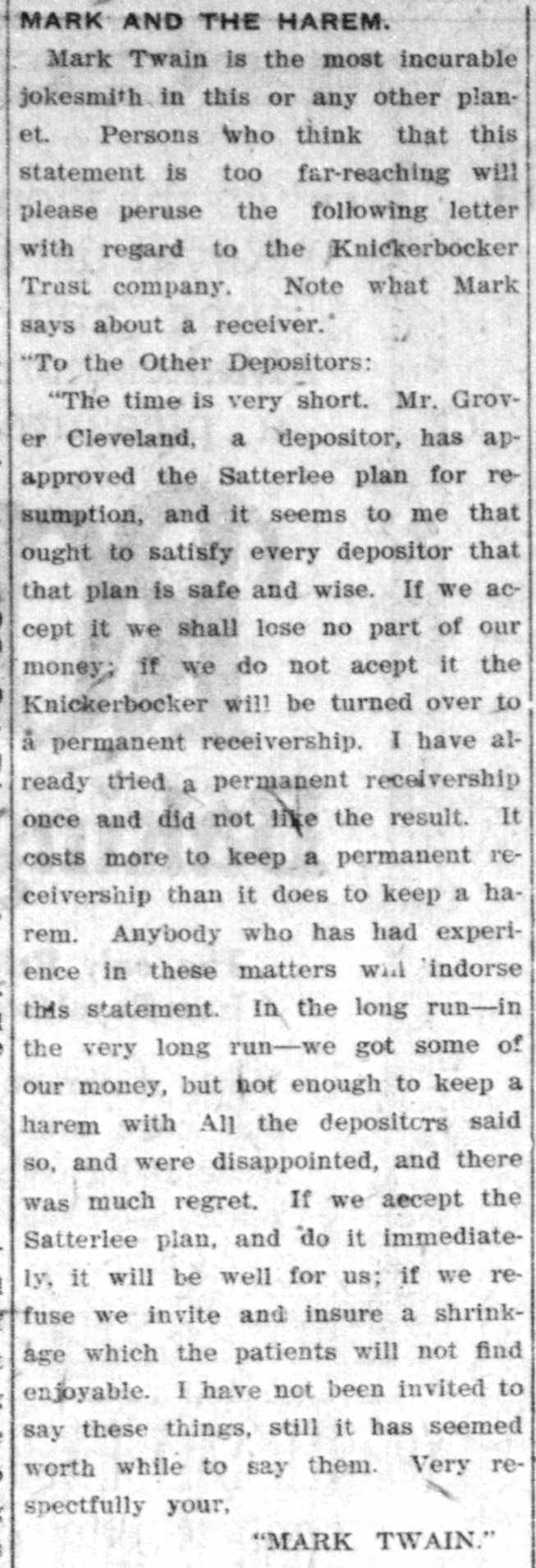
# MARK AND THE HAREM. Mark Twain is the most incurable jokesmith in this or any other planet. Persons who think that this statement is too far-reaching will please peruse the following letter with regard to the Knickerbocker Trust company. Note what Mark says about a receiver." "To the Other Depositors: "The time is very short. Mr. Grover Cleveland, a depositor, has approved the Satterlee plan for resumption, and it seems to me that ought to satisfy every depositor that that plan is safe and wise. If we accept it we shall lose no part of our money; if we do not acept it the Knickerbocker will be turned over to å permanent receivership. I have already tried a permanent receivership once and did not like the result. It costs more to keep a permanent receivership than it does to keep a harem. Anybody who has had experience in these matters wil indorse this statement. In the long run-in the very long run-we got some of our money, but not enough to keep a harem with All the depositors said so, and were disappointed, and there was much regret. If we accept the Satterlee plan, and do it immediately, it will be well for us; if we refuse we invite and insure a shrinkage which the patients will not find enjoyable. I have not been invited to say these things, still it has seemed worth while to say them. Very respectfully your, "MARK TWAIN."


Article from River Falls Journal, March 12, 1908

Click image to open full size in new tab

Article Text

der of the state historical department of Iowa, died at Boone, la. Congressman Adolph Meyer, formerly an assistant adjutant general in the confederate army, died in New Orleans. Giuseppe Alia was placed on trial in the Denver (Col.) criminal court. He shot down Father Leo Heinrichs. An effort is being made before congress to secure a new apportionment of the recompensation now given by the government for the transportation of United States mails by rail. The Point Loma (Cal.) wireless station reported a dispatch for the navy department from Admiral Evans on board his flagship, the Connecticut. Warden Frank Conley of the Deer Lodge (Mont.) state penitentiary was dangerously wounded and his first assistant warden, James Robinson, was killed when three life convicts made a dash for liberty. Japan's ultimatum in the case of the Tatsu Maru has been presented to the Chinese foreign board at Peking, and the board has the matter under consideration. The Tatsu Maru was seized off Macao by Chinese customs cruisers. Gov. Charles E. Hughes was formally indorsed as New York's candidate for president by the Republican state committee at its meeting in New York. The Argentine elections resulted in a complete victory for the existing government. David Waldo, a wealthy horseman well-known throughout the United States, and who formerly owned a race track. was killed near Independence, Mo., in a runaway accident. Raminez Arbelaez, the Colombian charge d'affaires, died at Lima, Peru. The Union Lumber company, St. Paul, Minn., which will take over seven sawmill plants and more than 3,000,000,000 feet of standing timber, has been granted a charter by the Manitoba government. A battle between farmers and three robbers, in which two of the latter were wounded, followed the daring robbery of the post offices at Pedricktown and Bridgeport, N. J. Twenty-six railroad laborers were overcome by gas in the Pennsylvania railroad tunnel at Baltimore, Md. Four died and ten badly affected. The Knickerbocker Trust company, New York, which suspended business at the beginning of the financial panic, resumes business soon. Mme. Anna Gould, who recently secured a divorce from her husband, Count Boni de Castellane, in Paris, denied the report that she married Prince Helie de Sagan. In court at Waukegan, III., a verdict JO tins u! returned SEM $144.00 JO Attorney Philip W. Mothersill against Overseer W. G. Voliva of Zion City. The army auto car, carried a message from Gen. Grant in New York city to Col. R. H. R. Loughborough, commandant at Fort Leavenworth, Kan. Germany's first mammoth war ship was launched at Wilhelmshaven successfully and named Nassau. The supreme court at Nashville, tion law. This law confines the saTenn.. upheld the Nashville segregaloons of the city to a certain territory. Fire destroyed the boys' dormitory at the New Mexico School of Agricul ture at Mesilla park, Tex., and many sleeping students had narrow escapes. While boating on the Appalache stiff B "D S Greens, JBOU puod IIIIII carrying ten people capsized and three young women were drowned. In a fire at Niigata, Japan, 1,500 houses were totally destroyed. the dis trict being swept clean. There was some loss of life. Daniel J. Ainsworth. commander of the revenue cutter Rush, committed suicide at Seattle, Wash. Floods were reported throughout northern Indiana. The Wabash was out of its banks for miles northeast of Lafayette. South Peru was partly under water. Kansas Republicans in state convention at Topeka, Kan., instructed to vote for the nomination of Secretary W. H. Taft for president. United States Senator Redfield Proctor of Vermont died in Washington after a short illness following an attack of grippe. Safe blowers robbed the Mount Orab bank. Mount Orab, O., 40 miles east of Cincinnati, of $3,000 in currency and securities. A complete shut-down of the coal mines in Iowa, worked by 15,000 miners, is threatened. The agreement expires March 31. Three Italians carved Joseph Piraino, a California farmer. almost to pieces, robbed him of $165 and threw him into the Sacramento river. At the New York home of E. H. Harriman it was said that the condition of Miss Carol Harriman. Mr. Har-


Article from The Chickasha Daily Express, March 26, 1908

Click image to open full size in new tab

Article Text

ANOTHER BANK RE-OPENS New York, Mar.26.-Marking another decided step toward the return of prosperity to the metropolis, the Knickerbocker Trust Co., which closed its doors last October, was re-oponed for business at noon today. The bank has assets of over $50,000,000, with liabilities slightly less and there is every likelyhood it will be able to pay all of the 20,000 depositors in full. The reoponing of the Knickerbocker trust company, in accordance with plans for its rehabilitation, prepared after four months lobor by a committee of depositors released to the community assets aggregating $46,370,520. "The reopening of the Knickerbocker Trust company," declared James Russel Seely of the council for the depositors committee, "will have a stimulating effect, not only upon the local financial situation, but upon every financial center on the globe. It is the best thing that has happened since the panic." Justice Clark, in dismissing the temporary receivers of the suspended trust company and signing the resumption order, spoke in commendatory vein of the work of the depositor's committee, counsel and others who had labored 80 assiduously in working out the rehabilitation plan. Under the terms of this plan the depositors of the Knickerbocker Trust company will receive their deposits in full when the company opens its doors


Article from Waterbury Evening Democrat, March 26, 1908

Click image to open full size in new tab

Article Text

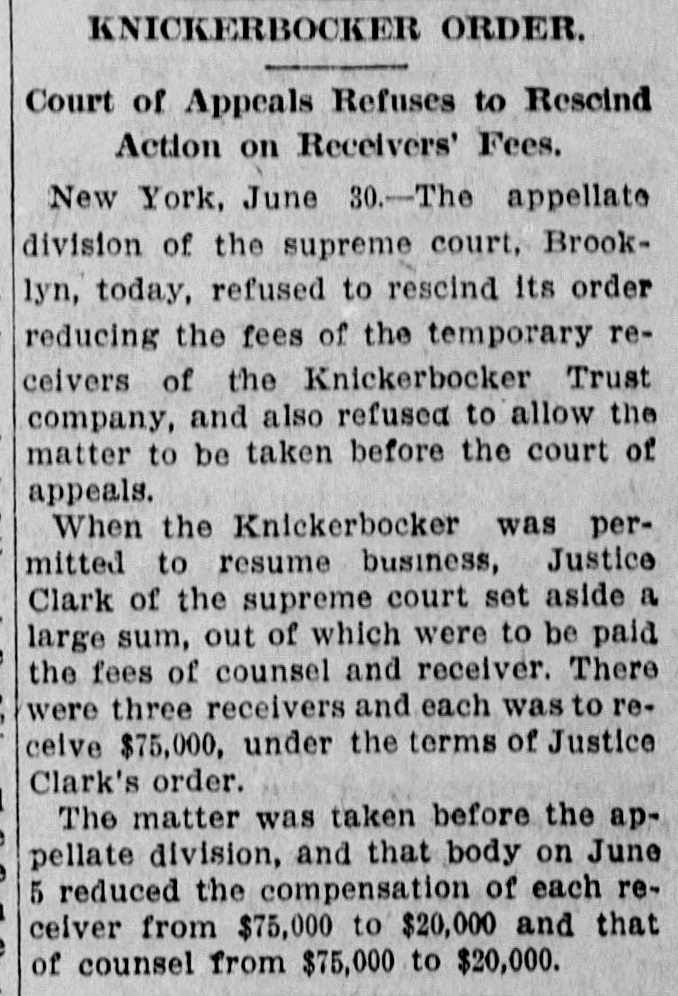
KNICKERBOCKER REOPENS. Court Orders Discharge of Receivers and Names Their Pay. New York, March 26.-The last detail having been settled, the Knickerbocker Trust company reopened its doors, which have remained closed since Oct. 2. The vaults of the main office and its branches are stored with currency, and the company will pay all comers the full amounts to which they are entitled. Depositors whose accounts aggregated about $3,000,000 refused to agree to the resumption plan by which other depositors will be entitled to only 10 per cent for the present, but even if this entire amount is withdrawn it is expected that an even larger amount will be deposited the first day. The receivers of the company were discharged by Justice Lester W. Clark of the supreme court, who also fixed their compensation. The court granted to each of the three receivers $75,000 and to the three counsel $75,000 collectively, thus making $300,000. Justice Clark also decreed that in case the defendant fails within ten days to consent to the above payments the sum of $400,000 be set aside to the receivers' credit to meet such allowances as the court may thereafter decide upon. On the motion to discharge made by George W. Wickersham, counsel for the receivers, $600,000 compensation was asked, that sum being deemed necessary to cover disbursements and transaction of business. It was pointed out that $20,000,000 had been handled in the receivership and that under the law the receivers were entitled to 5 per cent, which would entitle them to fees aggregating $1,000,000. Instead of this, however, the total compensation fixed for three receivers and three counselors was $300,000. Ernest L. Thalman, George L. Rives and Henry C. Ide, receivers, were named in a long typewritten order of Judge Clark and also Herbert L. Satterlee, counsel for the depositors' committee; Julian T. Davies, counsel for the trust company, and George W. Wickersham, counsel for the receivers. In brief Judge Clarke in his order said that the court had been in touch with the administration of the trust company's estate, and he paid a high compliment to the fidelity, delicacy and efficiency with which the receivers and counsel had conducted their business.


Article from Evening Journal, April 16, 1908

Click image to open full size in new tab

Article Text

Editorial Opinion Pay of Receivers. Dover News. The average reader understands that when a business establishment becomes practically bankrupt the courts appoint a "receiver" to take charge of the business. Well, these receivers it appears, are prepared to receive unto themselves as pay for services. all that can possibly be shaken out of receiver hopper. We read that the three receivers of the Knickerbocker Trust Company of New York, received for their services of five months. an average daily compensation of $1000 each. And the three lawyers hired by them $25,000 each additional. This was gigantic receiving from a hopper full of gold. We hardly suppose our Delaware receivers ever strike it so full in the belt. For instance when Receiver Bayard was suing at law for $2.50 Evans' match safe, and selling their stocks and securities at a dollar a peach basket, he must probably have charged a trifle less for his work than $1000 a day.


Article from The Evening Statesman, August 20, 1908

Click image to open full size in new tab

Article Text

BANK PAYS AHEAD. Knickerbocker Trust Depositors Getting Part of Their Money. NEW YORK, Aug. 20.-Prosperity got another boost today when the Knickerbocker Trust company placed at the disposal of depositors, subject to withdrawal, the fourth and fifth installments of its payments under the reorganization plan. These installments fall due on December 26 and February 26, but the present prosperous condition of the institution caused the directors to decide to anticipate the payments. The Knickerbocker Trust company was one of the most important financial institutions to close its doors during the panic last fall. When the bank was reopened, depositors were given time certificates for 70 per cent. of their deposits. Thirty per cent. have now been authorized to be paid, and it is believed that the remaining 40 per cent. will be considerably anticipated. Depositors will lose nothing through the temporary closing of the bank.


Article from The Evening World, March 17, 1909

Click image to open full size in new tab

Article Text

# JACKSON, POOR MAN, HERE TO PRACTISE LAW "Have My Health, Don't Mind the Rest," Former Attorney-General Says. # HE OFFENDED TAMMANY Gave Receiverships to Assistants and Turned Down Organization Selections. Former Attorney General William Schuyler Jackson arrived to-day at the Hotel Latham, No. 4 East Twenty-eighth street, and after registering went out to look up an office in which to follow the profession of law. Mr. Jackson has decided to cast the shadow of his future in the valleys of Manhattan. "A friend says that you take up the practice of law a poor man, and that your living is all in the future?" was asked of Mr. Jackson by an Evening World reporter. "Such is closer to the case than I like to confess," he replied, "but I shall hang out a shingle soon and see if I can earn a living. I had some offers to enter law firms—not the principal ones—but I have elected to go it alone, and as I have my good health. I don't much mind about the rest." He added with a chuckle: "I am a great bellever in myself, and as long as I keep a proper account with myself I don't much care what is said by others." In view of the fact that many of his assistants gathered some wealth through acting as bank receivers the plight of the head of the office is interesting. All of the others appear to be in comfortable berths. Some are connected with big financial interests, while others are still enjoying the profits of the fat receiverships which Jackson gave them. From Dec. 6 until Jan. 29 Jackson was a patient in the Albany Hospital, suffering from typhoid fever. He was near to death at one time, but none of the beneficiaries of his generosity while in office came near him. There was some talk of a dinner to him, but it ceased when Jackson got well enough to journey to South Carolina. They all forgot him—his star was descending. "Your former subordinates all seem to be doing well," was suggested. "I am glad to hear it," replied Jackson. "I tried to help them all—perhaps here is where I mostly failed. I have been told that I should have done more for myself, but I am satisfied. "And, say," he continued, changing the subject immediately, "I discovered a river without any name down in South Carolina, and I got out in a rowboat and put my appetite into that rowboat. Now I am ready to take a fall out of the world, for I have my good health and what more can a man want?" Offended Tammany. The former Attorney-General began his career in Buffalo. His success as an assistant public prosecutor got him the nomisation as Attorney-General on the Democratic ticket. After his election he offended his sponsor, State Chairman "Fingy" Conners, by charging full tilt against a forming telephone trust in Rochester. He began many actions, but finished none, and his final political error was to turn down Charles F. Murphy's Tammany-made receivers for the Knickerbocker Trust Company. The Democratic State Convention was notable for the ice heaped upon Jackson. But Jackson is still a young man. He is now a registered voter of New York County, and he says that he has decided to live out the remainder of his days right here among his chief critics.


Article from The Topeka State Journal, June 7, 1909

Click image to open full size in new tab

Article Text

FROM OTHER PENS # A PRACTICAL PRESIDENT. The American people are exceptionally fortunate in having for president at this time a man whose experience in the departments enables him to deal practically and intelligently with departmental estimates, without hurt to the public service in any department, and who at the same time is broad and keen enough mentally not to fail to discern forces which seem to be making for a disturbance of the balance in the domain of international affairs. More now than at any time in the recent history of this country, experienced, practical statesmanship is needed, and William Howard Taft, schooled by service for his high mission, cool of head, and morally courageous, seems to be ripe and ready for such hard tests as the presidency may impose upon him. By pruning the army estimates he will lessen the strain of the treasury, and possibly open the way for more reasonable and progressive naval expansion; and, finally, naval expansion is the first need, for there are shadows now which seem to foretell the coming of events of colossal concern to this country. Seattle Post-Intelligencer. # LAWYERS AND RECEIVERSHIP. The time was, a few years ago, when the surest way to acquire a big fortune in this or other states was to secure appointment as receiver for some large concern financially embarrassed. Men whose services are never rated above $10,000 a year, and some not half that, would send in bills for hundreds of thousands of dollars for a comparatively short term of service, and would be allowed it. Less than a year ago a New York supreme court justice allowed three receivers and their counsel $75,000 each in the case of the Knickerbocker Trust company, and this was for only five months' work. The appellate court cut the allowance down to $20,000 each. Receivers do not, as a rule, devote all their time to these duties. They usually carry on their own private business in addition; they are guided and protected by the courts in what they do, and there is nothing in their services, generally speaking, of such extraordinary merit as to call for the payment of 10 or 20 times as much as they can earn at their own business or profession in the period of time they are acting as receivers. Newark News. # COLLEGES AND INDUSTRY. The self-made man is prone to worship his maker. Ordinarily he is pathetically ignorant of the construction which gives him so much pride. An example of this truth is furnished by the Chicago millionaire who believes that all the colleges and universities in America should be put to the torch because they are "demoralizing the youth of the country" and teaching them to despise labor. This is an antiquated echo of a sentiment which many "self-made men" expressed half a century ago. College men have long since proved their power in commercial and industrial pursuits in the United States. Enlightened foreign visitors, including a special commissioner of the London Times, have remarked with wonder on the influence of the college man in business life in America. College men are building and managing the railroads of the country, carrying on the executive work of the big corporations, taking the responsible positions in banks and shirking no kind of work. Philadelphia Press.


Article from Mountain Home Maverick, June 10, 1909

Click image to open full size in new tab

Article Text

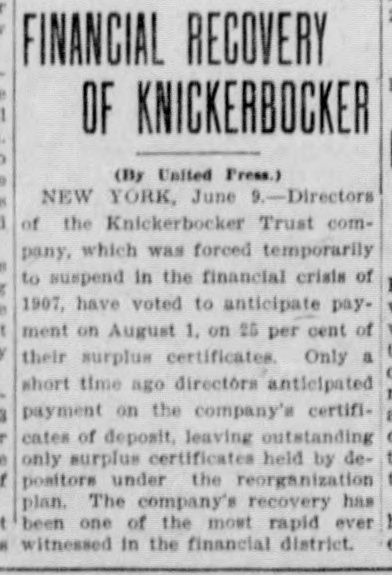
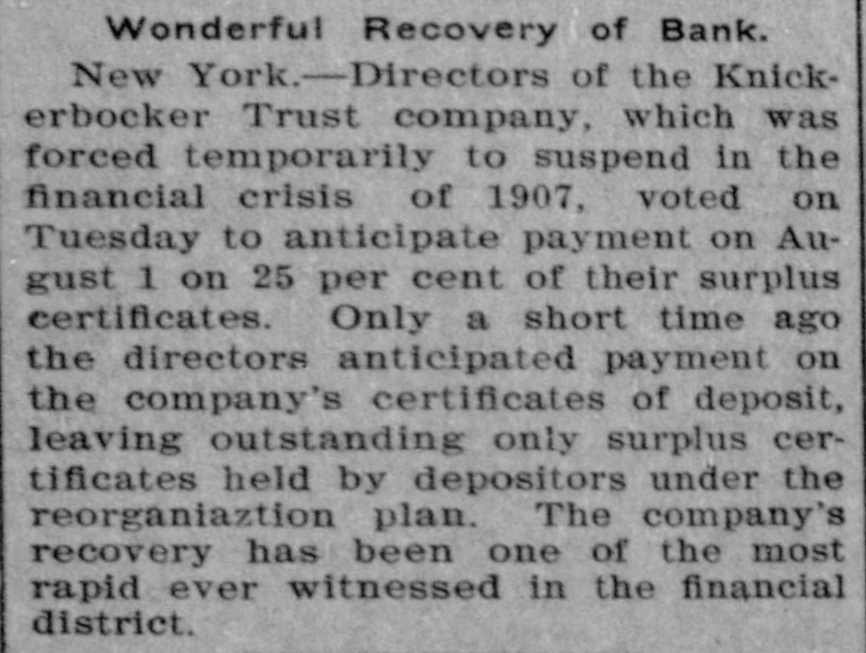
Wonderful Recovery of Bank. New York.-Directors of the Knickerbocker Trust company, which was forced temporarily to suspend in the financial crisis of 1907, voted on Tuesday to anticipate payment on August 1 on 25 per cent of their surplus certificates. Only a short time ago the directors anticipated payment on the company's certificates of deposit, leaving outstanding only surplus certificates held by depositors under the reorganiaztion plan. The company's recovery has been one of the most rapid ever witnessed in the financial district.


Article from Evening Journal, December 8, 1909

Click image to open full size in new tab

Article Text

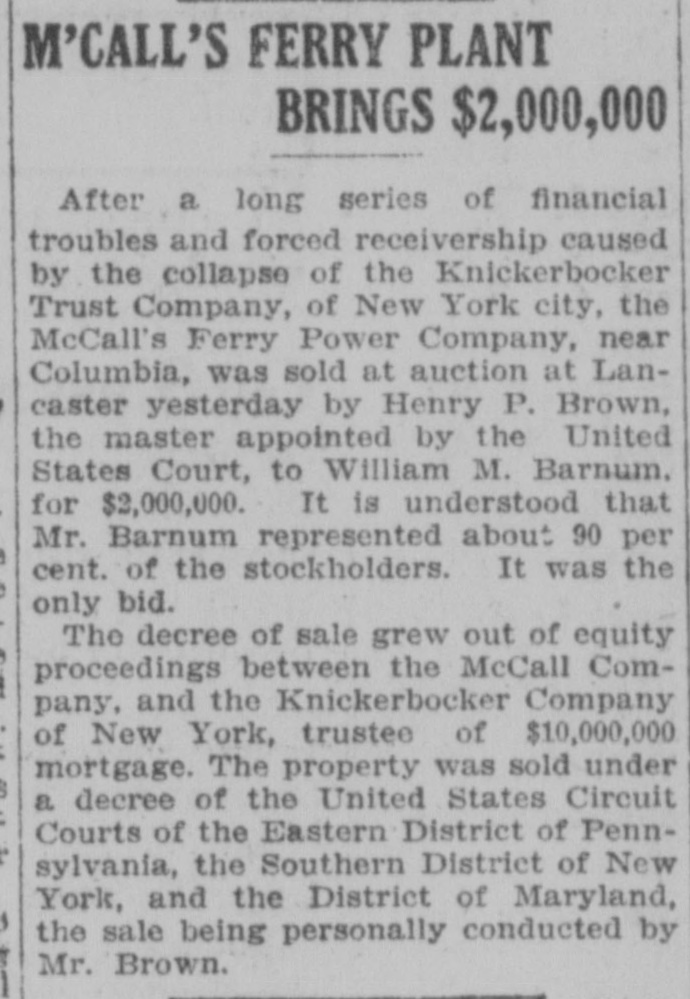
# M'CALL'S FERRY PLANT # BRINGS $2,000,000 After a long series of financial troubles and forced receivership caused by the collapse of the Knickerbocker Trust Company, of New York city, the McCall's Ferry Power Company, near Columbia, was sold at auction at Lancaster yesterday by Henry P. Brown, the master appointed by the United States Court, to William M. Barnum, for $2,000,000. It is understood that Mr. Barnum represented about 90 per cent. of the stockholders. It was the only bid. The decree of sale grew out of equity proceedings between the McCall Company, and the Knickerbocker Company of New York, trustee of $10,000,000 mortgage. The property was sold under a decree of the United States Circuit Courts of the Eastern District of Pennsylvania, the Southern District of New York, and the District of Maryland, the sale being personally conducted by Mr. Brown.