13460. Farmers State Bank (Overton, NE)

Bank Information

Episode Type
Suspension → Closure
Bank Type
state
Start Date
February 14, 1933
Location
Overton, Nebraska (40.739, -99.538)

Metadata

Model
gpt-5-mini
Short Digest
4ad6401f

Response Measures

None

Description

Articles (Feb 1933) describe the bank as insolvent with the state secretary/receiver in possession and litigation over actions by the bank receiver. No article describes a depositor run; the bank was in receivership (i.e., closed) so classified as a suspension leading to closure/receivership.

Events (1)

1. February 14, 1933 Receivership
Newspaper Excerpt
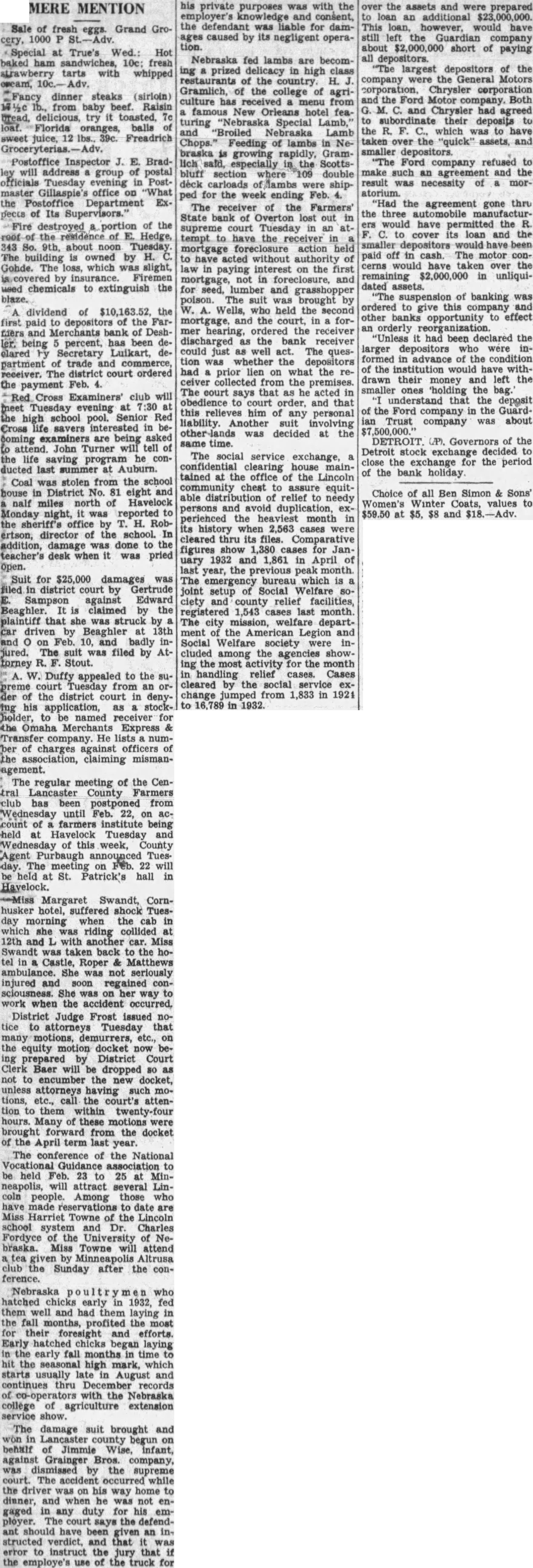
The receiver of the Farmers' State bank of Overton lost out in supreme court Tuesday in an attempt to have the receiver in a mortgage foreclosure action held to have acted without authority of law ... The bank was insolvent and the secretary of the department of trade and commerce was the receiver of the bank.
Source
newspapers

Newspaper Articles (4)

Article from Lincoln Journal Star, February 14, 1933

Click image to open full size in new tab

Article Text

MERE MENTION Sale of fresh eggs. Grand Grocery, 1000 P St.-Adv. Special at True's Wed.: Hot baked ham sandwiches, 10c; fresh strawberry tarts with whipped Fancy dinner steaks (sirloin) from baby beef. Raisin bread, delicious, try it toasted, Florida oranges, balls sweet juice, 12 lbs., 39c. Freadrich Postoffice Inspector J. E. Bradley will address group of postal officials Tuesday evening in Postmaster Gillaspie's office on 'What the Postoffice Department Expects of Its Supervisors." Fire destroyed portion of the roof the residence of E. Hedge, 343 So. 9th, about noon Tuesday. The building is owned by H. Gohde. The loss, which was slight, is.covered by insurance. Firemen used chemicals to extinguish the blaze. dividend of $10,163.52, the first paid to depositors of the FarLiers and Merchants bank of Deshler. being 5 percent, has been declared ry Secretary Luikart, department of trade and commerce, receiver. The district court ordered the payment Feb. 4. Red Cross Examiners' club will meet Tuesday evening at 7:30 at the high school pool. Senior Red Cross life savers interested in becoming examiners are being asked o attend. John Turner will tell of the life saving program he conducted last summer at Auburn. Coal was stolen from the school house in District No. 81 eight and nalf miles north of Havelock Monday night, it was reported to the sheriff's office T. H. Robertson, director of the school. In addition, damage was done to the teacher's desk when it was pried open. Suit for $25,000 damages was filed in district court by Gertrude Sampson against Edward Beaghler. is claimed by the plaintiff that she was struck by car driven by Beaghler at 13th and O on Feb. 10, and badly injured. The suit was filed by Attorney R. F. Stout. A. W. Duffy appealed to the supreme court Tuesday from an order of the district court in denying his application, as stockholder, to be named receiver for the Omaha Merchants Express Transfer company. He lists number of charges against officers of the association, claiming mismanagement. The regular meeting of the Central Lancaster County Farmers club been postponed from Wednesday until Feb. 22, on account of farmers institute being -held at Havelock Tuesday and Wednesday of this week, County Agent Purbaugh announced Tuesday. The meeting on Feb. 22 will be held at St. Patrick's hall in Havelock. Miss Margaret Swandt, Corn'husker hotel, suffered shock Tuesday morning when the cab in which she was riding collided at 12th and with another car. Miss Swandt was taken back to the hotel Castle, Roper & Matthews ambulance. She was not seriously injured and soon regained consciousness. She was on her way to work when the accident occurred. District Judge Frost issued notice to attorneys Tuesday that many motions, demurrers, etc., on the equity motion docket now being prepared by District Court Clerk Baer will be dropped SO as not to encumber the new docket, unless attorneys having such motions, etc., call the court's attention to them within twenty-four hours. Many of these motions were brought forward from the docket of the April term last year. The conference of the National Vocational Guidance association to be held Feb. 23 to 25 at Minneapolis, will attract several Lincoln people. Among those who have made reservations to date are Miss Harriet Towne of the Lincoln school system and Dr. Charles Fordyce of the University of Nebraska. Miss Towne will attend tea given by Minneapolis Altrusa club the Sunday after the conference. Nebraska m who hatched chicks early in 1932, fed them well and had them laying in the fall months, profited the most for their foresight and efforts. Early hatched chicks began laying in the early fall months in time to hit the seasonal high mark, which starts usually late in August and continues thru December records of co-operators with the Nebraska college of agriculture extension service show. The damage suit brought and won in Lancaster county begun on behalf of Jimmie Wise, infant, against Grainger Bros. company, was dismissed by the supreme court. The occurred while the driver was on his way home to dinner, and when he was not engaged in any duty for his employer. The says the defendant have been given an instructed verdict, and that it was error to instruct the jury that if the employe's use of the truck for his private purposes was with the employer's and consent, the defendant was liable for damages caused by its negligent operation. Nebraska fed lambs are becoming a prized in high class of the country. H. Gramlich, of the college of agriculture has received from famous New Orleans hotel featuring "Nebraska Special Lamb,' and "Broiled Nebraska Lamb Chops." Feeding of lambs in Nebraska is growing rapidly, Gramlich sald, especially in the Scottsbluff section where 109 double deck carloads of lambs were shipped for the week ending Feb. The receiver of the Farmers' State bank of Overton lost out in supreme court Tuesday in an attempt to have the receiver in mortgage foreclosure action held to have acted without authority of law in paying interest on the first mortgage, not in foreclosure, and for seed, lumber and grasshopper poison. The suit was brought by W. A. Wells, who held the second mortgage, and the court, in former hearing, ordered the receiver discharged as the bank receiver could just as well act. The question was whether the depositors had prior lien on what the receiver collected from the premises. The eourt says that as he acted in obedience to court order, and that this relieves him of any personal liability. Another suit involving other-lands was decided at the same time. The social service exchange, confidential clearing house maintained at the office of the Lincoln chest to equitable of relief to needy persons and avoid duplication, experienced the heaviest month in its history when 2,563 cases were cleared thru its files. Comparative figures show 1,380 cases for January 1932 and 1,861 in April of last year, the previous peak month. The emergency bureau which is joint setup of Social Welfare society and county relief facilities, registered 1,543 cases last month. The city mission, welfare department of the American Legion and Social Welfare society were included among the agencies showing the most activity for the month in handling relief cases. Cases cleared by the social service exchange jumped from 1,833 in 1924 to 16,789 in 1932. over the assets and were prepared to loan an additional $23,000,000. This loan, however, would have still left the Guardian company about $2,000,000 short of paying all depositors. "The largest depositors of the company were the General Motors corporation, Chrysler corporation and the Ford Motor Both G. M. C. and Chrysler had agreed to subordinate their deposits to the R. F. C., which was to have taken over the "quick" assets, and smaller "The Ford company refused to make such an agreement and the result was necessity of a moratorium. "Had the agreement gone thru the three automobile manufacturers would have permitted the R. F. C. to cover its loan and the smaller would have been paid off in cash. The motor concerns would have taken over the remaining $2,000,000 in unliquidated assets. "The of banking was ordered to give this company and other banks opportunity to effect an orderly reorganization. 'Unless it had been declared the larger depositors who were informed advance of the condition of the institution have withdrawn their money and left the smaller ones 'holding the bag. understand that the deposit of the Ford company in the Guardian Trust company was about 7,500,000." DETROIT. (AP). Governors of the Detroit stock exchange decided to close exchange for the period of the bank holiday Choice of all Ben Simon & Sons' Women's Winter Coats, values to $59.50 at $5, $8 and

Article from Bertrand Herald, February 17, 1933

Click image to open full size in new tab

Article Text

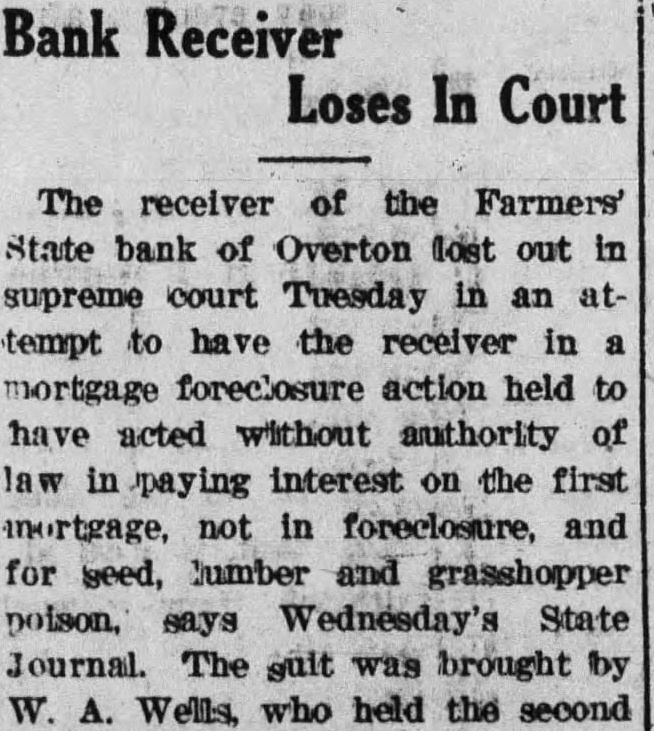
Bank Receiver Loses In Court The receiver of the Farmers' State bank of Overton lost out in supreme court Tuesday in an attempt to have the receiver in a mortgage foreclosure action held to have acted without authority of law in paying interest on the first inortgage, not in foreclosure, and for seed, lumber and grasshopper poison. says Wednesday's State Journal. The suit was brought by W. A. Wells, who held the second


Article from Nebraska Legal News, February 25, 1933

Click image to open full size in new tab

Article Text

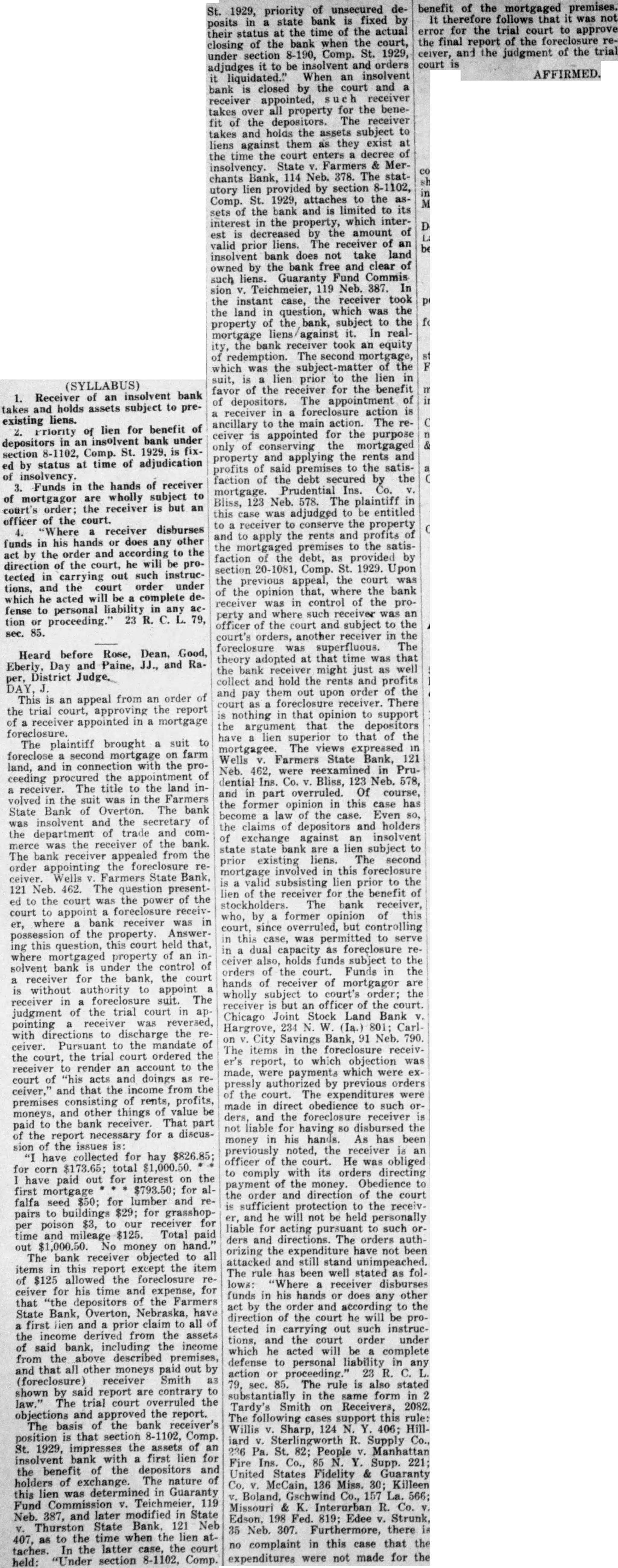
(SYLLABUS) 1. Receiver of an insolvent bank takes and holds assets subject to preexisting liens. Priority of lien for benefit of depositors in an insolvent bank under section Comp. St. 1929, is fixed by status at time of adjudication of insolvency. 3. Funds in the hands of receiver of mortgagor are wholly subject to court's order; the receiver is but an officer of the court. "Where receiver disburses funds in his hands or does any other act by the order and according to the direction of the court, he will be protected in carrying out such instructions, and the court order under which he acted will be complete defense to personal liability in any action or proceeding." 23 85. sec. before Rose, Dean, Good, Heard Eberly, Day and Paine, JJ., and Raper, District Judge._ DAY, This is an appeal from an order of the trial court, approving the report of a receiver appointed in mortgage foreclosure. The plaintiff brought a suit to foreclose a second mortgage on farm land, and in connection with the proceeding procured the appointment of receiver. The title to the land involved in the suit was in the Farmers State Bank of Overton. The bank was insolvent and the secretary of the department of trade and commerce was the receiver of the bank. The bank receiver appealed from the order appointing the foreclosure receiver. Wells Farmers State Bank, 121 Neb. 462. The question presented to the court was the power of the court to appoint foreclosure receiver, where bank receiver was in possession of the property. Answerthis question, this court held that, where mortgaged property of an solvent bank is under the control of receiver for the bank, the court is without authority to appoint receiver in foreclosure suit. The judgment of the trial court in appointing receiver was reversed, with directions discharge the ceiver. Pursuant to the mandate of the court, the trial court ordered the receiver to render an account to the court of "his acts and doings as ceiver," and that the income from the premises consisting of rents, profits, moneys, and other things of value be paid to the bank receiver. That part of the report necessary for a discussion of the issues is: have collected for hay $826.85; for corn $173.65; total have paid out for interest on the first $793.50; for mortgage falfa seed $50; for lumber and pairs to buildings $29; for grasshopper poison $3, to our receiver for time and mileage $125. Total paid out No money on hand. The bank receiver objected to all items in this report except the item of $125 allowed the foreclosure ceiver for his time and expense, for that "the depositors of the Farmers State Bank, Overton, Nebraska, have first lien and prior claim to all of the income derived from the assets of said bank, including the income from the above described premises, and that all other moneys paid out by (foreclosure) receiver Smith shown by said report are contrary to The trial court overruled the objections and approved the report. The basis of the bank receiver's position is that section 8-1102, Comp. St. 1929, impresses the assets of an insolvent bank with first lien for the benefit of the depositors and holders of exchange. The nature of this lien was determined in Guaranty Fund Commission Teichmeier, 119 Neb. 387, and later modified in State Thurston State Bank, 121 Neb 407, as to the time when the lien attaches. In the latter case, the court held: "Under section 8-1102, Comp. St. 1929, priority of unsecured deposits in state bank is fixed by the time of the actual their status at closing of the bank when the court, under section 8-190, Comp. St. 1929, adjudges it to be insolvent and orders When an insolvent it liquidated." bank is closed by the court and receiver appointed, receiver takes over all property for the benefit of the depositors. The receiver takes and holds the assets subject to liens against them as they exist at the time the court enters a decree of insolvency. State Farmers & Merchants Bank, 114 Neb. 378. The statutory lien provided by section Comp. St. 1929, attaches to the sets of the bank and is limited to its interest in the property, which interest is decreased by the amount of valid prior liens. The receiver of an insolvent bank does not take land owned by the bank free and clear of such liens. Guaranty Fund Commis sion Teichmeier, 119 Neb. 387. In the instant case, the receiver took the land in question, which was the property of the bank, subject to the mortgage it. In reality, the bank receiver took an equity of redemption. The second mortgage, which was the of the suit, is lien prior to the lien in favor of the receiver for the benefit of depositors. The appointment of receiver in a foreclosure action is ancillary to the main action. The receiver is appointed for the purpose only of conserving the mortgaged property and applying the rents and profits of said premises to the satisfaction of the debt secured by the mortgage. Prudential Ins. Bliss, 123 Neb. 578. The plaintiff in this case was adjudged to be entitled to a receiver to conserve the property and to apply the rents and profits of the mortgaged premises to the satisfaction the debt, as provided by section Comp. St. 1929. Upon the previous appeal, the court was of the opinion that, where the bank receiver was in control of the property and where such receiver was an officer of the court and subject to the court's orders, another receiver in the foreclosure was superfluous. The theory adopted at that time was that the bank receiver might just as well collect and hold the rents and profits and pay them out upon order of the court as foreclosure receiver. There nothing in that opinion to support the argument that the depositors have a lien superior to that of the mortgagee. The views expressed in Wells V. Farmers State Bank, 121 Neb. 462, were reexamined in Prudential Ins. Co. Bliss, 123 Neb. 578, and in part overruled. Of course, the former opinion in this case has become law of the case. Even so, the claims of depositors and holders of exchange against insolvent state state bank are a lien subject to prior existing liens. The second mortgage involved in this foreclosure a valid subsisting lien prior to the lien of the receiver for the benefit of stockholders. The bank receiver, who, by former opinion of this court, since overruled, but controlling in this case, was permitted to serve in dual capacity as foreclosure receiver also, holds funds subject to the orders of the court. Funds in the hands of receiver of mortgagor are wholly subject to court's order; the receiver is but an officer of the court. Chicago Joint Stock Land Bank Hargrove, 234 801; Carlon City Savings Bank, 91 Neb. 790. The items in the foreclosure receivreport, to which objection was made, were payments which were expressly authorized by previous orders of the court. The expenditures were made in direct obedience to such orders, and the foreclosure receiver not liable for having so disbursed the money in his hands. As has been previously noted, the receiver is an officer of the court. He was obliged to comply with its orders directing payment of the money. Obedience to the order and direction of the court is sufficient protection to the receivand he will not be held personally liable for acting pursuant to such orders and directions. The orders authorizing the expenditure have not been attacked and still stand unimpeached. The rule has been well stated as follows: 'Where receiver disburses funds in his hands or does other act by the order and according to the direction of the court he will be protected in carrying out such instructions, and the court order under which he acted will be complete defense to personal liability in any action or proceeding." 23 R. 79, 85. The rule is also stated substantially in the same form in Tardy's Smith on Receivers, 2082. The following cases support this rule: Willis Sharp, 124 Y. 406; Hilliard R. Supply Co., 236 Pa. St. 82; People Manhattan Fire Ins. Co., 85 Supp. 221; United States Fidelity & Guaranty Co. McCain, 136 Miss. 30; Killeen Boland, Gschwind Co., 157 566; Missouri & Interurban R. Co. Edson, 198 Fed. 819; Edee Strunk, 35 Neb. 307. Furthermore, there no complaint in this case that the expenditures were not made for the benefit of the mortgaged premises. It therefore follows that it was not error for the trial court to approve the final report of the foreclosure receiver, and the judgment of the trial court AFFIRMED.


Article from The Banner-Press, March 2, 1933

Click image to open full size in new tab

Article Text

JOTTED FROM THE JOURNAL Piquant and Pertinent Paragraphs Found in Lincoln Journal. Nebraska fed lambs are becoming a prized delicacy in high class restaurants of the country. H. Gramlich, of the college of agriculture, has received a menu from a famous New Orleans hotel featuring "Nebraska Special Lamb," and "Broiled Nebraska Lamb Chops.' Feeding of lambs in Nebraska is growing rapidly. Gramlich said. Estimating crowds is one thing in which it is difficult to get agreement. One man who sized up the farmer holiday crowd at the state house Thursday noon estimated that less than 1000 took part in the parade, that there were perhaps 1000 more farmers and visitors at the state house who did not take part and that 2000 visitors would have taken them all in A capitol employee estimated the crowd at between 4000 and 5000, while some wilder guesses ran as high as 6000 and 7000. There was something strangely reminiscent of populism days in the holiday march on the state house February 16. The populist movement was, at the start almost entirely from the farms. The holiday group, barring a few hangers on and self seeking individuals, is also farmer. The populist movement, in the end developed a surprising amount of political talent. The newer group has much talent to start with and with the organization complete and in action might bring with it many political surprises. There are traces of friction newer movement and there was much friction among the group that made history in the '90s. The receiver of the Farmers' State Bank of Overton lost out in supreme court in an attempt to have the receiver in a mortgageforeclosure action held to have acted without authority of law in paying interest on the first mortgage, not in foreclosure, and for seed, lumber and grasshopper pol son. The suit was brought by W. A. Wells, who held the second mortgage, and the court, in former hearing, ordered the receiver discharged as the bank receiver could just as well act. The question was whether the depositors had a prior lien on what the receiver collected from the premises. The court says that as he acted in obedience to court order, and that this relieves him of any personal liability It might interest members of the legislature to know that the public has shown more concern over the bills lowering automobile registration fees than anything else before the present session, including the farm moratorium. Many calls to The Journal have been about "What has the legislature decided on for automobile registration" and it is usually the first question the legislatve reporters are asked by their friends The answer is that no fees have yet been fixed, that nobody. not even the legislators themselves, can tell at this time. The house has recommended for passage a bill fixing a set of fees, and the senate has held up the various proposals before it until the house bill reaches it. There will be reduction and those have paid will get refunds. The tale of the $100 bill which went the rounds in a small town paying many debts and in the end proving to be only a counterfeit has met its rival in a true story related by the head of a building material firm in Lincoln. perfect cycle of six transactions between as many firms was completed last week without the transfer of any money or checks and involving only bookkeeping The president of the firm which shall be called A, wrote the following to B firm: "You may debit C on your books with $2057 and credit F. form." Imagine the man's surprise to learn within a few days that a cycle had been completed without any money changing hands and yet everyone was happy. Here is the schedule of payments: B firm paid C firm, C firm in turn paid D firm,-D-paid A firm and A firm paid E firm at Omaha. The Omaha concern paid F company in Lincoln and F company paid B firm with the original letter First Commemorative Coins The silver Columbian half dollar. 1892 and 1893, and the Isabella quarter dollar. struck In 1893. for the World's fair in Chicago, were the first commemorative coins made in the United States. Eight Centuries Old The eighth centenary of Waver ley abbey. 1128-1928, was recently celebrated at Farnham, England The old abbey was the first house to be founded in England by the order of Cistercian monks. Good Friends Take time to select a good 11. brary for the growing boy or girl. Good books at hand in their room will prove fine comrades and they will soon learn to disdain books of low caliber. Statistics of Longevity English people live longer than Americans. Our death rate for adult women is one-third higher than theirs, and for adult men 15 per cent higher.-Woman's Home