13448. Bank of Hudson (Hudson, NY)

Bank Information

Episode Type
Suspension โ†’ Reopening
Bank Type
state
Start Date
July 31, 1819
Location
Hudson, New York (42.253, -73.791)

Metadata

Model
gpt-5-mini
Short Digest
2dadc4162909828c

Response Measures

None

Description

Article (1819) reports the Bank of Hudson no longer redeems its paper in specie (suspension of specie payments). A later (1834) anecdote describes coordinated 'runs' engineered as a political attack but indicates the bank was propped up by specie from another bank, implying it did not permanently fail. No evidence of receivership or permanent closure; suspension followed by continued operations is most consistent.

Events (2)

1. July 31, 1819 Suspension
Cause Details
Article states the bank no longer redeems its paper in specie but gives no explicit cause for suspension of specie payments.
Newspaper Excerpt
The Northern Whig, printed at Hudson, says that this bank no longer redeems its paper in specie, or the bills of other banks.
Source
newspapers
2. * Run
Cause Details
A contemporaneous anecdote (1834) alleges coordinated weekly withdrawals (politically motivated) to break the bank; bank of North America supplied specie to maintain its credit.
Measures
Bank of North America furnished specie weekly to maintain the credit of the Bank of Hudson.
Newspaper Excerpt
Mr. Van Buren ... entered into an agreement ... to collect up the paper of the Bank, and weekly make runs upon it for specie, with a view to break it.
Source
newspapers

Newspaper Articles (2)

Article from Edwardsville Spectator, July 31, 1819

Click image to open full size in new tab

Article Text

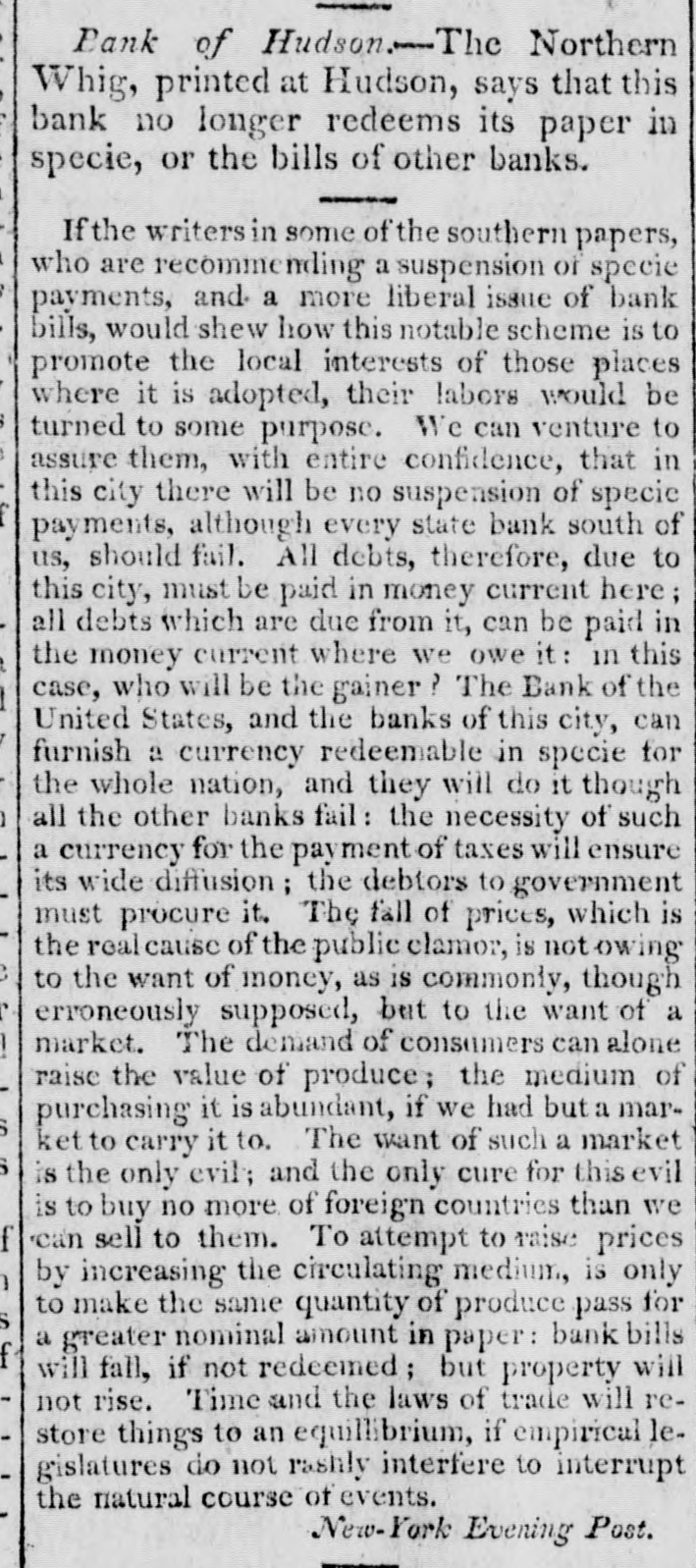
Bank of Hudson. - The Northern Whig, printed at Hudson, says that this bank no longer redeems its paper in specie, or the bills of other banks. If the writers in some of the southern papers, who are recommending a suspension of specie payments, and a more liberal issue of bank bills, would shew how this notable scheme is to promote the local interests of those places where it is adopted, their labors would be turned to some purpose. We can venture to assure them, with entire confidence, that in this city there will be no suspension of specie payments, although every state bank south of us, should fail. All debts, therefore, due to this city, must be paid in money current here; all debts which are due from it, can be paid in the money current where we owe it: in this case, who will be the gainer? The Bank of the United States, and the banks of this city, can furnish a currency redeemable in specie for the whole nation, and they will do it though all the other banks fail: the necessity of such a currency for the payment of taxes will ensure its wide diffusion; the debtors to government must procure it. The fall of prices, which is the real cause of the public clamor, is not owing to the want of money, as is commonly, though erroneously supposed, but to the want of a market. The demand of consumers can alone raise the value of produce; the medium of purchasing it is abundant, if we had but a market to carry it to. The want of such a market is the only evil; and the only cure for this evil is to buy no more of foreign countries than we can sell to them. To attempt to raise prices by increasing the circulating medium, is only to make the same quantity of produce pass for a greater nominal amount in paper: bank bills will fall, if not redeemed; but property will not rise. Time and the laws of trade will restore things to an equilibrium, if empirical legislatures do not rashly interfere to interrupt the natural course of events. New-York Evening Post.

Article from Lynchburg Virginian, November 6, 1834

Click image to open full size in new tab

Article Text

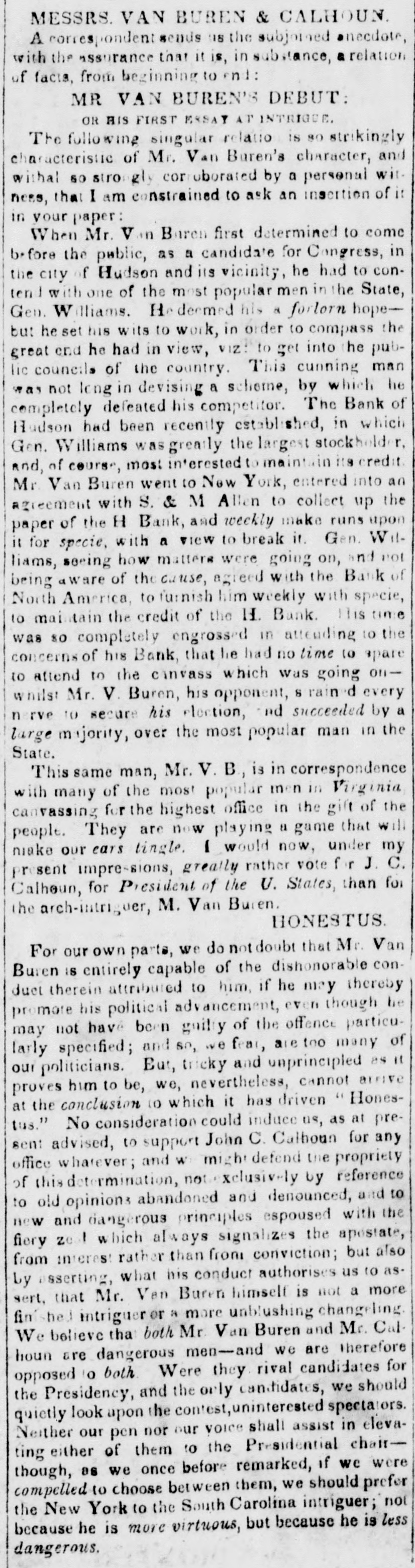
MESSRS. VAN BUREN & CALHOUN. A correspondent sends us the subjoined anecdote, with the assurance that it is, in substance, a relation of facts, from beginning to end: MR VAN BUREN'S DEBUT: OR HIS FIRST ESSAY AT INTRIGEE. The following singular relatio is so strikingly characteristic of Mr. Van Buren's character, and withal so strongly corroborated by a personal witness, that I am constrained to ask an insertion of it in your paper: When Mr. Van Buren first determined to come before the public, as a candidate for Congress, in the city of Hudson and its vicinity, he had to contend with one of the most popular men in the State, Gen. Williams. Hedeemed his a forlorn hope-but he set his wits to work, in order to compass the great end he had in view, viz: to get into the public councils of the country. This cunning man was not long in devising a scheme, by which he completely defeated his competitor. The Bank of Hudson had been recently established, in which Gen. Williams was greatly the largest stockholder, and, of course, most interested to maintain its credit. Mr. Van Buren went to New York, entered into an agreement with S. & M Allen to collect up the paper of the H Bank, and weekly make runs upon it for specie, with a view to break it. Gen. Williams, seeing how matters were going on, and not being aware of the cause, agreed with the Bank of North America, to furnish him weekly with specie, to maintain the credit of the H. Bank. His time was so completely engrossed in attending to the concerns of his Bank, that he had no time to spare to attend to the canvass which was going on-whilst Mr. V. Buren, his opponent, s rained every nerve to secure his election, and succeeded by a large majority, over the most popular man in the State. This same man, Mr. V. B., is in correspondence with many of the most popular men in Virginia canvassing for the highest office in the gift of the people. They are now playing a game that will niake our ears tingle. I would now, under my present impressions, greally rather vote for J. C. Calhoun, for President of the U. States, than for the arch-intriguer, M. Van Buren. HONESTUS. For our own parts, we do not doubt that Mr. Van Buren is entirely capable of the dishonorable conduct therein attributed to him, if he may thereby promote his political advancement, even though he may not have been guilty of the offence particularly specified; and so, we fear, are too many of our politicians. But, tricky and unprincipled as it proves him to be, we, nevertheless, cannot arrive at the conclusion to which it has driven "Honestus." No consideration could induce us, as at present advised, to support John C. Calhoun for any office whatever; and we might defend the propriety of this determination, not exclusively by reference to old opinions abandoned and denounced, and to new and dangerous principles espoused with the fiery ze! which always signalizes the apostate, from interest rather than front conviction; but also by asserting, what his conduct authorises us to assert, that Mr. Van Buren himself is not a more finished intriguer or a more unblushing changeling. We believe that both Mr. Van Buren and Mr. Calhoun are dangerous men-and we are therefore opposed to both. Were they rival candidates for the Presidency, and the orly candidates, we should quietly look apon the contest, uninterested spectators. Neither our pen nor our voice shall assist in elevating either of them to the Presidential chait-though, as we once before remarked, if we were compelled to choose between them, we should prefer the New York to the South Carolina intriguer; not because he is more virtuous, but because he is less dangerous.