13373. First National Bank (Earlville, NY)

Bank Information

Episode Type
Run Only
Bank Type
national
Bank ID
4493
Charter Number
4493
Start Date
June 28, 1911
Location
Earlville, New York (42.741, -75.544)

Metadata

Model
gpt-5-mini
Short Digest
bb1b71095c14f990

Response Measures

Accommodated withdrawals, Borrowed from banks or large institutions, Capital injected, Books examined

Description

Cashier Guy H. Clark admitted a $43,000 shortage in late June 1911, prompting a small run. The bank was described as solvent, borrowed funds from Chenango National Bank (Norwich) to meet withdrawals, and remained open in the reports. Multiple newspapers (June 28–29, 1911) report the event.

Events (3)

1. December 30, 1890 Chartered
Source
historical_nic
2. June 28, 1911 Run
Cause
Bank Specific Adverse Info
Cause Details
Cashier Guy H. Clark admitted a $43,000 shortage/theft and turned over his stock and real estate to the bank as restitution.
Measures
Summoned a bank examiner; borrowed funds from Chenango National Bank (Norwich) to meet withdrawals.
Newspaper Excerpt
The announcement caused a run on the part of depositors. It is certain, however, that the bank is solvent.
Source
newspapers
3. August 28, 1937 Voluntary Liquidation
Source
historical_nic

Newspaper Articles (5)

Article from New-York Tribune, June 29, 1911

Click image to open full size in new tab

Article Text

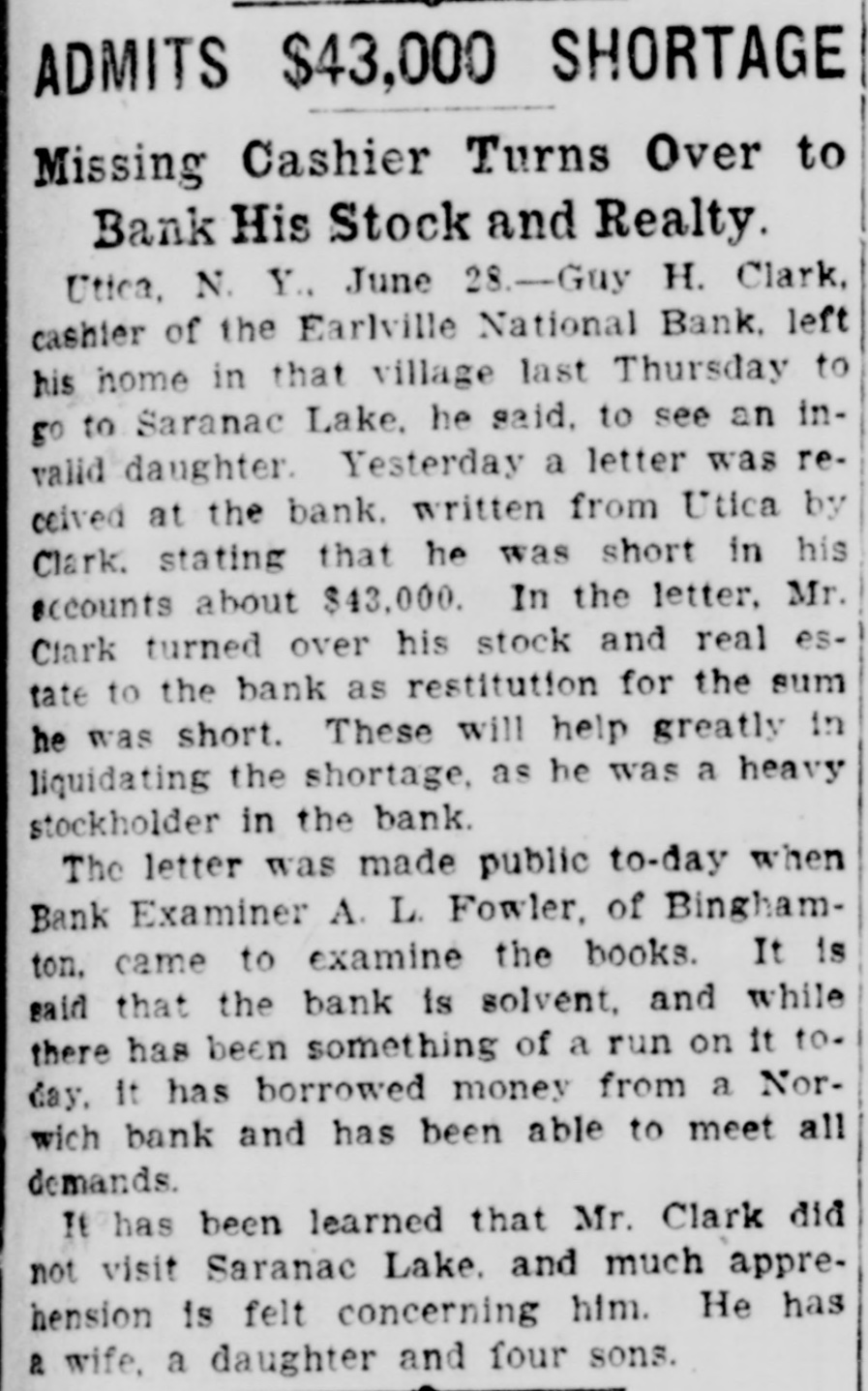
ADMITS $43,000 SHORTAGE Missing Cashier Turns Over to Bank His Stock and Realty. Utica, N. Y., June 28.-Guy H. Clark, cashier of the Earlville National Bank, left his home in that village last Thursday to go to Saranac Lake. he said, to see an invalid daughter. Yesterday a letter was received at the bank. written from Utica by Clark. stating that he was short in his accounts about $43,000. In the letter, Mr. Clark turned over his stock and real estate to the bank as restitution for the sum he was short. These will help greatly in liquidating the shortage, as he was a heavy stockholder in the bank. The letter was made public to-day when Bank Examiner A. L. Fowler, of Binghamton, came to examine the books. It is said that the bank is solvent, and while there has been something of a run on It today, It has borrowed money from a Norwich bank and has been able to meet all demands. It has been learned that Mr. Clark did not visit Saranac Lake. and much apprehension is felt concerning him. He has a wife, a daughter and four sons.


Article from Newark Evening Star and Newark Advertiser, June 29, 1911

Click image to open full size in new tab

Article Text

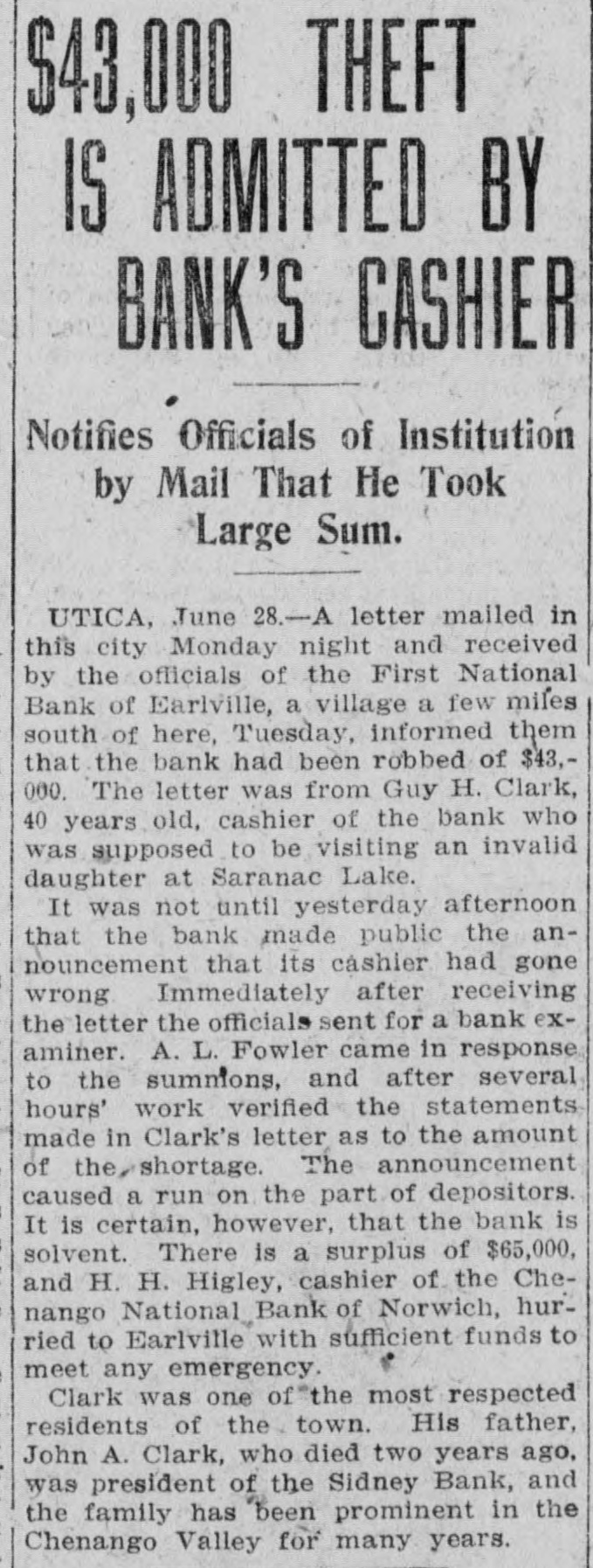
$43,000 THEFT IS ADMITTED BY BANK'S CASHIER Notifies Officials of Institution by Mail That He Took Large Sum. UTICA, June 28.-A letter mailed in this city Monday night and received by the officials of the First National Bank of Earlville, a village a few miles south of here, Tuesday, informed them that the bank had been robbed of $43,000. The letter was from Guy H. Clark, 40 years old, cashier of the bank who was supposed to be visiting an invalid daughter at Saranac Lake. It was not until yesterday afternoon that the bank made public the announcement that its càshier had gone wrong Immediately after receiving the letter the officials sent for a bank examiner. A. L. Fowler came in response to the summons, and after several hours' work verified the statements made in Clark's letter as to the amount of the shortage. The announcement caused a run on the part of depositors. It is certain, however, that the bank is solvent. There is a surplus of $65,000, and H. H. Higley, cashier of the Chenango National Bank of Norwich, hurried to Earlville with sufficient funds to meet any emergency. Clark was one of the most respected residents of the town. His father, John A. Clark, who died two years ago, was president of the Sidney Bank, and the family has been prominent in the Chenango Valley for many years.


Article from The Free Lance, July 1, 1911

Click image to open full size in new tab

Article Text

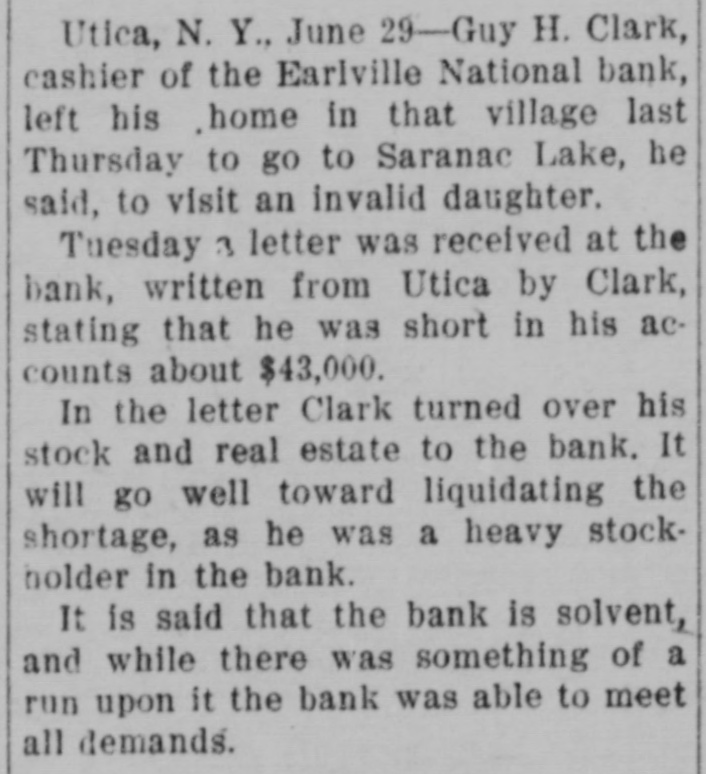
Utica, N. Y., June 29-Guy H. Clark, cashier of the Earlville National bank, left his home in that village last Thursday to go to Saranac Lake, he said, to visit an invalid daughter. Tuesday 3 letter was received at the bank, written from Utica by Clark, stating that he was short in his accounts about $43,000. In the letter Clark turned over his stock and real estate to the bank. It will go well toward liquidating the shortage, as he was a heavy stockholder in the bank. It is said that the bank is solvent, and while there was something of a run upon it the bank was able to meet all demands.


Article from Martinsburg Herald, July 1, 1911

Click image to open full size in new tab

Article Text

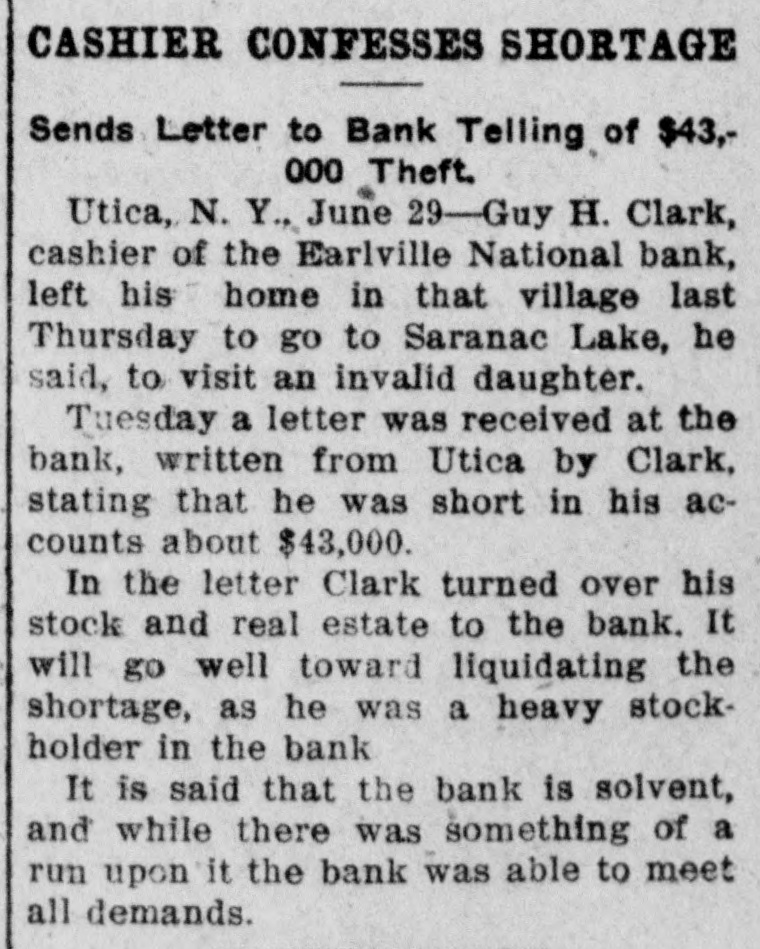
CASHIER CONFESSES SHORTAGE Sends Letter to Bank Telling of $43,000 Theft. Utica, N. Y., June 29-Guy H. Clark, cashier of the Earlville National bank, left his home in that village last Thursday to go to Saranac Lake, he said, to visit an invalid daughter. Tuesday a letter was received at the bank, written from Utica by Clark, stating that he was short in his accounts about $43,000. In the letter Clark turned over his stock and real estate to the bank. It will go well toward liquidating the shortage, as he was a heavy stockholder in the bank It is said that the bank is solvent, and while there was something of a run upon it the bank was able to meet all demands.


Article from The Olneyville Times, July 7, 1911

Click image to open full size in new tab

Article Text

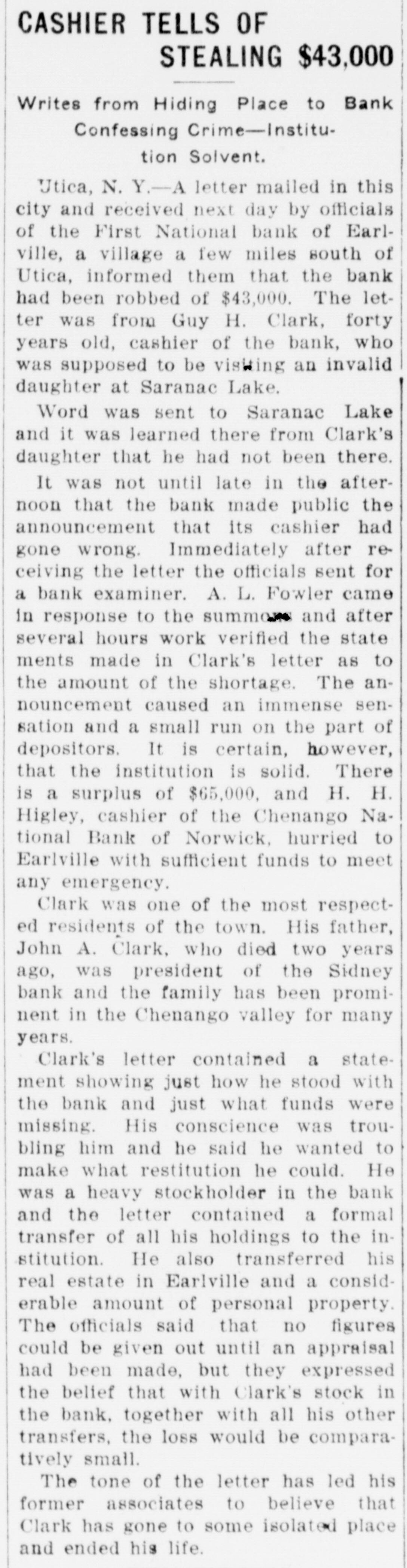
CASHIER TELLS OF STEALING $43,000 Writes from Hiding Place to Bank Confessing Crime-Institution Solvent. Utica, N. Y.-A letter mailed in this city and received next day by officials of the First National bank of Earlville, a village a few miles south of Utica, informed them that the bank had been robbed of $43,000. The letter was from Guy H. Clark, forty years old, cashier of the bank, who was supposed to be visiting an invalid daughter at Saranac Lake. Word was sent to Saranac Lake and it was learned there from Clark's daughter that he had not been there. It was not until late in the afternoon that the bank made public the announcement that its cashier had gone wrong. Immediately after receiving the letter the officials sent for a bank examiner. A. L. Fowler came in response to the summe and after several hours work verified the state ments made in Clark's letter as to the amount of the shortage. The announcement caused an immense sensation and a small run on the part of depositors. It is certain, however, that the institution is solid. There is a surplus of $65,000, and H. H. Higley, cashier of the Chenango National Bank of Norwick, hurried to Earlville with sufficient funds to meet any emergency. Clark was one of the most respected residents of the town. His father, John A. Clark, who died two years ago, was president of the Sidney bank and the family has been prominent in the Chenango valley for many years. Clark's letter contained a statement showing just how he stood with the bank and just what funds were missing. His conscience was troubling him and he said he wanted to make what restitution he could. He was a heavy stockholder in the bank and the letter contained a formal transfer of all his holdings to the institution. He also transferred his real estate in Earlville and a considerable amount of personal property. The officials said that no figures could be given out until an appraisal had been made, but they expressed the belief that with Clark's stock in the bank, together with all his other transfers, the loss would be comparatively small. The tone of the letter has led his former associates to believe that Clark has gone to some isolated place and ended his life.