Standard National Bank (Chicago, IL)

Episode Information

Episode UID
1337201590
Episode Type
Suspension โ†’ Closure
Bank Type
national
Bank ID
133720 national
Charter Number
13372
Start Date
June 21, 1932
Location
Chicago, Illinois (41.850, -87.650)

Metadata

Model
gpt-5-mini (chosen from majority vote of a three-model LLM ensemble)
Short Digest
accd248afcd9da75

Response Measures

None

Receivership Details

Depositor recovery rate
100.0%
Date receivership started
1932-06-25
Date receivership terminated
1936-07-25
Share of assets assessed as good
12.9%
Share of assets assessed as doubtful
72.7%
Share of assets assessed as worthless
14.4%

Description

Bank closed June 21, 1932 and later had a receiver who paid final dividend; article does not describe a discrete run on this specific bank.

Events (4)

1. September 9, 1929 Chartered
Source
historical_nic
2. June 21, 1932 Receivership
Newspaper Excerpt
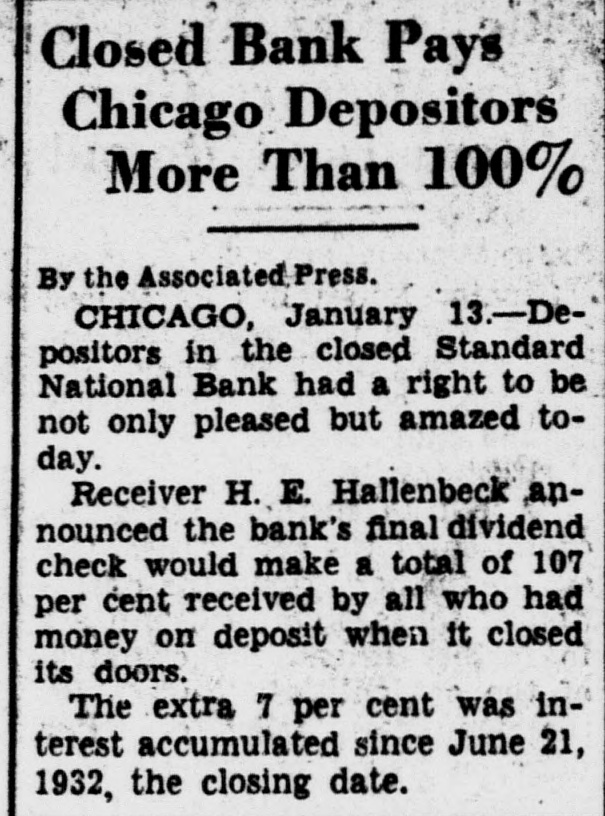
Depositors in the closed Standard National Bank... Receiver H. E. Hallenbeck announced the bank's final dividend... interest accumulated since June 21, 1932, the closing date. (1936-01-13 article describing receiver's final dividend).
Source
newspapers
3. June 21, 1932 Suspension
Cause
Government Action
Cause Details
Bank closed on June 21, 1932 (examiner/board action leading to closure); article does not describe a specific run causing the suspension.
Newspaper Excerpt
The Standard National bank of Chicago, 7921 South Ashland avenue, was closed.
Source
newspapers
4. June 25, 1932 Receivership
Source
historical_nic

Newspaper Articles (9)

Article from Chicago Tribune, June 22, 1932

Click image to open full size in new tab

Article Text

PHILLIP STATE BANK IN ROGERS PARK IS CLOSED Two National Banks of Chicago Shut Doors. The Phillip State Bank and Trust company, 7001 North Clark street, was closed by the auditor yesterday at the request of the board of directors. The bank was capitalized at $500,000 and its surplus and un. divided profit account was carried $285,000. Its deposits at the time of closing were $2,100,000. There had been heavy withdrawals in recent weeks. Trust Company Taken Over. The bank on June 2 acquired the Cook County Trust from Moe Rosenberg, side Democrat politician, through the purchase of $200,000 of preferred stock and 10,000 shares of stock. A year in July 1931, the bank assumed the liabilities of the Illinois State bank, which closed owing $385,000. The Illinois State bank was neighboring bank and the assumption of its debts was declared by Phillip bank officials to be contribution to the of Rogers Park." C. A. Beutel was president of the Phillip bank and Barnet L. Rossett was chairman of the board. Two National Banks Closed. Two national banks were closed yes. terday. One was the Peoples Bank and Trust 1542 West 47th street. The board of directors asked A. P. Leyburn, national bank examiner, to close the doors of the bank. It had deposits of $3,007,000, capital of $1,000,000, surplus of $250, 000 and undivided profits of $110,000. The bank had deposits of $12,000,000 in June, 1930. The Standard National bank of Chi. cago, 7921 South Ashland avenue, was closed. This bank had capital of $300,000, surplus of $25,000 and deposits of $300,000.

Article from The Great Falls Leader, July 28, 1932

Click image to open full size in new tab

Article Text

FOSTER DENIES REDS BACKING BANK ATTACK CHICAGO, July 28.-(P)-Authors of communistic propaganda found in a Pontiac, Mich., hotel were sought today by the secret service and detectives everywhere as the directors of a nationwide campaign against the confidence of bank depositors. Chicago bankers, government officials and Michigan police unhesttatingly blamed the communist party for systematized attack on the Integrity of financial institutions in many large cities, particularly the runs which threatened every bank in Chicago last month. It was said by C. L. Smith, prosecuting attorney at Pontiac, to have been backed by sovlet Russia. William Z. Foster. communist candidate for president, denied his organization had sponsored whispering campaign against the First National bank of Pontiac. or that man known as George Rowland. in whose room seditious letters found. was member of the party. Illinois' drastic sedition law. providing 20 years' imprisonment and directed against "anyone who advocates reformation of the government by violence or any other unlawful means," was eyed as the handlest weapon should any radicals be caught (Continued on Page Two)


Article from The Merrill Daily Herald, July 28, 1932

Click image to open full size in new tab

Article Text

BLAMED CAMPAIGN Melvin Head, Believes Plot found were sought today by the everywhere directors against the confidence Chicago officials Michigan police blamed the Communist party for attack the integrity financial institutions in many large cities, particularly the runs which every bank Chicago last month It said by prosecuting attorney Pontiac, have been backed by Soviet Russia William Foster. Communist candidate for president, denied organization had sponsored whisagainst the First pering campaign National bank Pontiac, that man known George ist whose room seditious was member of the party. 'Rowland,' believed today to be really George E. once candidate for president Queens Borough New York City and with record for criminal Michigan since last in August. Illinois' drastic sedition law. 20 years imprisonment and directed against "anyone who advocates the violence or any other ernment by unlawful means, was eyed as the should any radihandiest weapon caught and connected be the Pontiac more than the caused ing two in citadels soundest store upwards of order to meet cash on hand in mands of longer The situation definitely acute, appeared the Pontiac let references from Chicago, advising sent "much that there and progress on jugs in president of Melvin National bank and the First American Bankers head of the association, er blamed the 'radicals, "plot to be he believed the he said that he had and cities that ports from many used in frightenilar system was teledepositors by anonymous ing messages. bankers told how Other Chicago 300 400 bank radicals opened withdrew them accounts and en spreading news simultaneously, the


Article from Finger Lakes Times, July 28, 1932

Click image to open full size in new tab

Article Text

Begun for Authors of Red Propaganda Chicago Bankers, Government Officials and Michigan Police Unhesitatingly Blame Communist Party for Systematized Attack on Integrity of Financial Institutions in Many Large Cities Chicago, July communistic propaganda found Pontiac, Mich., hotel were sought today by the secret service and detectives everywhere the directors of campaign against the confidence bank depositors. Chicago bankers, government ficials and Michigan police unhesitatingly blamed the communist party systematized attack the integrity financial institutions in many large cities, particthe runs which threatened every bank Chicago month. said by Smith, prosecuting attorney Pontiac, have been backed by Soviet RusWilliam Foster, communist candidate for president, denied his organization had sponsored whispering campaign against the first national bank of Pontiac, or that man known as George Rowland, in whose room seditious letters were found, was member the party. "Rowland," was believed today really to be George Powers, once candidate for president Queens borough in York City with record for criminal syndicalism in Michigan since last August. He escaped police trap his raided hotel room and became object national dragnet. Illinois' drastic sedition viding 20 years imprisonment and directed against "anyone advocates reformation of ment by violence any lawful means," eyed the handiest weapon should any radicaught and connected with the Pontiac literature For letters signed "Yours for the revolution," and some discussed bringing about the unrest which will lead Chicago's June bank runs closed more than 40 includtwo in the loop, and caused city's citato store upwards of $100,000,000 in cash hand in order meet demands of depositors. The situation here. no longer acute, appeared definitely linked with in the Pontiac letters sent from Chicago, advising "Rowland" that there was "much progress here" and "considerable runs jugs in Melvin Traylor, president of the First Bank formhead the American Bankers Association, blamed the "radicals He said believed the "plot and that he had reports from many cities that similar system was used frightening depositors by anonymous telephone messages. Rowland's letters told of plan, discussed but abandoned, simultaneous many key cities. Other Chicago bankers radicals opened 400 bank accounts and then withdrew them simultaneously, spreading news of the The American vigilant intellifederation identified rade H. Rowland's Cleveland correspondent, Harry Gannes, director agitation and propaganda for the New They said he in Chicaduring 1931 when bank runs first became serious. Rowland's Chicago formant, they said, Herbert Newton, alias Gilmer Brady, with offices communist headquarters in West Madison St indicted in Atlanta for criminal syndicalism and studying sociology the Univerof Chicago. The federal seditious conspiracy makes force essential to prosecution for attempts to overthrow the government. Federal the service has jurisdiction over rumors against banks but that most state laws make them crimes.


Article from St. Joseph News-Press, July 28, 1932

Click image to open full size in new tab

Article Text

BANK PLOTTERS SOUGHT. Widespread Search Made for Men Traced to Pontiac, Mich. CHICAGO. July of Communistic propaganda found in Pontiac, Mich., hotel were sought today by the secret service and everywhere as the directors of against the confidence of bank depositors. Chicago bankers, government officials and Michigan police unhesitatingly blamed the Communist party for systematized attack on the integrity of financial institutions in many large cities, particularly the runs which every bank in Chicago last month. It was said by prosecuting attorney at Pontac, to have been backed by soviet William Z. Foster, Communist candidate for president, denied his organization had sponsored pering against the First National Bank of Pontiac, or that man known as George Rowland, in whose room seditious letters were found, was a. member of the party.


Article from Los Angeles Evening Citizen News, July 28, 1932

Click image to open full size in new tab

Article Text

NET SPREAD RED BANK PLOT CHICAGO July 28 Authors of Communistic propaganda found sought today by the secret service and detactives everywhere as directors nationwide campaign against the confidence of bank depositors. Chicago bankers government of ficials and Michigan police unhesitatingly blamed the Communist party for systematized attack on the integrity of financial institutions many large cities. particularly the runs which threatened every bank in Chicago last month. It was said by C. L. Smith, pros ecuting attorney at Pontiac to have been backed by Soviet Rus William Z. Foster Communist candidate for President, denied that his organization had sponsored whispering campaign against the First National Bank of Pontiac, or that man known as George Row ters were found. was member of the party Illinois' drastic sedition law provides 20 years imprisonment for "anyone who advocates reformation of the government by violence or any other unlawful means." Chicago's June bank rons closed more than 40 institutions and caused the city's soundest financial citadels to store upwards of $100.000,000 in cash on hand in order to meet demands of depositors. The situation here. no longer acute, appeared definitely linked with references in the Pontiac let ters sent from Chicago, advising 'Rowland' that there was "much progress here" and runs on jugs in loop."


Article from The Evansville Journal, July 28, 1932

Click image to open full size in new tab

Article Text

BANK BREAKERS ARE SOUGHT BY U. S. AND STATE COMMUNIST INFLUENCE IS OPENLY H ARGED AS RING IS EXPOSED CHICAGO, July 28-(AP) of communistic propaganda found in Pontiac, Mich., hotel were sought today by the secret service and detectives everywhere as the directors of nationwide campaign against the confidence of bank depositors. Chicago bankers, government officials, and Michigan police unhesitatingly blamed the communist party for systematized attack on the integrity of financial institutions in many large cities, particularly the runs which threatened every bank in Chicago last month. It was said by C. Smith. prosecuting attorney at Pontiac, have been backed by soviet Russia. Foster Denies Connection William z. Foster, cominunist candidate for president, denied his organization had sponsored whispering campaign against the First National bank of Pontiac, or that man known as George Rowland, in whose room seditious letters were found, was member of the party "Rowland, was believed today to be really George E. Powers, once candidate for president of Queens borough in New York City and with record for criminal syndicalism Michigan since last August. He escaped police trap 20 Year Penalty Illinois' drastic sedition law, providing 20 years' imprisonment and directed against "anyone who advocates reformation of the government by violence or any other unlawful means,' was eyed as the handiest weapon should any radicals be caught and connected with the Pontiac literature Chicago's June bank runs closed more than 40 institutions, including two in the Loop, and caused the city's soundest financial citadels to store upwards of $100,000,000 in cash on hand in order to meet demands of depositors.


Article from Henryetta Daily Free-Lance, July 29, 1932

Click image to open full size in new tab

Article Text

NATION SCOURED FOR AUTHORS OF BANK RUN PLOT CHICAGO, July 20.--Authors of ommunistic propaganda found in a Pontiac, Mich., hotel are being sought by the secret service and detectives everywher as the directors of a nation-wide campaign against the confednce of bank depositors. Chicago bankers, government officials and Mi higan police unhesitatingly blamed the Communist party for systematized attack on the intgrity of finan instituions in many large cities. parti ularly the runs which threatened every bank in Chicago last month. It was said by C.L. Smith, prosecuting attorney at Pontiac to have been backed by Soviet Russia. Norman Z. Foster, communist candidate for president. denied his organiaztion had sponsored a whispering campaign against the First National bank of Pontiac. or that a man known as George Rowland, in whose room seditious letters were found, was member of the party Illinois's drastic sedition law. providing 20 years imprisonment and directed against "anyone who advocates reformation of the government by violence or any other unlawful means, was eyed as the handiest weapon should any radicals be caught and connected with the Pontiac literature. For the letters were signed "yours for the revolution.' and some disussed "bringing about the unrest which will lead to the revolution." Chicago's June bank runs closed more than 40 institutions, including two in the Loop. and caused the city's soundest financial citadels to store upward of $100,000,000 in cash on hand in order to meet demands of The situation here, no longer acute, appeared definitely linked with ref erences in the Pontia: letters sent from Chicago, advising "Rowland" that there was "much progress here" and "considerable runs on jugs in Loop." Rowland's letters told of a plan. discussed but abandoned, of starting simultaneous runs in many key cities.


Article from Evening Star, January 13, 1936

Click image to open full size in new tab

Article Text

Closed Bank Pays Chicago Depositors More Than 100% By the Associated Press. CHICAGO, January 13.-Depositors in the closed Standard National Bank had a right to be not only pleased but amazed today. Receiver H. E. Hallenbeck announced the bank's final dividend check would make a total of 107 per cent received by all who had money on deposit when it closed its doors. The extra 7 per cent was interest accumulated since June 21, 1932, the closing date.