Click image to open full size in new tab
Article Text
Girl Speedsters
Paving Worn Out and Replaced But 40-Year-Old Bonds Unpaid and Roller Pin Hurlers Vie at Picnic SAVE MONEY IN TAXPAYERS MUST MEET OF STATE BANK HEAVY COST
Retirement Appropriation, Interest Nearly Equals Government Levy of 1933
Omaha taxpayers are still paying for street improvements made 40 years ago. Paving laid in 1892 has not yet been paid for. In several instances, the 40year-old pavements have been worn out and have been replaced. In two or three cases, new paving, which replaced that laid 40 years ago, has actually been paid for full, while the older paving will not be paid for in full until next year. The city failed to pay 20-year bonds issued 40 years ago to pay for the street improvements, when they became due about 1912 They refunded at that time and new 20-year bonds were issued. The latter are coming due The result of the old refunding system is that Omaha taxpayers will have paid out by the end of 1933 approximately $2,000,000 in interest and principal for street improvements that originally cost about $800,000 CITY SPENT MONEY According to the records, most of the special assessments levied to pay for the old street improvements were pard by the property owners against whose property the assessments was made Apparently the money received was used for other purposes instead of being used to retire bonds In other words, at some time during the past 40 years the Omaha city government was using bond money to finance its running expenses or for paying for other public improvements. property owner who paid all the special assessments levied against his real estate to pay for the 40-year-old street improvements has also been contributing his share of interest on these old bonds for the past years. This year the city has retired or will retire $240,000 worth of 40-year-old paving and street im provement bonds and in 1933 will pay off $584,000 worth of old bonds. NEED BIG LEVY The present city charter prohibits the city refunding any bonds: They must all be paid when due. Because that law is in effect, Omaha in 1933 must pay $1,359 000 worth of bonds. Of that sum, 43 per cent will be required to pay for the bonds first issued 40 years ago. Interest payments on bonds for 1933 will total more than $600,000. Next year's bond payments will be the heaviest Omaha will be called upon to make for the next 20 years provided the city does not issue some short-term bonds in that period. Almost $2,000,000 will be paid in bonds and interest Appropriations for hond retirement and interest next year will be almost as large as the appropriations required to run the entire city government
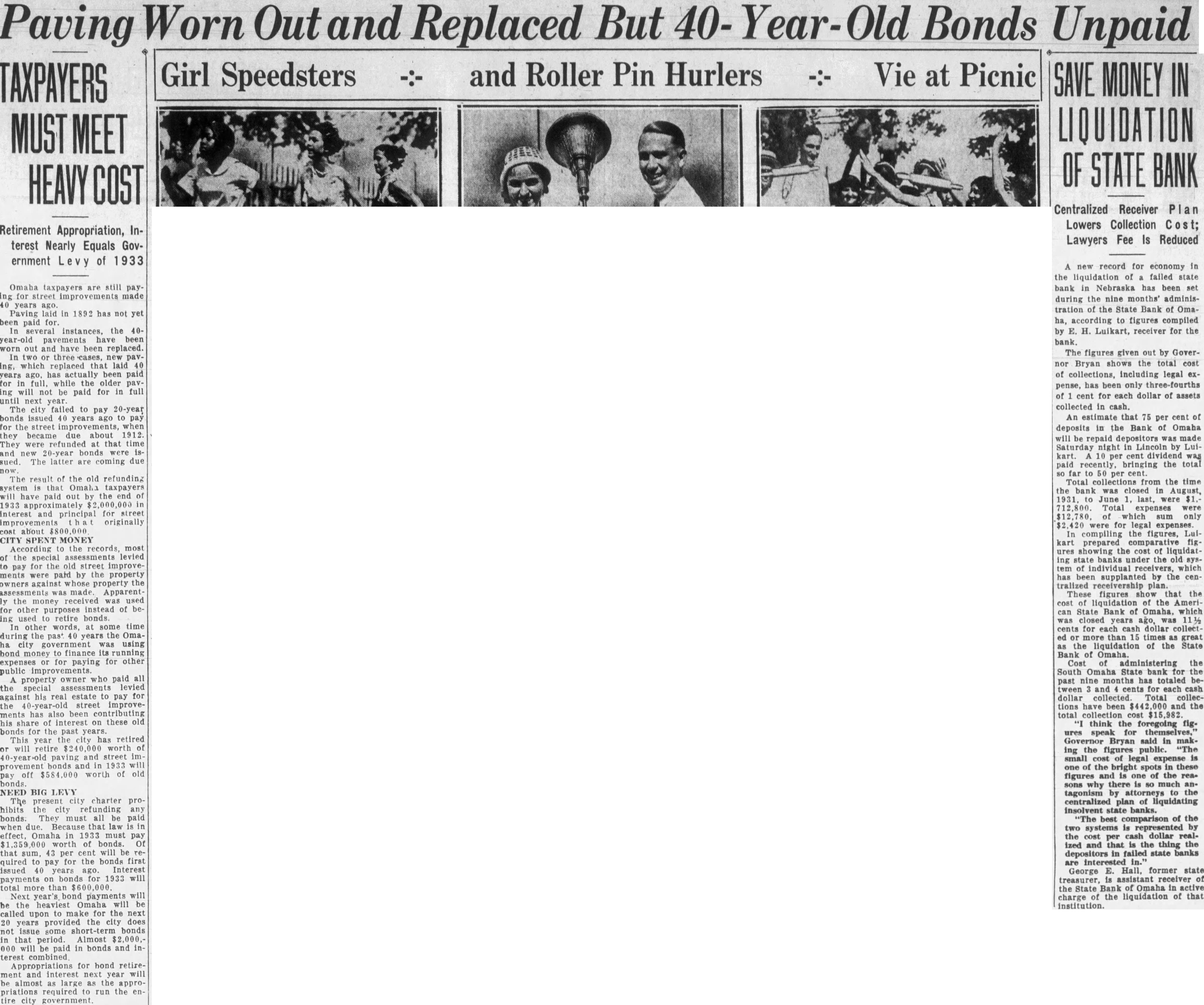
Centralized Receiver Plan Lowers Collection Cost; Lawyers Fee Is Reduced
A new record for economy in the liquidation of a failed state bank in Nebraska has been set during the nine months' administration of the State Bank of Omaha, according to figures compiled by E. H. Luikart, receiver for the bank.
The figures given out by Governor Bryan shows the total cost of collections, including legal expense, has been only three-fourths of cent for each dollar of assets collected in cash. An estimate that 75 per cent of deposits in the Bank of Omaha will be repaid depositors was made Saturday night in Lincoln by Luikart. A 10 per cent dividend was paid recently. bringing the total so far to 50 per cent. Total collections from the time the bank was closed in August, 1931, to June 1, last, were $1.712,800. Total expenses were $12,780. of which sum only $2, were for legal expenses In compiling the figures, Luikart prepared comparative figures showing the cost of liquidating state banks under the old system of individual receivers, which has been supplanted by the centralized receivership plan. These figures show that the cost of liquidation of the American State Bank of Omaha, which was closed years ago, was 11½ cents for each cash dollar collected or more than 15 times as great as the liquidation of the State Bank of Omaha. Cost of administering the South Omaha State bank for the past nine months has totaled between and cents for each cash dollar collected Total collections have been $442 000 and the total collection cost $15,982. "I think the foregoing figures speak for themselves," Governor Bryan said in making the figures public. "The small cost of legal expense is one of the bright spots in these figures and is one of the rea. sons why there is so much antagonism by attorneys to the centralized plan of liquidating insolvent state banks. "The best comparison of the two systems is represented by the cost per cash dollar realized and that is the thing the depositors in failed state banks are interested in." George E. Hall, former state treasurer, is assistant receiver of the State Bank of Omaha in active charge of the liquidation of that institution.