Niagara Bank (a state institution) was closed by NY Superintendent Kilburn on 1901-07-02 because it was insolvent after exposure to the failure of the City National Bank (its correspondent/closely connected institution). There is no evidence of a depositor run forcing suspension; actions afterwards included moves to appoint a receiver, a proposed settlement with Bank of Buffalo to liquidate/pay depositors, and ultimately denial of a receiver because Bank of Buffalo agreed to pay liabilities. The bank did not resume independent operations — it was settled/ liquidated via the Bank of Buffalo.
Events (4)
1.July 2, 1901Suspension
Cause
Correspondent
Cause Details
Closed by State Superintendent F. D. Kilburn because Niagara was insolvent due to close connection and exposure to the failure of the City National Bank (shared loans, president ties and correspondent credit).
Newspaper Excerpt
I have closed this bank because I think it insolvent. The main reason of its failure is the failure of the City National bank.
Source
newspapers
2.July 6, 1901Other
Newspaper Excerpt
Attorney-General John C. Davies arrived in Buffalo ... to consult with Superintendent Kilburn ... to make application for the appointment of a receiver; William C. Warren will be the receiver (discussed). (reports of receivership application and investigation.)
Source
newspapers
3.July 30, 1901Other
Newspaper Excerpt
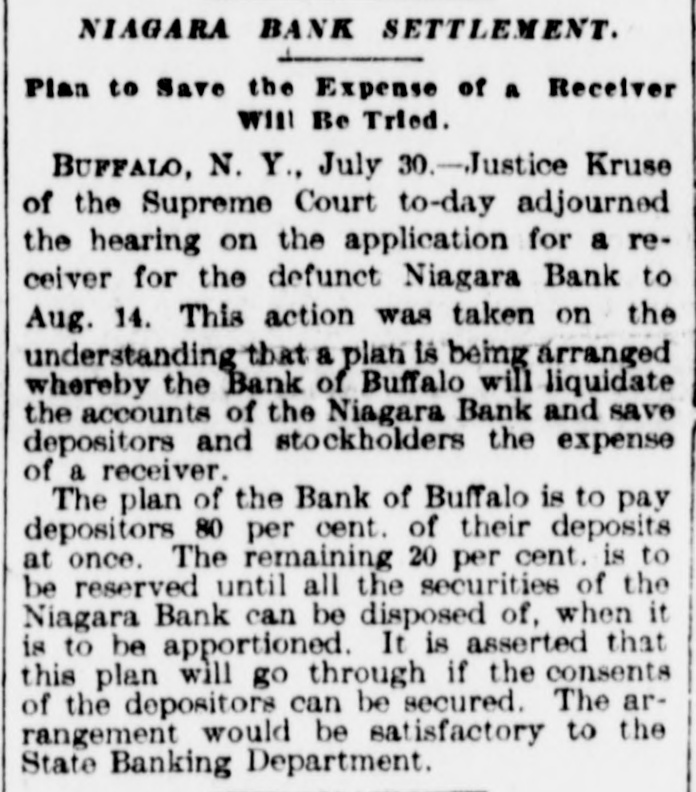
Plan to Save the Expense of a Receiver Will Be Tried. Bank of Buffalo will liquidate the accounts of the Niagara Bank and pay depositors 80 percent at once; remaining 20 percent later.
Source
newspapers
4.August 15, 1901Other
Newspaper Excerpt
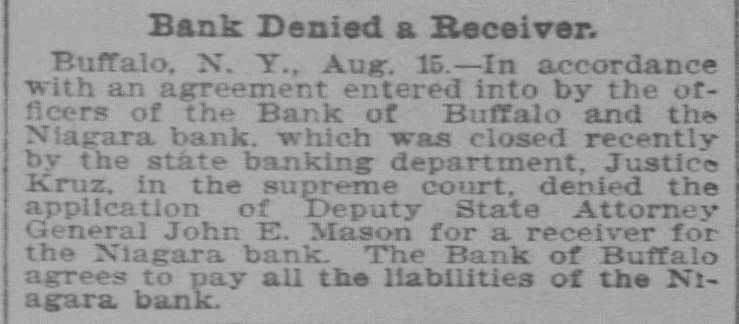
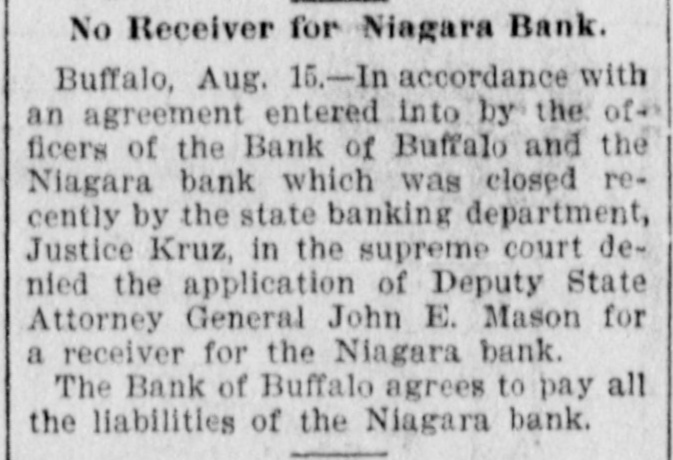
Justice Kruse denied application for a receiver for the Niagara Bank in accordance with agreement: Bank of Buffalo agrees to pay all the liabilities of the Niagara Bank.
Source
newspapers
Newspaper Articles (18)
1.July 2, 1901The Kalispell BeeKalispell, MT
Click image to open full size in new tab
Article Text
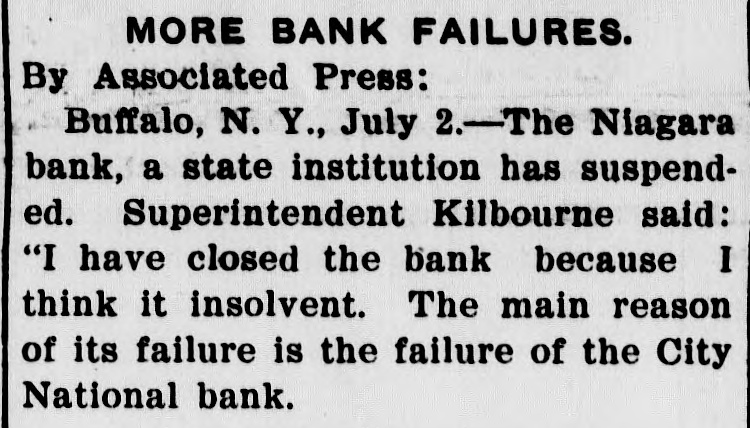
MORE BANK FAILURES. By Associated Press: Buffalo, N. Y., July 2.-The Niagara bank, a state institution has suspended. Superintendent Kilbourne said: "I have closed the bank because I think it insolvent. The main reason of its failure is the failure of the City National bank.
2.July 2, 1901Alexandria GazetteAlexandria, VA
Click image to open full size in new tab
Article Text
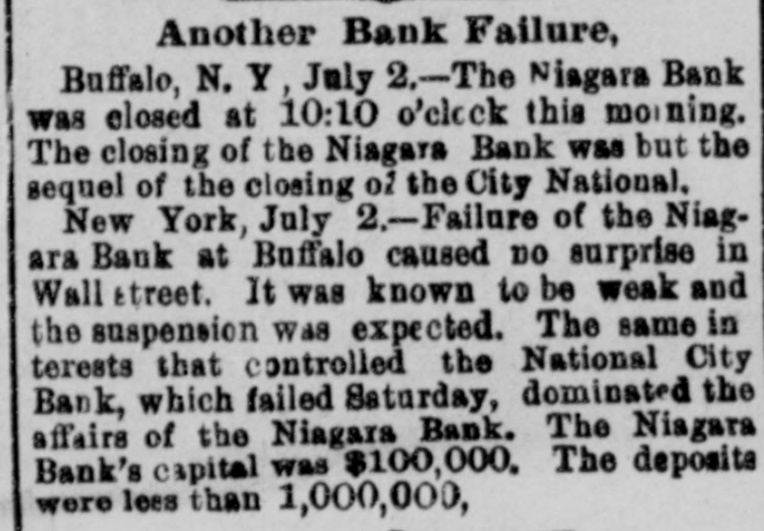
Another Bank Failure, Buffalo, N. Y, July 2.-The Niagara Bank was elosed at 10:10 o'clock this moining. The closing of the Niagara Bank W&S but the sequel of the closing of the City National. New York, July 2.-Failure of the Niagara Bank at Buffalo caused DO surprise in Wall street. It was known to be weak and the suspension was expected. The same in terests that controlled the National City Bank, which failed Saturday, dominated the affairs of the Niagara Bank. The Niagara Bank's capital was $100,000. The deposits were less than 1,000,000,
3.July 3, 1901New-York TribuneNew York, NY
Click image to open full size in new tab
Article Text
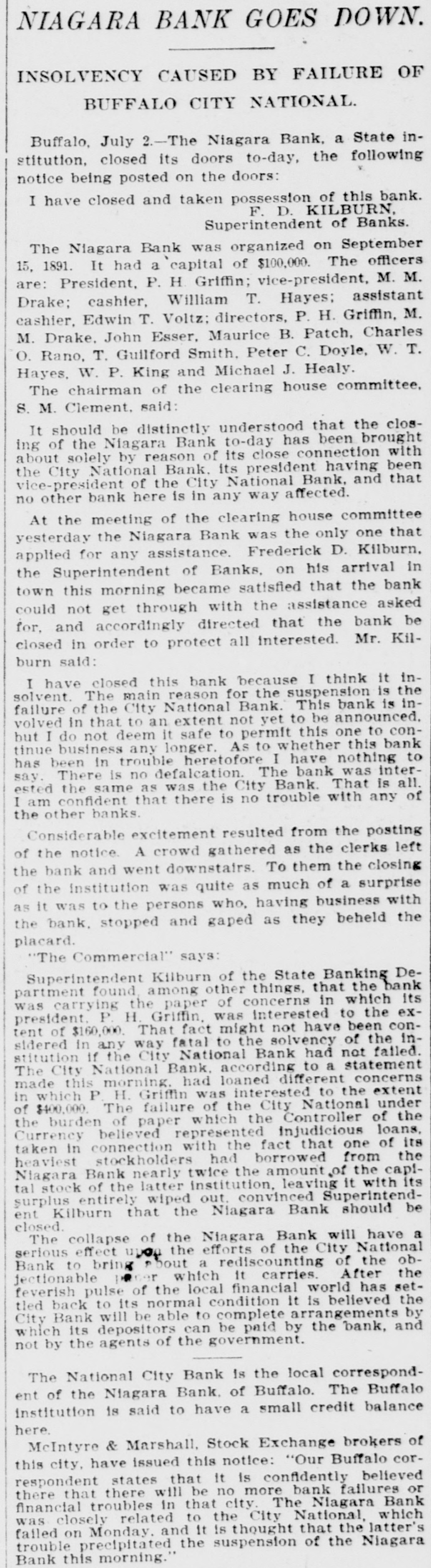
NIAGARA BANK GOES DOWN. INSOLVENCY CAUSED BY FAILURE OF BUFFALO CITY NATIONAL. Buffalo, July 2.-The Niagara Bank, a State institution, closed its doors to-day, the following notice being posted on the doors: I have closed and taken possession of this bank. F. D. KILBURN, Superintendent of Banks. The Niagara Bank was organized on September 15, 1891. It had a capital of $100,000. The officers are: President, P. H Griffin; vice-president, M. M. Drake: cashier, William T. Hayes; assistant cashier, Edwin T. Voltz: directors, P. H. Griffin, M. M. Drake. John Esser, Maurice B. Patch, Charles O. Rano, T. Gullford Smith, Peter C. Doyle, W. T. Hayes, W. P. King and Michael J. Healy. The chairman of the clearing house committee, S. M. Clement. said: It should be distinctly understood that the closing of the Niagara Bank to-day has been brought about solely by reason of its close connection with the City National Bank. its president having been vice-president of the City National Bank, and that no other bank here is in any way affected. At the meeting of the clearing house committee yesterday the Niagara Bank was the only one that applied for any assistance. Frederick D. Kilburn, the Superintendent of Banks, on his arrival in town this morning became satisfied that the bank could not get through with the assistance asked for, and accordingly directed that the bank be closed in order to protect all interested. Mr. Kilburn said: I have closed this bank because I think it insolvent. The main reason for the suspension is the failure of the City National Bank. This bank is involved in that to an extent not yet to be announced. but I do not deem it safe to permit this one to continue business any longer. As to whether this bank has been in trouble heretofore I have nothing to say. There is no defalcation. The bank was interested the same as was the City Bank. That is all. I am confident that there is no trouble with any of the other banks. Considerable excitement resulted from the posting of the notice. A crowd gathered as the clerks left the bank and went downstairs. To them the closing of the institution was quite as much of a surprise as it was to the persons who, having business with the bank. stopped and gaped as they beheld the placard. The Commercial" says: Superintendent Kilburn of the State Banking Department found among other things, that the bank was carrying the paper of concerns in which its president. P. H. Griffin, was interested to the extent of $160,000. That fact might not have been considered in any way fatal to the solvency of the institution If the City National Bank had not failed. The City National Bank, according to a statement made this morning. had loaned different concerns in which P. H. Griffin was interested to the extent of $400,000. The failure of the City National under the burden of paper which the Controller of the Currency believed represented Injudicious loans, taken in connection with the fact that one of its heaviest stockholders had borrowed from the Niagara Bank nearly twice the amount of the capital stock of the latter institution, leaving it with its surplus entirely wiped out. convinced Superintendent Kilburn that the Niagara Bank should be closed. The collapse of the Niagara Bank will have a serious effect upon the efforts of the City National Bank to bring about a rediscounting of the objectionable car which it carries. After the feverish pulse of the local financial world has settled back to its normal condition it is believed the City Bank will be able to complete arrangements by which its depositors can be paid by the bank, and not by the agents of the government. The National City Bank is the local correspondent of the Niagara Bank. of Buffalo. The Buffalo institution is said to have a small credit balance here. McIntyre & Marshall, Stock Exchange brokers of this city, have issued this notice: "Our Buffalo correspondent states that it Is confidently believed there that there will be no more bank failures or financial troubles in that city. The Niagara Bank was closely related to the City National, which failed on Monday. and it is thought that the latter's trouble precipitated the suspension of the Niagara Bank this morning.
4.July 3, 1901The SunWilmington, DE
Click image to open full size in new tab
Article Text
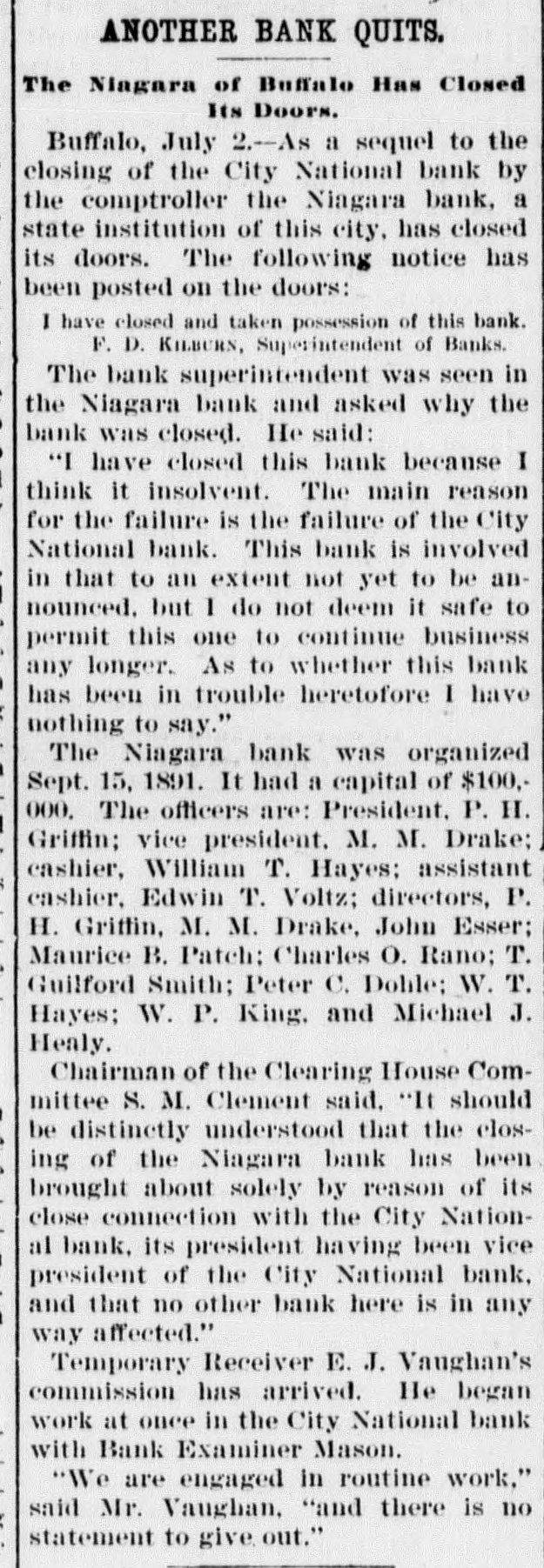
ANOTHER BANK QUITS. The Niagara of Buffalo Has Closed Its Doors. Buffalo, July 2.--As a sequel to the closing of the City National bank by the comptroller the Niagara bank, a state institution of this city, has closed its doors. The following notice has been posted on the doors: I have closed and taken possession of this bank. F. D. KILBURN, Superintendent of Banks. The bank superintendent was seen in the Niagara bank and asked why the bank was closed. He said: "I have closed this bank because I think it insolvent. The main reason for the failure is the failure of the City National bank. This bank is involved in that to an extent not yet to be announced. but I do not deem it safe to permit this one to continue business any longer. As to whether this bank has been in trouble heretofore I have nothing to say." The Niagara bank was organized Sept. 15, 1891. It had a capital of $100,000. The officers are: President, P.H. Griffin; vice president. M. M. Drake: cashier, William T. Hayes: assistant cashier, Edwin T. Voltz; directors, P. H. Grittin, M. M. Drake, John Esser; Maurice B. Patch: Charles O. Rano; T. Guilford Smith; Peter C. Dohle: W. T. Hayes; W. P. King. and Michael J. Healy. Chairman of the Clearing House Committee S. M. Clement said, "It should be distinctly understood that the closing of the Niagara bank has been brought about solely by reason of its close connection with the City National bank, its president having been vice president of the City National bank, and that no other bank here is in any way affected." Temporary Receiver E. J. Vanghan's commission has arrived. He began work at once in the City National bank with Bank Examiner Mason. "We are engaged in routine work." said Mr. Vaughan, "and there is no statement to give out."
5.July 4, 1901The Telegraph-CourierKenosha, WI
Click image to open full size in new tab
Article Text
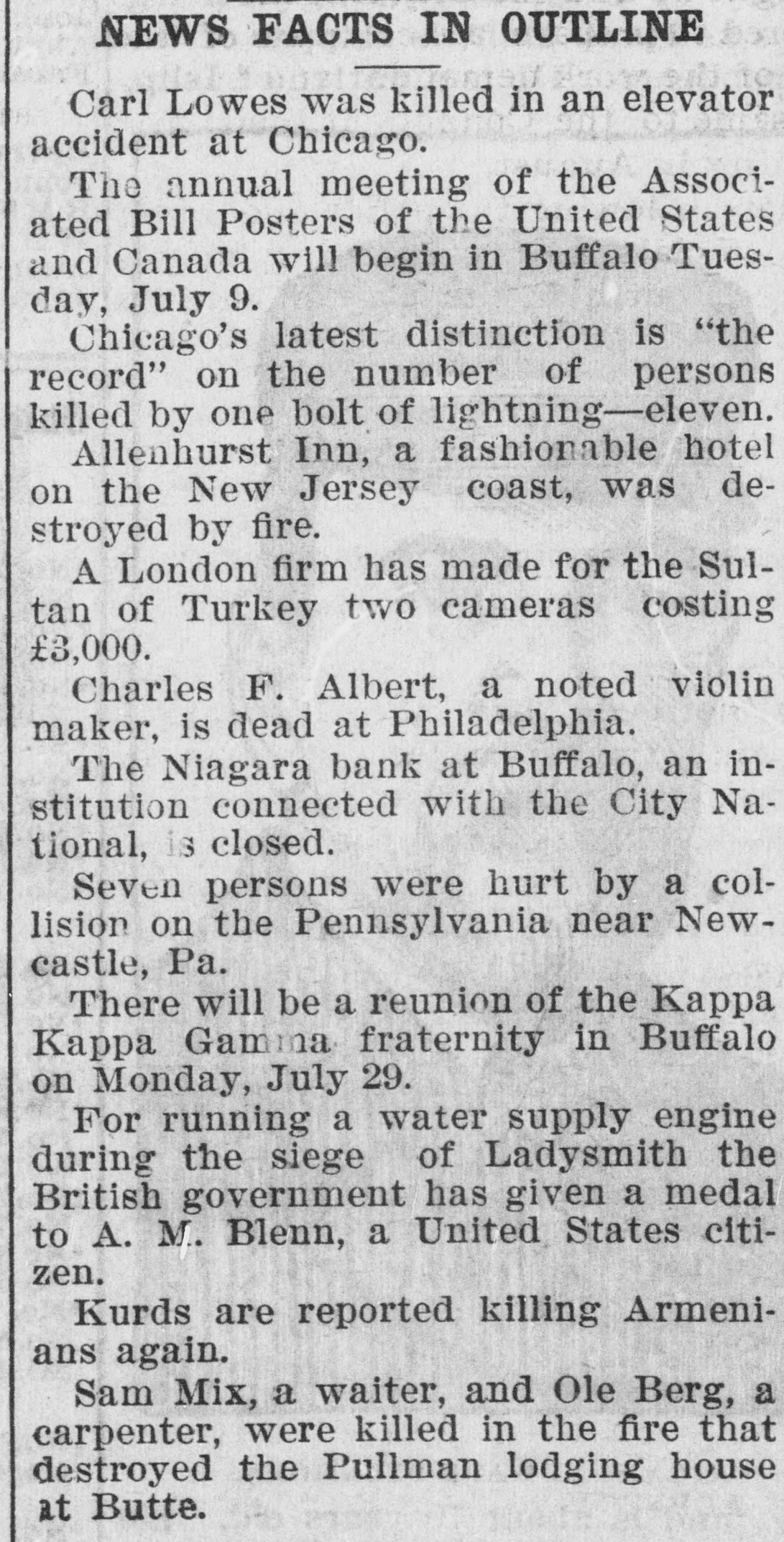
NEWS FACTS IN OUTLINE Carl Lowes was killed in an elevator accident at Chicago. The annual meeting of the Associated Bill Posters of the United States and Canada will begin in Buffalo Tuesday, July 9. Chicago's latest distinction is "the record" on the number of persons killed by one bolt of lightning-eleven. Allenhurst Inn, a fashionable hotel on the New Jersey coast, was destroyed by fire. A London firm has made for the Sultan of Turkey two cameras costing £3,000. Charles F. Albert, a noted violin maker, is dead at Philadelphia. The Niagara bank at Buffalo, an institution connected with the City National, is closed. Seven persons were hurt by a collision on the Pennsylvania near Newcastle, Pa. There will be a reunion of the Kappa Kappa Gamma fraternity in Buffalo on Monday, July 29. For running a water supply engine during the siege of Ladysmith the British government has given a medal to A. M. Blenn, a United States citizen. Kurds are reported killing Armenians again. Sam Mix, a waiter, and Ole Berg, a carpenter, were killed in the fire that destroyed the Pullman lodging house at Butte.
6.July 4, 1901Ottumwa Semi-Weekly CourierOttumwa, IA
Click image to open full size in new tab
Article Text
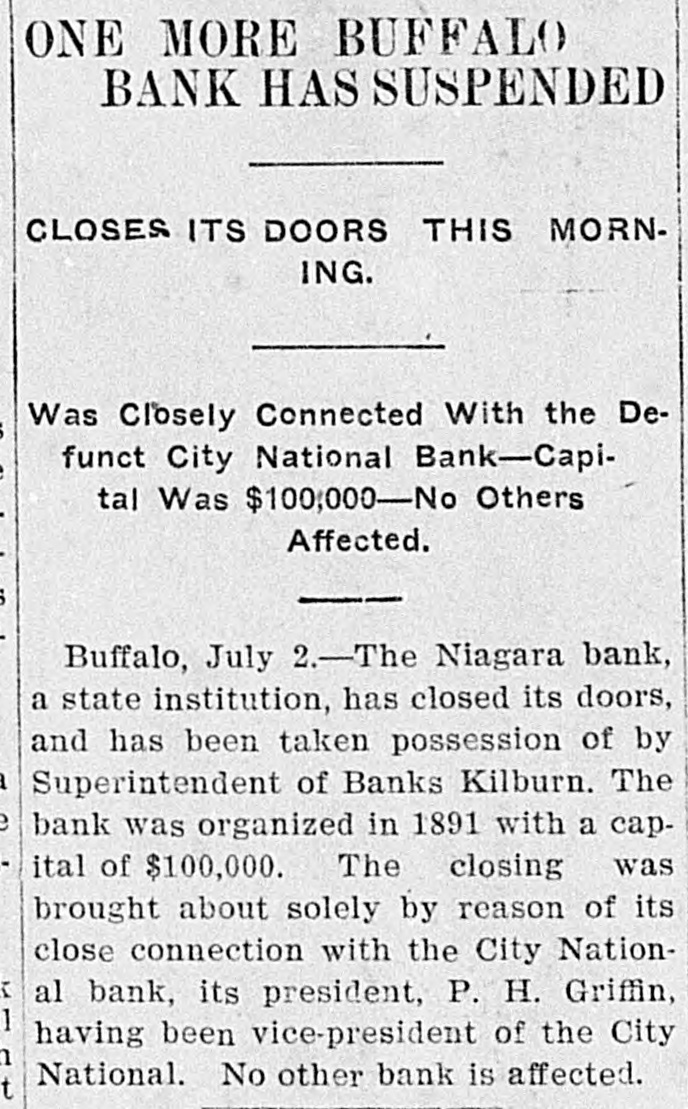
ONE MORE BUFFALO BANK HAS SUSPENDED CLOSES ITS DOORS THIS MORNING. Was Closely Connected With the Defunct City National Bank-Capital Was $100,000-No Others Affected. I Buffalo, July 2.-The Niagara bank, a state institution, has closed its doors, and has been taken possession of by Superintendent of Banks Kilburn. The bank was organized in 1891 with a capital of $100,000. The closing was brought about solely by reason of its close connection with the City National bank, its president, P. H. Griffin, 1 having been vice-president of the City National. No other bank is affected. t
7.July 6, 1901Evening StarWashington, DC
Click image to open full size in new tab
Article Text
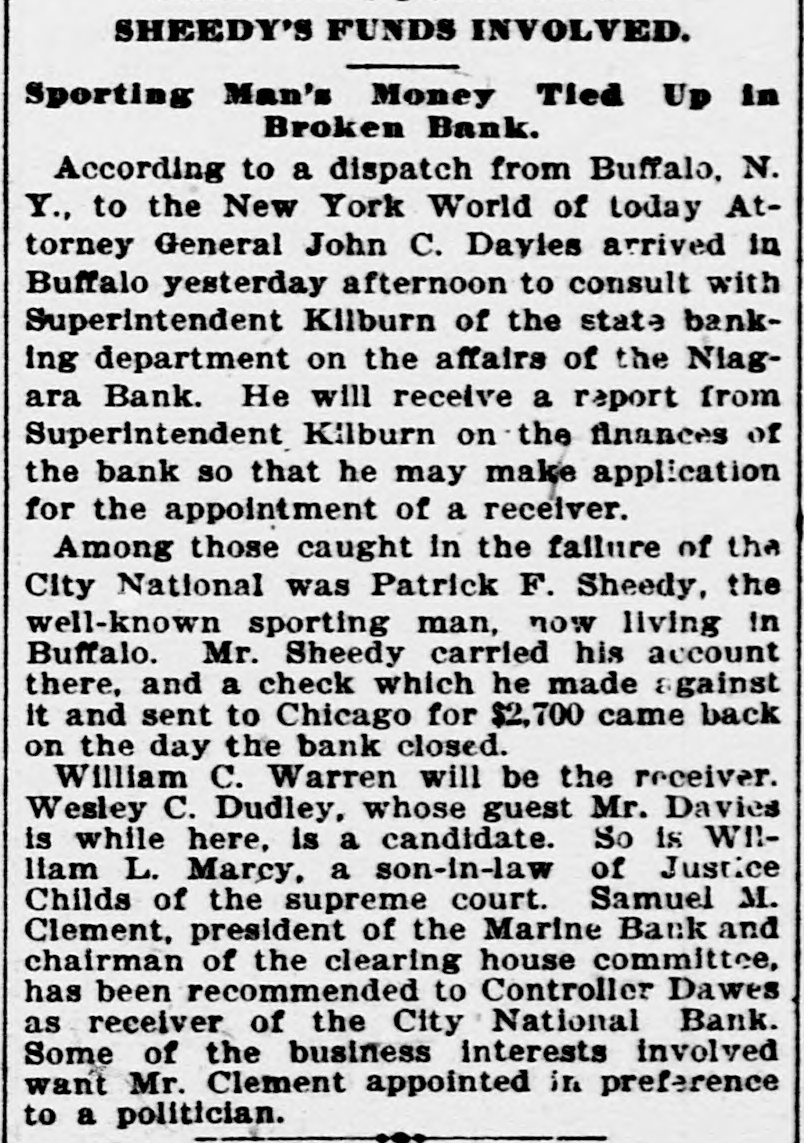
SHEEDY'S FUNDS INVOLVED. Sporting Man's Money Tied Up in Broken Bank. According to a dispatch from Buffalo, N. Y., to the New York World of today Attorney General John C. Dayies arrived in Buffalo yesterday afternoon to consult with Superintendent Kilburn of the state banking department on the affairs of the Niagara Bank. He will receive a report from Superintendent Kilburn on the finances of the bank so that he may make application for the appointment of a receiver. Among those caught in the failure of the City National was Patrick F. Sheedy, the well-known sporting man, now living in Buffalo. Mr. Sheedy carried his account there, and a check which he made against it and sent to Chicago for $2,700 came back on the day the bank closed. William C. Warren will be the receiver. Wesley C. Dudley, whose guest Mr. Davies is while here, is a candidate. So is William L. Marcy. a son-in-law of Justice Childs of the supreme court. Samuel M. Clement, president of the Marine Bank and chairman of the clearing house committee, has been recommended to Controller Dawes as receiver of the City National Bank. Some of the business interests involved want Mr. Clement appointed in preference to a politician. -
8.July 7, 1901New-York TribuneNew York, NY
Click image to open full size in new tab
Article Text
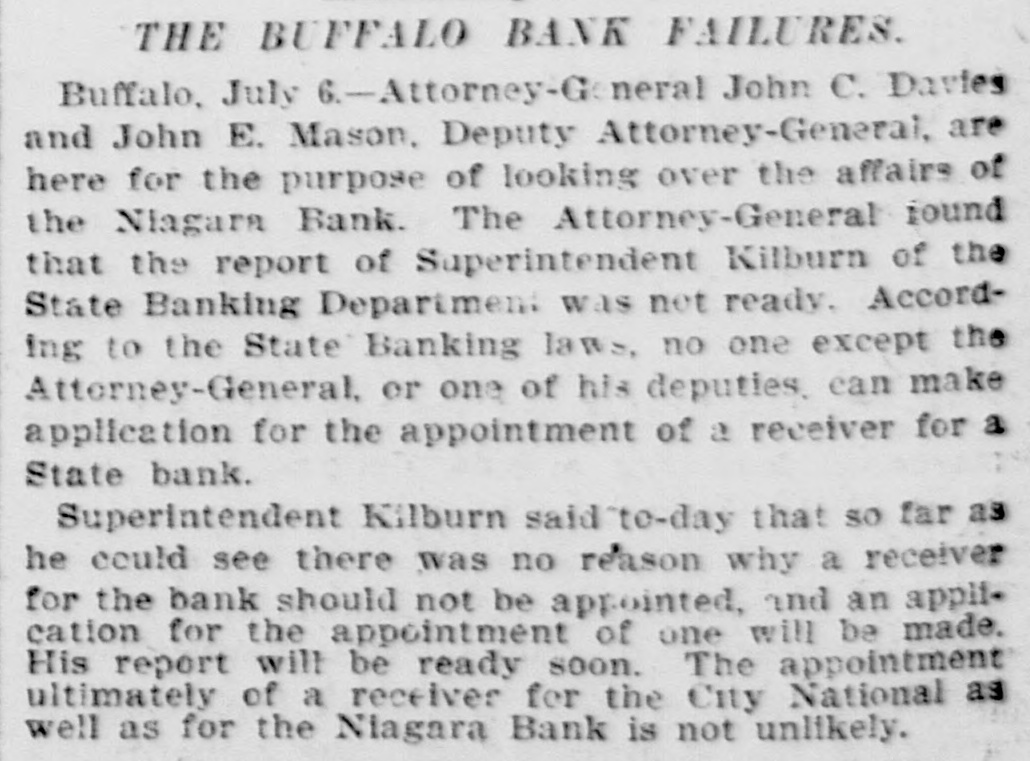
THE BUFFALO BANK FAILURES. Buffalo, July 6.-Attorney-Go neral John €. Davies and John E. Mason. Deputy Attorney-General, are here for the purpose of looking over the affairs of the Nlagara Bank. The Attorney-General round that the report of Superintendent Kilburn of the State Banking Department was not ready. According to the State Banking laws, no one except the Attorney-General, or one of his deputies. can make application for the appointment of a receiver for a State bank. Superintendent Kilburn said to-day that so far as he could see there was no reason why a receiver for the bank should not be appointed, and an application for the appointment of one will be made. His report will be ready soon. The appointment ultimately of a receiver for the City National as well as for the Niagara Bank is not unlikely.
9.July 10, 1901News and CitizenMorrisville, Hyde Park, VT
Click image to open full size in new tab
Article Text
THE WEEK'S NEWS. WEDNESDAY, JULY 3. Cyclone sweeps a section of Boston, causing damage to scores of houses: man killed and several persons injured -Heat continues in New England; hunderstorms afford temporary relief. but do much damage-Police Officer Cody shot and killed by John L. Smith. a colored man, at Arlington, Mass Cape Cod canal projectors once more fail to get authority to make a big issue of stock and bonds-Five new cases of smallpox at Fall River, Mass-Hawaiians seeking the removal of Judge Humphreys-Indiana courts probing affidavits in insanity cases-Niagara bank of Buffalo. a state institution, fails-Two killed and two severely Butter, u] edd B &q pean can Sheet Steel company announces great reduction in prices for July; the trade mystified-Steamship Morro Castle runs from Havana to New York in 2 days,13 hours and 11 minutes, in 2 days, 13 hours and 11 minutes, breaking the record--Political situation in Cuba said to be excellent-New bureau of forestry in the department of agriculture-Settlers must take chances in drawing for places on Indian reservations-Sugar interests rally to defense of Gage's countervailing duties in Russian sugar-Gomez's visit to this country said to be in connection with Cuba's new government--------------ncense likely to be used at King Edward's coronation-Chilean dislike of the United States is fanned for political reasons--Successful experiment near Paris with a new system of wireless telegraphy-Kurd said to be plundering villages and to have murdered Armenians-French clerical order said to have taken a large part of the German loan of 1897. to vinr University of Pennsylvania easily wins its first trial heat in the Henley regatta; Lowing Rowing club crew beaten with ease: Englishmen astonished ease with which it was done-Heat still keeps up deadly work; 3 deaths in Boston. 12 in New England. many prostrations; 206 victims in New York Dwight Davis and Holeomb Ward beaten by Dorothy brothers for all England championship-While leading the Constitution the Columbia has to withdraw from race on account of accident -General Gomez calls on President McKinley: General Fitzhugh Lee calls on General Gomez at his hotel: credits him with the liberty of Cuba-Directors of the Seventh National bank of New York city decide to pay depositors in full, and take up the Marquand Co. loan of $1,600,000-Steel combine makes peace proposal to the Amalgamated association, and conference is arranged-Strike on the Maine Central ended and men return to work-Captain Brown of the tug Gertrude saves three women belonging in Providence from drowning-New Haven citizens protest to trolley road officials against employing Yale students as motormen -Sidney Smith of Cambridge. Mass. claims title to 160 acres of fine dential land in Chicago-Sturges' bank of Mansfield, O., closes its doors Case of Smith, the slayer of Policeman Cody of Arlington, Mass., continued July 11, on a charge of murder. IS wine Great celebration of the Fourth Porto Rico; assembly adopts free trade resolution-Rev. William H. O'Connell formally installed as bishop of diocese of Maine-Tornado strikes Grand Island. Neb., with disastrous results— A. B. Gunn of Buffalo Y. M. C.A., wins all-around championship of the A. U--Franchi Luco, a peddler, fatally assaulted by four hoodlums at Boston -Anti-imperialists issue an address urging further consideration by people of the colonial problem-Shell of the Bradford crew broke in halves in regatta at Boston-Mrs. Amelia Carr instantly killed by shotgun being knocked overaby her nephew-New Northern hotel at Millinocket, Me., stroyed by fire; occupants had row escape from death-Death of Pro fessor Fiske, historian and lecturerGold amounting to $30,000 missing from "I '9 uug penter killed by a rocket at Medford
10.July 11, 1901The Hocking SentinelLogan, OH
Click image to open full size in new tab
Article Text
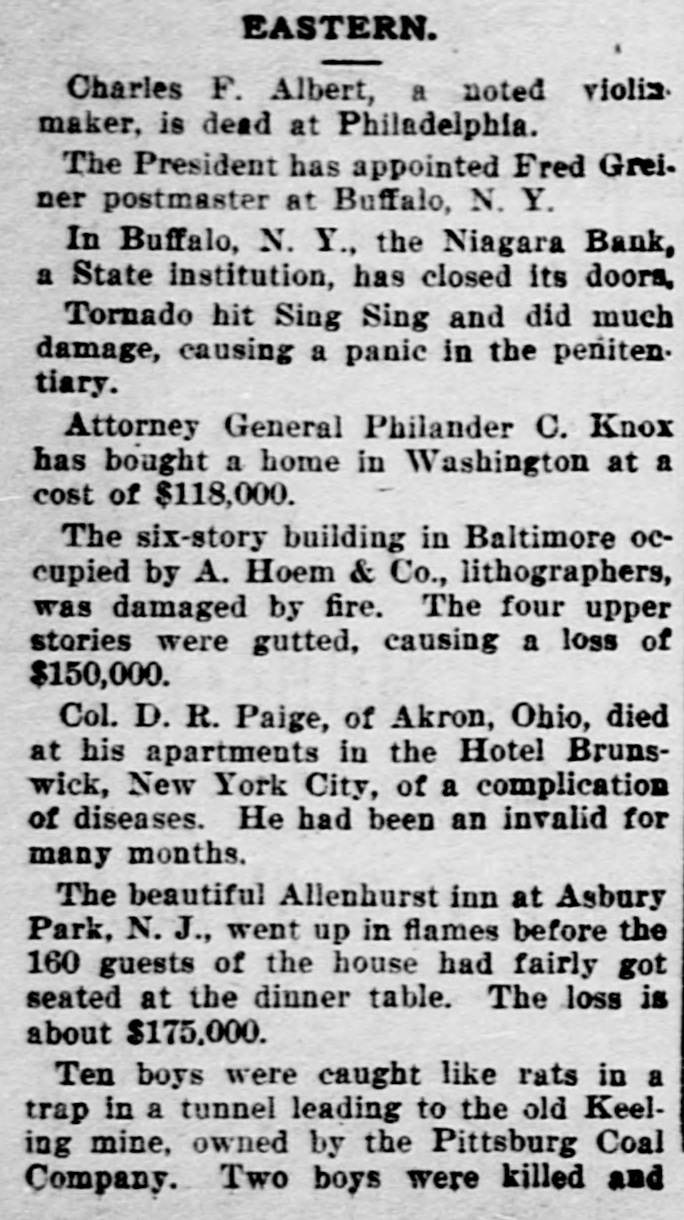
EASTERN. Charles F. Albert, a noted violin. maker, is dead at Philadelphia. The President has appointed Fred Greiner postmaster at Buffalo, N. Y. In Buffalo, N. Y., the Niagara Bank, a State institution, has closed its doors, Tornado hit Sing Sing and did much damage, causing a panic in the peniten. tiary. Attorney General Philander C. Knox has bought a home in Washington at a cost of $118,000. The six-story building in Baltimore occupied by A. Hoem & Co., lithographers, was damaged by fire. The four upper stories were gutted, causing a loss of $150,000. Col. D. R. Paige, of Akron, Ohio, died at his apartments in the Hotel Brunswick, New York City, of a complication of diseases. He had been an invalid for many months. The beautiful Allenhurst inn at Asbury Park, N. J., went up in flames before the 160 guests of the house had fairly got seated at the dinner table. The loss is about $175,000. Ten boys were caught like rats in a trap in a tunnel leading to the old Keeling mine, owned by the Pittsburg Coal Company. Two boys were killed and
11.July 11, 1901Reporter and FarmerWebster, SD
Click image to open full size in new tab
Article Text
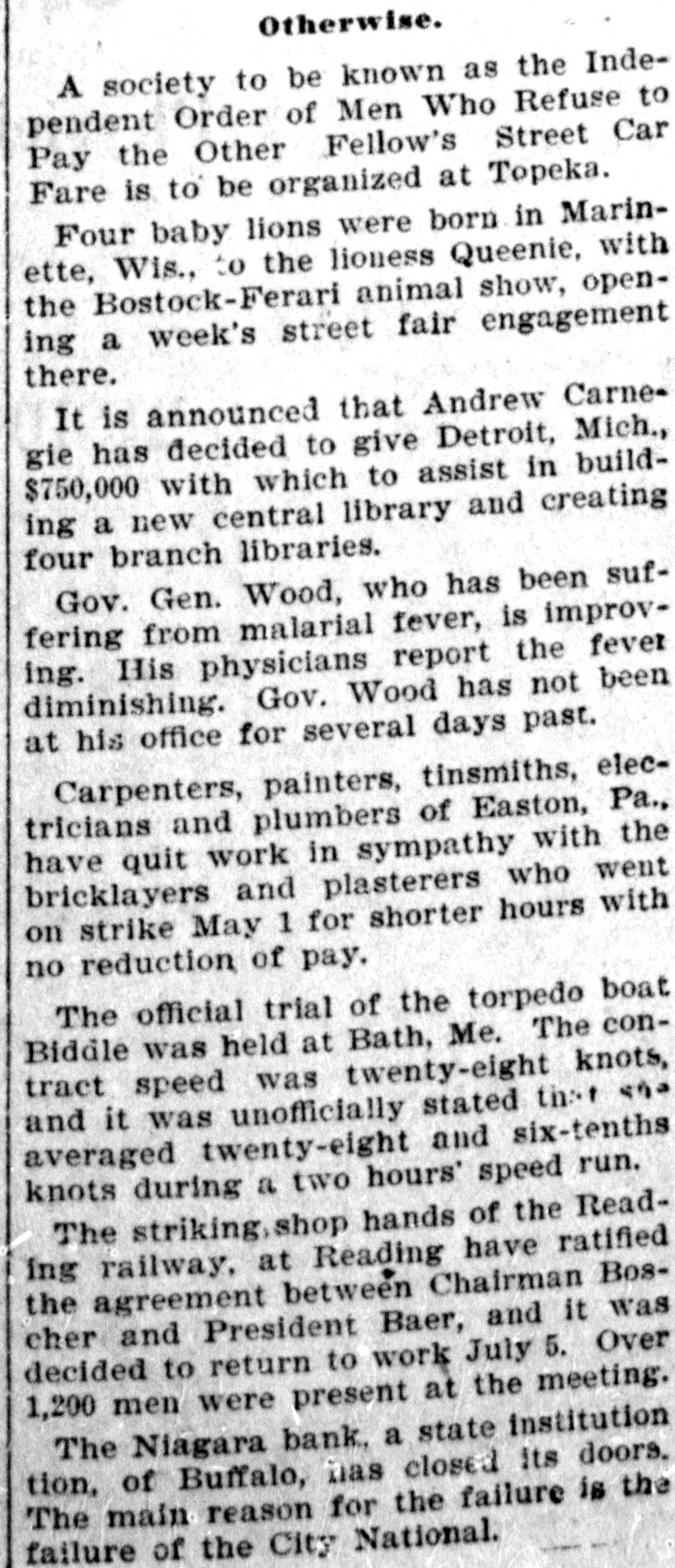
Otherwise. A society to be known as the Independent Order of Men Who Refuse to Pay the Other Fellow's Street Car Fare is to be organized at Topeka. Four baby lions were born in Marinette, Wis., to the lioness Queenie, with the Bostock-Ferari animal show, opening a week's street fair engagement there. It is announced that Andrew Carnegie has decided to give Detroit, Mich., $750,000 with which to assist in building a new central library and creating four branch libraries. Gov. Gen. Wood, who has been suffering from malarial fever, is improving. His physicians report the fever diminishing. Gov. Wood has not been at his office for several days past. Carpenters, painters, tinsmiths, electricians and plumbers of Easton, Pa., have quit work in sympathy with the bricklayers and plasterers who went on strike May 1 for shorter hours with no reduction of pay. The official trial of the torpedo boat Biddle was held at Bath, Me. The contract speed was twenty-eight knots, and it was unofficially stated that sno averaged twenty-eight and six-tenths knots during a two hours' speed run. The striking, shop hands of the Reading railway, at Reading have ratified the agreement between Chairman Boscher and President Baer, and it was decided to return to work July 5. Over 1,200 men were present at the meeting. The Niagara bank, a state institution tion, of Buffalo, has closed its doors. The main reason for the failure is the failure of the City National.
12.July 22, 1901The SunWilmington, DE
Click image to open full size in new tab
Article Text
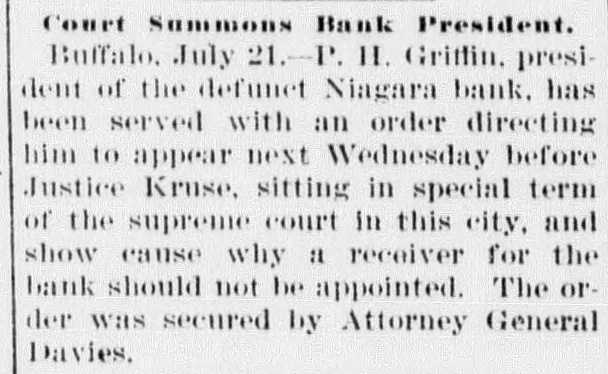
Court Summons Bank President. Buffalo, July 21.-P. 11. Griffin. president of the definet Niagara bank. has been served with an order directing him to appear next Wednesday before Justice Kruse, sitting in special term of the supreme court in this city, and show cause why a receiver for the bank should not be appointed. The order was secured by Attorney General Davies,
13.July 24, 1901The SunNew York, NY
Click image to open full size in new tab
Article Text
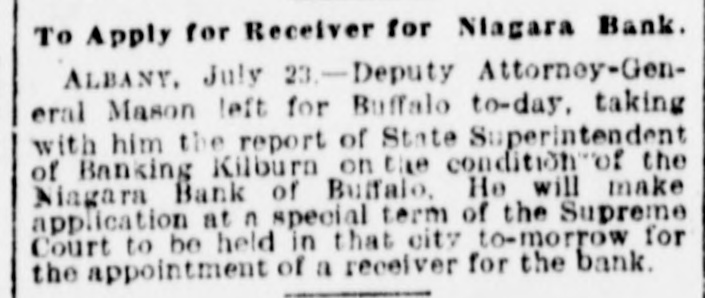
To Apply for Receiver for Niagara Bank. ALBANY. July 23.-Deputy Attorney-General Mason left for Buffalo to-day, taking with him the report of State Superintendent of Banking Kilburn on the condition of the Niagara Bank of Buffalo, He will make application at n special term of the Supreme Court to be held in that city to-morrow for the appointment of a receiver for the bank.
14.July 26, 1901The Wilmington Daily RepublicanWilmington, DE
Click image to open full size in new tab
Article Text
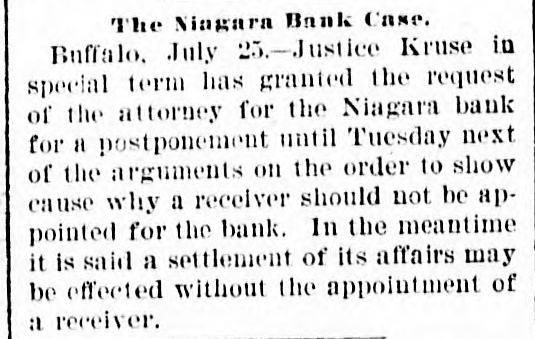
The Niagara Bank Case. Buffalo, July 25.-Justice Kruse in special term has granted the request of the attorney for the Niagara bank for a postponement until Tuesday next of the arguments on the order to show cause why a receiver should not be appointed for the bank. In the meantime it is said a settlement of its affairs may be effected without the appointment of a receiver.
15.July 31, 1901The SunNew York, NY
Click image to open full size in new tab
Article Text
NIAGARA BANK SETTLEMENT. Plan to Save the Expense of a Receiver Will Be Tried. BUFFALO, N. Y., July 30.-Justice Kruse of the Supreme Court to-day adjourned the hearing on the application for a receiver for the defunct Niagara Bank to Aug. 14. This action was taken on the understanding that a plan is being arranged whereby the Bank of Buffalo will liquidate the accounts of the Niagara Bank and save depositors and stockholders the expense of a receiver. The plan of the Bank of Buffalo is to pay depositors 80 per cent. of their deposits at once. The remaining 20 per cent. is to be reserved until all the securities of the Niagara Bank can be disposed of, when it is to be apportioned. It is asserted that this plan will go through if the consents of the depositors can be secured. The arrangement would be satisfactory to the State Banking Department.
16.August 12, 1901The Daily Morning Journal and CourierNew Haven, CT
Click image to open full size in new tab
Article Text
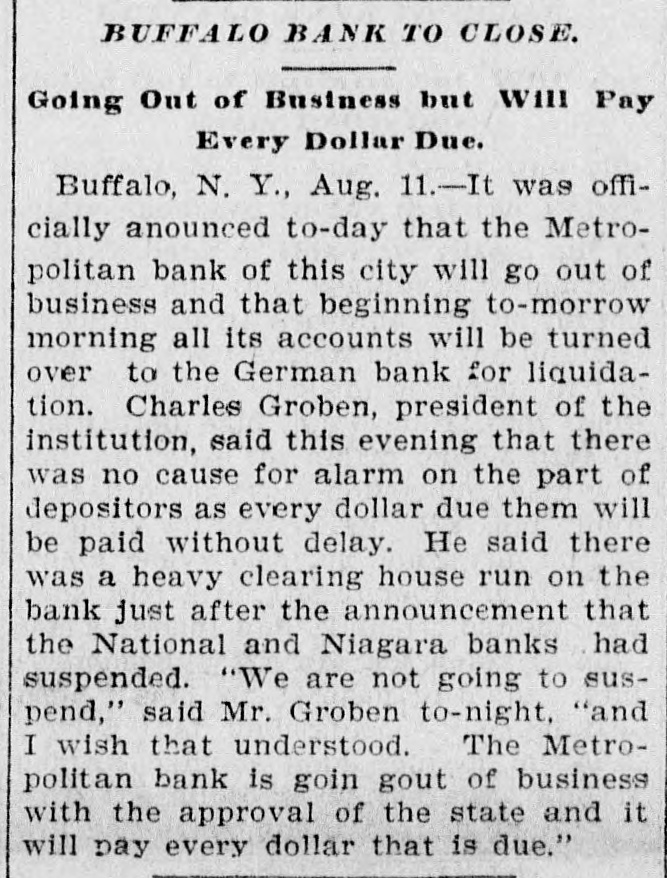
BUFFALO BANK TO CLOSE. Going Out of Business but will Pay Every Dollar Due. Buffalo, N. Y., Aug. 11.-It was officially anounced to-day that the Metropolitan bank of this city will go out of business and that beginning to-morrow morning all its accounts will be turned over to the German bank for liquidation. Charles Groben, president of the institution, said this evening that there was no cause for alarm on the part of depositors as every dollar due them will be paid without delay. He said there was a heavy clearing house run on the bank just after the announcement that the National and Niagara banks had suspended. "We are not going to suspend," said Mr. Groben to-night, "and I wish that understood. The Metropolitan bank is goin gout of business with the approval of the state and it will pay every dollar that is due."
17.August 15, 1901The Topeka State JournalTopeka, KS
Click image to open full size in new tab
Article Text
Bank Denied & Receiver. Buffalo, N. Y., Aug. 16.-In accordance with an agreement entered into by the officers of the Bank of Buffalo and the Niagara bank. which was closed recently by the state banking department, Justice Kruz, in the supreme court, denied the application of Deputy State Attorney General John E. Mason for a receiver for the Niagara bank. The Bank of Buffalo agrees to pay all the liabilities of the Ntagara bank.
18.August 15, 1901Deseret Evening NewsSalt Lake City, UT
Click image to open full size in new tab
Article Text
No Receiver for Niagara Bank. Buffalo, Aug. 15.-In accordance with an agreement entered into by the of ficers of the Bank of Buffalo and the Niagara bank which was closed recently by the state banking department, Justice Kruz, in the supreme court denied the application of Deputy State Attorney General John E. Mason for a receiver for the Niagara bank. The Bank of Buffalo agrees to pay all the liabilities of the Niagara bank.