13260. boro Bank (Brooklyn, NY)

Bank Information

Episode Type
Suspension β†’ Closure
Bank Type
state
Start Date
April 7, 1910
Location
Brooklyn, New York (40.660, -73.951)

Metadata

Model
gpt-5-mini
Short Digest
5eb941a20b6e11c4

Response Measures

None

Description

Articles describe the Borough Bank of Brooklyn as having closed its doors on April 7, 1910, with a receiver appointed and later liquidation/dividend activity. No article describes a run prior to suspension; the bank remained defunct with a receiver (so suspension followed by permanent closure). Corrected bank name from provided 'boro Bank' to 'Borough Bank'. Bank type set to 'state' because supervision and receivership are handled by the New York State Superintendent of Banks in the articles.

Events (4)

1. April 7, 1910 Receivership
Newspaper Excerpt
He acted as receiver for the Borough Bank of Brooklyn during its difficulties.
Source
newspapers
2. April 7, 1910 Suspension
Cause Details
Article states the bank 'closed its doors' and was defunct; no specific cause (e.g., insolvency details) provided in the excerpts.
Newspaper Excerpt
the defunct Borough Bank of Brooklyn ... closed its doors April 7, 1910
Source
newspapers
3. June 6, 1916 Other
Newspaper Excerpt
Prospects of an early dividend to depositors in the defunct Borough Bank of Brooklyn were brightened ... auditors' statement shows ... since it closed its doors April 7, 1910 ... leaving a total of $55,915 on hand.
Source
newspapers
4. April 21, 1919 Other
Newspaper Excerpt
would allow depositors of the failed Union and Borough Banks of Brooklyn to go before the State Court of Claims in an effort to collect for their losses
Source
newspapers

Newspaper Articles (3)

Article from New-York Tribune, June 6, 1916

Click image to open full size in new tab

Article Text

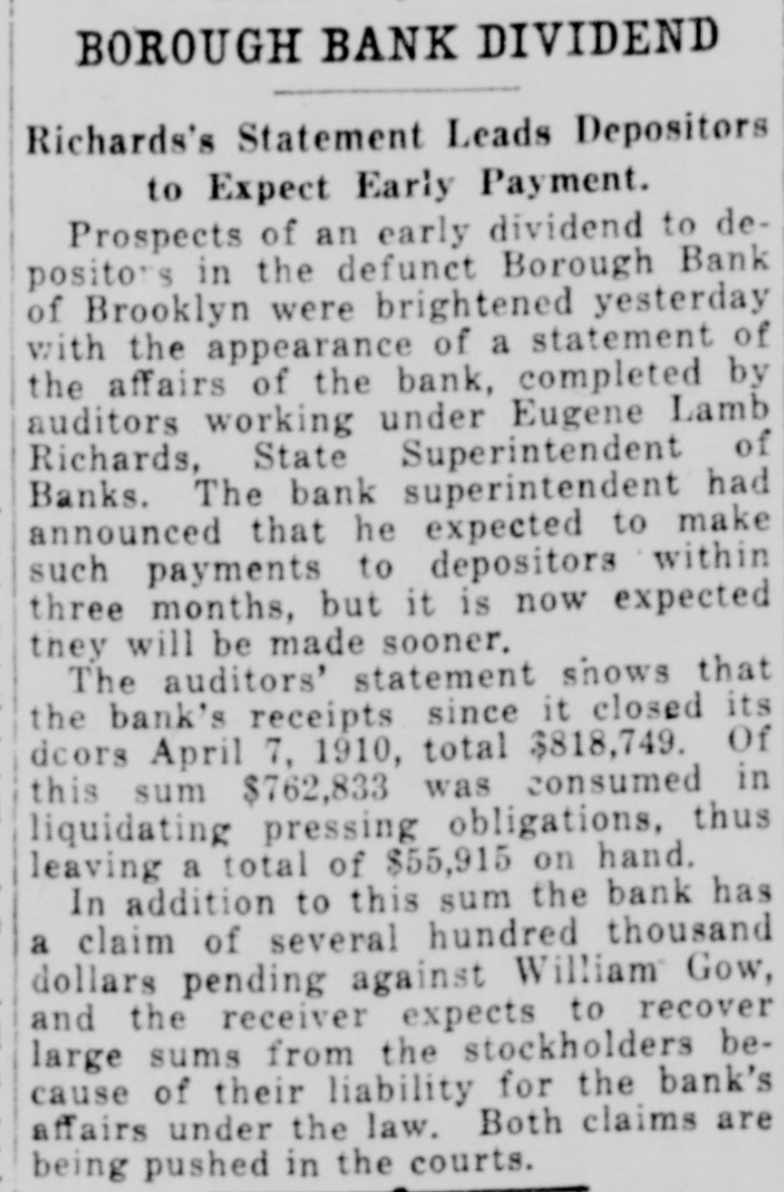
BOROUGH BANK DIVIDEND Richards's Statement Leads Depositors to Expect Early Payment. Prospects of an early dividend to depositors in the defunct Borough Bank of Brooklyn were brightened yesterday with the appearance of a statement of the affairs of the bank, completed by auditors working under Eugene Lamb Richards, State Superintendent of Banks. The bank superintendent had announced that he expected to make such payments to depositors within three months, but it is now expected they will be made sooner. The auditors' statement shows that the bank's receipts since it closed its doors April 7, 1910, total $818,749. Of this sum $762,833 was consumed in liquidating pressing obligations, thus leaving a total of $55,915 on hand. In addition to this sum the bank has a claim of several hundred thousand dollars pending against William Gow, and the receiver expects to recover large sums from the stockholders because of their liability for the bank's affairs under the law. Both claims are being pushed in the courts.
Article from Evening Public Ledger, September 29, 1916

Click image to open full size in new tab

Article Text

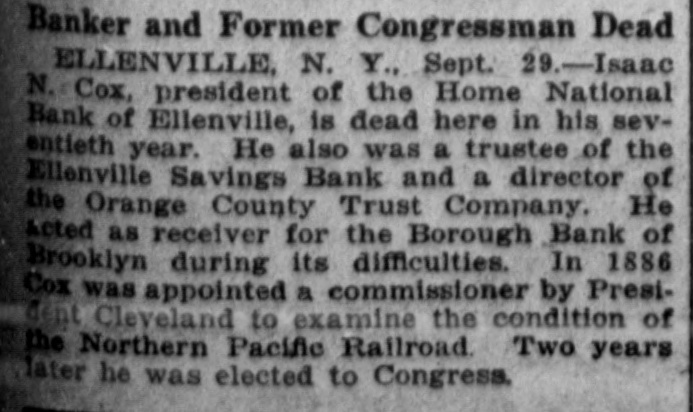
# Banker and Former Congressman Dead ELLENVILLE, N. Y., Sept. 29.β€”Isaac N. Cox, president of the Home National Bank of Ellenville, is dead here in his seventieth year. He also was a trustee of the Ellenville Savings Bank and a director of the Orange County Trust Company. He acted as receiver for the Borough Bank of Brooklyn during its difficulties. In 1886 Cox was appointed a commissioner by President Cleveland to examine the condition of the Northern Pacific Railroad. Two years later he was elected to Congress.


Article from The Sun, April 21, 1919

Click image to open full size in new tab

Article Text

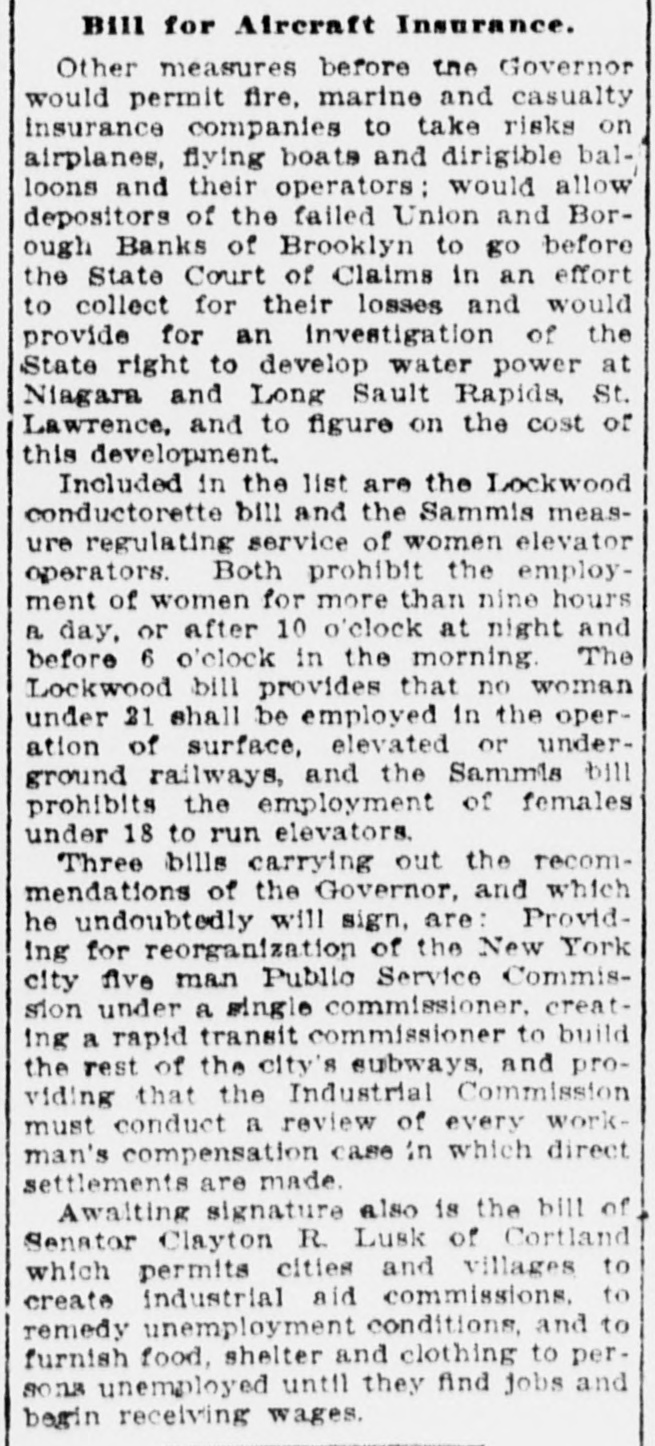
Bill for Aircraft Insurance. Other measures before the Governor would permit fire, marine and casualty insurance companies to take risks on airplanes, fiying boats and dirigible balloons and their operators: would allow depositors of the failed Union and Borough Banks of Brooklyn to go before the State Court of Claims in an effort to collect for their losses and would provide for an investigation of the State right to develop water power at Niagara and Long Sault Rapids, St. Lawrence, and to figure on the cost of this development. Included in the list are the Lockwood conductorette bill and the Sammis measure regulating service of women elevator operators. Both prohibit the employment of women for more than nine hours a day, or after 10 o'clock at night and before 6 o'clock in the morning. The Lockwood bill provides that no woman under 21 shall be employed in the operation of surface, elevated or underground railways, and the Sammis bill prohibits the employment of females under 18 to run elevators. Three bills carrying out the recommendations of the Governor, and which he undoubtedly will sign, are: Providing for reorganization of the New York city five man Public Service Commission under a single commissioner. creating a rapid transit commissioner to build the rest of the city's subways, and providing that the Industrial Commission must conduct a review of every workman's compensation case in which direct settlements are made. Awalting signature also is the bill of Senator Clayton R. Lusk of Cortland which permits cities and villages to create industrial aid commissions. to remedy unemployment conditions, and to furnish food, shelter and clothing to persons unemployed until they find jobs and begin receiving wages.