
13062. State Bank (Gothenburg, NE)

Bank Information

Episode Type
Suspension → Closure
Bank Type
state
Start Date
October 31, 1895
Location
Gothenburg, Nebraska (40.929, -100.161)

Metadata

Model
gpt-5-mini
Short Digest
da9650f3

Response Measures

None

Description

Contemporary dispatches (Oct–Nov 1895) report the State Bank of Gothenburg, Neb., failed/closed with assets $25,000 (largely uncollectable) and liabilities $8,000. No run or depositor panic is mentioned; this is a straightforward failure/closure due to bad/uncollectable assets.

Events (1)

1. October 31, 1895 Suspension
Cause
Bank Specific Adverse Info
Cause Details
Bank closed/failure attributed to assets of $25,000 that were uncollectable, leaving liabilities of $8,000; insolvency from bad/uncollectable assets assumed from text.
Newspaper Excerpt
State Bank failed; assets $25,000, but uncollectable: liabilities $8,000.
Source
newspapers

Newspaper Articles (3)

Article from Hutchinson Gazette, October 31, 1895

Click image to open full size in new tab

Article Text

CONDENSED DISPATCHES. Fraudulent warrants amounting to nation. $200,000 are in circulation in the Creek Sixty more Armenians have been slaughtered Erzingjane. by Turks, this time at Gothenburg, Neb., State Bank failed; assets $25,000, but uncollectable: liabilities $8,000. John W. Kitchen killed William Coates, his rival for the hand of Ella Spangler of Danville, Ill. Sir Robert Peel has compromised with his creditors at 50 per cent. Mrs. Langtry was one of them. A census of Prussia just completed shows a population of 31,491,209, an increase of 1,585,228 since 1690. Digging a trench for a water main caused the collapse of the Elmore bicycle factory at Clyde, Ohio. Several men were injured. Scottish Rite Masons will hold services at General Alfred Pike's grave, Oak Hill, Washington, at each triennial session hereafter. Edna Schmidt, aged 18, daughter of the millionaire Chicago brewer, went from her mother's grave to elope with her father's coachmen. Senator Sherman will not run for presidential nomination any more, but is out for McKinley, and will attend the convention in his interest. Mrs. Granville Lancaster, wife of a farmer at Livingstone, Ala., locked her three children in the house, and while she gossiped with a neighbor the children were roasted alive. A. K. Ward, the Memphis forger who defrauded banks and business men of $340,000, is at Puerto Cortez, Honduras, under close surveillance. Miss Jennie Dart, a bright and energetic young lady of Kansas City, Kan., has started for India, where she goes as a medical missionary. Miss Dart is a graduate from the highest medical colleges of this country, of both the new and old schools, and is well equipped for her work. The assistant chief of Police and police clerk of Fort Worth, Texas, are to be discharged because of an alleged shortage in police funds. A fellow named Graham attempted a daylight robbery of the Banner county bank, Harrisburg, Neb., but was shot and captnred through the quick work of Cashier Carlisle. Bank robbers all but secured $30,000 from J. M. Morley's bank at Severance, Kan., when they were frigutened off. Four men were killed and one seriously injured by a boiler explosion on a tugboat in Chicago. The British government has decided to exclude Americans hereafter from the Greenwich Royal School of Architecture. Sidney Lane, a brakeman, and C. H. Neville, a conductor, fought with revolvers at Houston, Texas. Neville is dead and Lane is dying. Owing to the prevalence of diphtheria the schools of North Topeka have been closed and the attendance in the Topeka schools has fallen from 5,200 to 3,700. Perry, Okla., negroes threaten to arrest the Board of education for not admitting colored children to white schools. F. F. Kiner, justice of the peace of Ida Grove, Iowa, has sued Rev. George Gleason for $5,000 damages for pulpit libels. Under the pretense of cutting timber for mining purposes, which the law allows, the public lands of California are being denuded. Republican silver men announce through Senator Stewart's paper that they will support only a silver man for the presidency. Senator Thurston, who is at San Diego, Cal., recuperating, has been compelled by ill health to decline an invitation to participate in the Nebraska campaign. A. S. Wightman, a San Antonio, Texas, bookkeeper, is $10,000 short in his accounts. Bamberger, Bloom & Co., Louisville's largest dry goods firm, has assigned. Liabilities, $1,200,000; assets about same. The Missouri University football team defeated DePauw, Ind., university by a score of to 0. Dick Pine, a member of the Ryan gang of outlaws, was shot dead by deputy United States marshals near Cushing, Okla. J. R. Burton is said to be figuring on securing the Topeka Capital in case it is forced to be sold, Zeke and Dick Crittenden, Cherokee Indian brothers, were shot dead by Marshal Ed Reed at Wagoner, Ind. Ter. They were drunk and began the firing. The United States court of private land claims has rendered its final decision declaring the alleged Peralta grant in Southern New Mexico and Arizona fraudulent. In a collision between an express train and a locomotive at Valley Junetion, Iowa, Mrs. Mary Hillhouse of Burlington, Iowa, was killed and two men injured. The Eureka Endowment Relief Association and the Eureka Relief Association, both of Baxter Springs, Kan., have been excluded from the mails for conducting forms of lotteries W. T. Purcell, a druggist and liveryman of South Greenfield, Mo., was found dead with his skull erushed on the track near there. Murder is suspected but the body was not robbed. Mrs. Parnell's household goods were sold at auction for about $500. McKinney, the county seat of Collins county Texas had $200 fire.

Article from Marshall County Independent, November 8, 1895

Click image to open full size in new tab

Article Text

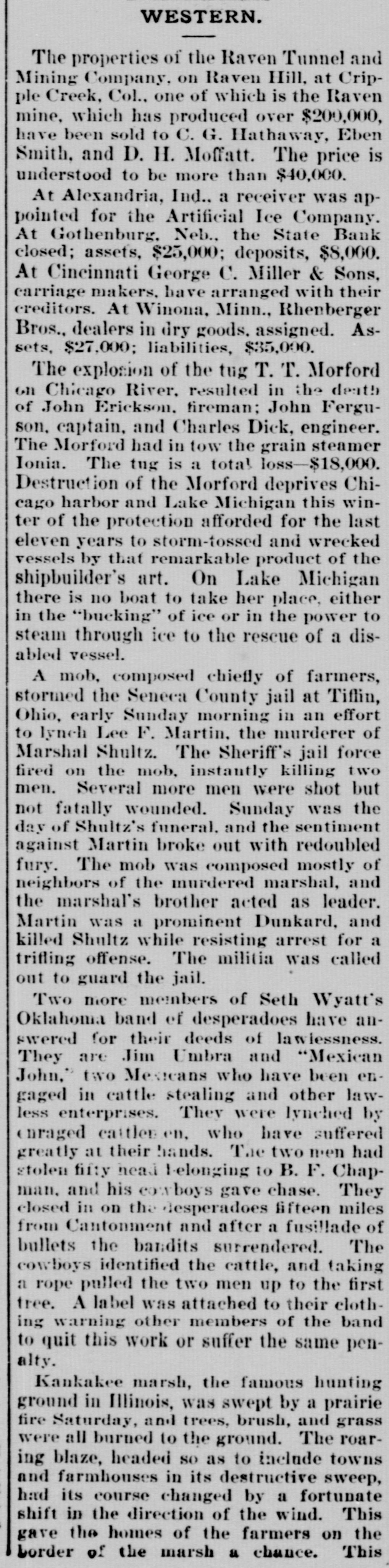
WESTERN. The properties of the Raven Tunnel and Mining Company, on Raven Hill, at Cripple Creek, Col., one of which is the Raven mine, which has produced over $200,000, have been sold to C. G. Hathaway, Eben Smith, and D. H. Moffatt. The price is understood to be more than $40,000. At Alexandria, Ind., a receiver was appointed for the Artificial Ice Company. At Gothenburg, Neb., the State Bank closed; assets, $25,000; deposits, $8,000. At Cincinnati George C. Miller & Sons, carriage makers, have arranged with their creditors. At Winona, Minn., Rhenberger Bros., dealers in dry goods. assigned. Assets, $27,000; liabilities, $35,000. The explosion of the tug T. T. Morford on Chicago River, resulted in the death of John Erickson, fireman; John Ferguson. captain, and Charles Dick, engineer. The Morford had in tow the grain steamer Ionia. The tug is a total loss-$18,000. Destruction of the Morford deprives Chicago harbor and Lake Michigan this winter of the protection afforded for the last eleven years to storm-tossed and wrecked vessels by that remarkable product of the shipbuilder's art. On Lake Michigan there is no boat to take her place, either in the "bucking" of ice or in the power to steam through ice to the rescue of a disabled vessel. A mob, composed chiefly of farmers, stormed the Seneca County jail at Tiffin, Ohio, early Sunday morning in an effort to lynch Lee F. Martin, the murderer of Marshal Shultz. The Sheriff's jail force fired on the mob, instantly killing two men. Several more men were shot but not fatally wounded. Sunday was the day of Shultz's funeral, and the sentiment against Martin broke out with redoubled fury. The mob was composed mostly of neighbors of the murdered marshal, and the marshal's brother acted as leader. Martin was a prominent Dunkard, and killed Shultz while resisting arrest for a trifling offense. The militia was called out to guard the jail. Two more members of Seth Wyatt's Oklahoma band of desperadoes have answered for their deeds of lawiessness. They are Jim Umbra and "Mexican John," two Mexicans who have been engaged in cattle stealing and other lawless enterprises. They were lynched by enraged cattlen en, who have suffered greatly at their hands. The two men had stolen fifty head belonging to B. F. Chapman. and his cowboys gave chase. They closed in on the desperadoes fifteen miles from Cantonment and after a fusillade of bullets the bandits surrendered. The cowboys identified the cattle, and taking a rope pulled the two men up to the first tree. A label was attached to their clothing warning other members of the band to quit this work or suffer the same penalty. Kankakee marsh, the famous hunting ground in Illinois, was swept by a prairie fire Saturday, and trees, brush, and grass were all burned to the ground. The roaring blaze, headed SO as to include towns and farmhouses in its destructive sweep, had its course changed by a fortunate in


Article from The Representative, January 22, 1896

Click image to open full size in new tab

Article Text

"BUSTED." THE GOLD STANDARD AT WORK. The Appeal to Reason says: Mercantile Cloak Company, New York, failed for $125,000. Too many cloaks and too little money. Western Building and Loan Association, of St. Louis, assigned. Liabilities way up there. People don't want any homes-want nothing but money. Big lumber firm in Ontario assigned for want of stuff. Plenty of lumber, but law does not compel men to have lumber, but money. Too little money to go 'round. Farmers' bank at Blackwell, Okla., went down last week with $60 in the vault. Lots of notes and mortgages, Too but deman who has de mon is de boss. little money and too many notes. The prosperity of the country continues with great eagerness. The First National bank of Wellington, Kansas, has joined the angels with asbestos wings in the next world. The bank at Ashgrove, Mo., has yielded to the grim monster of contraction. The State bank at Gothenburg, Neb., flew up the flue. The state bank at Washburn, Wis., has vanished with much cash. Judge Woods has granted Coffin, the wrecker of a great bank of Indianapolis a. new trial. Business houses all over the country are tumbling like a row of bricks, and the concentration of wealth into fewer and fewer hands is accelerated. Whoop em up. Glorious system to vote for. Sultzbach, great clothier of Philadel. phia, is out in the cold because he tried to make clothing for the people. People don't want any clothing want only filthy lucre. Nakedness and money is what they want-but money at any rate. Don't know enough to supply the demand. These people didn't have the mun to pay the officers or judges: Evictions of settlers on the Omaha reservation in Nebraska occur daily. Yesterday four families whose arms were badly lacerated by a rope employed to hasten their departure from their homes and who were otherwise severly treated, swore out a warrant for the arrest of Wm. and Sam Ashford, leadeers of the evicting parties of Indian police. Leo Mayer, big merchant of Janesville, Wis., failed 'because of his inability to make collections." So much money in the banks the people haven't any, see? Washburn, Wis., bank failed and a lot of howling dervishes who believe in putting their money in the hands of bankers are wailing their loss. Never put in bank more than you can afford to lose. M. Rosenberg & Co., wholesale hosiery, New York, failed. Liabilities many thousands. M. Bixby & Co., of New York, manufacturers of blacking, harness oil, etc., have succumbed to the returning prosperity. Liabilities, $240,028; actual assetts, $91,743. HERE'S ANOTHER BATCH. Fort Scott, Kan., Jan. 18.-The plant of the Fort Scott Paper Company, valued at $30,000 was today placed in the hands of W. T. Seagrave, as receiver, by Judge Simons, of the District Court. The application was made by the Bank of Fort Scott, which holds a mortgage on the factory. A few days ago the plant was closed down and the employes sued and got judgment for $2,300 back wages. The factory was built as an experiment to make paper out of bagasse, from the sugar mill. The experiment proved a success, but the company did not have money enough to carry on the business. The Receiver expects to resume operations soon. Philadelphia, Pa. Jan. 18.-The fifth failure has been reported consequent on the failure of Keene, Sutterlee & Co., the leather dealers. Charles W. Fink and Charles H. Heilgman, trading as Hartly, Fink & Co., morocco manufacturers, made an assignment. Liabilities are said to be at least $60,000. Several judgments were entered and a Sheriffs' sale realized between $8,000 and $9,000 on the firm's assets. Little Rock, Ark., Jan. 18.-Dave W. Pollock, clothing and furnishing goods dealer, was attached by the German National Bank and other local creditors tonight. Liabilities, $8,500; nominal assets the same. Duluth, Minn., Jan. 18.-The Duluth Provision and Dry Goods Company, operating a large department store in this city assigned today to Joseph C. Helm. Some of the creditors have applied for the appointment of a Receiver. The company was organized about two years ago, with a capital stock of $100,000. Gloversville, N. Y., Jan. 18.-Daniel B. Judson, manufacturer of gloves, has assigned to his son, John B. Judson, of this city, and J. P. Argensinger, of Johnstown. Liabilities, $65,000. Judson failed two years ago. Lexington, Ky., Jan. 18.-Frederick Halderman made an assignment here today to Leonard N. Deall. Assets, $2,800; liabilities, $3,000. Halderman is a diaryman. HERE'S THE RECORD OF ONE DAY. Philadelphia, Jan. 15.-The leather a trade of this city was thrown into state of consternation today by the announcement that the liabilities of Keen, Sutterlee & Co., leather dealers and Importers, who failed Saturday, will reach, if they do not exceed, $4,000,000. Leather was only one of the commodities handled by the firm. They were heavy importers of goat skins, chemicals, coffees, wool and hides, most of which came from South American ports. Four other leather houses have since gone down in the crash which wrought the ruin of the larger firm. These are: John M. Fenlin, liabilities nearly $100,000; Charles W. Landell, $150,000; Charles Illingsworth, trading as the Eagle Glazed Kid Company, and John A. Duncan. The liabilities of the latter two houses are not yet known. Frederick W. Sutterlee and Fenlin have not been seen since last Thursday. Mr. Sutterlee and Mr. Fenlin were intimates in their business life, as well as socially, and their absence has led many to suppose that they have gone together, although Mr. Sutterlee announced his departure in search of his health. From whisperings in the trade it would be supposed that many of the men who best knew the concern and its methods are inclined to believe that the failure hinges considerably more upon the disappearance of these two men than is commonly