12787. Somerset County Bank (Somerville, NJ)

Bank Information

Episode Type
Suspension → Closure
Bank Type
state
Start Date
December 16, 1894
Location
Somerville, New Jersey (40.574, -74.610)

Metadata

Model
gpt-5-mini
Short Digest
339c992b4f6a9f60

Response Measures

None

Description

Articles indicate the Somerset County Bank became insolvent and was placed in the hands of a receiver in December 1894 and remained defunct; no contemporaneous newspaper account describes a depositor run. The failure is attributed to alleged reckless/illegal management and large uncollectible loans (Pidcock and related companies). Multiple suits by the receiver and stockholders against directors followed, and a permanent receiver was appointed in Dec 1895.

Events (4)

1. December 16, 1894 Suspension
Cause
Bank Specific Adverse Info
Cause Details
Bank became insolvent due to alleged loose/reckless management and large uncollectible loans (notes of J. N. Pidcock and associated companies).
Newspaper Excerpt
Somerville, N. J., Dec. 16. The stockholders of the Somerset County Bank, which is now in the hands of a receiver, held a meeting yesterday...
Source
newspapers
2. July 25, 1895 Other
Newspaper Excerpt
Sheriff George A. Dilts yesterday served summons on Calvin Corle, Alvah A. Clark, James N. Pidcock ... as directors of the defunct Somerset County Bank, to defend themselves against the action of a large number of stockholders ... alleging gross mismanagement of the bank's affairs. The suit is brought by Receiver Johnson ... to recover moneys lost by illegal and fraudulent conduct of the directors.
Source
newspapers
3. August 20, 1895 Other
Newspaper Excerpt
By virtue of the orders made in the above entitled cause by the Chancellor, on December 10th, 1894, and July 20th. 1895. I. Linsly Rowe ... shall expose to sale ... all the securities ... held by the First National Bank of Jersey City as collateral to the debt of James N. Pidcock.
Source
newspapers
4. December 23, 1895 Receivership
Newspaper Excerpt
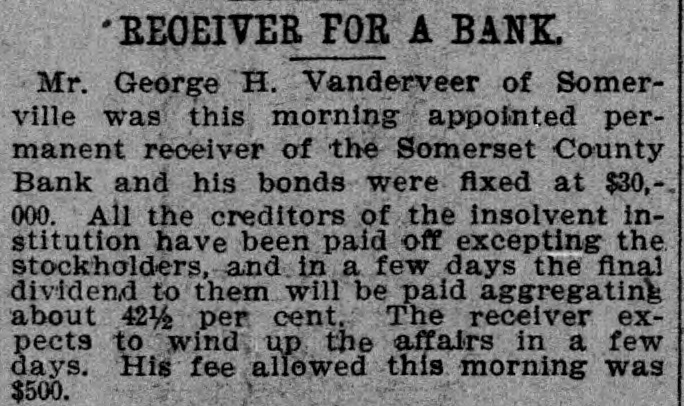
Mr. George H. Vanderveer of Somerville was this morning appointed permanent receiver of the Somerset County Bank and his bonds were fixed at $30,000. All the creditors of the insolvent institution have been paid off excepting the stockholders...
Source
newspapers

Newspaper Articles (10)

Article from New-York Tribune, December 17, 1894

Click image to open full size in new tab

Article Text

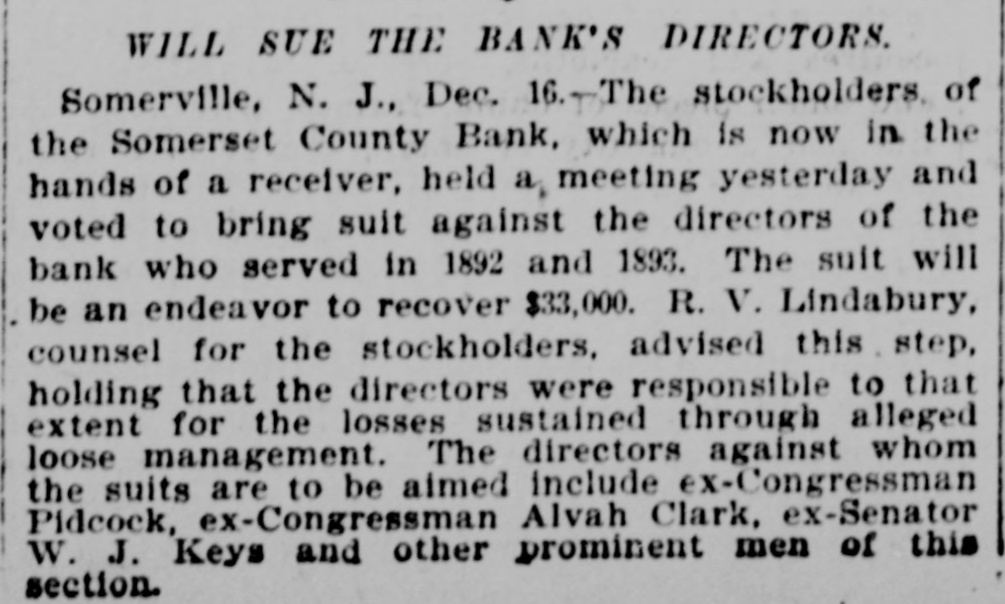
WILL SUE THE BANK'S DIRECTORS. Somerville, N. J., Dec. 16. The stockholders of the Somerset County Bank, which is now in the hands of a receiver, held a meeting yesterday and voted to bring suit against the directors of the bank who served in 1892 and 1893. The suit will be an endeavor to recover $33,000. R. V. Lindabury, counsel for the stockholders, advised this step, holding that the directors were responsible to that extent for the losses sustained through alleged loose management. The directors against whom the suits are to be aimed include ex-Congressman Pidcock, ex-Congressman Alvah Clark, ex-Senator W. J. Keys and other prominent men of this section.


Article from The Jersey City News, March 12, 1895

Click image to open full size in new tab

Article Text

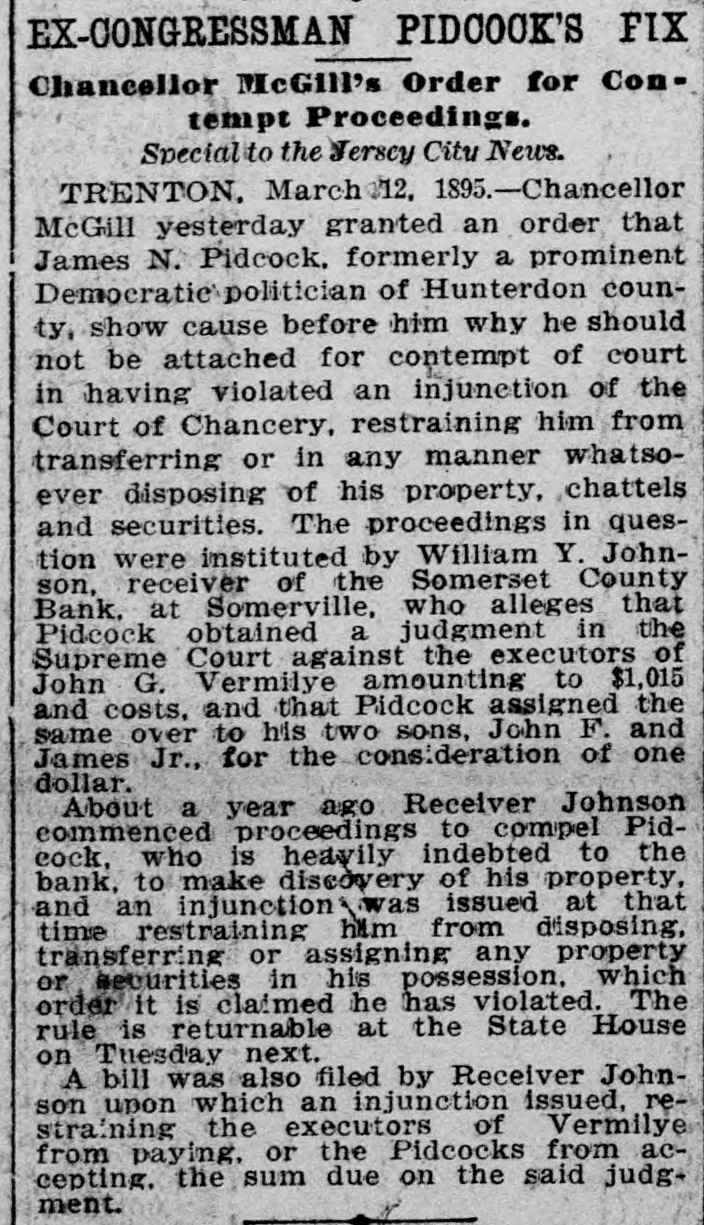
EX-CONGRESSMAN PIDCOOK'S FIX Chancellor McGill's Order for Contempt Proceedings. Special to the Jerscy City News. TRENTON. March 12, 1895.-Chancellor McGill yesterday granted an order that James N. Pidcock. formerly a prominent Democratic politician of Hunterdon county, show cause before him why he should not be attached for contempt of court in having violated an injunction of the Court of Chancery, restraining him from transferring or in any manner whatsoever disposing of his property, chattels and securities. The proceedings in question were instituted by William Y. Johnson, receiver of the Somerset County Bank. at Somerville, who alleges that Pidcock obtained a judgment in the Supreme Court against the executors of John G. Vermilye amounting to $1,015 and costs, and that Pidcock assigned the same over to his two sons, John F. and James Jr., for the consideration of one dollar. About a year ago Receiver Johnson commenced proceedings to compel Pidcock, who is heavily indebted to the bank, to make discovery of his property, and an injunction was issued at that time restraining him from disposing, transferring or assigning any property or securities in his possession, which order it is claimed he has violated. The rule is returnable at the State House on Tuesday next. A bill was also filed by Receiver Johnson upon which an injunction issued, restraining the executors of Vermilye from paying, or the Pidcocks from accepting. the sum due on the said judgment.


Article from The Jersey City News, July 19, 1895

Click image to open full size in new tab

Article Text

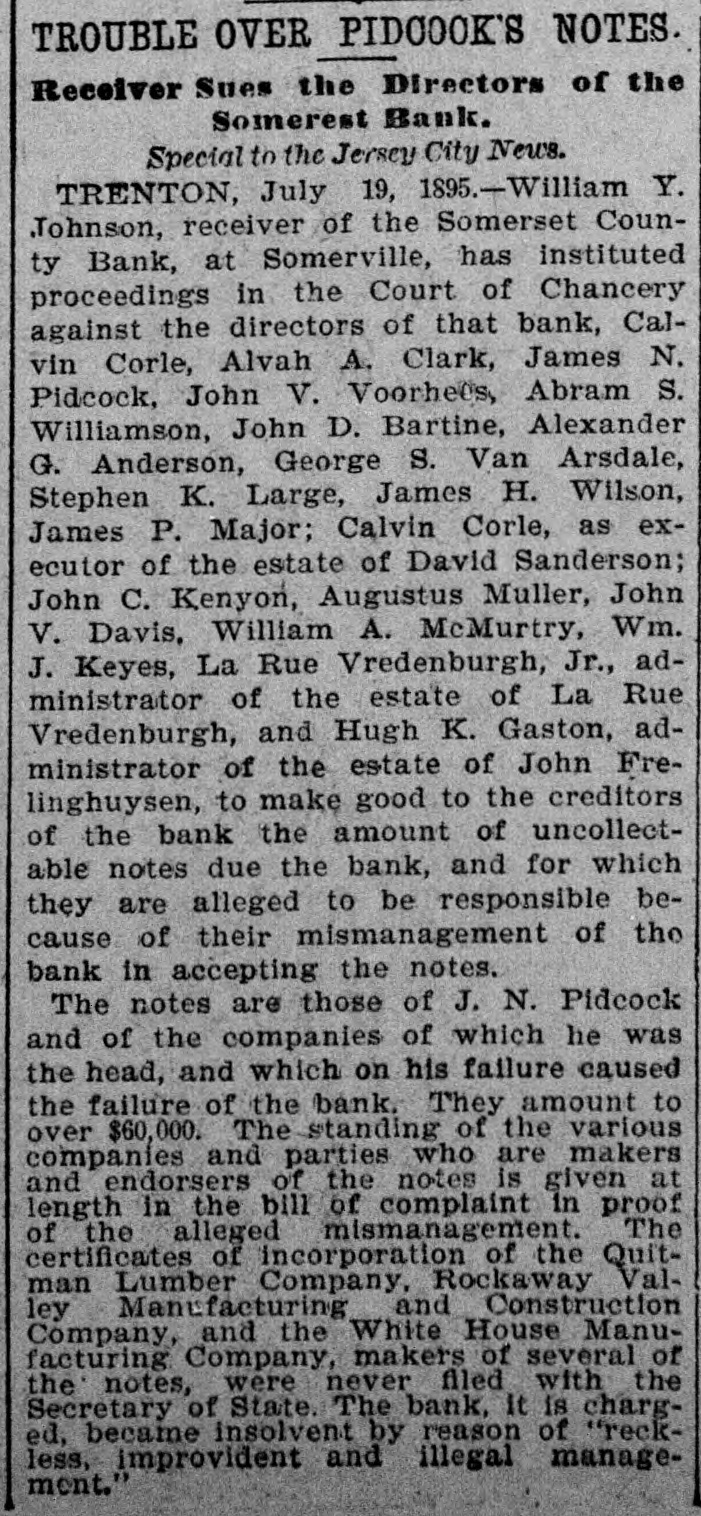
TROUBLE OVER PIDCOOK'S NOTES. Receiver Sues the Directors of the Somerest Bank. Special to the Jersey City News. TRENTON, July 19, 1895.-William Y. Johnson, receiver of the Somerset County Bank, at Somerville, has instituted proceedings in the Court of Chancery against the directors of that bank, Calvin Corle, Alvah A. Clark, James N. Pidcock, John V. Voorhe@s, Abram S. Williamson, John D. Bartine, Alexander G. Anderson, George S. Van Arsdale, Stephen K. Large, James H. Wilson, James P. Major; Calvin Corle, as executor of the estate of David Sanderson; John C. Kenyon, Augustus Muller, John v. Davis, William A. McMurtry, Wm. J. Keyes, La Rue Vredenburgh, Jr., administrator of the estate of La Rue Vredenburgh, and Hugh K. Gaston, administrator of the estate of John Frelinghuysen, to make good to the creditors of the bank the amount of uncollectable notes due the bank, and for which they are alleged to be responsible because of their mismanagement of the bank in accepting the notes. The notes are those of J. N. Pidcock and of the companies of which he was the head, and which on his failure caused the failure of the bank. They amount to over $60,000. The standing of the various companies and parties who are makers and endorsers of the notes is given at length in the bill of complaint in proof of the alleged mismanagement. The certificates of incorporation of the Quitman Lumber Company, Rockaway Valley Manufacturing and Construction Company, and the White House Manufacturing Company, makers of several of the notes, were never filed with the Secretary of State. The bank, It is charged, became insolvent by reason of "reckless, improvident and illegal management."


Article from The Jersey City News, July 25, 1895

Click image to open full size in new tab

Article Text

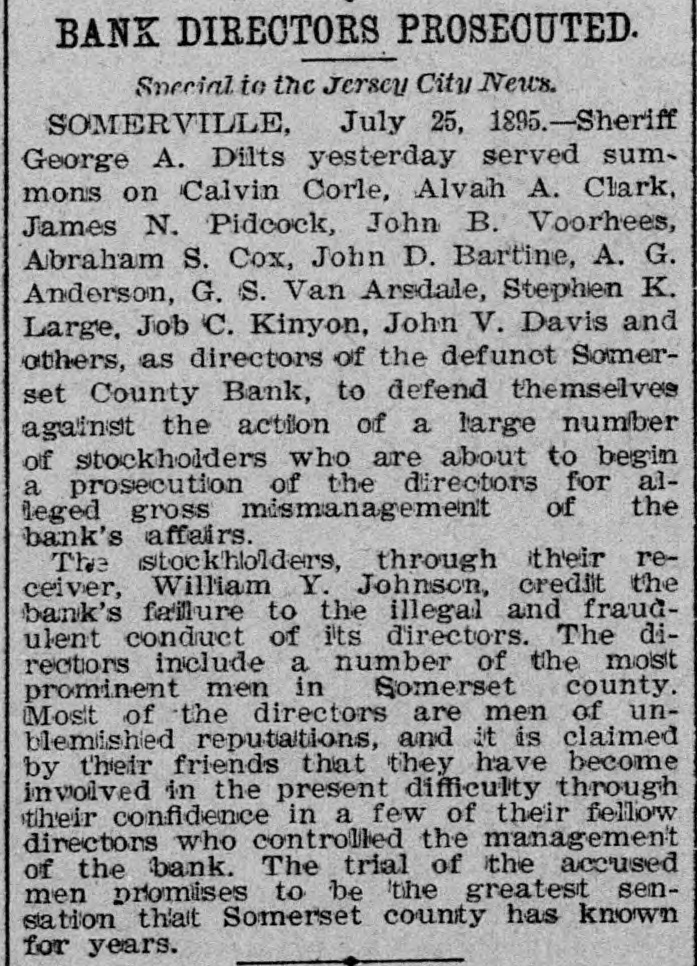
BANK DIRECTORS PROSECUTED. Special to the Jersey City News. SOMERVILLE, July 25, 1895.-Sheriff George A. Dilts yesterday served summons on Calvin Corle, Alvah A. Clark, James N. Pidcock, John B. Voorhees, Abraham S. Cox, John D. Bartine, A. G. Anderson, G. S. Van Arsdale, Stephen K. Large. Job C. Kinyon, John v. Davis and others, as directors of the defunct Somerset County Bank, to defend themselves against the action of a large number of stockholders who are about to begin a prosecution of the directors for alleged gross mismanagement of the bank's affairs. The stockholders, through their receiver, William Y. Johnson, credit the bank's failure to the illegal and fraudulent conduct of its directors. The directions include a number of the most prominent men in Somerset county. Most of the directors are men of unblemished reputations, and it is claimed by their friends that they have become involved in the present difficulty through their confidence in a few of their fellow directors who controlled the management of the bank. The trial of the accused men priomises to be the greatest sensation that Somerset county has known for years.


Article from New-York Tribune, July 26, 1895

Click image to open full size in new tab

Article Text

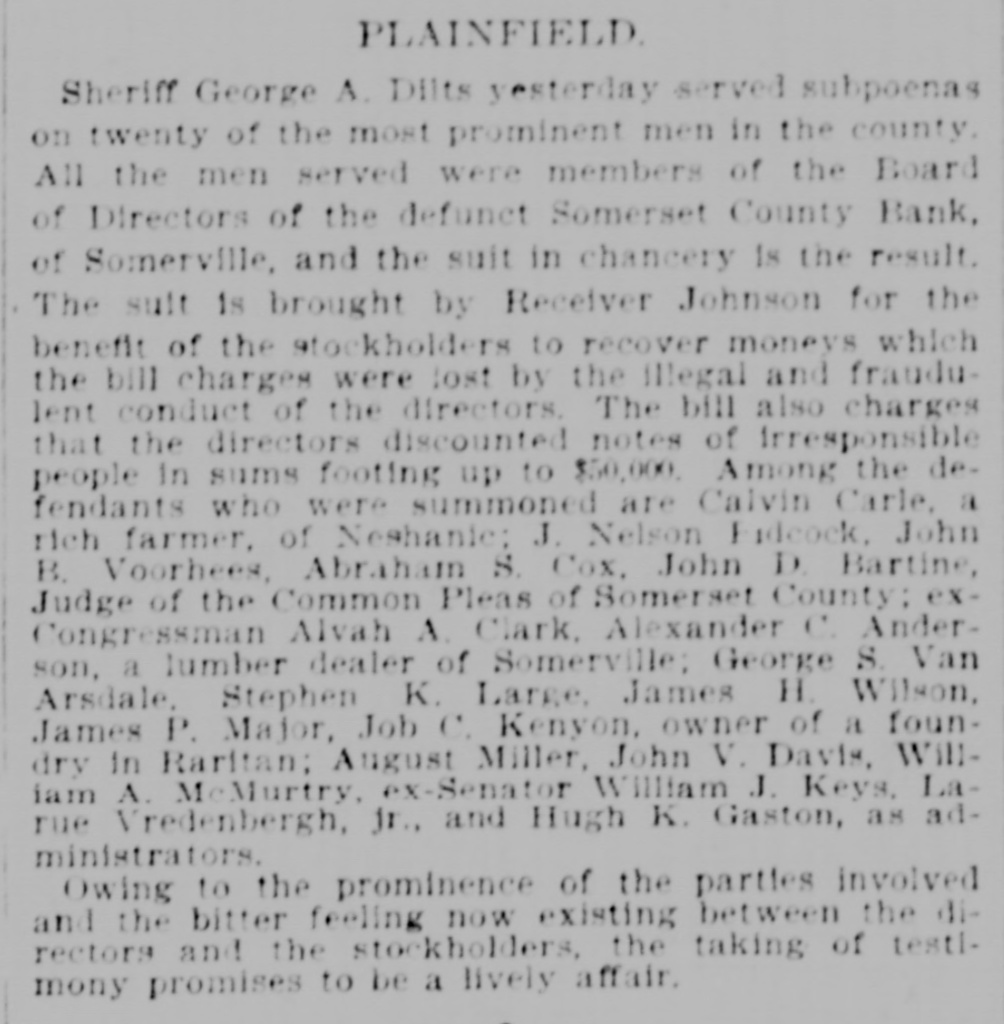
PLAINFIELD. Sheriff George A. Dilts yesterday served subpoenas on twenty of the most prominent men in the county. All the men served were members of the Board of Directors of the defunct Somerset County Bank, of Somerville, and the suit in chancery is the result. The suit is brought by Receiver Johnson for the benefit of the stockholders to recover moneys which the bill charges were lost by the illegal and fraudulent conduct of the directors. The bill also charges that the directors discounted notes of irresponsible people in sums footing up to $50,000. Among the defendants who were summoned are Calvin Carle, a rich farmer, of Neshanic; J. Nelson Fidcock, John B. Voorhees, Abraham S. Cox, John D. Bartine, Judge of the Common Pleas of Somerset County; ex-Congressman Alvah A. Clark, Alexander C. Anderson, a lumber dealer of Somerville; George S. Van Arsdale, Stephen K. Large, James H. Wilson, James P. Major, Job C. Kenyon, owner of a foundry in Raritan; August Miller, John V. Davis, William A. McMurtry, ex-Senator William J. Keys, Larue Vredenbergh, jr., and Hugh K. Gaston, as administrators. Owing to the prominence of the parties involved and the bitter feeling now existing between the directors and the stockholders, the taking of testimony promises to be a lively affair.


Article from The Evening Herald, July 26, 1895

Click image to open full size in new tab

Article Text

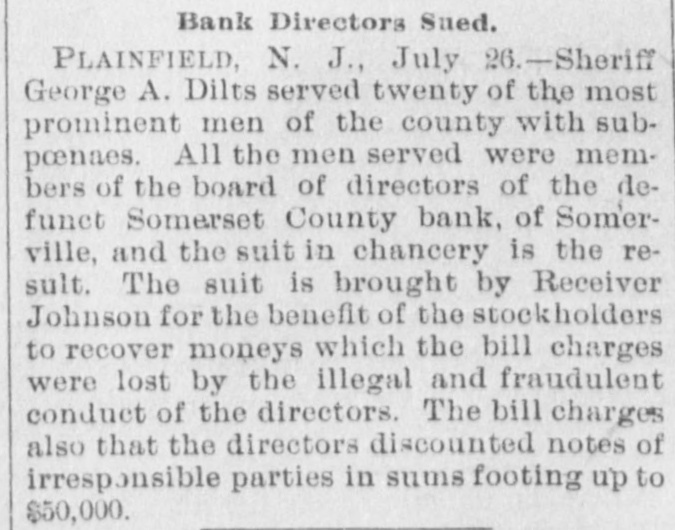
Bank Directors Sued. PLAINFIELD, N. J., July 26.-Sheriff George A. Dilts served twenty of the most prominent men of the county with subpœnaes. All the men served were members of the board of directors of the defunct Somerset County bank, of Som'erville, and the suit in chancery is the result. The suit is brought by Receiver Johnson for the benefit of the stockholders to recover moneys which the bill charges were lost by the illegal and fraudulent conduct of the directors. The bill charges also that the directors discounted notes of irresponsible parties in sums footing up to $50,000.


Article from The Wilmington Daily Republican, July 26, 1895

Click image to open full size in new tab

Article Text

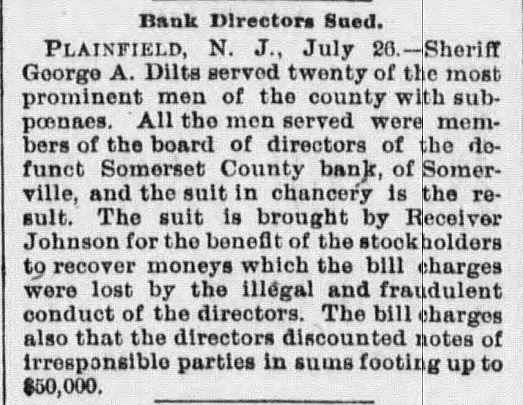
Bank Directors Sued. PLAINFIELD, N. J., July 26.-Sheriff George A. Dilts served twenty of the most prominent men of the county with subpoenaes. All the men served were members of the board of directors of the dofunct Somerset County bank, of Somerville, and the suit in chancery is the result. The suit is brought by Receiver Johnson for the benefit of the stockholders to recover moneys which the bill charges were lost by the illégal and fraudulent conduct of the directors. The bill charges also that the directors discounted notes of irresponsible parties in sums footing up to $50,000.


Article from The Jersey City News, August 19, 1895

Click image to open full size in new tab

Article Text

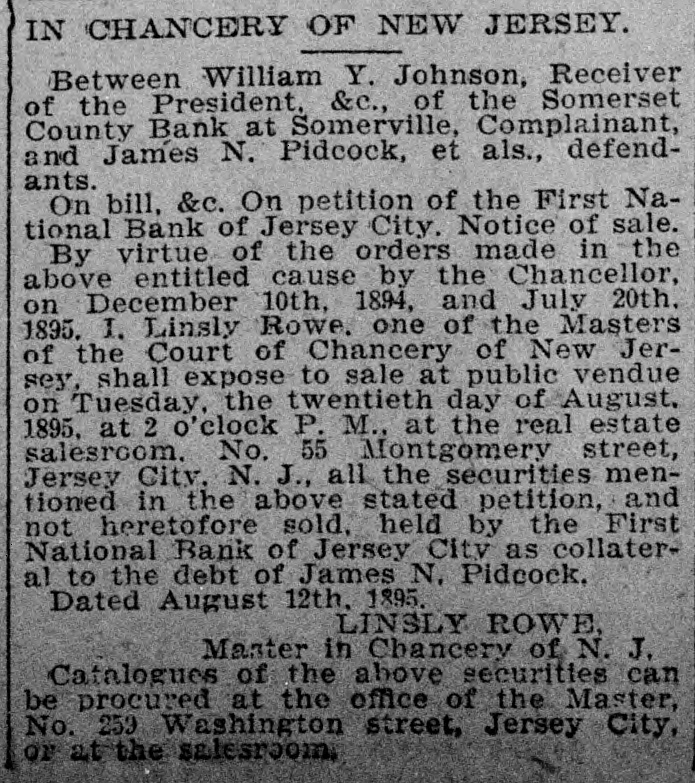
IN CHANCERY OF NEW JERSEY. Between William Y. Johnson, Receiver of the President, &c., of the Somerset County Bank at Somerville, Complainant, and James N. Pidcock, et als., defendants. On bill, &c. On petition of the First National Bank of Jersey City. Notice of sale. By virtue of the orders made in the above entitled cause by the Chancellor, on December 10th, 1894, and July 20th. 1895. I. Linsly Rowe. one of the Masters of the Court of Chancery of New Jersey, shall expose to sale at public vendue on Tuesday. the twentieth day of August. 1895, at 2 o'clock P. M., at the real estate salesroom. No. 55 Montgomery street, Jersey City. N. J., all the securities mentioned in the above stated petition, and not heretofore sold, held by the First National Bank of Jersey City as collateral to the debt of James N, Pideock. Dated August 12th. 1895. LINSLY ROWE, Master in Chancery of N. J. Catalogues of the above securities can be procured at the office of the Master, No. 259 Washington street, Jersey City, or at the salesroom.


Article from The Jersey City News, December 23, 1895

Click image to open full size in new tab

Article Text

RECEIVER FOR A BANK. Mr. George H. Vanderveer of Somerville was this morning appointed permanent receiver of the Somerset County Bank and his bonds were fixed at $30,000. All the creditors of the insolvent institution have been paid off excepting the stockholders, and in a few days the final dividend to them will be paid aggregating about 421/2 per cent. The receiver expects to wind up the affairs in a few days. His fee allowed this morning was $500.


Article from The Savannah Morning News, January 24, 1902

Click image to open full size in new tab

Article Text

White House, N. J., Jan. 21.—"The Pidcocks always did kind of like to keep their money" is about all that White House has to say about it. White House never goes very far in criticism of the Pidcock family. To find why the people of this village are so careful it is necessary to consult the town and county records. The present occasion for the remark as to the conservatism of the Pidcocks about letting money escape from the family circle is the filing of John Falks Pidcock's. will for probate. The will leaves $1,000 to the testator's loving and faithful wife, Jeanette Davis Pidcock, and after a few other bequests of trifling character leaves the residuary estate, amounting to $100,000 or more, to Mr. Pidcock's beloved sister, Nellie. Mr. Pidcock died on Jan. 11, a week ago Saturday, after an illness of two months. He was married to Jeanette Davis just before he became ill. She married him, against the protests of her father and the rest of the family, when he was about to submit to a serious operation. She nursed him all through his illness until his death. Now folks would like to know whether she is going to sue for what the neighborhood ventures to believe "her rights." Curiosity on this point was suppressed until to-day, when it was learned that Mr. Pidcock's two surviving brothers and the inheriting sister had gone South for an indefinite stay. To-day people have gone so far as to do some of their guessing out loud. Before the Pidcocks have been gone ten days it may be that some one will even pluck up courage enough to ask Squire Davis, the widow's father, what he and his daughter are going to do about it. But there is no use, according to general public opinion, in being in too much of a hurry about these things. A fellow can't always tell just where the Pidcocks are, anyway. Nelson Pidcock, the father of the present generation of the family, was one of the notable figures in Hunterdon county politics and finance in his day. He was Congressman from this district. Either through his acquaintance at the National Capital or through relatives living in the South he became interested in the pine lumber business in Georgia. He went to Moultrie, Ga., and was prominent in the organization of the Quitman Lumber Company. The concern required considerable capital. No small part of it came from the Somerset County Bank of Somerville. Congressman Pidcock was a director of the bank. A few years ago the bank went down. The receiver, William Johnson, made a trip to Georgia to see what security the bank had loaned its money on. When he came back he made such a report that the bank tried to make Nelson Pidcock responsible for the Quitman Lumber Company's paper, which he had indorsed. The old gentleman went into bankruptcy. A thorough search was made for moneys which some suspicious persons were sure he had, but no trace of it was ever found. He died about two years ago and left his wife the old family homestead and an allowance of $100 a month for life. "She had been married to him so long," said Whitehouse, "that she was almost one of the family." The sons have done well in a wordly way since their father's death. Long before Nelson Pidcock died. John Falks Pidcock had been the president of the Rockaway Valley Railroad, which runs from White House to Morristown. This railroad had only one engine, but that sufficed for the traffic for a long time. Less than ten years ago a new engine was bought, a thoroughly modern product of American skill and ingenuity. The manufacturers were rather proud of it. One day when one of their agents went out to the Rockaway Valley Railroad to see the engine, he couldn't find it. Nobody knew where it had gone. There was a long hunt for it, and at last it was reported that the engine had been found in Quitman county, Georgia. While the search was going on John Quitman went away. So far as his neighbors knew he did not return to Hunterdon county or to the state until last fall. His return caused no little excitement in the community. He was treated with all the more respect when it was learned that he had built the Georgia and Northern Railroad, a line fifty-one miles long, from Pidcock (as the site of the Quitman Lumber Company's business is now called) to Carlisle, Ga. It was also learned that he had been married in the South to a woman of aristocratic family and a Roman Catholic. This kept White House people busy going down to Somerville to talk—they never talk about the Pidcocks in White House, there are too many little birds around. None of the Pidcocks had ever been a Roman Catholic. The first Mrs. Pidcock died two years after her marriage. Meanwhile James Pidcock had been suffering all sorts of impositions in Hunterdon county. One of the negro employes was insulted in a White House barroom one Saturday night three years ago, and ran home and told his master about it. James went out with the negro, and a telegraph lineman named James Kane was pointed out to him as the one who had insulted the negro. There was a fight, and Kane was shot so that he died a few days afterward. The negro escaped. Pidcock said that the negro did the shooting. The case was taken before the grand jury and that body refused to indict Pidcock. The grand jury was rebuked by the court and the next grand jury indicted him. He was tried and acquitted. In the course of the proceedings an attempt was made to inspect the minutes of the first grand jury. The county clerk, after some pressure, said that he could not give up the minutes because he did not have them. He had sent them to James Pidcock, he said, when the jury was dismissed. The negro was arrested down South last year and was brought back for trial and acquitted.