Union National Bank (New York, NY)

Episode Information

Episode UID
127800945
Episode Type
Suspension โ†’ Closure
Bank Type
national
Bank ID
12780 national
Charter Number
1278
Start Date
September 11, 1878
Location
New York, New York (40.714, -74.006)

Metadata

Model
gpt-5-mini (chosen from majority vote of a three-model LLM ensemble)
Short Digest
16b653cb6f78d568

Response Measures

None

Description

Contemporary reports state a suspension (Sept 11, 1878) but give no reopening or receivership details; further articles could resolve permanence.

Events (3)

1. June 14, 1865 Chartered
Source
historical_nic
2. September 11, 1878 Suspension
Cause
Local Shock
Cause Details
Shrinkage (decline) of real estate values in New York leading to insolvency/strain.
Newspaper Excerpt
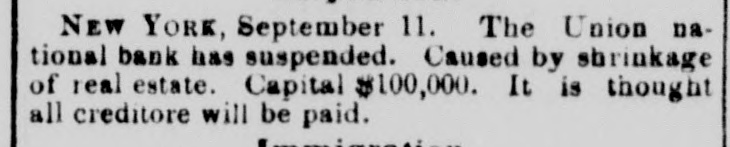
The Union national bank has suspended. Caused by shrinkage of real estate.
Source
newspapers
3. July 21, 1885 Voluntary Liquidation
Source
historical_nic

Newspaper Articles (3)

Article from Daily Kennebec Journal, September 12, 1878

Click image to open full size in new tab

Article Text

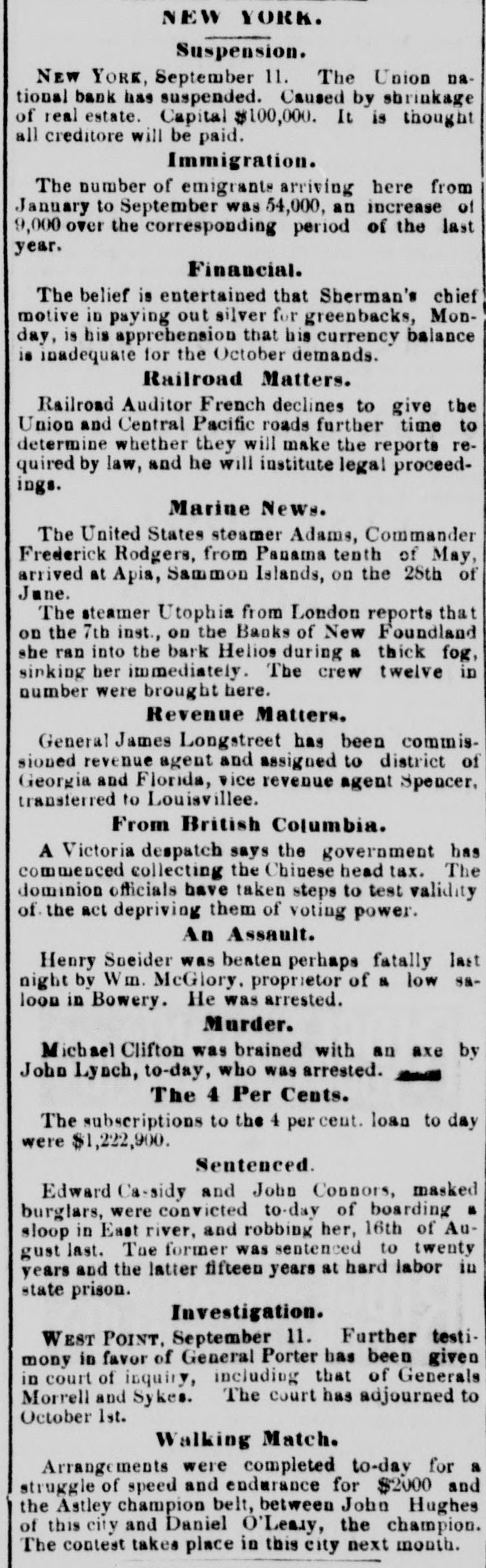
NEW YORK. Suspension. NEW YORK, September 11. The Union national bank has suspended. Caused by shrinkage of real estate. Capital $100,000. It is thought all creditore will be paid. Immigration. The number of emigrants arriving here from January to September was 54,000, an increase of 9,000 over the corresponding period of the last year. Financial. The belief is entertained that Sherman's chief motive in paying out silver for greenbacks, Monday, is his apprehension that his currency balance is inadequate for the October demands. Railroad Matters. Railroad Auditor French declines to give the Union and Central Pacific roads further time to determine whether they will make the reports required by law, and he will institute legal proceedings. Marine News. The United States steamer Adams, Commander Frederick Rodgers, from Panama tenth of May, arrived at Apia, Sammon Islands, on the 28th of June. The steamer Utophia from London reports that on the 7th inst., on the Banks of New Foundland she ran into the bark Helios during a thick fog, sinking her immediately. The crew twelve in number were brought here. Revenue Matters. General James Longstreet has been commissioned revenue agent and assigned to district of Georgia and Florida, vice revenue agent Spencer, transferred to Louisvillee. From British Columbia. A Victoria despatch says the government has commenced collecting the Chinese head tax. The dominion officials have taken steps to test validity of the act depriving them of voting power. An Assault. Henry Speider was beaten perhaps fatally last night by Wm. McGlory. proprietor of a low saloon in Bowery. He was arrested. Murder. Michael Clifton was brained with an axe by John Lynch, to-day, who was arrested. The 4 Per Cents. The subscriptions to the 4 percent. loan to day were $1,222,900. Sentenced. Edward Cassidy and John Connors, masked burglars, were convicted to-day of boarding a sloop in East river, and robbing her, 16th of August last. The former was sentenced to twenty years and the latter fifteen years at hard labor in state prison. Investigation. WEST POINT, September 11. Further testimony in favor of General Porter has been given in court of inquiry, including that of Generals Morrell and Sykes. The court has adjourned to October 1st. Walking Match. Arrangements were completed to-day for a struggle of speed and endurance for $2000 and the Astley champion belt, between John Hughes of this city and Daniel O'Leary, the champion. The contest takes place in this city next month.

Article from Daily Kennebec Journal, September 12, 1878

Click image to open full size in new tab

Article Text

NEW YORK, September 11. The Union national bank has suspended. Caused by shrinkage of real estate. Capital $100,000. It is thought all creditore will be paid.


Article from Essex County Herald, October 25, 1878

Click image to open full size in new tab

Article Text

On the failure of Jay Cooke & Co., a general feeling of distrust was engendered, and the consequence was the utter failure of many of the Nat onal Banks, and the total suspension of all the National Banks in the city of New York. Now this was not suspension of specie payments, but was a suspension of payments in legal tender Lotes or greenbacks. The promises of the government in the form of greenbacks rose to a premium of four per cent. above the value of National Bank notes, and who can tell the extent of the disaster to the whole country if we had been doing business upon a spe ie basis, as it is called? The ruin would have been general, but as it was, everybody knew that there was precisely the same amount of paper money in the country af'er as before the panic, and consequently it was of short duration, and there was comparative-ly very little derangement in the movements of the products of the country. If the banks could not pay in greenbacks when there was in the country more in amount of legal tenders tean the entire national bank circulation, how can it be expected hat they can maintain coin payments? The fact is, his talk about specie payments is simply absurd, whether uttered by Mr. Greeley or the Solons of Congress. Mr. Greeley's saying that the "way to resumption was to resume," is not a whit more absurd than the more elaborate proposition pending in Congress. To maintain coin payments in this count.y, commercial as it is, is simply impossible unti the Almighty has changed the character and habits of the people-until, as a nation and as individuals, we become a frugal and economical people, sp nding, as a whole, less than our incomes; and until our national, state, railroad and commercial debt abroad is paid or largely reduced, we cannot be secure from the effects of the vicissitudes that creditor nations are liable to, and consequently, if our banks are on a coin basis, we are liabl at all times to a foreign drain, which would compel suspension, Allowing the national ba ks to issue any currency is an unmitigated evil, and is the real obstacle to sound, wise a d wholesome legislation, and and they ought to be divested of that power as speedily as it can be done without disturbing values. This real or fanced -interests are antagonistic to wholesome financial legislation. Capital is timid and selfish, and at the same time is influential, and it has been said (by Senator Sprague) that nothing is meaner than one million of dollars except two millions. The circulation enjoyed by the banks is a valuable privilege, ard to protect it they will overlook every consideration of public good. The evils of such special favors do not end with the banks, for to secure and perpetuate favorable legislation for themselves hey must not oppose legislation for the benefi of other interests: so, legislation becomes a matter of special favor to various interests, and not for the general good. Therefore, the sooner Congress is relieved of this insidious and baneful influence the better. We have at this session of Congress ample evidence of the baneful work of men blinded by the supposed interests, r led by those who have se fish interests to uphold. The men outside of Congress who have tendered their advice, and whose suggestions will probably be followed, have intere ts in national banks, and wish to be protected in the privileges they now enjoy; and the mistake that many congressnen make, no doubt honestly, is in treating the interests of the banks as the public interests, while, in fact, the public has no interest in them other than to divest them, as soon as practicable, of the power or privilege of issuing money. But giving to congressmen full credit for honesty and the best intentions, it is, after all, pitiable to see how little comprehension they bring to the consideration of financial questions. They seem to be trying how not to do it. They appear to be in a muddle, or else they are determined to keep matters in a muddle, and we really cannot make up our mind which. It is hard to believe that they are so much at a loss as they appear to be, and yet. t is equally past belief that they desire to do wrong on questions of finance, for upon questions outside of t eir duties as congressmen, they are certainly equal to the average of business men in ability and honesty. We have come to the conclusion that in this matter of finance their appare..t want of foresight comes from the fact that in all uch matters they yield their convictions to the vews of supposed experts, such as the officers, stockholders and attorneys of the national banks in their several districts. Now the banks have a valuable privilege to maintain and protect, every one of them receiving an annual bonus from government of more than 4 per cent. on their entire capital, over and above all national taxation, for furnishing a circulating medium for the country, which is printed and renewed at the expense of government, and which is no better than greenback, and amounting in the aggregate to an annual net bonus to the stockholders of the national banks of over $15,000,000. At the same time government is obliged to maintain a more complicated and expensive system than would be required if the government is-sued the entire currency of the nation. Sensible and honest men out of Congress ask why this is done, when the nation so much needs the $15,000,000 annually to pay current expenses? Of ou senators and representatives, each proposes a different remedy for financial evils and an empty treasury. One wants more "greenbacks;" another national bank notes; another demands specie payments on a day to be fixed by Congress; an-