12483. Scandinavian American Bank (Minot, ND)

Bank Information

Episode Type
Run → Suspension → Unsure
Bank Type
state
Start Date
September 1, 1919*
Location
Minot, North Dakota (48.233, -101.296)

Metadata

Model
gpt-5-mini
Short Digest
3ea55d9a

Response Measures

Full suspension, Books examined

Other: Receiver appointed; affidavits and accountant statements contesting condition of bank included in articles; political context noted (Nonpartisan League, state officials).

Description

Articles describe heavy demands for cash by other banks/clearing house that depleted the bank's currency and the bank being closed with Receiver Halldorson appointed. Governor and local groups later discuss financing a reopening; receiver said bank may not be reopened, so ultimate outcome is unclear.

Events (3)

1. September 1, 1919* Run
Cause
Local Banks
Cause Details
Other local banks and the clearing house refused to clear items and demanded cash, depleting the bank's currency and precipitating heavy withdrawals/embarrassment.
Measures
Bank attempted to demand cash on its own items and made a demand on another bank for funds; directors and depositors filed affidavits supporting bank condition.
Newspaper Excerpt
Before she came back there was a move by the other banks to deplete our currency by demanding cash for clearing items. All the banks, in apparent concert, demanded cash and we were compelled to demand cash on our items
Source
newspapers
2. October 1, 1919* Suspension
Cause
Government Action
Cause Details
A receiver (Halldorson) was appointed and the bank was closed; official action put the bank into receivership/closed status.
Newspaper Excerpt
On the day that the bank was closed... Receiver Halldorson bega[n] to ask questions... Receiver Halldorson as saying that the bank may not be reopened.
Source
newspapers
3. October 22, 1919 Other
Newspaper Excerpt
farmers there had raised $25,000 toward financing the reopening of the defunct bank. Telegrams were read from some who offered to 'toss in' their liberty bonds ... asked the removal of Langer, Hall and Kositzky.'
Source
newspapers

Newspaper Articles (2)

Article from The Ward County Independent, October 9, 1919

Click image to open full size in new tab

Article Text

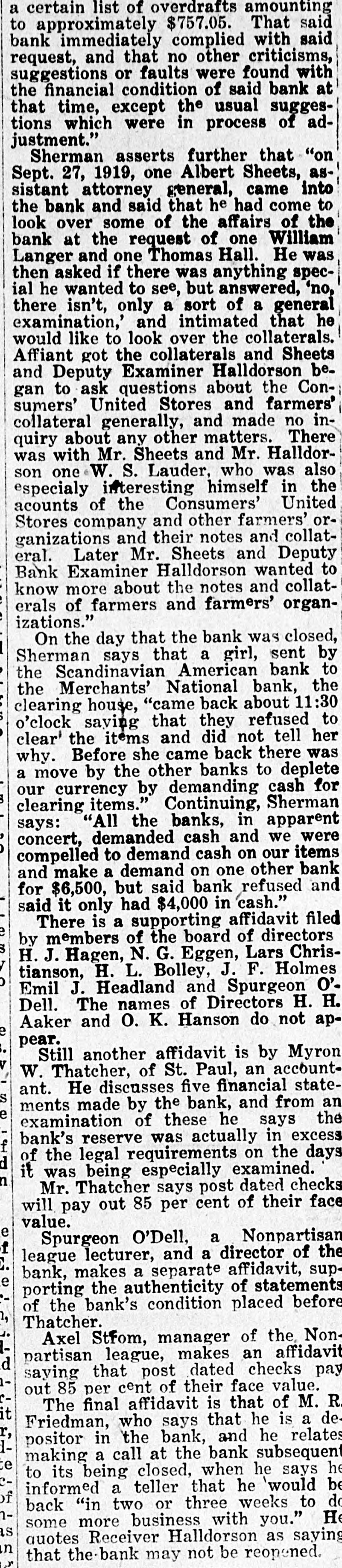
a certain list of overdrafts amounting to approximately $757.05. That said bank immediately complied with said request, and that no other criticisms, suggestions or faults were found with the financial condition of said bank at that time, except the usual sugges- tions which were in process of ad- justment." Sherman asserts further that "on Sept. 27, 1919, one Albert Sheets, as- sistant attorney general, came into the bank and said that he had come to look over some of the affairs of the bank at the request of one William Langer and one Thomas Hall. He was then asked if there was anything spec- ial he wanted to see, but answered, 'no, there isn't, only a sort of a general examination,' and intimated that he would like to look over the collaterals. Affiant got the collaterals and Sheets and Deputy Examiner Halldorson be- gan to ask questions about the Con- sumers' United Stores and farmers' collateral generally, and made no in- quiry about any other matters. There was with Mr. Sheets and Mr. Halldor- son one W. S. Lauder, who was also especialy interesting himself in the acounts of the Consumers' United Stores company and other farmers' or- ganizations and their notes and collat- eral. Later Mr. Sheets and Deputy Bank Examiner Halldorson wanted to know more about the notes and collat- erals of farmers and farmers' organ- izations." On the day that the bank was closed, Sherman says that a girl, sent by the Scandinavian American bank to the Merchants' National bank, the clearing house, "came back about 11:30 o'clock saving that they refused to clear the items and did not tell her why. Before she came back there was a move by the other banks to deplete our currency by demanding cash for clearing items." Continuing, Sherman says: "All the banks, in apparent concert, demanded cash and we were compelled to demand cash on our items and make a demand on one other bank for $6,500, but said bank refused and said it only had $4,000 in cash." There is a supporting affidavit filed by members of the board of directors H. J. Hagen, N. G. Eggen, Lars Chris- tianson, H. L. Bolley, J. F. Holmes Emil J. Headland and Spurgeon O'- Dell. The names of Directors H. H. Aaker and O. K. Hanson do not ap- pear. Still another affidavit is by Myron W. Thatcher, of St. Paul, an account- ant. He discusses five financial state- ments made by the bank, and from an examination of these he says the bank's reserve was actually in excess of the legal requirements on the days it was being especially examined. Mr. Thatcher says post dated checks will pay out 85 per cent of their face value. Spurgeon O'Dell, a Nonpartisan league lecturer, and a director of the bank, makes a separate affidavit, sup- porting the authenticity of statements of the bank's condition placed before Thatcher. Axel Stfom, manager of the Non- partisan league, makes an affidavit saying that post dated checks pay out 85 per cent of their face value. The final affidavit is that of M. R. Friedman, who says that he is a de- positor in the bank, and he relates making a call at the bank subsequent to its being closed, when he says he informed a teller that he would be back "in two or three weeks to do some more business with you." He quotes Receiver Halldorson as saying that the bank may not be reopened.

Article from The Weekly Times-Record, October 30, 1919

Click image to open full size in new tab

Article Text

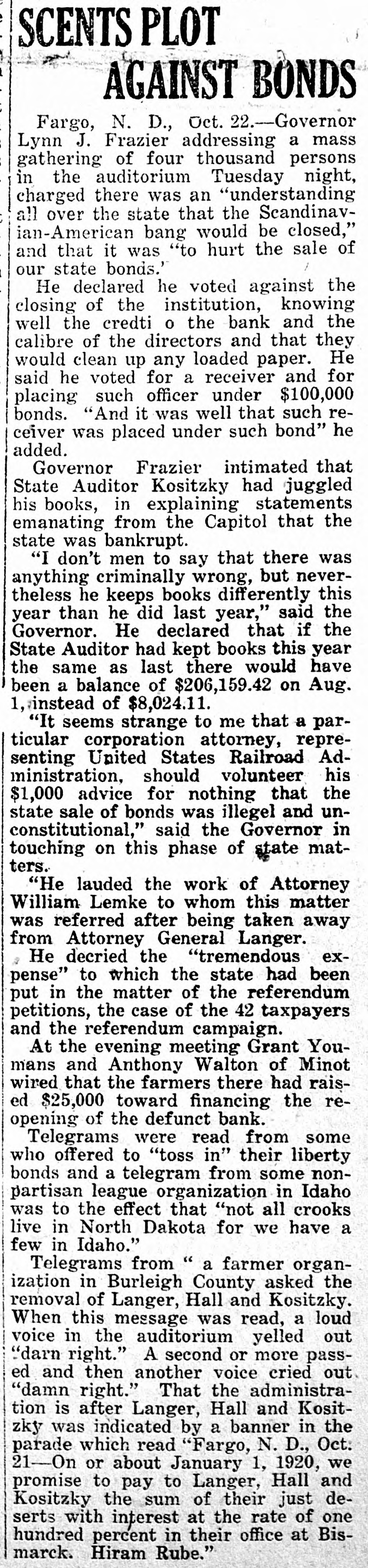
SCENTS PLOT AGAINST BONDS Fargo, N. D., Oct. 22.-Governor Lynn J. Frazier addressing a mass gathering of four thousand persons in the auditorium Tuesday night, charged there was an "understanding all over the state that the Scandinavian-American bang would be closed," and that it was "to hurt the sale of our state bonds.' He declared he voted against the closing of the institution, knowing well the credti o the bank and the calibre of the directors and that they would clean up any loaded paper. He said he voted for a receiver and for placing such officer under $100,000 bonds. "And it was well that such receiver was placed under such bond" he added. Governor Frazier intimated that State Auditor Kositzky had juggled his books, in explaining statements emanating from the Capitol that the state was bankrupt. "I don't men to say that there was anything criminally wrong, but nevertheless he keeps books differently this year than he did last year," said the Governor. He declared that if the State Auditor had kept books this year the same as last there would have been a balance of $206,159.42 on Aug. 1, instead of $8,024.11. "It seems strange to me that a particular corporation attorney, representing United States Railroad Administration, should volunteer his $1,000 advice for nothing that the state sale of bonds was illegel and unconstitutional," said the Governor in touching on this phase of state matters. "He lauded the work of Attorney William Lemke to whom this matter was referred after being taken away from Attorney General Langer. He decried the "tremendous expense" to which the state had been put in the matter of the referendum petitions, the case of the 42 taxpayers and the referendum campaign. At the evening meeting Grant Youmans and Anthony Walton of Minot wired that the farmers there had raised $25,000 toward financing the reopening of the defunct bank. Telegrams were read from some who offered to "toss in" their liberty bonds and a telegram from some nonpartisan league organization in Idaho was to the effect that "not all crooks live in North Dakota for we have a few in Idaho." Telegrams from " a farmer organization in Burleigh County asked the removal of Langer, Hall and Kositzky. When this message was read, a loud voice in the auditorium yelled out "darn right." A second or more passed and then another voice cried out "damn right." That the administration is after Langer, Hall and Kositzky was indicated by a banner in the parade which read "Fargo, N. D., Oct. 21-On or about January 1, 1920, we promise to pay to Langer, Hall and Kositzky the sum of their just deserts with interest at the rate of one hundred percent in their office at Bismarck. Hiram Rube."