12277. Connecticut River Savings Bank (Charlestown, NH)

Bank Information

Episode Type
Run → Suspension → Closure
Bank Type
savings bank
Start Date
February 22, 1895
Location
Charlestown, New Hampshire (43.239, -72.425)

Metadata

Model
gpt-5-mini
Short Digest
511d475b57e494e7

Response Measures

None

Description

Newspaper accounts (Feb–Apr 1895) describe large withdrawals and an injunction (Feb 22) limiting payments to 15% to allow conversion of assets, followed by trustees voting to petition for a receiver (Mar 28) and the bank being placed in receivership in April 1895. Cause of distress is tied to poor western investments and resulting heavy withdrawals; the bank did not resume normal operations but entered receivership and paid dividends from the receiver later (1897 dividends noted). Dates are taken from article publication dates and textual references.

Events (4)

1. February 22, 1895 Run
Cause
Bank Specific Adverse Info
Cause Details
Large withdrawals driven by depositors withdrawing to banks across state line and the bank's impaired income from poor western investments
Measures
Injunction restraining the bank from paying any depositor more than 15% of his deposit to allow time to convert assets to cash
Newspaper Excerpt
The withdrawals had been quite large for the past few weeks and notices of withdrawal were increasing so largely that it was a question whether the bank could reach the demands of its depositors
Source
newspapers
2. March 28, 1895 Suspension
Cause
Bank Specific Adverse Info
Cause Details
Continued large withdrawals and impaired income/uncertain western investments led trustees to seek a receiver; bank commissioners had examined accounts and withdrawals had been large enough to prompt injunction earlier in Feb 1895
Newspaper Excerpt
The trustees of the Connecticut River Savings Bank at a meeting today voted to petition the court to place the bank in the hands of a receiver.
Source
newspapers
3. April 11, 1895 Receivership
Newspaper Excerpt
the Connecticut River savings bank, of Charlestown, N. H., which has just passed into the hands of a receiver, died yesterday, aged 57. He had been treasurer of the bank for more than 30 years.
Source
newspapers
4. January 13, 1897 Other
Newspaper Excerpt
F. C. Faulkner, receiver of the Connecticut River Savings bank of Charlestown, announces that he will pay a second dividend of 10 per cent on and after Jan. 13, 1897. This will make 50 per cent of the principal secured by the depositors.
Source
newspapers

Newspaper Articles (13)

Article from Vermont Phœnix, February 22, 1895

Click image to open full size in new tab

Article Text

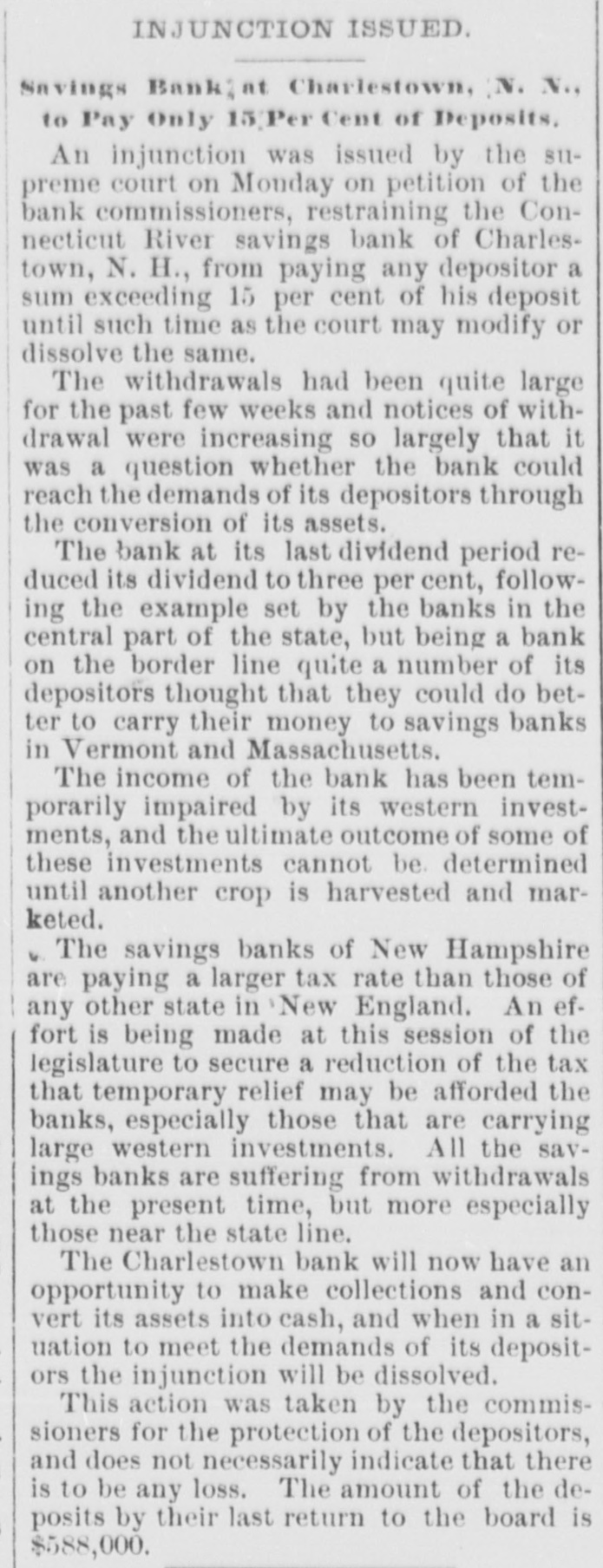
INJUNCTION ISSUED. Savings Bank,at Charlestown, :N. N., to Pay Only 15/Per Cent of Deposits. An injunction was issued by the supreme court on Monday on petition of the bank commissioners, restraining the Connecticut River savings bank of Charlestown, N. H., from paying any depositor a sum exceeding 15 per cent of his deposit until such time as the court may modify or dissolve the same. The withdrawals had been quite large for the past few weeks and notices of withdrawal were increasing so largely that it was a question whether the bank could reach the demands of its depositors through the conversion of its assets. The bank at its last dividend period reduced its dividend to three per cent, following the example set by the banks in the central part of the state, but being a bank on the border line quite a number of its depositors thought that they could do better to carry their money to savings banks in Vermont and Massachusetts. The income of the bank has been temporarily impaired by its western investments, and the ultimate outcome of some of these investments cannot be. determined until another crop is harvested and marketed. - The savings banks of New Hampshire are paying a larger tax rate than those of any other state in New England. An effort is being made at this session of the legislature to secure a reduction of the tax that temporary relief may be afforded the banks, especially those that are carrying large western investments. All the savings banks are suffering from withdrawals at the present time, but more especially those near the state line. The Charlestown bank will now have an opportunity to make collections and convert its assets into cash, and when in a situation to meet the demands of its depositors the injunction will be dissolved. This action was taken by the commissioners for the protection of the depositors, and does not necessarily indicate that there is to be any loss. The amount of the deposits by their last return to the board is $588,000.


Article from Evening Star, March 28, 1895

Click image to open full size in new tab

Article Text

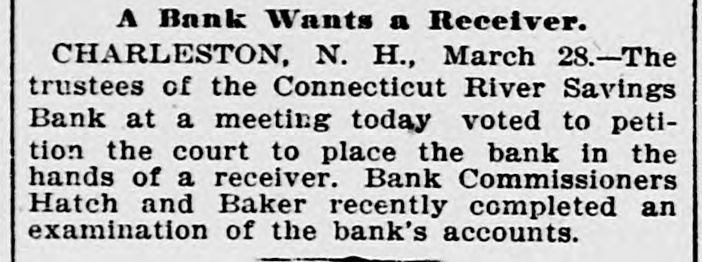
A Bank Wants a Receiver. CHARLESTON, N. H., March 28.-The trustees of the Connecticut River Savings Bank at a meeting today voted to petition the court to place the bank in the hands of a receiver. Bank Commissioners Hatch and Baker recently completed an examination of the bank's accounts.


Article from The Providence News, March 28, 1895

Click image to open full size in new tab

Article Text

past week have been increased transactions in California wools and the sale of a round lot of Missouri and Indiana 1/4 and %-blood clothing. The latter was disposed of at 15c., and was taken by worsted yarn people. The transactions in California wools were mostly at 6c. per pound, one round lot of 150,000 being disposed of at that figure. Other sales have ranged at from 5c. to 61/2c. The improved business in these lines, combined with a generally better inquiry for both territories and fleeces has resulted in bringing the aggregate of the week's transactions up to quite a respectable figure, the amount of trade showing quite a decided increase over that of the preceding week. There is, however, no improvement to be noted in values as yet, notwithstanding the continued strength in London, where prices have comtinued to harden, especially on inferior wools. The tone of the market here is very steady, it is true, but manufacturers have not yet been brought to that point where they will pay any higher prices for domestic wool. In spots there may be some firmness on the part of holdders, but anything like an advance has not yet taken place. Manufacturers are taking wools as they need them and nothing like a speculative tendency is yet discernible. The sales of the week amount to 2,230,500 pounds domestic and 614,000 pounds foreign, making a total of 2,844,500 against a total of 1,797,000 for the previous week, and a total of 2,847,500 pounds for the corresponding week last year. The sales since Jan. 1, 1895, amount to 34,690,550 pounds against 31,679,600 pounds a year ago. The sales in New York amount to 683,000 pounds. The sales in Philadelphia amount to 1,702,300 pounds. Wheat. New York wheat sales 760,000 bushels Options No. 1 red market quiet but generally firmer on continued drought talk; steady cables and reported damages by rain in Argentina. May, 60%; July 61a61/4; Sept., 61/4a61%; Dee., Receiver for Savings Bank. CHARLESTOWN, N. H., March 28.-The trustees of the Connecticut River Savings Bank at a meeting today voted to petition the court to place the bank in the hands of a receiver. Bank Commissioners Hatch and Baker recently completed an examination of the bank's accounts. General Financial Notes. A London special says the market for Americans is very tame. The fact that every little rise is followed by raids makes Americans too flabby for the ordinary operator. The Cincinnati Commercial Bank assigned yesterday. This was a very old bank, but a small one. Cammack is supposed to have put out some of the Grangers during the last hour yesterday. The Stock Exchange has listed $32,148,500 Manhattan Trust receipts of D. C.F. stock, with right to add as stock is deposited. It is said that the rate on Chicago Gas will be cut to 4 per cent. The meeting will probably be held April 2. The coal presidents are meeting today. They will give nothing out, but state that progress is being made. The St. Paul statement for February shows a net increase of $20,786. The C. B. & Q. report for February reveals a decrease in surplus after charges of $286,175. Chicago, with all her Western railroad connections, received eight cars of wheat today. Providence Clearing House. The clearings of the Providence banks today amounted to $503,900. New York Stock Quotations.


Article from The Indianapolis Journal, March 29, 1895

Click image to open full size in new tab

Article Text

Business Embarrassments. CHICAGO, March 28.-The Utah, Nevada and California Stage Company has confessed judgment in the Circuit Court for $108,660 in favor of Charles H. Newhall. The judgment was obtained on two notes aggregating the above amount, executed Feb. 6, and payable on demand. The attorneys for the plaintiffs said that the concern is a corporation organized under the laws of Utah, which is not now in active existence. It was in busines as a mail contractor under the United States government. CHICAGO, March 28.-The Oxford Manufacturing Company, makers of sewing machines, has applied for a receiver. The court is informed that the entire indebtedness of the company is not less than $40,000, which, however, has not matured. Several creditors have threatened legal proceedings and the company says that it is afraid its assets will be dissipated unless a receiver is appointed. CHARLESTON, N. H., March 28.-The trustees of the Connecticut River Savings Bank, at a meeting to-day, voted to petition the court to place the bank in the hands of a receiver. Bank Commissioners Hatch and Baker recently completed an examination of the bank's accounts. CHICAGO, March 28.-Malcolm & Waterbury, bucket shop traders, short on pork, have failed. Their liabilties in Chicago are small, but in Iowa, it is said, will reach $50,000 and in Omaha $6,000. The firm did an extensive business in Illinois, Missouri, Ne-, braska and Iowa.


Article from The Herald, March 29, 1895

Click image to open full size in new tab

Article Text

A Bank Wants a Receiver CHARLISTON. N. H., March 28.-The trustees of the Connecticut River Savings Bankstoday voted to petition the courtito place the bank in the hands of a receiver. :


Article from The Washington Bee, April 6, 1895

Click image to open full size in new tab

Article Text

THIS WEEK'S NEWS. A Summary of Current Events-The World's Deings for the Past Six Days Gathered and Condensed for Our Readers, General. William Small, class of '96, Tuft's College, was found dead in bed. Count Boniface de Castellane and his bride, formerly Miss Anna Gould, have arrived at Monte Carlo. A gang of counterfeiters was caught at San Francisco. They manufactured fraudulent certificates to Chinese. "Col." Gilbert, who was exhibited in dime museums throughout the country as "Dahomey Giant," is dead. The sloop John H. Thomas sunk in the Choptank River off Cambridge, Md. James Jones, colored, was drowned. The court house building at Regina, N. W. T., containing all the records of the Northwest Territory, was totally destroyed by fire. Gen. Oliver P. Gooding, of Washington, D. C., was found to be insane He had written a bock in which he threatened the President. Henry L. Fish was found dead in bed at his home in Rochester, N. Y. He was twice Mayor of Rochester and member of Assembly in 1872. The Washington brewery, owned and operated by Paul Ritter at Cumberland. Md., was destroyed by fire. Loss, $30,000; insurance, $14,000. The trustees of the Connecticut River Savings Bank, Charleston, N. H., voted to petition the court to place the bank in the hands of a receiver. The young colored woman who was murdered and whose body was mutilated in "Jack the Ripper" style, was identified as Pearl Ivory, of Newark. Sine Iielsen, a pretty Danish girl of Chicago, has secured a $5,000 verdict in her $25,000 breach of promise suit against H. D. Alyeworth, a railroad man. Almede Chattelle was put on trial at Stratford, Ont. He is accused of the murder of Jessie Keith. He refused a lawyer's services and is defending himself. The Countess Perponcher, arrested in Berlin for perjury in denying her intimacy with the Count's family doctor, has been released on 120,000 marks ball. Blanche Kerrigan, aged two years, was fatally burned by her clothing taking fire from a stove in the home of her father, William Kerrigan, of Clyde, Wayne County. It is rumored that Oscar Wilde left London suddenly to avoid being present at the trial of the suit for libel which he has brought against the Marquis of Queensbury. John A. Brown, aged thirty years, of New York, shot his wife. Mrs. E. B. Brown, at Philadelphia, Pa., and then committed suicide. The woman has but slight chances for recovery. Helena A. Pearson, aged twentytwo, a domestic in the employ of Henry Marteau, of Brooklyn, N. Y., was smothered, presumably by smoke, from a slight fire in the house. Alfred Martin and Henry James, miners, of Central City, Col., were crushed to death in the Sleepy Hollow mine by a mass of dirt and rock which fell upon them in a drift. Grand Master Workman Sovereign, of the Knights of Labor, in an interview in Columbus, nominated Eugene V. Debs as the candidate for the People's party for President in 1896. The residence of Phoenis Christensen, a carpenter, was consumed by fire at Minot, N. D. Five children, ranging in age from three to five years, perished in the flames. The woman suffrage clause in the proposed Constitution of the State of Utah has passed. An amendment favoring the submission of the clause to the vote of the people was defeated, 70 to 30. The Hon R. Bond, G. Emerson, E. P. Morris and W. Horwood left St. John's, N. F., for Canada in order to solicit terms for the entrance of Newfoundland into the confederacy. They were hissed. The five-story malt house at Wainwright's brewery, Pittsburg, Pa., collapsed. The weight of the grain stored in the upper floors caused the disaster. The loss will be $30,000. No one was injured. Charles McKeever, Charles McCarthy and Jack Fegarty, charged with engaging in a prize fight at Philadelphia, were convicted. This will put an end to boxing contests in Philadelphia, as this was a test case. The Florida Legislature has convened for its bi-ennial session of sixty days. Gov. Mitchell, in his annual message, devoted considerable space to lotteries and prize fighters, and urged legislation against them. George Scott, who for four years has had the position of cashier at Beelslough, Minn., for the Mississippi Logging Company, is reported to be $20,000 short. He has been in the employ of the company for fifteen years. Deputy United State Marshal Johnson and a posse of six men fought a gang of moonshiners in the mountains of Hempstead County, Ark. Two of the outlaws were killed, a third captured alive and an illicit still was confiscated. Archbishop Kain has arrived in St. Paul from an extended visit to the East. Concerning the scaling down of the allotment of money for the support of Catholic Indian schools

Article from Ellsworth American, April 11, 1895

Click image to open full size in new tab

Article Text

Another argument in favor of New Englanders' investing their money at home is furnished by the Connecticut River Savings bank, of Charlestown, N. H., whose trustees have voted to apply to the supreme court for a receiver. By reason of poor western investments, the depositors will lose at least twenty-five per cent.


Article from The Providence News, April 11, 1895

Click image to open full size in new tab

Article Text

Treasurer Olcott Dead. CHARLESTOWN, N. H., April 11.-George Olcett, treasurer of the Connecticut River Savings bank, which has just passed into the hands of a receiver, died yesterday, aged 57. He had been treasurer of the bank for more than 30 years.


Article from Iron County Register, April 18, 1895

Click image to open full size in new tab

Article Text

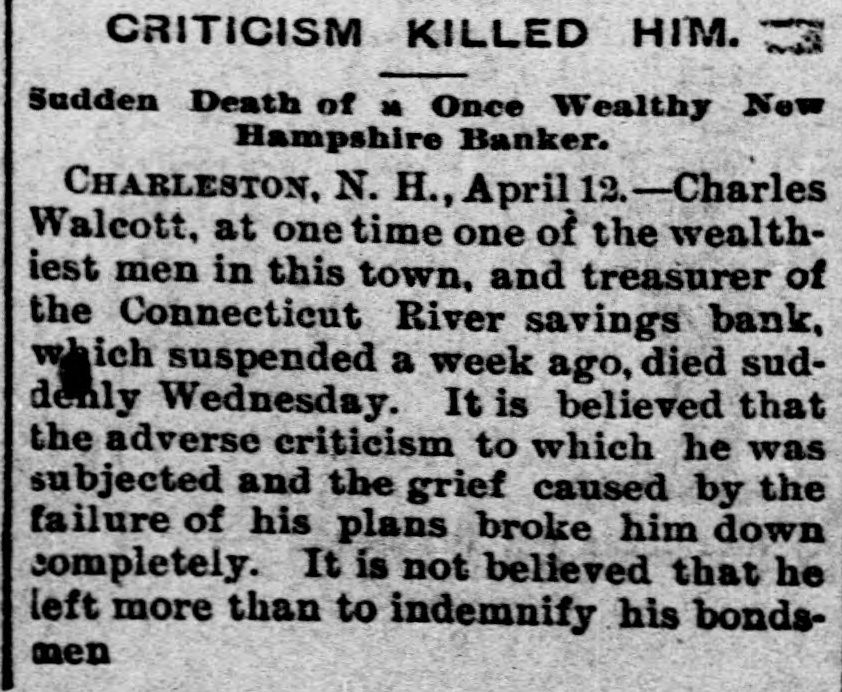
CRITICISM KILLED HIM. Sudden Death of M Once Wealthy New Hampshire Banker. CHARLESTON, N. H., April 12.-Charles Walcott, at one time one of the wealthiest men in this town, and treasurer of the Connecticut River savings bank, which suspended a week ago, died suddenly Wednesday. It is believed that the adverse criticism to which he was subjected and the grief caused by the failure of his plans broke him down completely. It is not believed that he left more than to indemnify his bondsmen


Article from The Washington Bee, June 22, 1895

Click image to open full size in new tab

Article Text

THIS WEEK'S NEWS. A Summary of Current Events-The World's Doings for the Past Six Days Gathered and Condensed for Our Readers, General. William Small, class of '96, Tuft's College, was found dead in bed. Count Boniface de Castellane and his bride, formerly Miss Anna Gould, have arrived at Monte Carlo. A gang of counterfeiters was caught at San Francisco. They manufactured fraudulent certificates to Chinese. "Col." Gilbert, who was exhibited in dime museums throughout the country as "Dahomey Giant," is dead. The sloop John H. Thomas sunk in the Choptank River off Cambridge, Md. James Jones, colored, was drowned. The court house building at Regina, N. W. T., containing all the records of the Northwest Territory, was totally destroyed by fire. Gen. Oliver P. Gooding, of Washington, D. C., was found to be insane. He had written a book in which he threatened the President. Henry L. Fish was found dead in bed at his home in Rochester, N. Y. He was twice Mayor of Rochester and member of Assembly in 1872. The Washington brewery, owned and operated by Paul Ritter at Cumberland. Md., was destroyed by fire. Loss, $30,000; insurance, $14,000. The trustees of the Connecticut River Savings Bank. Charleston, N. H., voted to petition the court to place the bank in the hands of a receiver. The young colored woman who was murdered and whose body was mutilated in "Jack the Ripper" style, was identified as Pearl Ivory, of Newark. Sine Iielsen. a pretty Danish girl of Chicago, has secured a $5,000 verdict in her $25,000 breach of promise suit against H. D. Alyeworth, a railroad man. Almede Chattelle was put on trial at Stratford, Ont. He is accused of the murder of Jessie Keith. He refused a lawyer's services and is defending himself. The Countess Perponcher, arrested in Berlin for perjury in denying her intimacy with the Count's family doctor, has been released on 120,000 marks bail. Blanche Kerrigan, aged two years, was fatally burned by her clothing taking fire from a stove in the home of her father, William Kerrigan, of Clyde, Wayne County. It is rumored that Oscar Wilde left London suddenly to avoid being present at the trial of the suit for libel which he has brought against the Marquis of Queensbury. John A. Brown, aged thirty years, of New York, shot his wife, Mrs. E. B. Brown, at Philadelphia, Pa., and then committed suicide. The woman has but slight chances for recovery. Helena A. Pearson, aged twentytwo. a domestic in the employ of Henry Marteau, of Brooklyn, N. Y., was smothered, presumably by smoke, from a slight fire in the house. Alfred Martin and Henry James, miners, of Central City, Col., were crushed to death in the Sleepy Hollow mine by a mass of dirt and rock which fell upon them in a drift. Grand Master Workman Sovereign, of the Knights of Labor. in an interview in Columbus, nominated Eugene V. Debs as the candidate for the People's party for President in 1896. The residence of Phoenis Christensen, a carpenter, was consumed by fire at Minot, N. D. Five children, ranging in age from three to five years, perished in the flames. The woman suffrage clause in the proposed Constitution of the State of Utah has passed. An amendment favoring the submission of the clause to the vote of the people was defeated, 70 to 30. The Hon. R. Bond, G. Emerson, E. P. Morris and W. Horwood left St. John's, N. F., for Canada in order to solicit terms for the entrance of Newfoundland into the confederacy. They were hissed. The five-story malt house at Wainwright's brewery, Pittsburg, Pa., collapsed. The weight of the grain stored in the upper floors caused the disaster. The loss will be $30,000. No one was injured. Charles McKeever, Charles McCarthy and Jack Fogarty, charged with engaging in a prize fight at Philadelphia, were convicted. This will put an end to boxing contests in Philadelphia, as this was a test case. The Florida Legislature has con-


Article from Vermont Phœnix, December 27, 1895

Click image to open full size in new tab

Article Text

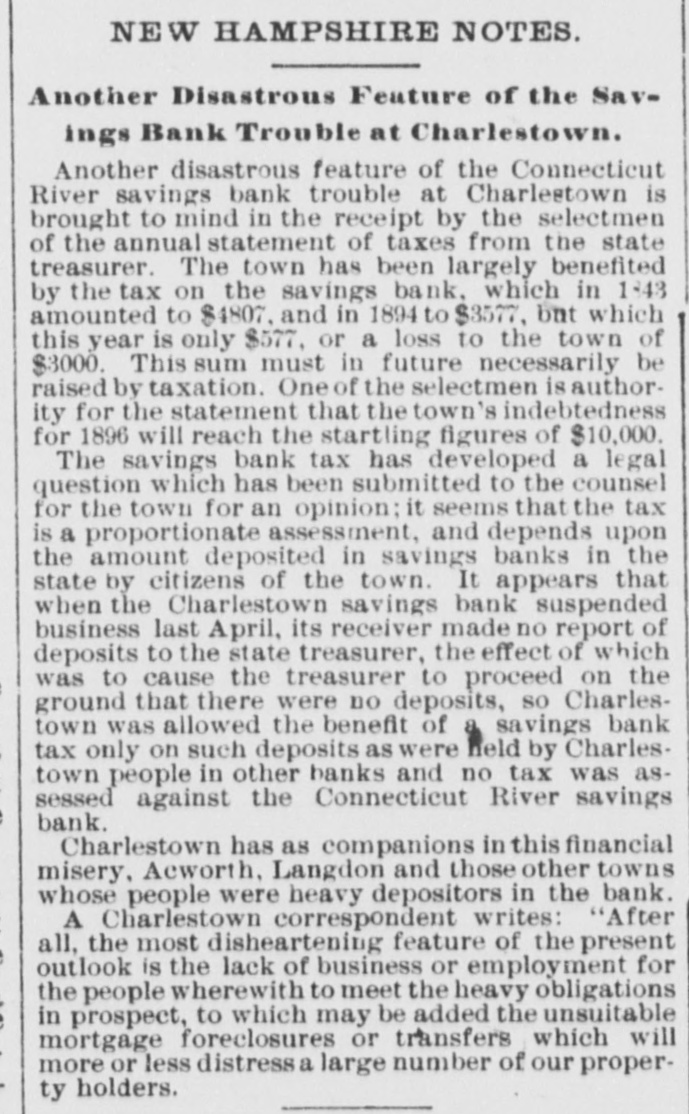
NEW HAMPSHIRE NOTES. Another Disastrous Feature of the Savings Bank Trouble at Charlestown. Another disastrous feature of the Connecticut River savings bank trouble at Charlestown is brought to mind in the receipt by the selectmen of the annual statement of taxes from the state treasurer. The town has been largely benefited by the tax on the savings bank, which in 1843 amounted to $4807. and in 1894 to $3577, but which this year is only $577. or a loss to the town of $3000. This sum must in future necessarily be raised by taxation. One of the selectmen is authority for the statement that the town's indebtedness for 1896 will reach the startling figures of $10,000. The savings bank tax has developed a legal question which has been submitted to the counsel for the town for an opinion; it seems that the tax is a proportionate assessment, and depends upon the amount deposited in savings banks in the state by citizens of the town. It appears that when the Charlestown savings bank suspended business last April, its receiver made no report of deposits to the state treasurer, the effect of which was to cause the treasurer to proceed on the ground that there were no deposits, so Charlestown was allowed the benefit of & savings bank tax only on such deposits as were held by Charlestown people in other banks and no tax was assessed against the Connecticut River savings bank. Charlestown has as companions in this financial misery, Acworth, Langdon and those other towns whose people were heavy depositors in the bank. A Charlestown correspondent writes: "After all, the most disheartening feature of the present outlook is the lack of business or employment for the people wherewith to meet the heavy obligations in prospect, to which may be added the unsuitable mortgage foreclosures or transfers which will more or less distress a large number of our property holders.


Article from Vermont Phœnix, January 1, 1897

Click image to open full size in new tab

Article Text

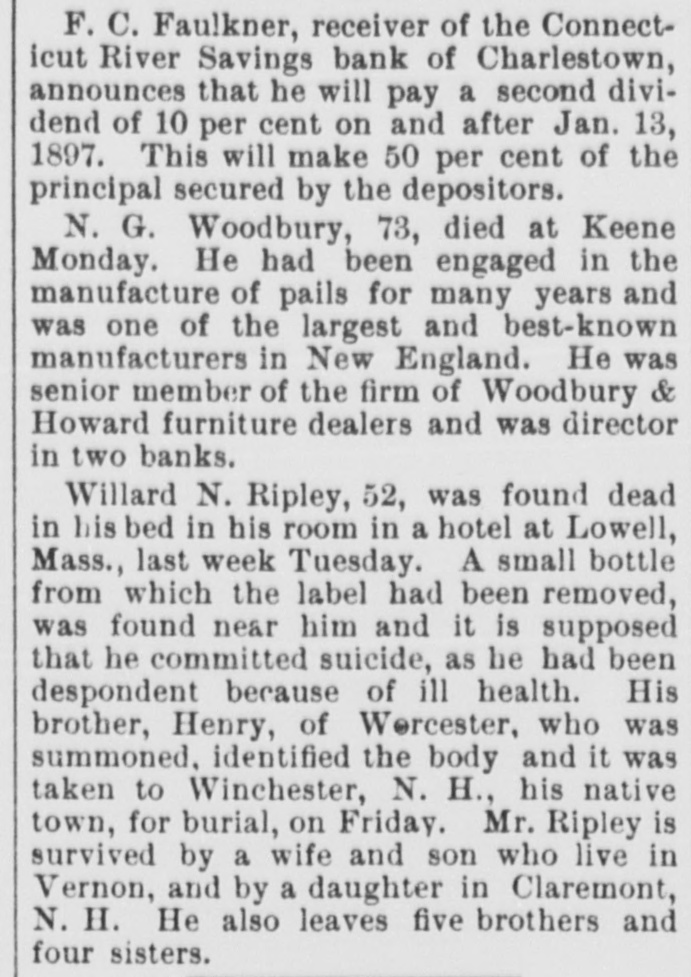
F. C. Faulkner, receiver of the Connecticut River Savings bank of Charlestown, announces that he will pay a second dividend of 10 per cent on and after Jan. 13, 1897. This will make 50 per cent of the principal secured by the depositors. N. G. Woodbury, 73, died at Keene Monday. He had been engaged in the manufacture of pails for many years and was one of the largest and best-known manufacturers in New England. He was senior member of the firm of Woodbury & Howard furniture dealers and was director in two banks. Willard N. Ripley, 52, was found dead in his bed in his room in a hotel at Lowell, Mass., last week Tuesday. A small bottle from which the label had been removed, was found near him and it is supposed that he committed suicide, as he had been despondent because of ill health. His brother, Henry, of Worcester, who was summoned, identified the body and it was taken to Winchester, N. H., his native town, for burial, on Friday. Mr. Ripley is survived by a wife and son who live in Vernon, and by a daughter in Claremont, N. H. He also leaves five brothers and four sisters.


Article from Vermont Phœnix, July 30, 1897

Click image to open full size in new tab

Article Text

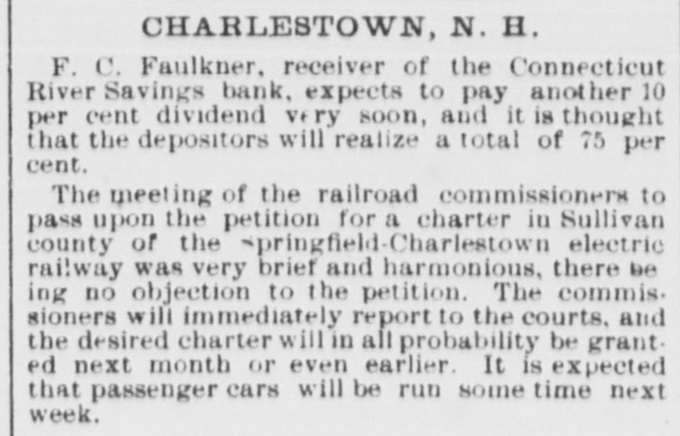
CHARLESTOWN, N. H. F. C. Faulkner, receiver of the Connecticut River Savings bank, expects to pay another 10 per cent dividend very soon, and it is thought that the depositors will realize a total of 75 per cent. The meeting of the railroad commissioners to pass upon the petition for a charter in Sullivan county of the springfield-Charlestown electric railway was very brief and harmonious, there be ing no objection to the petition. The commis. sioners will immediately report to the courts, and the desired charter will in all probability be grant. ed next month or even earlier. It is expected that passenger cars will be run some time next week.