Click image to open full size in new tab
Article Text
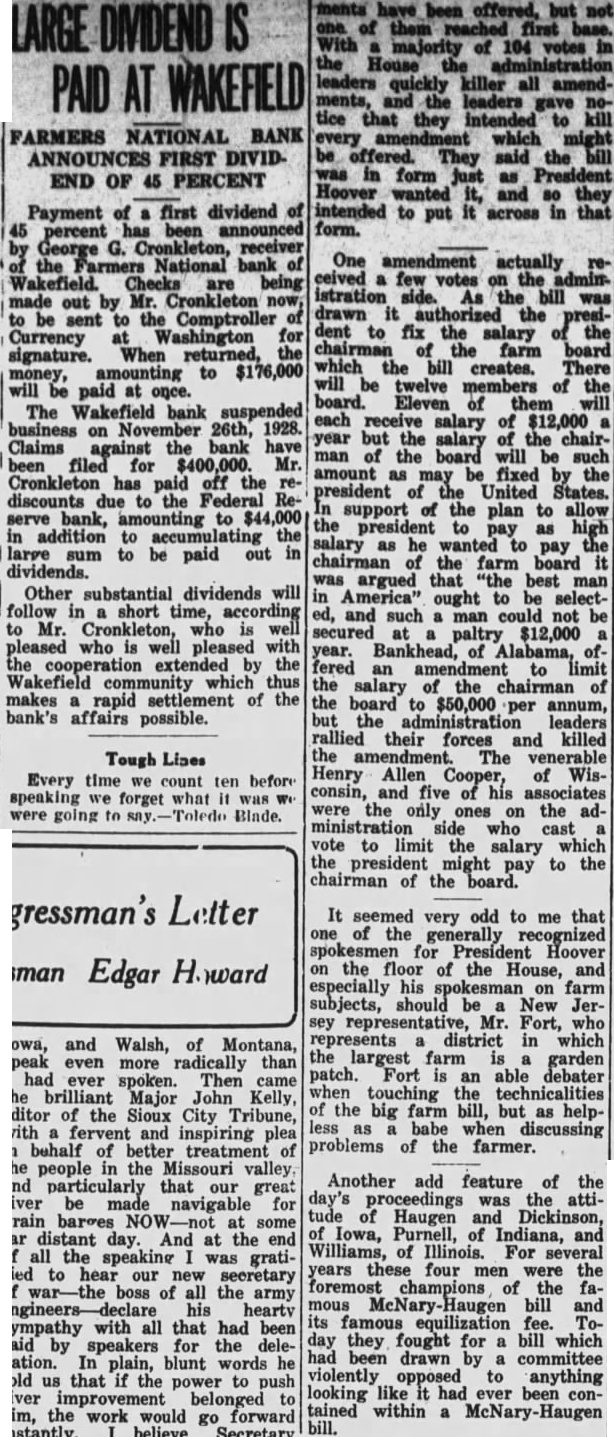
Payment of first dividend of percent been announced George G. Cronkleton, receiver the National bank Wakefield. Checks are being made out by Mr. Cronkleton to be sent to the Comptroller Currency at Washington for signature. When returned, the money, amounting to $176,000 will be paid at once. The Wakefield bank suspended business on November 26th, 1928. Claims against the bank have been filed for $400,000. Mr. Cronkleton has paid off the discounts due to the Federal Reserve bank, amounting to $44,000 addition to accumulating the large to be paid out in dividends. Other substantial dividends will follow in short time, according Mr. Cronkleton, who is pleased who well pleased with the extended by the Wakefield community which thus makes rapid settlement of the bank's affairs possible.
Tough Lines Every time we count ten before speaking we forget what was were going to Blade. intended to it across in put form.
One amendment actually ceived a few votes on the administration side. As the bill was drawn it authorized the presito fix the salary the chairman the farm board which the bill creates. There will be twelve members of the Eleven them will each receive salary of $12,000 year but the salary the chairman of the board will be such amount as may fixed the president United States. support of the plan to allow the president as high salary as he wanted pay the chairman of the farm board was argued that "the best America" ought to be selected, and such man could not be secured paltry $12,000 year. Bankhead, of Alabama, fered an amendment to limit the salary the chairman of the board to $50,000 per annum, the administration leaders rallied their forces and killed the amendment. The venerable Henry Allen Cooper, of Wisconsin, and five of his associates were the only ones on the administration side who vote to the salary which the president might pay to the chairman of the board.
It seemed very odd to me that one of the generally recognized for President Hoover on the floor of the House, and especially his farm subjects, should be New Jersey representative, Mr. Fort, who represents district in which the largest farm garden patch. Fort an able debater when touching the technicalities the big farm bill, but as helpless babe when discussing problems of the farmer.
Another add feature of the proceedings was the attitude Haugen and Dickinson, Iowa, Purnell, of Indiana, and Williams, of Illinois. For several years these four men were the foremost champions of the famous bill and its famous equilization fee. day they fought for bill which drawn by committee violently opposed to anything looking like had ever contained within McNary-Haugen bill.