Liberty State Bank (Milwaukee, WI)

Episode Information

Episode Type
Run → Suspension → Closure
Start Date
July 1, 1932*
Location
Milwaukee, Wisconsin (43.039, -87.906)
Bank Type
state
Routing Number
12-0078

Metadata

Notes

Bank was taken over by the state banking commissioner and described later as defunct/closed.

Events (2)

1. July 1, 1932* Run
Cause
Local Banks
Cause Details
Withdrawals attributed to hysteria recently experienced in Chicago, causing spillover runs in Milwaukee.
Newspaper Excerpt
A small run started on Liberty last week and continued with increased withdrawals.
Source
newspapers
2. July 23, 1932 Suspension
Cause
Government Action
Cause Details
Taken over/closed by the state banking commissioner (state banking department takeover following withdrawals).
Newspaper Excerpt
Three Milwaukee community banks with combined deposits of $2,000,000 were taken over by the state banking commissioner. Banks closed were Layton Park State, Liberty State and Security State.
Source
newspapers

Newspaper Articles (9)

Article from Seward Daily Gateway, July 23, 1932

Click image to open full size in new tab

Article Text

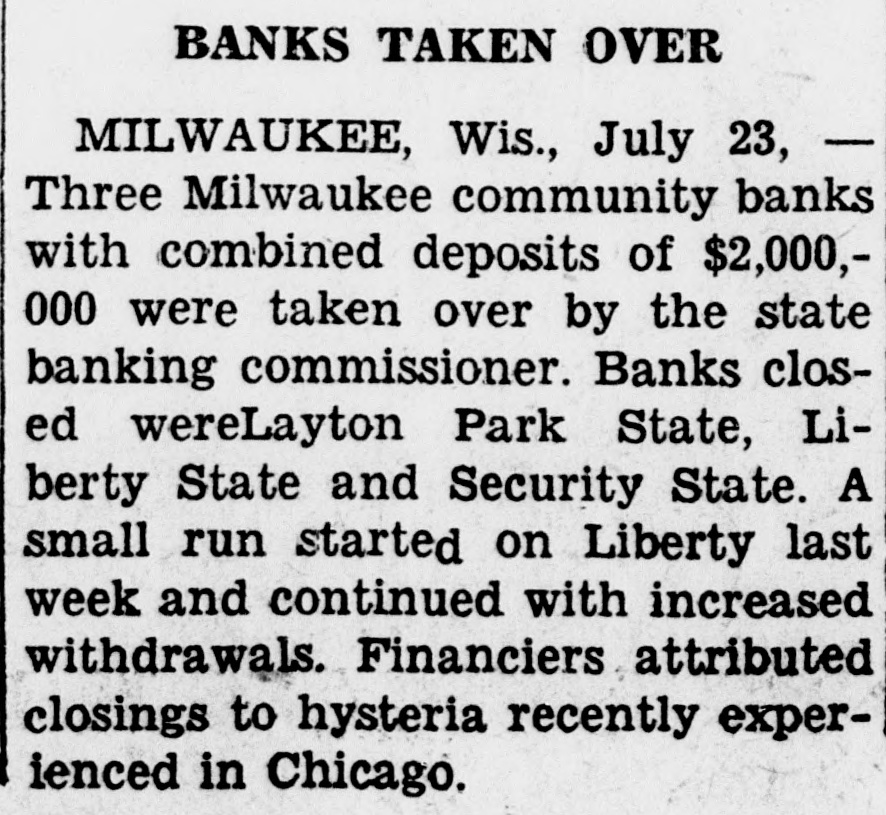
BANKS TAKEN OVER MILWAUKEE, Wis., July 23, Three Milwaukee community banks with combined deposits of $2,000,000 were taken over by the state banking commissioner. Banks closed wereLayton Park State, Liberty State and Security State. A small run started on Liberty last week and continued with increased withdrawals. Financiers attributed closings to hysteria recently experienced in Chicago.


Article Text

WISCONSIN NEWS NOTES

FOND DU LAC. — (AP) — After hearing testimony dealing with the closing of the Farmers' State bank at Calumet Harbor two years ago, Municipal Judge H. M. Fellenz yesterday continued until Feb. 20 the hearing of the Pinkerton Detective agency's suit against Charles Bergen Jr., president of the defunct bank. The detective agency asks payment for services rendered in tracing rumors alleged to have resulted in a run on the bank. Bergen contends he did not hire the agency and believed a detective who visited the village was employed by the Wisconsin Bankers' association.

MILWAUKEE, Feb. 7. — (AP) — The trial of Leroy Brant, former police officer of Wauwatosa, a suburb, who was charged with burglary after he was shot Sept. 24 while prowling around a grocery store, ended abruptly late yesterday when Judge C. M. Davison of Beaver Dam, presiding in municipal court, dismissed the charge. The judge ruled the state had failed to prove intent to commit a felony. Defense Attorney Winfred C. Zabel argued that Brant was "too drunk" to realize what he was doing.

MILWAUKEE. — (AP) — A grand jury charged with the task of ferreting out and fixing responsibility for alleged acts of crime and corruption in Milwaukee county was confronted with truckloads of records when it convened today. The first evidence to be presented involves bond transactions between I. J. Rosenberg, president of the closed Liberty State bank, and John I. Drew, former city treasurer.

MILWAUKEE. — (AP) — An alimony allowance of $18 a week was given in circuit court here yesterday to Mrs. Julia Dupee, who has filed suit for divorce against Charles Dupee, scion of a one-time wealthy and socially prominent Oconomowoc family. Dupee, now an insurance salesman, told Judge John C. Karel that he was earning barely enough to live in a boarding house and that he would find it difficult to make the payments.

MILWAUKEE. — (AP) — Five men found guilty of fraud against the county outdoor relief department were given sentences ranging from four to nine months in the house of correction by Municipal Judge George A. Shaughnessy yesterday. They were alleged to have obtained goods valued at $800.

WAUSAU — (AP) — District Attorney O. L. Ringle was expected to order an inquest today in the death of William J. Theisen Jr., former bank clerk who was found shot to death here Saturday night. Declaring he was not entirely convinced that Theisen committed suicide, the prosecutor last night ordered Dr. R. F. Fisher and Dr. E. E. Fleming to perform an autopsy.

MILWAUKEE. — (U.P.) — Dairy officials were notified today that the state department of markets order raising the retail price of milk to 8 cents a quart in Milwaukee will be enforced tomorrow. Agents of the commission will be sent here to search for violators of the order, Commissioner Charles L. Hill advised dealers. Milk dropped to 6 cents a quart during a price war between small distributors and large dairies.


Article Text

TWO ARRESTED

Milwaukee, served of Milwaukee 16 years and another who head the defunct Liberty State Bank, in jail today awaiting arraignment indictments charging embezzlement of $500,000 of ctiy funds John Drew, city treasurer from 1916 to 1932, charged by the grand jury with ating money, and Ros former bank president, with aiding through his banking connections. Deputy sheriffs arrested Drew night St. where he had been tient for several days. He for months. Rosenberg arrested at his home Both denied on pending the regular session of municipal court The indictments charged that the pair feloniously padded invoices when bonds purchased increase the appareent costs thereof the Investigation into the affairs the two men was first started several years ago by the Wiscon state income tax bureau, which assessed an extra against appealed case An additional investigation undertaken ently state authorities connection with the closing the Liberty State bank.


Article Text

WRIT TREASURER REQUEST HABEAS CORPUS IN MILWAUKEE for George ford Seeks to Block tradition Steps of Ely.

Feb. movetoday to nulliunderway action Joseph the granting Virginia's request in extradition George CrawNegro for women Midslaying January, 1932. Allen. former attorney of Massachusetts and chief Crawford. he asking for writ considering Corpus the first step movement nullify Governor action. conferred late yesterday Attorney Frederick relative to proposed the closing the Court no petition had been petition would place Crawbefore the Supreme or the Massachusetts law refusal Crawford voluntarily accept the extradition papers allow him "reasonable" in which to institute Habeas proceedings. charged by Virginia with slayings Agnes Boeing and her maid, Mrs. Nina the Ilsley estate dur arrested here for store and of the state fingerprint bureau similarity between the prints those of the man by Virginia authorities.

John Drew Taken From Hospital Bed Charged With Embezzling $500,000.

Wis., Feb. A man who served city treasurer of for 16 years and other who was head of the defunct Liberty State bank, were today awaiting arraignment of indictments charging embezzlement of $500,000 city funds. John Drew, city treasurer from 1916 to was charged by the grand the money, and Cosenberg, former bank president, with aiding him through his banking connections. Deputy sheriffs arrested Drew late last night at St. Joseph's hospital where had been patient for eral days He has been ill for several months. Rosenberg arrested his home. Both denied release on bail, pending arraignment the regular session Municipal Court to-

The indictments charged that the 'falsely, and felonipadded the when to the apparent costs into the affairs the two first years the come which has tax against appealed the and lost. tional undertaken recently by state nection with the closing of the Liberty State bank.


Article Text

CITY RECORDS PADDED Former Treasurer and Banker Are Arrested

MILWAUKEE, Wis., Feb. 18 (AP).—A man who served as city treasurer of Milwaukee for 16 years and another who was head of the defunct Liberty State bank, were in jail today awaiting arraignment on indictments charging embezzlement of $500,000 of city funds.


Article Text

Rosenberg Named in Stock Transfer

The state banking department has filed an affidavit with the circuit court of Milwaukee county charging that I. J. Rosenberg, former president of the Liberty State bank, Milwaukee, transferred $18,400 of stock in that bank to minor relatives to escape the 100 per cent assessment on the stock provided for by the statute in cases of bank suspensions.

Records of the bank show the stock was transferred to Beatrice Weiner, a niece now 21, and to Jack, Paula Sylvia, and Ruth Helen Rosenberg, all minor grandchildren.

The banking department contends that Rosenberg is the real owner of the stock.


Article Text

Organized in 1921

The Liberty State bank was organized in July, 1921 and closed on July 18, 1932. During its entire history, the banking commission states, it has maintained close relations with the First Wisconsin National bank, the latter institution having full access to its records.

In June, 1931, the complaint asserts, the Liberty State bank found that its assets had depreciated and defaulted loans had reduced its condition to a point where it could not qualify with the legal requirements for a banking corporation. At that time, it is stated, Rosenberg, who held one-third of the bank's capital stock, suggested an orderly liquidation of the bank's assets. Had this been done, the commission claims, the depositors could have been paid in full.

The First Wisconsin National bank, however, opposed the voluntary closing of the bank for the reason that it would weaken public confidence in Milwaukee banks, according to the commission, and agreed to loan money to the Liberty State bank so that it could continue operation.

Owed $240,000

At the time, the complaint states, the Liberty bank owed the First National approximately $240,000, secured by notes, securities, and other assets with a face value of $351,600.

Between June 18 and June 29, 1931, the First Wisconsin loaned the Liberty bank an additional $80,000 on security valued at $107,500. Then, in the latter part of June, the Liberty bank faced the necessity of publishing a statement of its financial condition, the commission alleges, would have alarmed depositors and caused a run on the bank.

To meet this situation, the commission alleges, the following took place: The First Wisconsin National bank loaned to Rosenberg on Rosenberg's personal note, without the knowledge or consent of the directors of the Liberty bank, the sum of $205,850 to be deposited in the First Wisconsin National bank to the credit of the Liberty bank.

A check was drawn on this deposit for the full amount payable to the First Wisconsin bank and the proceeds used to reduce the indebtedness of the Liberty bank to permit the issuance of a balanced financial statement.

The repurchase of the Liberty bank's notes by Rosenberg, the complaint charges, was illegal in that it was made without the knowledge and consent of the directors of the bank, although the First Wisconsin bank was informed of the transaction. The collateral held by the First Wisconsin bank for these loans, the commission alleges, was not returned.

Cite Loans Made

According to the complaint, this procedure was followed five times, with $205,850 loaned on Rosenberg's personal note in June, 1931, $210,225 in September, $210,020 in December, $280,000 in March, 1931, and $271,117 in June. In each of these cases, the loans were made to permit the preparation of a bank statement hiding the true condition of the bank, which grew steadily worse, according to the complaint.

The deposits of the Liberty State bank during this period were declining rapidly. On July 1, 1931, the bank's deposits totalled $1,465,830. When the bank closed as of July 18, the deposits had declined to $780,262.

The several personal loans made by the First Wisconsin National Bank to Rosenberg were "loans not in good faith but pursuant to collusive arrangements" between Rosenberg and the First Wisconsin, the complaint states. The Rosenberg "personal" transactions were not authorized and the collateral is illegally held, the commission claims.

Article Text

he has no appropriation for the purpose, Duncan said.

This procedure, he testified, was followed in Rosenberg's case, and the governor similarly accepted the board's recommendation in signing six orders permitting Rosenberg to make trips outside the state after his parole.

Duncan said he talked to Col. Hannan on the street in November, 1934, after Rosenberg's application for parole had been submitted. As La Follette's secretary during his first term, he knew the banking situation in Milwaukee, Duncan said, and he knew the Liberty State was only one of a dozen that had paid no dividends to depositors after "folding up."

Asked by Ryan whether his conversation with Hannan was based on any suggestion from the state banking department, Duncan replied in the negative. He was not in the state's employ at the time and had no contacts with the banking department, he said.

He talked with Hannan, he declared, because he knew the Liberty State bank situation was "a complicated mess." It was a "one-man bank," he explained, and he knew that unless somebody familiar with its affairs helped in the liquidation work it was a "good bet" that little would be accomplished.

Before a meager gallery, the governor's investigation opened Wednesday by rehearsing the facts which packed the room when the state senate covered the same ground.

Peter J. Cleary, state banking commissioner, was called to testify about requests made by banking department officials that Rosenberg's son be allowed to see him on business at the prison.

"Pull Out of Picture"

Cleary said that after receiving a letter informing the department of "the multiplicity of visits" which the banker was receiving, the department "pulled out of the picture." He said he doubted that any banking department official had asked Rosenberg's parole, but said it was possible.


Article Text

Keep Deposit Insurance

DISCLOSURES in the examination under the discovery statute of the lengths that were travelled to prevent the Liberty State bank of Milwaukee from closing during the hectic months of 1931 and 1932 are of themselves evidence of the necessity of the present federal deposit insurance law.

The country was in financial stress during the months that the temporary loans were made by Mr. Rosenberg for "window dressing" of bills payable of the Liberty State bank for the purpose of keeping from the public and perhaps for a time at least from the state banking department the real condition of the bank.

To secure the loans virtually two-thirds of the assets of the Liberty State bank were transferred to the First Wisconsin National bank of Milwaukee and thus rendered unavailable to the claims of depositors until the First Wisconsin National bank notes were satisfied in case of failure of the Liberty State bank. The Liberty State bank finally had to close its doors. All that the loans of the First Wisconsin National bank to the Liberty bank really did was to make depositors withdrawing before the failure of the Liberty State bank preferred creditors.

Virtually the same condition although without the attempt at "window dressing" occurred in other banks. Loans were made to meet the demands of withdrawing depositors with the result that the vaults of the bank were depleted of their best securities. The policy was all wrong. Closure of the banks would have been preferable and more just to all depositors having accounts in the bank before the loans were made.

Without banking insurance the same conditions will occur every time there is financial stress. With deposit insurance the banks are protected against runs. As the situation exists, depositors having accounts of less than $5,000 have no reason to fear any loss on their accounts. No necessity is thus given for desperate efforts to save banks by the use of their collateral for loans to meet the claims of scared depositors.

Furthermore, the interest that the government has in bank conditions through the deposit insurance will keep the government always alert to prevent loans by banks endangering their solvency. The insurance also removes the necessity of attempts by banks to press the liquidation of assets at the sacrifice of the welfare of borrowers. Freed from the fears of runs, always present under old conditions, there will be no reason for bankers resorting to desperate tactics or forcing collections on their own assets to save their banks. The deposits are insured and protection is thus given to both depositors and borrowers.

This editorial is not written for the purpose of condoning the actions of I. J. Rosenberg or any other banker who committed infractions of the banking laws in raising money or in any other way in attempting to save banks. The only idea is to give information on the dangers that lurk in any banking situation in this country where there is not an insurance of deposits.

Efforts are being made at this time by some powerful financial interests to secure repeal of the federal deposit insurance law. If the people and even bankers are alive to their own interests, they will do all in their power to prevent repeal of the law.

Deposit insurance offers the only solution of the banking problem carrying real protection to the people. Banking regulation, no matter how vigilant, by either state or federal banking departments will not entirely protect against bank failures.

Deposit insurance, however, prevents bank suspensions working a hardship upon depositors.