Article Text
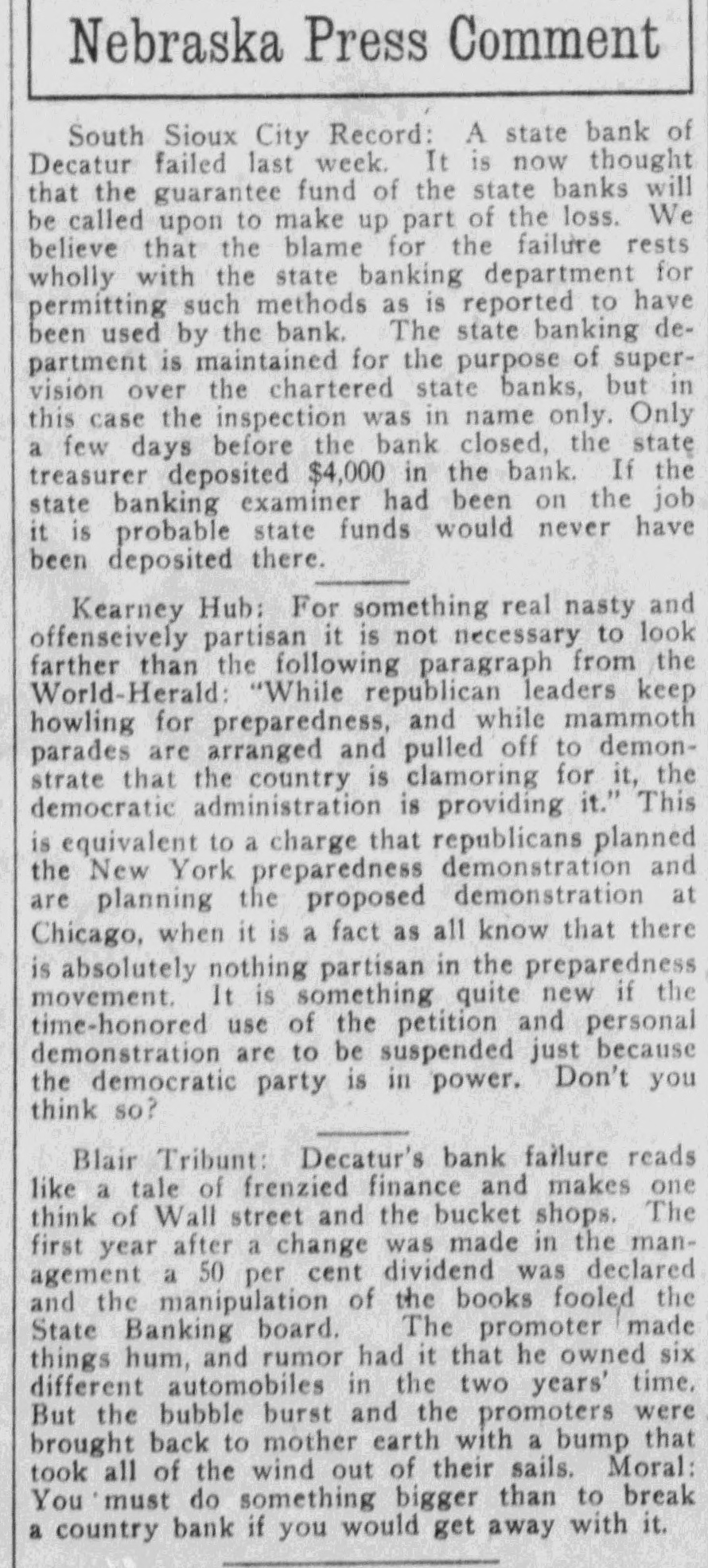
Nebraska Press Comment South Sioux City Record: A state bank of Decatur failed last week. It is now thought that the guarantee fund of the state banks will be called upon to make up part of the loss. We believe that the blame for the failure rests wholly with the state banking department for permitting such methods as is reported to have been used by the bank. The state banking department is maintained for the purpose of supervision over the chartered state banks, but in this case the inspection was in name only. Only a few days before the bank closed, the state treasurer deposited $4,000 in the bank. If the state banking examiner had been on the job it is probable state funds would never have been deposited there. Kearney Hub: For something real nasty and offenseively partisan it is not necessary to look farther than the following paragraph from the World-Herald: "While republican leaders keep howling for preparedness, and while mammoth parades are arranged and pulled off to demonstrate that the country is clamoring for it, the democratic administration is providing it." This is equivalent to a charge that republicans planned the New York preparedness demonstration and are planning the proposed demonstration at Chicago, when it is a fact as all know that there is absolutely nothing partisan in the preparedness movement. It is something quite new if the time-honored use of the petition and personal demonstration are to be suspended just because the democratic party is in power. Don't you think so? Blair Tribunt: Decatur's bank failure reads like a tale of frenzied finance and makes one think of Wall street and the bucket shops. The first year after a change was made in the management a 50 per cent dividend was declared and the manipulation of the books fooled the State Banking board. The promoter made things hum, and rumor had it that he owned six different automobiles in the two years' time. But the bubble burst and the promoters were brought back to mother earth with a bump that took all of the wind out of their sails. Moral: You must do something bigger than to break a country bank if you would get away with it.