11223. Tolley State Bank (Tolley, ND)

Bank Information

Episode Type
Suspension โ†’ Closure
Bank Type
state
Start Date
November 19, 1920
Location
Tolley, North Dakota (48.729, -101.827)

Metadata

Model
gpt-5-mini
Short Digest
83d5360d8f5ded66

Response Measures

None

Description

The Tolley State Bank (Tolley, ND) first suspended/closed in November 1920 due to crop failures and farmers holding wheat; receivers were appointed and the bank entered liquidation. Although there is evidence the Tolley bank later reopened for a time (by 1922) and then suspended payments again in Nov 1922 due to a currency shortage, the core episode documented is a suspension/closure with receivership and liquidation and depositors being paid via the state guaranty fund. No article describes a depositor run triggered by rumor/misinformation; causes are local agricultural factors and related liquidity issues. Dates are taken from the newspaper items; some events (reopening) are only dated to the month/year provided in the articles.

Events (5)

1. November 19, 1920 Suspension
Cause
Local Shock
Cause Details
Crop failures and farmers holding wheat (wheat strike) reduced liquidity and collateral values, forcing the bank to suspend/close in November 1920.
Newspaper Excerpt
The Tolley State Bank of Renville county ... closed. Lean years and successive crop failures ... The fact that farmers have not sold their wheat naturally prevents liquidation
Source
newspapers
2. February 5, 1921 Receivership
Newspaper Excerpt
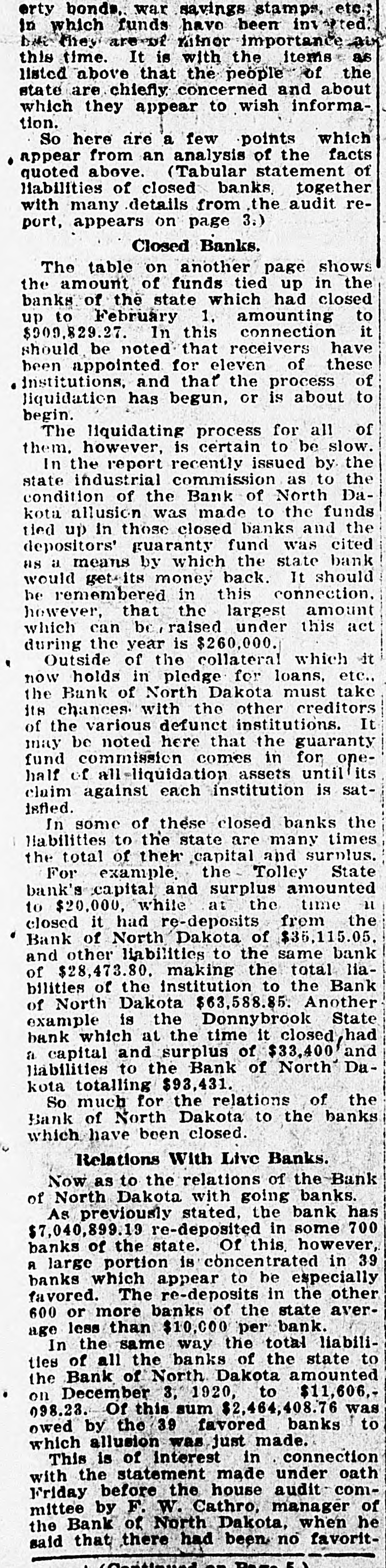
it should be noted that receivers have been appointed for eleven of these institutions ... For example, the Tolley State bank's capital and surplus amounted to $20,000, while at the time it closed it had re-deposits from the Bank of North Dakota ... making the total liabilities ... $63,588.85. (audit/receivership discussion).
Source
newspapers
3. April 16, 1921 Other
Newspaper Excerpt
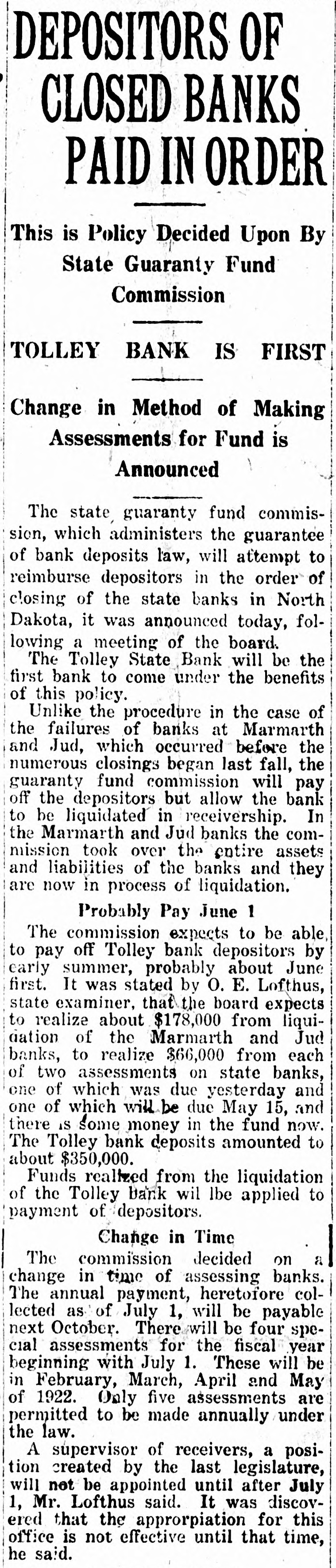
The Tolley bank deposits amounted to about $350,000. The guaranty fund commission ... will pay off Tolley bank depositors by early summer, probably about June first. (Guaranty fund to reimburse depositors).
Source
newspapers
4. August 1, 1922* Reopening
Newspaper Excerpt
The Farmers State Bank of Tolley which suspended business temporarily when the Tolley State Bank reopened has had its charter transferred to Greene. It reopened for business last week. (indicates Tolley State Bank had reopened prior to Aug 1922).
Source
newspapers
5. November 30, 1922 Suspension
Cause
Local Shock
Cause Details
Shortage of currency (car shortage) prevented meeting cash withdrawals; bank suspended payments temporarily while awaiting sale of grain to obtain cash.
Newspaper Excerpt
Because of a shortage of currency the Tolley State Bank has suspended payments. One of the officials ... it is not thought the bank will be closed. Checks will not be cashed until money is made available by the sale of large quantities of grain ... Except for a shortage of ready cash the institution is in excellent condition.
Source
newspapers

Newspaper Articles (19)

Article from The Bismarck Tribune, November 19, 1920

Click image to open full size in new tab

Article Text

3 BANKS CLOSE; HOLDING WHEAT HELD A CAUSE All May Be Reopened SoonCrop Failures Chief Cause of Situation Crop failures and the fact that farmers are holding their wheat are reasons assigned by O. E. Lofthus, state bank examiner, for the closing of three banks in the state, whose reserves fell below legal requirements. The banks are the Security State Bank of New England and the Farmers State Bank of Havelock, both in Hettinger county, and the Tolley State Bank of Renville county. None of them are and it is possible that they will reopen, or pay out virtually in full. "Lean years and successive crop failures in these particular localities is the main reason for the condition," said Mr. Lofthus. "Crops have been spotted 'in the state. The farmers failed to get crops to permit liquidation of their accounts. "The fact that farmers have not sold their wheat naturally prevents liquidation which was expected. Holding of wheat is one of the direct causes for the condition of the New England bank and was indirectly a factor in the other cases, because if crops are not sold in localities where there were crops, those banks do not have surplus money to send into the lo calities where there were crop failures." A good crop next year would entirely change conditions, the examiner stated. All the bank deposits are guaranteed by state law. The president of the New England and Havelock banks is C. W. Merrick, formerly of Bismarck. Fargo, Nov. 19.-The Equity Cooperative Packing company, with headquarters here, is at present following a policy of curtailed activities said J. M. Casey, its president, today. in denying rumors that the company is in serious financial difficulty. Farmers holding wheat for higher prices throughout the state and continued crop failures in the western part of North Dakota are, he says. responsible for the temporary curtailment. Mr. Casey stated that all debts of the company are more than balanced by its property and accounts due. "The Equity plant here representing $1,250,000 is clear of all indebtedness," he added. "Equipment in plants at Duluth and the Twin Cities is also clear of debt."


Article from Every Evening, Wilmington Daily Commercial, November 24, 1920

Click image to open full size in new tab

Article Text

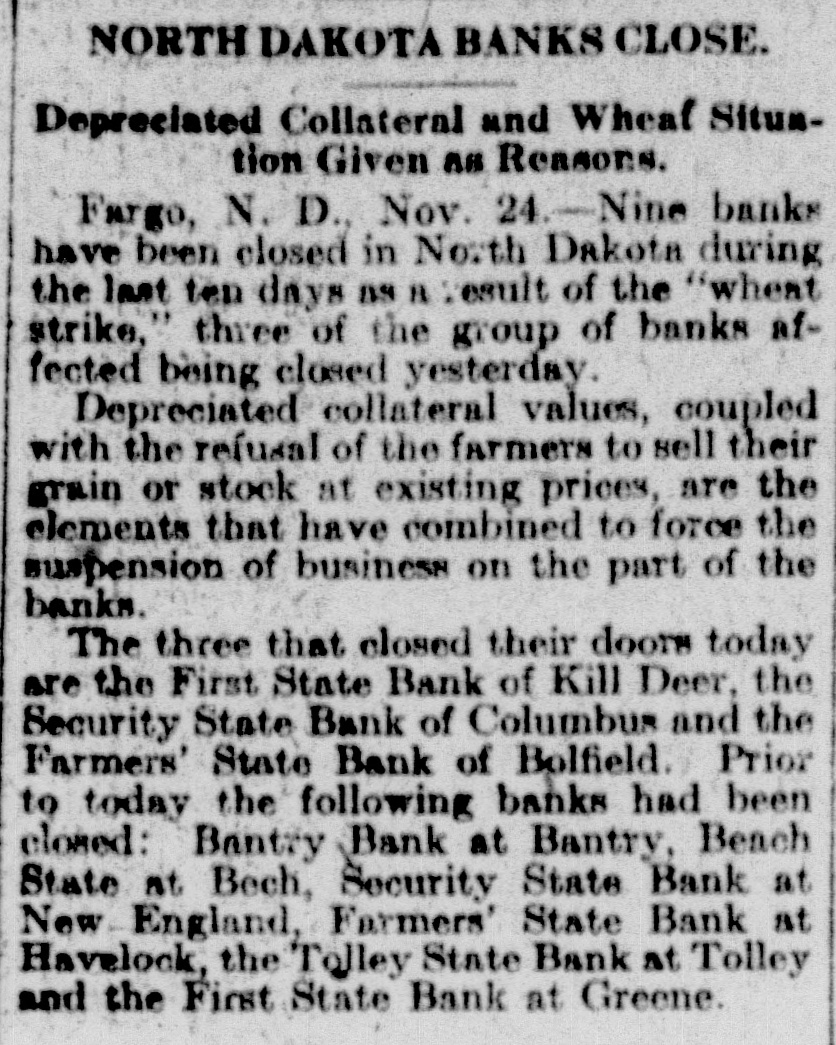
NORTH DAKOTA BANKS CLOSE. Depreciated Collateral and Wheat Situmtion Given AH Reasons. Fargo, N. D. Nov. 24. - Nine banks have been closed in North Dakota during the last ten days as R esult of the "whent strike," three of the group of banks affected being closed yesterday. Depreciated collateral values, coupled with the refusal of the farmers to sell their grain or stock at existing prices, are the elements that have combined to force the suspension of business on the part of the banks. The three that closed their doore today are the First State Bank of Kill Deer, the Security State Bank of Columbus and the Farmers' State Bank of Bolfield. Prior to today the following banks had been closed: Bantry Bank at Bantry, Beach State at Bech, Security State Bank at New England, Farmers' State Bank at Havelock, the Tolley State Bank at Tolley and the First State Bank at Greene.


Article from The Ward County Independent, November 25, 1920

Click image to open full size in new tab

Article Text

the state bank examiner to appoint a receiver. The reason for this institution closing was its inability to meet the unexpected demand for withdrawal of public funds deposited with the bank. Greene is in Renville county. Other banks which have been closed are the Security State Bank of New England; the Farmers State Bank of Havelock, and the Tolley State Bank of Renville county.


Article from Grand Forks Herald, February 5, 1921

Click image to open full size in new tab

Article Text

erty bonds, war savings stamps, etc.; in which funds have been inv sted bitt they are of minor importance air this time. It is with the items as listed above that the people of the state are chiefly concerned and about which they appear to wish information. So here are a few points which appear from an analysis of the facts quoted above. (Tabular statement of liabilities of closed banks, together with many details from the audit report, appears on page 3.) Closed Banks. The table on another page shows the amount of funds tied up in the banks of the state which had closed up to February 1. amounting to $909,829.27. In this connection it should be noted that receivers have been appointed for eleven of these institutions, and that the process of liquidation has begun, or is about to begin. The liquidating process for all of them. however, is certain to be slow. In the report recently issued by the state industrial commission as to the condition of the Bank of North Dakota allusion was made to the funds tied up in those closed banks and the depositors' guaranty fund was cited as a means by which the state bank would get-its money back. It should be remembered in this connection, however, that the largest amount which can bc raised under this act during the year is $260,000. Outside of the collateral which it now holds in pledge for loans, etc., the Bank of North Dakota must take its chances. with the other creditors of the various defunct institutions. It may be noted here that the guaranty fund commission comes in for onehalf of all-liquidation assets until its claim against each institution is satisfled. In some of these closed banks the liabilities to the state are many times the total of their capital and surplus. For example, the Tolley State bank's capital and surplus amounted to $20,000, while at the time 11 closed it had re-deposits from the Bank of North Dakota of $35,115.05. and other liabilities to the same bank of $28,473.80. making the total liabilities of the institution to the Bank of North Dakota $63,588.85. Another example is the Donnybrook State bank which at the time it closed,had a capital and surplus of $33,400 and liabilities to the Bank of North Dakota totalling $93,431. So much for the relations of the Bank of North Dakota to the banks which have been closed. 4 Relations With Live Banks. Now as to the relations of the Bank of North Dakota with going banks. As previously stated, the bank has $7,040,899.19 re-deposited in some 700 banks of the state. Of this however, A large portion is concentrated in 39 banks which appear to be especially favored. The re-deposits in the other 600 or more banks of the state average less than $10,000 per bank. In the same way the total liabilities of all the banks of the state to the Bank of North Dakota amounted on December 3, 1920, to $11,606,098.23. Of this sum $2,464,408.76 was owed by the 39 favored banks to which allusion was just made. This is of interest in connection with the statement made under oath Friday before the house audit committee by F. W. Cathro, manager of the Bank of North Dakota, when he said that there had been no favoritAMS am Date 5.00


Article from The Bismarck Tribune, April 16, 1921

Click image to open full size in new tab

Article Text

DEPOSITORS OF CLOSED BANKS PAID IN ORDER This is Policy Decided Upon By State Guaranty Fund Commission TOLLEY BANK IS FIRST Change in Method of Making Assessments for Fund is Announced The state guaranty fund commission, which administers the guarantee of bank deposits law, will attempt to reimburse depositors in the order of closing of the state banks in North Dakota, it was announced today, following a meeting of the board. The Tolley State Bank will be the first bank to come under the benefits of this policy. Unlike the procedure in the case of the failures of banks at Marmarth and Jud, which occurred before the numerous closings began last fall, the guaranty fund commission will pay off the depositors but allow the bank to be liquidated in receivership. In the Marmarth and Jud banks the commission took over the entire assets and liabilities of the banks and they are now in process of liquidation. Probably Pay June 1 The commission expects to be able to pay off Tolley bank depositors by early summer, probably about June first. It was stated by O. E. Lofthus, state examiner, that the board expects to realize about $178,000 from liquidation of the Marmarth and Jud banks, to realize $66,000 from each of two assessments on state banks, one of which was due yesterday and one of which will be due May 15, and there IS some money in the fund now. The Tolley bank deposits amounted to about $350,000. Funds realized from the liquidation of the Tolley bank wil lbe applied to payment of depositors. Change in Time The commission decided on a change in time of assessing banks. The annual payment, heretofore collected as of July 1, will be payable next October. There will be four special assessments for the fiscal year beginning with July 1. These will be in February, March, April and May of 1922. Only five assessments are permitted to be made annually under the law. A supervisor of receivers, a position created by the last legislature, will not be appointed until after July 1, Mr. Lofthus said. It was discovered that the approrpiation for this office is not effective until that time, he said.


Article from Grand Forks Herald, April 16, 1921

Click image to open full size in new tab

Article Text

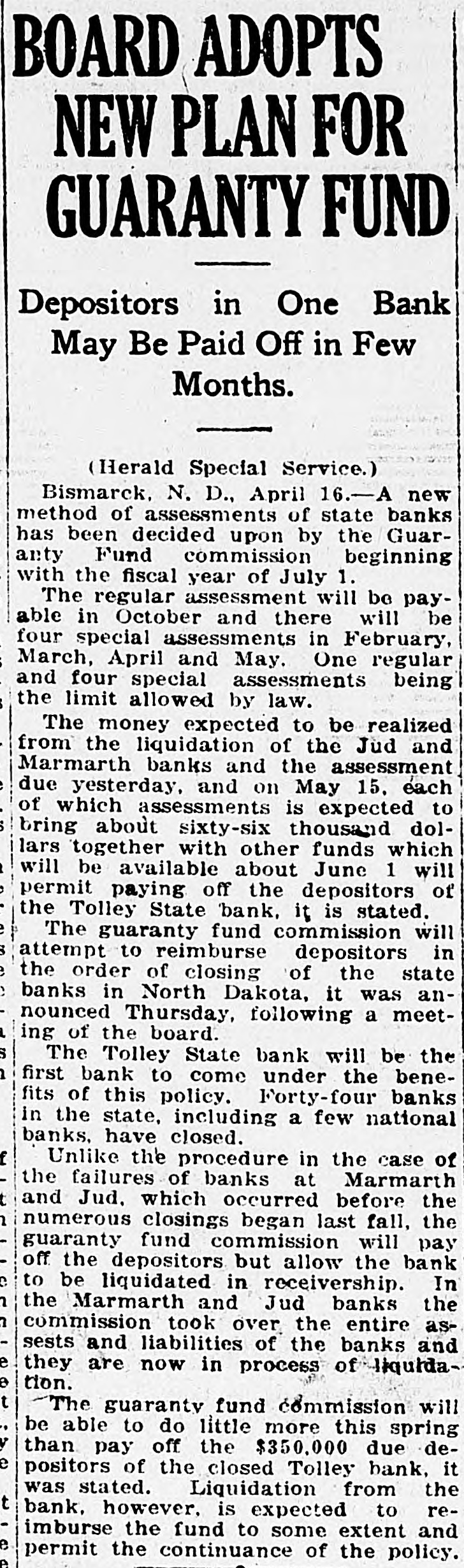
BOARD ADOPTS NEW PLAN FOR GUARANTY FUND Depositors in One Bank May Be Paid Off in Few Months. (Herald Special Service.) Bismarck, N. D., April 16.-A new method of assessments of state banks has been decided upon by the Guaranty Fund commission beginning with the fiscal year of July 1. The regular assessment will be payable in October and there will be four special assessments in February, March, April and May. One regular and four special assessments being the limit allowed by law. The money expected to be realized from the liquidation of the Jud and Marmarth banks and the assessment due yesterday, and on May 15. each of which assessments is expected to bring about sixty-six thousand dollars together with other funds which will be available about June 1 will permit paying off the depositors of the Tolley State 'bank, it is stated. The guaranty fund commission will attempt to reimburse depositors in the order of closing of the state banks in North Dakota, it was announced Thursday, following a meeting of the board. The Tolley State bank will be the first bank to come under the benefits of this policy. Forty-four banks in the state, including a few national banks, have closed. Unlike the procedure in the case of the failures of banks at Marmarth and Jud. which occurred before the numerous closings began last fall, the guaranty fund commission will pay off the depositors but allow the bank to be liquidated in receivership. In the Marmarth and Jud banks the commission took over the entire assests and liabilities of the banks and they are now in process of liquidation. The guaranty fund commission will be able to do little more this spring than pay off the $350,000 due depositors of the closed Tolley bank, it was stated. Liquidation from the bank, however, is expected to reimburse the fund to some extent and permit the continuance of the policy.


Article from Jamestown Weekly Alert, April 21, 1921

Click image to open full size in new tab

Article Text

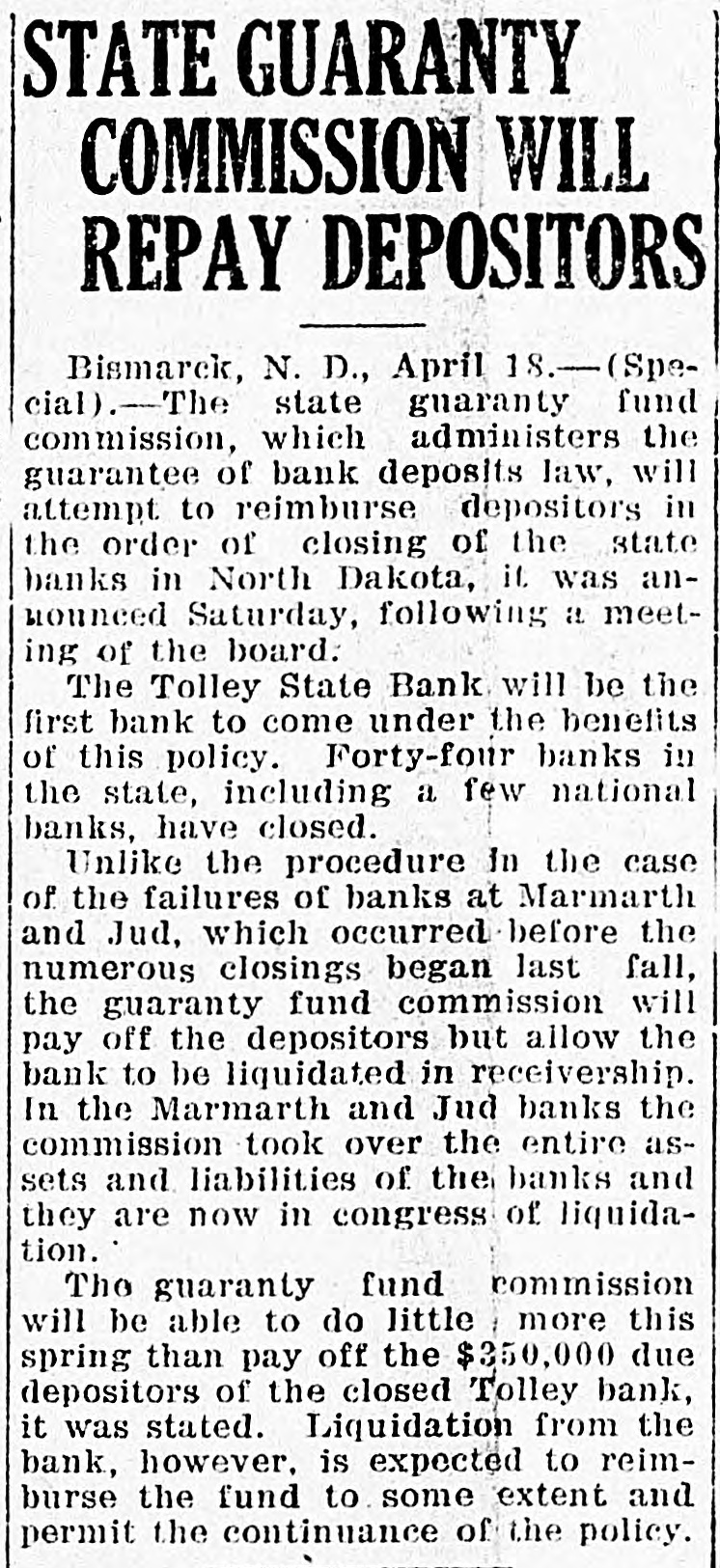
STATE GUARANTY COMMISSION WILL REPAY DEPOSITORS Bismarck, N. D., April .-(Special).--The state guaranty fund commission, which administers the guarantee of bank deposits law, will attempt to reimburse depositors in the order of closing of the state banks in North Dakota, it. was announced Saturday, following a meeting of the board. The Tolley State Bank will be the first bank to come under the benefits of this policy. Forty-four banks in the state, including a few national banks, have closed. Unlike the procedure In the case of the failures of banks at Marmarth and Jud, which occurred before the numerous closings began last fall, the guaranty fund commission will pay off the depositors but allow the bank to be liquidated in receivership. In the Marmarth and Jud banks the commission took over the entire assets and liabilities of the banks and they are now in congress of liquidation. The guaranty fund commission will be able to do little more this spring than pay off the $350,000 due depositors of the closed Tolley bank, it was stated. Liquidation from the bank, however, is expected to reimburse the fund to some extent and permit the continuance of the policy.


Article from The Bismarck Tribune, July 15, 1921

Click image to open full size in new tab

Article Text

GUARANTY TO MAKE SOON PAYMENTS to of be Bank Tolley Depositors by Reimbursed Commission, it is Stated IS NAME SUPERVISOR of of Money Question Depositing Commission The Schor of be to egge, Williston, for and the Tolley of the Bank State Guaranty in meeting o. are receivers, paying off are CommissMembers holding E. examiner, secretary Lofthus, S.G. Treasurer Bismarck. B. J. Schorese Frazier (Minot. Governor a the commission state Severtson, Williston, and M. is city. supMr. appointed of ervisor ed by the last of of Porter absent School from the was a position on the creat rec the legislatimete ndation Asso of Far Bankerollister. and North ommend Dakota of Geo. H of Bism Lofthus composed P. Goddard, of Velva, had Mr. sought for go; A E H Sevareld, the board of the position. state Mr. of said, after the bankers for the Bank of Schowing it was man among Schoregge desired is second County State said, was commis nvited to sion discuss the and the Williston. The bankers to committee the the su- of appointment unanimireceiver. who Theyage pervisor banks agreed of on Acceptance mission of ously member in his of the Barred he hesitated was Depositors president of Far George some H. Hollist company, Trust audit the first books of the Northerninted was appointed State Bank, last the fall Acgo, of the Tolley which closed Lofthus of the Tol ley bank the banks to o. to is week comwhich pleted, will cording be made as soon may as be the within a or two that recent of announced court when pays It was of the the supreme effect rate that of de in bank than the under decsion Nebraska to higher legal rate the posit not law will be that deposit. received guaranbakota banks and who than six North closed Interest protec Guaranty the ors higher in will rate not of have the fund amount law, of their the paid commisthe and tion percent will of deposits not be by the fund guarantrazier sion. The members are of Lofthus, Governor Bismarck secretary chairman: commission S. G. Severtson Williston, and M Depos treasurschoregge, B. R. Porter, J. Minot. collected Commisside by the for The Guaranty paying of itors money Fund off been de in the posited ta. the itors purpose closed of Bank banks of has North Dako ac about totals $308,000, state examin the comand who secretado cording The fund to W. Lofth the of money in sit the mission, er the state bank. viewed when had Many with banapprehensioney the Bank of uation learned that in the weeks ago, they deposited several Bank been Dakota, fact that the unable North of the been Mr. of because Dakota obligations. has North all its the Bank pay of meet that able to to Lofthu Dakota insists will be to depositors within North out off the checmailed be two next which may weeks. law fund provides in he left the The guaranty shall be is ready to wals be that the sgessed money until it the withdra weeks ago banks paid out ass However, two deposited three in that the this one bank to with were the made money been the Bank needed of and It had provide much that it Lofthus was was done Dakota declare3 expected out but cash North done Mr because would it be was paid found of new was the money that it audi necessary recent bank and that immediately to make because of ation by interesion "all the Tolley decision Commiss that court Guaranty also Fund provideceived Guar- from the The law collected the or Depositors under the time to moneys time Commissionall by be or depos- trust anty provisions Fund of this more act banks this law not ited provision in one operating or North under Dakota law. is Mr. companies The Bank of the guarant true added included said und this was fund commission rules for as the Lofthus that the power guaranty to selected make some the state has itself the it agency. BURGE An


Article from Jamestown Weekly Alert, July 21, 1921

Click image to open full size in new tab

Article Text

FUNDS COLLECTED BY GUARANTY COM. IN BANK OF N.D s Total Over Three Hundred n Thousand Dollars Accordd ing t o Lofthus-Bankers Apt View Situation With prehension. N. D., July 15. (special) by the Bismarck. money collected CommisGuaranty of paying Depositors All of the Fund de- off the purpose was sion for of closed banks Dakota depositors in the Bank of This Noth became posited weeks ago. meeting of several today following a plans for the known commission to consider of the Tolley State last paying Bank, off depositors the first of the banks to clos fall. totals about $308,000, The fund to O. E. Lofthus, state of the according and secretary-treasurer the moncommission, aminer who deposited ey Many in the bankers state bank. viewed when the situa- they the posited learned tion with in that the apprehension the Bank money of because had North been of Dako- debecame known, North Dakota ta, it the Bank of its oblifact that unable to meet all that the has been Mr. Lofthus insists be able to gations. North Dakota will depositors Bank of checks to within which pay off may the be mailed out the next two weeks, guaranty fund law provides in the The money shall be left to that until it is banks the assessed the withdraw- ready out. However. during be paid made on many banks money als were middle of May and the It has the in the one bank. done to deposited that this was Dakota been reported the Bank of North provide much needed cash. Mr. Lofthus it was with it was done because would be declares that the money it was expected out immediately but that audit paid necessary to make a new of a refound the Tolley bank because interpretation of court decision and Commission. cent by Guaranty Fund that all the law also provides from The collected or received Guarmoneys time by the Depositors the time to Fund Commission under deposanty of this act shall be trust provision one or more banks or their ited companies in operating under law." Bank of North Dakota is law. not The under the guaranty true but included Lofthus said this was comMr. that the guaranty fund some added mission has the power to make rules for itself. fact that the Bank of North Dakota The is obliged to pay out approx- fund $300,000 of guaranty of means that the money are increased far imately bank obligations beyond now the obligations which it is meet. the the bank is unable to Bank of known Within the last two days the paying North Dakota has begun not paid checks again, but has state the $368,000 state apportionment fund. The guaranty fund commission coin- at meeting here, met with Bankers a its of the North Dakota mittee Association The commission spokes- which said that the committee, Hollisman composed of George H. of Biswas of Fargo; H. P. Goddard Velva, ter, and A. E. Sevareid, of commismarck, invited to meet with the of was and discuss the liquidation closed sion banks and the appointment of a supervisor of receivers. Schoreggo Named Supervisor stated that the banker's It was unanimously suggested second committee of B. J. Schoregge, County the name president of the Williams vice Bank of Williston, to be banks. superState of receivers of the closed state visor Schoregge formerly was a of examiner Mr. and now is a member The the Guaranty Fund Commission. and Mr. appointment was made imSchoregge enters upon his duties of mediately. It is stated that none banks the receivors of the various will be removed as a result. H. Hollister was delegated George audit the claims of the Tolley State to Bank and pesent his recome mendations to the commission. It was announced that a recent of decision of the supreme court Nebraska to the effect that when a bank pays a higher rate of interest is than the legal rate the deposit guaranteed under a guaranty law, not will be applied in North Dakota, banks and that depositors in closed interwho received a higher rate of est than six per cent will not have fund the protection of the guaranty law, and will not be paid the amount of their deposits by the commission. fund The members of the guaranty commission are Governor. Frazier, chairman, O. E. Lofthus, secretarytreasurer, S. G. Severtson, Bismarck: R. B. J. Schoregge, Williston, and M. Porter, Minot. ORDER REASSESSMENT ou


Article from Grand Forks Herald, September 19, 1921

Click image to open full size in new tab

Article Text

OFFICERS OF CLOSED BANKS ARE RECEIVERS Is Administration State Loyally Taking Care Of Its Friends The Nonpartisan league state administration is showing unusual ability in taking care of its friends in connection with the appointment of receivers for many of the closed banks of North Dakota. The methods pursued might seem a little peculiar to some bankers, but evidently not to O. E. Lofthus, the talented state examiner, appointed by Governor Frazier, who has the appointing of the receivers. Out at Tolley; for instance, one A. M. Fruhs was president of the Tolley State bank, one the first banks to close. In spite of the fact that it was under his administration that he bank found It necessary to close up he has been appointed by Mr. Lofthus an re ceiver of his own bank, rather a novel stunt it would seem There seems to be similar confidence in the ability of A. A. Swanson, who was cashier of the Tolley State bank At least such would seem to be indi cated bv the fact that Mr. Swanson is receiver of the Merchants' State bank at Kenmare. Ebbert Also. Another friend of the administration is G. A. Ebbert, who was general man ager of the First Farmers' bank of Minot, another institution which is in the hands of a receiver. In spite of the fact that Mr. Ebbert was unable to keep his own bank out of the hands of a receiver, he is now receiver of the Mohall Security bank of Mohall. Incidentally it might be mentioned that Lieut. Gov. Howard Wood is whiling away the time between legislative sessions as receiver of the Prosper State bank. These are only a few of the cases that have come to hand. Presumably there are others


Article from Grand Forks Herald, September 19, 1921

Click image to open full size in new tab

Article Text

AMERICAN WOMEN no Roadbed and rails are laid to victory in the pending recall election, but the rails are not greased, and the Independent state headquarters are asking all Independent voters and workers to rush in funds so no unnecessary delay in the campaign will be caused for lack of money. From every county in the state comes ophimistic reports as to the result this there is no doubt but that administration (the all, state and the will Independ- suffer an overwhelming defeat if ent forces are able to carry the truth to the people and get the vote out on But money is needed right away is and election it day. is needed, if it going to bring the best results. It should be easer for the forces of law and order to get the necessary campaign funds than for those who are twisting the issues and condoning and protecting graft, greed and misconduct in office.-Bottineau Farmers' Advocate. This is the House that Bill built. This is the Money that paid for the House that Bill built. This is the Tax that raised the Money that paid for the House that Bill built. This is the State that levied the Tax that raised the Money that paid for the House that Bill built. This is the Boss that runs the State that levied the Tax that raised the Money that paid for the House that Bill built. This is the League that elected the Boss that runs the State, that levied the tax that raised the Money that paid for the House that Bill built. This is the Voter that sticks to the League that elected the Boss that runs the State that levied the Tax that raised the Money that paid for the House that Bill built.-Slope County News. Have the depositors in the Tolley bank received their money from the state? It will be recalled that this was the first bank closed last winter, and that its deposits were guaranteed under the state guarantee fund. It will also be remembered that several weeks back the fund was withdrawn from the different banks of the state and all gathered under the sheltering care of the big Bank of North Dakota. If the depositors of the Tolley bank are entitled to their money out of this don't they get it? The is to perhaps amounting fund, fact probably why that $300,000 this money, is so tied up in the Bank of North Dakota that it will be harder to get than from bank. The collecting of from the this the Tolley fund individual insolvent banks inand depositing it in an stitution lke the Bank of North Dakota is plainly a criminal act.-Mandan Pioneer. Apparently the "Wobblies' in North Dakota are to be protected in their campaign of terrorism by their friend in Bismarck, Lynn J. Frazier. Our precious governor who was so concerned about the "constitutional rights' of Max Eastman, isn't a bit perturbed about the "constitutional rights" of men who want to work in the harvest fields without joining the I W. W. or even of the citizens and officers at Langdon who arrest W W for ed peace some I violation themselves of our state laws and had to arm to keep the prisoners from being released.


Article from Grand Forks Herald, January 10, 1922

Click image to open full size in new tab

Article Text

NEW PLAN FOR RECEIVERSHIPS SAVES MONEY Twenty-five Per Cent Saving in Salaries Has Already Been Accomplished. Bismarck, N. D., Jan. 10.-Reduction of 25 per cent in the salaries paid receivers of closed banks in North Dakota already has been accomplished through consolidation of receiverships, it is said. With the announcement by the banking board of the appointment of three more receivers for groups of banks, there remains but two or three more groups in the state for which receivers will be named under the consolidated plan. The consolidation has not been carried to its full extent because of the fact that some receivers obtained confirmation of their appointments try courts and have refused to resign. The question of whether the court or state examiner, with approval of the state banking board, shall have power to name receivers will be settled through an appeal of a Dickinson case to the supreme court. W. E. Burgett, of Flaxton, president of the Citizens State bank of that city, has been named receiver for closed banks at Greene, Tolley, Fortuna. Columbus, Loraine and for the Security State of Mohall. G. R. Van Sickle, of Minot. has been appointed receiver for the Williston State bank of Williston. He also is receiver for the First Farmers bank of Minot and the First Security of Carpio. J. W. Lee, of Rhame, has been named receiver for closed banks at Haynes, Marmarth and for the First State bank of Amidon. He has been receiver for the Farmers State of Rhame and continues to act as receiver for that institution.


Article from The Ward County Independent, August 24, 1922

Click image to open full size in new tab

Article Text

Bank Opens at Greene The Farmers State Bank of Tolley which suspended business temporarily when the Tolley State Bank reopened has had its charter transferred to Green. It reopened for business last week. It is understood that there is as yet no connection between the Farmers State Bank of Greene which is in the hands of a receiver and the new bank. J. H. Sinclair, Chas. Docter and J. M. Lund are president, vice president and cashier respectively of the new institution.


Article from The Ward County Independent, November 30, 1922

Click image to open full size in new tab

Article Text

Because of a shortage of currency the Tolley State Bank has suspended payments. One of the officials of the institution informed the press that it is not thought the bank will be closed. Checks will not be cashed until money is made available by the sale of large quantities of grain belonging to the institution which it is thought will be in a short time. Except for a shortage of ready cash the institution is in excellent condition. This is one of the results of the car shortage.


Article from The Bismarck Tribune, June 7, 1923

Click image to open full size in new tab

Article Text

ASK GUARANTY FUND PAY OFF DEPOSITORS Suit Begun to Force Payment To Depositors in First Closed Bank TO TEST THE LAW Will Determine if Depositors Must Be Paid in Order of Bank Closings Dickinson, N. D., June T.-Suit to determine whether or not the Guaranty Fund Commission must reimburse depositors of closed banks ill the order of the banks' closing, and when, has been instituted in the Sixth district court by A. J. Wirtz in behalf of himself and other depositors of the closed Security State Bank of New England. Similar suit has been instituted by Peter Lux in behalf of himself and other depositors of the Farmers State Bank of Havelock. The Guaranty Fund Commission, it is understood, has taken the position that with numerous banks closed the commission is not obligated to pay the depositors of the first closed bank first. but that an equal liability is created. Wirtz states that when the Security State Bank of New England closed Nov. 17, 1920 he had on deposit $8,059.00, that the total of unsecured deposits is about $200,000 and that the Guaranty Fund Commission has about $400,000 in its fund at present. The Security State Bank of England, since a Tolley bank has reopened, and the Farmers State Bank of Havelock were the first banks to be declared inolvent of the closings which began about three years ago, the petition says. It holds the depositors are entitled to receive their deposits in full out of the commission funds. The court is asked to: 1. Order the Guaranty Fund Com. mission to pay the receiver of the Security State Bank of New England sufficient money to pay the claims in full. 2. That in event there is not sufficient money to pay all unsecured deposits to issue certificates of indebtedness against the Guaranty fund in payment in full. 3. Decide that unsecured depositors of the Security State Bank of New England are prior and superior to the unsecured deposits of all other banks becoming insolvent subsequent to the insolvency of the Security State. The petition in the suit instituted by Peter Lux is identical. Attorneys for plaintiffs are Crawford and Burnett of Dickinson and Chas. J. Simon and H. J. Miller, New England.


Article from The Bismarck Tribune, September 22, 1924

Click image to open full size in new tab

Article Text

# DEPOSITORS IN # ALL OF CLOSED # BANKS TO SHARE (Continued from page one.) state. The Tolley State Bank had closed before this time, but was lat- er reopened and closed again. Wirtz declared depositors of the Security Bank, since it was the first closed, should be paid in full first. John Watson, depositor in the Tolley Bank, intervened and held that if it were decided depositors should be paid in order of the banks' closing, his bank should be first. Attorneys for the Guaranty Fund Commission held depositors of all closed banks should be treated alike, and if the fund was not sufficient to pay all, it should be pro rated. At the time the suit was started, the allegations said, the Guaranty Fund was about $400,000 and the total liabilities to lepositors $8,000,000. ### Purpose of Legislature "The legislature of 1923, when chapter 200 of the laws of that session was enacted," says the majority opinion, "had before it a serious condition, caused by the closing of a large number of banks, the first of which went down in 1920, with large claims, actual and potential, against the Guaranty Fund. The situation, contrary to that which was before the legislature in 1917, clearly disclosed that it would be possible to pay immediately or within a reasonable time, from assessments levied against functioning banks, only a comparatively small number of the depositors in the banks then closed, without imposing burdens on open banks that would lead to general insolvency and collapse of the state banking system. Whether the power existed to impose such a burden, we need not decide. "It was also evident from the extent of the liabilities of closed banks to depositors and consequent potential and probable liability of the Guaranty Fund to such depositors, that if the depositors were paid in full by levying assessments to the maximum legally permissable, as well as practicably possible, under the law, in the order in which banks closed, the result would be that depositors in banks which closed last, or even a few months after those which first suspended, could not be paid any portion of their claims for a long period. Consequently, and doubtless in the interest of justice, as it seemed to the legislature, the provision for payment to depositors under the law of 1917, as made in section 15 thereof, was fundamentally changed. It is provided in section 21, chapter 200, S. L. 1923, that if the Guaranty Fund be insufficient to pay the claims of depositors duly allowed, the Commission may pro rate payments upon certificates of indebtedness from the fund on hand. That is, the legislature decided that instead of exhausting the Fund in paying depositors in banks that first closed and leaving others to wait for an indefinite period, it would be more just and equitable to provide that as many claimants as possible should receive a dividend upon their claims within a reasonable time." The court's opinion discusses the question as to whether Wirtz and other depositors similarly situated, had acquired a "vested right" in the Guaranty Fund on hand, which entitled him to payment in full as a depositor of one of the first banks closed, while depositors of banks closed later would get nothing. The law of 1917 contemplated payment on the priority basis; the law of 1923 changed it to the pro rata basis. The court's opinion reads: ### Plaintiff's Right "If the plaintiff acquired a vested right in that portion of the Guaranty Fund which had been collected at the time the bank closed merely because he was a depositor therein, then all depositors in banks that closed before the law of 1923 went into effect acquired a similar vested right to payment in full from that part of the Fund which had been accumulated through assessments made prior to July 1, 1923, in the order in which the banks closed. If that were the correct construction of the statute, it would operate to deprive the overwhelming majority of the depositors in closed banks of any payment whatever on their claims from the existing, altogether inadequate Guaranty Fund. Payment as to them would necessarily be postponed to such remote period as would be required to replenish the fund. The result would be that a plan obviously devised to protect all depositors equally would, through judicial construction, be made to give full protection to some and practically no protection to others. The difficulties, complications and injustice that would arise from such a construction of the law would render its administration cumbersome and costly, would to a great extent defeat the legislative purpose common to the act of 1917 and to that of 1923. These considerations doubtless influenced the legislature to enact chapter 200, S. L. 1923. Whether approval of a claim as guaranteed by the State Examiner would have created a vested right which the legislature could not have disturbed by subsequent legislation, is not decided." ### Many Closings The court, continuing the discussion of the abnormal situation as affecting the Guaranty Fund which rose from the large number of bank closings, held: "We are, therefore, of the opinion that the depositors in closed banks, who had taken no steps to have their claims determined, liquidated, and allowed in the manner provided by the act of 1917, or concerning which facts had not been certified to the Commission, as provided in that law, prior to July 1, 1923, had no such voated right or interest in the continuance of the plan of payment from
Article from The Bismarck Tribune, November 13, 1924

Click image to open full size in new tab

Article Text

TOLLEY BANK DEPOSITORS FIRST PAID Guaranty Fund Commission Completing Preparations For Dividend Depositors of the Tolley State Bank, which closed in the fall of 1920, will be the first to receive a dividend from the Depositors Guaranty Fund Commission. which now is engaged in preliminaries necessary to actually paying depositors, it was announced today by C. B. McMillan and S. G. Severtson, members of the commission. Under the method of procedure adopted by the commission, notices will be sent to depositors shown by the reports of the commission auditors, and depositors will be asked to return their receiver's claim and complete other necessary papers. The depositors then will be paid by check. It probably will be several days before actual payment is made. In the case of claims of depositors which are rejected or suspended, the commission will give notice that the depositors have 90 days in which to appeal and obtain a hearing. The dividend is to be paid to depositors of banks closing before July 1, 1923, that claims of $12 or less are to be paid in full, and depositors with claims of $100 or less are to be given a flat payment of $10. In cases where the commission is able to pay but 10 percent on the claim, a certificate of indebtedness, not bearing interest, will be given for the remainder. The Depositors Guaranty Fund Commission, with assistance of accountants, is setting up office machinery to continue the policy which it has adopted of paying dividends.


Article from The Bismarck Tribune, December 13, 1924

Click image to open full size in new tab

Article Text

FIRST CHECKS TO DEPOSITORS ARE SENT OUT Depositors of Tolley State Bank Get 10 Per Cent Dividend from Commission TO BE CONTINUED Depositors of Banks to be Paid in Order of the Closing of Banks First checks in payment of a ten percent dividend to depositors of closed in the state before July banks offices 1. 1923. were mailed from of the Depositors Guaranty Fund Commission, it was announced by members of the commission. Other checks will be mailed as rapidly as the commission's office force is able to proceed. The first check, for $94.00. was made payable to Esther M. Gordon of Minnesota, a depositor in the Tolley State Bank. She received for the balance of her deposit in that bank a certificate of indebtedness for $940.81. which is expected to be paid at some future time. The commission has been delayed longer than expected in actual payment of checks. because of the imiamount of particularity rein the work of quired mense organizing the office force and examining claims, according to C. B. McMillan of Hannah. a member of the commission. In order to secure accurate and proper distribution of the fund and lessen the expense of administration, an office system designed to serve for a long period has been established, and the work of payment will extend over a considerable per 10d, Mr. McMillan said. of the Many depositors Tolley in State Bank will receive a dividend the first batch of checks dispatched. Out of 140 claims for deposits lost in the bank, however, but 43 filed receivers' certificates, and only those who filed receivers' certificates and obtain approval of claims, can be paid. Checks will be mailed to depositors in the order of closing of banks. it was said, and the second batch of checks will go to depositors of the Security State Bank of New England. It was emphasized again that no depositors of banks closing after 1. 1923, are to receive a diviand July dend at this time, it is not desired that they file papers at this time. The appointive members of the Depositors Guaranty Fund Commission, who are in session here to supervise the detailed work, are S. G. Severtson. Bismarck; W. N. Harris. Turtle Lake, and Mr. McMillan of Hannah. Banks To Reopen It was announced by the commission that bank conditions in the state are improving steadily, and reopening of three more closed banks is expected within a few days.


Article from The Bismarck Tribune, January 26, 1925

Click image to open full size in new tab

Article Text

GUARANTYFUND NOW MILLION AUDITORS SAY Amount Available on October 31 of $806,898.24 Supplemented by Payments 32 BANKS NATIONALIZE This Many Take Out National Charters Since Guaranty Law Is Effective "In our opinion the Depositors Guaranty fund has been properly accounted for on its records, and that all disbursements are consistent and in order and properly authorized and authenticated." This is the statement made by the Temple, Brissman Co., certified publie accountants at the conclusion of their audit report of the depositors guaranty fund made as of October 31, 1924. The report shows that on Oct. 31, last. the amount available for the purposes for which the fund was created was $806,898.24. This is exclusive of $204,661 due from closed banks in the state on deposits and assessments. No figures are given however as to the total liability of the fund to depositors in closed banks, this being beyond the province of the examination. Total Expenses The total expenses of the commission since its inception in 1917 to the date of the audit was $78,801.19. Of this $37,848.79 has been paid from legislative appropriation and the remaining $40,952 from the assessment fund. On October 31, 1924 the commission had on deposit in closed banks $112,966.29. A supplementary report shows that since the date of the audit $18,901.55 has been withdrawn. These deposits are divided among 16 closed institutions, the largest amount in any one bank being $21,398.39 in the defunct Williams County State Bank at Williston. There was also $21,515.26 on deposit in banks which were on the special deposit list on October 31, but of this $15,773.88 has been withdrawn since that date. Closed banks which still hold deposits of the guaranty fund are the Clyde State Bank, Bank of Cogswell, Farmers Bank of Dunn County, Dunn Center; Farmers State Bank of East Fairview, Sawyer State Bank, Williston State Bank, Farmers Bank of Garrison, State Bank of Grenora, Farmers Bank, Hampden; Security State Bank of Hanks, State Bank of Maxbass, Farmers State Bank of Nome, Farmers State Bank of Rawson, Farmers Bank of Ray, Farmers and Merchants State Bank of Sherwood, Tolley State Bank, Farmers State Bank of Watford City, Williams County State Bank of Williston. There was also due from these closed banks $89,303 on assessments to the guaranty fund, but $34,625 of this has been remitted by the state receiver since the date of the audit. In addition to these obligations there is the sum of $2,341.99 listed as notes receivable. These notes represent loans made to the receiver of the Farmers' and Merchants Bank of Robinson for receivership expenses. Intervene In Affairs It is shown in the audit report that the commission has intervened in the affairs of a number of closed banks in order to protect its interests. Some of these were as follows: The Sawyer State Bank had pledged collateral to secure certain loans. (Continued on page 4)