1093. American National Bank (Denver, CO)

Bank Information

Episode Type
Suspension β†’ Reopening
Bank Type
national
Bank ID
4159
Charter Number
4159
Start Date
April 22, 1896
Location
Denver, Colorado (39.739, -104.985)

Metadata

Model
gpt-5-mini
Short Digest
c230d3cbbf5ddba1

Response Measures

None

Receivership Details

Date receivership started
1896-07-25
Date receivership terminated
1897-01-07
OCC cause of failure
Losses

Description

Directors voted to close and liquidate the American National Bank (Denver) on April 21-22, 1896 due to internal dissensions and large withdrawals (~$200,000). The bank was later permitted to re-open as a national bank on 1897-01-07 after meeting conditions imposed by the Comptroller. A temporary receiver was appointed July 25, 1896 to protect assets (per reports); nonetheless the bank resumed operations Jan 7, 1897. OCR minor inconsistencies corrected (dates April 21/22 given interchangeably in reports).

Events (8)

1. November 13, 1889 Chartered
Source
historical_nic
2. April 22, 1896 Other
Newspaper Excerpt
Over $200,000 were withdrawn Monday and Tuesday of this week and there being only $70,000 left, the directors decided that the best thing to do was to close the bank.
Source
newspapers
3. April 22, 1896 Suspension
Cause
Voluntary Liquidation
Cause Details
Directors voted to close and liquidate the bank because of internal dissensions among directors/stockholders and rapid withdrawals (over $200,000 withdrawn earlier in the week).
Newspaper Excerpt
This bank has closed its doors by a vote of its directors, and it is in my hands as representative of the government. ZEPH P. HILL.
Source
newspapers
4. July 25, 1896 Receivership
Source
historical_nic
5. July 25, 1896 Receivership
Newspaper Excerpt
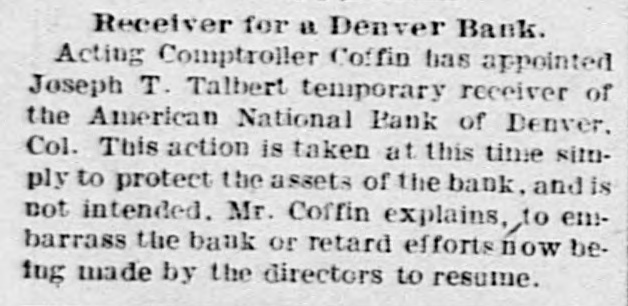
Acting Comptroller Coffin has appointed Joseph T. Talbert temporary receiver of the American National Bank of Denver, Col. This action is taken at this time simply to protect the assets of the bank, and is not intended to embarrass the bank or retard efforts now being made by the directors to resume.
Source
newspapers
6. January 7, 1897 Reopening
Newspaper Excerpt
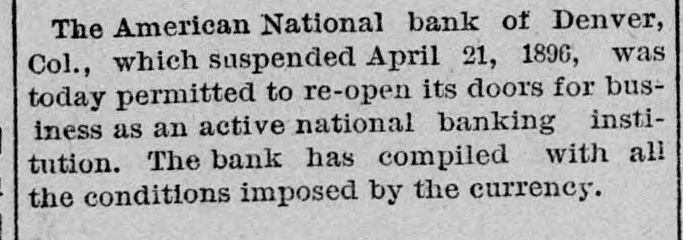
The American National bank of Denver, Col., which suspended April 21, 1896, was today permitted to re-open its doors for business as an active national banking institution.
Source
newspapers
7. January 7, 1897 Restored To Solvency
Source
historical_nic
8. April 1, 1899 Voluntary Liquidation
Source
historical_nic

Newspaper Articles (23)

Article from The Topeka State Journal, April 22, 1896

Click image to open full size in new tab

Article Text

HEAVY BANK FAILURE. American National Bank of Denver Breaks-Run on the Bank of Commerce. Denver, April 22.-The American National bank failed to open this morning. A notice was placed on the door to the effect that the directors had deeided to liquidate. The step was taken on account of internal dissension. It is said all depositors will be paid in full. Seph T. Hill is in charge of the bank on behalf of the government. The posted notice was as follows: "This bank has closed its doors by vote of its directors and is in my hands ES representative of the government. "SEPH T. HILL." The announcement of the failure does not come as a surprise to the business men of Denver nor indicate any lack of confidence in the general business situation. The condition of the bank has been weak for a long time because of disagreements among the large stockholders, directors and officers. The retirement from the directorate and the sale of the stock of several prominent and wealthy men has materially reduced the business of the bank and made it possible to carry it on profitably under present conditions. At the last report made at the close of business March 6. the total deposits were $1,471951: loans and discounts, $1,128,271: cash on hand. $232.265. The capital stock of the bank is $500,000: surplus fund, $150,000. The assets of the bank amount to $2,245,173. and it is claimed that but little trouble will be experienced in realizing on them. The following statement was taken from the books of the American National bank this morning: Resources, cash and exchange, $70,300: bills receivable, $1,078,000; stock and securities, $265,435; real estate, $136,590; excess on circulation, $22,000; total, $1,572,325. LIABILITIES. Individual deposits, $530,712; demand deposits, $28,698; time deposits, $66,297; due other banks, $97,024; borrowed money, $142,500; total, $865,231. A comparison of this statement with that published in March shows that the bank's deposits and reserve have declined very rapidly. Over $200.000 were withdrawn Monday and Tuesday of this week and there being only $70.000 left. the directors decided that the best thing to do was to close the bank Among the bank's assets are notes for $500,000 set aside for the reduction of the capital stock from $1,000,000 to $500.000 which was recently made and one-fifth interest in the Strong mine at Cripple Creek The president of the bank is John R. Hanna. The directorate consists of some Denver, of including the leading business men of Fine Pernst. Wm. and Moritz Barth, Mitchell Benedict and George W. Ballantine. In consequence of the failure a run has been started on the National Bank of Commerce.
Article from The Seattle Post-Intelligencer, April 23, 1896

Click image to open full size in new tab

Article Text

Business Failures. Denver. April 22.-The American National bank failed to open this morning. The following notice was posted: "This its bank has closed its doors by vote of directors, and is in my hands, as representative of the government, Zeph T. Hill." The failure does not come as a surprise or indicate any lack of confidence in the genΓ©ral business situation. The condition of the bank has been weak for a long time, because of internal dissensions. The retirement from the directorate and sale of stock by several wealthy men materially reduced the business of the bank. At the last report. made at the close of business March 6. the total deposits were $1,471,951; loans and discounts, $1,128,271; cash on hand, $232,265. The capital stock is $500,000, surplus $150,000. The assets amount to $2,245,173. and it is claimed there will be little trouble realizing on them. The following statement was taken from the books of the American National bank this morning: Resources, cash and exchange, $70,300; bills receivable, $1,078,000; stocks and securities, $265,435: real estate, $136,590: excess on circulation, $22,000; total, Liabilities: Individual deposits, demand deposits, $1,572,325. $530,712; $28,698; banks, time $97,024; deposits, $66,297; due to other A borrowed money, $142,500: total, $805,231. comparison of this statement with that published in March shows that the bank's deposits and reserve have declined very rapidly. Over $200,000 was withdrawn on Monday and Tuesday of this week, and, there being only $70,000 left, the directors decided that the best thing to do was to close the bank. Beside the resources given above there are notes for $500,000 set aside for the recent reduction of the capital stock from $1,000,000 to $500,000 and a fifth interest in the Strong mine at Victor. The president of the bank is John R. Hanna. The directorate consists of some of the leading men of Denver, including File P. Ernest, William and Moritz Barth. Mitchell Benedict, George W. Ballantine and T. J. O'Donnell. In consequence of the failure a run has been started on the National Bank of Commerce. John R. Hanna, president, and Howard Evans, cashier of the American National bank. were arrested late this afternoon on warrants sworn out in Justice Chapman's court, charging them with receiving deposits after the bank was known to be in a failing condition. Both were released on bonds. The run on the National Bank of Commerce ended about noon. All the demands were promptly met. At the other banks the deposits exceeded the withdrawals. President John R. Hanna, of the American National bank. in a published statement over his signature, said: "The shrinkage of deposits and but comparatively few new customers to replenish the loss and the inability to collect our bills, resulted in our inability to continue our business. I believe the depositors will eventually receive the entire amount due them. We have $350,000 in excess of assets exceeding OLT capital over our liabilities. The stockholders also may be assessed $500,000 more if necessary to pay the deposKors. With thus surplus I cannot see any loss to them." D. P. Moffat, president of the First National bank. said the failure was a weeding-out process which would not have any serious effect. The Denver clearing house offered to advance $300,000 to tide the bank over the crisis in its affairs, provided the leading directors and stockholders would become responsible for the sum by signing the necessary papers. It is said that none of them except Thomas Patterson would agree to this. It was then decided to close the institution. Chicago, April 22. -The Mason & Davis Company, manufacturers of stoves and ranges, failed today. and made John J. Whirl assignee. The assets are $73,000, liabilities $107,000. Syracuse, N. Y., April 22--T. C. & J. C. Miller. manufacturers of knit goods at Baldwinsville, have shut down their works and made a general assignment to Thomas H. Benton Crane and Wills Wendell The mill gave employment to 200 people. Preferences are made for $66,000 exclusive of interest and pay of employes. Cincinnati, April 22-The firm of Crawford. Eversole & Smith has assigned to D. D. Woodmansee. The liabilities are $800,000. assets $1,000,000. The firm succeeded Smith & Nixon, which was established in 1828.

Article from Hutchinson Gazette, April 23, 1896

Click image to open full size in new tab

Article Text

A NATIONAL BANK CLOSED. Suspension Caused by Dissension Among the Directors of a Denver 1 oncern. DENVER, Col., April 22.-The American national bank failed to open this morning, and a notice was placed on the door that the directors had decided to liquidate. The step was taken on account of internal dissension. It is said all depositors will be paid in full. The assets amount to $2,245,173, and it is claimed that but little trouble will be experienced in realizing on them.


Article from The Laramie Republican, April 23, 1896

Click image to open full size in new tab

Article Text

DENVER BANK FAILURE. The American National Closed Its Doors Yesterday. The American National bank of Denver closed its doors yesterday. It is said that all its liabilities will be settled in full. The following strong statment of its condition is made: RESOURCES. Cash and exchange, $70,300: bills received, $1,078,000; stock and securities, $265,435; real estate, $136,590; excess on circulation, $22,000; total, $1,572,325. LIABILITIES. Individual deposits, $530,712: demand deposits, $28,698; time deposits, $66,297; banks, $97,024: borrowed money, $142,500; total, $865,231. Besides the resources of $1,572,325 shown above, there are $500,000 of assets in the shape of notes set aside for the reduction of capital. Besides this the bank owns one-fifth interest in the Strong mine, which was obtained through a collection of a debt of the bank. The withdrawal of money from the bank on Monday and Tuesday amounted to over $200,000. and the directors thought it best to suspend. as It was only a question of time when that course would be necessary. This course was taken in justice to all the creditors of the bank.


Article from Evening Journal, April 23, 1896

Click image to open full size in new tab

Article Text

BRIEF NEWS NOTES. The American National bank of Denver closed its doors. Extensive damage has been done to the fruit crop of California by frost. Flames in the Cable building, Broadway and Houston street, New York, did damage estimated at $25,000. A dispatch from Havana says that Go. mez is marching toward Havana province to make a demonstration in favor of Maceo. The United States battleship Massachusetts in its run from Delaware capes to Cape Cod proved even faster than the battleship Indiana. Corporation Counsel Scott of New York has advised the police that hotels, to come within Raines law limits, must keep open regularly feb guests. William H. Dieffenbach and other creditors of the old New York, Lake Erio and Western Railway company have sued to set aside the recent foreclosure and reorganization. Estelle Burmeister of Philadelphia, a demented stenographer, who created a disturbance by ringing William K. Vanderbilt's doorbell, New York, was committed to Bellevue hospital. The body of a woman found locked in a closet at 636 Second avenue, New York, was supposed to be that of Delia Keegan, who once brought suit against Bussell Sage for alleged breach of promine.


Article from The Norfolk Virginian, April 23, 1896

Click image to open full size in new tab

Article Text

CLOSING A NATIONAL BANK. A Run Made on the Commerce Bank and is Promptly Met. Denver, Col., April 22.-The American National Bank failed to open its doors this morning. a notice being posted in the window that "by order of the directors the bank is in the hands of the Government." Bank Examiner Hill took charge of the institution. A run was at once precipitated on the National Bank of Commerce. a crowd of clamorous depositors gathering soon after 10 o'clock. The bank stood the drain, and at noon had paid every check presented. It is understood the associated banks will aid the Bank of Commerce should it be necessary. The failure of the American was not unexpceted in banking circles. At a meeting of the Associated Banks, held in the First National parlors, last night, proffers to assist the failed concern were made if the directors would do their part. As the Bank of Commerce continued to pay off steadily the excitement began to subside. At 12:30 the run on the Bank of Commerce ended after two thirds of the depositors had withdrawn their funds. A public meeting has been called by the angry depositors of the American National for to-morrow to protest against the alleged rottenness of the institution.

Article from Richmond Dispatch, April 23, 1896

Click image to open full size in new tab

Article Text

BANK RUN IN DENVER. The American National Fails-Bank of Commerce Suffers. DENVER, COL., April 22.-The American National Bank failed to open its doors this morning, a notice being posted in the window that "By order of the directors the bank is in the hands of the government." Bank-Examiner Hillo took charge. The event caused much excitement, and a run was at once precipitated on the National Bank of Commerce, a crowd of clamorous depositors gathering coon after 10 o'clock. The bank stood the drain, and at noon had paid every check presented. It is understood that the Associated Banks will aid the Bank of Commerce, should it be necessary. The failure of the American was not unexpected in banking circles. One by one its leading financial backers have been dropping out, and financiers knew that failure was inevitable. At a meeting of the Associated Banks, held in the First National parlors last night, proffers to assist the failed concern were made, if the directors would do their part. This being refused, the American closed. The failure and the run caused intense excitement throughout the city, and crowds gathered about the two bankinghouses involved. As the Bank of Commerce continued to pay off steadily, however, the excitement began to subside. At 12:30 the run on the Bank of Commerce had ended, after two thirds of the depositors had withdrawn their funds. A public meeting has been called by the angry depositors of the American National for to-morrow, to protest. against the alleged rottenness of the institution.


Article from The Salt Lake Herald, April 23, 1896

Click image to open full size in new tab

Article Text

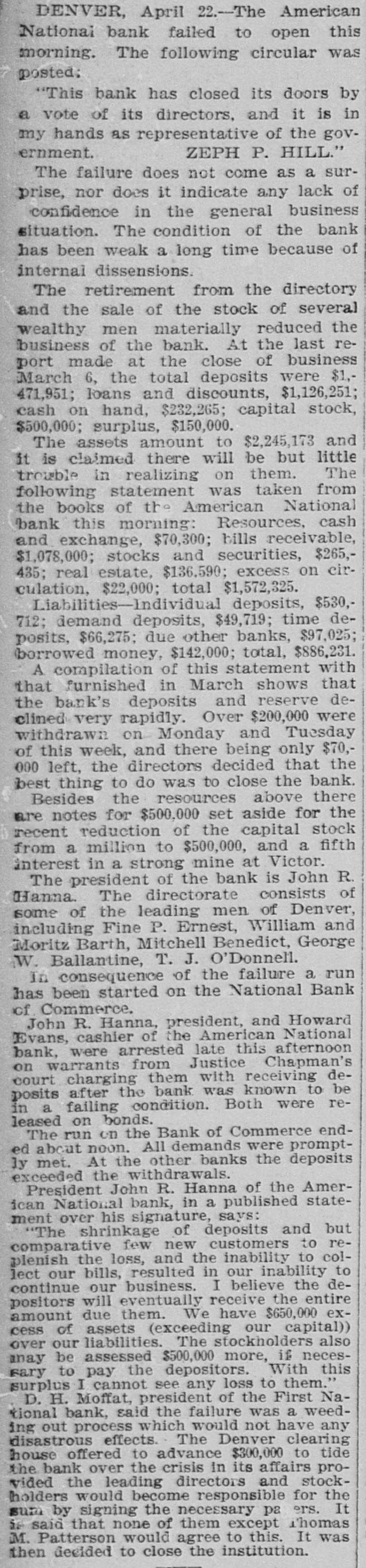
DENVER, April 22.-The American National bank failed to open this morning. The following circular was posted: "This bank has closed its doors by a vote of its directors, and it is in my hands as representative of the government. ZEPH P. HILL." The failure does not come as a surprise, nor does it indicate any lack of confidence in the general business situation. The condition of the bank has been weak a long time because of internal dissensions. The retirement from the directory and the sale of the stock of several wealthy men materially reduced the business of the bank. At the last report made at the close of business March 6, the total deposits were $1,471,951; loans and discounts, $1,126,251; cash on hand, $232,265; capital stock, $500,000; surplus, $150,000. The assets amount to $2,245,173 and it is claimed there will be but little trouble in realizing on them. The following statement was taken from the books of the American National bank this morning: Resources, cash and exchange, $70,300; bills receivable, $1,078,000; stocks and securities, $265,435; real estate, $136,590; excess on circulation, $22,000; total $1,572,325. Liabilities-Individual deposits, $530,712; demand deposits, $49,719; time deposits, $66,275; due other banks, $97,025; (borrowed money, $142,000; total, $886,231. A compilation of this statement with that furnished in March shows that the bank's deposits and reserve declined very rapidly. Over $200,000 were withdrawn on Monday and Tuesday of this week, and there being only $70,000 left, the directors decided that the best thing to do was to close the bank. Besides the resources above there are notes for $500,000 set aside for the recent reduction of the capital stock from a million to $500,000, and a fifth interest in a strong mine at Victor. The president of the bank is John R. Hanna. The directorate consists of some of the leading men of Denver, including Fine P. Ernest, William and Moritz Barth, Mitchell Benedict, George W. Ballantine, T. J. O'Donnell. In consequence of the failure a run has been started on the National Bank of Commerce. John R. Hanna, president, and Howard Evans, cashier of the American National bank, were arrested late this afternoon on warrants from Justice Chapman's court charging them with receiving deposits after the bank was known to be in a failing condition. Both were released on bonds. The run on the Bank of Commerce ended about noon. All demands were promptly met. At the other banks the deposits exceeded the withdrawals. President John R. Hanna of the American National bank, in a published statement over his signature, says: "The shrinkage of deposits and but comparative few new customers to replenish the loss, and the inability to collect our bills, resulted in our inability to continue our business. I believe the depositors will eventually receive the entire amount due them. We have $650,000 excess of assets (exceeding our capital)) over our liabilities. The stockholders also anay be assessed $500,000 more, if necessary to pay the depositors. With this surplus I cannot see any loss to them." D. H. Moffat, president of the First National bank, said the failure was a weeding out process which would not have any disastrous effects. The Denver clearing house offered to advance $300,000 to tide the bank over the crisis in its affairs provided the leading directors and stockholders would become responsible for the sum by signing the necessary pa ers. It is said that none of them except Thomas M. Patterson would agree to this. It was then decided to close the institution.

Article from The Topeka State Journal, April 24, 1896

Click image to open full size in new tab

Article Text

The Denver Bank May Reopen. Denver, April 24.-Leading stockholders of the American National bank are discussing a plan of resumption. It is proposed to raise money to pay off all depositors and place the bank on a sound foundation once more. If this is done, the appointment of a receiver will be obviated. The closing of the bank has not caused any business failures and the general financial feeling in Denver was never better than it is now.


Article from Fort Worth Gazette, April 25, 1896

Click image to open full size in new tab

Article Text

To Pay OR Creditors. Denver, Col., April 24.-Leading stockholders of the American National bank are discussing a plan of resumption. It is proposed to raise money to pay off all depositors and place the bank on a sound foundation once more. If this be done the appointment of a receiver will be obviated. The closing of the bank has not caused any busi-


Article from The Houston Daily Post, April 26, 1896

Click image to open full size in new tab

Article Text

SHORT NEWS STORIES. AURORA, Ill-General Meholas Greusel, veteran of the Mexican war and a hero of Stone river, Corinth and Murfreesboro, died at his home in this city of cancer. DETROIT. Mich.-A whaleback barge, coal-laden, was sunk in a collision with a steamer in Lake St. Claire. HUNTINGTON, W. Va.-The Hunting ton Glass Manufacturing company has been put In the hands of a receiver. It is the largest factory in the State. DENVER, Colo.-Depositors of the American National bank have been appointed a committee to examine the affairs of that institution. Some stockholders demanded that criminal process be unGertaken, but resolutions having this ohjeet in view were laid aside until after investigation. MILWAUKEE. Wis.-Judge Jenkins has entered a decree of sale In the forcelosure proceedings of the Conklin Trust company against the Waukesha Hygla Mineral Springs company. The company is given ten days in which to redeem the property. WASHINGTON-Cardinal Satolli has recelved no intimation. official or otherwise, as to his successor as papal detegate, and the report that the present nuncio to Mexico would succeed him at Washington is regarded as mere speculation. ABILENE, Kan-The greatest flood in Abilene's history has resulted from a terrifle rain a few miles north of town. In three hours Mud creek rose thirty feet and all west and north sides are under water. Much property is injured, but no lives lost, Much general damage has been done to crops. CHILLICOTHE, Mo.-John H. Veitich, general agent for the Chicago, Milwaukee and St. Paul rallway, is lying sick here of typhoid fever, with practically no hopes of recovery. FALL RIVER, Mass.-M. C. D. Bordon, principal owner of the American Printing company, has ordered the works in be shut down for an indefinite period. The works have been running short for some time, and Mr. Borden says he has enough finished goods on hand to supply all present needs. The American is one of the largest cotton printing establishments in the


Article from St. Johnsbury Caledonian, May 1, 1896

Click image to open full size in new tab

Article Text

# NEWS SUMMARY. Thursday. Pennsylvania republican convention declares for Quay. Congressmen Money and Hall have a fierce encounter in committee room; one called the other a liar and an ink well thrown by Hall cut Money's head. -Town of Caribou, Me., flooded by the bursting of a dam; damage estimated at $40,000. -President Cleveland and party go fishing. -Insurgents in Cuba said to have a force of 25,000 men in the field and are opposed by 160,000 Spanish. The United States battle-ship Massachusetts in its run from Delaware Capes to Cape Cod proved even faster than the battle-ship Indiana. -The American National Bank of Denver, Col., closed its doors. -American securities were lower in London, owing to the renewed talk of the Venezuela discussion. -Princess Marguerite of Orleans was married to Patrice MacMahon. -The Assembly passed the Greater New York bill over the vetoes of Mayors Strong and Wurster. -The Maryland republican state convention elected an uninstructed delegation to St. Louis. Friday. The Bourgeois Ministry resigned; President Faure immediately accepted the surrender of the portfolios. -Buluwayo is now completely cut off from all means of telegraphic communication. -Ambassador Bayard unveiled the "American" memorial window in the Shakespeare church at Stratford. -Two classes of college girls in Galesburg Ill., have a lively scrimmage during which dresses were torn, hair pulled, faces badly scratched, etc. -School census just completed in Chicago shows that her population falls 50,000 short of the census taken two years ago. -Grand Forks, N. D., national bank, capital $200,000, fails. -A 19-year-old desperado in Guthrie, O. T., shoots his employer and keeps sheriff's posse at bay. Saturday. Peer Egbert, 23 years of age, of Rockville, Ind., kills six people and then shoots himself. -A fine equestrian statue of Gen. U. S. Grant unveiled in Brooklyn by the general's grandson. -Three boys under age arrested in Charlestown, Mass., for robbing a pawn shop of $3000. -Negroes armed near Cranberry, N. C., and threaten to burn the town because a negro was recently lynched there. -A monster meeting was held in Tivoli Hall, Paris, deploring the fall of the Bourgeois Ministry. -More fighting was reported at Episkopi, Crete, between the Turks and Christians; the latter have appealed to Greece for aid. -Colonel Rhodes and two of his associates in the Johannesburg uprising have pleaded guilty of treason. -The Venezuelan Boundary Commission held a meeting in Washington, and decided to send an agent to the Hague to search the Dutch archives. -The Virginia republican state convention instructed its delegates to St. Louis for McKinley. -Two women murdered by burglars in the village of Hill Top, Md. Sunday. Salisbury must retire and there is much speculation as to his successor. -Confederate memorial day in the south; veterans of both armies joining in the exercises and graves of both northern and southern soldiers decorated. -Sixty-seven Mexicans buried alive in a mine catastrophe near Chihuahua. -Mrs. Christina McLeod run over and killed by a trolley car in Brooklyn. -A cyclone of tremendous force sped through Clay county, Kas., last night, dealing death and destruction on every hand, five persons killed and 20 injured. Monday. Secret legislation at Albany aims to turn over the state asylum for the insane to Platt. -An A. P. A. council at Canton, Ohio, denounces the attempt to use the order against Major McKinley. -The government secured a large majority in the senate elections in Spain; there were no disturbances. -The defeat of the Matabeles near Buluwayo was confirmed by a dispatch from Sir Hercules Robinson. -Masked men hold up two mine managers near Berwind, Col., and rob them of $4,000. -The aggregate of the losses by the fire at Cripple Creek, Col., will be nearly $1,000.000. -An Italian living near Boston, sells his wife to one of his countrymen for 50 cents. -An ag


Article from The Morning Times, May 3, 1896

Click image to open full size in new tab

Article Text

Receivers for Western Banks. Comptroller Eckels says he thinks it will be necessary to put the recently failed American National Bank of Denver, Col., and the Grand Fork National Bank of Grand Forks, N. D., lato the hands of receivers.


Article from The Madisonian, May 9, 1896

Click image to open full size in new tab

Article Text

OK AND TRADE. The American National bank of Denver has decided to liquidate. The Movius state bank has begun business at Lidgerwood, N. D., with a capital of $10,000. The Interstate Packing company of Dubuque has decided to wind up its business and retire. The whaleback Frank Rockefeller was launched from the West Superior yards. It is the largest whaleback ever built. The Mason & Davis Co., Chicago, manufacturers of stoves and ranges, has failed. Assets, $73,000; liabilities, $107,000. The property of the Hygeia Mineral Springs company of Waukesha, Wis., has been ordered sold to satisfy $1,315,000 of first mortgage bonds. The piano firm of Crawford, Ebersole and Smith, Cincinnati, has assigned to D. D. Woodmansee. The liabilities are estimated at $800,000; assets $1,000,000.


Article from The Record-Union, May 13, 1896

Click image to open full size in new tab

Article Text

BANK OFFICIALS INDICTED. Charges Preferred Against Them by the Grand Jury at Denver. DENVER, May 12.-Indictments have been found by the United States Grand Jury against John J. Reithmann, Chas. M. Clinton, J. J. Reithmann, Jr., and Charles Kunzmiller, officials of the defunct German National Bank, which suspended in 1893. It is not publicly known what the specific charges against these former bank officials include. A special bank examiner is again in the city looking up evidence of illegal conduct in the American National Bank, which recently failed. His report upon the German National Bank is understood to be the basis for the present findings of the Grand Jury.


Article from The Evening Times, May 14, 1896

Click image to open full size in new tab

Article Text

BANK OFFICIALS INDICTED. Accused of Receiving Deposits When the Institution Was Insolvent. Denver, Colo., May 14.-A majority of the suspended American National Bank depositors have agreed to accept certificates bearing 4 per cent interest, and the probabilities are that the bank will soon resume business. Ten per cent of the deposits will be paid in cash when the bank resumes. and the remainder in six equal installments half yearly. The federal grand jury has indicted four officials of the defunct German National Bank on the charge of receiving deposits when they knew the bank was insolvent. Thoseindicted are John J. Riethmann, father and son; Charles McClinton and Charles Kunzmiller, jr.


Article from The Evening Times, July 25, 1896

Click image to open full size in new tab

Article Text

Receiver for a Denver Bank. Acting Comptroller Coffin has appointed Joseph T. Talbert temporary receiver of the American National Bank of Denver. Col. This action is taken at this time simply to protect the assets of the bank, and is not intended. Mr. Coffin explains, to embarrass the bank or retard efforts now befug made by the directors to resume.


Article from Arizona Republican, November 17, 1896

Click image to open full size in new tab

Article Text

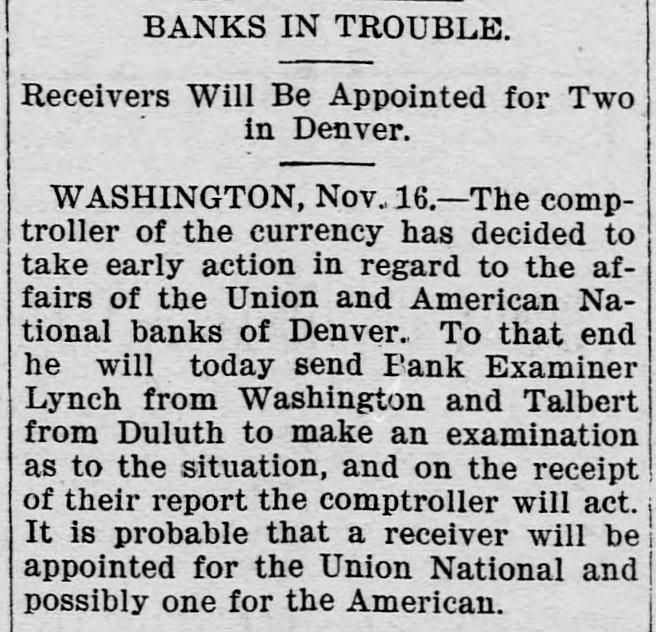
BANKS IN TROUBLE. Receivers Will Be Appointed for Two in Denver. WASHINGTON, Nov. 16.-The comptroller of the currency has decided to take early action in regard to the affairs of the Union and American National banks of Denver. To that end he will today send Pank Examiner Lynch from Washington and Talbert from Duluth to make an examination as to the situation, and on the receipt of their report the comptroller will act. It is probable that a receiver will be appointed for the Union National and possibly one for the American.


Article from The Portland Daily Press, January 8, 1897

Click image to open full size in new tab

Article Text

The American National bank of Denver, Col., which suspended April 21, 1896, was today permitted to re-open its doors for business as an active national banking institution. The bank has compiled with all the conditions imposed by the currency.


Article from The Wichita Daily Eagle, January 8, 1897

Click image to open full size in new tab

Article Text

GOT A STRAIGHT TIP BANKS THAT STOOD FROM UNDER A GREAT FINANCIAL SMASH. Somebody. Nobody Will Tell Who, Told Certain Favored Banks What Was Going to Happen to the National Bank of IIIIneis, Giving Them an Opportunity to Withdraw Their Deposits Which They Were Swift to Improve-Eckles Names Bank Receivers-American National, of Denver Re-opens-Day's List of Failures Chicago, Jan. 7.-It has been ascertained positively that several banks which had deposits in the defunct Natioral Bank of Illinois were warned of what was to come and as a result their money was withdrawn just in time to save them from being carried down with the wreck. Henry W. Austin, president of the Oak Park State bank, made the statement today that he had received information of the dangerous condition of the Illinois National during the week previous to the failure. Acting upon this tip, Mr. Austin says, he immediately took out of the bank the money his bank had there. Five thousand dollars was withdrawn Friday previous to the Monday in December when the National Bank of Illinois failed to open its doors for business. The following day, Saturday, $45,000 more, which constituted the balance due the Oak Park State bank by the National Bank of Illinois was taken out. Hinckley and Tilden, proprietors of the West Side bank, were also warned In time to withdraw their cash from the tottering institution. Mr. Austin refused positively to state who his informant was. He said, however, that he was not a director or official of the Illinois National. BANK RECEIVERS NAMED. Washington, Jan. 7.-The comptroller of the currency has appointed Bank Examiner Blancing temporary receiver of the First National Bank of Sioux City, and Examiner Anheir receiver of the Citizens National bank, of Fargo, N. D. Both of these appointments are temporary, pending resumption. Bank Examiner Turtilot has been appointed rereiver of the Second National, of Grand Forks, N. D. The comptroller has received information that the Commercial National bank of Roanoke, W. Va., which suspended some time ago, has raised sufficient funds with which to go into liquidation without the intervention of a receiver. DENVER BANK RE-OPENS. Washington, Jan. 7.-The American National bank of Denver, Colo., which suspended payment April 21, 1896, having complied with the conditions imposed by the comptroller of the currency precedent to resumption, has today been permitted to re-open its doors for business as a national banking association. Denver, Colo., Jan. 7.-The American National bank re-opened today under its old management with $600,000 cash on hand to meet liabilities and conduct business. There remains but $200,000 of liabilities to be provided for out of all other assets of the bank. DAY'S LIST OF FAILURES. New York, Jan. 7.-J. J. Johnston & Co., a corporation, dealers in diamonds, jewelry and silverware, today assigned to John R. Keim, and Arthur H. Masten. The liabilities are reported to be $219,000 and assets about $201,000. St. Paul, Minn., Jan. 7.-A Preston, Minn., dispatch to the Dispatch says: The Bank of Canton, at Canton, and the Citizens bank of Lanesboro, both owned and operated by Field, Kelsey & Co., suspended business yesterday. Lancaster, Pa., Jan. 7.-Schroder, Smith & Schroder's ready-mixed paint works were entirely destroyed by fire today. The origin of the fire is unknown. The members of the firm decline to make an estimate of the loss, but it is thought to be fully covered by insurance.


Article from The Greenville Times, January 9, 1897

Click image to open full size in new tab

Article Text

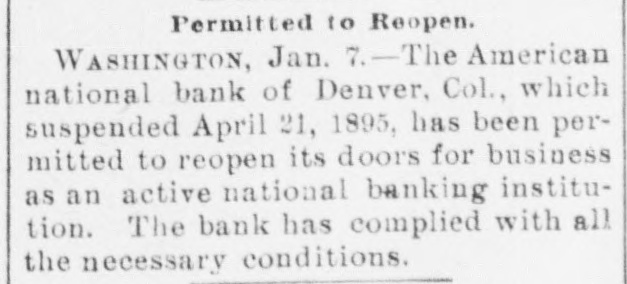
Permitted to Reopen. WASHINGTON, Jan. 7.-The - American national bank of Denver, Col., which suspended April 21, 1895, has been permitted to reopen its doors for business as an active national banking institution. The bank has complied with all the necessary conditions.


Article from Omaha Daily Bee, January 12, 1897

Click image to open full size in new tab

Article Text

The Improving Outlook. Louisville Courier-Journal. The American National bank of Denver has resumed business and the Roanoke, Va., bank and several of the St. Paul and other northwestern suspended banks are preparing to reopen. Comptroller Eckels has ordered the payment of a 50 per cent dividend to the depositors of the National Bank of Illinois, and the financial horizon is altogether clearing. Really the northwestern situation must be sounder than was at first supposed or the runs started at St. Paul and other places would have carried down many more concerns. Several of the banks that were forced to close were intrinsically sound, but were cleaned out of cash by frightened depositors.


Article from River Falls Journal, January 14, 1897

Click image to open full size in new tab

Article Text

At Unodilla,Ga.,Anthony Henderson,a negroarrested for the murder of George Summer and attempted assault upon his daughter, was lynched by a mob. Gus Homer and John Vaughn, armed with a pistol and knife, engaged in a duel at Memphis, Tenn., and both were fatally wounded. The general assembly of Indiana met in Indianapolis. Henry C. Pettit, of Wabash, was chosen speaker of the house. At Denver, Col., the American national bank, which suspended April 21, 1896, has reopened its doors. While skating at Creston, Ia., Howard Wilson and Miss Fay Rawls broke through the ice and in saving the life of the young lady Wilson lost his own. Near Plato, Mo., Thomas Wilson, accompanied by his daughter, Mrs. Kinnery and her five childrer. attempted to ford Prairie creek, and the children were all drowned. Gov. Stone in his message to the Missouri legislature advocated the hanging of persons convicted of train robbery. Near Sumter, S. C., Simon Cooper. a negro outlaw, who murdered three members of the Wilson family and a colored servant, was lynched by a mob. The doors of the Bank of North St. Paul, Minn., were closed with liabilities of $25,000. Burglars blew open a safe in the post office at Blooming Grove, Tex., and secured $9,000. In his last message to the Indiana legislature Gov. Matthews expressed strong sympathy with the Cuban insurgents and advocated compulsory education and a law prohibiting the formation of trusts in the state. A resolution was passed by the North Carolina legislature instructing the senators and congressmen from that state to try and bring about the passage of an act recognizing the independence of the patriots of Cuba. Fire destroyed the office of the Leader, a newspaper at Montpelier, O., the loss being $10,000. Mike Martin and Charles Walstrom, who lived on an island across the bay from Charlevoix, Mich., were murdered by unknown parties. Flames destroyed the stables of the Norfolk (Va.) Driving Club and Fair association, together with 13 race horses valued at $30,000. The oldest odd fellow in Missouri, John T. Dowdall, and the second oldest in the United States, died in St. Louis. At Janesville, Wis., Herman Slimm killed his wife and son and then committed suicide. Domestic trouble was the cause. A train on the Big Four road ran from St. Louis to Cleveland, 548 miles, in 10 hours and 4 minutes. The doors of the First national bank of Alma, Neb., were closed with liabilities of $134,000. At Brooksville, Ky., Robert Laughlin was hanged for the murder of his invalid wife and 14-year-old niece. After the murder he set fire to the house and the bodies were consumed. Fire destroyed the First Baptist church at Portage, Wis. The packing houses of the Anchor flour mill at Minneapolis, owned by the Pillsbury-Washburn Milling company, was burned. Loss, $200,000. A fire in the big leaf tobacco factory of the American Tobacco company at Danville, Va., caused a loss of $150,000. P. W. Hisson and James O'Connell, two bridgemen, fell from a trestle near Butte, Mont., and were killed. The following governors were inaugurated: John R. Tanner (rep.), IIIinois; James A. Mount (rep.), Indiana; John W. Leedy (pop.), Kansas, and Lon V. Stephens (dem.), Missouri. Chicago consumed 3,198,222 barrels of beer during the past year, an increase of 549,887 over the year 1895. In Cincinnati the Ohio Photograph company, capitalized at $1,000,000, went into the hands of a receiver. An attempt was made to wreck a through express between Chicago and CL Poul on the Chicago,