Article Text
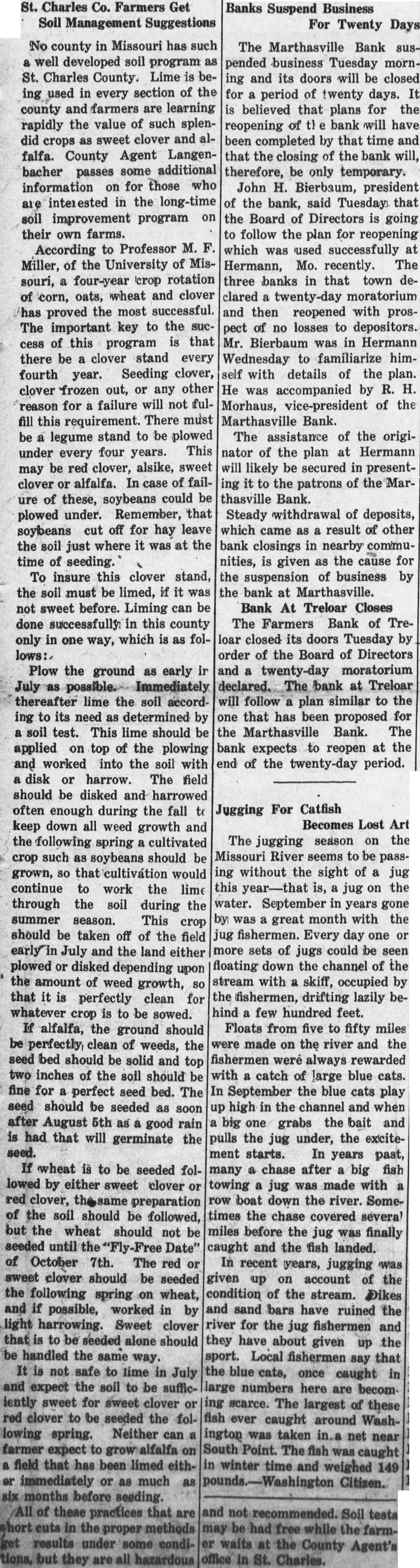
St. Charles Co. Farmers Get Soil Management Suggestions No county in Missouri has such a well developed soil program as St. Charles County. Lime is being used in every section of the county and farmers are learning rapidly the value of such splendid crops as sweet clover and alfalfa. County Agent Langenbacher passes some additional information on for those who are interested in the long-time soil improvement program on their own farms. According to Professor M. F. Miller, of the University of Missouri, a four-year crop rotation of corn, oats, wheat and clover has proved the most successful. The important key to the success of this program is that there be a clover stand every fourth year. Seeding clover, clover frozen out, or any other reason for a failure will not fulfill this requirement. There must be a legume stand to be plowed under every four years. This may be red clover, alsike, sweet clover or alfalfa. In case of failure of these, soybeans could be plowed under. Remember, that soybeans cut off for hay leave the soil just where it was at the time of seeding. To insure this clover stand, the soil must be limed, if it was not sweet before. Liming can be done successfully: in this county only in one way, which is as follows:Plow the ground as early ir July as possible. Immediately thereafter lime the soil according to its need as determined by a soil test. This lime should be applied on top of the plowing and worked into the soil with a disk or harrow. The field should be disked and harrowed often enough during the fall to keep down all weed growth and the following spring a cultivated crop such as soybeans should be grown, so that cultivátion would continue to work the lime through the soil during the summer season. This crop should be taken off of the field early in July and the land either plowed or disked depending upon the amount of weed growth, so that it is perfectly clean for whatever crop is to be sowed. If alfalfa, the ground should be perfectly, clean of weeds, the seed bed should be solid and top two inches of the soil should be fine for a perfect seed bed. The seed should be seeded as soon after August 5th as a good rain is had that will germinate the seed. If wheat is to be seeded followed by either sweet clover or red clover, thesame preparation of the soil should be followed, but the wheat should not be seeded until the "Fly-Free Date" of October 7th. The red or sweet clover should be seeded the following spring on wheat, and if possible, worked in by light harrowing. Sweet clover that is to be seeded alone should be handled the same way. It is not safe to lime in July and expect the soil to be sufficiently sweet for sweet clover or red clover to be seeded the following spring. Neither can a farmer expect to grow alfalfa on a field that has been limed eithor immediately or as much as six months before seeding. All of these practices that are short cuts in the proper methods get results under some conditions, but they are all hazardous Banks Suspend Business For Twenty Days The Marthasville Bank suspended business Tuesday morning and its doors will be closed for a period of !wenty days. It is believed that plans for the reopening of the bank will have been completed by that time and that the closing of the bank will, therefore, be only temporary. John H. Bierbaum, president of the bank, said Tuesday that the Board of Directors is going to follow the plan for reopening which was used successfully at Hermann, Mo. recently. The three banks in that town declared a twenty-day moratorium and then reopened with prospect of no losses to depositors. Mr. Bierbaum was in Hermann Wednesday to familiarize himself with details of the plan. He was accompanied by R. H. Morhaus, vice-president of the Marthasville Bank. The assistance of the originator of the plan at Hermann will likely be secured in presenting it to the patrons of the Marthasville Bank. Steady withdrawal of deposits, which came as a result of other bank closings in nearby communities, is given as the cause for the suspension of business by the bank at Marthasville. Bank At Treloar Closes The Farmers Bank of Treloar closed its doors Tuesday by order of the Board of Directors and a twenty-day moratorium declared. The bank at Treloar will follow a plan similar to the one that has been proposed for the Marthasville Bank. The bank expects to reopen at the end of the twenty-day period. Jugging For Catfish Becomes Lost Art The jugging season on the Missouri River seems to be passing without the sight of a jug this year-that is, a jug on the water. September in years gone by was a great month with the jug fishermen. Every day one or more sets of jugs could be seen floating down the channel of the stream with a skiff, occupied by the fishermen, drifting lazily behind a few hundred feet. Floats from five to fifty miles were made on the river and the fishermen weré always rewarded with a catch of large blue cats. In September the blue cats play up high in the channel and when a big one grabs the bait and pulls the jug under, the excitement starts. In years past, many a chase after a big fish towing a jug was made with a row boat down the river. Sometimes the chase covered several miles before the jug was finally caught and the fish landed. In recent years, jugging was given up on account of the condition of the stream. Dikes and sand bars have ruined the river for the jug fishermen and they have about given up the sport. Local fishermen say that the blue cats, once caught in large numbers here are becoming scarce. The largest of these fish ever caught around Washington was taken in.a net near South Point. The fish was caught in winter time and weighed 149 pounds.-Washington Citizen. and not recommended. Soil tests may be had free while the farmer waits at the County Agent's office in St. Charles.