
10725. Bank of North Dakota (Bismarck, ND)

Bank Information

Episode Type
Suspension → Reopening
Bank Type
state
Start Date
July 1, 1932
Location
Bismarck, North Dakota (46.808, -100.784)

Metadata

Model
gpt-5-mini
Short Digest
7adb083b7d0d219b

Response Measures

None

Description

Articles describe the Bank of North Dakota suspending its farm-loan operations on July 1, 1932 because the bond market closed amid moratorium agitation and related financing problems. There is no description of a depositor run. Banks (including the Bank of North Dakota) reopened after the national banking holiday in March 1933. I treat this as a suspension (of farm loan operations / limited activities) with later reopening; no run occurred.

Events (3)

1. July 1, 1932 Suspension
Cause
Macro News
Cause Details
Organized agitation/legislative moratorium proposals and falling bond market closed the market for North Dakota bonds, forcing suspension of farm loan operations.
Newspaper Excerpt
The result is that the Bank of North Dakota was compelled to suspend the making of all farm loans on July 1
Source
newspapers
2. March 15, 1933 Reopening
Newspaper Excerpt
They were the Dakota National Bank and Trust company. First National Bank and the Bank of North Dakota. Residents crowded the local institutions to make deposits ... local financiers confident people will not rush to withdraw funds. Banks opened wide their doors Wednesday forenoon after a nine-day legal holiday
Source
newspapers
3. * Other
Newspaper Excerpt
Action on an application to the Reconstruction Finance Corporation by the Bank of North Dakota for funds is being withheld, the governor said. ... the application was withdrawn after defeat of the moratorium measure and subsequent considerations of management change and RFC timing took place. (discussion of RFC loan application and farm loan department financing.)
Source
newspapers

Newspaper Articles (4)

Article from The Bismarck Tribune, October 17, 1932

Click image to open full size in new tab

Article Text

CONTINUED from page one Governor Calls on Voters to Defeat Moratorium Issue renewals and extensions of such loans must be made to enable the debtors to carry on. "The president has directed the United States department of agriculture to accept 25 per cent of the 1932 crop production loans and to renew the balance for a term of years under such conditions as congress shall prescribe. Undoubtedly, congress will, as in the past, require crop security as a condition to such renewals and extensions. "If our farmers can not give crop security for such renewals on account of the anti-crop mortgage law, the renewal privileges will be denied to them and the government will be compelled to enforce the collection of the entire amount of the loans due this fall." Moratorium Is Threat Of the moratorium measure the governor said that "the mere threat and agitation for this bill has already practically suspended our public credit. both within and without the state." Those who can pay taxes and other debts, the governor stated, "should remain under a legal duty to do so in the interest of maintaining the solvency of both public and private institutions." Serious damage, the governor said has been done to the state by agitation for the moratorium. "During 1931, the Bank of North Dakota had no difficulty in selling state bonds for farm loan purposes," he stated. "It sold over $3,000,000 of such bonds at rates ranging from 4½ per cent down to 4 per cent. It was able to, and did, make farm loans to North Dakota farmers in the amount of $4.074.300 in 1931. During 1932, up to July 1, it made $1,070,300 in farm loans. In June. this year, however. when it was learned a five-year moratorium measure was pending, the bond market was entirely closed to North Dakota bonds. Since the reinitiation of the present measure in August, it has not been possible to sell any new North Dakota farm loan bonds in any market at any price. Minnesota, on the other hand, has recently sold rural credit bonds and highway bonds at rates as low 3.90 per cent. The result is that the Bank of North Dakota was compelled to suspend the making of all farm loans on July 1, and no further loans can be made until this moratorium threat is entirely eliminated." R. F. C. Action Withheld Action on an application to the Reconstruction Finance Corporation by the Bank of North Dakota for funds is being withheld, the governor said. on account of the moratorium measure, while the regional agricultural credit corporation set up at Minneapolis to furnish emergency livestock loans to farmers of the northwest is limiting loans to persons of proven financial responsibility. The governor called attention to the fact that, due to the drought, the Bank of North Dakota loaned nearly $2,500,000 on certificates of indebtedness and warrants to counties. cities and school districts in the northwestern part of the state. "Since July 1, this year," he added "no further loans have been made by the Bank of North Dakota to any political subdivisions for any purpose," because "the value of these certificates, bonds, or warrants, as security. would be entirely destroyed for three years, should the proposed moratorium measure be adopted." The governor said adoption of the moratorium measure would result in "such a drastic drop in the collections as to make the conduct of both local and state governments impossible without heavy borrowing." and would make borrowing impossible "because it will destroy the foundation of public credit which rests upon both the ability and legal duty of the citizens to pay a substantial part of their taxes each year." Hundreds of rural and town schools will be obliged to close, he declared, unless the teachers are able to serve out their terms without compensation

Article from The Bismarck Tribune, January 4, 1933

Click image to open full size in new tab

Article Text

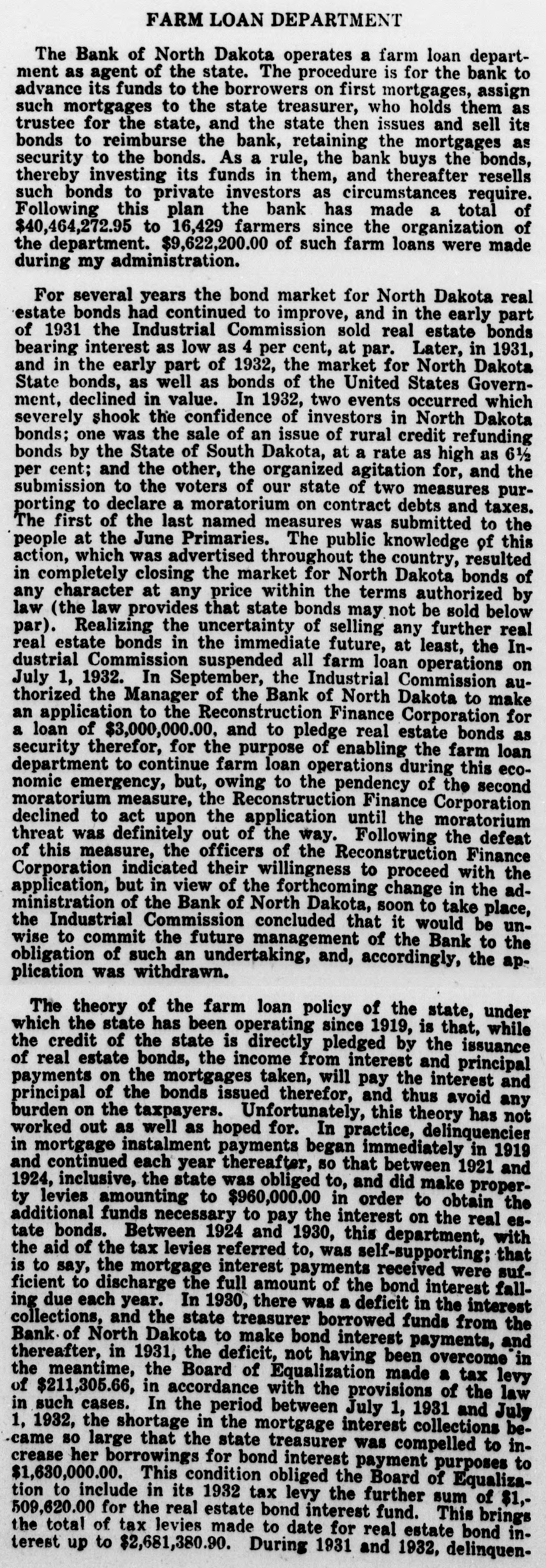
FARM LOAN DEPARTMENT The Bank of North Dakota operates a farm loan department as agent of the state. The procedure is for the bank to advance its funds to the borrowers on first mortgages, assign such mortgages to the state treasurer, who holds them as trustee for the state, and the state then issues and sell its bonds to reimburse the bank, retaining the mortgages as security to the bonds. As a rule, the bank buys the bonds, thereby investing its funds in them, and thereafter resells such bonds to private investors as circumstances require. Following this plan the bank has made a total of $40,464,272.95 to 16,429 farmers since the organization of the department. $9,622,200.00 of such farm loans were made during my administration. For several years the bond market for North Dakota real estate bonds had continued to improve, and in the early part of 1931 the Industrial Commission sold real estate bonds bearing interest as low as 4 per cent, at par. Later, in 1931, and in the early part of 1932, the market for North Dakota State bonds, as well as bonds of the United States Government, declined in value. In 1932, two events occurred which severely shook the confidence of investors in North Dakota bonds; one was the sale of an issue of rural credit refunding bonds by the State of South Dakota, at a rate as high as 6½ per cent; and the other, the organized agitation for, and the submission to the voters of our state of two measures purporting to declare a moratorium on contract debts and taxes. The first of the last named measures was submitted to the people at the June Primaries. The public knowledge of this action, which was advertised throughout the country, resulted in completely closing the market for North Dakota bonds of any character at any price within the terms authorized by law (the law provides that state bonds may not be sold below par). Realizing the uncertainty of selling any further real real estate bonds in the immediate future, at least, the Industrial Commission suspended all farm loan operations on July 1, 1932. In September, the Industrial Commission authorized the Manager of the Bank of North Dakota to make an application to the Reconstruction Finance Corporation for a loan of $3,000,000.00, and to pledge real estate bonds as security therefor, for the purpose of enabling the farm loan department to continue farm loan operations during this economic emergency, but, owing to the pendency of the second moratorium measure, the Reconstruction Finance Corporation declined to act upon the application until the moratorium threat was definitely out of the way. Following the defeat of this measure, the officers of the Reconstruction Finance Corporation indicated their willingness to proceed with the application, but in view of the forthcoming change in the administration of the Bank of North Dakota, soon to take place, the Industrial Commission concluded that it would be unwise to commit the future management of the Bank to the obligation of such an undertaking, and, accordingly, the application was withdrawn. The theory of the farm loan policy of the state, under which the state has been operating since 1919, is that, while the credit of the state is directly pledged by the issuance of real estate bonds, the income from interest and principal payments on the mortgages taken, will pay the interest and principal of the bonds issued therefor, and thus avoid any burden on the taxpayers. Unfortunately, this theory has not worked out as well as hoped for. In practice, delinquencies in mortgage instalment payments began immediately in 1919 and continued each year thereafter, so that between 1921 and 1924, inclusive, the state was obliged to, and did make property levies amounting to $960,000.00 in order to obtain the additional funds necessary to pay the interest on the real estate bonds. Between 1924 and 1930, this department, with the aid of the tax levies referred to, was self-supporting; that is to say, the mortgage interest payments received were sufficient to discharge the full amount of the bond interest falling due each year. In 1930, there was a deficit in the interest collections, and the state treasurer borrowed funds from the Bank. of North Dakota to make bond interest payments, and thereafter, in 1931, the deficit, not having been overcome in the meantime, the Board of Equalization made a tax levy of $211,305.66, in accordance with the provisions of the law in such cases. In the period between July 1, 1931 and July 1, 1932, the shortage in the mortgage interest collections became so large that the state treasurer was compelled to increase her borrowings for bond interest payment purposes to $1,630,000.00. This condition obliged the Board of Equalization to include in its 1932 tax levy the further sum of $1,509,620.00 for the real estate bond interest fund. This brings the total of tax levies made to date for real estate bond interest up to $2,681,380.90. During 1931 and 1932, delinquen-


Article from The Bismarck Tribune, January 5, 1933

Click image to open full size in new tab

Article Text

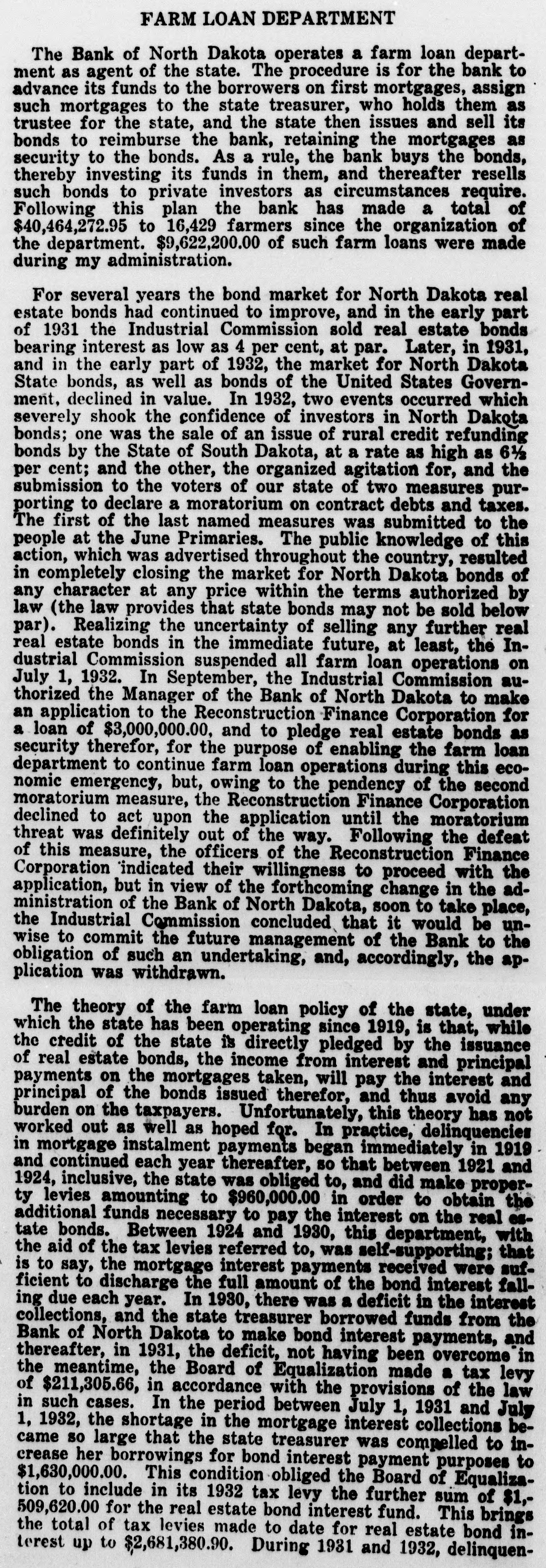
FARM LOAN DEPARTMENT The Bank of North Dakota operates a farm loan department as agent of the state. The procedure is for the bank to advance its funds to the borrowers on first mortgages, assign such mortgages to the state treasurer, who holds them as trustee for the state, and the state then issues and sell its bonds to reimburse the bank, retaining the mortgages as security to the bonds. As a rule, the bank buys the bonds, thereby investing its funds in them, and thereafter resells such bonds to private investors as circumstances require. Following this plan the bank has made a total of $40,464,272.95 to 16,429 farmers since the organization of the department. $9,622,200.00 of such farm loans were made during my administration. For several years the bond market for North Dakota real estate bonds had continued to improve, and in the early part of 1931 the Industrial Commission sold real estate bonds bearing interest as low as 4 per cent, at par. Later, in 1931, and in the early part of 1932, the market for North Dakota State bonds, as well as bonds of the United States Government, declined in value. In 1932, two events occurred which severely shook the confidence of investors in North Dakota bonds; one was the sale of an issue of rural credit refunding bonds by the State of South Dakota, at a rate as high as 6½ per cent; and the other, the organized agitation for, and the submission to the voters of our state of two measures purporting to declare a moratorium on contract debts and taxes. The first of the last named measures was submitted to the people at the June Primaries. The public knowledge of this action, which was advertised throughout the country, resulted in completely closing the market for North Dakota bonds of any character at any price within the terms authorized by law (the law provides that state bonds may not be sold below par). Realizing the uncertainty of selling any further real real estate bonds in the immediate future, at least, the Industrial Commission suspended all farm loan operations on July 1, 1932. In September, the Industrial Commission authorized the Manager of the Bank of North Dakota to make an application to the Reconstruction Finance Corporation for a loan of $3,000,000.00, and to pledge real estate bonds as security therefor, for the purpose of enabling the farm loan department to continue farm loan operations during this economic emergency, but, owing to the pendency of the second moratorium measure, the Reconstruction Finance Corporation declined to act upon the application until the moratorium threat was definitely out of the way. Following the defeat of this measure, the officers of the Reconstruction Finance Corporation indicated their willingness to proceed with the application, but in view of the forthcoming change in the administration of the Bank of North Dakota, soon to take place, the Industrial Commission concluded that it would be unwise to commit the future management of the Bank to the obligation of such an undertaking, and, accordingly, the application was withdrawn. The theory of the farm loan policy of the state, under which the state has been operating since 1919, is that, while the credit of the state is directly pledged by the issuance of real estate bonds, the income from interest and principal payments on the mortgages taken, will pay the interest and principal of the bonds issued therefor, and thus avoid any burden on the taxpayers. Unfortunately, this theory has not worked out as well as hoped for. In practice, delinquencies in mortgage instalment payments began immediately in 1919 and continued each year thereafter, so that between 1921 and 1924, inclusive, the state was obliged to, and did make property levies amounting to $960,000.00 in order to obtain the additional funds necessary to pay the interest on the real estate bonds. Between 1924 and 1930, this department, with the aid of the tax levies referred to, was self-supporting; that is to say, the mortgage interest payments received were sufficient to discharge the full amount of the bond interest falling due each year. In 1930, there was a deficit in the interest collections, and the state treasurer borrowed funds from the Bank of North Dakota to make bond interest payments, and thereafter, in 1931, the deficit, not having been overcome in the meantime, the Board of Equalization made a tax levy of $211,305.66, in accordance with the provisions of the law in such cases. In the period between July 1, 1931 and July 1, 1932, the shortage in the mortgage interest collections became so large that the state treasurer was compelled to increase her borrowings for bond interest payment purposes to $1,630,000.00. This condition obliged the Board of Equalization to include in its 1932 tax levy the further sum of $1,509,620.00 for the real estate bond interest fund. This brings the total of tax levies made to date for real estate bond interest up to $2,681,380.90. During 1931 and 1932, delinquen-


Article from The Bismarck Tribune, March 15, 1933

Click image to open full size in new tab

Article Text

RE-OPEN DOORS FOR BUSINESS FOLLOWING NINE - DAY RESPITE Only Restrictions Are Those Conserving Gold and Preventing Hoarding CONFIDENCE IS RESTORED Local Financiers Confident Peopie Will Not Rush to Withdraw Funds Bismarck's three banks opened wide their doors Wednesday forenoon after a nine-day legal holiday which had held financial institutions throughout the nation practically inoperative following President Roosevelt's emergency proclamation. They were the Dakota National Bank and Trust company. First National Bank and the Bank of North Dakota. Residents crowded the local institutions to make deposits, and money deposited was far greater than that withdrawn the opening day, the bankers said. In this respect Bismarck kept step with the nation. A healthy condition of confidence is apparent here as well as throughout the country. The only restrictions prevailing as the banks reopened were the prohibition of withdrawals of gold or gold certificates and the taboo on withdrawals of "unusual" amounts for hoarding purposes. Sixty-three of North Dakota's 77 national banks were open Wednesday, with the remaining 14 expected to open in the near future. Among those open was the First National Bank at Mandan and several others throughout the Missouri Slope area. Much Gold Returned Though there was not much gold coinage in this area when the holiday was proclaimed, local bankers say, a surprisingly high percentage of it has been returned to the banks following the president's plea and warning that hoarders will be penalised. Among gold pieces returned were many $5 coins, local bankers say. Some residents even inquired of the banks how much gold in one's possession would constitute "hoarning." "Though the government will not attempt to ferret out every $5 gold piece in existence," one banker said Wednesday, "Uncle Sam will appreciate every piece of gold that is returned to banks, no matter how small. Everyone who deposits gold or gold certificates is giving the government an additional boost in its fight to overcome the present economic situation." None of the new currency just issued by the government under authority of the few-days-old bank bill has reached Bismarck yet and local banks have not ordered any. 'Hoarding' Is Described What constitutes withdrawals for "hoarding" purposes is left up to the discretion of the local bankers. Excessive and unusual withdrawals, as compared to normal withdrawals of depositors in the past, will not be permitted. However, if one wants $500 for a trip to New York, he will get it. If he wants $500 without offering an explanation, when his past business does not indicate such a large withdrawal is necessary, he will not get it. Stocks traded in blocks of 1,000 to 5,000 shares during the first few minutes and although the pace slackened somewhat as the day passed the trend continued upward. Other exchanges also resumed trading and on the Chicago exchange brewery stock made a quick advance of three points on the strength of confidence in the monetary system and the prospect of the early legilization of beer. The Chicago board of trade and the cotton market deferred reopening until some communities in outlying sections of the nation returned to full (Continued on page six)