Other: Clearing house forced resignation of entire board; new president (Seth Milliken) installed and the bank placed into slow liquidation/reorganization under clearing-house supervision.
Clearinghouse involved: Yes
(loan, examination, or other measures)
Notes
Sources describe depositor pressure/clearing-house rescue, subsequent slow liquidation and later references to the bank as failed.
Events (6)
1.April 27, 1865Chartered
Source
historical_nic
+42 years
2.October 17, 1907Run
Cause
Bank Specific Adverse Info
Cause Details
Collapse of United Copper/Heinze brokerage and revelations about Heinze's operations triggered depositor withdrawals and loss of confidence.
Measures
Clearing house banks promised funding and examiners; directors resigned; clearing house protected the bank.
Newspaper Excerpt
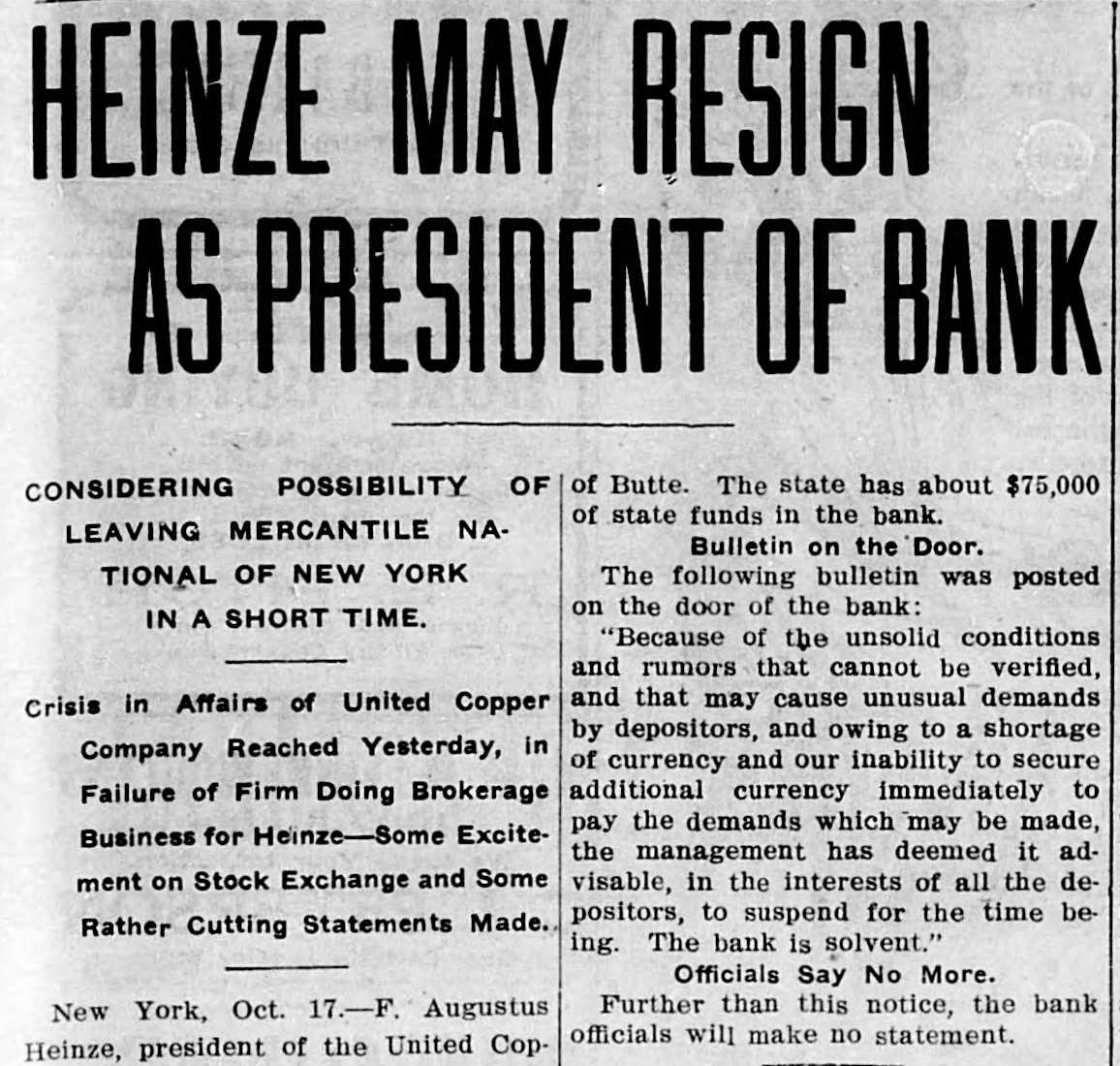
Because of the unsolid conditions and rumors that cannot be verified, and that may cause unusual demands by depositors...the management has deemed it advisable...to suspend for the time being.
Source
newspapers
same day
3.October 17, 1907Suspension
Cause
Bank Specific Adverse Info
Cause Details
Announcement and fallout from Otto Heinze & Co. suspension and related scandals undermined confidence, prompting suspension of payments/operations.
Newspaper Excerpt
the management has deemed it advisable, in the interests of all the depositors, to suspend for the time being. The bank is solvent.
Source
newspapers
+4 days
4.October 21, 1907Other
Newspaper Excerpt
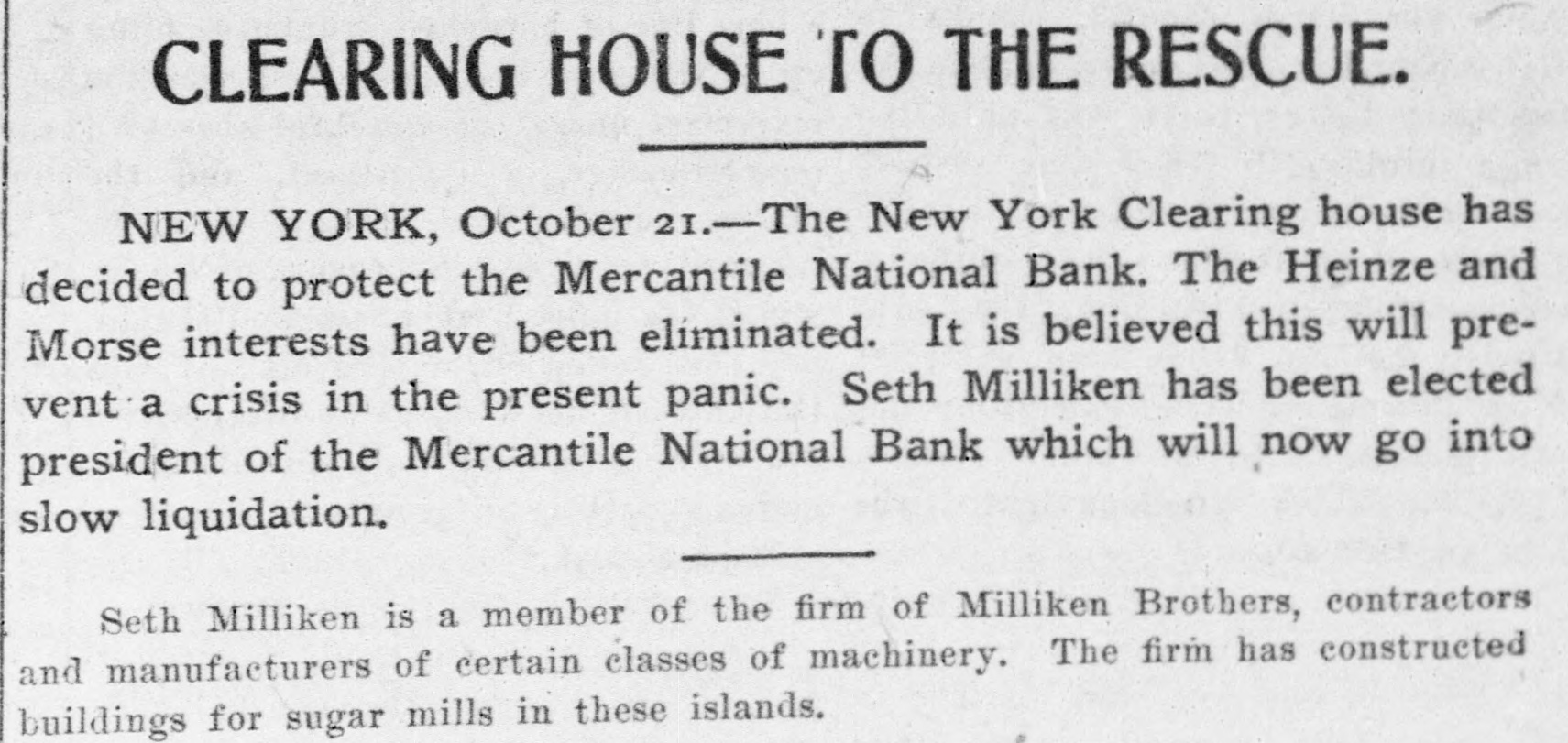
Seth Milliken has been elected president of the Mercantile National Bank which will now go into slow liquidation. The New York Clearing house has decided to protect the Mercantile National Bank.
Source
newspapers
+19 months
5.June 4, 1909Other
Newspaper Excerpt
investigation into affairs of the Mercantile National bank, which failed during the panic of 1907, will be gone into and F. Augustus Heinze's transactions will be cleared up.
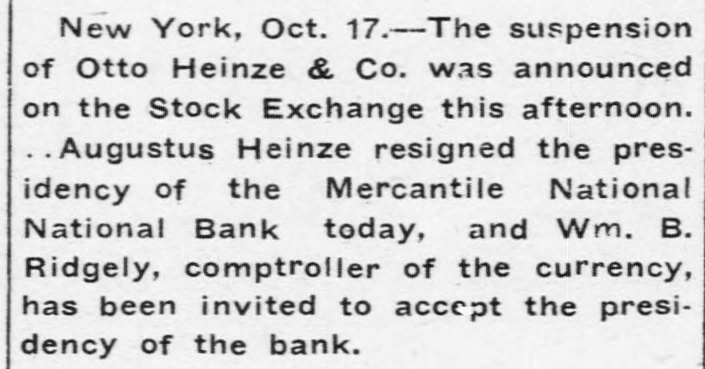
New York, Oct. 7.--The suspension of Otto Heinze & Co. was announced on the Stock Exchange this afternoon. . . Augustus Heinze resigned the presidency of the Mercantile National National Bank today, and Wm. B. Ridgely, comptroller of the currency, has been invited to accept the presidency of the bank.
HEINZE MAY RESIGN AS PRESIDENT OF BANK of Butte. The state has about $75,000 CONSIDERING POSSIBILITY OF of state funds in the bank. LEAVING MERCANTILE NABulletin on the Door. TIONAL OF NEW YORK The following bulletin was posted on the door of the bank: IN A SHORT TIME. "Because of the unsolid conditions and rumors that cannot be verified, and that may cause unusual demands Crisis in Affairs of United Copper by depositors, and owing to a shortage Company Reached Yesterday, in of currency and our inability to secure additional currency immediately to Failure of Firm Doing Brokerage pay the demands which may be made, Business for Heinze-Some Excitethe management has deemed it adment on Stock Exchange and Some visable, in the interests of all the depositors, to suspend for the time beRather Cutting Statements Made. ing. The bank is solvent." Officials Say No More. Further than this notice, the bank New York, Oct. 17.-F. Augustus officials will make no statement. Heinze, president of the United Cop-
3.October 18, 1907The Pacific Commercial AdvertiserHonolulu, HI
Click image to open full size in new tab
Article Text
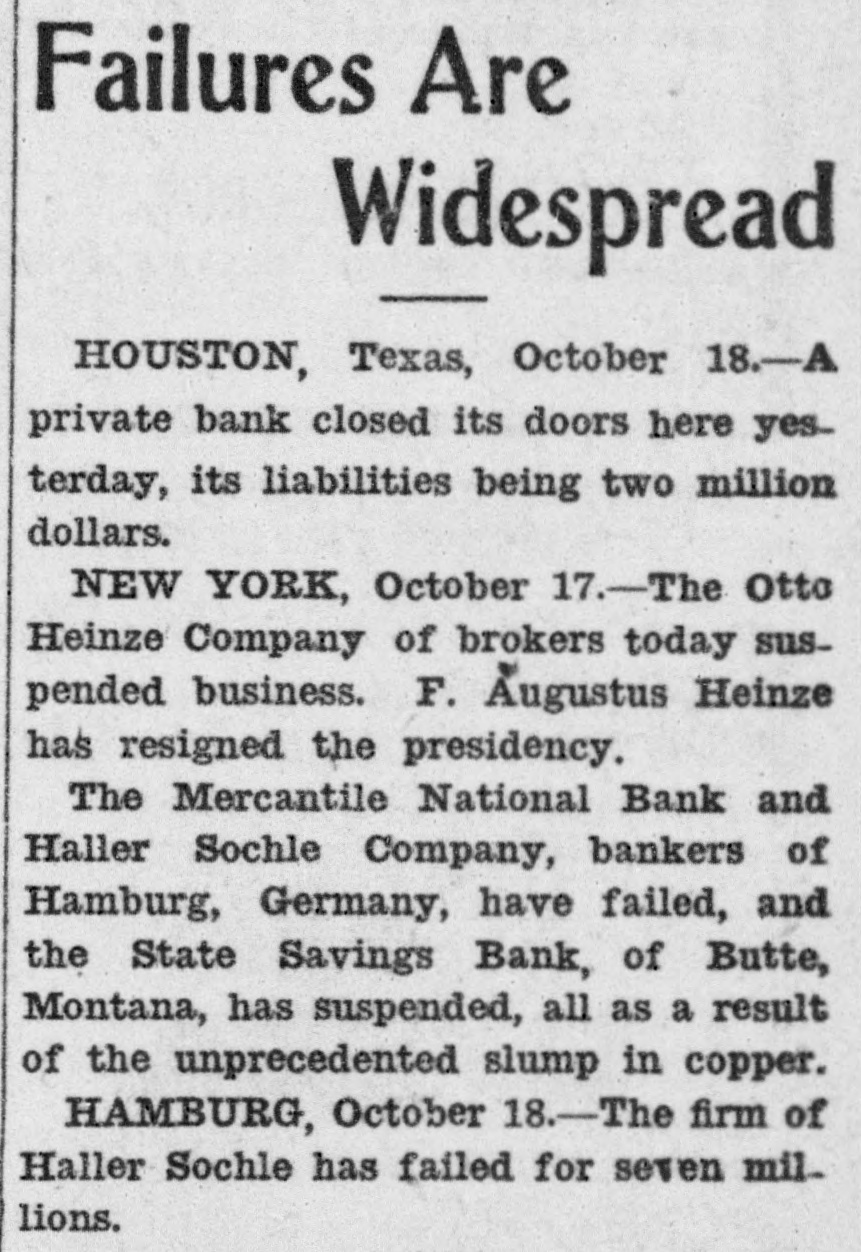
Failures Are Widespread HOUSTON, Texas, October 18.-A private bank closed its doors here yesterday, its liabilities being two million dollars. NEW YORK, October 17.-The Otto Heinze Company of brokers today suspended business. F. Augustus Heinze has resigned the presidency. The Mercantile National Bank and Haller Sochle Company, bankers of Hamburg, Germany, have failed, and the State Savings Bank, of Butte, Montana, has suspended, all as a result of the unprecedented slump in copper. HAMBURG, October 18.-The firm of Haller Sochle has failed for seven millions.
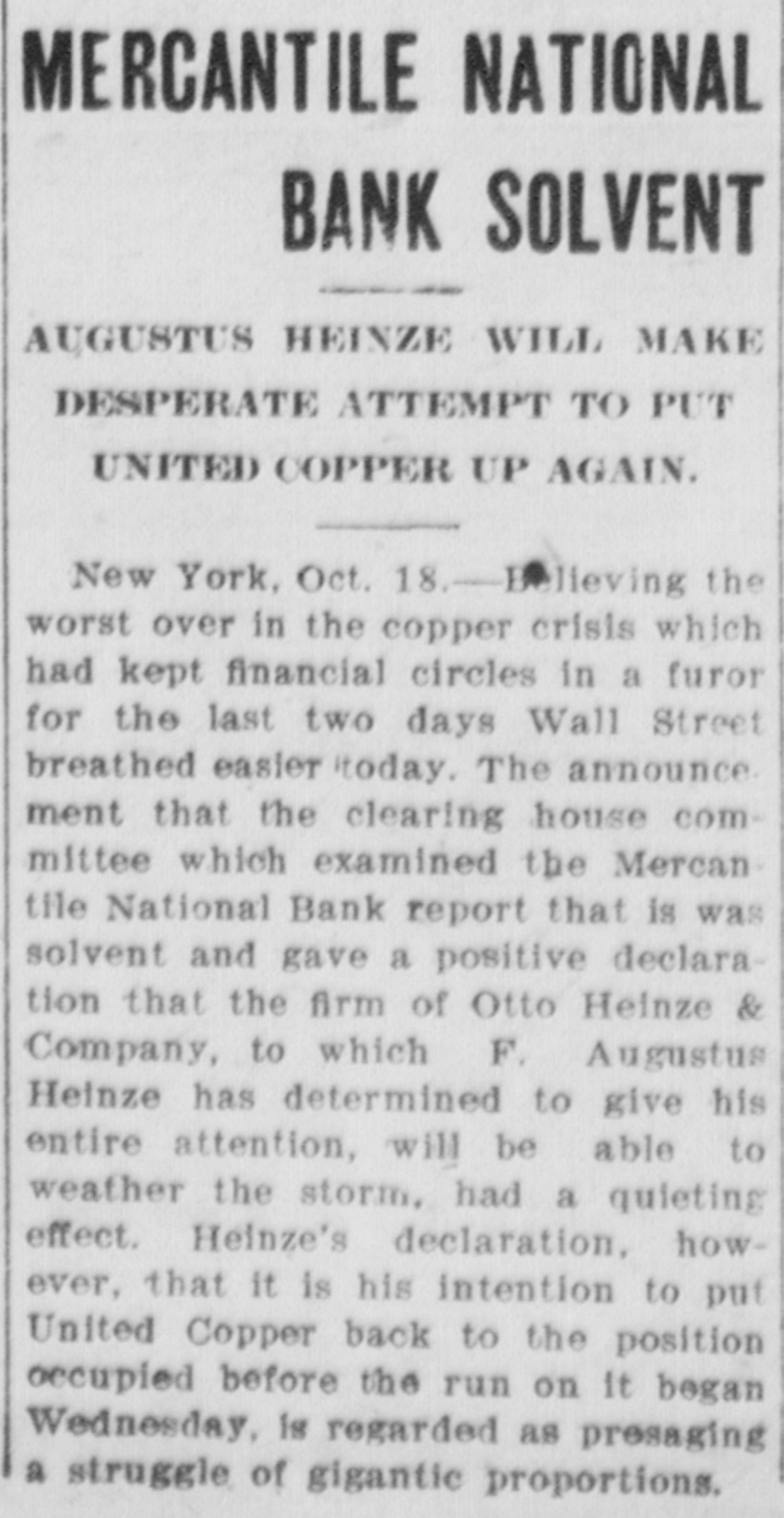
MERCANTILE NATIONAL BANK SOLVENT AUGUSTUS HEINZE WILL MAKE DESPERATE ATTEMPT TO PUT UNITED COPPER UP AGAIN. New York, Oct. 18. Believing the worst over in the copper crisis which had kept financial circles in a furor for the last two days Wall Street breathed easier today. The announce ment that the clearing house committee which examined the Mercan tile National Bank report that is was solvent and gave a positive declaration that the firm of Otto Heinze & Company, to which F. Augustus Heinze has determined to give his entire attention, will be able to weather the storm. had a quieting effect. Heinze's declaration. however, that it is his intention to put United Copper back to the position occupied before the run on It began Wednesday, is regarded as presaging a struggle of gigantic proportions.
5.October 18, 1907Omaha Daily BeeOmaha, NE
Click image to open full size in new tab
Article Text
Temperature at Omaha yesterday
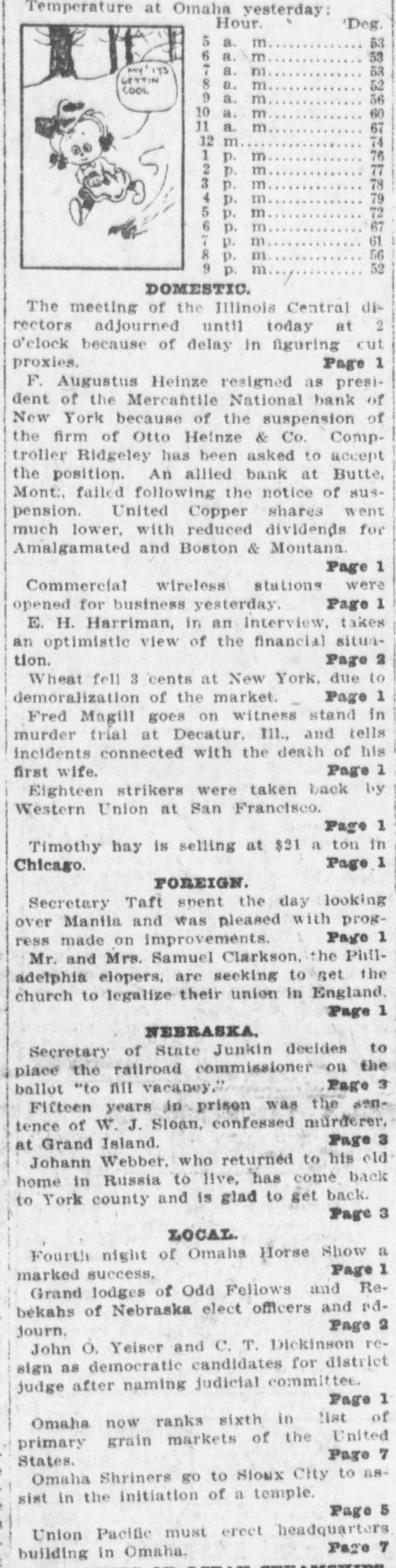
Hour. Deg. 5 a. m 53 6 a. m 53 MY ITS 7 a. m 53 It GETTIN 8 a. m 52 COOL 9 a. m 56 10 a. m 60 11 a. m 67 12 m 74 ao 76 1 p. m 77 2 p. m 78 3 p. m 79 4 p. m 72 5 p. m 67 6 p. m 61 7 p. m 56 8 p. m 52 9 p. m DOMESTIC. The meeting of the Illinois Central di2 rectors adjourned until today at o'clock because of delay in figuring cut proxies. Page 1 F. Augustus Heinze resigned as president of the Mercantile National bank of New York because of the suspension of the firm of Otto Heinze & Co. Comptroller Ridgeley has been asked to accept the position. An allied bank at Butte, Mont., failed following the notice of suspension. United Copper shares went much lower. with reduced dividends for Amalgamated and Boston & Montana. Page 1 Commercial wireless stations were opened for business yesterday. Page 1 E. H. Harriman, in an Interview, takes an optimistic view of the financial situation. Page 2 Wheat fell 3 cents at New York, due to demoralization of the market. Page 1 Fred Magill goes on witness stand in murder trial at Decatur. 111., and tells incidents connected with the death of his Page 1 first wife. Eighteen strikers were taken back by Western Union at San Francisco. Page 1 Timothy hay is selling at $21 a ton in Page 1 Chicago. FOREIGN. Secretary Taft spent the day looking over Manila and was pleased with progPage 1 ress made on improvements. Mr. and Mrs. Samuel Clarkson, the Philadelphia elopers, are seeking to get the church to legalize their union in England, Page 1 NEBRASKA. Secretary of State Junkin decides to place the railroad commissioner on the Page 3 ballot "to fill vacaney. Fifteen years in prison was the sentence of W. J. Sloan, confessed murderer, Page 3 at Grand Island. Johann Webber. who returned to his old home in Russia to live, has come back to York county and is glad to get back. Page 3 LOCAL. Fourth night of Omaha Horse Show a Page 1 marked success. Grand lodges of Odd Fellows and Rebekahs of Nebraska elect officers and adPage 2 journ. John O. Yeiser and C. T. Dickinson resign as democratic candidates for district judge after naming judicial committee. Page 1 Omaha now ranks sixth in list of primary grain markets of the United Page 7 States. Omaha Shriners go to Sioux City to assist in the initiation of a temple. Page 5 Union Pacific must erect headquarters Page 7 building in Omaha.
6.October 19, 1907Evening StarWashington, DC
Click image to open full size in new tab
Article Text
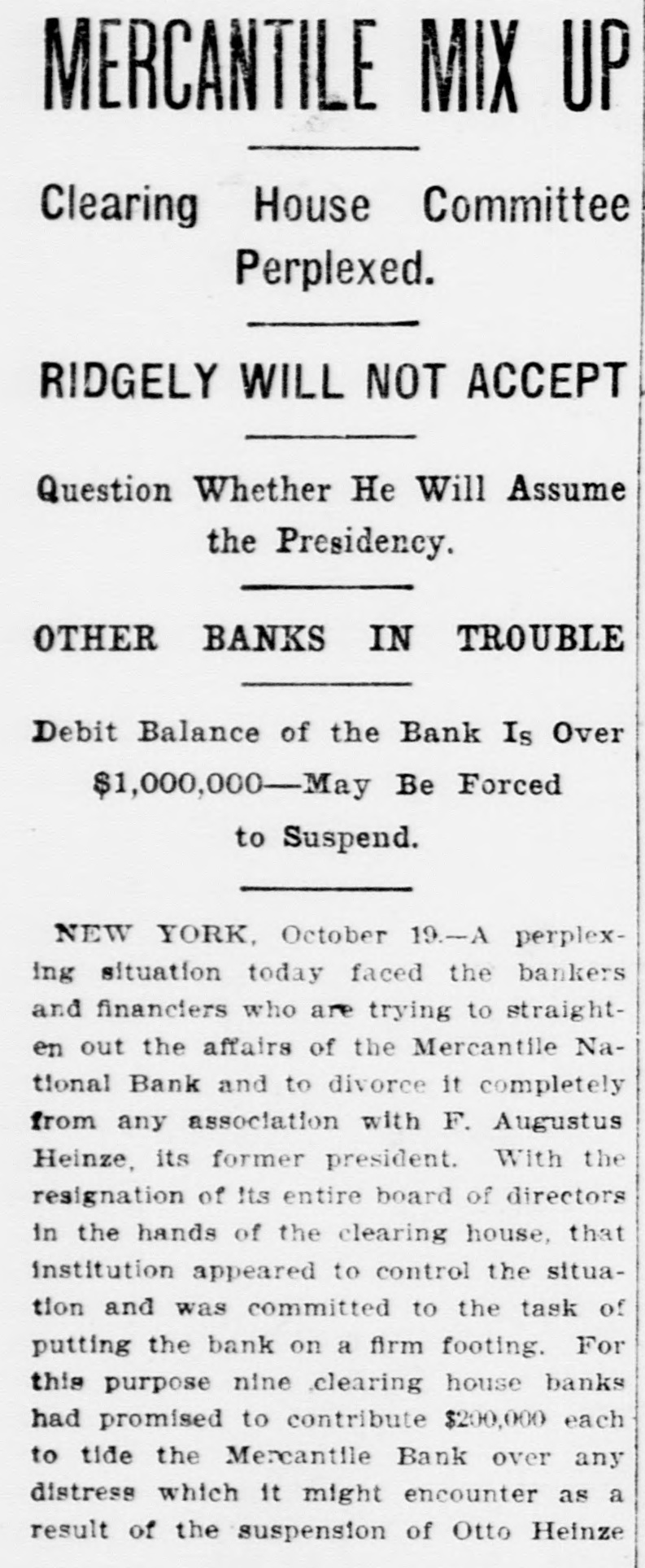
MERCANTILE MIX UP House Committee Clearing Perplexed. RIDGELY WILL NOT ACCEPT Question Whether He Will Assume the Presidency. OTHER BANKS IN TROUBLE Debit Balance of the Bank Is Over $1,000,000-May Be Forced to Suspend. NEW YORK, October 19.-A perplexing situation today faced the bankers and financiers who are trying to straighten out the affairs of the Mercantile National Bank and to divorce it completely from any association with F. Augustus Heinze, its former president. With the resignation of Its entire board of directors in the hands of the clearing house, that institution appeared to control the situation and was committed to the task of putting the bank on a firm footing. For this purpose nine .clearing house banks had promised to contribute $200,000 each to tide the Mercantile Bank over any distress which it might encounter as a result of the suspension of Otto Heinze
7.October 19, 1907The Marion Daily MirrorMarion, OH
Click image to open full size in new tab
Article Text
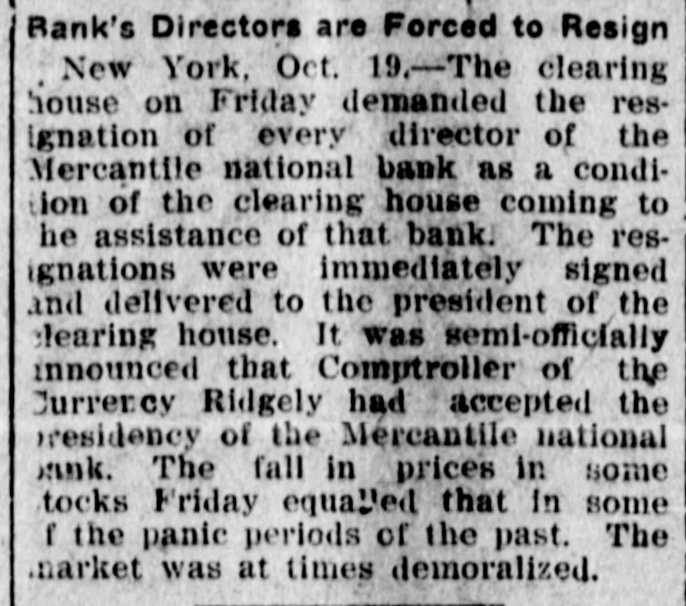
Bank's Directors are Forced to Resign New York, Oct. 19.-The clearing house on Friday demanded the resignation of every director of the Mercantile national bank as a condiion of the clearing house coming to he assistance of that bank. The resignations were immediately signed and delivered to the president of the clearing house. It was semi-officially innounced that Comptroller of the Currency Ridgely had accepted the presidency of the Mercantile national sank. The fall in prices in some tocks Friday equalled that in some f the panic periods of the past. The narket was at times demoralized.
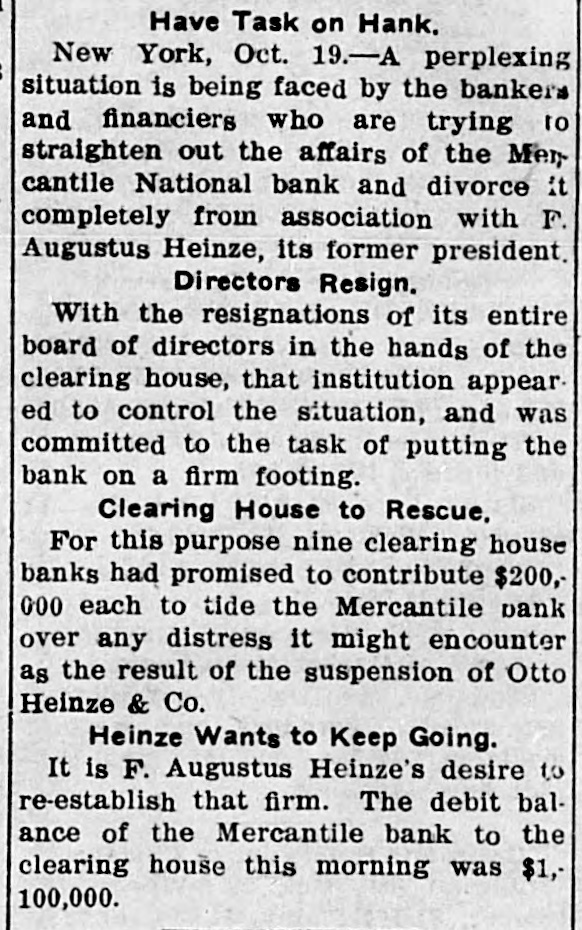
Have Task on Hank, New York, Oct. 19.-A perplexing situation is being faced by the bankers and financiers who are trying to straighten out the affairs of the Men cantile National bank and divorce it completely from association with F. Augustus Heinze, its former president. Directors Resign. With the resignations of its entire board of directors in the hands of the clearing house, that institution appear. ed to control the situation, and was committed to the task of putting the bank on a firm footing. Clearing House to Rescue, For this purpose nine clearing house banks had promised to contribute $200,000 each to tide the Mercantile bank over any distress it might encounter as the result of the suspension of Otto Heinze & Co. Heinze Wants to Keep Going. It is F. Augustus Heinze's desire to re-establish that firm. The debit balance of the Mercantile bank to the clearing house this morning was $1,100,000.
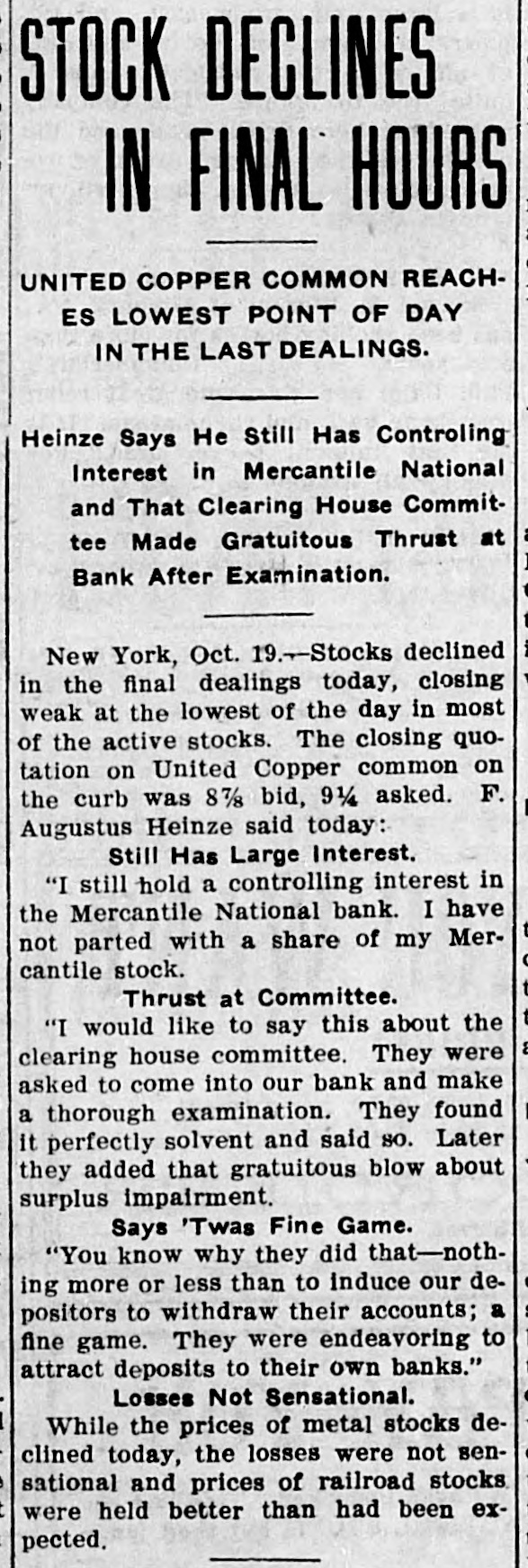
STOCK DECLINES IN FINAL HOURS UNITED COPPER COMMON REACHES LOWEST POINT OF DAY IN THE LAST DEALINGS. Heinze Says He Still Has Controling Interest in Mercantile National and That Clearing House Committee Made Gratuitous Thrust at ] Bank After Examination. 1 i New York, Oct. 19.-Stocks declined . in the final dealings today, closing weak at the lowest of the day in most of the active stocks. The closing quotation on United Copper common on the curb was 8% bid, 9½ asked. F. Augustus Heinze said today: Still Has Large Interest. "I still hold a controlling interest in the Mercantile National bank. I have t not parted with a share of my Mercantile stock. t Thrust at Committee. "I would like to say this about the on clearing house committee. They were asked to come into our bank and make I a thorough examination. They found it perfectly solvent and said so. Later they added that gratuitous blow about surplus impairment. Says 'Twas Fine Game. "You know why they did that-nothing more or less than to induce our depositors to withdraw their accounts; a fine game. They were endeavoring to attract deposits to their own banks." Losses Not Sensational. While the prices of metal stocks declined today, the losses were not sensational and prices of railroad stocks were held better than had been expected.
10.October 19, 1907The News-DemocratProvidence, RI
Click image to open full size in new tab
Article Text
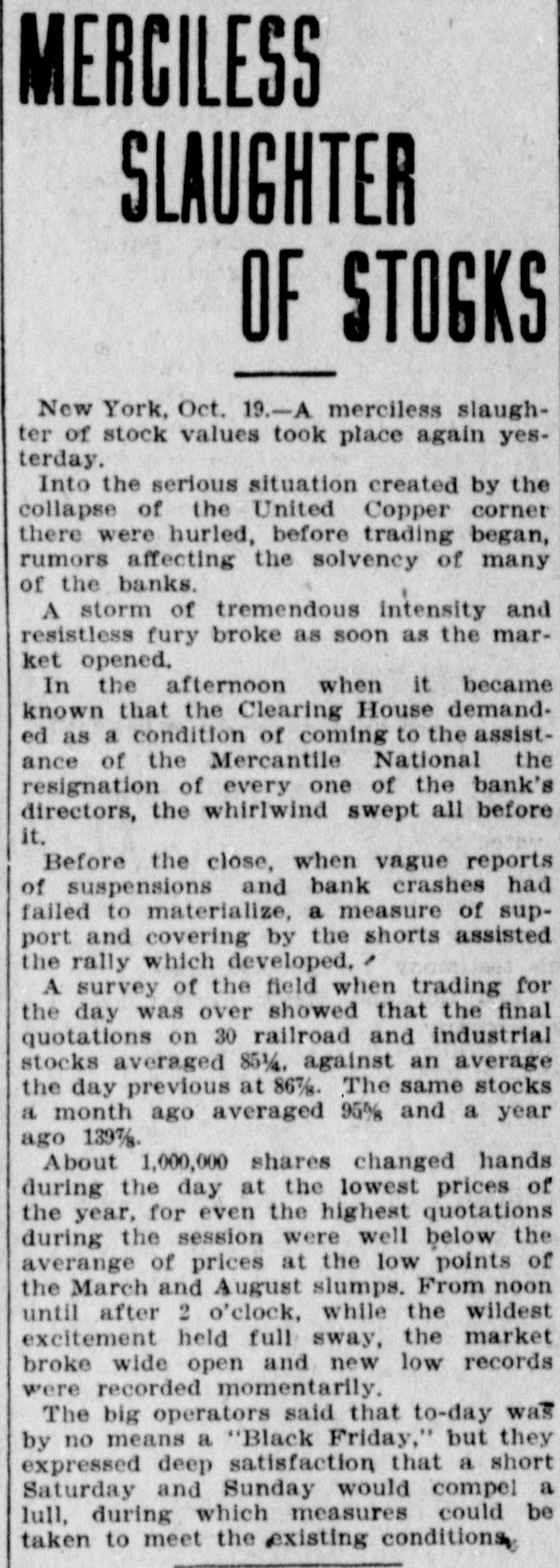
MERCILESS SLAUGHTER OF STOCKS New York, Oct. 19.-A merciless slaughter of stock values took place again yesterday. Into the serious situation created by the collapse of the United Copper corner there were hurled, before trading began, rumors affecting the solvency of many of the banks. A storm of tremendous intensity and resistless fury broke as soon as the market opened. In the afternoon when it became known that the Clearing House demanded as a condition of coming to the assistance of the Mercantile National the resignation of every one of the bank's directors, the whirlwind swept all before it. Before the close, when vague reports of suspensions and bank crashes had failed to materialize, a measure of support and covering by the shorts assisted the rally which developed. , A survey of the field when trading for the day was over showed that the final quotations on 30 railroad and industrial stocks averaged 851/4, against an average the day previous at 867/g. The same stocks a month ago averaged 95% and a year ago 1397/s. About 1,000,000 shares changed hands during the day at the lowest prices of the year, for even the highest quotations during the session were well below the averange of prices at the low points of the March and August slumps. From noon until after 2 o'clock, while the wildest excitement held full sway, the market broke wide open and new low records were recorded momentarily. The big operators said that to-day was by no means a "Black Friday," but they expressed deep satisfaction that a short Saturday and Sunday would compel a lull, during which measures could be taken to meet the existing conditions,
11.October 20, 1907The Montgomery AdvertiserMontgomery, AL
Click image to open full size in new tab
Article Text
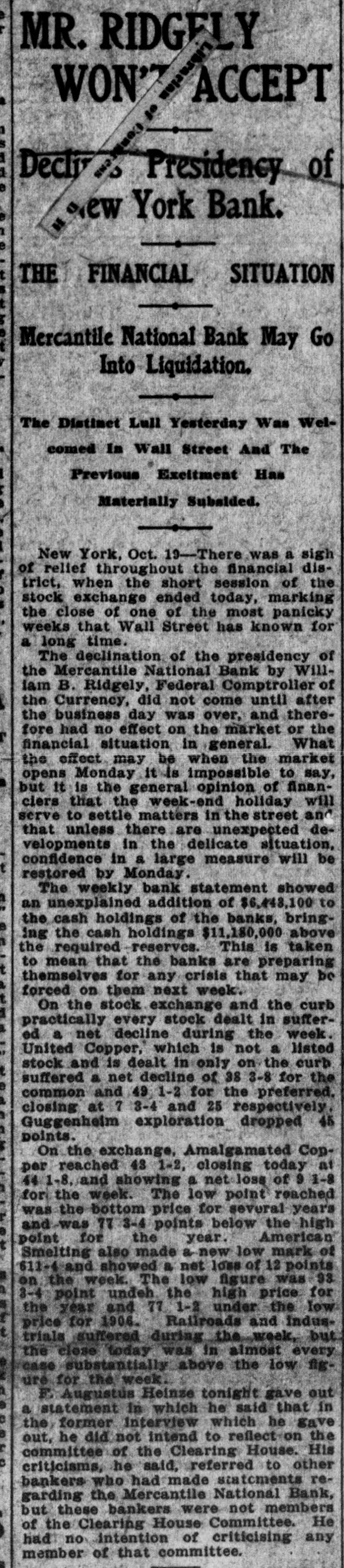
MR. RIDGELY WON'T ACCEPT Decli is Presidency of ew York Bank. THE FINANCIAL SITUATION Mercantile National Bank May Go Into Liquidation. The Distinct Lull Yesterday Was Welcomed In Wall Street And The Previous Excitment Has Materially Subsided. York, Oct. 19-There was a sigh disNew relief throughout the financial of the of when the short session marking trict, exchange ended today, panicky stock of one of the most for the weeks close that Wall Street has known a long time. of declination of the presidency by WillThe National Bank of the Mercantile Ridgely, Federal Comptroller after lam B. did not come and until therethe Currency, day was over, or the C the business no effect on the market situation in the financial may be when to say, the fore had general. market finan- What effect Monday it is impossible of opens it is the general opinion holiday will ciers that settle matters in the serve but that to the there week-end are unexpected street situation, and deunless the delicate will t velopments in in a large measure restored weekly by bank statement of $6,443,100 The addition banks, e confidence unexplained Monday. of the showed bring- above be to an cash holdings $11,180,000 the cash This is the the ing holdings reserves. preparing taken required the banks are may be themselves them next to mean that for any crisis week. that curb forced the on stock exchange stock dealt and in the sufferpractically On every decline during the week. listed ed a net Copper, which is not on the a curb stock United and is net dealt decline in only of the 38 3-8 preferred. for the closing suffered common at a and 7 3-4 exploration 1-2 and for 25 respectively. dropped 45 points. Guggenheim the exchange. Amalgameted closing today Cop- 1-8 at per On reached and showing 43 1-2, a low net point loss of roached years for 44 1-8, the the week. bottom The price for below several the high point was was 77 3-4 points year. American mark of Smelting and also showed a low net loss figure was 611-1 week. The the high price the t on 3-4 point and undeh 77 Railroads 1-2 under and indus- but and the the year for 1906. the made a new the low of weak, 12 points low for 93 case price for suffered during in almost every figfor are F. gave Heinze tonight the trials close substantially today was above the low out Augustus in a he that in said which statement he the which gave interview on to the he did not out, reflect intend His of the House. Clearing committee to he other said, referred rehad made who statements the Bank, National garding not but these members He House Clearing we Committee. of any criticising of member had the no of Intention that
12.October 20, 1907Los Angeles HeraldLos Angeles, CA
Click image to open full size in new tab
Article Text
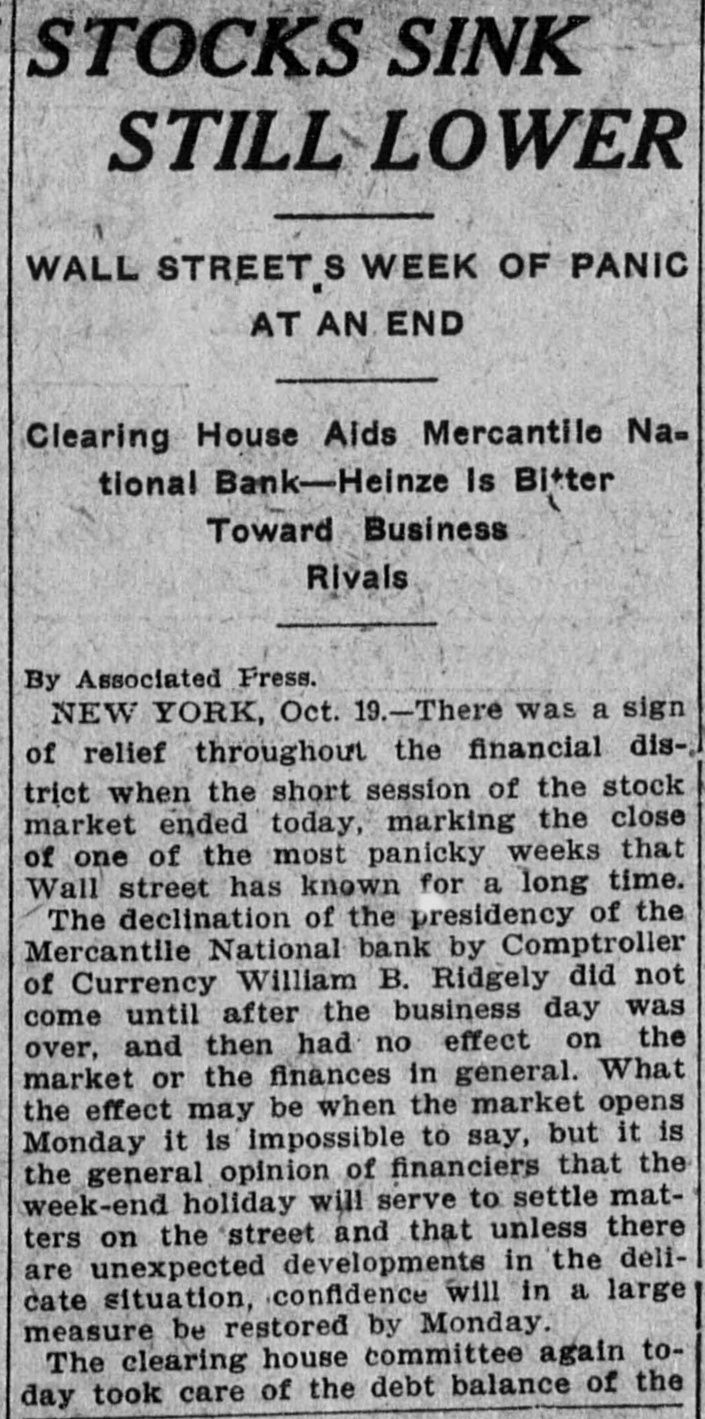
STOCKS SINK STILL LOWER WALL STREETS WEEK OF PANIC AT AN END Clearing House Aids Mercantile National Bank-Heinze Is Bitter Toward Business Rivals By Associated Press. NEW YORK, Oct. 19.-There was a sign of relief throughout the financial district when the short session of the stock market ended today, marking the close of one of the most panicky weeks that Wall street has known for a long time. The declination of the presidency of the Mercantile National bank by Comptroller of Currency William B. Ridgely did not come until after the business day was and then had no effect on the over, market or the finances in general. What the effect may be when the market opens Monday it is impossible to say, but it is the general opinion of financiers that the week-end holiday will serve to settle matters on the street and that unless there are unexpected developments in the delicate situation, confidence will in a large measure be restored by Monday. The clearing house committee again today took care of the debt balance of the
13.October 21, 1907The Pacific Commercial AdvertiserHonolulu, HI
Click image to open full size in new tab
Article Text
CLEARING HOUSE TO THE RESCUE
NEW YORK, October 21.-The / New York Clearing house has decided to protect the Mercantile National Bank. The Heinze and Morse interests have been eliminated. It is believed this will prevent a crisis in the present panic. Seth Milliken has been elected president of the Mercantile National Bank which will now go into slow liquidation. Seth Milliken is a member of the firm of Milliken Brothers, contractors and manufacturers of certain classes of machinery. The firm has constructed buildings for sugar mills in these islands.
14.October 21, 1907The Hawaiian StarHonolulu, HI
Click image to open full size in new tab
Article Text
TO THE RESCUE
NEW YORK, October 21.-The New York Clearing house has decided to protect the Mercantile National Bank. The Heinze and Morse interests have been eliminated. It is believed this will prevent a crisis in the present panic. Seth Milliken has been elected president of the Mercantile National Bank which will now go into slow liquidation.
15.October 21, 1907The Seattle StarSeattle, WA
Click image to open full size in new tab
Article Text
MILLIKEN PRESIDENT OF MERCANTILE BANK
(By United Press.) NEW YORK, Oct. 21.Seth M. Milliken has been made president of the Mercantile National bank, to succeed F. Augustus Heinze, resigned. The bank will run under a process of slow Hquidation.
The Heinze failure in New York last week was a much greater one than the first news of it led the people to believe. The total losses of the syndicate, which include the depreciation in stock values, is placed at 65 millions. The most notable slump is in the price of the capital stock of the Mercantile National Bank, of which F. A. Heinze was the president. When the syndicate purchased the stock of the bank the price paid was $300 per share. On Saturday it was offered at $180. It is feared that the bank may *find its resources badly impaired. The Clearing House has already advanced more than a million dollars to tide the bank over its present distress, but a run, which seems probable, is certain to precipitate its ruin. Heinze's chief associate in the bank was one C. W. Morse, who acquired prominence a few years ago as a figure in a domestic scandal, which had its final denouement in the conviction and imprisonment in the penitentiary of Abe Hummel, a notorious lawyer.-Parkersburg Sentinel.
17.October 24, 1907The National TribuneWashington, DC
Click image to open full size in new tab
Article Text
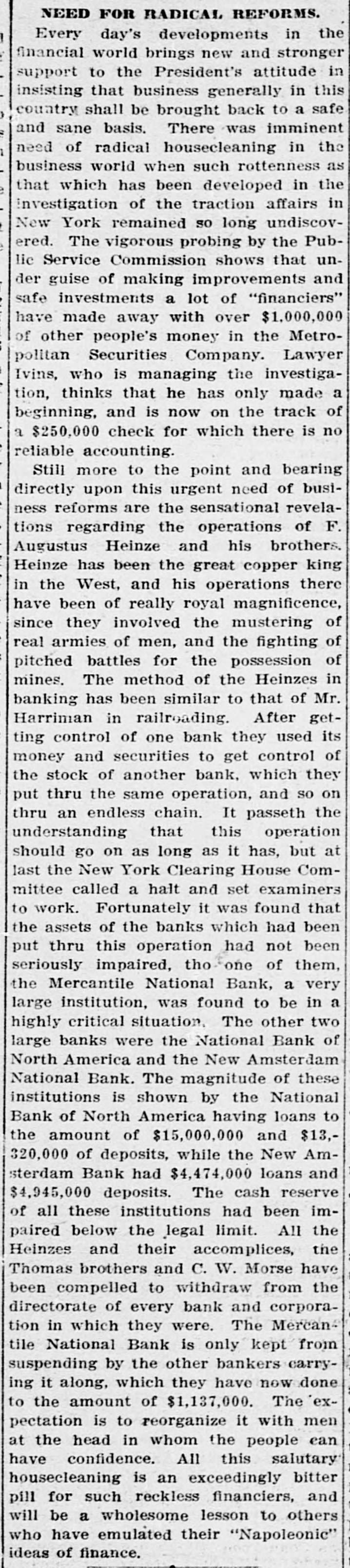
NEED FOR RADICAL REFORMS
Every day's developments in the financial world brings new and stronger support to the President's attitude in insisting that business generally in this country shall be brought back to a safe and sane basis. There was imminent need of radical housecleaning in the business world when such rottenness as that which has been developed in the investigation of the traction affairs in New York remained so long undiscovered. The vigorous probing by the Public Service Commission shows that under guise of making improvements and safe investments a lot of "financiers" have made away with over $1,000,000 of other people's money in the Metropolitan Securities Company. Lawyer Ivins, who is managing the investigation, thinks that he has only made a beginning, and is now on the track of a $250,000 check for which there is no reliable accounting. Still more to the point and bearing directly upon this urgent need of business reforms are the sensational revelations regarding the operations of F. Augustus Heinze and his brothers. Heinze has been the great copper king in the West, and his operations there have been of really royal magnificence, since they involved the mustering of real armies of men, and the fighting of pitched battles for the possession of mines. The method of the Heinzes in banking has been similar to that of Mr. Harriman in railroading. After getting control of one bank they used its money and securities to get control of the stock of another bank, which they put thru the same operation, and SO on thru an endless chain. It passeth the understanding that this operation should go on as long as it has, but at last the New York Clearing House Committee called a halt and set examiners to work. Fortunately it was found that the assets of the banks which had been put thru this operation had not been seriously impaired, tho one of them, the Mercantile National Bank, a very large institution, was found to be in a highly critical situation. The other two large banks were the National Bank of North America and the New Amsterdam National Bank. The magnitude of these institutions is shown by the National Bank of North America having loans to the amount of $15,000,000 and $13,320,000 of deposits, while the New Amsterdam Bank had $4,474,000 loans and $4,945,000 deposits. The cash reserve of all these institutions had been impaired below the legal limit. All the Heinzes and their accomplices, the Thomas brothers and C. W. Morse have been compelled to withdraw from the directorate of every bank and corporation in which they were. The Mercantile National Bank is only kept from suspending by the other bankers carrying it along, which they have now done to the amount of $1,137,000. The 'expectation is to reorganize it with men at the head in whom the people can have confidence. All this salutary housecleaning is an exceedingly bitter pill for such reckless financiers, and will be a wholesome lesson to others who have emulated their "Napoleonic" ideas of finance.
18.January 8, 1908The Morning AstorianAstoria, OR
Click image to open full size in new tab
Article Text
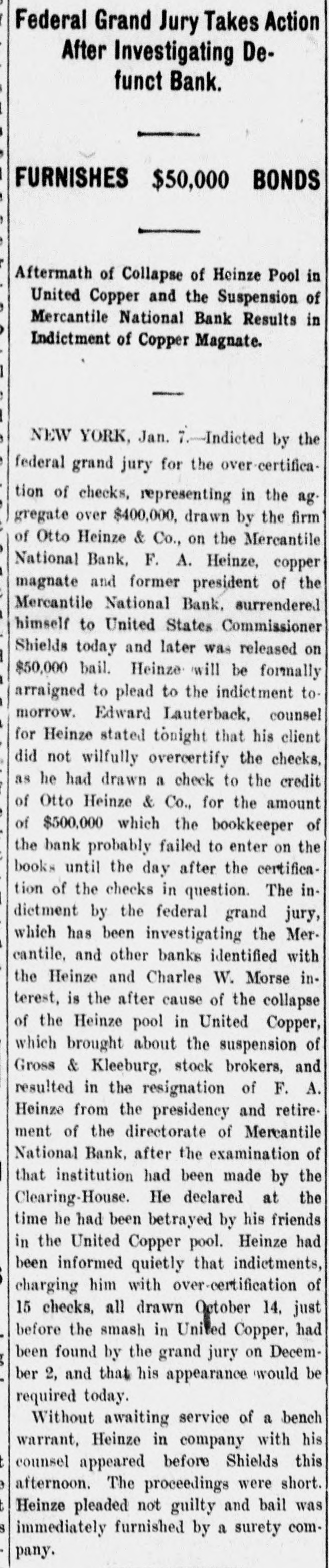
Federal Grand Jury Takes Action
After Investigating Defunct Bank.
FURNISHES $50,000 BONDS
Aftermath of Collapse of Heinze Pool in United Copper and the Suspension of Mercantile National Bank Results in Indictment of Copper Magnate.
NEW YORK, Jan. 7.-Indicted by the federal grand jury for the over-certification of checks, representing in the aggregate over $400,000, drawn by the firm of Otto Heinze & Co., on the Mercantile National Bank, F. A. Heinze, copper magnate and former president of the Mercantile National Bank, surrendered himself to United States Commissioner Shields today and later was released on $50,000 bail. Heinze will be formally arraigned to plead to the indictment tomorrow. Edward Lauterback, counsel for Heinze stated tonight that his client did not wilfully overcertify the checks, as he had drawn a check to the credit of Otto Heinze & Co., for the amount of $500,000 which the bookkeeper of the bank probably failed to enter on the books until the day after the certification of the checks in question. The indictment by the federal grand jury, which has been investigating the Mercantile, and other banks identified with the Heinze and Charles W. Morse interest, is the after cause of the collapse of the Heinze pool in United Copper, which brought about the suspension of Gross & Kleeburg, stock brokers, and resulted in the resignation of F. A. Heinze from the presidency and retirement of the directorate of Mercantile National Bank, after the examination of that institution had been made by the Clearing-House. He declared at the time he had been betrayed by his friends in the United Copper pool. Heinze had been informed quietly that indictments, charging him with over-certification of 15 checks, all drawn October 14, just before the smash in United Copper, had been found by the grand jury on December 2, and that his appearance would be required today.
Without awaiting service of a bench warrant, Heinze in company with his counsel appeared before Shields this afternoon. The proceedings were short. Heinze pleaded not guilty and bail was immediately furnished by a surety company.
19.January 11, 1908Spirit of the AgeWoodstock, VT
Click image to open full size in new tab
Article Text
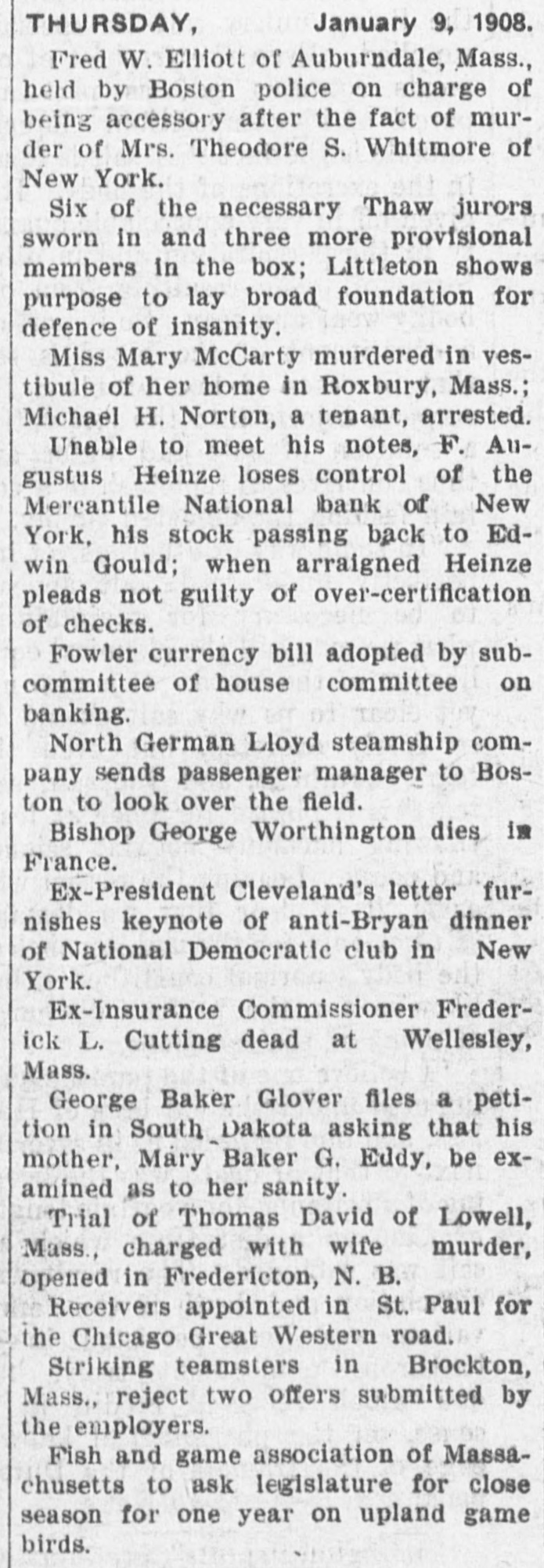
THURSDAY, January 9, 1908. Fred W. Elliott of Auburndale, Mass., held by Boston police on charge of being accessory after the fact of murder of Mrs. Theodore S. Whitmore of New York. Six of the necessary Thaw jurors sworn in and three more provisional members in the box; Littleton shows purpose to lay broad foundation for defence of insanity. Miss Mary McCarty murdered in vestibule of her home in Roxbury, Mass.; Michael H. Norton, a tenant, arrested. Unable to meet his notes, F. Augustus Heinze loses control of the Mercantile National bank of New York, his stock passing back to Edwin Gould; when arraigned Heinze pleads not guilty of over-certification of checks. Fowler currency bill adopted by subcommittee of house committee on banking. North German Lloyd steamship company sends passenger manager to Boston to look over the field. Bishop George Worthington dies in France. Ex-President Cleveland's letter furnishes keynote of anti-Bryan dinner of National Democratic club in New York. Ex-Insurance Commissioner Frederick L. Cutting dead at Wellesley, Mass. George Baker Glover files a petition in South Dakota asking that his mother, Mary Baker G. Eddy, be examined as to her sanity. Trial of Thomas David of Lowell, Mass., charged with wife murder, opened in Fredericton, N. B. Receivers appointed in St. Paul for the Chicago Great Western road. Striking teamsters in Brockton, Mass., reject two offers submitted by the employers. Fish and game association of Massachusetts to ask legislature for close season for one year on upland game birds.
20.February 5, 1908The Birmingham Age-HeraldBirmingham, AL
Click image to open full size in new tab
Article Text
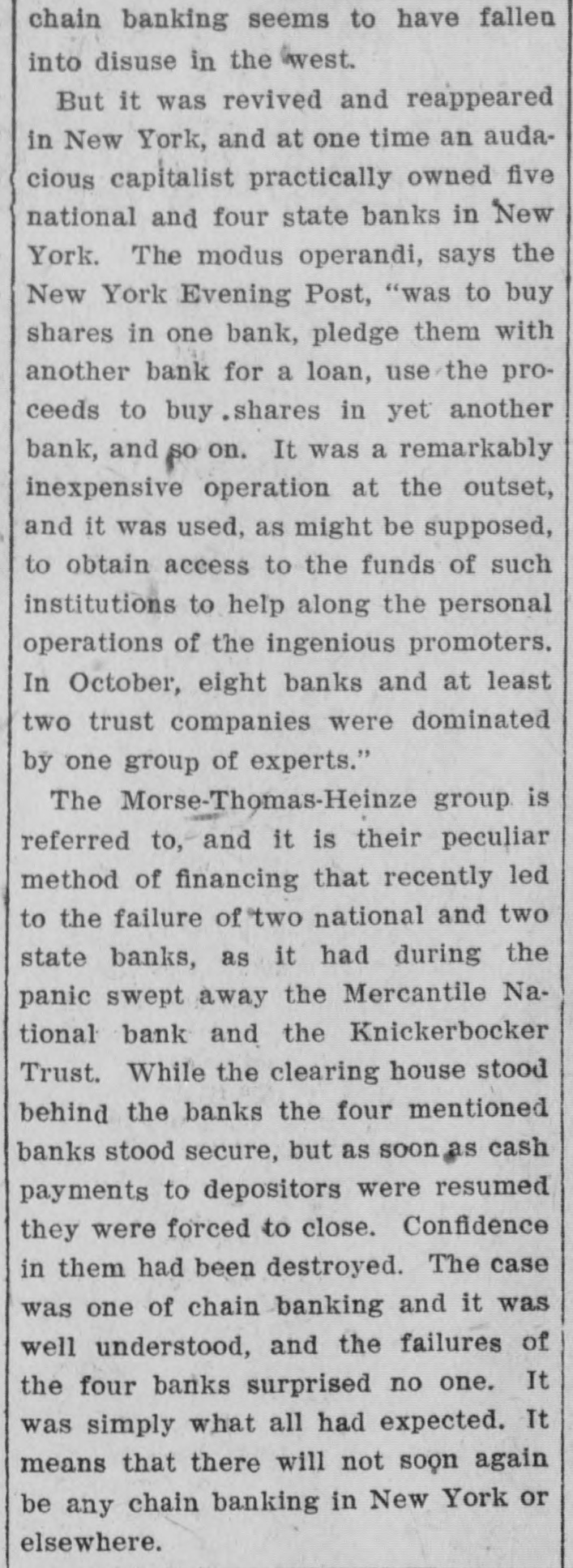
chain banking seems to have fallen into disuse in the west. But it was revived and reappeared in New York, and at one time an audacious capitalist practically owned five national and four state banks in New York. The modus operandi, says the New York Evening Post, "was to buy shares in one bank, pledge them with another bank for a loan, use the proceeds to buy shares in yet another bank, and SO on. It was a remarkably inexpensive operation at the outset, and it was used, as might be supposed, to obtain access to the funds of such institutions to help along the personal operations of the ingenious promoters. In October, eight banks and at least two trust companies were dominated by one group of experts." The Morse-Thomas-Heinze group is referred to, and it is their peculiar method of financing that recently led to the failure of two national and two state banks, as it had during the panic swept away the Mercantile National bank and the Knickerbocker Trust. While the clearing house stood behind the banks the four mentioned banks stood secure, but as soon as cash payments to depositors were resumed they were forced to close. Confidence in them had been destroyed. The case was one of chain banking and it was well understood, and the failures of the four banks surprised no one. It was simply what all had expected. It means that there will not soon again be any chain banking in New York or elsewhere.
21.October 23, 1908The Star and Newark AdvertiserNewark, NJ
Click image to open full size in new tab
Article Text
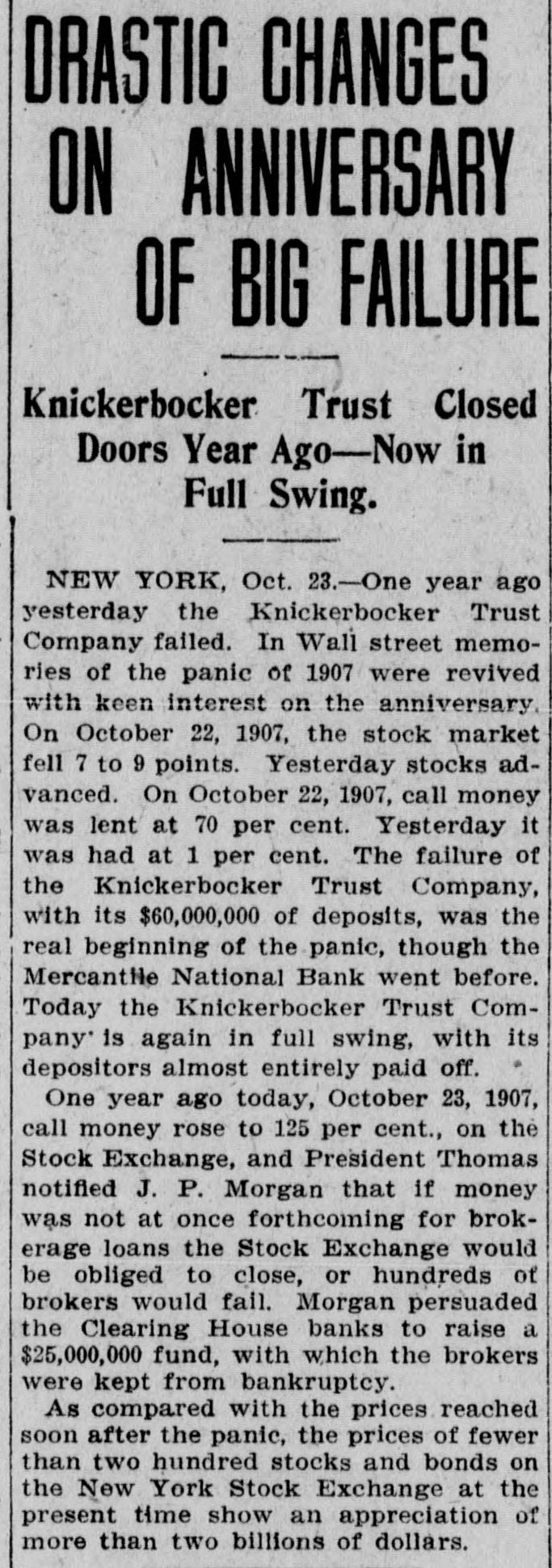
DRASTIC CHANGES ON ANNIVERSARY OF BIG FAILURE Knickerbocker Trust Closed Doors Year Ago-Now in Full Swing. NEW YORK, Oct. 23.-One year ago yesterday the Knickerbocker Trust Company failed. In Wall street memories of the panic of 1907 were revived with keen interest on the anniversary On October 22, 1907, the stock market fell 7 to 9 points. Yesterday stocks advanced. On October 22, 1907, call money was lent at 70 per cent. Yesterday it was had at 1 per cent. The failure of the Knickerbocker Trust Company, with its $60,000,000 of deposits, was the real beginning of the panic, though the Mercantile National Bank went before. Today the Knickerbocker Trust Company' is again in full swing, with its depositors almost entirely paid off. One year ago today, October 23, 1907, call money rose to 125 per cent., on the Stock Exchange, and President Thomas notified J. P. Morgan that if money was not at once forthcoming for brokerage loans the Stock Exchange would be obliged to close, or hundreds of brokers would fail. Morgan persuaded the Clearing House banks to raise a $25,000,000 fund, with which the brokers were kept from bankruptcy. As compared with the prices reached soon after the panic, the prices of fewer than two hundred stocks and bonds on the New York Stock Exchange at the present time show an appreciation of more than two billions of dollars.
22.June 5, 1909Bismarck Daily TribuneBismarck, ND
Click image to open full size in new tab
Article Text
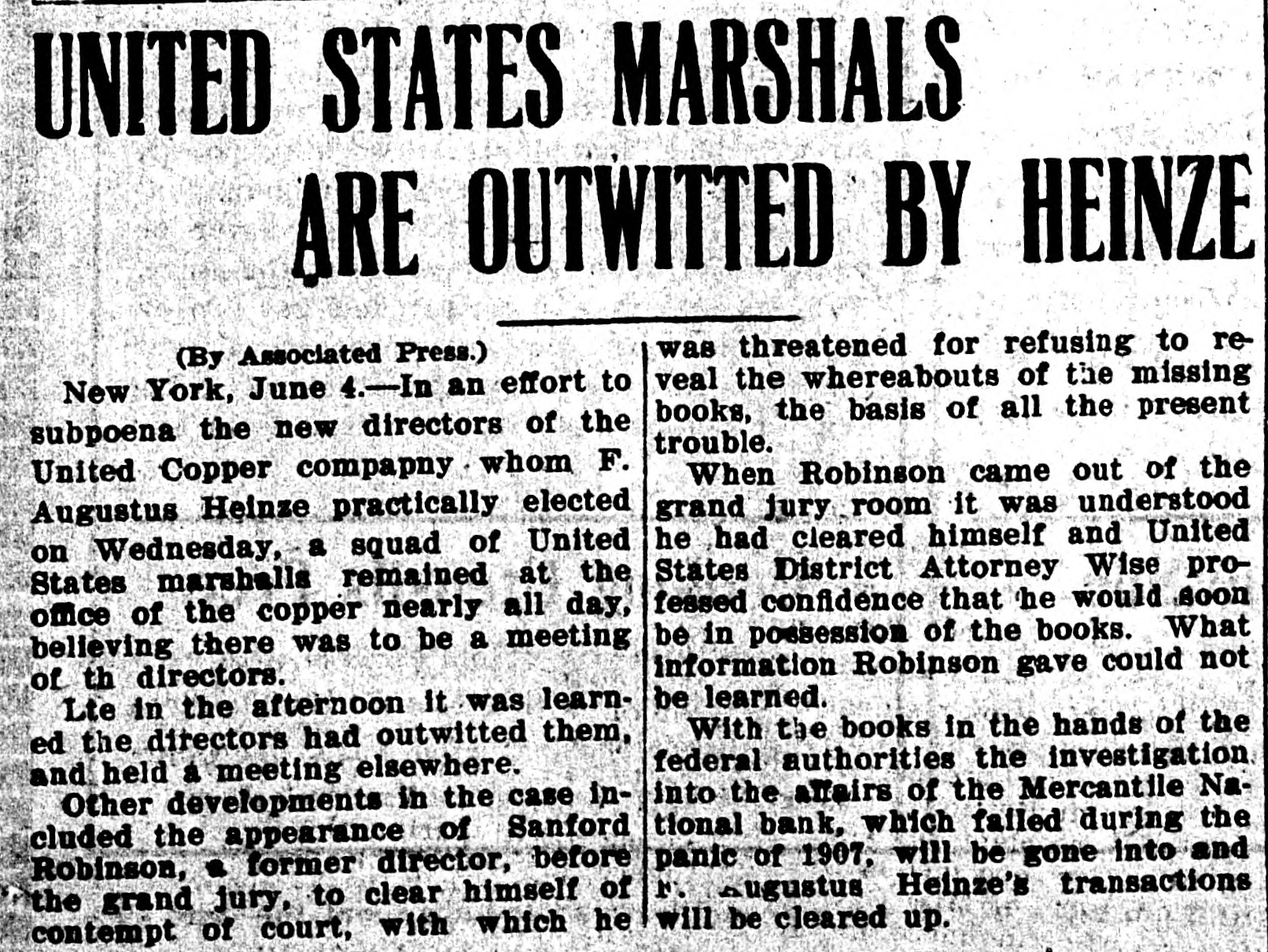
UNITED STATES MARSHALS ARE OUTWITTED BY HEINZE was threatened for refusing to re(By Associated Press.) veal the whereabouts of the missing New York, June 4.-In an effort to books, the basis of all the present subpoena the new directors of the trouble. United Copper compapny . whom F. When Robinson came out of the grand jury room it was understood Augustus Heinze practically elected he had cleared himself and United on Wednesday, a squad of United States District Attorney Wise proStates marshalls remained at the fessed confidence that he would soon office of the copper nearly all day, be in poesession of the books. What believing there was to be a meeting information Robinson gave could not of th directors. be learned. Lte in the afternoon it was learnWith the books in the hands of the ed the directors had outwitted them, federal authorities the investigation and held a meeting elsewhere. into the affairs of the Mercantile NaOther developments in the case included the appearance of Sanford tional bank, which failed during the Robinson, a former director, before panic of 1907, will be gone into and the grand jury, to clear himself of N. augustus Heinze's transactions contempt of court, with which he will be cleared up.
23.June 6, 1909Omaha Daily BeeOmaha, NE
Click image to open full size in new tab
Article Text
COPPER BOOKS ARE COMING Director Robinson Agrees to Produce Necessary Records. OPEN SHOP IN SHEET MILLS Judge Gary of Steel Combine Explains Notices Recently Posted in Sheet and Tin Plants. NEW YORK, N. Y., June 5.-In an effort to subpoena new directors of the United Copper company, whom F Augustus Heinze practically elected on Wednesday, a squad of United States marshals remained at the offices of the company nearly all day understanding that there was to be a meeting. Late in the evening it was learned the directors had held a meeting elsewhere, just where is not known. Other developments in the case included the appearance of Sanford Robinson, a former director. before the grand jury with the idea of clearing himself of contempt of court with which he was threatened for refusing to reveal whereabouts of the missing books, the basis of all the present trouble When Robinson came from the grand jury room It was understood that he had purged himself and United States District "Attorney Wise professed confidence that he would soon be in possession of the books. What information Robinson volunteered concerning the whereabouts of the books could not be learned, but Mr. Wise indicated that he would have them in the near future. With the books in the hands of the federal authorities investigation into affairs of the Mercantile National bank, which failed in the panic of 1907, will be gone into and F. Augustus Heinze's transactions will be cleared up. His apparent effort to checkmate such a move has caused the present mix up. Open Shop in Steel Mills. In explanation of the new wage scale posted a few days ago at mills of the American Sheet and Tin Plate company, Elbert H. Hary, chairman of the United States Steel corporation, made the following statement today: "Most of the mills of the American Sheet and Tin Plate company here have for some years been operated as 'open shops,' the others were run as union mills and with these the wage scale has been signed on July 1 of each year. The management of the American Sheet and Tin Plate company has dicovered it has been discriminated against and in other ways unfairly treated by the Amalgamated association; the management also discovered beyond question that a decided majority of the men prefer to have all the mills operated as 'open shops.' Under these conditions It has become clear It is for the best interests for the operators to conform to the wishes of the majority. As a result the company posted notices accordingly and also posted the wage scale effective on and after July 1, which in all essential respects is unchanged. There is no dispute regarding wages. It is clear that the employes have appreciated the attitude of the company in its maintenance of the high Level of wages in the period of great business depression." Rockefeller Likes Golf. Saying that the financial situation is not half as interesting as golf, John D. Rockefeller returned here today from Hot Springs, Va., where he took Mrs. Rockefeller five months ago for her health. "We have had a splendid time," said Mr. Rockefeller, "and Mrs. Rockefeller is much better." Mr. Rockefeller was asked If he cared to say anything regarding the financial situation. "What do I know about the financial situation?" he replied. "Why, finance can't be compared with golf. I hope some day to be able to play good golf. I have played a good deal of it in my life." He spoke feelingly of the recent death of H. H. Rogers. "It is sad, very sad," he said. More Delay ir Gould Trial. Probability of a further delay in brining to trial the suit of Mrs. Katherine Clemmons Gould for a separation from her husband, Howard Gould, was indicated today when Supreme Court Justice Gildersleeve appointed Junius T. Auerbach of Boston a commissioner to examine Dr. Martin D. Moran of that city as a witness in behalf of Mrs. Gould. It was stated that Monday and Tuesday of next week might be required for the examination of Dr. Moran and that the trial of the suit would probably not be started before next Wednesday. Mayor McClellan has sent a letter to the father of George B. Duffy, the Brooklyn boy whose troubles with the police have been at the bottom of the charges brought by Supreme Court Justice Gaynor against Police Commissioner Bingham, asking that the youth be brought before the mayor next Monday.. The father is requested also to bring character witnesses. Fight With Counterfeiters. Four Italians suspected of counterfeiting were arrested in a saloon today by agents of the secret service after a fight in which bottles and glasses were thrown. The police say they found seventeen bad $2 bills on one prisoner. In his room was a rubber stamp which would print a fair imitation of a $2 bill. Bee Want Ads. are bustness boosters
Bank runs are almost always and everywhere a deterioration of bank fundamentals.
But not for you.
You are the measure-zero exception: great fundamentals, solid bank, and yet the Diamond Dybvig fairy spread its rumor. Depositors woke up. Your collateral was not prepositioned. The Clearinghouse had it for you.
Do not pass Go. Do not collect $200. Go directly to jail… or worse.