10592. Page & Bacon (Saint Louis, MO)

Bank Information

Episode Type
Run → Suspension → Closure
Bank Type
private
Start Date
January 12, 1855
Location
Saint Louis, Missouri (38.627, -90.198)

Metadata

Model
gpt-5-mini
Short Digest
469e1f8d

Response Measures

Accommodated withdrawals, Borrowed from banks or large institutions, Public signal of financial health, Capital injected, Full suspension

Other: Citizens pledged private property to guarantee deposits; assignee appointed to administer final winding up.

Description

Page & Bacon (St. Louis) suffered an initial suspension amid a run in mid-January 1855, resumed payments about 15 Jan 1855, then suffered a second suspension in early April 1855 and was ultimately placed under assignment/receiver by June 1855. I classify the overall episode as run -> suspension -> (temporary reopening) -> final suspension/closure (receivership), so the overall outcome is closure after runs and suspensions. Dates are taken from newspaper reports; OCR errors in originals corrected (e.g., spelling of Bacon/Bason).

Events (5)

1. January 12, 1855 Suspension
Cause
Bank Specific Adverse Info
Cause Details
House overextended in railroad securities and facing heavy maturities; inability to meet a draft and depleted liquidity after heavy payments forced suspension.
Newspaper Excerpt
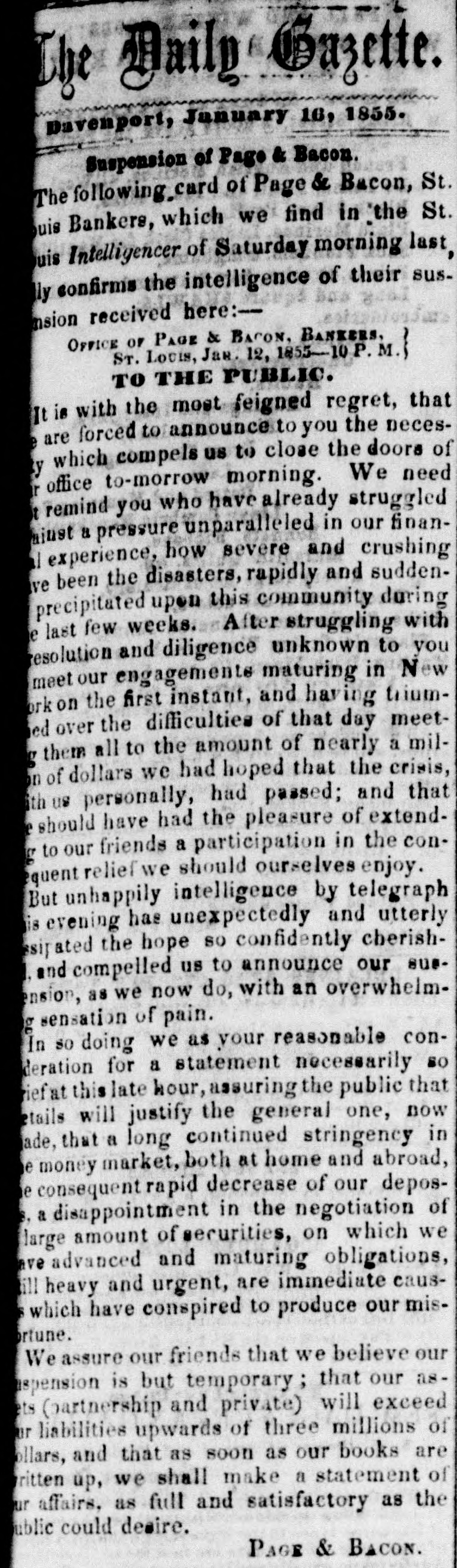
OFFICE OF PAGE & BACON, BANKERS, St. Louis, Jan. 12, 1855-10 P. M. TO THE PUBLIC... compelled us to announce our suspension, as we now do, with an overwhelming sensation of pain.
Source
newspapers
2. January 13, 1855 Run
Cause
Bank Specific Adverse Info
Cause Details
Public alarm following announcement of Page & Bacon's suspension and disclosure of their entanglements and inability to meet certain drafts; deposit withdrawals from multiple St. Louis houses.
Measures
Some bankers kept doors open late to pay liabilities; prominent citizens pledged private property to guarantee deposits of several banking houses.
Newspaper Excerpt
A panic seized the citizens, to a greater or less extent, and a run upon our bankers was the consequence. A large amount of deposits was withdrawn during the day;
Source
newspapers
3. January 15, 1855 Reopening
Newspaper Excerpt
Their resumption is confirmed... the early resumption of Messrs. Page & Bacon... On the 15th inst. a full resumption takes place. Mr. H. D. Bacon left the city... fortified with the means to meet every demand against the firm, upon presentation.
Source
newspapers
4. April 1, 1855 Suspension
Cause
Bank Specific Adverse Info
Cause Details
Reverses in California and continued illiquidity/entanglement with railroad securities led to a second suspension and assignment of funds to pay certain drafts.
Newspaper Excerpt
a telegraphic advice of the second suspension of Page & Bacon... the second and probably final suspension of Page & Bacon
Source
newspapers
5. June 21, 1855 Receivership
Newspaper Excerpt
J. H. Alexander, trustee of the exploded bankers, has taken formal possession... Under this proceeding there is a total suspension of the powers of the corporation... conversion of the entire road into a mere personal chattel in the hands of Page & Bacon; and reports of assignment/assignee administering affairs and paying dividends are noted earlier as well.
Source
newspapers

Newspaper Articles (20)

Article from The New York Herald, January 14, 1855

Click image to open full size in new tab

Article Text

The failure of Page & Bacon, of St. Louis, announced jesterday, hal no particular effect on our local financial affairs. The business of this house was principally at the West and with California. It is the opinion here that bat for the treachery of certain repated friends of the house, the failure would not have occurred. The draft upon which payment was refused was for, comparatively, a small amount; and had Mr. Bacon supposed for a moment that any difficulty would have arisen, arrangements could easily have been made to have protected it. The friends of Page & Bason are not at all satisfied with the way in which the house has been treated by those who have largely benefitted by their operations; and it has been hinted that & desire to supersede them in the California business is the actual cause of the summary manner in which they have been treated. Messrs. Page & Bacon have carried on a very profitable business in bullion for some time, and but for its entanglements with the depreciated securities of Western railroad companies, would have maintained itself and passed through the present stringency in financial affairs unscathed. The firm of Page & Bacon, of St. Louis, some time since became involved in the finances of the Ohio and Missi ssippi Railroad Company. In ordinary times it could have easily carried the burden assumed, but the difficulty experienced during the past three months in raising money, even on the best securities, made the dead weight pressing upon them greater than they could bear up under. Arrangements have been made for aid from the California branch of the house, which will in a short time be realized, and it was the knowledge of this fact that makes the conduct of certain parties so contrary to all custom, to say the least. With temporary aid to a moderate extent, the house could have continued its business. The effect of this failure upon California remittances must be most disastrous. This house was the largest recipient of California gold in the Atlantic States, and an immense amount of drafts drawn on remittances must be in the hands of the public. It is estimated that there are now and will be on the way to this port from San Francisco, before the news of the failare reaches California, full three million of lollars in gold, consigned to this house, drafts for which will come along with the gold. All arrivals after this day will probably be set aside for the payment of these drafts. If not, it will extend the disastrous effect of the failure, entail losses upon hundreds more than are already sufferers. The suspension of Page & Bacon is only another instance of the danger of departing from a legitimate business. As bankers they were eminently successful, and had amassed wealth, but as operators in railroad securities they made a failure.


Article from The New York Herald, January 15, 1855

Click image to open full size in new tab

Article Text

known anti-slavery men of the North and the Know Norbings! For example, they have discovered that General Wilson, late a prominent free soiler, will probably be elected to the United States Senate, from Massachusetts, by the Know Nothings! What does this signify ? Mr. Wise was formerly the great Southern Ajax of the whigs in Congress against the federal policy of Jackson and Van Buren; but who doubts bis democracy now, except Billy Smith ? And so, if the Know Nothings elect General Wilson to the Senate, we are conudent that he will prove a conservative upon the slavery question, in accordance with their sound national principles. We have shown that the fortunes of the administration, of Wise, and of Seward are blended together, though each party is fighting a separate battle. We have shown the despicable system of warfare of the Cabinet organs. The game of Seward is equally mean. Under pretence of a legal argument before one of our courts in a patent case, we find him absenting himself from his official duties at Washington, (though still pocketing his eight dollars a day,) and making and publishing a sneaking electioneering speech to help case at Albany. A patent case of Senatorial dignity most truly! How striking the contrast of the manly and open electioneering policy of Henry A. Wise, before his electors, face to face, freely and eloquently discussing the great practical interests of his State, ever ready to confront his adversaries in open day! Pity that the success of Wise should depend, in any degree, upon the success of Seward; pity that, in spite of himself, he should be tied to the dead carcass of the administration. Pity that the great popular work of the new political revolution should involve the sacrifice of such a man as Wise. But so it is, and we must bow to the will of the people. A New Feature in the Commercial CrisisWar In Wall street. A correspondence of a somewhat unusual character appeared in our columns yesterday morning. It was between H. D. Bacon, of the house of Page & Bacon, bankers, of St. Louis, and a number of residents and merchants of that city, who happened to be here on Saturday; and conveyed to the former the sympathies of the latter, on the occasion of the failure of the house of which he was a member. In his reply Mr. Bacon observed that he would hereafter publish the facts, which would show that had good faith characterized the conduct of our (Page & Bacon's) correspondents," the suspension would not have occurred. Such a charge made at such a moment by a man of Mr. Bacon's standing in reference to firms equally eminent, is quite worthy of attention by the public at large. On whatever grounds it may rest-these must for the present remain unknown-it shows that a state of war existed between the financial houses of New York and the leading financial house of the West. Mr. Bacon charges bad faith on his "correspondents." This they may deny, but they can hardly deny that whether from policy, or prudence or some less honorable motive, they were directly instrumental in breaking down his house. It is of course true that a banker trusts whom he pleases, and the 'correspondents" are the sole judges of what is right for them to do; but when a wealthy firm is ruined by an act of theirs, much suffering ensues, and the public at large have some right to inquire why and how it was done. Page & Bacon were engaged in a most lucrative branch of the banking business, and some one or other among "the correspondents" must fill the vacancy occasioned by their failure. Moreover, the moment the suspension took place, unusually full accounts of the disaster appeared in three of the me rning journals whose money column is understood to be at the service of a certain financial circle in Wall street; notably for the purpose of announcing to the farmers and traders of the West that Page & Bacon were no longer competent to transact their business, and that they had better transfer it to the Wall street firms which proposed to succeed them. These circumstances, taken in connection with Mr. Bacon's letter, will be likely to produce a general impression that the house of Page & Bacon was wilfully broken down by rival houses in Wall street, from pure jealousy and avarice. Nor will that impression be confined to the case of that firm alone. Other failures have occurred in the West, where blame has been laid at the door of the same Wall street circle; and the inference from the whole will be that a struggle is pending between the Western bankers and hose of New York; that the latter are endeavoring to ruin and destroy the former, and that they have already succeeded in one or two prominent instances. A similar contest between two other classes of financial men is within the memory of most of us. About the year 1829, the strife between the United States Bank and the States banks began, and from 1830 to 1836,those institutions, on.one side


Article from Daily Davenport Gazette, January 16, 1855

Click image to open full size in new tab

Article Text

The Daily Gazette. Davenport, January 16, 1855. Suspension of Page & Bacon. The following. card of Page & Bacon, St. Touis Bankers, which we find in 'the St. Touis Intelligencer of Saturday morning last, confirms the intelligence of their susPrension received here:OFFICE OF PAGE & BACON, BANKERS, Sr. Louis, Jan. 12, 1855-10 P. M. TO THE PUBLIC. is with the most feigned regret, that are forced to announce to you the neceswhich compels us to close the doors of office to-morrow morning. We need remind you who have already struggled Wainst a pressure unparalleled in our finanand experience, how severe and crushing have been the disasters, rapidly and suddenprecipitated upon this community during last few weeks. After struggling with resolution and diligence unknown to you Ameet our engagements maturing in New on the first instant, and having triumover the difficulties of that day meetthem all to the amount of nearly a milof dollars we had hoped that the crisis, with us personally, had passed; and that should have had the pleasure of extendto our friends a participation in the conequent relief we should ourselves enjoy. But unhappily intelligence by telegraph his evening has unexpectedly and utterly asipated the hope so confidently cherishand compelled us to announce our sueension, as we now do, with an overwhelmsensation of pain. In SO doing we as your reasonable conderation for a statement necessarily so riefat this late hour, assuring the public that details will justify the general one, now Dade, that a long continued stringency in money market, both at home and abroad, consequent rapid decrease of our deposa disappointment in the negotiation of Harge amount of securities, on which we have advanced and maturing obligations, till heavy and urgent, are immediate causwhich have conspired to produce our misfortune. We assure our friends that we believe our inspension is but temporary that our as(partnership and private) will exceed liabilities upwards of three millions of dollars, and that as soon as our books are written up, we shall make a statement of affairs, as full and satisfactory as the Sublic could desire. PAGE & BACON.


Article from Glasgow Weekly Times, January 18, 1855

Click image to open full size in new tab

Article Text

Financial Affairs in St. Louis. Financial affairs in St. Louis have reach. ed a crisis and tumbling has commenced.Belcher & Bros., extensive sugar menufac turers have failed for two million. Page & Bacon, the heaviest and wealthiest private bankers in the city, suspended last Saturday. Loker, Renick & Co., Bankers, did not open their doors on Saturday. Page & Bacon's suspension was announced in Saturday morning's papers, and produced, as might be expected, extensive excitement.Although no one supposes for a moment, that any person will lose anything by their suspension, yet the fact that a firm of its vast resources should be forced to suspend, created alarm. A run was commenced and kept up during the day on Lucas & Simonds, L. A. Benoist & Co., and the Boatman's Saving Institute. The State Bank was al#0 called on to redeem some of her notes, and all the private bankers were busier than usual. The excitement was so great and universal that it was useless to attempt to check it. Sunday intervening, before business began again on Monday, it is to be hoped the excitement had cooled down and confidence again restored. Should this not have been the case, a general suspension is Later information warrants the feared. belief that the excitement had subsided.


Article from The New York Herald, January 18, 1855

Click image to open full size in new tab

Article Text

Railroad, 1; Hudson River Railroad, 1; Michigan Central Railroad, 1. The transactions at the Assistant Treasuier's office to-day were as follow Received $221,032 59 Payments 86,720 57 1,708 02 Paid for Assay Office Balance 2,591,299 61 There will be a meeting of the Chamber of Com. merce to-morrow, (Thursday), at 1 o'clock, to prepare a memorial to the Legislature for a repeal of the usury laws of this State. It is time somestrong, decided movement was made in this matter, and we hope that time has come. The Nicaragua Transit Company have incurred no responsibility in delivering to Mr. Bacon the let. ters from his house in San Francisco, addressed to Duncan, Sherman & Co. The Transit Company carry in their steamers a private letter bag, over which the government has no control, and its contents are delivered to parties to whom they are addressed, unless a better claim is presented. Mr. Bason had a perfect right to intercept the correspondence between his house in San Francisco and his agents here. Duncan, Sherman & Co., were the hired ser van's of Page, Bacon & Co. They received payment for the performance of certain services, and Mr. Baeon, under the advice of counsel, took the responsibility of seizing all letters and bi Is of lading as bis own property. It would have been very comfortable for Duncan, Sherman & Co. to have got possession of the remittance of gold by the Northern Light, and then to have had an attachment put upon it. By so doing, and by giving tk necessary security, they would have retained possession and used it in their financial operations. In these tight times it would have been of great service to them. Before the news of the suspension of Page & Bacon, of St. Louis, reaches San Francisco, full five million of dollars in gold will have been shipped by Page, Bacon & Co., of San Francisco, to their agents here, Duncan, Sherman & Co. In the event of that enormous sum going into the hands of Duncan, Sherman & Co., it could be retained then by attachment, upon giving the necessary security, and the parties to whom it really belonged would be compelled to go without it for a time. Such an accession of capital at the present time to the only "American banking house" in the country, would be particularly comfortable, and be much more available than Providence Plantations or cotton manufa turing stocks. The probability is, that Duncan, Sherman & Co. will not get possession of much of the gold now on the way from California, belonging to Page, Bacon & Co., and it will go into the hands of Daniel Hoadley, Esq for the liquidation of all drafts drawn against it. The business of Page, Bacon & Co. will not be interrupted in the least. That of Page & Bacon will be closed up as soon as possible, and there is no doubt but that they will show a surpluslarge enough to bu up all the American banking houses" in this city. Henry D. Bacon and Wm. H. Aspinwal! are a match for provincial financiers, beyond a doubt, and we have only referred to the correspondence which bas already passed on this subject, to show the mental calibre of the parties engaged. In the Supreme Court to day an application was made by the stockholders of the Knickerbocker Bank, for the appointment of a receiver. The bank appearsto be in a very bad condition, and If something is not done at once the remaining good an sets will disappear. The directors fairly gutted the concern. It will have to be wound up and wiped out. If placed in the hands of a careful receiver, the depositors may get a good part of their claims. A statement of the assets and liabilities is given in the report of the proceedings in the Supreme Court. The number of banks established and doing business under the general banking law of Wisconsin is twenty-four, with an aggregate capital of $1,450,000. The amount of securities, consisting entirely of State stocks, deposited with the Comptroller, is $1,033,000; upon which the issue of circulating notes amounted on the first day of the present year to $937,592-yielding a revenue to the State, by tax, for the year 1854, of $18,165 63. One hundred shares of the Tradesmen's Bank were sold at auction to-day at 105 per cent. The warrants entered at the Treasury Department, Washington, on the 15th inst., were: $1,100 32 For paying Treasury debts 13,004


Article from The New York Herald, January 19, 1855

Click image to open full size in new tab

Article Text

CO. New York and St Louis, will continue to conduct, but within their own control, the immensely large and profitable business in gold shipments, which they have secured in California. It is supposed by many that, if they had had this ar. rangement all along, and their business certainly justified it, the recent ill fate would not have befalien them. PUBLIC CONFIDENCE. If capital can restore fully the public confidence in relation to monetary affairs at this time, we presume the following card, subscribed by many of our wealthiest citizens, must have that effect The gentlemen who pledge themselves and guarantee their property to make good the deposits in the banking houses named, repre sent at least eight will ons of dollars. This 13 certainly sufficient for the most panic stricken depositor. Besides the money basis which this subscription presents, it exhibits 11. moral power worthy of the highest consideration. Men. impelled by an honorable motive to protect the character and standing of our city, both as regards her commercial credit and the quiet of the commun ty, have volunteered their private fortunes for the purpose, and no one can require stronger evidence of the entire safety of his funds:TO THE PUBLIC The undersigned, knowing and relying on the ample ability of the following bank houses, in the city of St. Louis, and with & view of quieting the public mind in regard to the safety of deposits made with them, hereby pledge themselves. and offer as a guarantee their property, to make good all deposits with either of said banking houses, to wit:-Messrs Lucas & Simonds, Bogy, Miltenberger & Co., Tessen & Danjen, L A. Benoist & Co John J Anderson & Co., Darby & Barksdale, and Boatmen's Savings Institution. J. O'Failen, D. A January, John How, Ed Walsh, James Harrison, Louis A. Labeaume, J. B. Brant, Andrew Christy, Charles P. Choutsau. L. M Kennett, ST. LOUIS, January 15, 1855. PANIO ON CHANGE. SATURDAY EVENING, Jan. 13. Transactions to-day, on Change, were extremely 11mited, emounting, indeed, to but few lots of grain, and these principally to feeders. Our entire population was in an excitement of an unusual character, growing out of a financial erisis Such another scene has never before been witnessed in St. Louis. Since the suspension of Belcher & Brother, some doubt has been entertained relative to the ability of a few houses here and elsewhere, to maintain their credit; and when this morning we announced the failure of Page & Bacon, & panic seized the citizens, to a greater or less extent,au a run upon our bankers was the consequence A large amount of deposits was withdra during the day; but up to the hour of closing business (4 o'clock), the dif ferent houses had maintaine their standing to the public satistaction. Several of the bankers kept open doors until dark, exhibiting thereby their willingness as well as capacity to meet promptly every liability We suppose, from the manner in which depositors have been ensured of the safety of their funds, that all excitement ceased at the close of the day, and that we may not anticipate a continuance of the run 00 Monday. There is certainly no just ground or a want of confidence at present. Messrs. Page & Bacon state their assets as entirely ample for the liquidation of every demand against them, and all must be aware that Lucas & Simonds, as well as other houses, are fully prepared, even it a short time be required for the purpose, to redeem, 10 the utmo- farthing, their indebtedness. The whole difficulty is a mere matter of time. The Boatmen's Saving Institution have their money out on short loans, and a few days ar only requisite to collect these loans and replenish the vaults of that institution with cash to the full extent of its liabilities. There is no in tention to swindle a single depositor, and we are confident that with the exercise of proper confidence and cool reflection, the smallest loss will not be sustained. CARD OF LOKER, RENICE & CO. A CARD.— undersigned, while they deeply regret the difficulties alfuded to in their notice yesterday, basten to assure - their depositors and customers LUCAR BOOK pay all their liabilit and that at an early day they will resume pay nent in part, if not in whole. Those having notes or drafts left here for collection, will please call and get them. LOKER, RENICK & CO. St. Louis, Jan. 13, 1855. [Correspondence of the St. Louis Republican.] THE SCENES OF SATURDAY. How useless, and at the same time how injurious, are the panies sometimes got up in communities! People seem bereft of their ordinary quet senses, and rush in a state of alarm to acts which, un ier other circumstances, they would never commit. A. B. has suspended, therefore all seem to conclude no body can pay, and they all rush to make their apprehensions good, not recollecting that the means of every man, in order to be made useful, must be actively employed, and if so employed cannot in a moment be made available without notice. There has been some money excitement in our city today-let us calmly examine its basis, and I think every candid inquirer will agree with me that it was a most unnecessary excitement. No one of the houses on which any run has been mide has been unable to meet all the calls made; they have all stood the rush, and I think all can stand a great deal more than can possibly be presented against them. But let us contemplate the matter. The Boatmen's Savings Institution is a place of deposite for gain-that is, persons place their money there that it may be sale, and at the same time may earn 802 ething. Now everybody knows that money must be loaned, that it may make interest; and bence the institution has discounted paper, which is abundantly secured, and will be paid at maturity; but can depositors suppose the officers can have the money on hadd, ano yet have it loaned out, making money for them? Of course they must see the impossibility of this thing. And yet they go to draw their money. Why, this money could not be safer anywhere-there are no bad debts made, the notes are all good, they can all be called in within ninety days, and all depositors can be paid. But what can these persons do with the money they have drawn to-day? It may be said it is safe in their own hands. Possibly it may be; but it would have been quite as safe where it was this morn. ing, and where most of it doubtless will again be placed on Monday morning-the Boatmen's Savings Instit Now look into toe banking house of Lucas & Semonds: how strange it is that there-should be a Fan on them, as there was to day could any one for one moment sup. pose that they were not a safe depository ?-abundantly good for all they owe to their depositors? No one who will re flect, can for & moment suppose they are other. wise than secured for any amount the house may owe. But they had no reason to expect last night that to day they would be called on to pay all moneys deposited with them why should they expect 117 Pnere was no reason They bad cash on ban! sufficient to meet all legitimate demand-more they need not have had But without notice, or reason to expect, they are called on by some to pay, and therefore, others are alarmed, and they come also. All who come are paid, but many others come, with confidence unimpaired in th solveney and ability, and integrity of the house, and they deposit largely. Thus, probably, even this day, the deposits largely exceed th payments. And why should it not be so? Contemplate the immense wealth of this houselook at the head of it-worth millions, unencombered. All the members of the house with immense means: why should confidence be impaired They do only a legitsmate business-are not engaged in speculation. Nothing could be safer than deposits with them, and when the people have a moment to redect, they will see the folly of becoming wild. So also with Lewis A. Benoist. He 18 also immensely wealthy, nor does he engage in any hazardous specula-

Article from New-York Daily Tribune, January 20, 1855

Click image to open full size in new tab

Article Text

The Clearing-House business to-day was $14,257,092. At a meeting of the Directors of the Sixth Avenue Railroad Company held yesterday afternoon, Sidney Mason, Esq., was elected President, and Gideon De Angelis, Esq., Cashier of the People's Bank, Treasurer. The deposits at the New-Orleans Mint, in December, were $66,201. The total deposits for the year were $2,450,898, and the total coinage $4,520,500. Telegraphic dispatches from St. Louis, to the 18th, state that everything was quiet, and no further failures had taken place. The St. Louis Republican of Tuesday says: "We are glad to announce that the panic which seemed to reign in our monetary circles at the close of last week, has entirely subsided. The prompt payment of all deposits that were called for at the private banking houses, and at the Boatmen's Sav. ings Institution, and the generous manner in which a number of our wealthiest citizens pledged their private property to secure the depositors of these institutions against all loss, restored confidence entirely; and confidence was all that was wanting to enable money matters to resume their wonted course. Although there were some indications of a 'run' yesterday morning, yet they soon disappeared; and after 12 o'clock, we presume that there was more money deposited in the Banking Houses than withdrawn from them. "A feeling of renewed security seems to prevail in our community. The crisis of Saturday, though it seemed for & time about to resolve itself into fearful public calamity, has, in reality, been productive of much good. It has developed resources in St. Louis which were before latent. "The two houses which suspended on Saturday will, we are informed, resume operations at any early day. Messrs. Loker, Renwick & Co. will probably resume, in part, at least, on Monday next. We hope that Messrs. Page & Bacon, of St. Louis, will be able to open their doors soon. "Lucas & Simonds-The ordeal which this house has just passed through has only increased public confidence in their strength and solvency. On Saturday last, so great was the rush to their counters, that they paid out to depositors the large amount of $260,000. On Monday, bowever, 80 completely was confidence restored that the amount of money deposited with them exceeded the amount withdrawn by more than $56,000. As the card of yesterday issued by many of our responsible citizens, guaranteeing the banking houses of the city, omitted several firms, (E. W. Clark & Brothers and Haskell & Co., for instance,) we deem it proper to state that the omission was not intended 0 imply any want of confidence in the ability of those


Article from Demoine Courier, January 25, 1855

Click image to open full size in new tab

Article Text

Suspension of Page & Bacon. This announcement will be received with unfeigned regret and dismay by many of our readers. The terrible pressure in financial matters which has crushed so many of the prominent Houses of the East, causing wide spread disaster and universal apprehension has now reached the Mississippi valley and borne down beneath its merciless tread, the most liberal and enterprising Banking firm of the West. The following card which we find in the St. Louis Intelligencer of Saturday morning last, fully confirms the intelligence of their suspension:


Article from Minnesota Weekly Times, January 30, 1855

Click image to open full size in new tab

Article Text

Sibley and Willim, recommended the annulment of the charter, while Mr. Fridley opposed it. NOT REMOVED.-The Minnesotian and Democrat both state that Mr. WARREN has not been removed from the office of U.S. District Attorney for Minnesota. He has been suspended. RESIGNED.--Mr. Soule, our Minister to Spain, has resigned his position and Mr. Breckenridge is to take his place. His appointment will probably be confirmed. LET THEM COME: We are anticipating an accession to our Minnesota immigration, on the opening of Spring navigation, of a character hitherto unknown. Thousands of with latent are itching, discharged energies, laborers and impatiently remedial idle artizans, looking to our broad prairies, as the agents needed in the disordered rule of supply and demand; while broken merchants will gather up their remnantsand hurry from the scenes of their disasters into the untried West.-Let them come! Space and unused soil are two things we are possessed of as yet.- The years following '36, which commercial disasters our were the West all is witnessed beyond sea-board, such precedent. years The that present peopled revulsion along the neither so wide nor so men have means got spread left but the ruinous. future threatens Working them and they will prefer getting nearer the frontier,where society's arrangements bear less unequally upon them, and the race is to the swift and the battle to the strong. We predict an emigration from the sea-board to the centre of our Continent during the coming season, wholly unexampled save in the migratory fever that hurried the people en masse to the California El Dorado. Let them come! Minnesota would not be behind in exhibiting her wares. We have a soil black with the elements of price set it pays upon which the fertility, luckless emigrant without the who ventures upon the pestilential "bottoms" of Illinois and Indiana. Healthful breezes play among our oak groves, and luscious fish fill our limpid lakes. Let capable, industrious men who would secure a delightful home and a sure competency, come to Minnesota. CT Reports injurious to the Commercial Bank of at are Kentucky, Democrat, Padueah, which pronounced vouches false by the Missouri for its soundness. or The nominal assets of Messrs. Wadsworth & Sheldon, are, as given by themselves, $1,500,000, and their liabilities $1,000,000. They were the principal owners of the Merchants Bank, of Macon, Georgia, using its bills for circulation in the West. IV Money is tight-no doubt of it-a man in tight in a tight place at the time-and ccper per month for on the of statically pants- ti_ht $5, himself-offering security 10 of his cent. word honor-and the unhesitating refusal by the brokers of these advantageousterms-illustrates the prevailing tightness, as well as the St. Anthony Celebration itself, if possible. It is a solemn fast-money is tight. Great Marmon! was it ever loose. Nat smiles at this exclamation-pr duces two half dimes, one three cent piece and a rusty watch key-says that's all the loose change he has got-admits that all the rest of his money is light. (7) is rumored that Page & Bacon have resumel. This may be premature, but it is not unexpected. GV The panic has subsided at St. Louis. The Banks there have recent run them. The appears in upon triamphantly following borne card the the St. Louis papers TO THE PUBLIC.-It is with the greatest satisfaction that we are able to announce that all drafts on Bacon Co., on us, and will be paid Page, other promptly correspondents by California, the in the bank Atlantic of America, orders States New York. Holders of such drafts will please forward for payment. St. Louis, January 15, 1855. OF The failure of Wardsworth & Sheldon, of New York, is generally spoken of as partaking of sharp financeering. The impression given out that their Western co:respondents were overdrawn is unjust, except in cases where they themselves were partners in the houses. The giving out of checks for drafts, and in payment of loans, and they omitting to make their Bank account good, was certainly a very dishonroable act. We refer to up loans and the securities on have receiving particularly, their checks paying which not been honored. The swamping of the moneys of the State of Illinois, to the amount of one hundred and eighty thousand dollars, thus letting the interest of the State go unpaid, is a financial transaction equally dubious in its character. be We have received the following note from the cashier of the Westminster Bank, Providence, R.I. We do not publish it entire, but give all the pith of his remarks : "The Westminster Bank has not failed. It has not lost one assets are all good and sound, always and perfectly now dollar by bad debts, its and and bills its it at has continues to redeem the Suffolk Bank, Boston, and at its counter, and is doing a prosperous business." Go The New Haven Railroad Company have offered $5,000, for the apprehension of Robert Schuyler. B The Cashier of the Merchants Bank of Massilon, Ohio, writes us as follows: "All the State Banks. and all the Independent


Article from The New York Herald, February 14, 1855

Click image to open full size in new tab

Article Text

omce to-day, were as follows:Received $123 400 00 Payments. 30,630 70 306,243 19 Paid for Assay Office, in bars mostly Balance 4,374,349 94 The steamship Prometheus, at New Orleans from Nicaregua, brings seven days later news from Callfornia. The steamship Northern Light left Nica. ragua on the 6th instant for this port, with $600,000 in specie on freight. The news from California is not of much importance. No change had taken place in business matters or in mining since the de. parture of the previous steamer. The announcement made in our columns a few days since, of the resumption of Measrs. Page & Bacon, of Br. Louis, on the 15th inst., is confirmed by the correspondence published in yesterday's HERALD between Mr. Bacon and Mr. Aspinwall. That correspondence is characteristic of the two gentlem en from whom it emanated, and will be read with satisfaction by the friends of all the parties interested. The early resumption of Page & Bacon places in a more odious light the causes which led to their suspersion, and every high minded, honorable business man in this or any other community, must condemn B still stronger terms, thenarrow, contracted policy of those who unfortu ately bad the power to arrest the active operations of one of the most extensive and wealth iest banking houses in the country. The early resumption of Messre. Page & Bacon must confound those who were the direct cause of their temporary suspansion. A renewal of active busiDear by a house EO extensively engaged in banking, in DO ordinary matter, and the amount of capital re' quired in the face of such an interruption of credit, is what very few firms could command. That they are able to raise the necessary means, is the best evidence In the world of their strength and solidity, and the unlimited confidence placed in them by th ose con. nected with them in commercial matters. The firm of Page & Bacon for many years has been one of the most prominent banking houses of the West, aud in St. Louis, where banking is seriously restricted by the Legislature, they have farnished facilitics to the commercial classes which have greatly accelerated the growth of that thriving city. After several years of prosperity and success, daring which the firm accumulated an immense capital, the house became involved in the construction of a railioad connecting St. Louis with Cincinnati, of vast importance to both cities and the intervening country. In taking hold of this enterprise Page & Bacon had in view more the advancement and prosperity of the city of St. Louis than their individual profit, and they would have carried the r plans through successfully but for the recent sudden and severe collapes in public credit and the utter un availability of the securities taken in return for money invested. The capital involved be came, therefore, insctive and seriously restricted the legitimate operations of the house. Apprebending difficulty resulting from such en" tanglements, the senior partner, Mr. Page, departed for Sen Francisco last fall, for the purpose of providing the necessary means to meet all their engagements at maturity; and his efforts would have been successful butffor the obstacles encountered in a quarter as unexpected as they were at the time unavoidable. Arrangements had been made in Callfornia for the remistance of gold to an extent sufficient to place the firm in the easiest circumstances. These remittances have come to hand, and although too late to save the house from suspension, they come in time to ensure a resumption, without delay enough to entail loss upon any creditor. With the aid the house had a right to expect, and which had in fact been promised by its correspondents, 1: would never have faltered in its obligations, but, on the contrary, have sustained itself amidet all the surrounding disasters. But about thirty days have elapeed since the community were astound. ed, not so much by the announcement of the suspension of Page & Bacon, as by an exposé of the treachery and abuse of confidence on the part of those causing that suspension. In that short time the resources of the house have been made available, in the face of all the difficulties and embarrassments growing out of a temporary suspension, and on the 15th inst. a full resump lon takes place. Mr. H. D. Bacon leit the city on Sa turday for St. Louis, fortified with the means to meet every demand against the firm, upos presentation. We have no idea that he will be called upon to pay a large per cent of all claims, for the character and credit of the house have only been shakeo, not destroyed, particularly where the parent house la located. Those who have toiled for years up the rugged paths of mer antile credit-who have passed sleepless nights in devising ways and means to fulfil all pecuniary promises-who have finally, after witnessing the wreck of many who have commenced life with fairer prospects, reached the height of commercial prosperity, and see in their declining years peace and plenty, with a sufficiency of the world's goods for themselves and those near and dear to them - those who have been upon the ere of realiz Ing such a result to all their labors, cab tell what It is to fall by the treachery of a false friend, and to


Article from The Evansville Daily Journal, February 22, 1855

Click image to open full size in new tab

Article Text

Page & Bacon. We are glad to announce the full and complete resumption of payments by this house, whose failure some thirty days since created general surprise and regret. There are several notable facts in the suspension and subsequent resumption of these bankers: 1. They were treacherously discredited at New Yo:k, for the paltry sum of $50.000. 2. In less than five days after their dis. credit, Mr. Bacon extricated his California house, (Page, Bacon & Co.,) and it resumes, and has continued to pay all demands on presentation. 3. In thirty days they show energy and resources sufficient to raise a million of dollars in hard cash. 4. They resumed in full on the 15th inst., both at New York and St. Louis, with cash means to pay every depositor, and every matured liability, in full. The transactions of these houses count by tens of millions annually, Their checks and drafts find the ir way to every section of the country; their resumption is, therefore, a matter of general concern. The investigations of the condition and resources of the houses, show them to be possessed of large means, and great individual wealth. The extensive aid which they have given, through Mr. Bacon, to the great work of the West, the Ohio and Miseissippi Railroad, and their general liberality and enterprise, gives to their movements a sectional as well asa general interest. This resumption is anothers unmistakeable evidence of the improvement in our monetary affairs which is gilding the future with hope end promise.-{ Cin. Cour.


Article from The Daily Union, February 25, 1855

Click image to open full size in new tab

Article Text

former president of that institution. This suit was esq., brought to recover a large sumfrom Mr. Wheatley, on two grounds for losses to the bank through neglect of duty, and for alleged misapplications of the funds of the institution. The suit as brought reached quite to an impeachment of the moral integrity of the defendant. " After a long, patient, and thorough investigation, sided by the ablest and most astute members of our bar on both sides, an intelligent special jury, composed mostly of merchants and experienced business men, have rendered a verdiet for the defendant, and thus furnished & complete vindication of the character of Mr. Wheatley from the imputations against it, of which this suit is all ever known in this community to give foundation to them. It cannot be otherwise than gratifying to the friends of Mr. W heatley thus to know that the implicit confidence they have bitherto reposed in him has found no cause of disturbance from the trying orden! to which it has been subjected, but, on the contrary, has been only the more justified as the scruting into his acts became close and severe. We chronicle this result with the more alacrity that this journal (while in other hands, however) was made the vehicle of an advertisement, some years since, well calculated to engender suspicions in the public mind unfavorable to Mr. W., and it is but just to him that the vindication which a jury of bis countrymen has awarded should have publicity through the same medium." THE EXPECTED SANDINIAN convicts-Mayor Wood, of New York, and the Sardinian minister had a private interview a few days since in relation to the Sardinians now on their way to this port. The minister assured the mayor that the men were merely political exiles. If they are only obnoxious to monarchies, no objection will now be made to their landing on our shores. THE NEW YORK STATE LOAN-The bids for the canal-enlargement loan of one million dollars, payable in 1873, at 6 percent, were opened at Albany on Thursday. There were fifty-six bidders, and the aggregate amount offered was over $4,000,000. Of the whole amount, $682,000 was taken at and above 13 per cent. premium, and the remainder, $318,000, at and above $112 86-only $23,000 being at that figure. The result affords gratifying evidence of the satisfactory condition of the money market. How. MR. SOULE-Mr. Soulé and family were to have left Liverpool in the steamer of the 17th instant for New York. VALENTINE TO MAYOR Wood.-The good mayor of New York has received a Valentine from one of his fair and admiring constituents. We make room for the last verse so Dear Mayor since you have been so very kind in trying to stop the sale of Brandy gin and Vine you shall be my true Valentine your Fourth St. NY please to give opinion of this in the Son paper a well wisher to temperance THE HEAR LADY.-There is "a bear lady" now on exhibition at New Orleans. Her appearance is thus described in the advertisement: She possesses features similar to those of a bear, the nose, mouth, forebead, and ears being those of this animal. The mouth is misshapen and horrible, and the internal teeth, when revealed, give her a truly savage aspect. "She is a rational creature, endowed with speech, which monster has never possessed." SUNDAY LIQUOR LAW IN PENNSYLVANIA.-The bill prohibiting the selling of liquor on Sunday has passed both houses of the legislature of Pennsylvania, and will no doubt receive the governor's signature. It will go into effect on the first of April. OFF AT LAST.-The famous clipper-ship Great Republic sailed from New York for Liverpool on Friday last. VALUABLE LEAD MINES-The St. Louis Republican of the 17th inst. says: A subscriber in Oliver's Prairie, Newton county, Missouri, writes us that a wonderful lead mine has been recently discovered in that township, by Mr. Foster, an English gentleman. The vein found is about four feet and a half thick, and of unknown extent. Mr. Foster has at present about fifty men engaged in working the mine, each one raising about half a ton of ore per day. In addition, our correspondent states that the land, water, and mineral resources of Newton county are unrivalled. In fact, all that southwestern Missouri needs is the south branch of the Pacific road to open her rich lands to purchase and settlement. The fact that mineral wealth is so abundant in that region should serve to hasten the construction of the Southwest Pacific milroad.' A CAR LOAD OF GOLD.-On the 17th inst., a car filled with bags of gold was transported from the United States Assistant Treasurer's office to the banking house of Page & Bacon, at St. Louis, who resumed payment on Monday last. The gold was the cash for a $500,000 draft from New York. REVIVAL-A great revival of religion is progressing in the Methodist Church of Jacksonville, Florida. The number of members received on probation into the church is stated to be about sixty whites and twenty blacks. TELESCOPES versus OPERA GLASSES-A nice question has been raised in New Orleans, whether or not taking a telescope to a theatre, instead of an opera glass, is a breach of the peace. Some sea captains, it seems, attended the St. Charles, and between the acts amused themselves and the audience by "spying" at those provided with opera glasses, and an emente was the result. One of the captains was arrested, and the recorder held him to bail-much to the surprise of the public. The Delta says: "Manager De Bar has acted in this case in a pompous and ridiculous manner, and the only amende be can make 18 to apologize to Mr. Dickinson, and so let the affair end. Telescopes are too noble an institution to be put down by a De Bar." INTENDED FOR A DAGUERREOTYTE.-Fanny Fern is thus dagperreotyped by the Charleston Courier: "Fanny, whose incognita is removed partially in this volume, stands revealed as decidedly and confessedly the Penthiselea of the literary amazons-the queen and fuglewoman-in corduroy pantalets, however-of the Tom-boy school of scribbling. While using all the privileges of womanhood, and vociferously protesting against all abatements in the courtesies due the sex, she is no woman. She is an Ishmaelite, born with the right to petticoats, and she runs a muck through society and against family, friends, and relatives, with angry face and dishevelled hair, bearing in one hand an unusually long bodkin, and in the other a steel pen, both sharpened to the finest point, and the latter dipped in acid of the most malignant sort. Instend of a vinaigrette, she carries in a cigar case, which answers for a reticule, a small vial of oil of vitriol, which she takes occasion slyly to spurt out on ladies' dresses or gentlemen's faces." A FEARFUL FRAT-A Professor James McFarland recently, in New York, performed the fearful feat of walking on a tight rope from the top of the Branch Hotel to the German Theatre, on the opposite side of the street. An immense crowd was present, and at one time the wildest


Article from Iowa Capitol Reporter, March 7, 1855

Click image to open full size in new tab

Article Text

Commercial Record. New York.-Ohio, Michigan and Indiana flour bringing $8,94@$9,31₫ ou the 27th ult л CHICAGO -Feb. 27th: not so many horses in market as usual: cattle bringing $3,50@$4,25, and the Press speaks of a lot of 11 steers selling at $55 a head for shipment east: sheep, scaree at $4 per cwl: hogs steady at 4,25. Money matters are easier, Indiana Free Bank paper being nearly all out of market and the State Auditor of Illinois having issued many bonds, in exchange for notes of suspended banks, the latter being now bought up freely at 10 per cent discount, and the bonds sent to New York for sale. Four $5@$7,50 for extra: wheat $1,12}@ $1,20 for common choice spring-$1,20@ $1,55 for common winter to choice white: corn 50@51c. Sr Louis.-Page & Bacon publish a card to the effect that their house would resume bus. iness on the 16th ult Land, sixteen miles from St. Louis was sold on the 15th ult., at $20 per acre. Itis on the Pacific R. R. and the Herald thinks it would have brought $50, had it been properly advertised. FACTS.-The steamboat fleet of the West is estimated at 800 steamboats. of nearly 200,000 tons, traversing 30,000 miles of coast, and moving a commerce of three hundred and thirty millions of dollars. The railroads in the United States now use annually 382,000 tons of iron, less than one third of which is manufactured in this country. In 1837 the area of the United States was 2,055. 163 acres 1854 3,230,572; our pop. ulation was nearly 16 millions: it is now near ly twenty six: our yield of gold $700,000; now 53,000.000: :specie in circulation, thirty-five millions; now one hundred and eighty one millions: railroads 1400 miles: now 19266; emigration 78,000 and now 400,000. Insurance companies east appear to be doing poorly. The Atlas at New York, offsets its earnings of $719,852 by losses and expenses of $698,422, leaving a net prfit of some 25,000 dollars, while the Union Mutual, comes out minus about $11,700!! The Canada. at Halifax Mar. 1st from Liverpool, reports flour. wheat and corn, a little lower, and provisions dull. BURLINGTON.-Mar. 3d,--Flour$7.-Wheat 84@$1,05 -corn 30--Hay $8--eggs 121. DAVENPORT, Mar. 3.-Flour $6,50@$7. wheat, fall $1. winter 90, corn 30, in the ear 25. Hogs.-In Burlington, says the Hawkeye, there have been killed and packed during the past season, 28000 hoge, of which Law & Co., slaughtered 11,500; all averaging better than any previous year. -In the ruins of the furniture factory of Ferris & Boyd, which was recently burned at Chicago, the remains of A workman, Joseph M. Arnold, have been discovered. He leaves a wife and three children. -There was a destructive fire in Freeport, III., on the 19th ult. on Main St. among the business houses. Loss $16000 $18000. -About twelve tons of quails have been shipped from Wisconsin east, during the past season. -Green, the Chicago Suicide, willed all his property, some $50,000, to his youngest son Albert, and in case of his death, to the Firemen's Benevolent and the Young Men's, Asso ciations of that city. No SENATOR.-The Joint Convention of tha Pennsylvania Legislature adjourned on the 27th ult. to the first Tuesday in October, by a vote of 66 to 64, after three unsuccessful bal lottings for U.S. Senator. New HAMPSHIRE.-A Demoeratic mass meeting was held at Manchester on the 27d presided over by ex Governor Steele, at which the Knownothing organization was denoun. ced as unconstitutional, and much confidence manifested in the success of the Democrate at the coming election,


Article from Daily Davenport Gazette, April 6, 1855

Click image to open full size in new tab

Article Text

A Discrepancy. We notice that two items contained in yesterday's paper did not correspond very well with each other,-one being a statement taken from the St. Louis Intelligencer of $2,000,000 of surplus specie in the banks and banking houses of that city, which was about to be put into circulation. to the great easing of the money market,-and the other, the telegraphic advice of the second suspension of Page & Bacon. We know not whether the Intelligencer supposed itself warranted by facts in making the statement which we copied, or was merely executing a strategical manœuvre, though we are inclined to adopt the more charitable conclusion. In love and war artifice is said to be justifiable, and whatever may be the theory in regard to money operations, we believe the general presumption is, that the practice is not entirely free from occasional experiments in the art of mistifying the people. We felt inclined to regret the second suspension of the firm, but as the dispatch says there was little excitement, perhaps both the firm and the St. Louisites are getting used to suspending, and any expression of regret might be misplaced and officious. THE BRITISH ARISTOCRACY.-The Boston Atlas inclines to the opinion that the British aristocracy is not 80 unpopular with the middle classes and the masses of the people, as some suppose it. to be. It thinks that the veneration for rank is as great as ever, and though there is great dissatisfaction on account of mismanagement in the army, it is not because the army is managed ty the aristocracy, for they would prefer that. if the matter was properly attended too, If the English are well governed, they would rather be governed by Dukes and Earls than by plebians. Such is the opinion of the Atlas. Others, however, looking at the same facts, come to different conclusions, and think that the present feeling against the nobili'y is more deeply settled and cherished by larger numbers that at any time since the Restoration. We apprehend it is more likely that the opinion of the Atlas will prove to have been the correct one.


Article from New-York Daily Tribune, April 13, 1855

Click image to open full size in new tab

Article Text

A recent number of The St. Louis Democrat, in noticing the second and probably final suspension of Page & Bacon, gives a brief history of its career, from which we learn that the house commenced business at St. Louis, under the most favorable auspices, in 1848. Its credit was of high character from the very beginning, "and its doors were scarcely opened when deposits from all classes flowed into its vaults." It enjoyed entire confidence, and every one felt that money, when committed to the keeping of this firm, was safe. Its business grew to be immense, controlling, by its magnitude, the operations of other bankers, and making the Bank of Missouri perform a course subordinate to the great money power it wielded. The Democrat goes on to show that the gold discoveries in California, at a subsequent date, tempted the junior partner of the firm into the idea that a wide field was open to them for the profitable extension of the house, which led to the establishment of the branch at San Francisco. "Up to this time," says The Democrat, "the house "had not deviated from its legitimate business of "banking," and so long as that was legitimately pursued, its profits were large and ample. But "in an "unhappy hour the firm of Page & Bacon took upon "themselves the Herculean contract for building the "Ohio and Mississippi Railroad, involving no less a "responsibility than ten to twelve millions of dollars, "and from that hour the credit of the house began to wane." Shrewd business men, even at that early period, foresaw trouble when the business of the house assumed the three fold aspect of bankers, agents and contractors. The cash means of the road becoming wholly inadequate to its enormous expenditures, its bonds without a market, and its credit impaired, no alternative was at command but for Page & Bacon, the bankers, to furnish Page & Bacon, the contractors, whatever was required to sustain the latter in their engage- ments. Thus were all their resources and cash means drawn from their regular and legitimate business. Thus also may the troubles of this great house be traced to two prominent causes, the departure from their legitimate business of banking, and becoming railroad contractors. We make this reference to this faithful history to show how unjust and absurd has been the idea, in whatever quarter it may have existed, that the failure of this unfortunate firm has been produced by any other causes than its own enormous and improvident engagements, ranging widely from the sphere of legitimate banking and encumbering itself with stupendous railroad undertakings, which, as we all know, have, through the severe financial pressure of the past year, brought ruin and disaster upon thousands. In some quarters great censure has been bestowed on the correspondents of Page & Bacon in this city, for allowing the drafts of that firm to go to protest in January last. The failure was then by some supposed to have been unnecessary, and to have been caused more by the timidity of their correspondents than from any real weakness or inability of Page & Bacon. Such, however, was not the general sentiment, and subsequent events have abundantly proved that Messrs. Duncan, Sherman & Co. were much better informed of the true state of the case than were those who so freely censured their course. It cannot now be doubted that they acted most wisely. That they had to the latest moment been liberal to the very verge of prudence, is manifest; for it is current rumor that when the month of January came in, they were under cash advances to Page & Bacon, by way of loans on Stocks, paper under discount, credits in Europe, and over drafts of account, to an aggregate of over half-a-million of dollars-an amount, surely, that but few bankers, in this or any other country, would or could advance in such a severe money pressure as we had during the period that this large amount was furnished. The very fact of furnishing such large aid, in times so stringent and trying, is an abundant evidence of the earnest desire Messrs. D. S & Co had to preserve this house. They had a strong inducement, and interest to preserve them, because P. & B. were valuable customers. But, in process of time, all the available securities of P. & B. became exhausted and still they continued from day to day, to require heavy advances. Without funds, and without authority to do so, the St. Louis house drew daily on D., S. & Co., to pay their depositors and other creditors, until the amount was assuming a magnitude that D., S.&. Co. were naturally unwilling to increase, unless positive and absolute securities were furnished. Throughout the months of November and December, the embarrassed state of P. & B. was, as we have since learned, the subject of frequent private consultation between Mr. Bacon, Mr. Aspinwall, and D., S. & Co. Various suggestions and efforts were made for


Article from New-York Daily Tribune, April 13, 1855

Click image to open full size in new tab

Article Text

sion was more than once arrived at before the let of January that the house could not go on. Therefore those who have supposed the failure to have been unexpected and nanecessary, will at once discover how little they knew compared with th se who were behind the scenes. On the lat of January the house of P. & B hid an enormous amount of payments to meet with means wholly inadequate to do 80. The card of the St. Louis house, announcing their failure, states the amount of their payments to have been nearly a million of dollars. Finding themselves unable, from their own resources, to meet the full amount of this large sum, Mr. Bason and bis friend Mr. Aspinwall, it is now known made earnest and urgent appeal to Messrs. D., S. & Co. to still further aid P. & B and to increase their loans and advances to an amount sufficient to carry them over that day, which they then regarded as a crisis in their aff sirs. From what we have since learned D., S. & Co. refused at first to do this without ample securities to cover whatever they might further advance, but eabsequently were induced to do so on statements from Mr. Bacon and Mr. Aspinwall that remittances of gold, ample to cover the sum, were soon expected from California, and if these falled, they, D., S. & Co., should be fully and perfectly protected at all bazards. Thus, through the aid furnished largely by D, S. & Co. was the house of P & B: carried through this crisis, and ever & point which, as was hoped, would enable it to reach a position of ease and comfort. But immediately following this came the failure of Belcher & Bros. of St. Louis, with whom Page & Bacon unfortunately were largely implicated, and also following the latter crash, commenced a silent but steady withdrawal of deposits from the St Louis firm. Their embarrassments thickened, and the necessity of their overdrawing their bankers' account here daily increased. Under this state of things, Mr. Sherman informed Mr. Bacon of the unwillingness of his firm to AO on without ample securities. Mr. Bacon then, as on many other occasions, said he could not ask D., S. & Co. to do 80; that they had been more than liberal on all occasions, and done for his house more than he had a right to ask. Mr. Sherman became alarmed at his desponding tone, and urged him to exert bimself and call in the aid of his friends, to join in a mutual liability for his house; that D., S & Co. were ready and willing to advance to a still further extent, if it would be effectual in saving P. & B. provided D., S. & Co. could be made perfectly secure; and it was at this juncture that Mr. Sherman himself proposed to Mr. Bacon that if he (Bacon) could induce Mr Aspinw to lend P. & B bis note for $100,000, D., S & Co. would cash it, and allow the first $100,000 of gold that arrived from California to reimburse Mr. Aspinwall for this note, and not to apply it toward reimbursing the moneys already advanced by D., S. & Co., to whom these anticipated remittances were pre. viously pledged and promised. Mr. Bacon undertook to accomplish this arrangement, but Mr. Aspinwall utterly declined giving his note, stating that bis advances to P. & B. were already large, and that he was also largely interested in the O. and M. road, and be knew of no reason why he should further implicate himself. At a subsequent meeting of all these parties in relation to the pressing embarrassments of this house, (which, by the published proceedings of the public meeting at the Metropolitan Hotel, it appears took place in Mr. Bacon's room Mr. Aspinwall consented to become liable for half the $100 000, if D., S. & Co. would advance that further amount. Mr. Sherman promptly agreed to this, after being first assured by Mr Bacon that this $100,000 would be adequate to sustain his house. By referring to the subsequent correspondence between Mr. Aspinwall and Mr. Sherman, which we annex, a point will be perceived which has been much overlooked in the discussion of this matter, which is that Mr. Sherman made two distinct conditions connected with this advance: 1, That it should be adequate to sustain the house uninterrupedly in its business; and, 2d, That the money should be used in the ordinary course of the business of Page & Bacon. The large drafts advised by the St. Louis house the following day, and other developments in its affairs, as is well known, made it 80 manifest to D., S. & Co. that this $100,000 would fall very far short of sustaining the house; and also, that drafts and other liabilities in the shape of their Railroad acceptances, were coming in for payment-not connected with the ordinary course of the business of P. & B., that they considered both of the conditions they bad connected with the further advance of the $100,000 as being utterly forfeited, and all hope of saving the house on this inadequate promise failed. Under these circumstances, both Mr. Bacon and Mr. AspinwaH were immediately sent for at an early hour on the day of failure, and not, as has been falsely stated, at a few minutes before 3 o'clock. Mr. Bacon reached the office of D, S & Co. about 12 o'clock, and Mr. Aspinwall a short time after. The state of the case was then fully explained to these gentlemen, andthey werethen both distinctly informed of the utter inadequacy of the sum named to save the house from protest even for that day, and that under these circumstances, they (D S. & Co could not consent to advance another dollar, unless upon positive and ample security. But that with such security, they were ready and willing to advance wise or three times that additional sum, if necessary, to avert the threatened calamity. Mr. Bacon declared his inability to furnish any further securities, and Mr. Aspinwall his unwillingness to come der any further liabilities; as a consequence, the protest and failure of the house followed. From all these facts, it will be seen how grossly un just has been the charge of illiberality or bad faith made against D., S & Co for it is certainly difficult to see how, with even ordinary prudence, they could have been more liberal or indulgent than they were. We


Article from The Ottawa Free Trader, April 14, 1855

Click image to open full size in new tab

Article Text

PAGE & BACON.-The second suspension of this Banking House in St. Louis was announced ten days ago. The reverses in California brought on this second crash. The firm have now made an assignment to Daniel Hoadley, of all treasure and property which has been forwarded to New York for them between the 16th of March and the 9th of April, to pay in full all drafts drawn from the 9th to the 16th of March, those parties having come forward to aid them in resuming business, and with the surplus, other drafts to be paid pro rato.


Article from The New York Herald, June 3, 1855

Click image to open full size in new tab

Article Text

The steamship Star of the West, from Nicaragua, brings probably one millien of dollars, in gold and drafts The passengers, it is known, have & very large amount, and the amount on freight was larger than usual. The second suspension of Page, Bacom & Co. of San Francisco, was expected, and therefore had no effect here. It was well known that when the news arrived in San'Francisco, of the second suspension of Page & Bacon, of St. Louis, that another panic would spring up among depositors and other creditors there, and that we should have another excitement similar to the last. This is probably the last. Both houses are now in a state of suspension, and must wind up in the regular way. That every creditor will ultimately get every dollar due, principal and interest, there is not the slightest doubt. It will only be a matter of time. The assignee of the house here has judiciously appropriated all the funds received from California, and we have no doubt he will continue to administer the affairs of both houses to the satisfaction of all parties. We understand that the assignee will pay to-morrew, Monday, at the Bank of America, a dividend of sixty per cent on all the drafts of Messrs. Page, Bacon & Co., of San Francisco, on their agents, of the dates of 9th April to 3d May, both inclusive. These are the only drafts covered and protected by the assignment. The following letter from Lucas, Turner & Co., of San Francisco, appears in the San Francisco Chronicle, relative to a false report which had obtained credence, of the failure of their house in New York :ORIGIN OF THE REPORT THAT A NOTE OF LUCAS, TURNER & Co., HAD BEEN PROTESTED IN NEW YORK. BANKING HOUSE OF LUCAS, TURNER & Co., SAN FRANCISCO, May 2, 1855. } We have at last found out the origin of the rumor which was afloat last night, that one of our bills had come back protested. January 31st last, we sold Burgoyne & Co. a bill of exchange on Lucas & Simmonds, of St. Louis, payable at the Metropolitan Bank on the 19th of this month. This draft went into the hands of Page, Bacon & Co., who sent it to St. Louis, where it was duly accepted. Subsequent to the remittance of the draft, Mr. Burgoyne obtained from Page, Bacon & Co., here, an order on Duncan, Sherman & Co., for the surrender to Burgoyne & Co., or order, of the above named draft, or the proceeds thereof. We believe Mr. Burgoyne hypothecated this order with Adams & Co., of this city, who, of course, re mitted it to New York, where, it appears, Dunsan, Shermnn & Co. refused to surrender the draft or its value. It is this order which has been protested, not the draft, which makes all the difference in the world. Our draft is not due until the 19th of this month, and of course could not be protested; but the order for the draft was such an instrument as would necessarily be protested to hold the endorser. It is a simple contest between Page, Bacon & Co., and Adams & Co, for the proceeds of said dratt. Any person curious in such matters can see the notice in the hands of Mr. Cohen, assignee of Adams & Co. No notice was sent us, as we are in no way concerned. LUCAS, TURNER & CO. The Philadelphia Ledger of the 2d inst., says:We are glad to learn that the State authorities have repudiated the discredited and filthy "Relief" notesmore properly termed distress notes-and we hope soon to bear of their being banished from circulation-driven home to the banks issuing them. Our City Treasurer, we are informed, says he has instructions from Harrisburg not to receive the "Relief" notes in payment of State taxes. If this is to be the rule, our citizens ought to know it, and govern themselves accordingly. No person should touch one of them. And yet what a humiliating spectacle for the commonwealth? Refusing the notes of her own endorsement, and supposed to be backed by all her great resources. The annexed statement of the Treasurer of the United States will show the amount on deposit and subject to draft in the several depositaries of the United States, on the 28th ult:U.S. FINANCES-SURPLUS REVENUE


Article from The Daily Union, June 21, 1855

Click image to open full size in new tab

Article Text

PRENTICE. Yours, THE FAILURE OF PAGE & BACOS.-CONFIBCATION OF THE OHIO AND MISSISSIPPI RAILROAD.-The failure of Page & Bacon, the St. Louis bankers, is likely to seriously affect the finances of that city. We learn from the Democrat that J. H. Alexander, trustee of the exploded bankers, has taken formal possession of the Ohio and Mississippi railroad, with all its fixtures, in accordance with the powers conferred upon him by A deed of trust lately executed by w directory for the benefit of Page & Bacon. The Democrat, of that city, says: "Under this proceeding there is a total suspension of the powers of the corporation, a confiscation of the interest of every stockholder, a transfer of the books and accounts, and a conversion of the entire road into a mere personal chattel in the hands of Page & Bacon, who hereafter receive all profits, choose all officers, make all engagements for labor or material, and have exclusive control and porseasion." This act swallows up at once the $700,000 subscription of the city and county of St. Louis, and the entire amount contributed by private stockholders. The city and county will, in addition to the loss of the $700,000, be required to pay, during the next eighteen years, no less than $756,000 for interest on the unlucky investment.


Article from Daily American Organ, June 21, 1855

Click image to open full size in new tab

Article Text

American Rally To-Night. By reference to a call in this day's Organ, our readers will learn that a grand rally of the American party of Washington will take place this evening at the City Hall, to respond to the action of the National Council at its recent session in Philadelphia. From the preparations already made, it is expected that this will be the largest and most enthusiastic demonstration ever made in the capital of America. Several eminent orators have accepted invitations to address the meeting-among them Kenneth Rayner of North Carolina, Albert Pike of Arkansas, Mr. Bradford of Alabama, Mr. Cunningham of South Carolina, Mr. Broom of Pennsylvania, Mr. Burwell of Virginia, and other gentlemen of distinction and high standing in the American party. The meeting will be held at the City Hallthe Forum of Washington-and there to-night will be assembled thousands of freemen who are determined that Americans shall rule America." The Intelligencer of this morning copies from the New York Commercial Advertiser an account of the recent American meeting in the Park of that city. The Advertiser is owned by an Englishman, and edited by an Englishman, and a large portion of its support is derived from the English residents of Canada and New York. Its report of the American meeting is, therefore, precisely what might be expected from an Englishman who desired to cater for the tastes of his own countrymen. The Intelligencer, in selecting the report of the Advertiser, is at least consistent. The American party in this city have ceased to look for justice at the hands of that journal, since it became the semi-official organ of the present miserable administration. THE FAILURE OF PAGE & BACON-CONFISCATION OF THE OHio AND MISSISSIPPI RAILROAD.-The failure of Page & Bacon, the St. Louis bankers, is likely to seriously affect the finances of that city. We learn from the Democrat that J. H. Alexander, trustee of the exploded bankers, has taken formal possession of the Ohio and Mississippi railroad, with all its fixtures, in accordance with the powers conferred upon him by a deed of trust lately executed by the directory for the benefit of Page & Bacon. The Democrat, of that city, says: " Under this proceeding there is a total suspension of the powers of the corporation, a confiscation of the interest of every stockholder, a transfer of the books and accounts, and a conversion of the entire road into a mere personal chattel in the hands of Page & Bacon, who hereafter receive all profits, choose all officers, make all engagements for labor or material, and have exclusive control and possession." This act swallows up at once the $700,000 subscription of the city and county of St. Louis, and the entire amount contributed by private stockholders. The city and county will, in addition to the loss of the $700,000, be required to pay, during the next eighteen years, no less than $756,000 for interest on the unlucky investment. A GREAT OUTRAGE.-The postmaster at Marshall, Missouri, an American-born citizen, has been removed from office, and an Irish Roman Catholic shoemaker appointed in his place. This is justly regarded as a great outrage by the citizens of Marshall. MONTEREY, in Northern Mexico, has tallen into the hands of the Revolutionists.