10555. State Bank of North Carolina (Raleigh, NC)

Bank Information

Episode Type
Run Only
Bank Type
state
Start Date
June 1, 1819*
Location
Raleigh, North Carolina (35.772, -78.639)

Metadata

Model
gpt-5-mini
Short Digest
6576d5c8d9a6f8de

Response Measures

None

Description

Articles (1819, 1829) describe heavy withdrawals/specie demands by brokers/speculators on the State Bank of North Carolina in 1819. Banks agreed to refuse specie to brokers and to permit renewals on interest, but there is no clear evidence of a full suspension of payments or of a permanent closure. Classify as a run-only episode driven by speculative/speculator pressure rather than insolvency or rumor-misinformation.

Events (1)

1. June 1, 1819* Run
Cause Details
Repeated heavy specie demands by brokers/speculators who purchased notes at a discount and presented them for specie; coordinated/speculative withdrawals rather than insolvency or a single false rumor.
Measures
Banks resolved to refuse to pay specie to brokers/speculators and to permit debtors to renew notes on payment of interest; branches tendered drafts instead of specie.
Newspaper Excerpt
That the repeated heavy runs for specie made by Brokers and others, who by disingenuous means depreciate the notes of the Banks of the State, then purchase them and present them for payment in specie
Source
newspapers

Newspaper Articles (2)

Article from Richmond Enquirer, June 8, 1819

Click image to open full size in new tab

Article Text

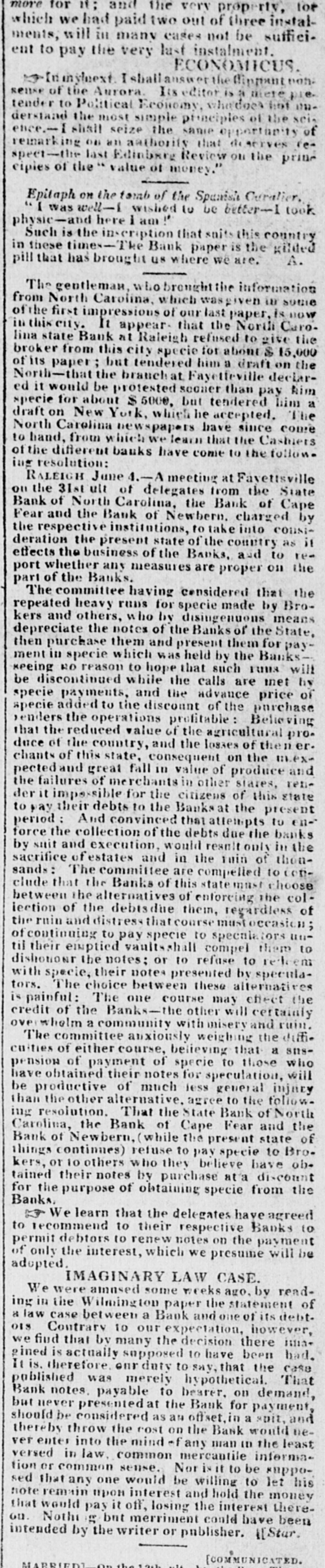
which we had paid two out of three instalments, will in many cases not be sufficient to pay the very last instalment. ECONOMICUS. myleext. I shallanswer the sense of the Aurora. Its editor is a metepic tender to Political Economy, whoches not 1783derstand the most simple principles of the sei, ence.-1 shall seize the sanie opportunity of remarking on an authority that deserves respect-the last Edinbare Review ou the priu cipies of the value of money." Epitaph on the tomb of the Spanish Curalier. I was well-1 wished to be better-1 took physic-and here am Such is the inscription that snits this country in these times-The Bank paper is the kilded A. pill that has brought us where we are. The gentleman, who broughtthe information from North Carolina, which was given in some of the first impressions of our last paper, is now in thiscity. It appear- that the North Caro. lina state Bank at Raleigh refused to give the broker from this city specie for about $ 15,000 fits paper; but tendered him a draft on the North-that the brauchat Fayetfeville declared it would be protested secner than pay him specie for about $ 5000, but tendered him a draft on New York, which he accepted. The North Carolina newspapers have since coure to hand, from which learn that the Cashiers of the different banks have come to the follow. ing resolution: RALEIGH June 4.-Ameeting at Favettsville on the 31st ult of delegates from the State Bank of North Carolina, the Bank of Cape Fear and the Bank of Newbern. charged by the respective institutions, to take into cousideration the present state of the country as it effects the business of the Banks, and to report whether any measures are proper on the part of the Banks. The committee having considered that the repeated heavy runs for specie made by Brokers and others, who by disingenuous means depreciate the notes of the Banks of the State, then purchase them and present them for payment in specie which was held by the Bankskeeing NO reason to hope that such runs will be discontinued while the calls are met by specie payments, and the advance price of specie added to the discount of the purchase , enders the operations profitable: Believing that the reduced value of the agricultural produce of the country, and the losses of thener. chants of this state, consequent on the mexpected and great fall in value of produce and the failures of merchants in other states, retider it impossible for the citizens of this state to pay their debts to the Banks at the present period: And convinced that attempts to enforce the collection of the debts due the banks by suit and execution, would result only in the sacrifice of festates and in the min of thensands: The committee are compelled to conclude that the Banks of this statemust choose between the alternatives of enforcing the collection of the debtsdire their, regardless of the rnin and distressti course occasion; of continuing to pay specie to special tors 1111 til their eimptied vaultsshall compel them to dishonour the notes: or to refuse to reteem with specie, their notes presented by speculators. The choice between these alternatives is painful: The one course may effect the credit of the Banks-the other will certainly overwhelm a community with misery and ruin. The committee anxiously weighing the dufficuities of either course, believing that a suspension of payment of specie to those who have obtained their notes for speculation, will be productive of much less general injury than the other alternative. agree to the following resolution. That the State Bank of North Carolina, the Bank of Cape Fear and the Bank of Newbern, (while the present state of things continues) refuse to pay specie to Bro. kers, or 10 others who they believe have ob. tained their notes by purchase at a discount for the purpose of obtaining specie from the Banks 7 We learn that the delegates have agreed to recommend to their respective Banks to permit debtors to renew notes on the payment of only the interest, which we presuine will be adopted IMAGINARY LAW CASE. We were amnsed some weeks ago, by reading in the Wilmington paper the statement of a law case between a Bank and one of its debt. 013 Contrary to our expectation, however, find that by many the decision there mile. gined is actually supposed to have been had. It is. therefore. our duty to say, that the case published was merely hypothetical. That Bank notes. payable to bearer. on demand, but never presented at the Bank for payment, should be considered as an offset, in a spit, and thereby throw the cost on the Bank would never enter into the mind of any man ID the least versed in law. common mercantile information or common sense. Nor is it to be supposed that any one would be willing to let his note remain upon interest and hold the money that would pay it off, losing the interest thereon. Nothi g but merriment could have been intended by the writer or publisher. if Star.


Article from Richmond Enquirer, January 8, 1829

Click image to open full size in new tab

Article Text

rious, profligate, and bargaining course of the Clay men, is very great, and certainly not less at those prominent Jackson men, who have suffered them- selves to be seduced and ruined by accepting their abandoned advances. Public opinion has much to do in this State before our political atmos- phere will be purified of the pestilence which has been breathed into it by the Coalition of Clay and Adams. As for Col. Johnson, there is no doubt that his old Congressional District will call upon him by acclamation to go into the Houre of Representa- tives at the next session; so that the effect of the late intrigue will only be to bring another efficient friend of the good cause upon the theatre of active political life. Indeed, there is a belief and desire prevailing here, that Gen. Jackson will at once place Col. Johnson upon an eminence still more ex- alted. EID. # BANKS OF NORTH CAROLINA. Report of majority of the Continittee. The Joint Select Committee, to whom was re- ferred so much of the Governor's message as re- lates to the Banks within the State, REPORT: That in consequence of various rumours circu- lated, and charges made against the Banks, your committee have been induced to direct their at- tention and inquiries to several points touching the conduct and situation of those institutions at various periods, and more particularly have endeavoured to as certain, whether the stock of the Banks has been paid for in the manner, and at a time prescribed by their Charters; whether they have at any time issued more paper, or contracted larger debts than their charters authorised; whether they have paid spe- cie on demand; whether they have dealt or traded in any articles unauthorised by charter; whether they have exacted usurious interest; whether they have purchased up or speculated in their own pa- per; and such other matters as were necessarily connected with these inquiries. Your committee have been satisfied from the evidence adduced to them, that the 1st and 2nd instalments of the stock originally subscribed for in the State Bank of North Carolina, were paid for in specie, and some small proportion of 3rd and 4th instalments; but that much the greater part (nearly the whole) of the 3rd and 4th instalments were paid for in the current Bank notes of the State. That this circumstance arose, firstfar are the eth instalment,) from the impracti- cability of procuring the old paper currency of the State, which at that time, was monopolised by the other two Banks; and secondly, from the circum- stance that the Bank, having gone into operation. as required by its charter, after the second fustal- ment was paid and before the third was due, and having issued its own notes to a large amount, re- deemable on demand in specie, was necessarily compelled to consider those notes equivalent to specie, and as such receive them in payment. Your committee, however, further state that at the time when a third instalment was due, tirere was in the principal Bank at Raleigh a larger a- mount in specie, than three fourths the stock suh- scribed for at that place by individuals, and that previous to the time when the fourth instalment hecame due, there had been in its vaults $160,170 in specie, which subsequently, and before the 4t instalment was due, was reduced, by runs upon the Bank, to $62,809 in spečie, besides $11,859 in the paper currency of the State. That had the whole capital subscribed by individuals at the prin- cipal Bank in Raleigh been paid in specie and pa- per currency, there ought then to have been paid into the Bank $184,000 in specie and paper cur- rency. As to the manner in which subscriptions wATS paid for at the various branches of this institution, your committee have had no direct evidence. Your committee have no evidence of any time being prescribed for the payment for stock different from that prescribed by the charter. It is further in evidence before your committee, that the whole stock of this Bank was not sub- scribed for when the books were originally opened; and that by an act of Assembly, passed in the year 1811, the corporation was required again to open its books for subscription to fill up the unsubscri- bed stock, amounting to 4,240 shares, which it did in November 1818; and that these shares were paid for in such notes as were then currently cin- culated in the State; and that although the Banks of the State were then considered specie-paying Banks, yet it appears that at the principal branch of the State Bank, there was at that time $99,973 06-100 in specie, while the notes of that Branch in circulation amounted to $1,186,677. As to the Banks of Newbern and Cape Fear on this point of inquiry, your committee report, that the evidence satisfies them, that when those in stitutions first went into operation, by virtue of the act of 1804, their whole capital was paid in specie: That when their capital was enlarged by the new charter granted in the year 1814, the new stock was paid for in the Bank notes of the State and o- ther current notes. A's to the second point of inquiry to which your committee have directed their attention, whether any of the Banks of this State have at any time issued more notes, or contracted larger debts than they were authorised to do by their charters? they report, it does not appear to your committee that either of the Banks of this State have issued more than three dollars for one of their chartered capital; but that all the Banks have issued more than three for one for every dollar in specie áctu- ally paid in for stock. As to the next inquiry, whether the Banks have paid specle on demand for their notes? your com- mittee report, that during the late war, when the whole Southern States were drained of their spe- cie in consequence of the large expenditure of money at the North, the Banks of North Carolina, together with all the Banks in the United States South of the Potomac, suspended specie pay- ments, as a necessary protection of their specia capital; and that soon after the war, viz. in 1815, 1816, or 1817, the Banks of this State resumed the payment of specie, and from that time did pay specie on demand for their noter tintil June 1819, when by a joint resolution of the three Bangs st was resolved to resist the heavy drafts made upon their funds by brokers; and they declared they would not thenceforward pay specie to brokers or their agents. That since it has been found that brokers compel them to pay specie, the Banks have in general paid brokers their demands. and have as generally refused. payment of their notes to citizens of the State, not owing however. as is believed, to any preference which the Banks entertain for Brokers over citizens; but because the former being capitalists, have it in their power to coerce them; while the latter, rather than en- dure the law's delay content themselves with the notes, and forego their claim to speci. That since that period, (June 1819) though, in effec the Banks of the State have either voluntarily or by compulsion paid all demands against them. which were persisted in, în specie, or fonds deem ed equivalent to specie; yet frequently those de- mands have not been met promptiv: and, in some instances, payments have been made only through the coercion of the law. It is, however, due