Farmers & Merchants National Bank (Fairbury, NE)

Episode Information

Episode UID
1034001491
Episode Type
Suspension โ†’ Closure
Bank Type
national
Bank ID
103400 national
Charter Number
10340
Start Date
March 15, 1924
Location
Fairbury, Nebraska (40.137, -97.181)

Metadata

Model
gpt-5-mini (chosen from majority vote of a three-model LLM ensemble)
Short Digest
d71a8f494bd6fb94

Response Measures

None

Receivership Details

Depositor recovery rate
66.3%
Date receivership started
1924-03-15
Date receivership terminated
1929-09-30
OCC cause of failure
Governance
Share of assets assessed as good
40.3%
Share of assets assessed as doubtful
22.7%
Share of assets assessed as worthless
37.0%

Description

Closed by order of the Comptroller of the Currency; receiver litigation followed.

Events (4)

1. March 5, 1913 Chartered
Source
historical_nic
2. March 15, 1924 Receivership
Source
historical_nic
3. March 15, 1924 Receivership
Newspaper Excerpt
Howard S. Lahman, receiver for the defunct Farmers and Merchants Bank, said to a News reporter this week: ... (receiver named and handling liquidation).
Source
newspapers
4. March 15, 1924 Suspension
Cause
Government Action
Cause Details
Closed by order of the Comptroller of the Currency after unsafe lending practices (loans to stockholders).
Newspaper Excerpt
March 15 the Farmers and Merchants National bank of Fairbury was closed by order of the comptroller of currency.
Source
newspapers

Newspaper Articles (7)

Article from Nebraska Signal, March 27, 1924

Click image to open full size in new tab

Article Text

Mrs. Russell Tetard is much improved. Red onion sets, 10 cents quart.โ€”Camp's Grocery. Judge J. J. Grimm of Wilbur was in Geneva Tuesday. Telephone 60. Free delivery.โ€”Camp's Grocery. J. W. Andrew went to Beaver Crossing yesterday to visit relatives. Two pounds walnuts 35 cents.โ€”Camp's Grocery. Mrs. Irene Blume of Omaha is visiting at the home of her brother, R. Tetard. Elegant flavored coffee, 30, 35, 40, 45 and 50 cents.โ€”Camp's Grocery. Miss Bertha Brown went to Edgar yesterday to attend the funeral of an uncle, W. W. Mallory. Rich stage setting, elaborate Japanese costumes, catchy music, "Yanki San," auditorium, April 4. The measles situation in Geneva is much improved but there are still a number of children out of school. Now is the time to have your hanging baskets filled. Take them to the greenhouse for that purpose. 26-tf Attorney Grady Corbitt left Tuesday for Fremont and points west on the Northwestern. He is seeing Nebraska first. M. R. Campbell, farmer at the girls' training school, was taken suddenly ill of appendicitis Saturday. He is now much improved. W. E. Pumphrey shipped three cars of hogs to Kansas City Sunday. Joe Owens shipped a car of hogs to Kansas City Tuesday. The mother's department will meet April 3 with Mrs. W. A. Biba instead of with Mrs. Robert Waring as stated in the year book. There have been so many cases of measles at Hebron that some of the lower grades of the Hebron school have been closed. Thirty years ago Tuesday Coxey's army started from Massillon, O., with seventy-five men in the ranks to march to Washington. Ira Whipple, a former employee of the Picard Pharmacy, visited friends there a few days this week. He went to Cornish, Col., yesterday. Telephones are made for the ordinary tone of voice. If you scream or shout the other party can hear you all right but can't understand you. Mrs. John Boe of Shickley said yesterday in a telephone conversation with The Signal that Mr. Boe is improving and is able to sit up a little. Mrs. H. H. Theisen left Saturday for her home at Antigo, Wis. She was called here by the death of her grandparents, Mr. and Mrs. C. H. Pierce. Mrs. Homer Thompson left yesterday for her home at Kingfisher, Ok. She was called here by the fatal illness of her father, William Benson. Mrs. A. H. Elder left yesterday for Malvern, Ia., for a two weeks' visit to her parents. She was joined at Lincoln by her sister, Miss Fern Skerritt, who teaches at Hastings. Dramatic recital by Everett Roles Friday, March 28, Geneva City Auditorium, 8:30 p. m. Mrs. H. L. Monson, soloist. Tickets on sale at Fellow Bros. cafe. Popular prices. The article announcing the sale of forty acres of land by Frank W. Sloan to Art Sole stated the price incorrectly. The price was $175 per acre. The land adjoins Geneva and has no buildings on it. Fairbury News: A Kansas paper complains that a "good ball player gets twice as much salary as the average governor." Well, some of us who live in Nebraska can readily see why that should be. Howard Davis, who is working in George Knight's bank at University Place, went to University Place Tuesday after spending the first half of the spring vacation at home. He is attending Wesleyan university. The four York newspapers, two of them democratic, have united in a circular asking the republicans of the state to elect Charles A. McCloud of York their national committeeman. It is an unusual tribute to an unusual man. Naturally Fillmore county republicans will vote for Mr. McCloud because he proved a good committeeman when he held the position before, he has proved his stability as a party worker and he is their neighbor. March 15 the Farmers and Merchants National bank of Fairbury was closed by order of the comptroller of currency. It was the smallest and weakest of the Fairbury banks. Its capital was small, its surplus was very small and its deposits were small. The bank got into trouble by loaning money to its stockholders. Of course they couldn't pay it back. Fairbury papers say the depositors won't lose much. Men who have to borrow money shouldn't be allowed to run a bank. Sunday afternoon while five young men were sitting in Leo Dondlinger's car in front of the Meridian cafe the car was suddenly found to be on fire. It is not known how the fire started. An alarm was turned in and the fire was extinguished with the chemical truck. The upholstering, top and windshield were destroyed but the body of the car was not seriously damaged. The gasoline tank did not explode. The car was driven under its own power to a garage for repairs. Chairman Allen of the democratic state committee has issued a call for the state platform convention, which will also select a state committee and electors for president and vice president, at Omaha on May 1. The meeting is called for 1 o'clock, and altho the committee fixed the basis on the vote for governor two years ago the call gave each county one delegate at large and one for every 125 votes cast for Cox for president in 1920. No proxies are to be allowed. County conventions will meet on April 24.
Article from The Lincoln Star, July 1, 1924

Click image to open full size in new tab

Article Text

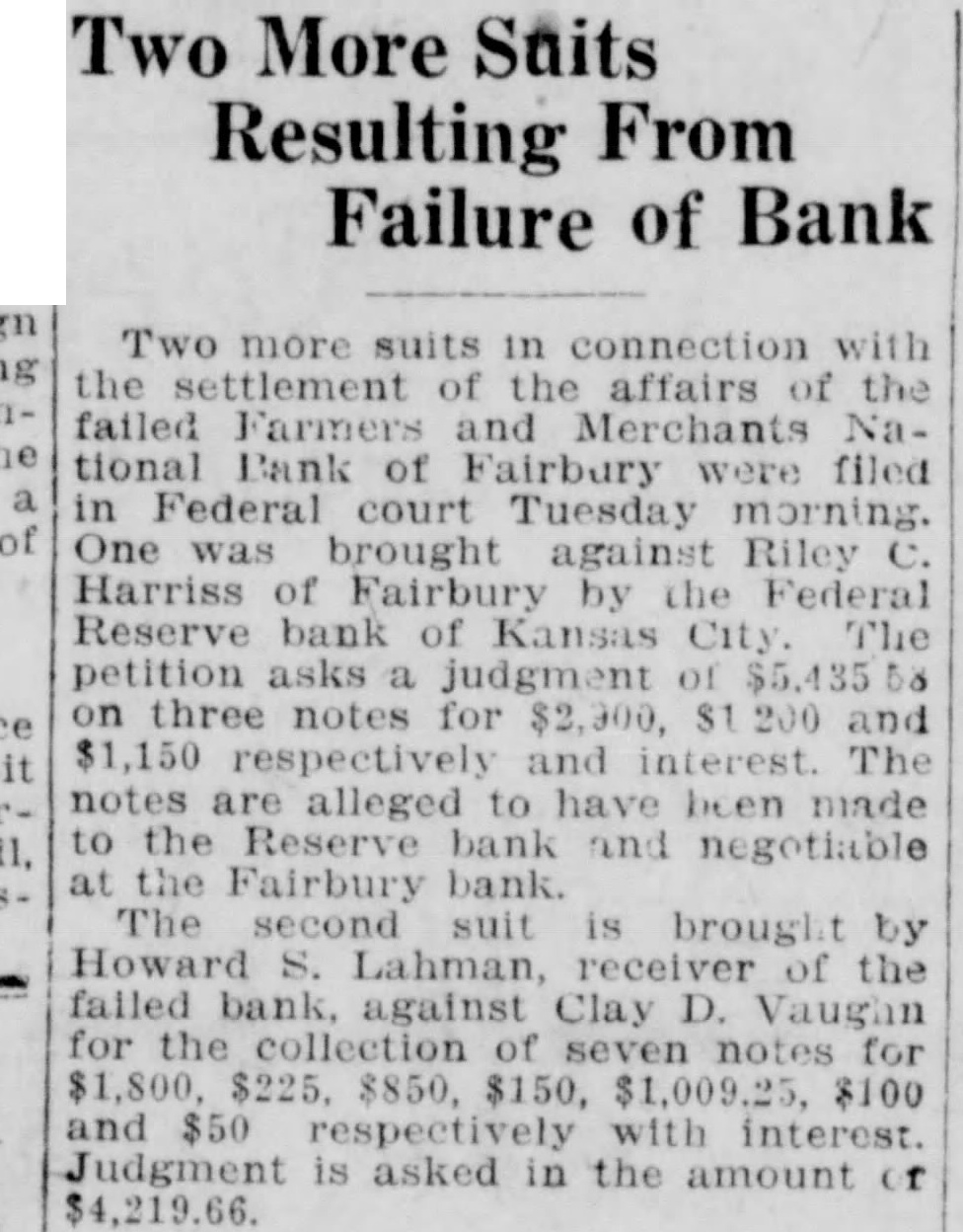
Two More Suits Resulting From Failure of Bank Two more suits in connection with the settlement of the affairs of the failed Farmers and Merchants National Bank of Fairbury were filed in Federal court Tuesday morning. One was brought against Riley C. Harriss of Fairbury by the Federal Reserve bank of Kansas City. The petition asks a judgment of $5,435.58 on three notes for $2,300, $1,200 and $1,150 respectively and interest. The notes are alleged to have been made to the Reserve bank and negotiable at the Fairbury bank. The second suit is brought by Howard S. Lahman, receiver of the failed bank, against Clay D. Vaughn for the collection of seven notes for $1,800, $225, $850, $150, $1,009.25, $100 and $50 respectively with interest. Judgment is asked in the amount of $4,219.66.


Article from The Lincoln Star, July 1, 1924

Click image to open full size in new tab

Article Text

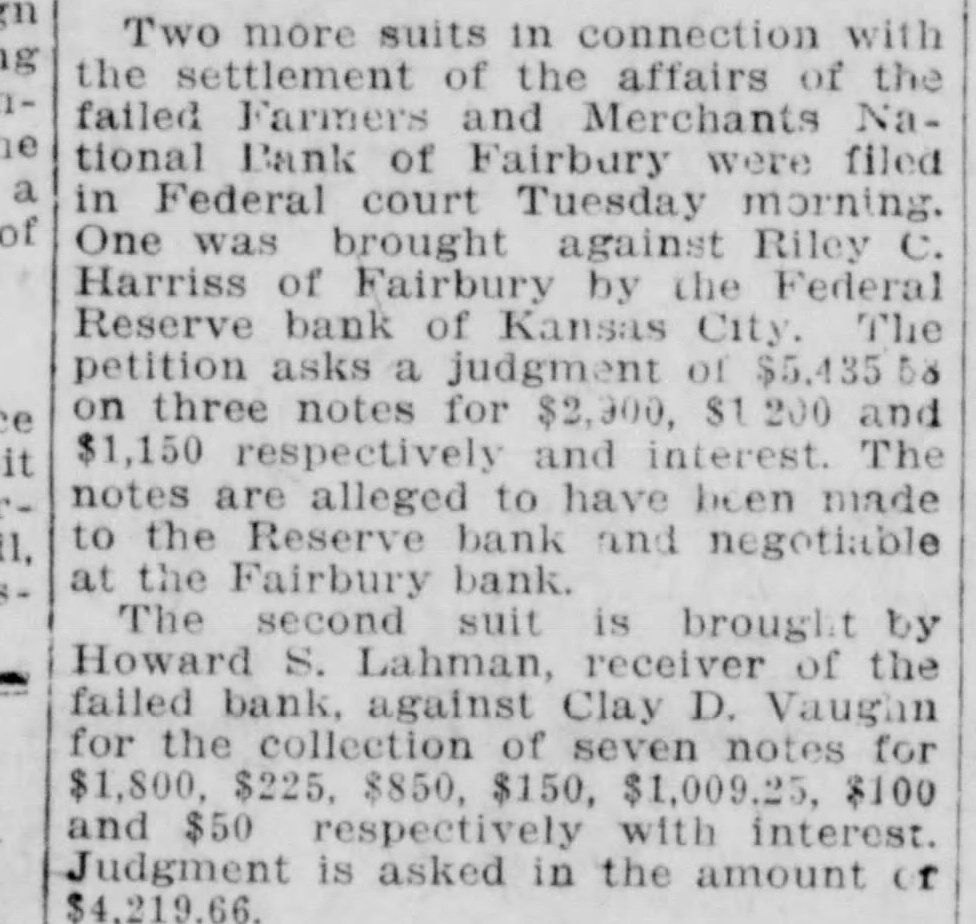
Two more suits in connection with the settlement of the affairs of the failed Farmers and Merchants National Bank of Fairbury were filed in Federal court Tuesday morning. One was brought against Riley C. Harriss of Fairbury by the Federal Reserve bank of Kansas City. The petition asks a judgment of $5,435.58 on three notes for $2,300, $1,200 and $1,150 respectively and interest. The notes are alleged to have been made to the Reserve bank and negotiable at the Fairbury bank. The second suit is brought by Howard S. Lahman, receiver of the failed bank, against Clay D. Vaughn for the collection of seven notes for $1,800, $225, $850, $150, $1,009.25, $100 and $50 respectively with interest. Judgment is asked in the amount of $4,219.66.


Article from The Lincoln Star, December 10, 1924

Click image to open full size in new tab

Article Text

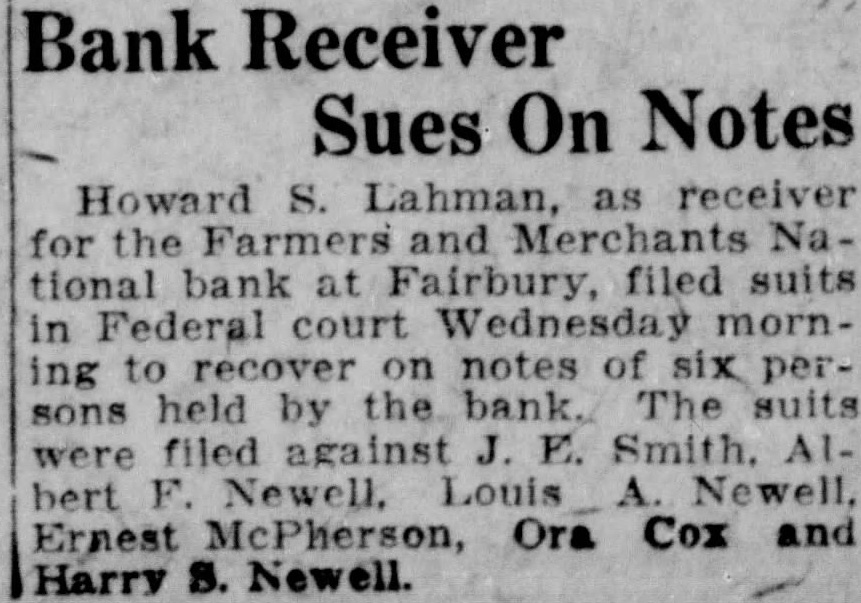
Bank Receiver Sues On Notes Howard S. Lahman, as receiver for the Farmers and Merchants National bank at Fairbury, filed suits in Federal court Wednesday morning to recover on notes of six persons held by the bank. The suits were filed against J. E. Smith, Albert F. Newell, Louis A. Newell, Ernest McPherson, Ora Cox and Harry S. Newell.


Article from The Fairbury Daily News, March 12, 1925

Click image to open full size in new tab

Article Text

FAILED BANK AFFAIRS Receiver Believes It Will Pay At Least 50 Per Cent. Howard S. Lahman, receiver for the defunct Farmers and Merchants Bank, said to a News reporter this week: "The following comparisons are made from figures taken from the reports of your receiver and other receivers to the Comptroller of the Currency for the period from 1921 to the date this Trust was created and includes only figures from failed National Banks located in Nebraska and territory immediately contiguous. "Out of 33 failed National Banks, many of which have been in liquidation from one to three years longer than this trust, 21 had paid no dividend at all up to the time this bank paid its first dividend of 25 per cent. The most paid by any of these banks was 30 per cent. The average paid by the 33 banks was 8.66 per cent. With several of these 33 banks, was quite familiar and it is therefore reasonable for me to forecast that none will finally pay out better than the Farmers and Merchants National Bank of Fairbury, and few of them will pay as well. One of the four trusts which. had paid 30 per cent at the time this trust had paid its first dividend is already closed for good. Most of the 33 trusts have been in receivership year to three years longer than this one. At least two of the nine receiverships in Nebraska will not likely pay depositors over 15 per cent in the final wind-up. "For this trust, there is no reason, yet, to doubt that depositors will receive less than 50 per cent. Collections still continue to conform quite closely to the original estimates of asset values, with some assets classed doubtful or worthless being collected steadily. "Litigation, so far, has been very favorable to the bank, both as to decisions and amounts involved, and is believed judgments obtained will much more than justify the expenditures required to procure them. "With the view not only to increasing collectibility but to avoid harmful tactics in general, many debts have been extended until next harvest. Therefore, it is not likely another dividend will be paid until August, although one may be possible earlier. The pense of paying dividend discourages paying less than 15 per cent at time. "One obstacle to the payment of dividends is the fact that two claims aggregating $50,000.00 have been filed and although they were rejected, enough cash must be held back to pay these claimants their pro rata share should the courts compel me to recognize them. Thus if were to pay another dividend of 15 per cent in addition to the one of 25 per cent already distributed, before could do so would have to have sufficient cash not only to pay 15 per cent on all proved claims, but sufficient to leave 40 per cent of these two $50,claims in the receiver's hands. Thus $20,000.00 would have to withheld from creditors whose claims have been proved. However, as soon as the case shall have been adjudicated, if in your favor, the will, of course be prorated to you along with other funds collected."


Article from The Fairbury Daily News, July 23, 1925

Click image to open full size in new tab

Article Text

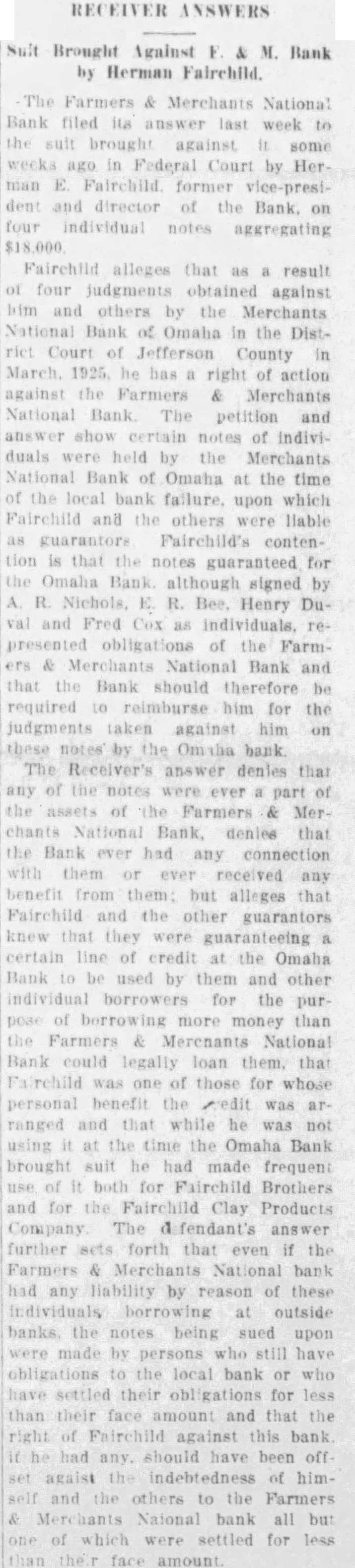
RECEIVER ANSWERS Suit Brought Against & M. Bank by Herman Fairchild. The Farmers & Merchants National Bank filed its answer last week to the suit brought against some weeks ago in Federal Court by Herman E Fairchild former vice-president and director of the Bank. on four individual notes aggregating Fairchild alleges that as a result of four judgments obtained against him and others by the Merchants National Bank of Omaha in the District Court of Jefferson County in March. 1925. he has right of action against the Farmers & Merchants National Bank The petition and answer show certain notes of Individuals were held by the Merchants National Bank of Omaha at the time of the local bank failure upon which Fairchild and the others were liable as guarantors Fairchild's contention is that the notes guaranteed for the Omaha Bank although signed by A. R. Nichols, E. R. Bee, Henry Duval and Fred Cox as individuals. represented obligations of the Farmers & Merchants National Bank and that the Bank should therefore be required to reimburse him for the judgments taken against him on these notes by the bank. The Receiver's answer denies that any of the notes were ever a part of the assets of the Farmers & Merchants National Bank, denies that the Bank ever had any connection with them or ever received any benefit from them: but alleges that Fairchild and the other guarantors knew that they were guaranteeing certain line of credit at the Omaha Bank to be used by them and other individual borrowers for the purpose of borrowing more money than the Farmers & Mercnants National Bank could legally loan them. that Fairchild was one of those for whose personal benefit the redit was arranged and that while he was not using it at the time the Omaha Bank brought suit he had made frequent use of It both for Fairchild Brothers and for the Fairchild Clay Products Company The defendant's answer further sets forth that even if the Farmers & Merchants National bank had any liability by reason of these individuals borrowing at outside banks the notes being sued upon were made by persons still have obligations to the local bank or who have settled their obligations for less than their face amount and that the right of Fairchild against this bank had any. should have been off set agaist the indebtedness of himand the others to the Farmers Merchants Naional bank all but of which were settled for less their face amount


Article from Lincoln Journal Star, December 18, 1925

Click image to open full size in new tab

Article Text

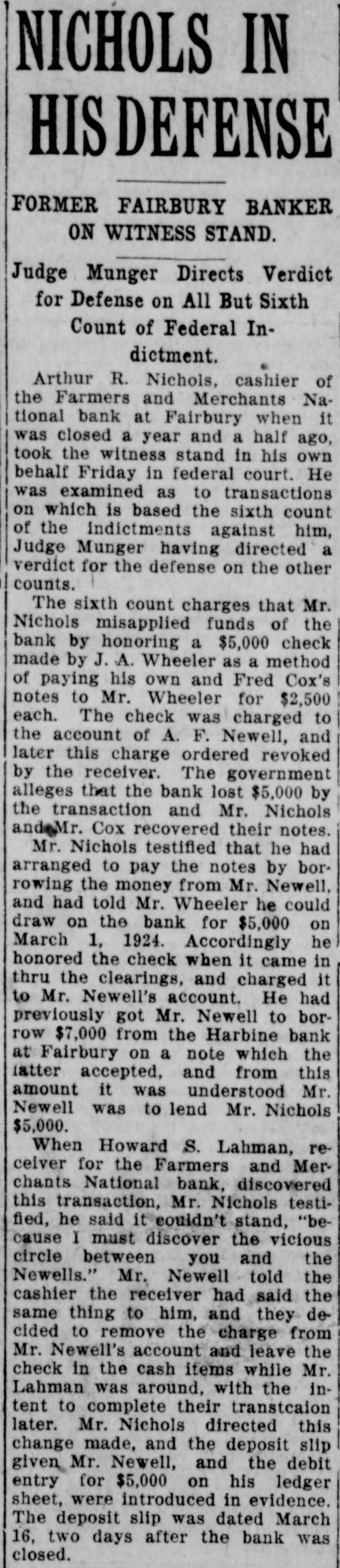
NICHOLS IN HIS DEFENSE FORMER FAIRBURY BANKER ON WITNESS STAND. Judge Munger Directs Verdict for Defense on All But Sixth Count of Federal Indictment. Arthur R. Nichols, cashier of the Farmers and Merchants National bank at Fairbury when it was closed a year and a half ago, took the witness stand in his own behalf Friday in federal court. He was examined as to transactions on which is based the sixth count of the indictments against him, Judge Munger having directed a verdict for the defense on the other counts. The sixth count charges that Mr. Nichols misapplied funds of the bank by honoring a $5,000 check made by J. A. Wheeler as a method of paying his own and Fred Cox's notes to Mr. Wheeler for $2,500 each. The check was charged to the account of A. F. Newell, and later this charge ordered revoked by the receiver. The government alleges that the bank lost $5,000 by the transaction and Mr. Nichols and Mr. Cox recovered their notes. Mr. Nichols testified that he had arranged to pay the notes by borrowing the money from Mr. Newell, and had told Mr. Wheeler he could draw on the bank for $5,000 on March 1, 1924. Accordingly he honored the check when it came in thru the clearings, and charged it to Mr. Newell's account. He had previously got Mr. Newell to borrow $7,000 from the Harbine bank at Fairbury on a note which the latter accepted, and from this amount it was understood Mr. Newell was to lend Mr. Nichols $5,000. When Howard S. Lahman, receiver for the Farmers and Merchants National bank, discovered this transaction, Mr. Nichols testified, he said it couldn't stand, "because I must discover the vicious circle between you and the Newells." Mr. Newell told the cashier the receiver had said the same thing to him, and they decided to remove the charge from Mr. Newell's account and leave the check in the cash items while Mr. Lahman was around, with the intent to complete their transaction later. Mr. Nichols directed this change made, and the deposit slip given Mr. Newell, and the debit entry for $5,000 on his ledger sheet, were introduced in evidence. The deposit slip was dated March 16, two days after the bank was closed.