Click image to open full size in new tab
Article Text
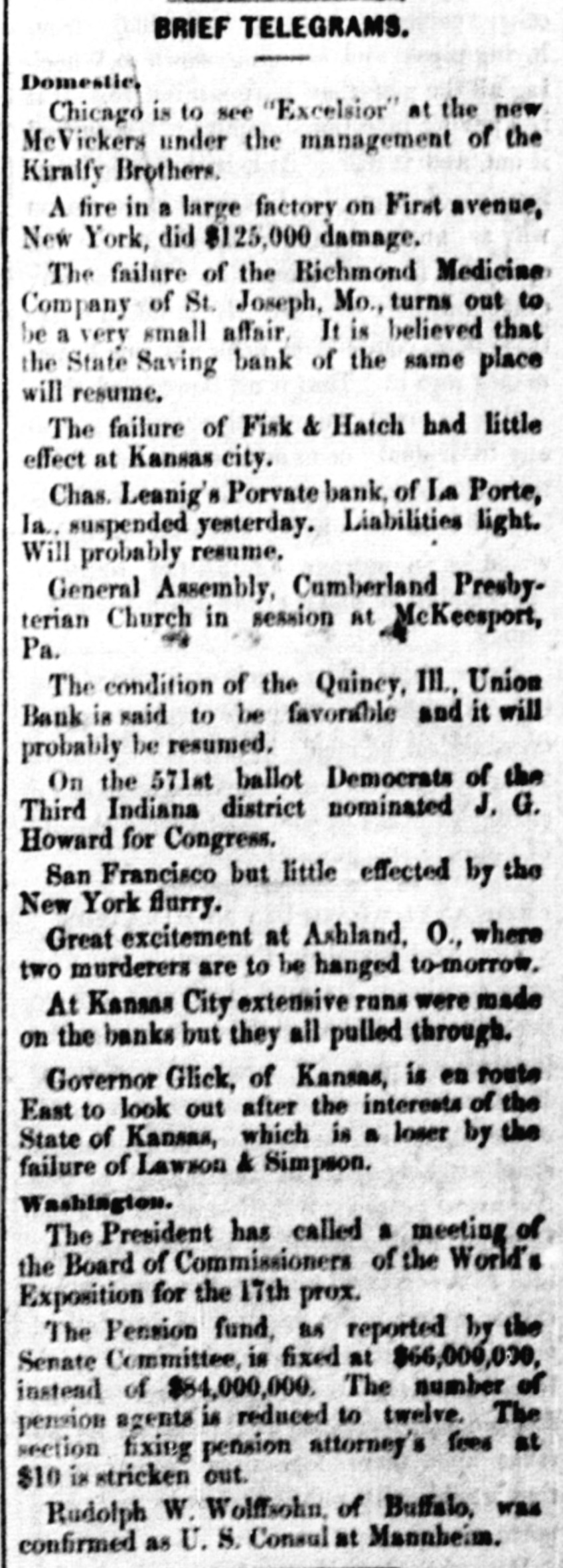
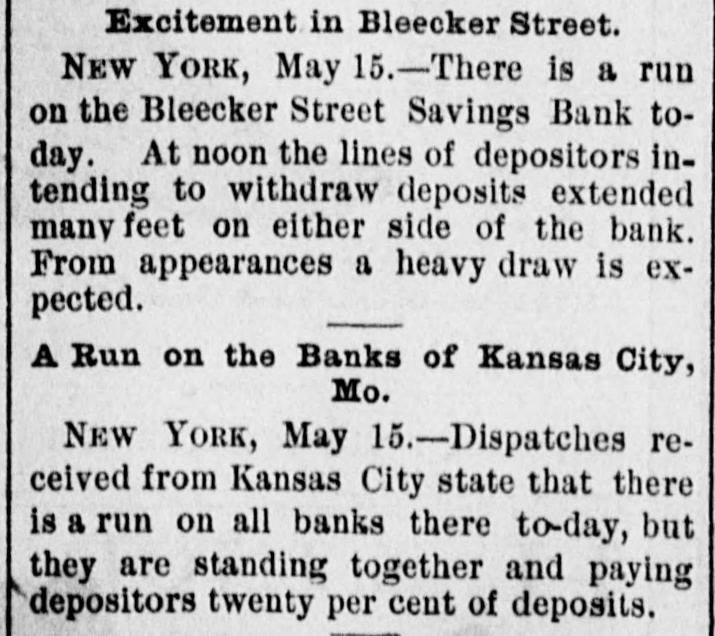
days of 1873, when business was nearly suspended and when fortunes were swallowed up in the twinkling of an eye. Since 1873 it has not required much of an. effort to create an excitement, and so when the firm of Grant & Ward failed for ten millions of dollars and the country could not understand of what the firm's capital originally consisted, or how it was possible for any legitimate business to fall suddenly behind to such an alarming extent, there immediately grew up an uneasiness, a doubting of bankers and brokers generally. Last Thursday the crash came, and a dozen or more small brokers' in New York closed their doors. Fisk & Hatch, a leading firm of brokers, and the most extensive dealers in government securities on Wall street, gave up the ghost. Donnell, Lawson & Simpson, the well known bankers, suspended. The Metropolitan bank closed its doors. No sooner had the news flashed across the continent than the west became alarmed and wanted its money. Two of the firm of D. L. & S. were western men, from Missouri, and the bank had succeeded in becoming the correspondent for a large number of western banks-an hundred in Missouri, and as many in Kansas; and besides was the fiscal agent of the state of Kansas. Of course the announcement of such a failure caused trouble. At St. Joseph, Missouri, the State Savings bank largely owned by Donnell, was compelled to suspend, though it had always been considered safe. At Kansas City a considerable run was made on the banks, and as a matter of self protection they agreed to pay twenty per cent. of all demands, and give certified checks for the balance due depositors. This arrangement was satisfactory, and no serious inconvenience was experienced, though from this distance it is apparent that there was some trembling indulged in by the Kansas City institutions. By Saturday the excitement had about subsided, and up to now no new failures have been reported from the east. It is safe to say that the time is not far distant when the system of gambling in stocks, now the life of Wall street, will be entirely changed. It must be broken up, or only confined to the class who would gamble on the weather, or events as uncertain. Sound business men are fast finding out that they can invest their money in the great and growing west, and besides having it secured by actual property, they can derive a reasonable dividend on their investment. The time has past when the capitalists of the east would as soon think of loaning money on the fish in Boston harbor as on the cattle grazing over western plains. But outside of cattle the west can offer hundreds of other investments absolutely safe. These will, in time, take up the surplus money now being recklessly thrown away on the uncertainties connected with stock speculations. The values of railroad stocks and bonds must be settled municipal obligations must be redeemed or refunded into paper bearing a lower rate of interest, which interest must be promptly paid. Everything in the shape of securities must be trimmed up, re-written, and their exact valuations known. The country is too prosperous, the producing classes too independent, the real capitalists too particular to longer indulge in guess work when seeking investments. The sooner every rotten broker, every unsound bank, every snide financial speculator is forced to the wall the better. We hope to see the list of Wall street gamblers that are compelled to suspend run up into the thousands of names. We hope to hear of the failure of every banking institution that permits its funds used in buying "futures" or in monkeying with "wild cat" stocks. When the rotten branches of this immense financial and commercial tree have been cut off new life must be the