10289. First National Bank (Asheville, NC)

Bank Information

Episode Type
Suspension โ†’ Closure
Bank Type
national
Bank ID
3418
Charter Number
3418
Start Date
January 1, 1893*
Location
Asheville, North Carolina (35.601, -82.554)

Metadata

Model
gpt-5-mini
Short Digest
aa9a606f7160a3dd

Response Measures

None

Receivership Details

Depositor recovery rate
7.3%
Date receivership started
1897-08-23
Date receivership terminated
1909-07-27
OCC cause of failure
Fraud
Share of assets assessed as good
6.4%
Share of assets assessed as doubtful
15.8%
Share of assets assessed as worthless
77.7%

Description

Articles (1904) report the embezzlement trial of former president William E. Breese and repeatedly refer to the First National Bank of Asheville as a defunct bank that previously failed. No contemporaneous run is described in these items; the bank's failure is attributed to bank-specific malfeasance (embezzlement) and earlier effects of the panic of 1892โ€“93. Exact failure/suspension date is not given in these clippings; failure occurred historically in the 1890s per Breese's testimony.

Events (4)

1. December 4, 1885 Chartered
Source
historical_nic
2. January 1, 1893* Suspension
Cause
Bank Specific Adverse Info
Cause Details
Embezzlement by president William E. Breese and improper officer overdrafts; bank described as having failed following the panic of 1892โ€“93.
Newspaper Excerpt
In his testimony, Mr. Breese explained that the failure of the bank was due to the panic of 1892 and 1893...the cases against Penland and Dickerson, other officers of the defunct bank...
Source
newspapers
3. August 23, 1897 Receivership
Source
historical_nic
4. * Receivership
Newspaper Excerpt
the First National Bank of Asheville ... of which he was president ... the cases against Penland and Dickerson of the defunct bank ... are accused of taking about $175,000 (articles refer to the bank as defunct and to prosecutions related to its failure).
Source
newspapers

Newspaper Articles (4)

Article from The Savannah Morning News, July 21, 1904

Click image to open full size in new tab

Article Text

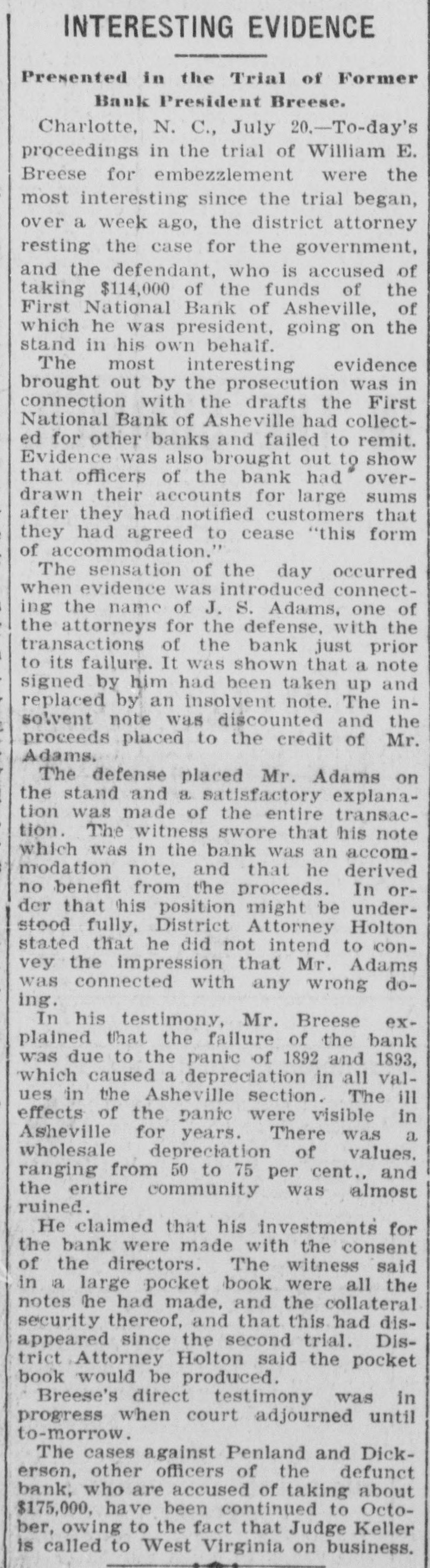
INTERESTING EVIDENCE Presented in the Trial of Former Bank President Breese. Charlotte, N. C., July 20.-To-day's proceedings in the trial of William E. Breese for embezzlement were the most interesting since the trial began, over a week ago, the district attorney resting the case for the government, and the defendant, who is accused of taking $114,000 of the funds of the First National Bank of Asheville, of which he was president, going on the stand in his own behalf. The most interesting evidence brought out by the prosecution was in connection with the drafts the First National Bank of Asheville had collected for other banks and failed to remit. Evidence was also brought out to show that officers of the bank had overdrawn their accounts for large sums after they had notified customers that they had agreed to cease "this form of accommodation." The sensation of the day occurred when evidence was introduced connecting the name of J. S. Adams, one of the attorneys for the defense, with the transactions of the bank just prior to its failure. It was shown that a note signed by him had been taken up and replaced by an insolvent note. The insolvent note was discounted and the proceeds placed to the credit of Mr. Adams. The defense placed Mr. Adams on the stand and a satisfactory explanation was made of the entire transaction. The witness swore that his note which was in the bank was an accommodation note, and that he derived no benefit from the proceeds. In order that his position might be understood fully, District Attorney Holton stated that he did not intend to convey the impression that Mr. Adams was connected with any wrong doing. In his testimony, Mr. Breese explained that the failure of the bank was due to the panic of 1892 and 1893, which caused a depreciation in all values in the Asheville section. The ill effects of the panic were visible in Asheville for years. There was a wholesale depreciation of values. ranging from 50 to 75 per cent., and the entire community was almost ruined. He claimed that his investments for the bank were made with the consent of the directors. The witness said in a large pocket book were all the notes he had made, and the collateral security thereof, and that this had disappeared since the second trial. District Attorney Holton said the pocket book would be produced. Breese's direct testimony was in progress when court adjourned until to-morrow. The cases against Penland and Dickerson, other officers of the defunct bank, who are accused of taking about $175,000. have been continued to October, owing to the fact that Judge Keller is called to West Virginia on business.
Article from The Times Dispatch, July 21, 1904

Click image to open full size in new tab

Article Text

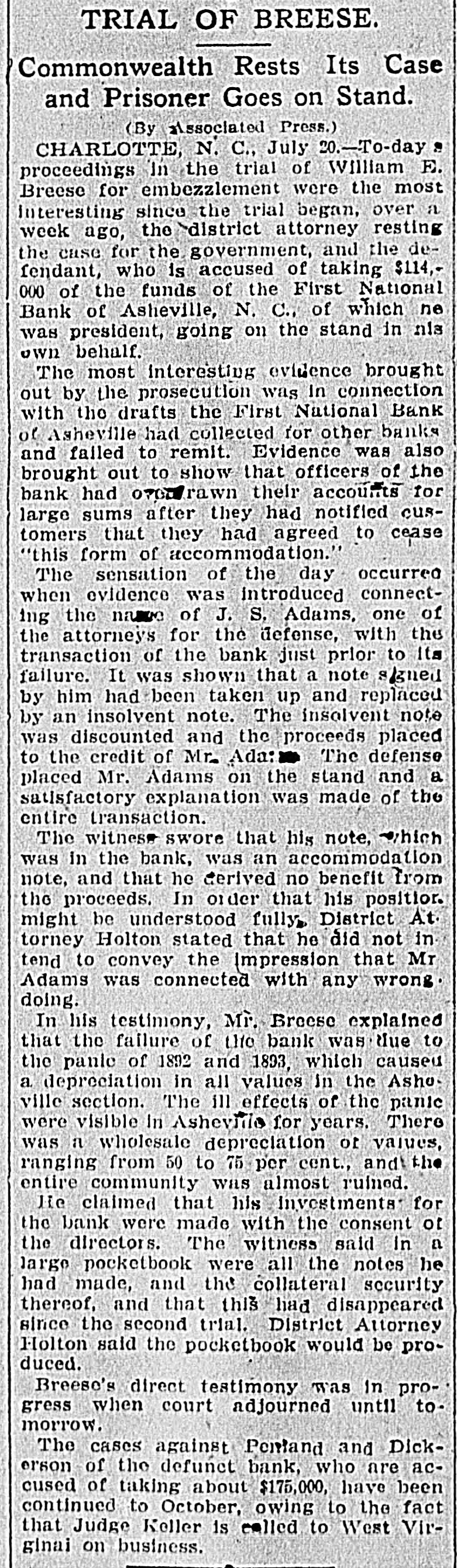
# TRIAL OF BREESE. Commonwealth Rests Its Case and Prisoner Goes on Stand. (By Associated Press.) CHARLOTTE, N. C., July 20.-To-day proceedings in the trial of William E. Breese for embezzlement were the most interesting since the trial began, over a week ago, the district attorney resting the case for the government, and the defendant, who is accused of taking $114,000 of the funds of the First National Bank of Asheville, N. C., of which he was president, going on the stand in his own behalf. The most interesting evidence brought out by the prosecution was in connection with the drafts the First National Bank of Asheville had collected for other banks and failed to remit. Evidence was also brought out to show that officers of the bank had overdrawn their accounts for large sums after they had notified customers that they had agreed to cease "this form of accommodation." The sensation of the day occurred when evidence was introduced connecting the name of J. S. Adams, one of the attorneys for the defense, with the transaction of the bank just prior to its failure. It was shown that a note signed by him had been taken up and replaced by an insolvent note. The insolvent note was discounted and the proceeds placed to the credit of Mr. Adams. The defense placed Mr. Adams on the stand and a satisfactory explanation was made of the entire transaction. The witness swore that his note, which was in the bank, was an accommodation note, and that he derived no benefit from the proceeds. In order that his position might be understood fully, District Attorney Holton stated that he did not intend to convey the impression that Mr Adams was connected with any wrong doing. In his testimony, Mr. Breese explained that the failure of the bank was due to the panic of 1892 and 1893, which caused a depreciation in all values in the Asheville section. The ill effects of the panic were visible in Asheville for years. There was a wholesale depreciation of values, ranging from 50 to 75 per cent., and the entire community was almost ruined. He claimed that his investments for the bank were made with the consent of the directors. The witness said in a large pocketbook were all the notes he had made, and the collateral security thereof, and that this had disappeared since the second trial. District Attorney Holton said the pocketbook would be produced. Breese's direct testimony was in progress when court adjourned until tomorrow. The cases against Perland and Dickerson of the defunct bank, who are accused of taking about $175,000, have been continued to October, owing to the fact that Judge Keller is called to West Virginia on business.


Article from The Semi-Weekly Messenger, July 22, 1904

Click image to open full size in new tab

Article Text

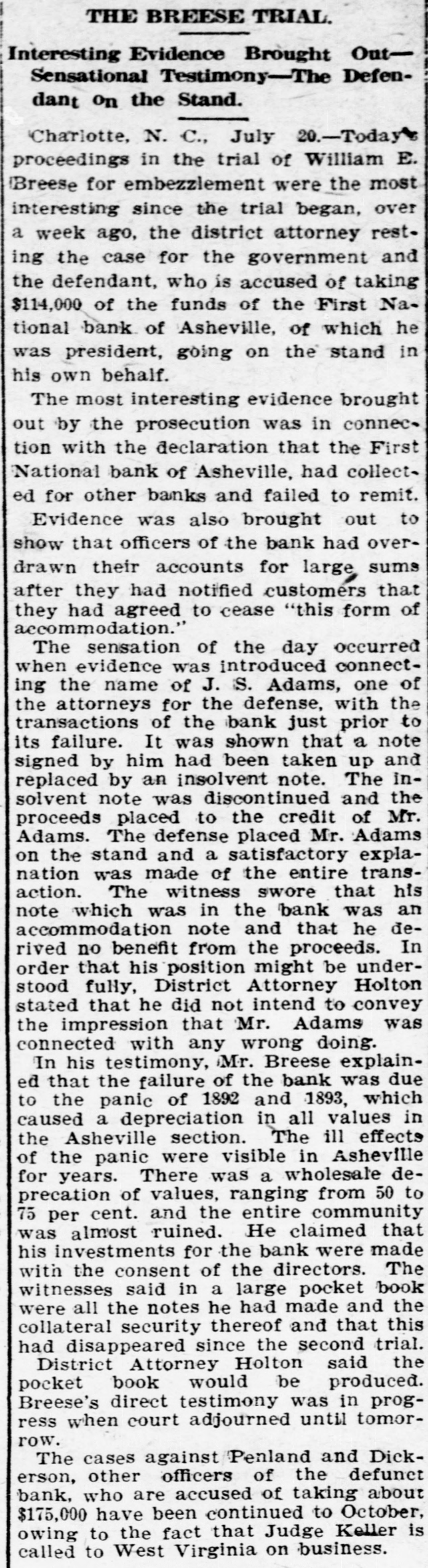
THE BREESE TRIAL. Interesting Evidence Brought OutSensational Testimony-The Defendant on the Stand. Charlotte, N. C., July 20.-Today proceedings in the trial of William E. Breese for embezzlement were the most interesting since the trial began, over a week ago, the district attorney resting the case for the government and the defendant, who is accused of taking $114,000 of the funds of the First National bank of Asheville, of which he was president, going on the stand in his own behalf. The most interesting evidence brought out by the prosecution was in connection with the declaration that the First National bank of Asheville, had collected for other banks and failed to remit. Evidence was also brought out to show that officers of the bank had overdrawn their accounts for large sums after they had notified customers that they had agreed to cease "this form of accommodation." The sensation of the day occurred when evidence was introduced connecting the name of J. S. Adams, one of the attorneys for the defense, with the transactions of the bank just prior to its failure. It was shown that a note signed by him had been taken up and replaced by an insolvent note. The insolvent note was discontinued and the proceeds placed to the credit of Mr. Adams. The defense placed Mr. Adams on the stand and a satisfactory explanation was made of the entire transaction. The witness swore that his note which was in the bank was an accommodation note and that he derived no benefit from the proceeds. In order that his position might be understood fully, District Attorney Holton stated that he did not intend to convey the impression that Mr. Adams was connected with any wrong doing. In his testimony, Mr. Breese explained that the failure of the bank was due to the panic of 1892 and 1893, which caused a depreciation in all values in the Asheville section. The ill effects of the panic were visible in Asheville for years. There was a wholesale deprecation of values, ranging from 50 to 75 per cent. and the entire community was almost ruined. He claimed that his investments for the bank were made with the consent of the directors. The witnesses said in a large pocket book were all the notes he had made and the collateral security thereof and that this had disappeared since the second trial. District Attorney Holton said the pocket book would be produced. Breese's direct testimony was in progress when court adjourned until tomorrow. The cases against Penland and Dickerson, other officers of the defunct bank, who are accused of taking about $175,000 have been continued to October, owing to the fact that Judge Keller is called to West Virginia on business.


Article from The Birmingham Age-Herald, July 22, 1904

Click image to open full size in new tab

Article Text

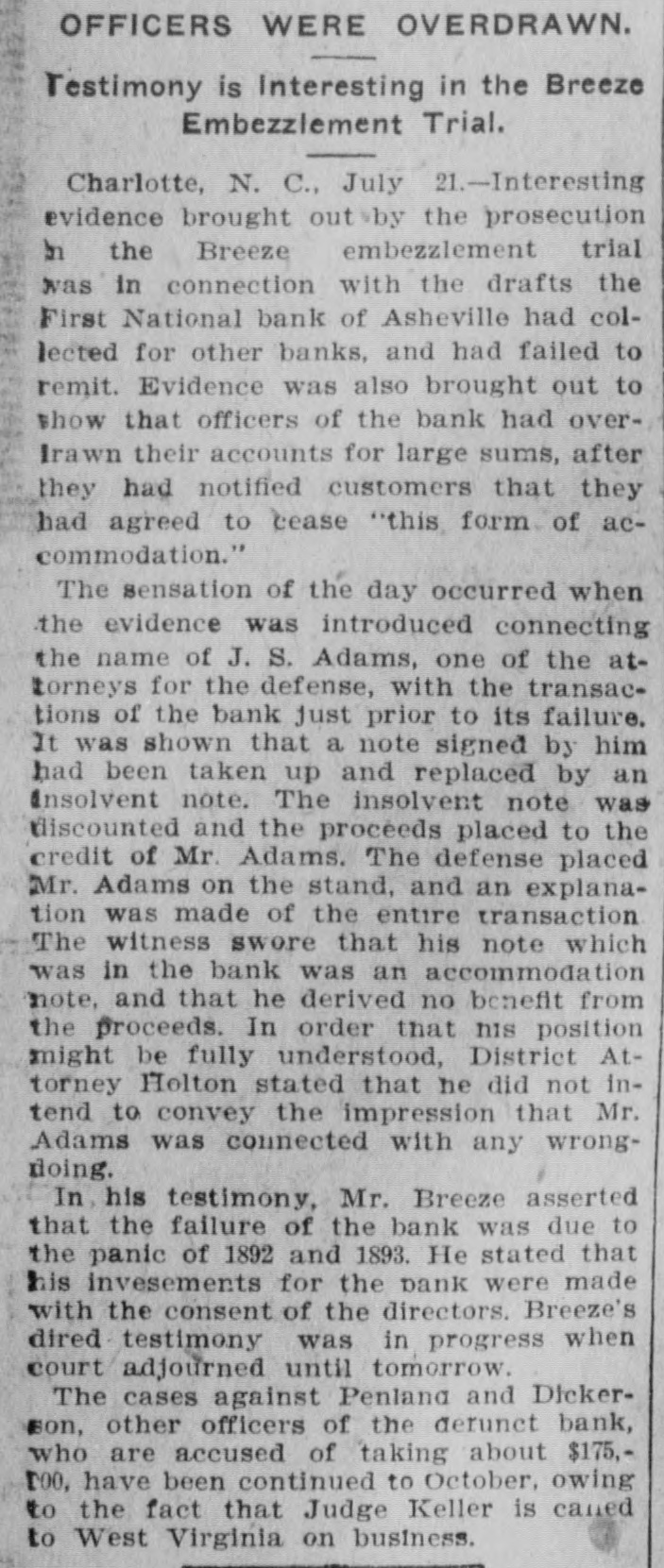
OFFICERS WERE OVERDRAWN. Testimony is Interesting in the Breeze Embezzlement Trial. Charlotte, N. C., July 21.-Interesting evidence brought out by the prosecution in the Breeze embezzlement trial was in connection with the drafts the First National bank of Asheville had collected for other banks, and had failed to remit. Evidence was also brought out to show that officers of the bank had overIrawn their accounts for large sums, after they had notified customers that they had agreed to cease "this form of accommodation." The sensation of the day occurred when the evidence was introduced connecting the name of J. S. Adams, one of the attorneys for the defense, with the transactions of the bank just prior to its failure. It was shown that a note signed by him had been taken up and replaced by an Insolvent note. The insolvent note was discounted and the proceeds placed to the credit of Mr. Adams. The defense placed Mr. Adams on the stand, and an explanation was made of the entire transaction The witness swore that his note which was in the bank was an accommodation note, and that he derived no benefit from the proceeds. In order that his position might be fully understood, District Attorney Holton stated that he did not intend to convey the impression that Mr. Adams was connected with any wrongdoing. In, his testimony, Mr. Breeze asserted that the failure of the bank was due to the panic of 1892 and 1893. He stated that his invesements for the bank were made with the consent of the directors. Breeze's dired testimony was in progress when court adjourned until tomorrow. The cases against Penland and Dickerson, other officers of the derunct bank, who are accused of taking about $175,100, have been continued to October, owing to the fact that Judge Keller is caned to West Virginia on business.