Union Trust Company (New York, NY)

Episode Information

Episode Type
Run → Suspension → Reopening
Start Date
September 19, 1873
Location
New York, New York (40.714, -74.006)
Bank Type
private
Routing Number
1-0191
Alt. names
Central Union Trust Company

Metadata

Notes

Defalcation by secretary (Carlton) triggered run; receiver appointed and later Vanderbilt settlement enabled resumption.

Events (6)

1. September 19, 1873 Run
Cause
Bank Specific Adverse Info
Cause Details
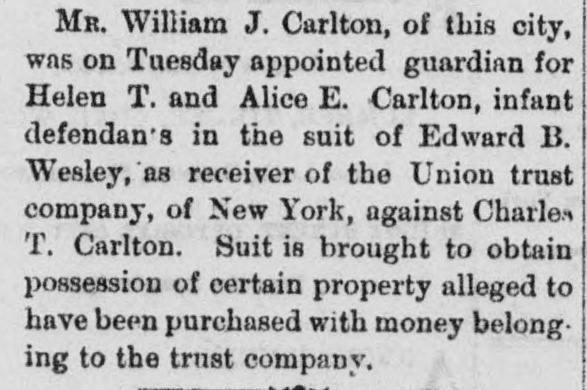
Discovery of large defalcation by the company's secretary (Charles/Carleton) and heavy unavailable call loans.
Measures
Paid out large sums during the day; police stationed to preserve order; inquiries and public statements by trustees to dispel rumors.
Newspaper Excerpt
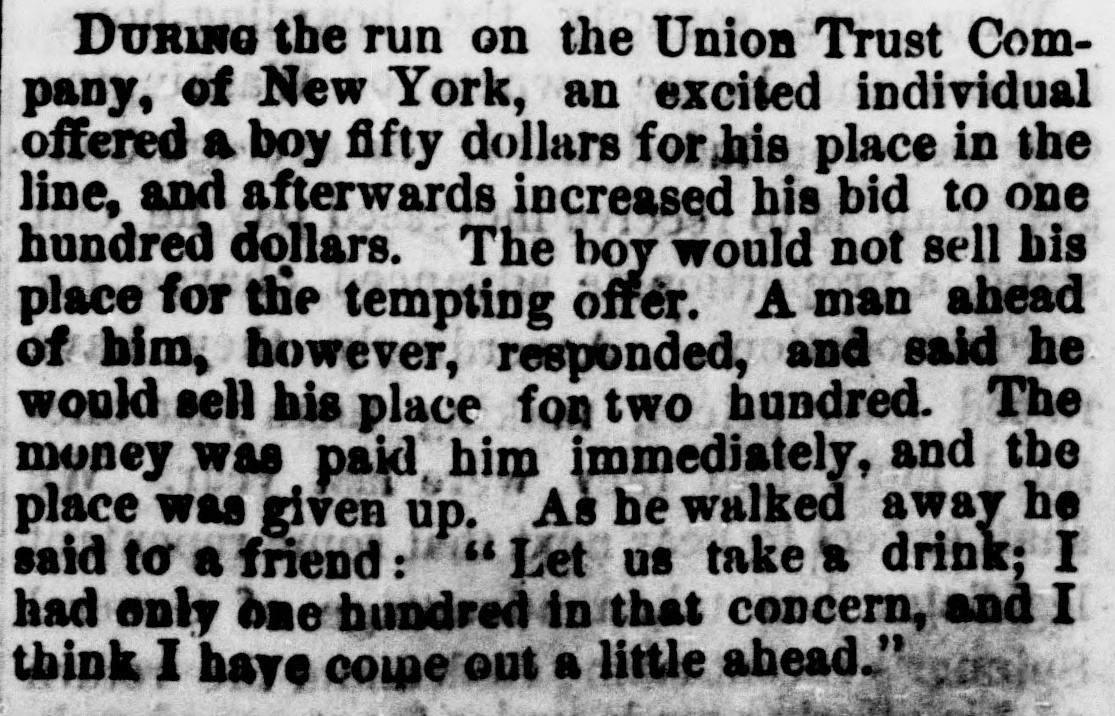
there was an immediate run upon it, which lasted until about the close of banking hours.
Source
newspapers
2. September 20, 1873 Suspension
Cause
Bank Specific Adverse Info
Cause Details
Suspension prompted by inability to realize on large call loans (notably Lake Shore loan) and discovered defalcation by secretary; directors closed doors to examine affairs.
Newspaper Excerpt
posted a notice ... it would be necessary for the Company to suspend payment until Monday morning at 10 o'clock.
Source
newspapers
3. September 22, 1873 Other
Newspaper Excerpt
This institution is in the hands of a receiver. A statement of its affairs is being prepared and will soon be made public.
Source
newspapers
4. October 25, 1873 Other
Newspaper Excerpt
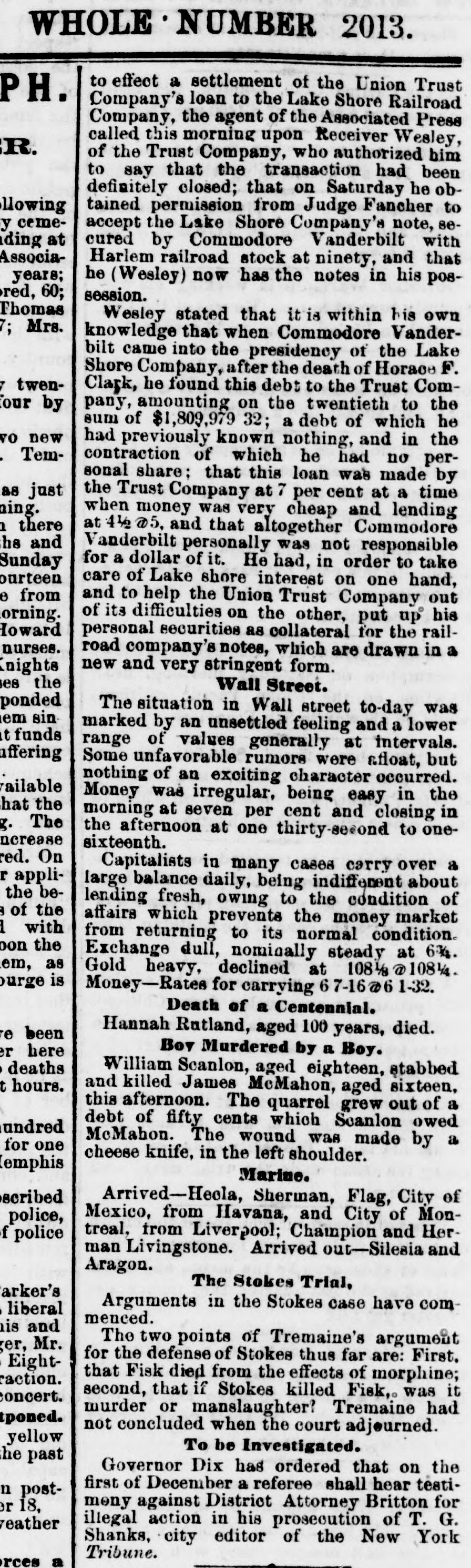
Commodore Vanderbilt ... settles with the Union Trust Company and enables it to resume - the Union Trust Company would probably sell these notes, and with additional capital subscribed would be enabled to resume business about Nov. 1.
Source
newspapers
5. November 1, 1873 Reopening
Newspaper Excerpt
would be enabled to resume business about Nov. 1 (reported after Vanderbilt arranged to settle the loan).
Source
newspapers
6. December 1, 1873 Other
Newspaper Excerpt
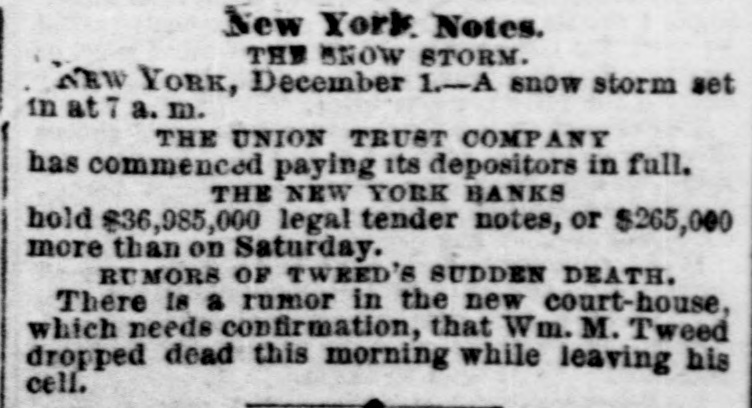
THE UNION TRUST COMPANY has commenced paying its depositors in full.
Source
newspapers

Newspaper Articles (24)

Article from New-York Tribune, September 19, 1873

Click image to open full size in new tab

Article Text

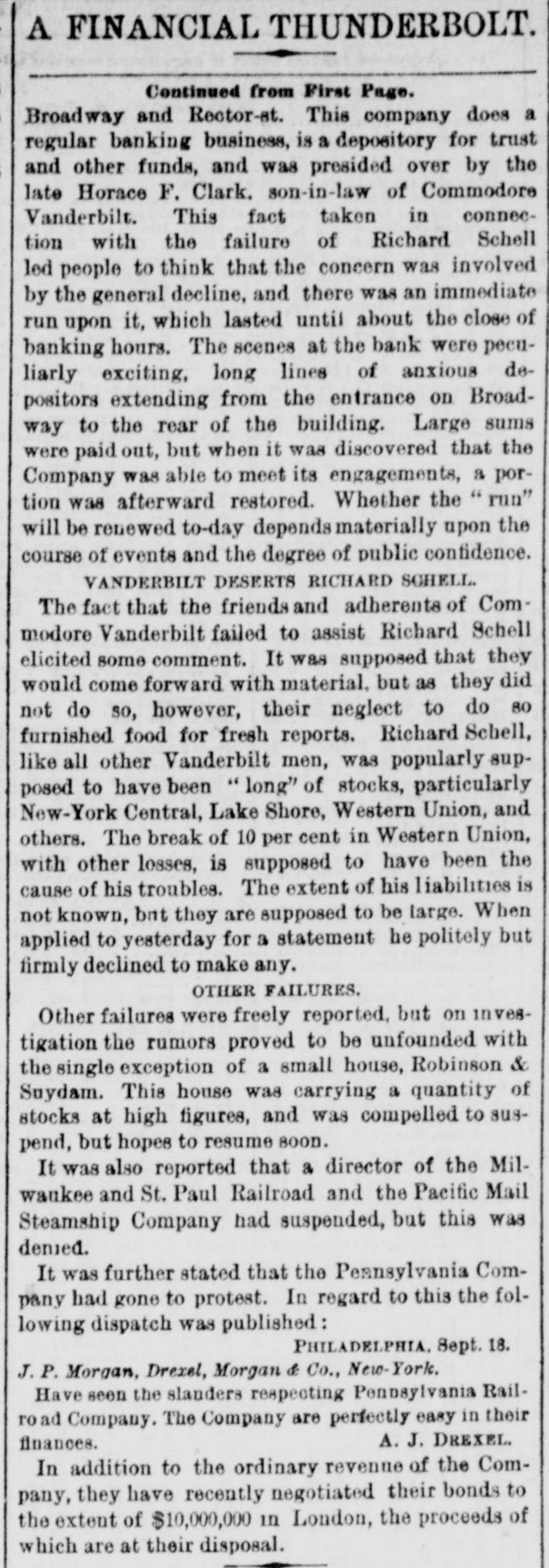
A FINANCIAL THUNDERBOLT.

Continued from First Page. Broadway and Rector-st. This company does a regular banking business, is a depository for trust and other funds, and was presided over by the late Horace F. Clark, son-in-law of Commodore Vanderbilt. This fact taken in connection with the failure of Richard Schell led people to think that the concern was involved by the general decline, and there was an immediate run upon it, which lasted until about the close of banking hours. The scenes at the bank were peculiarly exciting, long lines of anxious depositors extending from the entrance on Broadway to the rear of the building. Large sums were paid out, but when it was discovered that the Company was able to meet its engagements, a portion was afterward restored. Whether the "run" will be renewed to-day depends materially upon the course of events and the degree of public confidence.

VANDERBILT DESERTS RICHARD SCHELL.

The fact that the friends and adherents of Commodore Vanderbilt failed to assist Richard Schell elicited some comment. It was supposed that they would come forward with material, but as they did not do so, however, their neglect to do so furnished food for fresh reports. Richard Schell, like all other Vanderbilt men, was popularly supposed to have been "long" of stocks, particularly New-York Central, Lake Shore, Western Union, and others. The break of 10 per cent in Western Union, with other losses, is supposed to have been the cause of his troubles. The extent of his liabilities is not known, but they are supposed to be large. When applied to yesterday for a statement he politely but firmly declined to make any.

OTHER FAILURES.

Other failures were freely reported, but on investigation the rumors proved to be unfounded with the single exception of a small house, Robinson & Suydam. This house was carrying a quantity of stocks at high figures, and was compelled to suspend, but hopes to resume soon.

It was also reported that a director of the Milwaukee and St. Paul Railroad and the Pacific Mail Steamship Company had suspended, but this was denied.

It was further stated that the Pennsylvania Company had gone to protest. In regard to this the following dispatch was published:

PHILADELPHIA, Sept. 18. J. P. Morgan, Drexel, Morgan & Co., New-York. Have seen the slanders respecting Pennsylvania Railroad Company. The Company are perfectly easy in their finances. A. J. DREXEL. In addition to the ordinary revenue of the Company, they have recently negotiated their bonds to the extent of $10,000,000 in London, the proceeds of which are at their disposal.


Article from Evening Star, September 20, 1873

Click image to open full size in new tab

Article Text

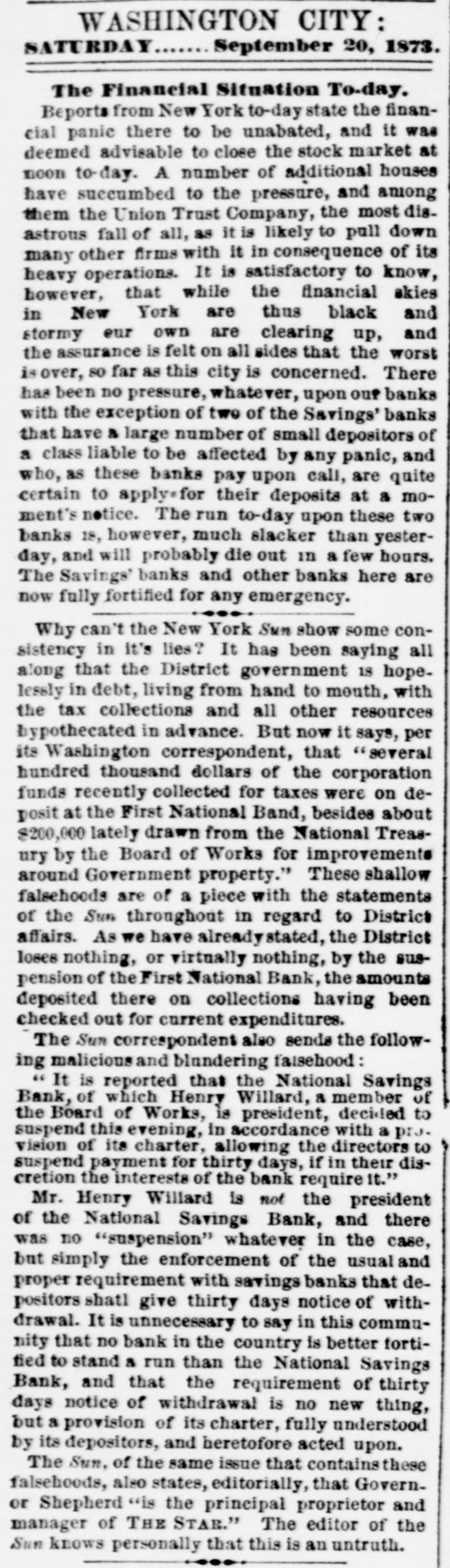
WASHINGTON CITY

SATURDAY September 20, 1873. The Financial Situation To-day. Beports from New York to-day state the financial panic there to be unabated, and it was deemed advisable to close the stock market at noon to-day. A number of additional houses have succumbed to the pressure, and among them the Union Trust Company, the most disastrous fall of all, as it is likely to pull down many other firms with it in consequence of its heavy operations. It is satisfactory to know, however, that while the financial skies in New York are thus black and stormy our own are clearing up, and the assurance is felt on all sides that the worst over, so far as this city is concerned. There has been no pressure, whatever, upon our banks with the exception of two of the Savings' banks that have a large number of small depositors of a class liable to be affected by any panic, and who, as these banks pay upon call, are quite certain to apply=for their deposits at a moment's notice. The run to-day upon these two banks 18, however, much slacker than yesterday, and will probably die out in a few hours. The Savings banks and other banks here are now fully fortified for any emergency. Why can't the New York Sun show some consistency in it's lies? It has been saying all along that the District government 18 hopelessly in debt, living from hand to mouth, with the tax collections and all other resources hypothecated in advance. But now it says, per its Washington correspondent, that "several hundred thousand dollars of the corporation funds recently collected for taxes were on deposit at the First National Band, besides about $200,000 lately drawn from the National Treasury by the Board of Works for improvements around Government property." These shallow falsehoods are of a piece with the statements of the Sun throughout in regard to District affairs. As we have alreadystated, the District loses nothing, or virtually nothing, by the suspension of the First National Bank, the amounts deposited there on collections having been checked out for current expenditures. The Sun correspondent also sends the following malicious and blundering falsehood: It is reported that the National Savings Bank, of which Henry Willard, a member of the Board of Works, is president, decided to suspend this evening, in accordance with a pro. vision of its charter, allowing the directors to suspend payment for thirty days, if in their discretion the interests of the bank require it.' Mr. Henry Willard is not the president of the National Savings Bank, and there was no "suspension" whatever in the case, but simply the enforcement of the usual and proper requirement with savings banks that depositors shatl give thirty days notice of withdrawal. It is unnecessary to say in this community that no bank in the country is better tortified to stand a run than the National Savings Bank, and that the requirement of thirty days notice of withdrawal is no new thing, but a provision of its charter, fully understood by its depositors, and heretofore acted upon. The Sun, of the same issue that contains these falsehoods, also states, editorially, that Governor Shepherd "is the principal proprietor and manager of THE STAR." The editor of the Sun knows personally that this is an untruth.


Article from The Rutland Daily Globe, September 20, 1873

Click image to open full size in new tab

Article Text

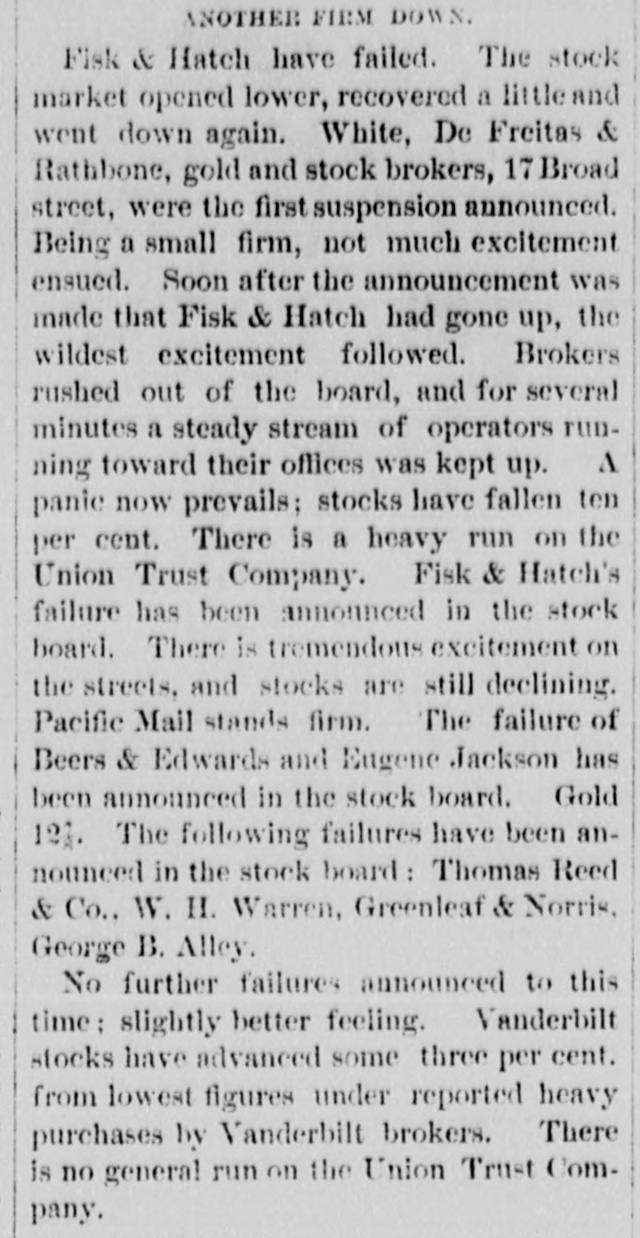
ANOTHER FIRM DOWN.

Fisk & Hatch have failed. The stock market opened lower, recovered a little and went down again. White, De Freitas & Rathbone, gold and stock brokers, 17 Broad street, were the first suspension announced. Being a small firm, not much excitement ensued. Soon after the announcement was made that Fisk & Hatch had gone up, the wildest excitement followed. Brokers rushed out of the board, and for several minutes a steady stream of operators running toward their offices was kept up. A panic now prevails; stocks have fallen ten per cent. There is a heavy run on the Union Trust Company. Fisk & Hatch's failure has been announced in the stock board. There is tremendous excitement on the streets, and stocks are still declining. Pacific Mail stands firm. The failure of Beers & Edwards and Eugene Jackson has been announced in the stock board. Gold 12¼. The following failures have been announced in the stock board: Thomas Reed & Co., W. H. Warren, Greenleaf & Norris, George B. Alley.

No further failures announced to this time; slightly better feeling. Vanderbilt stocks have advanced some three per cent. from lowest figures under reported heavy purchases by Vanderbilt brokers. There is no general run on the Union Trust Company.


Article from New York Times, September 20, 1873

Click image to open full size in new tab

Article Text

coincidence that the gold corner of September, 1869, when so many persons were ruined, and the culmination of the panic of 1873, when the finances of the entire country have been placed in the most dangerous condition, happened upon the same day of the week and in the same month. Many men who appeared prominently in the first of these disturbances have also figured extensively in the last. Houses identified with the interests of the Government have been forced to succumb to the tremendous pressure brought to bear from damaging rumors and an unparalleled tightness of money. Jay Gould, too, who bulled gold in 1869 until it touched 162, is engaged in the present trouble. There have been two Black Fridays in the history of the country, and the sixth day of the week will hereafter be looked upon with suspicion in Wall street.

Commercial men, bankers, brokers, and the financial public generally, gathered in Wall street long before 10 o'clock yesterday morning. There was reason for it too. The rumors which had gained currency were not at all reassuring to people who had money to invest, or who wished to borrow it. Many persons had long lines of stocks which they were carrying; a panic would swallow up their margins, and leave them—wealthy the day before—in a state of penury. Some had money deposited in banks; a panic might force these institutions to suspend. Others were in a state of indecision, and did not know what to do.

The consequence was that thousands of people who are seldom seen down-town thought it worth their while to arrive on the scene of action early in the morning, so as to be on hand for anything which might turn up. It was a universal case of looking out for "number one," and so everybody who had anything to lose, or aught to gain, was on hand.

When the hour of 10 arrived, the time for the opening of the Stock Exchange, one of the most turbulent crowds of humanity ever seen in Wall street surged about the doors eager to obtain entrance. As soon as admittance was accorded there was a general rush to reach the floor of the Long Room, and in a moment afterward quotations for stocks were in order. No one knew what to offer, and everybody was undecided as to selling prices. It was at least a minute before quotations could be made, owing to the general uncertainty regarding the situation. The adherents of the bear clique thought that Western Union ought to sell at 70, and graded their bids accordingly. The few believers in a bull movement thought it was cheap at 80, and accordingly stood at that figure. When an average was reached, it appeared that the bears were the strongest, and so prices began to decline. Western Union, as on the day before, was the bone of contention, and the bears subjected it to their fiercest attacks.

The failure of Jay Cooke & Co. on the previous day had inspired such a distrust in wealthy banking-firms and in financial institutions of every class, that it soon became evident that the street was completely demoralized, and that there was not the slightest chance for the bulls to resist the onset. The Vanderbilt stocks, which are held at high prices, and which in ordinary times are regarded as among the safest of all investments, gave way shortly, and a tumble of a remarkable nature ensued.

While prices were falling off rapidly, the news came of the suspension of Fisk & Hatch, supposed to be one of the strongest and most careful banking-houses in Wall street.

Up to this time, everything had been going in favor of the bears. As soon as the failure was announced on the Exchange, a tremendous panic ensued, and what appeared to be a sort of retreat on the part of the bulls and holders of stocks was turned into a frightful rout. There were no quotable prices for stocks for several minutes. Then a kind of "bottom" was found, when Western Union, New-York Central, Lake Shore, Harlem, and Rock Island, sold from five to twenty-five per cent. below the quotations of Thursday. Money, too, grew stringent, every one being afraid to loan upon any kind of stocks.

In addition to the failure of Fisk & Hatch, it was learned that the Fourth National Bank and the Union Trust Company were besieged by depositors, who were anxious to get their money. This was supplemented by a report that the Manhattan Company had refused to certify the checks of the Union Trust Company, in consequence of a dearth in deposits. This rumor proved to be correct, and had anything but a cheering influence upon the stock market and the rates for money.

Then the failures of different banking and brokerage houses were announced on the Exchange and news of these came so rapidly that each dealer was afraid to trust his neighbor, and so there was a difference in the cash and regular quotations of stocks of from one to five per cent. As fast as the failures were announced the news was carried out into the street by brokers, and in spite of a cold, drenching rain, hundreds of people gathered about the offices of fallen reputation and gazed curiously through the windows, trying to form some conception of the way in which the broken brokers were behaving.

Merchants up-town took a trip to Wall street and swelled the crowds who stood about inspired by their aimless curiosity to gaze upon the distress of neighbors, and nearly every house of deposit in the street was thronged by nervous customers who didn't care to draw out their money if they could have it, but who were terribly anxious to grasp the greenbacks if there were no funds on hand.

A long line of depositors extended outside of the Union Trust Company's building far into the street, waiting for money which had been put in, but which might remain longer than had been calculated upon. At the Fourth National Bank there was a like scene. Umbrellas were called into requisition, and the financial arena of the country resembled a stony pavement covered with black mushrooms.

The peculiar position of the steps of the Sub-Treasury, which affords a commanding view of both Wall and Broad streets, caused them to be used for convenient points of observation, and they were thronged with people for the entire day. The rain seemed to have no effect whatever upon the crowds, which, financially interested, cared nothing whatever for bodily discomfort.

Some time in the afternoon a rumor was prevalent that Secretary Richardson would deposit $10,000,000 in the various banks as a means of relief from the pressing monetary stringency, and in a few minutes the stock market began to show signs of strength.


Article from New York Times, September 21, 1873

Click image to open full size in new tab

Article Text

The Union Trust Company yesterday morning posted a notice in front of their offices to the effect that as the called loans had not been paid in it would be necessary for the Company to suspend payment until Monday morning at 10 o'clock. Another notice was also posted that the Company's checks would be bought during the day at a neighboring house. The announcement of this suspension caused great excitement, although it was far from being unexpected. It was found necessary to have a large force of police stationed at the outer door and within the office so as to preserve order, the crowds which visited the office to make inquiries being so very large. Rumors of every imaginable nature began to float on the street, some of them of the most suspicious character; but inquiries being made of Mr. Augustus Schell, at the Company's office, the rumors were generally dispelled. The presence, yesterday, of Commodore Vanderbilt in the office, walking about with a cool and calm demeanor, led to the rumor that he had secured himself by drawing out over $1,000,000 on Saturday of last week. This story was, however, emphatically denied by Mr. Schell. During the day several ladies and others who had money in the Union Trust Company, and who depended on the interest upon their deposits for their livelihood, visited the Company's office in order to obtain some information relative to the condition of their funds. As Mr. Schell could give no positive information at that time concerning the condition of the Company, or even when business would be resumed, the applicants left the office with anything but pleasant expressions with regard to "the coolness of those men who would take their money, and then give no satisfaction as to its safety." Some expressions were even stronger with regard "to the dishonesty of taking the savings which had required years of labor to accumulate, and squandering them on the altar of speculation;" and when the whole was in danger of being lost, to refuse any other satisfaction than the reply that "the Company could not yet say anything about the condition of its affairs."

During the day the City Chamberlain visited the Union Trust Company in order to ascertain the safety of the Supreme Court trusts. In conversation with THE TIMES reporter, Mr. Lane said that the Union Trust Company only held about $30,000 of trusts, which had been deposited in their hands by order of the Supreme Court, and over which he held no control so far as ordering their transfer. All other City or County moneys previously deposited in the Union Trust Company, had been transferred to other banks soon after he came into office, and thus the City and County funds held by the Company, and which at a former time amounted to a large sum of money, had been reduced to the small amount quoted above. He, however, had no doubt but that the $30,000 was thoroughly secured and would be paid.

The excitement was greatly increased yesterday by the report that Charles T. Carlton, the former Secretary, had not been seen at his desk in the Union Trust Company's office since noon on Friday, and that a heavy defalcation had been discovered in the Company's funds. Rumor was very busy as to the amount that had thus disappeared, some persons placing it as high as $500,000; but although Mr. Schell admitted that there had been a defalcation, and a heavy one, it was not, in his opinion, so large as the sum mentioned. He would, however, state no sum as the probable amount taken, and declined to talk about the matter until after the Directors had held a meeting. When Carlton, the Secretary, left the offices of the Company on Friday afternoon, he said he was too unwell to remain. When it was necessary to consult him in regard to certain matters he was not to be found, and then it was that the Trustees began to suspect he was a defaulter. Under a hurried examination into his affairs, it soon became quite certain that he had been using the securities of the Company for his own personal purposes. He had made loans to relatives and friends, it is said, on securities which were regarded as very doubtful. The security for the one loan, it is understood, is good, but there are others that are of no great value. He had his favorites among the brokers, and loaned large amounts to them on securities that it will be difficult to realize on, and this fact, it is supposed, led the Trustees to close their doors yesterday morning, and secure time to make a thorough examination into the assets and the security of the Company. It is well known that Carlton has had almost the entire management of this great financial institution.

The Directors, last evening, held an informal meeting at the Company's office for the purpose of talking over the condition of affairs, and making a cursory examination of the alleged defalcation. The meeting was strictly private, and those present at it refused positively to give any information as to the result of their deliberations, merely saying that they had arrived at nothing sufficient to justify any further statement than that the Company would pay all its obligations. The only direct information which was given was that the Company would not resume business on Monday.

THE TIMES reporter, last evening, called on Alderman Van Schaick, one of the stockholders of the Company, who had been engaged during the day in negotiating United States securities for the Directors. He said that he had been able to dispose of nearly $1,000,000 worth of United States bonds at 109 1/2 to 110 during the day. He was well conversant with the affairs of the Company, and felt certain that it would be able to pay every dollar of principal and interest, if the affairs were only properly managed. The securities were all of the best class, and not a dollar had been loaned except on good securities. He did not believe the defalcations of Charles T. Carlton, (who is a son of Dr. Carlton, of the Methodist Book Concern,) would amount to as much as $300,000, and it would require more than double that amount of defalcation to place the Company in a position that it could not pay every dollar of its indebtedness. He positively denied the rumor that the Company had loaned money in excess of its surplus. The officers would not, in his opinion, be justified in resuming business on Monday; but if the securities were only properly negotiated and not forced on the market, he saw no reason why the Company should not be placed on as good a footing as formerly in less than ten days. He did not think the run had been caused by Carlton's defalcation; but if he, Carlton, had remained at his post and properly provided for the emergency, as he might have done, the run on the Company could easily have been met with honor, and without serious loss to the institution. His absence caused the greatest confusion on Friday, as he had been the financial man of the Company. Had he, the Alderman, been aware in time of the exact condition of affairs, it would have been easy to have met the crisis so as to have saved the suspension.

The deposits of the Union Trust Company on Thursday were $7,500,000. Yesterday between $1,100,000 and $1,200,000 were paid out.

Mr. S. B. Chittenden, one of the Trustees of the Union Trust Company, yesterday made the following statement to a reporter of THE TIMES: He said that he was present at the examination of the affairs of the Company on Friday evening. The examination was necessarily rapid and general. It was discovered that some securities were missing, (at least $300,000 worth,) and, as Mr. Carlton had suddenly disappeared, it was naturally supposed that he had disposed of them. This fact alone would not have occasioned any serious embarrassment, for the actual surplus at the July meeting of the Company exceeded the capital of the Company, which is $1,000,000. The Company suspended because its call loans were not available. The largest of their loans was to the Lake Shore Railroad Company, and amounted to $1,750,000, and dates from the last dividend, Aug. 1. Besides this loan, other large loans were equally unavailable. The directors seem to be unanimously of the opinion that the amount due by the


Article from The Wheeling Daily Register, September 22, 1873

Click image to open full size in new tab

Article Text

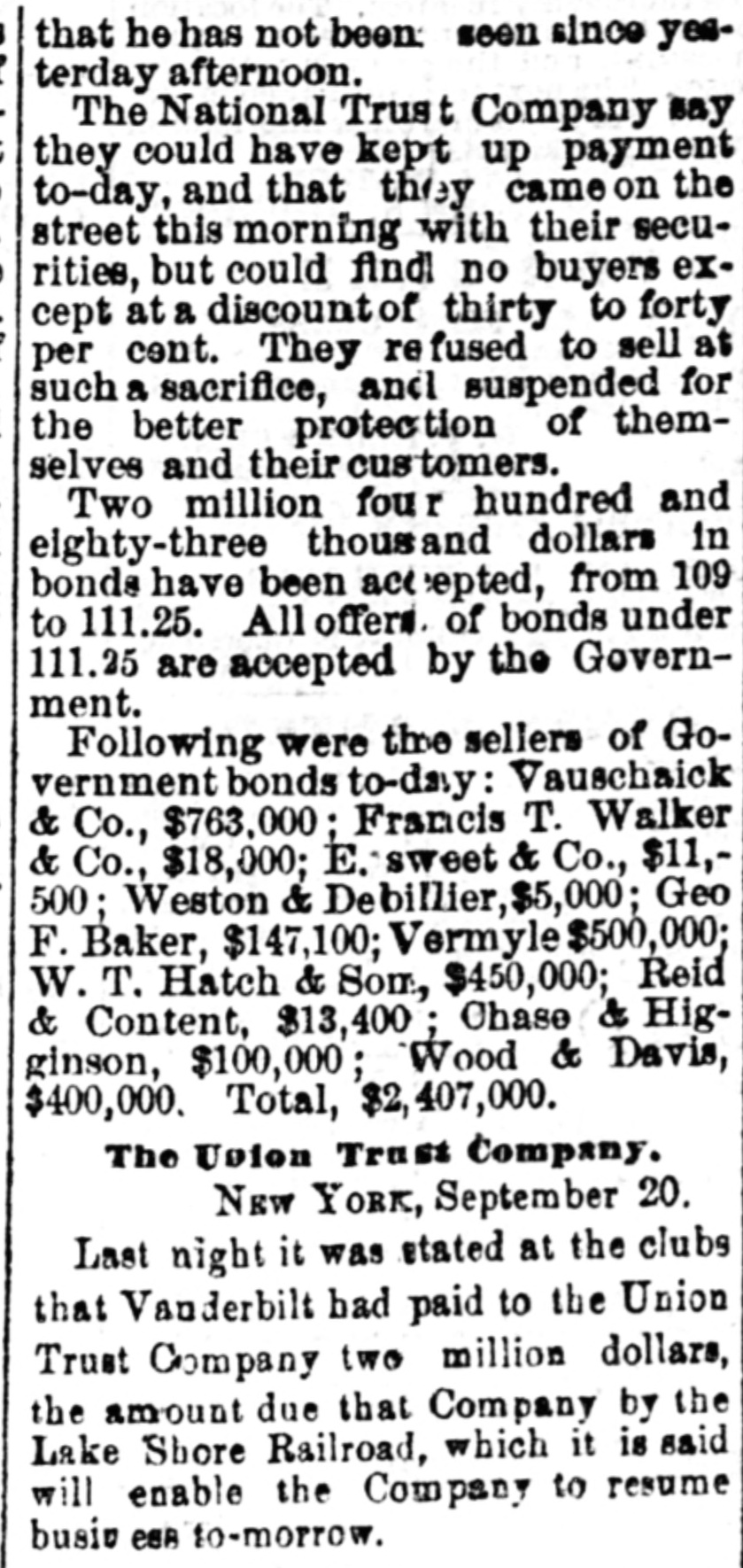
that he has not been seen since yesterday afternoon. The National Trust Company say they could have kept up payment to-day, and that they cameon the street this morning with their securities, but could find no buyers except at a discount of thirty to forty per cent. They refused to sell at such a sacrifice, and suspended for the better protection of themselves and their customers. Two million four hundred and eighty-three thousand dollars in bonds have been accepted, from 109 to 111.25. All offers. of bonds under 111.25 are accepted by the Government. Following were the sellers of Government bonds to-day: Vauschaick & Co., $763,000; Francis T. Walker & Co., $18,000; E. sweet & Co., $11,500; Weston & Debillier, $5,000; Geo F. Baker, $147,100; Vermyle $500,000; W. T. Hatch & Son, $450,000; Reid & Content, $13,400; Chase & Higginson, $100,000; Wood & Davis, $400,000. Total, $2,407,000. The Usion Trust Company. NEW YORK, September 20. Last night it was stated at the clubs that Vanderbilt had paid to the Union Trust Company two million dollars, the amount due that Company by the Lake Shore Railroad, which it is said will enable the Company to resume busic CSR to-morrow.


Article from The Rock Island Daily Argus, September 22, 1873

Click image to open full size in new tab

Article Text

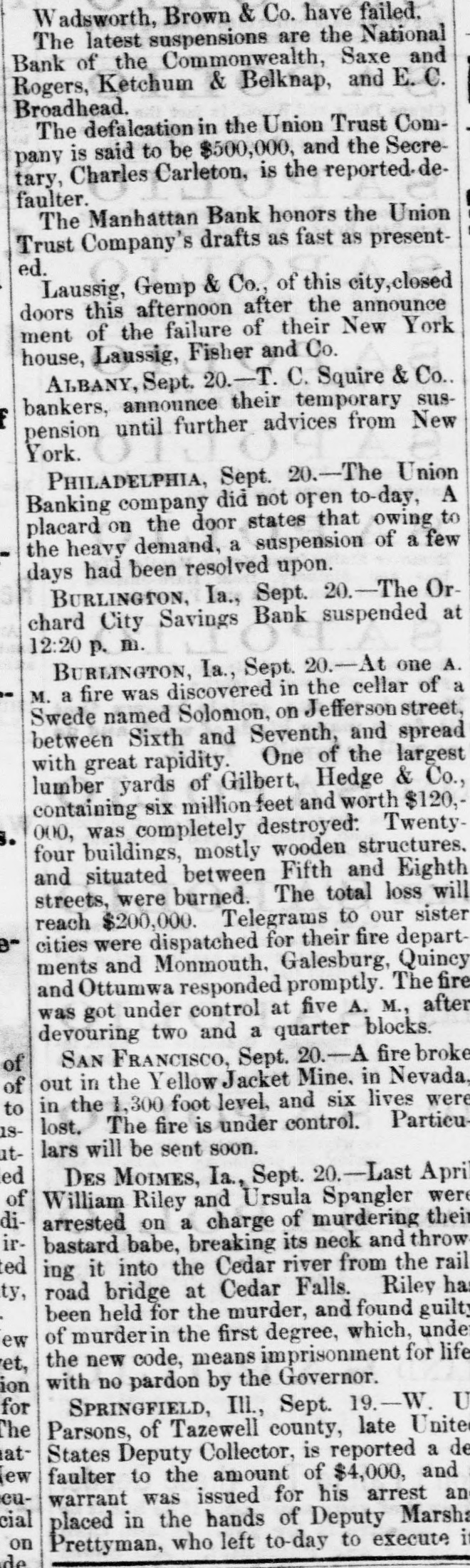
Wadsworth, Brown & Co. have failed. The latest suspensions are the National Bank of the Commonwealth, Saxe and Rogers, Ketchum & Belknap, and E.C. Broadhead. The defalcation in the Union Trust Company is said to be $500,000, and the Secretary, Charles Carleton, is the reported defaulter. The Manhattan Bank honors the Union Trust Company's drafts as fast as presented. Laussig, Gemp & Co., of this city, closed doors this afternoon after the announce ment of the failure of their New York house, Laussig, Fisher and Co. ALBANY, Sept. 20.-T. C. Squire & Co. bankers, announce their temporary suspension until further advices from New York. PHILADELPHIA, Sept. 20.-The Union Banking company did not open to-day, A placard on the door states that owing to the heavy demand, a suspension of a few days had been resolved upon. BURLINGTON, Ia., Sept. 20.-The Orchard City Savings Bank suspended at 12:20 p. m. BURLINGTON, Ia., Sept. 20.-At one A. M. a fire was discovered in the cellar of a Swede named Solomon, on Jefferson street, between Sixth and Seventh, and spread with great rapidity. One of the largest lumber yards of Gilbert, Hedge & Co., containing six million feet and worth $120,000, was completely destroyed: Twentyfour buildings, mostly wooden structures. and situated between Fifth and Eighth streets, were burned. The total loss will reach $200,000. Telegrams to our sister cities were dispatched for their fire depart ments and Monmouth, Galesburg, Quincy and Ottumwa responded promptly. The fire was got under control at five A. M., after devouring two and a quarter blocks. SAN FRANCISCO, Sept. 20.-A fire broke of out in the Yellow Jacket Mine. in Nevada of in the 1,300 foot level, and six lives were to lost. The fire is under control. Particu18lars will be sent soon. uted DES MOIMES, Ia., Sept. 20. - -Last April of William Riley and Ursula Spangler were diarrested on a charge of murdering their its irted into the ing bastard it babe, breaking Cedar river neck from and the throw rail ty, road bridge at Cedar Falls. Riley ha been held for the murder, and found guilty of murder in the first degree, which, under ew the new code, means imprisonment for life et, with no pardon by the Governor. ion for SPRINGFIELD, Ill., Sept. 19.-W. U The Parsons, of Tazewell county, late Unite atStates Deputy Collector, is reported a de few faulter to the amount of $4,000, and cuwarrant was issued for his arrest an cial placed in the hands of Deputy Marsha on Prettyman, who left to-day to execute it


Article from New-York Tribune, September 22, 1873

Click image to open full size in new tab

Article Text

THE SATURDAY PANIC.

EFFECTS OF FRAUD, SPECULATION, AND DISTRUST.

HEAVY DEFALCATION IN THE UNION TRUST COMPANY FORCES IT TO SUSPEND—THE NATIONAL TRUST COMPANY UNABLE TO NEGOTIATE ITS SECURITIES—OVERDRAFTS ON THE BANK OF THE COMMONWEALTH COMPEL IT TO CLOSE — THE STOCK EXCHANGE ADJOURNED—SPECULATION AT AN END—THE CLEARING-HOUSE ISSUES $10,000,000 LOAN CERTIFICATES—THE GOVERNMENT THROWS $10,000,000 IN CURRENCY ON THE STREET.

Failures Officially Announced on Saturday. KETCHAM & BELKNAP, TAUSSIG, FISHER & Co., C. G. WHITE, WILLIAMS & BOSTWICK, PETER M. MYERS & Co., LAWRENCE JOSEPHS, FEARING & DILLINGER, SAXTON & ROGERS, BROWN, WADSWORTH & Co., MILLER & WALSH, EDWARD HAIGHT & Co.

Banks Suspended. UNION TRUST COMPANY, NATIONAL TRUST COMPANY, BANK OF THE COMMONWEALTH. NEW-YORK GOLD EXCHANGE BANK.

Exchange Closed. NEW-YORK STOCK EXCHANGE,

Failures on Thursday and Friday. JAY COOKE & Co., ROBINSON & SUYDAM, RICHARD SCHELL, FISK & HATCH, WHITE, DEFREITAS & RATHBORNE, BEERS & EDWARDS, EUGENE J. JACKSON, THOMAS REED & Co., W. H. WARREN, GEO. BOLTON ALLEY & Co., GREENLEAF, NORRIS & Co., THEODORE BERDELL, AMOS M. KIDDER, S. H. SMITH & SEAVER, DAY & MORSE, HAY & WARNER, VERNAM & HOY, FITCH & Co., W. E. CONNER, WHITTEMORE & ANDERSON, JACOB LITTLE & Co., E. D. RANDOLPH & Co.

The result of the financial panic may be summed up in a brief paragraph. It is a thunder-storm merely which will serve to clear the atmosphere. "The street is clean broke." Few brokers know where they stand. On Saturday the best securities went begging at the lowest rates; there was no fixing values on any stocks, and the Stock Exchange was wisely closed to give men time to recover from their distrust and gather their scattered senses. Eleven additional houses failed, and their suspension was announced in the Exchange before it was closed. A few more of the weakest will go down when the settlements are made; some of those who have been announced from the Board will recover and go on. Not a single mercantile house, savings bank, or other institution doing a legitimate trade has fallen. The excitement and distrust caused by the wild speculations extended the panic beyond the Stock Exchange, and three banks suffered from severe runs upon them. The Union Trust Company was weakened by the discovery of a large defalcation, aggregating $600,000, and the impossibility of realizing on heavy call loans to the Lake Shore Railroad Company, and it suspended. The Bank of the Commonwealth was weakened by the payment of an overdraft of $225,000 of a house which had suspended. The National Trust, with $800,000 Governments on hand, could not realize a dollar on them and wisely closed its doors until it could dispose of them. Runs on the Fourth National and Manhattan were laughed to scorn by those institutions. During the morning the banks went on the principle of Fisk—"Each man to drag out his own corpse"—and refused one another's checks, but later a meeting was held and concerted action agreed on, and subsequently there was no further trouble. The purchase of bonds by the Government also aided to break the force of the storm.


Article from New-York Tribune, September 24, 1873

Click image to open full size in new tab

Article Text

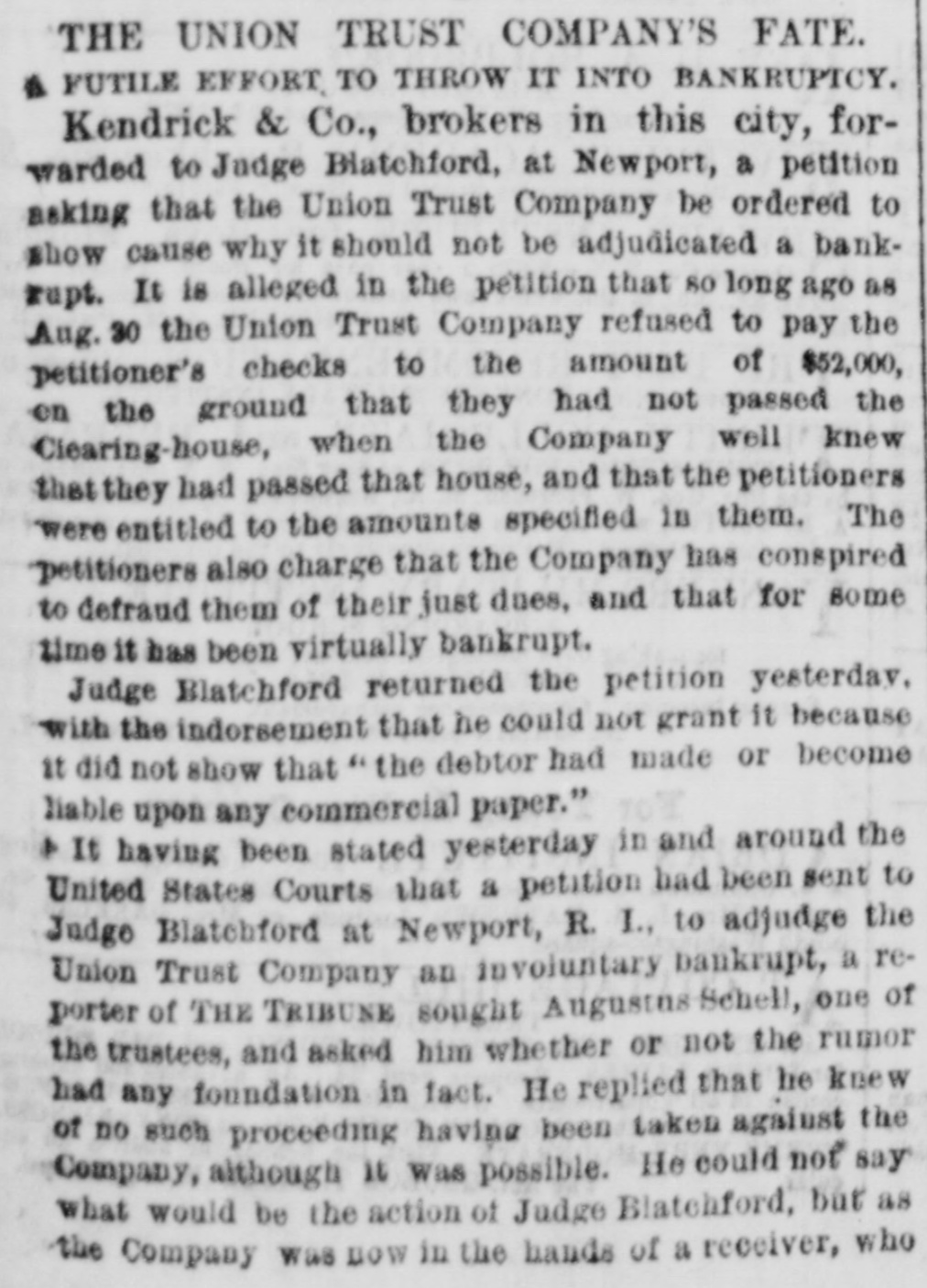
THE UNION TRUST COMPANY'S FATE.

▲FUTILE EFFORT TO THROW IT INTO BANKRUPTCY.

Kendrick & Co., brokers in this city, forwarded to Judge Blatchford, at Newport, a petition asking that the Union Trust Company be ordered to show cause why it should not be adjudicated a bankrupt. It is alleged in the petition that so long ago as Aug. 30 the Union Trust Company refused to pay the petitioner's checks to the amount of $52,000, on the ground that they had not passed the Clearing-house, when the Company well knew that they had passed that house, and that the petitioners were entitled to the amounts specified in them. The petitioners also charge that the Company has conspired to defraud them of their just dues, and that for some time it has been virtually bankrupt.

Judge Blatchford returned the petition yesterday, with the indorsement that he could not grant it because it did not show that "the debtor had made or become liable upon any commercial paper."

It having been stated yesterday in and around the United States Courts that a petition had been sent to Judge Blatchford at Newport, R. I., to adjudge the Union Trust Company an involuntary bankrupt, a reporter of THE TRIBUNE sought Augustus Schell, one of the trustees, and asked him whether or not the rumor had any foundation in fact. He replied that he knew of no such proceeding having been taken against the Company, although it was possible. He could not say what would be the action of Judge Blatchford, but as the Company was now in the hands of a receiver, who


Article from Buffalo Weekly Courier, September 24, 1873

Click image to open full size in new tab

Article Text

THE MONEY PANIC.

Yesterday in Wall Street—Things Settling Down Somewhat—Effect of Secretary Richardson's Measures. Additional Failures—Statements of Large Stock-Jobbers—Comments of the Metropolitan Press, &c., &c.

Special to the Courier.

WASHINGTON, Sept. 22.—The president and Secretary Richardson arrived here this morning. The president at 11 o'clock called at the treasury and spent an hour in consultation with the secretary. So far as can be learned of what transpired there is no reason to believe any other action than that already ordered will be taken at present for the relief of financial circles. Secretary Richardson expresses satisfaction at the suspension of the New York banks. To pay currency, he says, will have a tendency to stop the panic.

By Associated Press.

DECISION OF THE ADMINISTRATION.

President Grant accompanied by General Babcock returned to Washington this morning. In the course of the morning the president called at the treasury department and had a conference with Secretary Richardson, the result of it may be inferred from the fact that subsequently stated to the agent of the New York Associated Press that the president will do anything within the law, but in no particular will he go beyond clear legal authority. He will maintain the safety of the treasury department and protect the credit of the United States from the influences of the present financial embarrassment. In answer to inquiries nothing was elicited to strengthen the report that action will be taken in regard to placing part of the legal reserve at the disposal of the New York city banks. The treasury has a sufficient amount of currency on hand to meet all demands. Much excitement exists throughout Washington consequent on news from the north. The banks here do not seem to be as yet seriously affected by it.

SECOND DISPATCH.

The president had another interview of more than an hour with Secretary Richardson at the White House this morning, at which Secretary Delano and Postmaster-General Creswell were present. It has been decided to send $20,000,000 from the national treasury here to Treasurer Hillhouse in New York, to-night, to enable him to buy all bonds that may be offered.

The president feels encouraged at the news to-day and will be guided by circumstances as to whether he will leave to-night. Secretary Richardson has been receiving telegrams from New York every few minutes during the day, posting him as to the condition of affairs there.

In reply to the interrogatories this morning he said that everything was more encouraging and the government would buy bonds just as fast as they were presented. He had plenty of money and would give it out to all who came with their bonds. When the question was asked whether or not this money to pay for the bonds would come from legal reserve, he answered, never mind about that, I will attend to getting the money; the government is all right and intends to keep so.

THE RESULT.

Secretary Richardson received the following dispatch from New York to-day:

Mercantile business progresses as usual. Wall street is clearing itself. The people join in congratulations to the president and Secretary Richardson for their stability.

The stock exchange will be opened on Wednesday.

NEW YORK.

THE CONFERENCE.

NEW YORK, Sept. 22—7:40.—The official statement is made this morning that the assistant treasurer will continue to purchase five-twenty bonds in accordance with his notice of Saturday, paying for them in currency at the average prices of sales on that day.

Secretary Richardson said last night he did not see that he had the power to do any more than buy bonds, and all the five-twenties offered will be bought without delays or red tape.

The Government, the secretary added, is not a trust company or loan institution and it is doubtful whether congress would sanction any such construction of my power. The language, "This is none of my funeral", which was attributed to Secretary Richardson last evening seems this morning to have been made by a leather merchant, who was present at the conference and who was asked to state briefly the views of the secretary of the treasury. In answer to this question the merchant replied: "The secretary as much as said this was none of his funeral and he did not feel inclined to act."

INDIVIDUAL EXPRESSIONS.

The following is the substance of an interview with Commodore Vanderbilt last night: He had during the day enjoyed a very agreeable interview with President Grant. He had not made formal proposition to the president, as had been reported, that he would furnish the sum of $10,000,000 under certain conditions, but had merely said, in conversation with the president and several other gentlemen, that something should be done to make money easier, and he would willingly lend his aid to that end. He had then announced informally that if the government or other parties could in any way furnish $40,000,000, or that amount of securities, to the banking association, he would be one to furnish $10,000,000. Whether his offer would be accepted or not, or whether the government would take any steps in the matter, he was ignorant, but hoped something would certainly be done to make money easier until the crisis was past.

Thurlow Weed visited Wall street during the height of excitement yesterday. He said in conversation yesterday that we are now simply paying one of the penalties of our great war; that the usury laws, instead of being repealed, should be made ten times stronger and more effective; that those who have combined to lock up money should be imprisoned wherever found; that he is not a director but a stockholder of the Union Trust Co.

John V. L. Pruyn, of the Union Trust Company's directors, is reported by the Tribune as saying that the securities offered by Commodore Vanderbilt on Saturday to the company for the loan made to the Lake Shore company were not by any means sufficient to cover the loan.

Senator Morton said yesterday, assuming that the forty-four million greenbacks were issued, the question was how to get them into circulation. The government could act as a purchaser of its own bonds, but could not come into the market as a lender.

CORPORATION NOTICES.

8.45 A. M.—It is believed that neither the Stock Exchange nor the banks will open this morning. On the other hand Mr. Camp, general manager of the clearing house, said in an interview at 10 o'clock last night that every check passed in the regular way through the clearing house will be paid. They were never stronger than they are to-day and the action of the bank officers yesterday made them doubly strong.

Fisk & Hatch hope to resume this week if the panic does not continue.

10 A. M.—The following notice is posted on the door of the Union Trust Company: This institution is in the hands of a receiver. A statement of its affairs is being prepared and will soon be made public. Depositors are cautioned against sacrificing their accounts.

The feeling on the street is better and hopes are expressed that the panic will spend itself to-day; still everything is involved in uncertainty.

10.10 A. M.—The following notice has just been issued: "The New York Stock Exchange will remain closed to-day. A meeting of the governing committee will be held to-morrow morning at half-past nine o'clock." It is signed by H. G. Chapman, the president.

Carleton, the defaulter was largely interested in Western Union. Envelopes picked up in the office showed that he also speculated in Union Pacific and other fancy stocks. Most of his losses resulted from the crash in the market last week. Up to last night the detectives had not arrested Carleton. His defalcations are ascertained to be fully $500,000.

The Varvin Brothers are added to the list of suspended broker firms.

ON THE STREET.

10.20 A. M.—Gold opened at 112 amid some excitement.

10.30 A. M.—The Gold Exchange has just closed same as Stock Exchange. 112 has been established as the basis of settlement.

The rate of interest is fixed at seven per cent. for carrying.

10.40 A. M.—There is a run on the Seaman's Savings Bank in Wall street.

Edward Haight thinks his firm will be able to resume in a few days.

The following notice was posted in the United States sub-treasury:

"Purchases of United States bonds to-day will include all the different series of 5-20s. Payments will be made in currency at the rate of $110 72, and the accrued interest in coin." $50,000 worth so far has been purchased.

Small amounts from individuals will not be bought, that not being the intention of the government in authorizing the purchase.

A meeting of the directors of various savings banks is now being held to decide upon the advisability of compelling depositors to wait sixty or thirty days as their charters allow.

The banks are generally open. Crowds of spectators throng the lower streets of the city, but the excitement is less than on Saturday.

11 A. M.—The sub-treasurer has bought one million dollars in bonds. Large crowds are waiting to sell.

11.30 A. M.—At a meeting of the directors of the Seamen's Savings Bank it was decided to pay immediately sums of $100 or under. All amounts will not be paid before 30 days, as the charter allows.

11.45 A. M.—Mr. Camp, of the clearing house, states that all banks have pulled through except two, and those two are now settling through the loan committee.

11.50 A. M.—A run has begun on all the savings banks throughout the city. The crowds are much larger on the east side of the town than on the west and the utmost excitement prevails. One of the largest of the savings banks has already paid out $5,000 in excess of its daily payments. It is stated that a majority of the banks will take advantage of their charter, which allows them from 30 to 60 days time.

12 M.—Two million bonds have been purchased by the sub-treasury up to this hour.

The clearing house loan committee have issued two million and a half loan certificates this morning.

Pette Cooke and Hugh McColloch have arrived by the Egypt, and will be in Wall street by one o'clock.

12.30 P. M.—The national banks are promptly meeting all demands.

Savings banks are nominally in a state of suspension merely as a relief to the nationals.

1 P. M.—The clearing house statement has been made public and all the banks have been cleared satisfactorily.

The feeling among all classes of people down town is one of great relief. There are no runs on any of the banks. There are no more than the average crowds on Wall and Broad streets at this hour, and the general impression is one of momentarily growing confidence.

A tour of the national and savings banks of Brooklyn developes the fact that there is more than the ordinary quiet there, and there is no disturbance of the channels of financial or other business in that city.

Excited crowds still throng Wall, Broad, New, Nassau, and other streets in the vicinity of the stock and gold exchange.

The report published that a run on savings banks would be made to-day was rather premature. A tour around the east side at noon found everything quiet, and more deposits than drafts being made.

The banks are generally availing themselves of the provisions of their charter, which empowers them to compel 60 days notice from depositors desiring to withdraw their accounts.

THE LATEST.

NEW YORK, Sept. 22 — 1.15 P. M.—Only $200,000 worth of stock have been bought at the sub-treasury since twelve o'clock. There is considerable falling off in the number of sellers.

The following bids were made on the street: Central, 95; Wabash, 50; Rock Island, 88 to 90; Western Union Telegraph, 72.

There is considerable inquiry for stocks on the streets; investors with greenbacks in hand seeking to purchase, but the prohibition of the stock exchange precludes transactions.

The national banks are paying all demands made upon them that looks like legitimate business in greenbacks, but anything like a run is paid in certified checks which must pass through the clearing house.

No meeting of Jay Cook's creditors will be held until statements have been received from various branch offices throughout the country. These are now being prepared with the utmost dispatch. The firm cannot at present say anything regarding the duration of the suspension.

1.30 P. M.—The feeling continues to improve in financial circles and considerable dealings in stocks outside of the Board for cash, greenbacks, prices ruling strong. The crowd down town is diminishing.

2 P. M.—The Gold Exchange Bank's gross clearing was $92,000,000. $2,400,000 bonds have been purchased up to this hour. The brokers generally are busy paring off the transactions of Friday and Saturday.

2.10 P. M.—Three million dollars worth of bonds were bought by the sub-treasurer up to this hour and more coming in. All quiet at the Fourth National bank.

2.15 P. M.—D. Williams & Co. over-drew their account in the bank of North America to the amount of $450,000. To-day the firm deposited securities for $250,000, leaving $200,000 still due the bank. The authorities are now engaged in endeavoring to compel payment of that sum.

The statement on Saturday that the check of the Continental bank had been thrown out at the clearing house was an error, it having been confounded with the National Bank of Commonwealth. The Continental bank is and has been paying as usual.

A dispatch from Milwaukee says the chamber of commerce adjourned until Wednesday next on account of the state of affairs.

3 P. M.—Isaac H. Bailey is appointed receiver of the Bank of Commerce.

The following are the street quotations showing a falling off: New York Central 91, Harlem 106, Erie 51, Rock Island 87, and Panama 88.

NEWSPAPER COMMENTS.

The Tribune asserts editorially that the cause of to-day opening with such gloomy prospects is immediately due to the failure of Commodore Vanderbilt, president of the Lake Shore railroad, to pay when called upon a call loan for $1,750,000 negotiated with the Union Transit Company, whereof his son-in-law, the late Horace F. Clark, was president.

The Sun says yesterday afternoon Messrs.

Article from The Manitowoc Tribune, September 25, 1873

Click image to open full size in new tab

Article Text

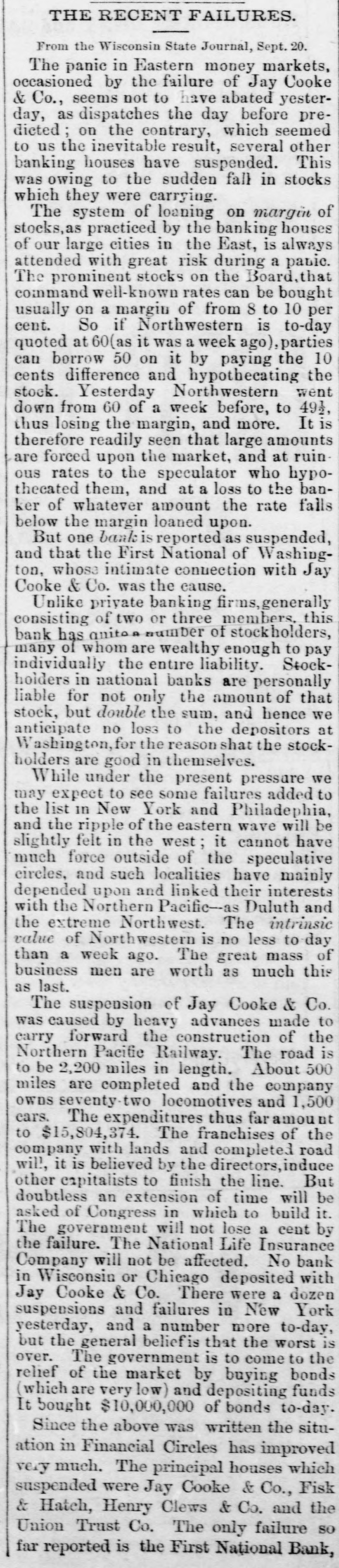
THE RECENT FAILURES

From the Wisconsin State Journal, Sept. 20. The panic in Eastern money markets, occasioned by the failure of Jay Cooke & Co., seems not to have abated yesterday, as dispatches the day before predicted; on the contrary, which seemed to us the inevitable result, several other banking houses have suspended. This was owing to the sudden fall in stocks which they were carrying. The system of loaning on margin of stocks, as practiced by the banking houses of our large cities in the East, is always attended with great risk during a panic. The prominent stocks on the Board,t command well-known rates can be bought usually on a margin of from 8 to 10 per cent. So if Northwestern is to-day quoted at 60(as it was a week ago), parties can borrow 50 on it by paying the 10 cents difference and hypothecating the stock. Yesterday Northwestern went down from 60 of a week before, to 491, thus losing the margin, and more. It is therefore readily seen that large amounts are forced upon the market, and at ruinous rates to the speculator who hypothecated them, and at a loss to the banker of whatever amount the rate falls below the margin loaned upon. But one bank is reported as suspended, and that the First National of Washington, whose intimate connection with Jay Cooke & Co. was the cause. Unlike priyate banking firms,generally consisting of two or three members. this bank has anite a number of stockholders, many of whom are wealthy enough to pay individually the entire liability. Stockholders in national banks are personally liable for not only the amount of that stock, but double the sum. and hence we anticipate no loss to the depositors at Washington, for the reason shat the stockholders are good in themselves. While under the present pressure we may expect to see some failures added to the list in New York and Philadephia, and the ripple of the eastern wave will be slightly felt in the west; it cannot have much force outside of the speculative circles, and such localities have mainly depended upon and linked their interests with the Northern Pacific--as Duluth and the extreme Northwest. The intrinsic value of Northwestern is no less to day than a week ago. The great mass of business men are worth as much this as last. The suspension of Jay Cooke & Co. was caused by heavy advances made to carry forward the construction of the Northern Pacific Railway. The road is to be 2,200 miles in length. About 500 miles are completed and the company OWDS seventy-two locomotives and 1,500 cars. The expenditures thus far amount to $15,804,374. The franchises of the company with lands and completed road will, it is believed by the directors, induce other capitalists to finish the line. But doubtless an extension of time will be asked of Congress in which to build it. The government will not lose a cent by the failure. The National Life Insurance Company will not be affected. No bank in Wisconsin or Chicago deposited with Jay Cooke & Co. There were a dozen suspensions and failures in New York yesterday, and a number more to-day, but the general beliefis that the worst is over. The government is to come to the relief of the market by buying bonds (which are very low) and depositing funds It bought $10,000,000 of bonds to-day. Since the above was written the situation in Financial Circles has improved very much. The principal houses which suspended were Jay Cooke & Co., Fisk & Hatch, Henry Clews & Co. and the Union Trust Co. The only failure SO far reported is the First National Bank,


Article from Edgefield Advertiser, September 25, 1873

Click image to open full size in new tab

Article Text

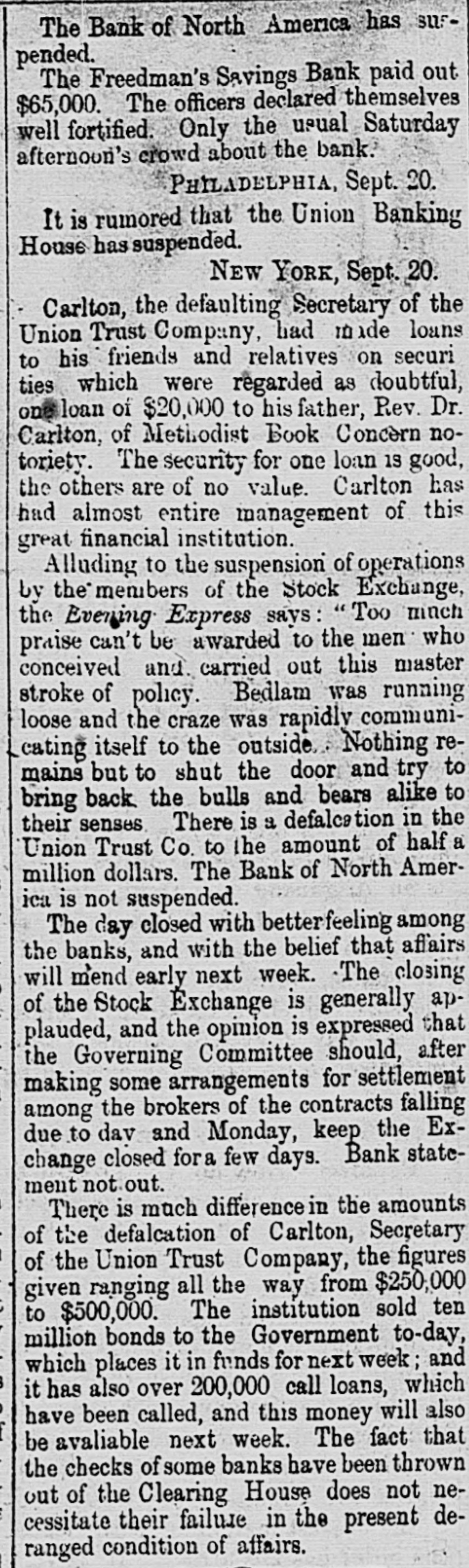
The Bank of North America has surpended. The Freedman's Savings Bank paid out $65,000. The officers declared themselves well fortified. Only the usual Saturday afternoon's crowd about the bank. PHILADELPHIA, Sept. 20. It is rumored that the Union Banking House has suspended. NEW YORK, Sept. 20. Carlton, the defaulting Secretary of the Union Trust Company, had made loans to his friends and relatives on securi ties which were regarded as doubtful, one loan of $20,000 to his father, Rev. Dr. Carlton, of Metiodist Book Concern notoriety. The security for one loan 19 good, the others are of no value. Carlton has had almost entire management of this great financial institution. Alluding to the suspension of operations by the members of the Stock Exchange, the Evening Express says: "Too much praise can't be awarded to the men who conceived and carried out this master stroke of policy Bedlam was running loose and the craze was rapidly communicating itself to the outside Nothing remains but to shut the door and try to bring back the bulls and bears alike to their senses There is a defalcation in the Union Trust Co. to the amount of half a million dollars. The Bank of North America is not suspended. The day closed with betterfeeling among the banks, and with the belief that affairs will mend early next week. The closing of the Stock Exchange is generally applauded, and the opinion is expressed that the Governing Committee should, after making some arrangements for settlement among the brokers of the contracts falling due to dav and Monday, keep the Exchange closed fora few days. Bank statement not out. There is much difference in the amounts of the defalcation of Carlton, Secretary of the Union Trust Company, the figures given ranging all the way from $250,000 to $500,000. The institution sold ten million bonds to the Government to-day, which places it in funds for next week; and it has also over 200,000 call loans, which have been called, and this money will also be avaliable next week. The fact that the checks of some banks have been thrown out of the Clearing House does not necessitate their failure in the present deranged condition of affairs.


Article from The Toledo Chronicle, September 25, 1873

Click image to open full size in new tab

Article Text

Panic in Wall Street

The financial world was shocked last Thursday by the announcement that the heavy firm of Jay Cook & Co,, of New York, had suspended payment This firm, as is well known was one of the heaviest banking houses in the world, having advanced immense sums of money w the gov erument during the war when the national credit was gone, and being now one of the leading members o! the syndicate, besides having advance ed millions of dollars to Railroad companies. Th bank suffere a run on Thursday morning. an was com pelled quate early 1a the day to clust The phuosophy of this future, which led to many other suspensions, must be sought in the fact that, instead of attending to a. legitim t banking bu-mess, speculative enterprises were entered into. Immense loads of railroad bonds, in which capitalists are now slow to invest, were taken and the result we see in a financial crisis, whose extent will never 1, known, because of the heavy loss on tailed upon holders of railroad stock responded of at a she " after 1. panic occurred. Among the new vailures we notice the following: Fish & Hatch, N " Y ik; the Fax National Bank of Washington, the New Your Unen Trust Company; he National Bank of in Common wealth, N.W York the National Trust Company. New York; the Bank of America, Non York; the Union Banking Company. 01 Philadelphia. These froms," of them at least. were intimatey associated with Couke & Co 111 their business trans actions, and the financial distress will be more of less wile-spread in proportion to the permanency of the failures. If the alone soff l' ed from the panic, the financial dis turbance would excite little sympto thy, but as it entailed losses upon many who had their all invested in radroal securities, which they sold at he ay loss, the panic is J. plorable. The effect produced upon the floor 01 the Stock Exchange may be intere red from the fact that last Saturday the extreme factuations on some clocks were as follows: Harlem 30 per cam; Panama, 18; Rook Island 91; Western Union. 9; Hammbal & St. Joseph, 9, with other stocks flue tuating from 2 to 8 points. The government came to the relief of the money market by purchasing U. Bonds. By this meaus, togeth. er with the action of Bank Presi dems, through the Clearing House loan certificates, many millions of greerbacks were released, with III touching any portion of the $44,000. 000 reserve now In the National Treasury.


Article from Puget Sound Dispatch, September 25, 1873

Click image to open full size in new tab

Article Text

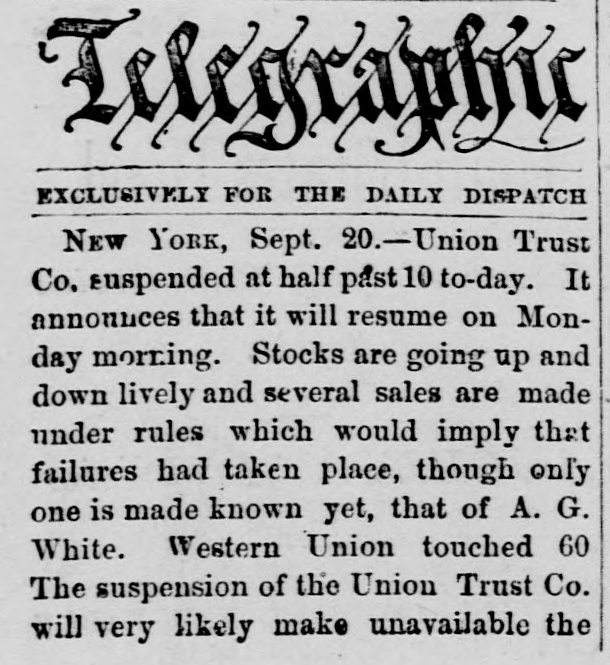
Ielegraphic EXCLUSIVELY FOR THE DAILY DISPATCH NEW YORK, Sept. 20.-Union Trust Co. suspended at half past 10 to-day. It announces that it will resume on Monday morning. Stocks are going up and down lively and several sales are made under rules which would imply that failures had taken place, though only one is made known yet, that of A. G. White. Western Union touched 60 The suspension of the Union Trust Co. will very likely make unavailable the


Article from Helena Semi-Weekly Herald, September 25, 1873

Click image to open full size in new tab

Article Text

TELEGRAMS

REPORTED SPECIALLY FOR THE HERALD BY WESTERN UNION TELEGRAPH COMPANY.

UNITED STATES.

The Conference at the Fifth Avenue Hotel.

NEW YORK, September 21.—The conference at the Fifth Avenue Hotel to-day with President Grant and Secretary Richardson, in relation to the best means of averting financial disasters in Wall street, has absorbed the public interest. At the conference, and conspicuous, were Commodore Vanderbilt, H. Clews, Isaac Bailey, Seligman Bros., George H. Opdyke, Wm. Orton, President of W. U. T. Co., Prospect H. Sharpe, Jas. H. Burke, Wm. L. Scott, of the Erie (Pa.) Bank, Robt. Lenox Kennedy, Horace B. Claflin, General E. S. Sanford, President of Adams Express Company, Mr. Vail, of the Bank of Commerce, Senator West, and John Hoey, Vice President of Adams Express Company. A committee was appointed to agree upon some proposition to be submitted to the President and Secretary Richardson. After the committee had retired, Vanderbilt entered the parlor in which the President and Secretary were. The rooms and corridors adjoining the audience chamber were quickly thronged with crowds awaiting impatiently the exit of the railroad king, and nervously anxious to glean even the faintest idea of the result of his visit to the President. Commodore Vanderbilt made the proposition, that the President authorize the Secretary of the Treasury to place $30,000,000 of the legal reserve in the banks of this city, and on that condition he (Vanderbilt) would add $10,000,000. President Grant replied that he was anxious to do all in his power to relieve the present financial embarrassment and to prevent disaster, but that he must, however, conform to the Constitution. Mr. Opdyke and others represented to President Grant and Secretary Richardson the necessity for immediate action, but they were informed that the Constitution could not be violated.

The bank Presidents and capitalists were endeavoring to agree upon a proposition to be submitted, but, although they had been conferring up to six o'clock they could not arrive at any conclusion, and no paper was presented to the President.

The President and Secretary were not diverse in sentiment, it appears, for it was agreed between them to instruct the Assistant Treasurer to buy all government bonds offered for sale to any amount. The savings banks hold many millions of government bonds, and it is probable that they will sell them and deposit the proceeds in the National banks, which will give them relief.

The Action of the Stock Exchange.

NEW YORK, September 20.—Shortly before noon, in the midst of the panic, the governing committee of the Stock Exchange determined to close the Exchange. Immediately afterward a committee of the associated banks met at the New York Clearing House and it was voted by all the Associated Banks that they would issue certificates pledging the Association as a whole. These certificates are to be issued by the manager of the Clearing House to any Associated bank against the deposit of the bank's securities or assets. The effect of this action is to enable all the solvent part of the financial community to convert their assets into money, apparently, and without any sacrifice to themselves. The Stock Exchange ordinarily is simply a medium for converting securities into cash in a prevailing panic. The scarcity of money prevented this from being accomplished, securities being constantly offered for sale at constantly decreasing prices without finding buyers unless at an enormous loss to the sellers. By the issue of the bank certificates any bank can realize money upon its assets, and be able to extend to its customers all the accommodation for which they can find security, without compelling the sale or sacrifice of the assets offered. The whole machinery, therefore, of conversion is once more set in operation and is likely to run smoothly, and all concerns which have assets will find no difficulty in converting them into money. This action of the banks at the Clearing House meeting gave rise to a feeling of confidence on the street that no additional failures were likely to occur, and the impression obtained was that the panic was over.

Exciting Scene on Closing the New York Stock Exchange.

NEW YORK, September 20.—The excitement and panic which followed the announcement in the Stock Exchange of the suspension of the Union Trust Company and the Bank of the Commonwealth were beyond description. The Stock Exchange resembled a mad house, and the streets were blocked with people, all laboring under great excitement and frenzy. Prices tumbled from 2 to 16 per cent., and stocks were slaughtered without any apparent regard to values. Amid the surging of the excited crowd in the Stock Exchange and the continued destruction of values, there were few cool and level heads. These men conceived the idea of imitating the Vienna plan of closing the Exchange, and immediately the governing committee was convened to take action thereon. In a few moments the Board was called to order and the announcement was made that the Exchange would be closed until further orders from the President. This was received with great joy, the Exchange resounded with cheers, the gong sounded, and in less time than it takes to record the fact the wild excitement was over, the surging crowd of frantic brokers disappeared, and the Stock Exchange was closed.

Additional Failures Announced.

NEW YORK, September 20.—The following failures have been announced:

The Union Trust Company; Bank of Commonwealth; Ketchum & Belknap; E. C. Brodhead; Saxe & Rogers; Edward Haight & Co.; Brown, Wadsworth & Co.; C. G. White.

CHICAGO, September 21.—The Franklin Savings Bank, a small concern, was unable to meet the demands at the clearing house to-day, and closed its doors. As the concern has no connection, so far as known, with any of the suspended New York banks or bankers, it is supposed that it will soon resume business.

ST. LOUIS, September 20.—Toussing, Gemp & Co., of this city, closed its doors this afternoon, after the announcement of the failure of their New York house, Toussing, Fischer & Co. They are confident of being able to resume in a few days, and state that no one will lose a dollar by them. The house dealt pretty extensively in railroad securities on their own account.

TORONTO, Canada, September 20.—H. J. Morse & Co., bankers and brokers in this city, have suspended, in consequence of the failure of Jay Cooke & Co., and other prominent houses in New York.

ALBANY, N. Y., September 20.—T. C. Squire & Co., bankers, announce their suspension until further advices from New York.

PHILADELPHIA, September 20.—The Union Banking Company has failed. This bank has a State charter.

BURLINGTON, Iowa, September 20.—The Orchard City Savings Bank closed its doors to-day.

BUFFALO, September 22.—H. W. Bart & Co., private bankers and brokers, closed this afternoon.

ST. CATHARINES, Ontario, September 22.—Owing to the financial crisis in New York the Canada Southern Railroad Company have been obliged to cancel all their contracts for the present, and have ordered the discharge of all their workmen not employed. No regular train is running over the road. The cause of this is reported to be owing to complications in Daniel Drew's affairs, he being a large stockholder in the company.

New York News.

NEW YORK, September 20.—Two million eight hundred and sixty-three thousand dollars in bonds were accepted to-day at from 9 to 11 1/4. All offers of bonds under 11 1/4 are accepted by the government.

There were thirteen proposals to sell bonds to the government at the Sub-Treasury to-day aggregating $3,672,650, at from 10-9 to 11-2.

Five hundred Mormons, who arrived in this city yesterday, left to-day for Utah. Two hundred of them are Scandinavians and the remainder English, Irish and Welch.

NEW YORK, September 21.—Jay Cooke & Co. say there is no truth whatever in the story published here to-day that the London house of Jay Cooke, McCulloch & Co. failed. They say their London business continues uninterrupted.

The Effect in Chicago.

CHICAGO, September 21.—While the panic in New York has had the effect to temporarily unsettle values and grain and caused dullness on 'Change, it has caused comparatively little excitement. It appears to be the general opinion of the merchants and grain dealers that thus far the trouble has been outside of the commercial interests, and that unless it should spread it is not likely to involve those interests. The banks, however, are taking the usual precautions at a time of monetary excitement, in order to be prepared should the storm reach them.

Financial Condition in Philadelphia.

PHILADELPHIA, September 22.—The financial flurry has subsided. The run on the savings banks has ceased, and the National banks experience no unusual demand for capital.

The Situation.

NEW YORK, September 22.—The day has closed quiet, and it is believed the panic is now over. The Clearing House statement shows that all the banks here made their clearings satisfactorily, and the general feeling is decidedly better.

There is considerable inquiry in a quiet way for stocks. The following cash bids for stocks were made on the street: Central, 95; Wabash, 50; Rock Island, 88; Toledo, 90; Western Union Telegraph, 72.

All the foreign markets are strong, with a better feeling.

The announcement of the Commercial Advertiser that the certificates of the Continental Bank were thrown out of the Clearing House on Saturday was a mistake. The Continental is paying all liabilities on demand.

The Fourth National Bank had certified to $6,000,000 on Saturday, about six times as much as they ordinarily do.

Isaac H. Bailey has been appointed Receiver of the Bank of the Commonwealth.

Hugh McCulloch and Pitt Cooke, of Jay Cooke & Co., arrived from Europe to-day, and learned for the first time of the suspension of their United States firm.

The Clearing House Transactions.

NEW YORK, September 22.—The banks of discount were all open, some certifying to checks good through the Clearing House, and others paying in greenbacks. The Clearing House to-day issued about $5,000,000 of loan certificates in settlement of balances. This was a great assistance to the banks.

The Gold Exchange.

NEW YORK, September 22.—There was, of course, no regular business in either stocks or gold, and brokers were doing nothing beyond trying to effect a settlement of old transactions. The bankers who had not suspended were transacting no business beyond paying such depositors as called for their money. Those engaged in foreign exchange were entirely idle, as the closing of the Gold Room stopped business in exchange on London and the continent. The gold brokers to-day cleared all the business of Friday and Saturday through the Gold Exchange Bank by united action, which, under the circumstances, was certainly a great result. Every man settled promptly by certified checks, and the Gold Room is now perfectly clear of all unfinished business. This is important in view of the situation, and will greatly facilitate matters when the room is again opened for business. The gold clearings were $92,000,000. There is no price for money and very little is said about it. This afternoon $100,000 of 1881 bonds were sold 115 cash, and the brokers had orders for 5-20's at prices above the government standard.

The Union Trust Company.

NEW YORK, September 22.—The suspension of the Union Trust Company is generally attributed to the defalcating Secretary and the neglect to call in the $3,000,000 in loans, as ordered on Thursday. According to general reports he completely lost his mental balance, and showed no disposition to submit the affairs of the company to inspection. His whereabouts are still unknown. It is currently reported that the company will be ready to resume business in a few days. It is a little remarkable that only one trustee of the Union Co. has any money on deposit in the institution, and with the exception of two or three own but little stock. This may account for the bad management of the concern.

The Savings Banks.

NEW YORK, 22.—There was a moderate run on the Seamens' Savings Bank, corner of Wall and Pearl streets. The Trustees held a meeting and resolved to pay all sums under $100, but on larger sums to demand the thirty days' notice granted in the charter. This action is in accordance with an agreement made among the savings bank managers last evening. Some few of the banks can delay payment for ninety days, and all for thirty and on to sixty. Thus it will be seen that no


Article from The Fremont Weekly Journal, September 26, 1873

Click image to open full size in new tab

Article Text

THE FINANCIAL PANIC of last week was equal to that of the memmorable "Black Friday," if not even greater. The excitement was intense, and af ter the crash commenced in earnest there was no let up until Saturday noon, when the Stock Exchange closed until otherwise ordered, and forbid all purchases of stock outside. Each new failure had added to the general excitement, until it was feared the Savings Banks would also go down in the general crash. A meet ing of the Associated banks was held, however, and arrangements entered into by which certificates for $10,000,000 were issued, for which the faith of the Association was pledged. These were receivable at the Clearing House, and by the use of them all solvent banks were enabled to realize upon their securities without loss, in case of need. Sate urday the President and Secretary of the Treasury were on the ground, anxious to avert the calamity, yet unable to do more than arrange for the purchase of all bonds offered. Ten millions were purchased on Saturday, and the currency thus set afloat with the capital sent from a distance to buy stocks while low, leased matters and made money more easily attainable. Monday the scene opened with more calmness but with forebodings. The Assistant Treasurer continued to buy bonds, which still further eased matters; confidence began to be felt, and a feeling that the worst was over was experienced when the announcement was made that the government had sent forward twenty millions more with which to purchase bonds. There is a probability that a few days will see money more plenty in New York than it had been for months, and also that some of the leading houses among those obliged to suspend will be enabled to resume business again. On Tuesday morning, the feeling in New York was indicative of more confidence, yet a nervous dread prevailed,which upon the announcement of the failure of Henry Clews & Co., broke out into wild excitement, and the panic was renewed. Wednesday the panic grew and the banks virtually suspended, paying no checks only for small amounts except through the Clearing House. The crash commenced with the failure of Kenyon, Cox & Co., who had been carrying the Canada South ern Railway, then followed in a few days Jay Cooke & Co., with their branches at Philadelphia and Washington-that at London remaining sound. In their efforts to sustain the Northern Pacific, and their failure to realize from its bonds, they were forced to the wall. Fisk & Hatch, who had floated the Chesspeake and Ohio, were also obliged to give way, with scores of others of less note; and when the panic seemed to have culminated, away went the Bank of the Commonwealth and the Union Trust Company, on Saturday, amid renewed excitement.The Cashier of the Union Trust Company adding to its embarrassment by suddenly leaving with $350,000 of bonds belonging to it. This bank h failed to realize on a million of bonds


Article from Nashville Union and American, October 12, 1873

Click image to open full size in new tab

Article Text

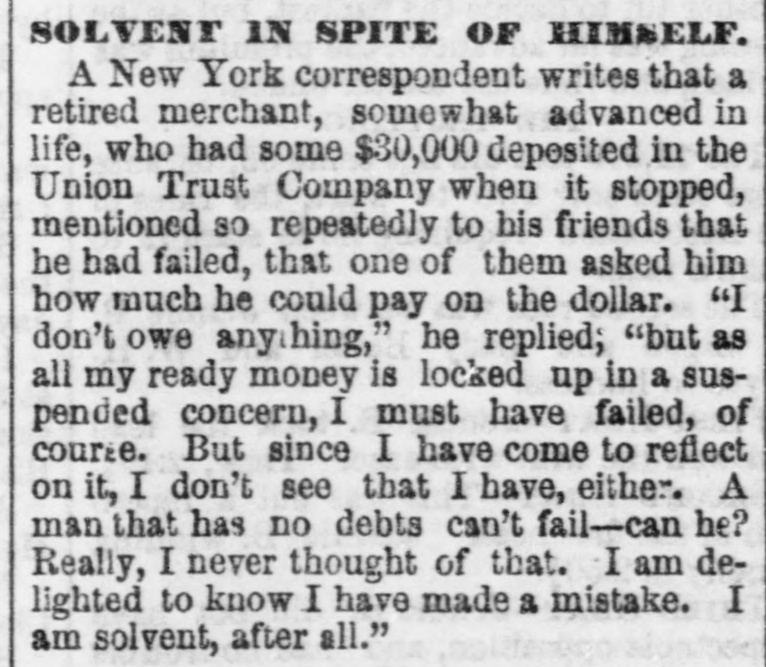
SOLVENT IN SPITE OF HIMSELF.

A New York correspondent writes that a retired merchant, somewhat advanced in life, who had some $30,000 deposited in the Union Trust Company when it stopped, mentioned so repeatedly to his friends that he had failed, that one of them asked him how much he could pay on the dollar. “I don't owe anything," he replied; "but as all my ready money is locked up in a suspended concern, I must have failed, of course. But since I have come to reflect on it, I don't see that I have, either. A man that has no debts can't fail—can he? Really, I never thought of that. I am delighted to know I have made a mistake. I am solvent, after all."


Article from The Rutland Daily Globe, October 17, 1873

Click image to open full size in new tab

Article Text

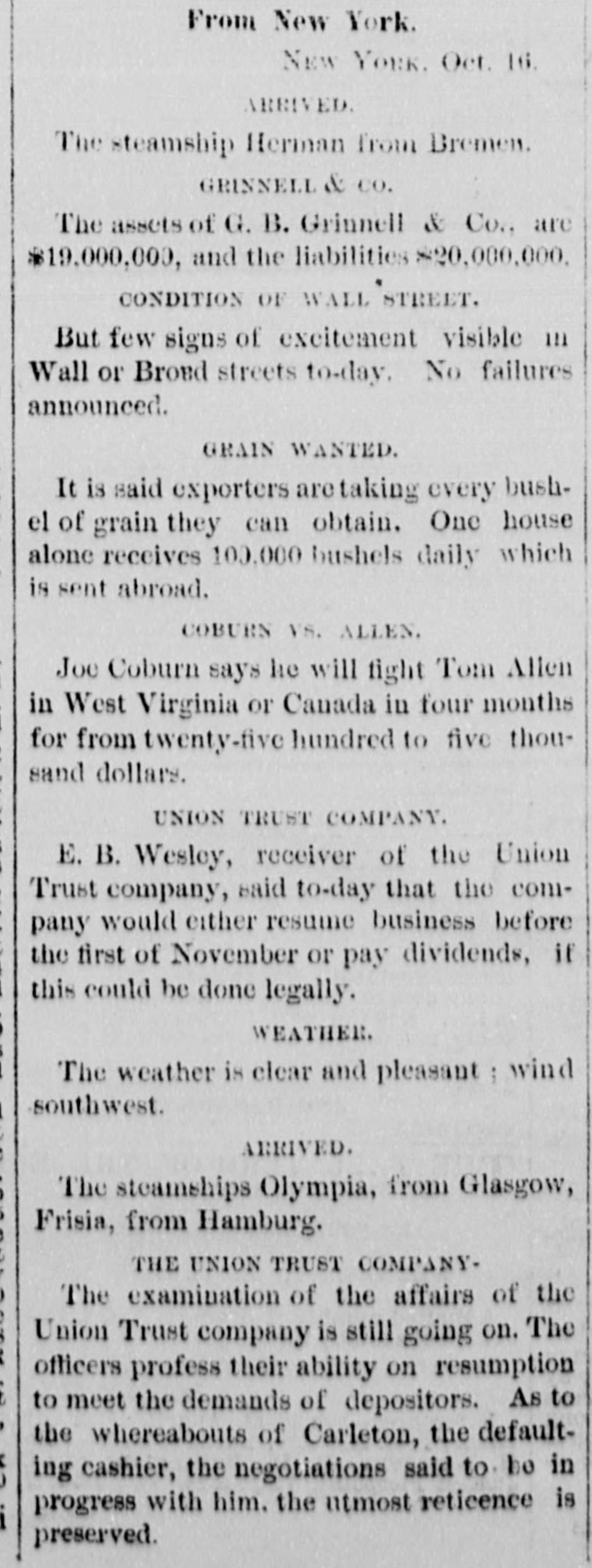
From New York

New York. Oct. 16. ARRIVED The steamship Herman from Bremen. GRINNELL & CO. The assets of G. B. Grinnell & Co. are $19,000,000, and the liabilities $20,000,000. CONDITION OF WALL STREET. But few signs of excitement visible 111 Wall or Broud streets to-day. No failures announced. GRAIN WANTED. It is said exporters aretaking every bushel of grain they can obtain. One house alone receives 100.000 bushels daily which is sent abroad. COBURS VS. ALLEN. Joe Coburn says he will fight Tom Allen in West Virginia or Canada in four months for from twenty-five hundred to five thousand dollars. UNION TRUST COMPANY. E. B. Wesley, receiver of the Union Trust company, said to-day that the company would either resume business before the first of November or pay dividends, if this could be done legally. WEATHER. The weather is clear and pleasant ; wind southwest. ARRIVED. The steamships Olympia, from Glasgow, Frisia, from Hamburg. THE UNION TRUST COMPANY. The examination of the affairs of the Union Trust company is still going on. The officers profess their ability on resumption to meet the demands of depositors. As to the whereabouts of Carleton, the defaulting cashier, the negotiations said to. be in progress with him. the utmost reticence is preserved.


Article from New-York Tribune, October 25, 1873

Click image to open full size in new tab

Article Text

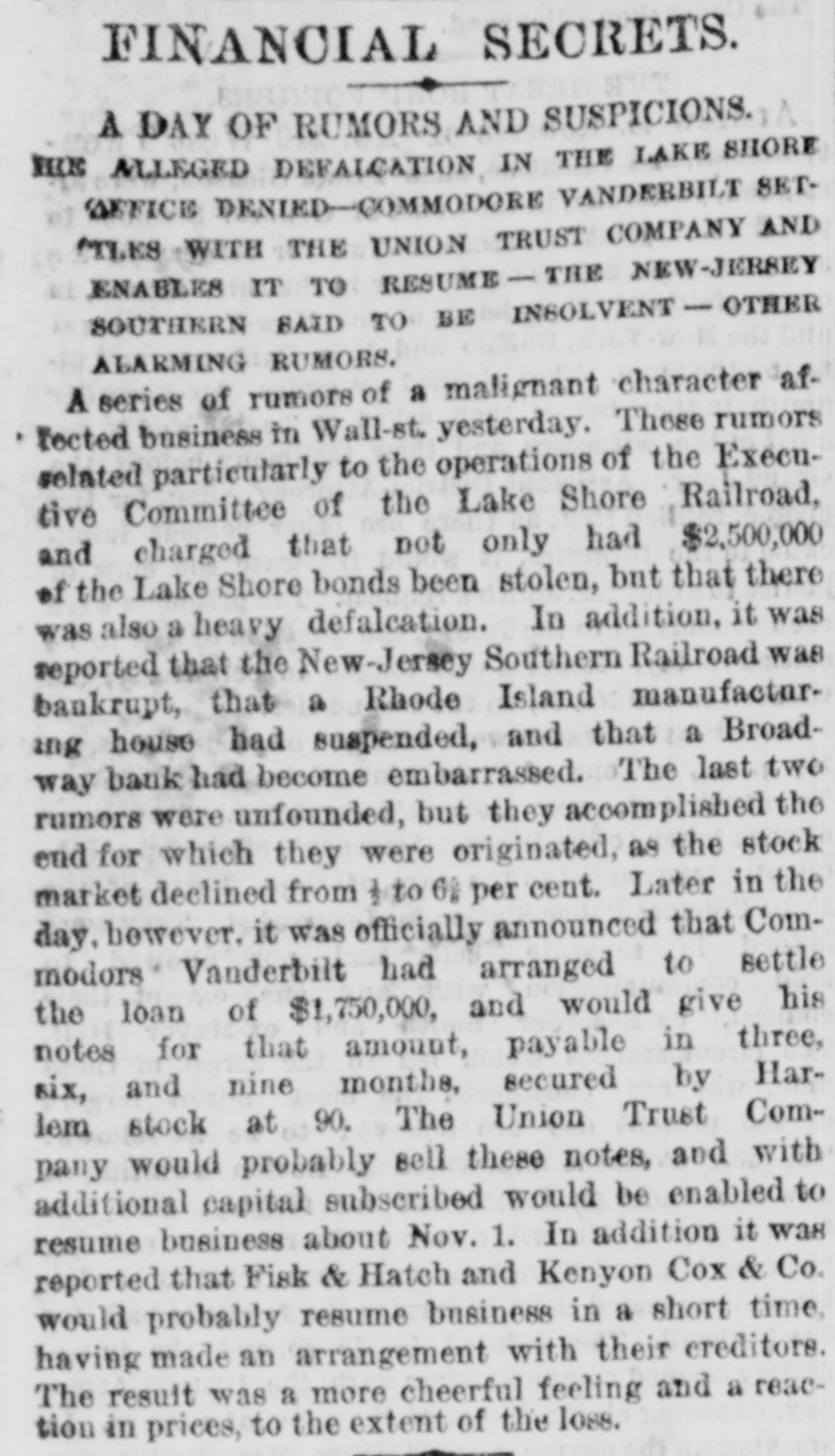
FINANCIAL SECRETS.

A DAY OF RUMORS AND SUSPICIONS. THE ALLEGED DEFALCATION IN THE LAKE SHORE OFFICE DENIED-COMMODORE VANDERBILT SET- TLES WITH THE UNION TRUST COMPANY AND ENABLES IT TO RESUME - THE NEW-JERSEY SOUTHERN SAID TO BE INSOLVENT - OTHER ALARMING RUMORS.

A series of rumors of a malignant character affected business in Wall-st. yesterday. These rumors related particularly to the operations of the Executive Committee of the Lake Shore Railroad, and charged that not only had $2,500,000 of the Lake Shore bonds been stolen, but that there was also a heavy defalcation. In addition, it was reported that the New-Jersey Southern Railroad was bankrupt, that a Rhode Island manufacturing house had suspended, and that a Broadway bank had become embarrassed. The last two rumors were unfounded, but they accomplished the end for which they were originated, as the stock market declined from to 6 per cent. Later in the day, however, it was officially announced that Commodore Vanderbilt had arranged to settle the loan of $1,750,000, and would give his notes for that amount, payable in three, six, and nine months, secured by Harlem stock at 90. The Union Trust Company would probably sell these notes, and with additional capital subscribed would be enabled to resume business about Nov. 1. In addition it was reported that Fisk & Hatch and Kenyon Cox & Co. would probably resume business in a short time, having made an arrangement with their creditors. The result was a more cheerful feeling and a reaction in prices, to the extent of the loss.


Article from The Wheeling Daily Intelligencer, October 25, 1873

Click image to open full size in new tab

Article Text

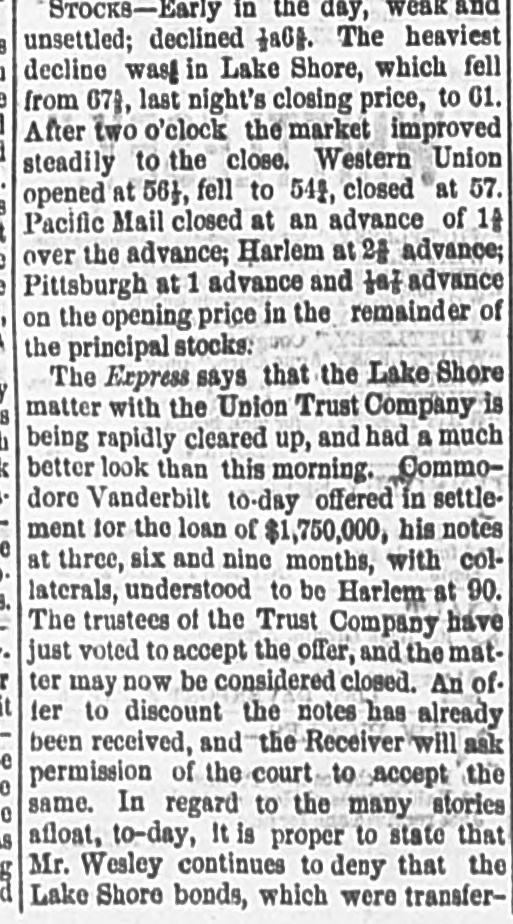
STOCKS

Early in the day, weak and unsettled; declined 1/8. The heaviest decline was in Lake Shore, which fell from 67 1/2, last night's closing price, to 61. After two o'clock the market improved steadily to the close. Western Union opened at 56 1/2, fell to 54 1/4, closed at 57. Pacific Mail closed at an advance of 1 1/4 over the advance; Harlem at 2 1/4 advance; Pittsburgh at 1 advance and 1/4 advance on the opening price in the remainder of the principal stocks.

The Express says that the Lake Shore matter with the Union Trust Company is being rapidly cleared up, and had a much better look than this morning. Commodore Vanderbilt to-day offered in settlement for the loan of $1,750,000, his notes at three, six and nine months, with collaterals, understood to be Harlem at 90. The trustees of the Trust Company have just voted to accept the offer, and the matter may now be considered closed. An offer to discount the notes has already been received, and the Receiver will ask permission of the court to accept the same. In regard to the many stories afloat, to-day, it is proper to state that Mr. Wesley continues to deny that the Lake Shore bonds, which were transfer-


Article from New Orleans Republican, October 28, 1873

Click image to open full size in new tab

Article Text

WHOLE NUMBER 2013

to effect a settlement of the Union Trust PH. Company's loan to the Lake Shore Railroad Company, the agent of the Associated Press called this morning upon Receiver Wesley, R. of the Trust Company, who authorized him to say that the transaction had been definitely closed; that on Saturday he obllowing tained permission from Judge Fancher to y cemeaccept the Lake Shore Company's note, seding at cured by Commodore Vanderbilt with AssociaHarlem railroad stock at ninety, and that years; he (Wesley) now has the notes in his posred, 60; session. Thomas Wesley stated that it is within his own 7; Mrs. knowledge that when Commodore Vanderbilt came into the presidency of the Lake Shore after the death of Horace F. to 7 twenClark, Company, he found this debt the Trust Company, amounting on the twentieth to the four by sum of $1,809,979 32; a debt of which he vo new had previously known nothing, and in the . Temcontraction of which he had no personal share: that this loan was made by as just the Trust Company at 7 per cent at a time ning. when money was very cheap and lending h there at 41/2 @5. and that altogether Commodore he and Vanderbilt personally was not responsible for a dollar of it. He had, in order to take Sunday burteen care of Lake shore interest on one hand, e from and to help the Union Trust Company out orning. of its difficulties on the other, put up his Howard personal securities as collateral for the railnurses. road company's notes, which are drawn in a new and very stringent form. (nights es the Wall Street. ponded The situation in Wall street to-day was em sin marked by an unsettled feeling and a lower t funds range of values generally at intervals. affering Some unfavorable rumore were sfloat, but nothing of an exciting character occurred. vailable Money was irregular, being easy in the hat the morning at seven per cent and closing in g. The the afternoon at one thirty-second to oneincrease sixteenth. red. On Capitalists in many cases carry over a r applilarge balance daily, being indifferent about the belending fresh, owing to the condition of 3 of the affairs which prevents the money market 1 with from to its bon the at Exchange returning dull, nominally normal steady condition. 6% em, as Gold heavy, declined at urge is Money-Rates for carrying 67-16@61-32. Death of a Centennial. Hannah Rutland, aged 100 years, died. e been Boy Murdered by a Boy. er here , deaths William Scanlon, aged eighteen, stabbed t hours. and killed James McMahon, aged sixteen, this afternoon. The quarrel grew out of a debt of fifty cents which Scanlon owed undred McMahon. The wound was made by a for one cheese knife, in the left shoulder. (emphis Marine. scribed Arrived-Heela, Sherman, Flag, City of Mexico, from Havana, and City of Monpolice, treal, from Liverpool; Champion and Herf police man Livingstone. Arrived out-Silesia and Aragon. The Stokes Trial, arker's Arguments in the Stokes case have coms liberal menced. is and The two points of Tremaine's argument er, Mr. for the defense of Stokes thus far are: First. | Eightthat Fisk died from the effects of morphine; raction. second, that if Stokes killed Fisk, was it concert. murder or manslaughter? Tremaine had tponed. not concluded when the court adjourned. yellow To be Investigated. the past Governor Dix has ordered that on the first of December a referee shall hear testin postmony against District Attorney Britton for r 18, illegal action in his prosecution of T. G. yeather Shanks, city editor of the New York Tribune. rces a


Article from Helena Weekly Herald, October 30, 1873

Click image to open full size in new tab

Article Text

DURING the run on the Union Trust Company, of New York, an excited individual offered a boy fifty dollars for his place in the line, and afterwards increased his bid to one hundred dollars. The boy would not sell bis place for the tempting offer. A man ahead of him, however, responded, and said he would sell his place fon two hundred. The money was paid him immediately, and the place was given up. As he walked away he said to a friend: 'Let us take a drink; I had only one hundred in that concern, and I think I have coupe out a little ahead."


Article from Elizabeth Daily Monitor, November 20, 1873

Click image to open full size in new tab

Article Text

MR. William J. Carlton, of this city, was on Tuesday appointed guardian for Helen T. and Alice E. Carlton, infant defendan's in the suit of Edward B. Wesley, as receiver of the Union trust company, of New York, against Charles T. Carlton. Suit is brought to obtain possession of certain property alleged to have been purchased with money belong. ing to the trust company.


Article from Evening Star, December 1, 1873

Click image to open full size in new tab

Article Text

New York Notes

THE SNOW STORM. NEW YORK, December 1.-A snow storm set in at 7 a. m. THE UNION TRUST COMPANY has commenced paying its depositors in full. THE NEW YORK BANKS hold $36,985,000 legal tender notes, or $265,000 more than on Saturday. RUMORS OF TWEED'S SUDDEN DEATH. There Is a rumor in the new court-house, which needs confirmation, that Wm. M. Tweed dropped dead this morning while leaving his cell.