10166. First State Bank (Ovando, MT)

Bank Information

Episode Type
Suspension → Closure
Bank Type
state
Start Date
June 16, 1921
Location
Ovando, Montana (47.020, -113.133)

Metadata

Model
gpt-5-mini
Short Digest
69b98d6df3cda76c

Response Measures

None

Description

The bank was closed by state authorities on or about 1921-06-16 and placed in the hands of a receiver. Subsequent legal actions (supreme court decision) revolve around the receiver's administration of the closed bank. No article describes a depositor run prior to suspension.

Events (3)

1. June 16, 1921 Suspension
Cause
Government Action
Cause Details
Closed by state authorities (official action) resulting in cessation of operations
Newspaper Excerpt
The bank was closed June 16, 1921, at which time the county had on deposit therein $19,926.82
Source
newspapers
2. August 3, 1921 Receivership
Newspaper Excerpt
C. H. and Scott Cassell... president and cashier respectively of the First State bank of Ovando, were arraigned... The bank with which they were connected was recently closed by the state authorities and is in the hands of a receiver.
Source
newspapers
3. December 24, 1923 Other
Newspaper Excerpt
The opinion was written in the appeal... against the receiver of the First State bank of Ovando... The bank was closed June 16, 1921... The supreme court... reversed and remanded with instructions that the district court enter judgment to the effect that the receiver appoint the claim of plaintiffs as general creditors of the bank only.
Source
newspapers

Newspaper Articles (3)

Article from Great Falls Tribune, August 4, 1921

Click image to open full size in new tab

Article Text

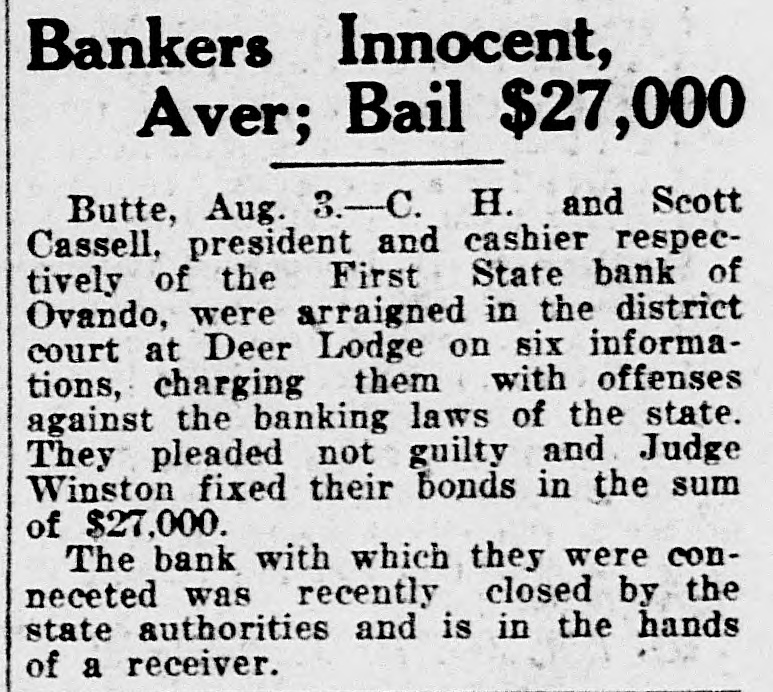
Bankers Innocent, Aver; Bail $27,000 Butte, Aug. 3.-C. H. and Scott Cassell. president and cashier respectively of the First State bank of Ovando, were arraigned in the district court at Deer Lodge on six informations, charging them with offenses against the banking laws of the state. They pleaded not guilty and Judge Winston fixed their bonds in the sum of $27,000. The bank with which they were conneceted was recently closed by the state authorities and is in the hands of a receiver.


Article from The Producers News, December 28, 1923

Click image to open full size in new tab

Article Text

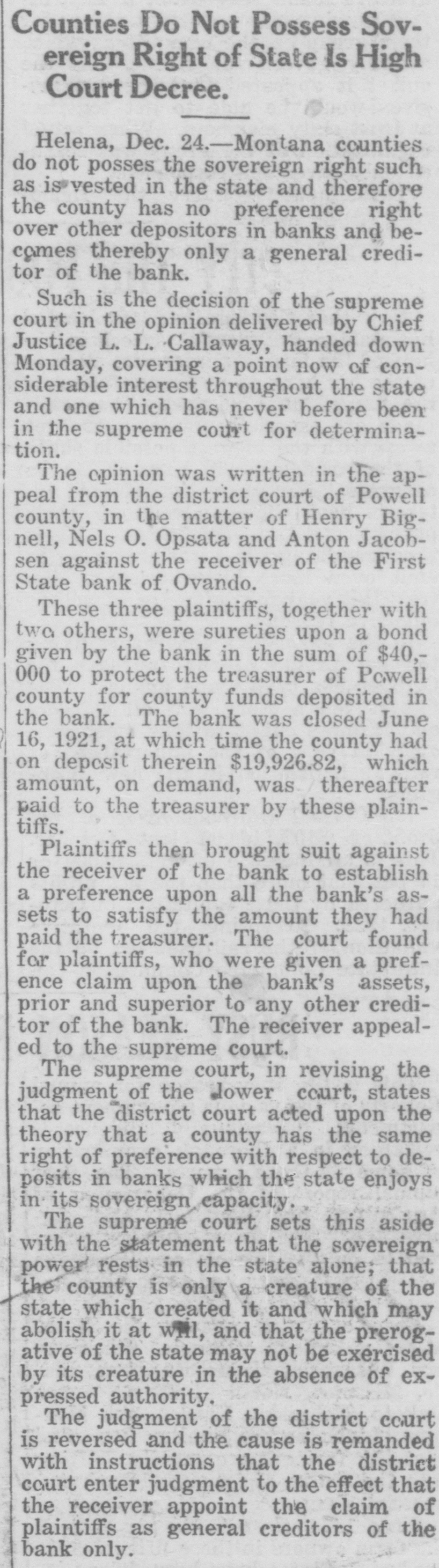
Counties Do Not Possess Sovereign Right of State Is High Court Decree. Helena, Dec. 24.-Montana counties do not posses the sovereign right such as is vested in the state and therefore the county has no preference right over other depositors in banks and becames thereby only a general creditor of the bank. Such is the decision of the supreme court in the opinion delivered by Chief Justice L. L. Callaway, handed down Monday, covering a point now of considerable interest throughout the state and one which has never before been in the supreme court for determination. The opinion was written in the appeal from the district court of Powell county, in the matter of Henry Bignell, Nels O. Opsata and Anton Jacobsen against the receiver of the First State bank of Ovando. These three plaintiffs, together with two others, were sureties upon a bond given by the bank in the sum of $40,000 to protect the treasurer of Pewell county for county funds deposited in the bank. The bank was closed June 16, 1921, at which time the county had on deposit therein $19,926.82, which amount, on demand, was thereafter paid to the treasurer by these plaintiffs. Plaintiffs then brought suit against the receiver of the bank to establish a preference upon all the bank's assets to satisfy the amount they had paid the treasurer. The court found for plaintiffs, who were given a prefence claim upon the bank's assets, prior and superior to any other creditor of the bank. The receiver appealed to the supreme court. The supreme court, in revising the judgment of the dower court, states that the district court acted upon the theory that a county has the same right of preference with respect to deposits in banks which the state enjoys in its sovereign capacity. The supremé court sets this aside with the statement that the sovereign power rests in the state alone; that the county is only a creature of the state which created it and which may abolish it at will, and that the prerogative of the state may not be exercised by its creature in the absence of expressed authority. The judgment of the district court is reversed and the cause is remanded with instructions that the district court enter judgment to the effect that the receiver appoint the claim of plaintiffs as general creditors of the bank only.

Article from The Circle Banner, January 11, 1924

Click image to open full size in new tab

Article Text

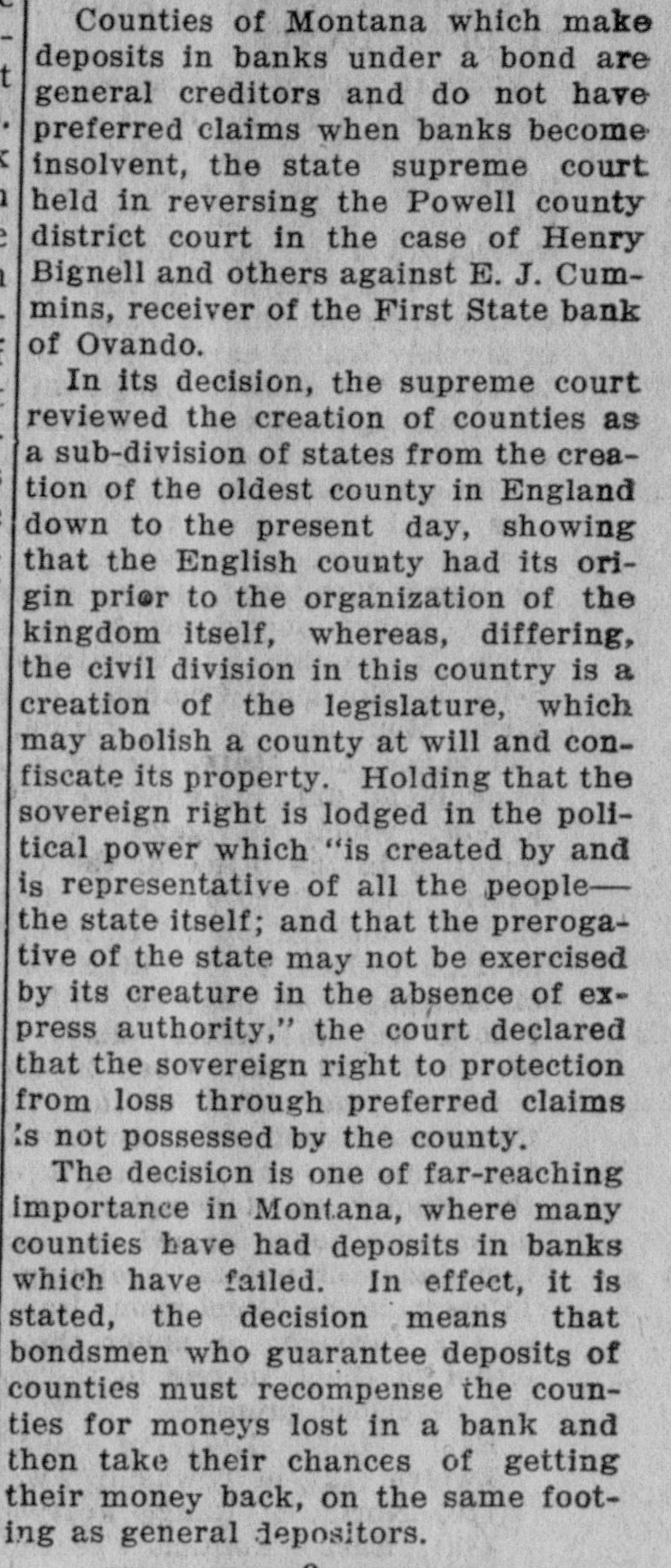
Counties of Montana which make deposits in banks under a bond are general creditors and do not have preferred claims when banks become insolvent, the state supreme court held in reversing the Powell county district court in the case of Henry Bignell and others against E. J. Cummins, receiver of the First State bank of Ovando. In its decision, the supreme court reviewed the creation of counties as a sub-division of states from the creation of the oldest county in England down to the present day, showing that the English county had its origin prior to the organization of the kingdom itself, whereas, differing, the civil division in this country is a creation of the legislature, which may abolish a county at will and confiscate its property. Holding that the sovereign right is lodged in the political power which "is created by and is representative of all the peoplethe state itself; and that the prerogative of the state may not be exercised by its creature in the absence of express authority," the court declared that the sovereign right to protection from loss through preferred claims is not possessed by the county. The decision is one of far-reaching importance in Montana, where many counties have had deposits in banks which have failed. In effect, it is stated, the decision means that bondsmen who guarantee deposits of counties must recompense the counties for moneys lost in a bank and then take their chances of getting their money back, on the same footing as general depositors.