State Bank (New York, NY)

Episode Information

Episode UID
1009671261
Episode Type
Run Only
Bank Type
state
Bank ID
100967 routing
Routing Number
1-0096
Start Date
January 11, 1905
Location
New York, New York (40.714, -74.006)

Metadata

Model
gpt-5-mini (chosen from majority vote of a three-model LLM ensemble)
Short Digest
72c808c67aae8b2a

Response Measures

None

Events (1)

1. January 11, 1905 Run
Cause
Rumor Or Misinformation
Cause Details
Long line of depositors and spreading rumors/nervousness among East Side depositors prompted panic withdrawals; no specific insolvency allegation.
Measures
Paid out specie (large amounts of silver/gold brought by truck), limited admission (women first), police detail called to control mob, bank officials refused many outside offers of help.
Newspaper Excerpt
RUN ON THE STATE BANK. $25,000. WITHDRAWN, Police Called to Control Mob
Source
newspapers

Newspaper Articles (11)

Article from New-York Tribune, January 11, 1905

Click image to open full size in new tab

Article Text

RUN ON THE STATE BANK. $25,000. WITHDRAWN, Police Called to Control Mob$1,000,000 in Vaults for To-day. There was a run on the State Bank, at No. 376 Grand-st., beginning at 1 o'clock yesterday afternoon and continuing until 3, when the bank closed, its regular hour for closing. Its president, O. L. Richard, who lives at No. 46 East Seventy-second-st., said last night that there had been a run and that about $25,000 had been taken out. "We had a run, and we expect it will continue for several days," he said. "This is not a new experience. We have had several such runs, and always cared for them without trouble. Our capital stock is $100,000. We have a surplus and undivided profits of $726,000. Our stock is quoted at 1,200. We recently paid a 50 per cent ennual dividend and had earned 244 per cent. We have 45 per cent quick assets. Thirty-four per cent is in cash and trust companies, and we can raise in an hour from this source over $3,500,000. We have $1,250,000 in Stock Exchange securities which can be sold in the morning, if necessary, for cash. Our deposits amount to $10,500,000." Mr. Richard said he did not know the cause of the run. He thought the crusade the American Banking Association was making against many small "banks" in the East Side which have robbed poor depositors of many thousands had caused people to suspect temporarily all banks. He said there was $1,000,000 in cash in the bank vaults for to-day. The State bank has a branch in Brownsville and another in upper Fifth-ave. As at all such runs, the crowd quickly grew, and by the time the bank closed there were several hundred in line waiting to get their money. They were greatly excited. It became necessary to call the police, and Sergeant Sweeney and fifteen men from the Delancey-st. station went over. They did the best they could to restore confidence. It was late at night before they got the mob even partly cleared away. As late as 11 o'clock it was estimated that there were five or six thousand depositors and others in Grand-st. near the bank.


Article from New-York Tribune, January 12, 1905

Click image to open full size in new tab

Article Text

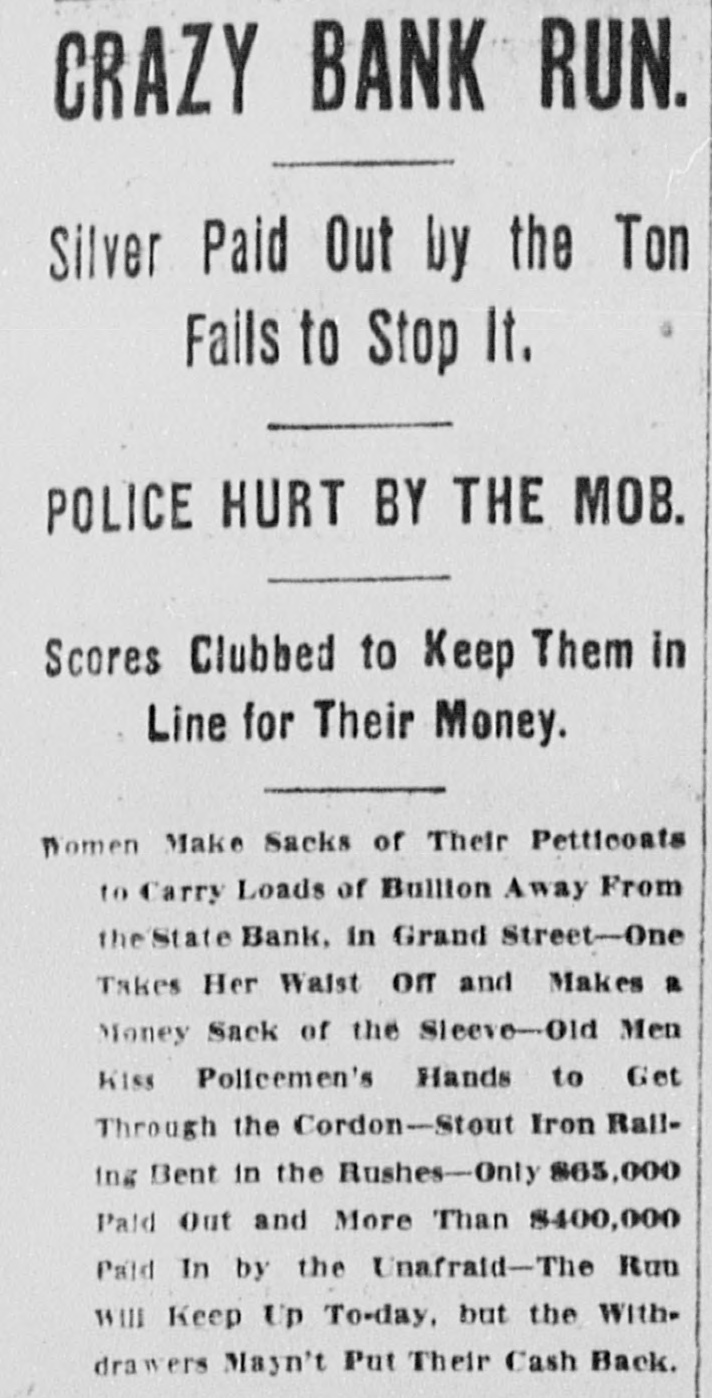
AT STATE BANK/RUN. OVER $80,000 PAID OUT. Deposits Exceed Payments Police Charge Frenzied Crowd. Panic stricken, and like a flock of sheep foltheir leader, the motles throng of 378 delowing in the State Bank, Nos. 376 and positors continued the run on that institution time Grand-st from 9 a. m. to For a inyesterday forenoon the excitement became so in the that a serious riot sprevented only by tense quick action of the police. the of the most anxious had remained in the to Some all night waiting for the bank doors street when they did open for admission, more open, and struggled three than hundred half were women. By 11 a frenzied mob, and of persons whom become o'clock Captain the crowd Tighe had to send for reinforcements. Reserves came The had the Eldridge and Fifth st. stations. from jammed itself against & brass railing the basement in crowd that surrounded had break. front Twenty of the The railing threatened to and some plain clothes men with their clubs just in to the bank. policemen mob time charged avert accident. After this the sidewalk was roped an off and the people kept in line. The blocks on side of the bank were patrolled. became evident that the run was continue all day, and for each When to it perhaps likely several days. two of the bank officials were sent Wall Street, one with a $50,000 gold certifito and the other with one for $25,000. They brought cate back two truckloads of silver dollars. depositor is told that he or she must take Every all his or her money out or none at all, they must accept silver dollars. These and weigh so much that several were unable to away the amounts due them. carry Cohen, of No. 227 Broome-st., one of Becky women to draw her money, received the first in a bag. Each $1,000 of silver weighs $1,085 pounds. When she found the money it fifty-five heavy she begged the cashier to take was so and keep it. but he refused. Up to 3:40 which p. back women were allowed in the line cashm. formed only on the sidewalk and ended at the ier's window in the basement. soon became the rule for a woman who reIt over $200 to take off her skirt, or petti- a celved and make a bag of it. One woman cut into coat. from her waist and made a bag of it, sleeve she poured several hundred dollars. which While some $60,000 was paid out yesterday $400,000 was deposited in the same time. bank officials said they would allow none The old depositors to put back their money, the and of the were paying in specie, so they could tell old depositors when they came back. Roundsmen Blunt and Robinson and Detective crowd were injured in the crush. The of the jammed Kenny them against the railing in front was bank. The six-inch coping of granite out about two inches by the pulling away of of pulled the railing, and the railing was bent out shape. is the sixth run that this bank has weathered. This The "runs" have occurred from all of causes. The first was started by a fight sorts in front of the bank, excited Hebrews thinking that the crowd was storming the bank. The second was caused by a man who had an epileptic fit at the bank and fell into the areathird started from a fire. The fourth occurred in the Spanish war, when there was talk that the Spanish fleet would bombard NewYork and foot the banks. The fifth was in one of the Bryan campaigns. A Nebraska State bank had 2 run. Some of the papers used "Neb." and the Hebrews thought it meant "neblesh," which means poor. A handbill was distributed among the crowd, printed in Yiddish, stating that the bank would pay out money day and night. and that there was nothing to be feared. This seemed to have a good effect, as the crowd thinned out afterward. After the last of the depositors, just before 5 o'clock had been paid. the crowd melted away. With the coming of the men and women from of work at 6 o'clock and after, there was none the congestion or attempts at disorder feared by a Inspector Titus. By 7 o'clock there was not person standing about the bank, and the police guard had been reduced to two men. President O. L. Richard said he was confident the run was about over. Five hundred and eighty-seven accounts had been closed, aggregating $80,763. The depositors, he said, by withdrawing their funds lost the 2 1/2 per cent interest, which would have been paid to-day. The senseless scare had not interfered with deposits made by active depositors. Vice-President Kohn showed a check for $23,750 from Harry Fischel, which was the first deposit received yesterday. He said that up to noon over $20,000 had been deposited, the usual amount and the "scare" money was therefore below the of running business, deposits. At the Brownsville branch of the State Bank, Pitkin and Stone aves. Brooklyn. a number of small depositors withdrew their accounts on account of the stories from Manhattan, and there run was some excitement, but nothing approaching a


Article from Evening Star, January 12, 1905

Click image to open full size in new tab

Article Text

WOMEN KEEP UP BANK RUN. Frightened Depositors Continue to Draw Their Money. NEW YORK, January 12.-Through the freezing rain last night and a chilly fog early today a score of depositors waited at the doors of the State Bank, on Grand street, to head the line when the run on that bank was resumed today. For two days the frightened Hebrews of the East Side have been engaged in a frenzied rush for no other apparent reason than that they saw a rush of depositors to place their money in the bank. Long before the bank was opened for business today the number of those waiting to withdraw their deposits had increased to 200, of whom four-fifths were women. Apparently, it is the women who are keeping up the run, and in the big erush yesterday they predominated. A detail of policemen was on duty at the bank all night and twenty fresh men were sent there early today. Cashier A. I. Voorhis said today that the bank paid out $85,000 yesterday and that he believed the excitable Hebrews would begin to "come to their senses today and see the foolishness of the run, realizing that the bank is financially strong and will meet every demand promptly, no matter how prolonged the rush." When the doors of the bank opened the women were admitted first. There was not nearly as great a crush as yesterday and the crowd was orderly. About 400 people were in line. A truckload of 50,000 silver dollars was brought to the bank early today and carried through the crowd to the vaults. It was announced that $200,000 in gold would be brought up from the subtreasury to be held in readiness, if needed.


Article from Alexandria Gazette, January 12, 1905

Click image to open full size in new tab

Article Text

RUN ON A BANK. Three policemen and two Hebrew women were injured in a run on the State Bank in Grand street, in the heart of the business section of the East Side of New York, yesterday. The run was attended by some sensational incidents. The 5,000 persons crowded about the bank became so insistent that they broke down an iron railing around a light well in front of the building, and it was only by desperate clubbing on the part of the police that the uaruly mob was prevented from forcing many of its number into The women at that detail of the police were the well. hurt policemen point. called Delancey The emergency and and police- street station were finally out men were stationed at intervals of five or six feet for two blocks either side of the bank. The cause of the run was as extraordinary as the frenzied character of the run itself. On Tuesday there wasa rush of depositors to get their money into the bank in time to begin to draw interest at once, and the long line of waiting depositors convinced the excitable Hebrews that something was wrong with the institution Five hundred persons waited in front of the building all last night, and their number quickly swelled to 5,000 when the bank opened yesterday, though not all of that number were depositors. The bank, which has deposits of $10,500,000 and a cash reserve of $4,000,000, and which, Cashier A. I. Voorhis said, earned 244 per cent. profits last year, sent down the street for money early yesterday and $250,000 was brought by the wagon load, largely in specie. At the sight of money those waiting became only more impatient to get at it. The bank officials paid depositors off as fast as the operation could be conducted. In all the bank paid out yesterday $55,000 and received in deposits $440,000. Remarkable scenes attended the paying off within the bank. The officers paid off in two-thirds specie and one third in bills. and some of the depositors were fairly overwhelmed by the amount of currency thrust upon them when they passed in their books. Immediately upon getting their money into their hands and becoming convinced that the bank was able to pay them the frantic Hebrews became equally anxious to get their money into the bank again, and several of them created scenes when the officers refused to accept it. The depositors were paid in specie to prevent a redeposit, as this was the sixth run the bank has experienced from equally trivial causes. One of the aged depositors received 60 pounds of silver and staggered under the load when he carried it away. Women swept their accumulated savings into shawls, aprons and their outer skirts, held in the form of aprons, and got through the crowd as best they could. Payment of depositors was made up to 6 o'clock last night. Officers of the bank declare it is absolutely sound and can secure $4,000,000 at an hour's notice. It received many offers of help yesterday and declined most of them. Of the previous runson this bank, one was started by a fire, another a fight, 2 third by a rumor in the Bryan campaign that silver dollars were to be cut in half, 2 fourth by the Spanish-American war and a fifth by the failure of a bank in Nebraska.


Article from Alexandria Gazette, January 12, 1905

Click image to open full size in new tab

Article Text

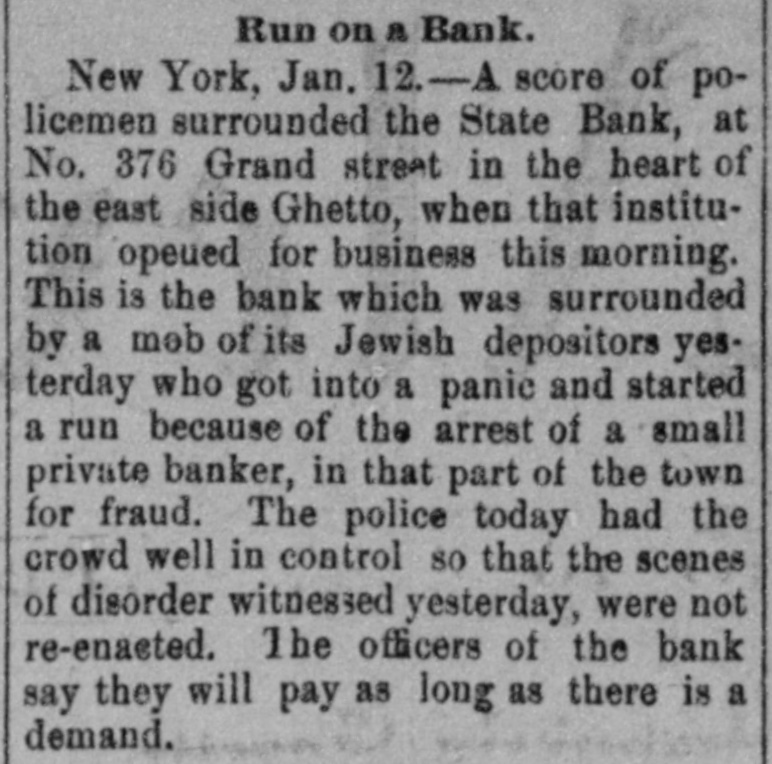
Run on a Bank. New York, Jan. 12.-A score of policemen surrounded the State Bank, at No. 376 Grand street in the heart of the east side Ghetto, when that institution opeued for business this morning. This is the bank which was surrounded by a mob of its Jewish depositors yesterday who got into a panie and started a run because of the arrest of a small private banker, in that part of the town for fraud. The police today had the crowd well in control so that the scenes of disorder witnessed yesterday, were not re-enacted. The officers of the bank say they will pay as long as there is a demand.


Article from Evening Journal, January 12, 1905

Click image to open full size in new tab

Article Text

Tiff WORLD'S NEWS THE WAR. he Emperors of Russia and Japan T granted the Kaiser's request that he be permitted to confer decorations on Generals Nogi and Stoessel. The rearguard of the Russian Baltic fleet entered the Suez Canal bound for Madagascar. The main squadron is believed to be off the island of St. Marie, south of Madagascar. Two hundred Russian reservists were shot down by troops at Warsaw durIng rioting. Admiral Doubassoff denied having stated that peace between Japan and Russia was near. CONGRESS. In the Cenate Mr. Newlands spoke in favor of his resolutions looking to control of the railroads. The House considered the army appropriation bill and passed an amendment to cut off full pay of retired officers in State service. Democrats charged that this action was aimed at General Miles. WASHINGTON. The President has announced that he will withdraw the arbitration treaties if they are emasculated by the Senate. The President announced his intention to call an early extra session of the Fifty-ninth Congress to consider the freight rate question if a bill is not passed at the present session. He will leave the tariff to the judgment of the House. In the Smoot hearing evidence was heard in support of the Mormons. FOREIGN. Richard Croker's action in bidding against King Edward's agent at Newmarket auction declared cause for interdiction by jockey club. The army of Morocco deserted the Sultan, while Southern tribes proclaimed Sultan's brother their ruler. Survivors of foundered American dredge Texas, adrift at sea. had chosen one of the party to be killed for food when succor arrived. Twenty were drowned. Thirteen reached Waterford, Ireland. Natives on upper Congo were reported to have revolted, storming the American and Catholic missionary stations and murdering white 'settlers. MISCELLANEOUS. The Chief of Police of Colorado Springs traced the alleged Cutler Mountain murderer to Detroit. Chicago Alderman instituted suit to compel City Council to expunge vote of censure. A Chicago man murdered his wife and two infant children and is in a dying condition from self-inflicted wounds. W. J. Bryan appealed to higher court in Bennett will case. John Matthews, an actor, who was held as the suspected accomplice of Booth in the assassination of President Lincoln, died in New York. Evidence was heard in the Blair insurance case in New York. The suit of John R. Platt against Hannah Elias was postponed until today. Five thousand people participated in a run on the State Bank, on the East Side, New York. Three policemen and two women were injured. The run was caused by rumors arising from the long line of depositors there on Tuesday. Insurance companies in South were declared to be canceling policies in locallites where surplus crop was being burned. Frank Raisinger was convicted of wife murder at Bridgeton, and was sentenced to be hanged February 15. A. O. Whitaker, a student of the military academy at Asheville, N. C., hanged himself because he was homesick. John Holland was acquitted of the murder of Lawyer Albert Constable, in the Cecil Court at Elkton. Frank P. Flint was elected a United States Senator from California, to succeed Thomas R. Bard. Referee in bankruptcy in New York recommended that discharge from bankruptcy be refused D. Leroy Dresser. Jewelry worth $23,000 stolen from a daughter-in-law of Bishop Potter's wife was found buried in Harlem. Venezuela expressed satisfaction at the reference of the asphalt cases to Attorney General Moody.


Article from Waterbury Evening Democrat, January 12, 1905

Click image to open full size in new tab

Article Text

MOB STORMED BANK. State Bank In New York Suffers Its Sixth Run. NEW YORK. Jan. 12.-Three policemen and two Hebrew women were injured in a run on the State bank in Grand street, in the heart of the business section of the east side in this city. The run was attended by some sensational incidents. So great did the crush of 5,000 persons thronged about the bank become that they broke down an iron railing around a light well in front of the bank. and it was only by desperate clubbing on the part of the police that the excited and unruly mob was prevented from forcing many of its number into the well. The policemen and women were hurt at that point. The emergency police detail of the Delancey street station were finally called out and policemen were stationed at intervals of five or six feet for two blocks on either side of the bank. The cause of the run was as extraor. dinary as the frenzied character of the run itself. There was a rush of depositors to get their money into the bank by the 10th inst., in time to begin to draw interest at once, and the long line of waiting depositors convinced the excited Hebrews that something was wrong with the institution. Five hundred persons waited in.front of the building all through the night. and their number quickly swelled to 5,000 when the bank opened. though not all of that number were depositors. Of the five previous runs on this bank one was started by a fire. another by a fight. a third by a rumor in the Bryan campaign that silver dollars were to he cut in half. a fourth by the SpanishAmerican war and a fifth by the failure of a bank in Nebraska. There was a small run also upon a branch of the State bank in Brooklyn.


Article from Daily Press, January 12, 1905

Click image to open full size in new tab

Article Text

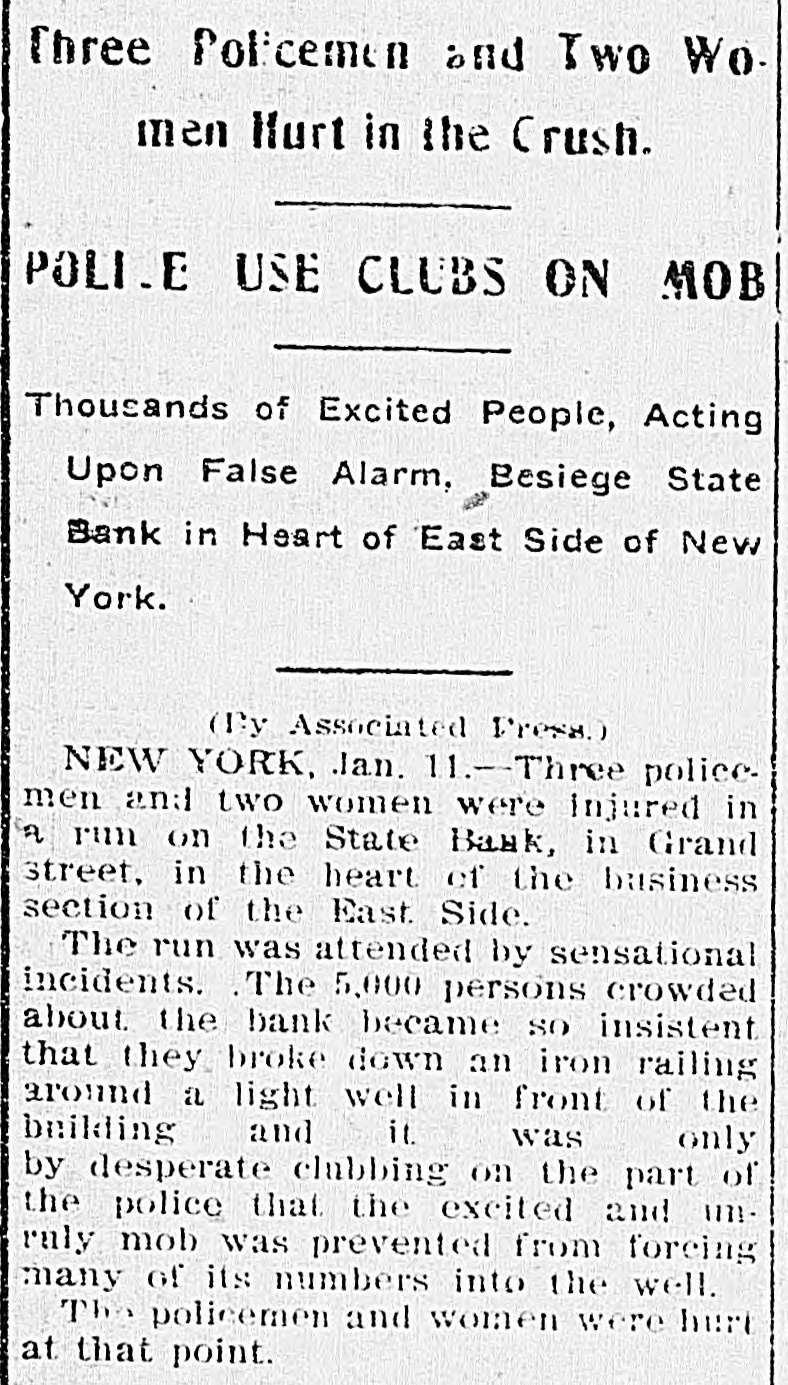
Three Policemen and Two Wo. men Hurt in the Crush. POLI.1 USE CLUBS ON MOB Thousands of Excited People, Acting Upon False Alarm, Besiege State Bank in Heart of East Side of New York. (Ty Associated Press.) NEW YORK, Jan. 11.-Three policemen and two women were Injured in a run on the State Bank, in Grand street, in the heart of the business section of the East Side. The run was attended by sensational incidents. The 5,000 persons crowded about the bank became SO insistent that they broke down an iron railing around a light well in front of the building and it. was only by desperate clubbing on the part of the police that the excited and 1111ruly mob was prevented from foreing many of its numbers into the well. The policemen and women were hurt at that point.


Article from New-York Tribune, January 13, 1905

Click image to open full size in new tab

Article Text

ARREST AT STATE BANK. Man Charged with Attacking Its Reputation. When the State Bank. at No. 376 Grand-st., closed its doors at the end of yesterday's business the "run," which began on Tuesday, the sixth the bank had withstood, was practically over. President O. 1.. Richards said the run had been shorter than those that had preceded it, one of which extended over a period of about two weeks, in which time some $400,000 had been paid out. Less than half of that amount has been drawn this time, he said, and considerable interest has been saved for the bank, which would have been paid out yesterday and today on all the deposits. Beyond the extra work for the clerks, the bank has not been inconvenienced in the least, he said. Joseph Gross, who said he was a law student at No. 203 Broadway, got himself into trouble by advising a depositor, so it was charged, to draw out her money because the bank was no good. He accompanied two women to the bank, and when they drew out $900 in silver declared the coin was not legal tender, and was $10 short besides. According to the bank officers he then threatened to go aniong the Jews and make the biggest run on the bank it had ever seen. Gross was locked up on three charges-disorderly conduct, threatening to publish a libel against the bank and attempting to incite riot. He was held for further examination until to-day, and released on bail of $1,000. The money in dispute was counted before witnesses, and was found to be correct. This was the first arrest since the run began. At 9 o'clock the doors were opened. The women were admitted, the men being kept back. About four hundred persons waited in the rain. At 10 b'clock a double truck backed up to the curb. In it were fifty sacks from the Sub-Treasury, each containing $1,000 in silver dollars. Arnold Kohn, vice-president of the bank, said $76,000 was paid out on Wednesday, and about $46,000 yesterday. He said one of the reasons the bank paid in silver was to discourage pickpockets, who would, it was hoped, find silver dollars unhandy to steal,
Article from The Times Dispatch, January 15, 1905

Click image to open full size in new tab

Article Text

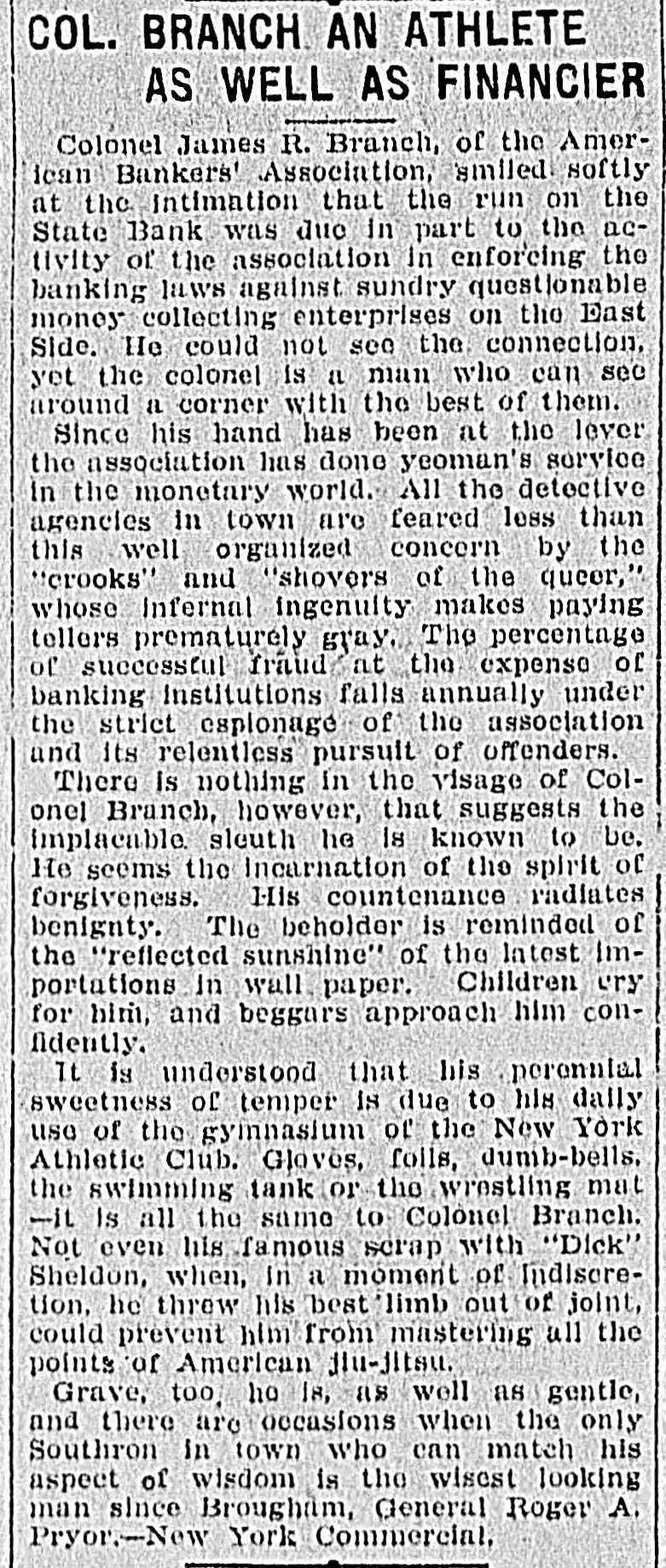
# COL. BRANCH AN ATHLETE # AS WELL AS FINANCIER Colonel James R. Branch, of the American Bankers' Association, smiled softly at the intimation that the run on the State Bank was due in part to the activity of the association in enforcing the banking laws against sundry questionable money collecting enterprises on the East Side. He could not see the connection, yet the colonel is a man who can see around a corner with the best of them. Since his hand has been at the lever the association has done yeoman's service in the monetary world. All the detective agencies in town are feared less than this well organized concern by the "crooks" and "shovers of the queer," whose infernal ingenuity makes paying tellers prematurely gray. The percentage of successful fraud at the expense of banking institutions falls annually under the strict espionage of the association and its relentless pursuit of offenders. There is nothing in the visage of Colonel Branch, however, that suggests the implacable sleuth he is known to be. He seems the incarnation of the spirit of forgiveness. His countenance radiates benignty. The beholder is reminded of the "reflected sunshine" of the latest importations in wall paper. Children cry for him, and beggars approach him confidently. It is understood that his perennial sweetness of temper is due to his daily use of the gymnasium of the New York Athletic Club. Gloves, foils, dumb-bells, the swimming tank or the wrestling mat - it is all the same to Colonel Branch. Not even his famous scrap with "Dick" Sheldon, when, in a moment of indiscretion, he threw his best limb out of joint, could prevent him from mastering all the points of American jiu-jitsu. Grave, too, he is, as well as gentle, and there are occasions when the only Southron in town who can match his aspect of wisdom is the wisest looking man since Brougham, General Roger A. Pryor.-New York Commercial,


Article from Valentine Democrat, January 19, 1905

Click image to open full size in new tab

Article Text

RUN IS KEPT UP. Crush at New York Bank Not so Great Thursday. Throughout a freezing rain Wednesday night and a chilly fog early Thursday a score of depositors waited at the doors of the State Bank in New York City to head the line when the run on the bank was resumed. Apparently it is the women who are keeping up the run, and in the big crush Wednesday they predominated. When the doors of the bank opened Thursday there was not nearly as great a crush as the day before and the crowd was orderly. About 400 people, mostly women, were in line. A truckload of $50,000 was brought to the bank early. It was announced $200,000 in gold would be brought up from the subtreasury and held in readiness if needed.